Insula of the Ara Coeli
In short. The Insula of the Ara Coeli is the Roman rental apartment building that can be seen set into the embankment to the left of the staircase of Santa Maria in Aracoeli, at Piazza d'Aracoeli 1, and since May 1, 2024 it has been closed to the…
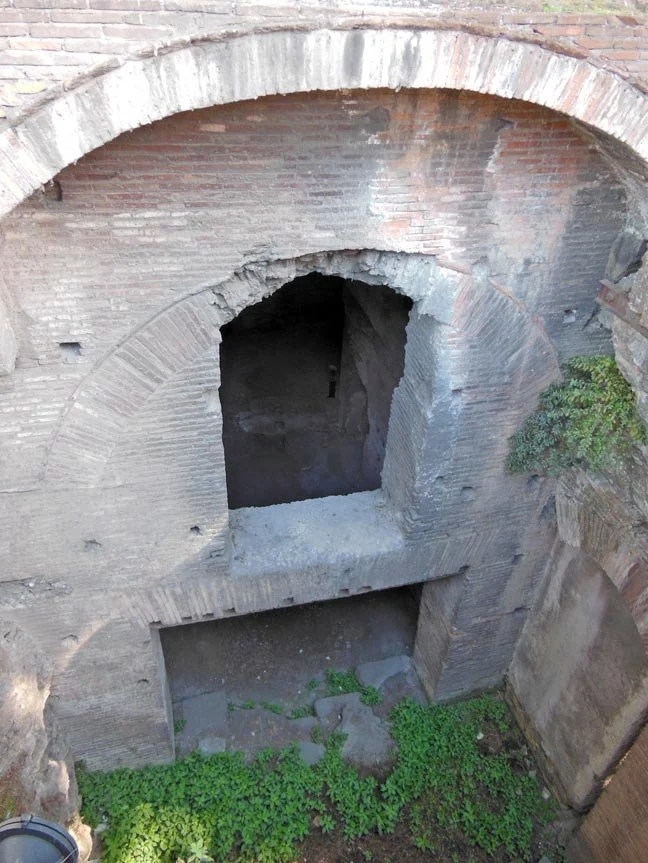
The Insula of the Ara Coeli is the Roman rental apartment building that can be seen set into the embankment to the left of the staircase of Santa Maria in Aracoeli, at Piazza d'Aracoeli 1, and since May 1, 2024 it has been closed to the public for the PNRR works. When it reopens, you enter only by reservation at the number 060608, with groups of at most 12 people. Four euros full price, three reduced, free for residents of Rome and the metropolitan area and for holders of the MIC card. The guided tour is not included in the ticket.
This building is the closest thing to a working-class apartment block that Roman archaeology has left standing inside the center of Rome. Not a temple, not a senators' domus: a house of people who paid rent. In a city where visitors spend 10 days looking at imperial marbles, here you look at a brick wall with rectangular windows and shops on the ground floor. Between the Capitoline Hill and the Roman Forum, it remains the place you remember best, precisely because it resembles nothing of what you expect.
What an insula is and why this one matters
Insula, in Latin, is the income-producing apartment block: stacked floors, apartments for rent, shops on the street. In imperial Rome it was the most common form of housing, and by a wide margin: the city of the domus was a minority crushed by the city of the insulae. The problem is that the insulae were cheap constructions, tall, often poorly put up, and almost all of them have vanished. Of that form of city very little remains standing in Rome.
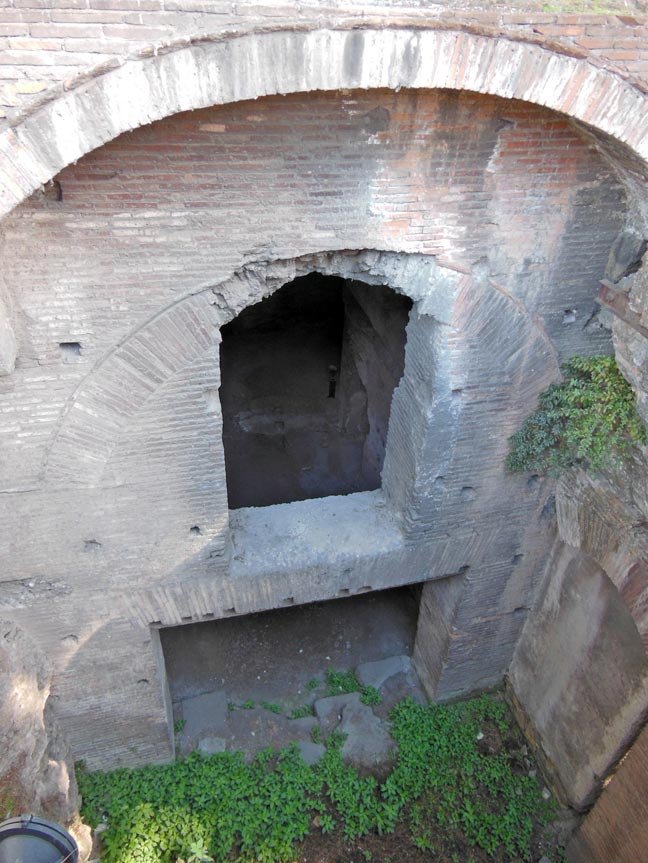
The comparison everyone makes is with Ostia Antica, where dozens of similar apartment blocks remain and you walk through whole city blocks. Ostia, however, is outside Rome, it is another urban scale, and it is an open-air archaeological site. Here instead the apartment block has remained wedged under the living city, with traffic passing over its head and the medieval basilica leaning its side against it. The difference is not archaeological, it is one of feeling.
The Sovrintendenza Capitolina, which manages the monument, describes the building as built in brickwork in the 2nd century AD, leaning against a wall in opus reticulatum probably linked to an arrangement of the Capitoline Hill in the 1st century. This is the dating that holds: bricks of the full 2nd century, on an older structure reused as a buttress. Anyone who tells you about the republican age is mixing up the two walls.
How many people really lived here
The estimate that circulates in popular literature and on Roman portals speaks of about 380 inhabitants. It is an estimate, built on the volumes and the hypothetical subdivision of the rooms, not an archival fact: nobody has the register of the 2nd-century tenants. I report it because it gives the right order of magnitude, which is that of a modern working-class apartment tower, not that of a small villa.
380 people on a surface like this means a density that no building regulation would accept today. It means narrow stairs, water fetched in the street, shared latrines or chamber pots, and the constant risk of collapse and fire that ancient sources repeat to the point of boredom. Juvenal and Martial insist on this, and not to make literature: it was the normal condition of anyone renting on the upper floors.
Where it is and how to get there
The address is Piazza d'Aracoeli 1, 00186 Rome. The building can be seen from the street, on the left flank of the staircase that climbs to Santa Maria in Aracoeli, in that narrow stretch between the staircase itself and the complex of the Vittoriano. Anyone coming from Piazza Venezia meets it after about 30 meters, looking down past the railing.
By public transport the matter is less simple than it seems, because the metro C construction site at Piazza Venezia keeps moving the stops. Lines 30, 81 and 628 serve the Aracoeli stop in Piazza d'Aracoeli, but during the construction phase they have been diverted to the stop on Via del Teatro di Marcello. Lines 44 and 715 have their terminus at Teatro Marcello, three minutes on foot. The H, the 60 and the 170 pass along Via del Plebiscito, on the other side of Piazza Venezia.
The practical advice is not to trust any printed map for this area. The stops around Piazza Venezia were moved several times between 2024 and 2026, and the communication of Roma Servizi per la Mobilità states explicitly that routes and stops may change according to the needs of the construction site. Check on the morning itself on the transport company's site, not the day before.
The metro doesn't arrive. The useful station is Colosseo on line B, and from there it is 12 or 15 minutes on foot along Via dei Fori Imperiali, with the Colosseum behind you and the Forums on your right. It is a flat and pleasant walk, but in summer at two in the afternoon there isn't a tree on that straight stretch. Plan accordingly.
The detail of the rione, which doesn't add up on the official sites
The Sovrintendenza Capitolina's entry classifies the insula under rione VII, Regola. Topographically it can't be: Piazza d'Aracoeli and the slopes of the Capitoline Hill belong to rione X, Campitelli, while Regola is on the other side, toward the Tiber and Via Giulia. Local sources, starting from the reference works on the rioni, correctly place the building in Campitelli. I flag the discrepancy because a wrong piece of data on an institutional entry then gets copied everywhere.
How to visit, how much it costs, when it is closed
The opening regime today is this, and it should be read carefully because it generates continual misunderstandings. Since May 1, 2024 the site is listed as temporarily closed to the public for the start of the works planned under the PNRR: the Sovrintendenza Capitolina declares this on its own page for the monument. At the date of checking, September 28, 2026, that closure statement is still published and no reopening date has been announced.
When the site is open, the ordinary regime provides two channels. The first is entry for accompanied groups, at most 12 people per visit, with mandatory reservation at the number 060608, active from 09:00 to 19:00 every day. The second is entry for individual visitors, also by reservation only at the same number, according to a quarterly calendar published by the Sovrintendenza on the page dedicated to access arrangements.
The published prices are 4 euros full price and 3 euros reduced. Admission is free for residents of Rome and the metropolitan city, on showing a document proving residence, and for holders of the MIC card. Payment is in cash on site: the page on access arrangements does not indicate an electronic payment channel. In the ticket price the guided tour is not included and has to be organized on your own.
The group rule, explained as it really works
Associations and organized groups can book a limited number of dates per quarter, with a minimum number of tickets per visit and the obligation to cancel 72 hours in advance. This explains why the openings of the insula seem rare and random: they are not on a fixed calendar like a museum, they depend on who manages to get the slot. The visits you see advertised by Roman cultural associations almost all arise this way.
Anyone who phones 060608 asking generically about the insula risks being told there are no openings. The right question to ask is another: which dates of the current quarterly calendar include the opening of the insula for individuals, and if the site has come out of the closure regime for the works. Phrased like this, the answer comes more precise.
Accessibility: the information is not published in clear
On the monument's page there is no specific accessibility statement for people with mobility difficulties. The Sovrintendenza publishes a general page on the accessibility of its heritage, but for this site no ramps, elevators or alternative routes are indicated. Since the visit takes place by going down to the levels below street level, on stairs, the problem is concrete and has to be raised at the time of booking, not on the spot.
A rule of caution: when accessibility information is not published, the cautious answer is to consider the site not accessible until the body confirms otherwise in writing. Bringing a person in a wheelchair to a staircase without a handrail, after having had them cross half the city, is a mistake you make only once.
A curiosity about the Insula of the Ara Coeli
The real curiosity is that this building was a church for centuries, and nobody knew it. On top of the remains of the ancient apartment block, in the Middle Ages, the church of San Biagio de Mercato was built, which in the 17th century was transformed into the church of Santa Rita: the Roman building ended up absorbed into the sacred structures, walled up, reused as foundation and as cellar. Anyone passing by saw a baroque facade, not an imperial apartment block.
The church of Santa Rita was built around the middle of the 17th century to a design by Carlo Fontana, with perspective devices thought out for the very narrow space of the street that then climbed toward the Capitoline Hill. In 1928 it was taken apart piece by piece for the works to isolate the Capitoline Hill, and reassembled only at the end of the 1930s in its present position, between the Theater of Marcellus and Piazza Campitelli.
A church taken apart and reassembled elsewhere. The dismantling is the reason the insula still exists: removing the church brought out what lay beneath, and what lay beneath was too important to throw away. All around, instead, whole blocks were razed to the ground without much regard.
The dedication to Saint Rita, which has to do with Cascia
The dedication to Saint Rita comes from the settling, in the mid 17th century, of the confraternity of the people of Cascia in the church of San Biagio. Rita of Cascia had been canonized in 1627 and the Umbrian devotees living in Rome took over that church. The change of title is the reason a medieval church dedicated to an Armenian bishop of the 4th century ends up with the name of an Augustinian nun of the 15th century.
What the building was like: floors, shops, apartments
On the ground floor, the one that today lies below the level of the modern street, opened the tabernae: shops with their wide opening on the front, the counter and the back room. Above each shop ran a mezzanine, the low and squat floor where the person running the shop slept. It is an arrangement found identical at Ostia and one that says a lot about how retail trade worked in the city.
On the upper floors were the cenacula, the actual rental apartments, connected by stairs. The windows were rectangular, with wooden frames, and the floors were of planks. As you climbed the rooms became smaller and poorer: unlike today, the Roman attic was the worst place, the one most exposed to fires and farthest from the water. The rent dropped with height.
How many floors are preserved: the sources don't agree
On this point the sources diverge and it is worth saying so. The Sovrintendenza Capitolina writes that the building consisted of at least 5 floors, still preserved today, connected by an internal staircase of the medieval era. Other popular entries and the Italian entry of the free encyclopedia speak of six original floors, of which 4 recovered including the mezzanine. The entry of another local source describes ground floor, mezzanine and 3 levels, with traces of a fourth.
The range, set out in a row, goes from 4 readable levels to 6 hypothesized levels. The difference depends on what you count: the floors that can be visited, the floors of which wall fragments remain, or the floors reconstructed on the presumed height. The number to keep is 5, that of the body that manages the monument, but it changes according to the criterion. Anyone who gives you a flat figure without explaining the criterion hasn't read the sources.
The levels below street level
What strikes you physically is that you go down. The ancient walking surface lies considerably lower than today's street, because in 20 centuries the ground level around the Capitoline Hill has risen with rubble, Tiber floods and dumped earth. The figures that circulate on the depth vary a lot from source to source and some are plainly inflated: I report none, because none is confirmed by an institutional source.
What can be said without error is that the most interesting part of the building is not visible from the street. From the outside you see the upper levels, the ones emerging from the embankment. The tabernae and the mezzanine, which are the part that tells of daily life, are below, and to see them you have to go in. This is the reason the visit makes sense and is not a formality.
One thing nobody tells you about the Insula of the Ara Coeli
Nobody tells you that the insula can be seen very well for free, and that 90 percent of what the guides tell from the inside can be told from the outside. From the railing of Piazza d'Aracoeli, leaning over, you read the whole elevation: the bricks of the 2nd century, the windows, the Romanesque bell tower that pokes out, the frescoed arcosolium. The Sovrintendenza itself writes that the building is partly visible from the outside too.
This doesn't mean the interior visit is useless. It means that anyone arriving in Rome for 3 days and finding the site closed has lost nothing irreplaceable: you lean over, look, and take home 80 percent of the information. The difference is made by the tabernae and the medieval staircase, which can't be seen from above.
The second thing they don't tell you concerns the noise. That spot of Piazza d'Aracoeli is one of the most chaotic traffic knots in the center, with buses turning, sirens and horns. Going down inside the insula and hearing the noise suddenly muffled is one of the most effective experiences of the visit, and no entry tells it. Sudden silence. It always works.
The third detail: the staircase is medieval, not Roman
The internal staircase that connects the floors is not the Romans' staircase: it is medieval, built when the building had been reused as a service structure of the church above. The Sovrintendenza's entry says so and the archaeological descriptions confirm it. When you climb it you are walking on an intervention from a thousand years later, inside a container from 2000 years ago.
The stratification is the real point of this monument. Reticulate wall of the 1st century, brick of the 2nd, medieval church, medieval staircase, fresco of the 14th century, baroque church of the 17th century, demolitions of the 20th century, PNRR construction site in the 2020s. Seven phases over 20 meters of facade. Few places in Rome line them up so well, and among them are San Nicola in Carcere and the Crypta Balbi.
The bell tower of San Biagio de Mercato and the fresco
The Romanesque bell tower that you see leaning against the insula belonged to the church of San Biagio de Mercato, the medieval church built over the ancient remains and then transformed into Santa Rita in the 17th century. The Sovrintendenza Capitolina confirms that both the bell tower and an arcosolium decorated with a 14th-century fresco re-emerged with the works of the 1930s, both still visible today.
On the dating of the bell tower local sources give the 11th century and describe the presence of mullioned windows, as in Roman bell towers of that type. The institutional entry limits itself to calling it Romanesque, without a century. Anyone who wants to be precise says Romanesque bell tower and leaves aside the exact century, because the 11th-century date is not confirmed by the managing body. Better a broad and true dating.
The fresco inside the arcosolium is from the 14th century and the most widespread description speaks of a Deposition of Christ. Here too caution is called for: the Sovrintendenza's entry says 14th-century fresco without specifying the subject, while the subject appears in local sources. I report the subject as the current attribution, not as certified fact.
Why a bell tower in the middle of an ancient apartment block
The Romanesque bell tower says something precise about how Rome went through the Middle Ages: it did not build from scratch, it reused. An imperial apartment block with its walls still standing was a gift for a poor community of the 10th or 11th century. A sacred hall was put up on the reachable level, the tabernae were closed off, the ancient masonry was used as foundation.
This logic can be seen across the whole area between the Capitoline Hill and the Tiber. San Nicola in Carcere sits inside three republican temples of the Forum Boarium, the Temple of Portunus survives because it became a church, and so does the Temple of Hercules Victor. Without Christian reuse, Roman archaeology would be half of what it is.
The advice I give you for visiting the Insula of the Ara Coeli
Advice number one is by phone and has to be done before buying any plane ticket: call 060608 and ask if the site has come out of the closure for the PNRR works. If the answer is no, cross the insula off the program and reorganize the day around the Capitoline Hill and the Capitoline Museums, which have plenty of ancient stairs and stratification.
Advice number two concerns the order of the day. The insula should be seen before the Capitoline Hill, not after. If you first climb to the Cordonata and the Michelangelo square, going down into a brick apartment block afterward will feel like a demotion. If instead you start from below, from the house of ordinary people, and then climb to power, the day has a direction and is remembered.
Third: half an hour. The interior visit is short, and anyone expecting a museum route with panels, dramatic lighting and reconstructions will be disappointed. The spaces are bare, with essential lighting. The value comes from whoever tells the story, not from the display, and since the guide is not included in the ticket it's best to arrive having read up, or to bring one along.
What to bring
Closed shoes with a non-slip sole, because the ancient floors are irregular and in some places damp. A small flashlight or a charged phone, because the lighting doesn't reach everywhere. A sweatshirt even in August: underground in Rome the temperature drops and stays stable around 15 or 18 degrees Celsius, and the difference with the outside is felt on your body in two minutes.
Don't bring suitcases or trekking backpacks. The passageways are narrow, the group is 12 people at most and turning around with luggage on your back means rubbing against ancient masonry. If you arrive from the station with luggage, the left-luggage office is at Termini, certainly not here.
With children, honestly
For children under 7 the insula says little: there are no activities, reconstructions, games. From 9 years up, instead, it works better than almost anything else in the center, because they grasp the concept of an apartment block right away and the comparison with the building where they live starts on its own. A question to ask them: where would you sleep, on the lower floor or the top one?
If the site is closed and you want an alternative that works with kids, the Case Romane del Celio have a route, lights and frescoes, and the Domus Romane di Palazzo Valentini work with projections. They are two approaches opposite to that of the insula, and for a young audience they hold up better.
Another well-known fact, yet rarely cited
That the Capitoline Hill was isolated in the 1920s and 1930s everybody knows. What is cited little is the price paid: around the hill whole blocks of inhabited houses, alleys, gardens and churches were demolished, to build Via del Mare and clear the slopes. The Sovrintendenza writes it dryly in its entry: the building was spared by the demolition works that in the 1930s affected all the slopes of the Capitoline Hill.
The word to weigh is spared. The insula was not discovered and valorized through a project: it was met during a demolition and not knocked down. The sources place the discovery between 1926 and the early 1930s, with dates that vary according to the criterion: some indicate the works of 1926 for the isolation of the Capitoline Hill, others the two years 1928 and 1930 tied to the opening of Via del Mare, others the period 1929 and 1933. There is no single date and anyone who gives you just one is simplifying.
The same season of works erased the fabric that lay between the hill and the Theater of Marcellus, and produced that rarefied archaeological landscape that we take as natural today. It wasn't natural. It was a political choice, with a precise idea of what of Rome should be shown and what should be cleared out of the way. The houses of the living belonged to the second category.
The bill, in buildings
Among the buildings touched by that season are the church of Santa Rita, taken apart and rebuilt elsewhere, and a number of private houses of which only a trace remains in archive photographs. Anyone who wants an idea of that vanished fabric can look at the area around San Marco al Campidoglio and Palazzo Venezia, where the distances between buildings today make no urban sense.
The same logic had been applied later elsewhere, with the results visible around the Forum of Trajan and the Markets of Trajan, where to open Via dell'Impero the Alessandrino neighborhood disappeared. The Imperial Forums Museum today tells this too, and does so without much embarrassment.
The right photo to take at the Insula of the Ara Coeli
The right photo is not the one of the insula alone. It is the one that puts three eras in the same frame: the Roman bricks at the bottom, the Romanesque bell tower in the center, and at the top the 14th-century staircase of Santa Maria in Aracoeli or the white marble of the Vittoriano. It is shot from the railing of Piazza d'Aracoeli, resting your elbows on the parapet, keeping the horizon straight.
The good light arrives in the late afternoon, when the sun swings toward the west and catches the brick front from the side: the bricks light up orange and the mortar joints draw the weave. In the early morning that front stays in full shade, squeezed between the embankment and the staircase, and the photos come out flat and gray. In winter the useful window closes very early.
With the phone, turn off the extreme wide angle. The temptation is to take everything, insula, staircase and Vittoriano, and the result is an image where the insula becomes a postage stamp in a corner. Better to tighten on the brick front and the bell tower, leaving out the white marble that steals all the exposure.
The photo you can't take
Inside, a serious photo is difficult. Little light, tight spaces, a group moving: without a tripod the interior images come out blurred or noisy, and a tripod can't be set up in a space with 12 people. If your interest is photographic, the exterior gives much more than the interior. Check anyway when booking if filming is allowed, because the Sovrintendenza applies its own rules on the use of images of the heritage.
Another frame that works is taken from the base of the Capitoline Cordonata, turning to the right: you have the Aracoeli staircase climbing very steeply and the flank of the insula running beside it, and the relationship of scale between the two reads well. From there you understand how narrow that corridor of city is.
Some important events that happened here in history
The first event datable with certainty is the construction, during the 2nd century AD, of an apartment block in brickwork leaning against an earlier reticulate wall. It is the moment when the slopes of the Capitoline Hill, which had been arranged in the 1st century with retaining works, fill up with income-producing building. The city grows and needs housing, and builds it vertically against the hill.
The second moment is medieval and has no precise date. On top of the apartment block, by then abandoned on the upper floors, the church of San Biagio de Mercato arises, with its Romanesque bell tower. The qualifier in the title, de mercato, indicates the proximity of an exchange area: at that point, between the Capitoline Hill and the Tiber, the market had always been there, as the very place-name of the Forum Boarium recalls.
In the 14th century the fresco of the arcosolium is painted, contemporary or nearly so with the great staircase of Santa Maria in Aracoeli, which tradition ties to 1348 and the year of the plague. The two things look at each other closely, a few meters apart, and give the idea of what this corner of Rome was in the full 14th century: a place of popular devotion, not an upper-class district.
The 17th century and the confraternity
Around 1655 the confraternity of the people of Cascia settles in the church of San Biagio, which is rebuilt and reconsecrated to Saint Rita of Cascia, canonized a few decades earlier. The design is attributed to Carlo Fontana and the sources vary between 1650 and 1658 for the construction phase. Of the Roman building underneath, at that point, nobody speaks any more: it has become invisible, walled inside the foundations.
Some entries note that in the 18th century some ancient rooms were nevertheless known, evidently through the cellars and underground spaces of the church. The knowledge, however, remained local and undocumented: nobody had yet understood that under Santa Rita there was a multi-story imperial apartment block, and not a simple substructure wall.
The 20th century, the dismantling and the discovery
In 1928 the church of Santa Rita is taken apart for the works to isolate the Capitoline Hill. Underneath, the insula comes out. Between the late 1920s and the early 1930s demolitions, excavations and arrangements follow one another that leave the building isolated in a hollow at a lower level than the street, as we see it today. The church is reassembled between 1938 and 1940 in its present position.
From 1990 the Comune takes back control of the Santa Rita building and around 2000 restores it, turning it into an exhibition space. The insula meanwhile enters the circuit of the monuments of the territory managed by the Sovrintendenza Capitolina, with the visiting regime by reservation that is still today's. From May 1, 2024 comes the closure for the PNRR works.
Anyone who compares the archive photographs of the 1920s with what is seen now finds two different cities. On the left of the staircase, where today there is the railing and the void, there were houses, a baroque facade and a street going uphill. The photographic documentation of that season is kept in the Capitoline archives and is the most direct source for understanding what was taken away.
Who has passed through the Insula of the Ara Coeli
The vast majority of those who passed through here left no name. Shopkeepers, porters, carriers, women who carried water up by hand, craftsmen, people who paid rent month by month and who at the first delay found themselves in the street. It is the public that historiography calls the urban plebs and that in our museums almost never appears, because it didn't commission portraits.
Then there are the devotees of San Biagio and the confraternity members from Cascia of the 17th century, who made a church of this building without knowing what they had under their feet. And there are the workers and technicians of the 1920s and 1930s who took Santa Rita apart stone by stone: a job of surveying and numbering that today we would call architectural archaeology and that back then served only to move an inconvenient building.
Among the documented names of the season of the demolitions appears Antonio Muñoz, superintendent of monuments of the Governatorato, cited as editor of a 1930 publication on the Capitoline Hill in which the first discoveries are recorded. His figure is central and debated: to him are owed both important rescues and demolitions that nobody would do again today. On this building his signature weighs in both senses.
The scholars who worked on it afterward
In recent times the building has been re-examined with modern criteria: the English-language encyclopedia entry cites the study conducted by Sascha Priester between 1997 and 2002, with a detailed archaeological analysis of the structures. It is the kind of work that makes it possible to distinguish the ancient building phases from the medieval rebuildings, and that supports the datings you read today in the entries.
It is a mandatory stop for many itineraries. Roman cultural associations have built a part of their repertoire of visits on this site, precisely because it is one of the few places where you can tell the story of the ancient working-class home while staying inside the center. When the site reopens, those visits will restart: it is the right place to understand how people lived one block from the Roman Forum.
A contrarian position on this monument
The unpopular position is this: the Insula of the Ara Coeli, as it is managed today, does not deserve the trip to Rome nor even a dedicated half day. I say it against the current narrative, which presents it as one of the great revelations of underground Rome. It is not. It is a hugely important monument for understanding the city, and at the same time a poor visitor experience.
The reasons are three and all concern management, not archaeology. Stop-and-start opening, tied to a quarterly calendar and to reservations that sell out. No display: no serious panels, no reconstructions, no route. Guide not included in the ticket, which on a site like this means leaving the visitor alone in front of masonry that says nothing without explanation. Four euros is little, but four euros for 30 minutes without a narrative is still a bad deal.
The practical consequence is that the insula works as a stop inside a broader itinerary on the Capitoline slopes, not as a standalone destination. Anyone with 3 days in Rome who puts it on the program in place of the Capitoline Museums or the Palatine makes a choice they will regret. Anyone who instead lives in Rome, or comes back often, must see it: you get in free if you are a resident, and you understand the city much better than before.
The most frequent reply
The objection is that authenticity is worth more than display, and that adding lights and panels would ruin the place. The reply has a right core and a big flaw. The right core is that intrusive digital reconstructions have worn people out. The flaw is that between the three-dimensional projection and nothing there is the whole space of a good caption, a printed plan, a drawn section showing the floors. An intervention like that costs little and changes the visit.
The restoration funded with PNRR money is the chance to fix this. If on reopening the site has a plan hung on the wall, a section with the levels and two printed pages to hold in your hand, the verdict changes for the better right away. If it reopens identical to how it was, the verdict stays the same.
What to see around, in half a day on foot
From the railing of Piazza d'Aracoeli you climb to the Capitoline Cordonata in two minutes, and at the top opens Piazza del Campidoglio with the Palazzo dei Conservatori on the right. Next to it, the steep staircase of Santa Maria in Aracoeli climbs to the basilica: 124 steps that you take on once and then avoid forever, choosing the Cordonata and the side passage.
From the belvedere of the Tabularium, inside the Capitoline Museums, you see the Roman Forum from above with the Temple of Saturn in the foreground. It is the view that is worth the ticket even on its own, and it reminds you why the insula stood exactly where it stood: behind the political center, on the slope that faced the market and the river.
Going down the other side you reach the Mamertine Prison, which is the other great underground space on this side of the hill, and from there along Via dei Fori Imperiali you meet the Trajan's Column, the Markets of Trajan and, further on, the Colosseum. It is the most trodden route in Rome and at noon in summer it is a sweaty single file.
Better the other direction, downward. From the Theater of Marcellus you go down to the Portico d'Ottavia and enter the Ghetto, with the Synagogue at the end and Tiber Island beyond the bridge. In 15 minutes you pass from ancient working-class housing to a neighborhood that made its own working-class housing for five centuries.
Two churches nearby that nobody looks at
The church of Santa Maria in Campitelli is on the square where the rebuilt Santa Rita also faces today, and it is one of the most rigorous baroque interiors in Rome, almost always empty. A little further, toward the river, the Basilica of San Giorgio in Velabro keeps a severe medieval bareness that goes well with the insula, because it speaks of the same poor Rome.
On the other side of the Capitoline Hill, San Marco al Campidoglio opens onto Piazza Venezia and is one of the oldest churches in the city, with the apse mosaic of the 9th century. None of these three asks you to queue. All three close at lunch, usually between 12:00 and 16:00: plan accordingly.
If you want to stay on the subject of the underground
Anyone who comes to the insula for the question of buried levels has a half day in a row to build. The Vicus Caprarius a step from the Trevi Fountain shows a Roman block with water pipes, the Stadium of Domitian lies under Piazza Navona, and the Underground Basilica of Porta Maggiore is outside the center but is the strangest underground space in the city.
A general overview of what you can visit under Rome is on the page dedicated to underground Rome, and for the urban archaeological area with medieval stratification in evidence the Crypta Balbi remains unbeatable, 10 minutes on foot passing through Largo Argentina.
Anyone with a whole day who wants to really understand insulae must however take the train to Ostia Antica. There the apartment blocks number in the dozens, you go in, you climb, you walk in the streets between one house and the next. The insula of the Aracoeli is the single sample left inside Rome, Ostia is the whole neighborhood. The two visits together close the subject.
Eating in the area
Piazza d'Aracoeli is one of the worst spots in Rome for eating, and it's worth knowing before you come out of the visit hungry. We are between Piazza Venezia, the climb to the Capitoline Hill and Via del Teatro di Marcello: a funnel crossed every day by tens of thousands of people who never come back. Where nobody comes back, the cooking has no reason to be good, and indeed it isn't.
The signs to recognize are always the same and in this area you find them all within 200 meters. The menu with photographs of the dishes, maybe translated into six languages and laminated, indicates a place that doesn't trust the written description because it knows the customer won't return. The photographed carbonara is never the carbonara that arrives.
The woman rolling out the pasta sheet behind the window or at a little table on the sidewalk is a staging, not a sign of cooking. It is part of the furnishings, like the neon sign. Good fresh pasta in Rome is made in quantity, but not in front of passing tourists: it is made in the kitchen, early in the morning, without an audience.
The person at the entrance who invites you to sit down is the clearest sign of all. A place where you eat well has the opposite problem, that is, letting in fewer people than would like to come in. Someone who sends a person into the street to intercept passersby is buying customers one at a time, and the bill for that operation is paid by you on the plate.
Then there are continuous hours. A kitchen open from 11:00 in the morning to midnight, without a break, means someone is reheating portions prepared earlier. Serious Roman kitchens close in the afternoon, between 3 and 7, because in those hours they clean, prep and rest. A place that never closes never really cooks.
The last sign concerns the price lists. In front of the most visited monuments you sometimes find unpriced items, fish or meat by weight with no indication, and different price lists between the outdoor table and the indoor dining room. On this there is no compromise: if an item has no written price, ask before ordering, and if the answer is vague, get up. It happens more than you would believe right within the radius of the Capitoline Hill and the Forum.
The chains with a repeated sign
In the center of Rome there are restaurant chains with the same sign repeated at 10 or 15 addresses, all placed in front of the main monuments. I don't name them, and there's no need: you recognize them because you meet them three times on the same walk. They work like tourist attractions, with a standardized product, multilingual staff and an offer designed for someone who has 40 minutes between one visit and the next.
There is nothing scandalous in all this, and it's pointless to make it a moral question. They serve a real public and solve a real problem. The point is only informational: Romans don't go, and if you are looking for what a Roman from this neighborhood eats you are looking in the wrong direction. It is a legitimate choice, you just need to know which choice you are making.
The single criterion that always works
The criterion is one and is applied from the street, without going in: look at who is sitting and in what language they order. If at the tables there are employees of the offices in the area, people speaking Roman, workers, lawyers from the nearby courthouse, the place holds up. If at the tables there are only visiting groups with a backpack and a map, move on. 10 seconds of observation are worth more than 200 reviews.
Applied here, the criterion leads to a practical conclusion: move away. Walk 8 minutes toward the Ghetto, or 10 toward the alleys behind Largo Argentina, or take the bridge and go to Trastevere in the side streets. Eight minutes of walking are worth 20 euros each in difference and a lunch you remember. For anyone who wants to stay on the subject of popular Roman food, the neighborhood markets remain the best school, and the district of Monte dei Cocci in Testaccio is the one where tradition defends itself best.
For anyone who wants an already skimmed starting point, Daniele keeps a public list of addresses on Google Maps, updated with the places he really frequents: the list of the places where we eat. It is not a ranking and it is not sponsored, they are just addresses tried out.
Frequently asked questions
Can you visit the Insula of the Ara Coeli now?
As of the checking date of September 28, 2026 the institutional page of the Sovrintendenza Capitolina reports that since May 1, 2024 the site has been temporarily closed to the public for the start of the works planned under the PNRR. A reopening date is not published in clear by any official source. Before planning the visit it's worth phoning 060608 and asking for confirmation of the site's status.
How much is the ticket for the Insula of the Ara Coeli?
The prices published by the Sovrintendenza Capitolina are four euros full price and three euros reduced, with free admission for residents of Rome and the metropolitan city on showing a document proving residence, and for holders of the MIC card. Payment is in cash on site. The guided tour is not included in the ticket price and has to be organized on your own.
How do you book the visit to the insula?
Reservation is mandatory and goes through the number 060608, active every day from 09:00 to 19:00. For accompanied groups the limit is 12 people per visit, with constraints on the number of bookings per quarter and cancellation required 72 hours in advance. For individual visitors the openings follow a quarterly calendar published by the Sovrintendenza on the page about access arrangements to the monuments of the territory.
Are the visits on a fixed calendar or on request?
The regime combines the two. Organized groups book their own dates within a quarterly cap, so on request. Individuals instead get in only on the dates of the quarterly calendar, so on a calendar. This double track explains why the openings seem irregular and why many visits to the insula circulate through cultural associations, which have the structure to manage group booking.
How many floors of the insula are preserved?
The sources diverge. The Sovrintendenza Capitolina indicates at least five floors still preserved today, connected by an internal staircase of the medieval era. Other entries speak of six original floors with four levels recovered including the mezzanine, and a local source describes ground floor, mezzanine and three levels with traces of a fourth. The range depends on the counting criterion, between readable floors and hypothesized floors.
How old is the insula of the Aracoeli?
The shared dating is the 2nd century AD, on the basis of the brickwork construction technique. The building leans against a wall in opus reticulatum, in all probability referred to an arrangement of the Capitoline slopes in the 1st century. The two masonries therefore belong to different phases and have to be kept distinct: confusing them leads to datings wrong by more than a century.
What remains of the church of San Biagio de Mercato?
What remains is the Romanesque bell tower and an arcosolium decorated with a 14th-century fresco, both re-emerged with the works of the 1930s and still visible. Local sources date the bell tower to the 11th century and describe the subject of the fresco as a Deposition of Christ, while the institutional entry limits itself to indicating Romanesque bell tower and 14th-century fresco without further specifics.
Can the insula also be seen from the outside?
Yes, and this is the good news for anyone who finds the site closed. The Sovrintendenza explicitly writes that the building is partly visible from the outside too, beside the staircase of the Ara Coeli. Leaning over from the railing of Piazza d'Aracoeli you read the brick elevation, the windows and the bell tower. Out of view remain the tabernae and the lower levels, which are the most interesting part.
Is the Insula of the Ara Coeli wheelchair accessible?
Specific accessibility information for this site is not published in clear. The Sovrintendenza maintains a general page on the accessibility of its heritage, but for the insula there are no indications about ramps, elevators or alternative routes. Since the visit route goes down to the levels below street level by stairs, the question has to be raised at the time of booking and not resolved on the spot.
How much time does the visit take?
For the insula alone 30 minutes is enough, 40 if whoever accompanies you tells the story well. The monument does not have an extensive museum route and the visitable rooms are few. Fitting it into a morning that includes the Capitoline Hill, the Capitoline Museums and the descent toward the Theater of Marcellus comfortably fills the time until lunch.
What is the difference between the insula and the Case Romane del Celio?
They are two different housing categories. The insula is income-producing building, rental apartments on several floors for the lower classes. The Case Romane del Celio instead preserve decorated rooms of a comfortable level, with fine frescoes. Seeing the two things on the same trip gives the measure of the social gap of imperial Rome better than any theoretical explanation.
What can you see in the surroundings if the insula is closed?
Within a radius of 10 minutes on foot you find the Capitoline Hill, the Basilica of Santa Maria in Aracoeli, the Vittoriano complex with the Ala Brasini, the Mamertine Prison and the Roman Forum. Going down toward the river you reach the Mouth of Truth and, continuing, the Circus Maximus.
Who wrote this page
The page is edited by the team of Tour Leader Pro, the Roman project office that designs and coordinates visits, itineraries and cultural events in Rome and Lazio. The access data, prices and opening status reported here were checked against the institutional sources cited in the text as of September 28, 2026. The conditions of a monument open by reservation change often: recheck before leaving and let us know of any discrepancy.
Anyone lining up a Roman itinerary runs into the same variables every time: monuments that open only by phone reservation, quarterly calendars that sell out in a few days, construction sites that move bus stops from one month to the next, sites closed for restoration with no reopening date and distances that look like nothing on the map and are not so uphill. Whoever organizes for themselves or for a group will find planning tools and working materials on Tour Leader Pro, designed both for those who guide for a living and for those who travel on their own.
For the broader picture, with rail connections, airport transfers, rentals and destinations in Lazio outside the center of Rome, from the Castelli to the lakes to the coast, a useful resource is Italy Planner.