Villa Falconieri in Frascati
In short. Villa Falconieri is at viale Borromini 5 in Frascati (RM) and today can be visited only on Sunday, with two free guided tours in Italian at 10:00 and 12:00, by mandatory reservation to be sent by 16:00 on the preceding Friday.
Villa Falconieri is at viale Borromini 5 in Frascati (RM) and today can be visited only on Sunday, with two free guided tours in Italian at 10:00 and 12:00, by mandatory reservation to be sent by 16:00 on the preceding Friday. It is the seat of the Vivarium Novum Academy, which has managed it since 2016 in a state-owned property registered to the Agenzia del Demanio. There is no ticket office and without the secretariat's confirmation you don't get in.
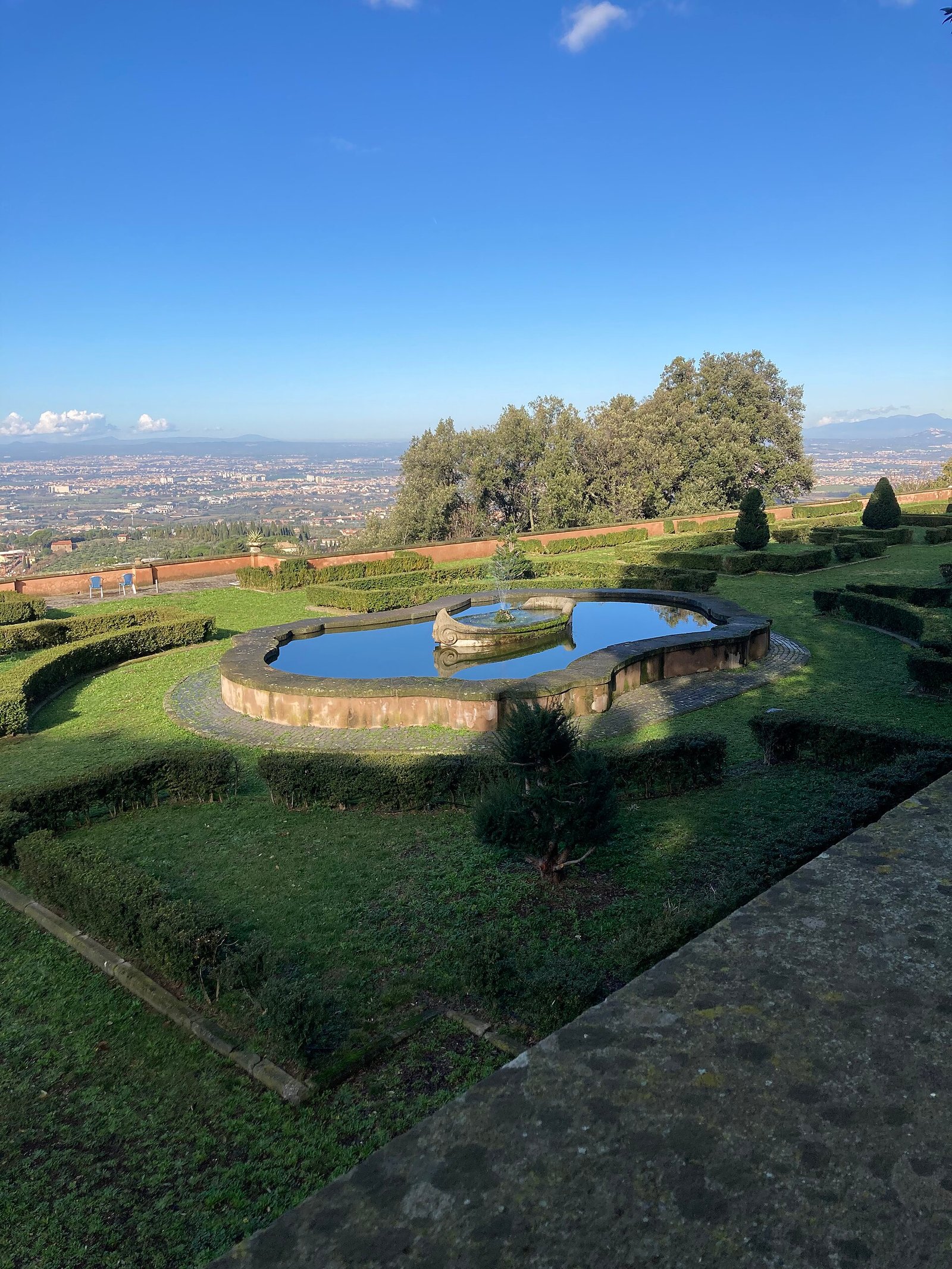
It is the oldest of the Tusculan Villas, born in the mid-16th century as Villa Rufina for Bishop Alessandro Rufini over the remains of a Roman villa, and transformed in the 17th century by the Falconieri, who held it for more than two centuries. Inside are rooms frescoed between the 17th and 18th centuries by Ciro Ferri, Pier Leone Ghezzi, Giacinto Calandrucci and other painters of papal Rome. Outside is a park with an Italian garden and a small lake surrounded by cypresses.
Data checked on September 29, 2026 on the Academy's page dedicated to the villa, on the Art Bonus entry of the Ministry of Culture and on the other sources cited below. The dates in the villa's history vary quite a bit from one source to another, and where they don't coincide the text points it out. For the visit there is only one rule: without the confirmation email the gate stays closed, even on Sunday.
At a Glance: Address, Hours, Ticket
- Address: viale Borromini 5, 00044 Frascati (RM). Some sources write via Francesco Borromini 5.
- Manager: Vivarium Novum Academy, since 2016. Owner: Agenzia del Demanio, Lazio regional directorate.
- How to get in: only with the guided visit, booking at visite@vivariumnovum.net or with the form on the Academy's website by 16:00 on Friday.
- Price: free visit.
- Hours: every Sunday, departures at 10:00 and 12:00, in Italian.
- Getting there: regional train from Roma Termini to Frascati or Cotral bus from the Anagnina station of metro A, then on foot to the avenue.
- Accessibility and parking: the manager doesn't list them, information at accademia@vivariumnovum.net or on +39 06 6689034.
Where It Is and What You Really See
The villa occupies a flank of the Alban Hills east of the historic center of Frascati, in the belt of noble residences that the papal court built on the slopes of Tusculum between the 16th and 17th centuries. Not far away are Villa Aldobrandini, the most visible from the square, and toward Monte Porzio Villa Mondragone. Villa Falconieri stands inside its park, and the guided visit is the only way to see its interiors.
The complex is large. The network of historic residences of Lazio describes a main building on several levels, from the basement to the attic, an outbuilding made up of two blocks of 835 square meters, service cottages for another 361, two artificial grottoes and a small lake with a central fountain and a waterfall. All of it inside a park of about 59,000 square meters. It is not a country house: it is a small noble village.
The facade you see is the result of the 17th-century work site. The old 16th-century building was enclosed between two long, narrow wings, and a large niche was opened in the center. The Ministry entry speaks of a monumental portico, and specialist descriptions recall the Falcon Portal, in the Tuscan order, with the emblem of the family that gives the villa its name. The falcon is the owners' signature.
Inside, the entrance hall has on the ceiling a Birth of Venus that an art magazine attributes to Carlo Maratta with Niccolò Berrettoni, while the Castelli Romani tourist guide calls it Homage to Venus. In the little room of the railing there are 16th-century grotesques attributed to Perin del Vaga, the painter who also worked on the papal apartments of Castel Sant'Angelo. Ciro Ferri signs the Rape of Proserpina in the room of that name and, in the Room of Spring, the Triumph of Flora with the allegories of Autumn and Winter.
The Italian garden was enlarged in the 17th century and reorganized between 1724 and 1734 by Ferdinando Fuga for Cardinal Alessandro Falconieri. The small lake surrounded by cypresses is 18th-century. The Castelli Romani guide also names the Peschiera della Galera, the Fontana delle Colonne, the Peschierone and the Fontana della Stella. The manager, however, doesn't say in detail which rooms and which parts of the park are included in the Sunday visit route: it's best to ask when booking.
A Curiosity About Villa Falconieri in Frascati
For a few years this villa was a gift to the German emperor. Baron Ernst von Mendelssohn-Bartholdy, a Berlin banker and grandson of the composer Felix Mendelssohn, bought it and gave it to Wilhelm II. The Kaiser wanted to make it the seat of a German school of fine arts and letters, according to the Academy's website to compete with the French Academy at Villa Medici. The dates of the purchase vary between 1905 and 1907 depending on the source.
On April 6, 1911 Crown Prince Wilhelm and Princess Cecilie visited the villa and started the restorations. In the same period, in Rome, another Berlin patron was having Villa Massimo built, which would become the German Academy. The Frascati school had a short life. With the First World War the Italian state confiscated the property after a diplomatic dispute, and the villa never returned to German hands.
The second curiosity is literary. The German writer Richard Voss lived at the villa for 25 years, called it his bright home and dedicated a novel to it titled precisely Villa Falconieri, published in Italian translation in 2015. Voss is little read in Italy. For those who know German, though, those pages remain the most direct portrait of the villa in the years that preceded the gift to the Kaiser.
There is a detail that makes the story even more singular. Within a few years the same villa passed from a community of Trappist monks to a Berlin banker, then to the German emperor and finally, with the confiscation, to the Italian state. That is four owners of very different nature in less than a quarter of a century. According to the Academy's website, the villa's German period runs from 1907 to 1918, the end of the war that closed it.
Something Nobody Tells You About Villa Falconieri in Frascati
The villa you visit is partly rebuilt. According to the Academy's website, the bombings of September 8, 1943 severely damaged the building, which lost the entire right wing. Two major restoration campaigns followed, between 1956 and 1958 and between 1983 and 1996. An encyclopedia entry places the restoration of the most damaged wing in 1959. Part of what looks 17th-century, then, was redone in the post-war years.
The second point the brochures keep quiet about concerns the frescoes. Between 1898 and 1905 the villa hosted a community of Trappist monks, and the network of historic residences of Lazio writes that in those years the paintings suffered serious damage. It's not clear which rooms suffered most. The practical consequence is that the decoration that has come down to today is the result of losses and restorations, not a sequence intact from the 17th century.
Third point, perhaps the most useful: you are not entering a museum. Villa Falconieri is the seat of an academy of classical languages, with students, teachers and daily activities. The Sunday visit is an opening granted inside a place of study and life, with times and routes decided by the manager. Anyone who arrives with the idea of wandering freely among rooms and gardens, stopping where they like, is disappointed. Those who know beforehand enjoy what is shown.
Did Borromini Really Work at Villa Falconieri?
Almost all the guides answer yes. The encyclopedia entries write that Orazio Falconieri, after the purchase of 1628, entrusted the works to Francesco Borromini. The Castelli Romani guide attributes the transformation to Borromini on commission from Paolo Francesco Falconieri. The Ministry entry adds that Borromini and Francesco Massari completed the works in 1668. An art magazine describes Massari as Borromini's assistant, with duties as a stonecutter.
The manager is more cautious. On the Academy's official page one reads that the attribution of the villa's drawings to Borromini is controversial, and that the most recent studies indicate Camillo Arcucci as the probable designer. The sources, then, don't agree: for some the villa is a Borromini work, for others a work site in Borromini's circle with another architect in charge. The same entries also recall an elevation by Alessandro Specchi dated 1699.
Our opinion, against the grain of almost all tourist accounts, is that Borromini's name is the wrong reason to come here. Anyone looking for the curves and ovals of San Carlo alle Quattro Fontane, of Sant'Ivo alla Sapienza or of the Oratorio dei Filippini won't find them here. The real reasons to come are the 17th-century frescoes, the garden with the small lake and the very long history of a house that changed hands dozens of times.
For the Borromini of the Falconieri it's better to go to Rome, to via Giulia. At Palazzo Falconieri, today the Hungarian Academy, his intervention for the same family is documented and recognizable, from the falcons at the corners of the facade to the loggia toward the Tiber. The full route through his architecture is collected on the page Borromini in Rome. Frascati, in this account, remains a debated chapter.
The 16th-century origins too have more versions. The manager lists as architect of the 1546 enlargement Giovanni Lippi, from the circle of Antonio da Sangallo the Younger, other sources speak of Nanni di Baccio Bigio. The Ministry entry, finally, writes that the villa was built between 1540 and 1549 for Alessandro Farnese, future Paul III, a formula that doesn't fit the dates, because in 1540 Farnese had already been pope for six years.
The Advice I Give You for Visiting Villa Falconieri in Frascati
The advice is to book at the beginning of the week, not on Friday afternoon. The official deadline is 16:00 on Friday, but the confirmation arrives by email from the secretariat, and the manager itself invites you to check the spam folder. Anyone who writes on Thursday evening and gets no answer is left without a visit. Writing on Monday or Tuesday leaves time for a phone follow-up to the Academy's number.
Choose the 10:00 tour if you want to build a full day in the Castelli. Leaving around mid-morning you have time to go down to the center, have lunch and spend the afternoon at the park of Villa Aldobrandini or climb to Tusculum. The 12:00 tour, instead, takes you straight to lunchtime, and on a fine Sunday the tables in Frascati fill up early.
In the booking email ask three things: the length of the visit, if the route includes the park and the small lake with cypresses, and exactly where to show up. The manager doesn't publish these details, and knowing beforehand if you'll also see the garden changes how you organize the morning. If the group includes people with mobility difficulties, also ask about stairs and interior routes, because accessibility information is not published.
The visit is in Italian. For those traveling with foreign friends or family it is a real limit: it's best to prepare two lines beforehand on the villa's history and the painters, so the account stays understandable even to those who follow only the images. For organized groups the right approach is to write well in advance to the Academy's general address, explaining the number of participants and language, and ask if dedicated formats exist.
Last rule of conduct. You are guests in a place of study: low voices in the rooms, no food, phones on silent and photos only where whoever is guiding allows. It seems obvious, but the openings of a place like this also depend on the good manners of the visitors. One Sunday gone badly, with noisy groups or damage, is the fastest way to convince a manager to reduce openings to the public.
How Much Does It Cost and How Do You Book?
The Sunday guided visit is free. You book by writing to visite@vivariumnovum.net or by filling in the online form, by 16:00 on the preceding Friday. The secretariat answers with a confirmation email, without which you don't get in. There are two departures, at 10:00 and 12:00, and the guide speaks Italian. For other information the Academy publishes the telephone +39 06 6689034 and the address accademia@vivariumnovum.net.
There is no ticket to buy, so there is no reseller to look for either. The official channel is only one, the villa's page on the Vivarium Novum Academy website, with the booking form. On the main tour platforms there is no product dedicated to this villa. Beware of anyone selling paid entry for the ordinary Sunday visits: the manager offers them for free.
The situation is different for extraordinary openings organized by other bodies, which may have a cost. On November 6, 2022 the FAI offered an event at the villa with a visit guided by the Academy's students, a concert by a choir in Latin and lunch, at €60 for members and €75 for non-members. On November 1, 2023 the regional series Di Villa in Villa organized a visit at €10, free up to age 12, with a shuttle from the station.
These initiatives are not fixed and change every year. To know if there are special openings, it's best to follow the Academy's events calendar, the FAI Days and the series dedicated to the Tusculan Villas announced by the municipalities of the area. For the ordinary visits, instead, the calendar is simple: every Sunday, two sessions, by reservation. The manager only warns that visits are skipped on Sundays when the villa hosts conferences or other initiatives, without publishing a calendar of them, so ask for confirmation when you write.
For schools, associations and organized groups the manager doesn't publish a separate procedure. A local guide from 2020 reported that groups of more than 20 people had to book from the website, but the current rules on the official page speak only of mandatory reservation for everyone. It's best, then, to write well in advance, state right away the number of participants, the age of the kids and the means of transport, and get written confirmation of day, session and meeting point.
Another Well-Known Fact, Yet Rarely Cited
That Villa Falconieri is the oldest of the Tusculan Villas everyone repeats. Less often said is who wanted it: not a pope or a great Roman family, but Monsignor Alessandro Rufini, bishop of Melfi, who had it built around the middle of the 16th century over the remains of a Roman villa. From him comes the first name, Villa Rufina. The model of the pleasure villa on the hills is born, at Frascati, from a mid-ranking prelate.
The intellectual life of the Falconieri is also rarely cited. The family, owners from 1628, gathered a rich library, inventoried in 1849 but formed starting in the 17th century. In the villa there were music, theatrical performances and the meetings of the circle tied to Queen Christina of Sweden, to which Cardinal Lelio Falconieri belonged. According to a reconstruction published by the local press, from 1656 the family also funded 20 scholarships a year.
The third fact concerns the 20th century. Between the wars the villa was chosen as the seat of the International Institute of Educational Cinematography, the only body of the League of Nations based in Italy, inaugurated, according to historical reconstructions, in the presence of the king and Mussolini. Then, from 1938, it housed an institute for relations with foreign countries. From the post-war period it became a place of Italian schooling: first the European Center for Education, then INVALSI.
Put in a row, these facts tell of a continuity. From the Falconieri library to the Kaiser's art school, from educational cinema to pedagogical research, up to today's academy of Latin and Greek, the villa has changed owners but has returned several times to being a place of study. It's a thread less spectacular than Borromini, but it explains better why the building has come down to us inhabited and not abandoned.
The Right Photo to Take at Villa Falconieri in Frascati
The photo that tells the villa is the one of the small lake with the cypresses. The 18th-century sheet of water, with the fountain in the center and the dark row of trees reflected, is the image the sources describe most often and is also the most recognizable. It works better with overcast sky or low light, when the reflections are sharp. Ask first if the small lake is part of your visit's route.
The second image is the facade seen from the garden, with the central niche and the two side wings. It's the photo that explains the building's history in a single shot: the 16th-century core in the center, the 17th-century wings at the sides. To get it whole you need a bit of distance, so it's best to look for the frame during the visit, without moving away from the group and without entering areas not included in the visit.
Inside, the rules are decided by whoever guides. In the frescoed rooms always ask if photos are allowed and if flash is permitted, which in painted rooms is generally not used. The detail to look for is the Room of Spring with the cup fountain and Ciro Ferri's Triumph of Flora. Remember that people live and study in the villa: no photos of students or teachers without their permission.
A third shot, often forgotten, is the Falcon Portal. Specialist descriptions give it as Tuscan order, with the bird of prey that was the family's emblem. Photographed up close, with the falcon clearly readable, it links the Frascati villa to the Falconieri's Roman palace on via Giulia, where falcons decorate the corners of the facade. It's a small detail photo, but it tells who gave the place its name better than a panorama.
How Do You Get There from the Center of Rome?
The simplest way is the regional train from Termini Station to Frascati, on the line that connects the capital to the Castelli Romani. Hours and tickets are on the Trenitalia page dedicated to the Castelli Romani. From the Frascati station you climb toward the center and continue on foot to the avenue. The manager doesn't publish directions for the walk, so save the address on your phone first.
The second possibility is the Cotral intercity buses that leave from Anagnina station, the terminus of metro A, and arrive at piazza Marconi in Frascati. From there too you continue on foot. Hours and frequencies must be checked on the Cotral website before leaving, because on Sunday the runs are generally less frequent than on weekdays. Leave a margin: the visit starts at the stated time.
By car from Rome you follow via Tuscolana to Frascati. The manager doesn't say if there is a parking lot for visitors inside the villa, and the center of Frascati on Sunday is very busy. The advice is to ask in the booking email where to leave the car, or to park lower down and climb on foot. For the extraordinary visits of 2023 the organizers had planned a shuttle from the station square.
If you arrive with a group by coach, ask the manager first where the vehicle can stop to let passengers off. The streets around the villas of Frascati are narrow and uphill, and not always suited to large vehicles. For those arriving from other towns of the Castelli, like Grottaferrata, Marino or Albano, the bus connections are the Cotral ones: routes and times are checked on the company's website.
Some Important Events That Happened Here in History
Around the middle of the 16th century Alessandro Rufini, bishop of Melfi, builds the first villa over the remains of a Roman residence. Around 1546, under Paul III Farnese, the building is enlarged. Decades of rapid changes follow: the Cenci, the Sforza, the Gonzaga and the Montalto. According to historical reconstructions Cardinal Gian Vincenzo Gonzaga buys the villa in 1587 from Mario Santi di Santafiori and enlarges it until 1603.
In 1628 Orazio Falconieri acquires it. The longest and richest season begins: the new work site with the side wings, the frescoes of Ciro Ferri and the painters of his circle, the circle of Christina of Sweden, the library. Between 1724 and 1734 Ferdinando Fuga reorganizes the garden for Cardinal Alessandro Falconieri. The family remains until 1879 according to the manager, until 1859 according to other reconstructions.
Then the villa passes to Elisabetta Aldobrandini Lancellotti and, between 1898 and 1905, hosts the Trappist monks. Baron Mendelssohn-Bartholdy then arrives and the gift to Kaiser Wilhelm II, with the German school of fine arts. After the First World War the Italian state confiscates the property, in 1921 according to some reconstructions. At the end of the 1920s the villa becomes the seat of the League of Nations institute for educational cinema.
During the Second World War Frascati hosts the German command of the southern front, and historical reconstructions place the headquarters of Field Marshal Albert Kesselring right in the villa, starting in 1941. On September 8, 1943, the day the armistice was announced, American aviation bombs Frascati. The villa loses the entire right wing. The post-war period is a long season of restorations, between the 1950s and the mid-1990s.
From 1959 according to the manager, from 1970 according to other sources, and until 1999 the villa is the seat of the European Center for Education. From 2000 to 2015 it hosts INVALSI, the national institute for the evaluation of the school system. In 2016 the Vivarium Novum Academy arrives, with a concession from the Agenzia del Demanio. In May 2026 the 10 years of the new management opened a city political debate on the future of the villa.
The last decade is made of openings and work sites more than big events. In 2022 the Ministry's Art Bonus portal records the fundraising for an annex in the park and the works on the Sala Europa, intended as a library. In the same year the FAI organizes a day at the villa with students as guides, and in November 2023 the series Di Villa in Villa brings visitors from Frascati with a shuttle. Meanwhile the free visits by reservation continue, every Sunday.
Who Passed Through Villa Falconieri in Frascati
In the 16th century Bishop Alessandro Rufini and the court of Paul III, then the cardinals of the great families who passed the villa among themselves, up to Gian Vincenzo Gonzaga. In the 17th century Orazio Falconieri and his heirs, among them Cardinal Lelio Falconieri, and with them the intellectuals of Queen Christina of Sweden's circle. In the rooms worked Ciro Ferri, Pier Leone Ghezzi, Giacinto Calandrucci, Niccolò Berrettoni, and according to some sources Carlo Maratta.
In the 18th century came the architect Ferdinando Fuga, called by Cardinal Alessandro Falconieri for the garden. Between the 19th and 20th centuries passed the Trappist monks, the banker Ernst von Mendelssohn-Bartholdy, the writer Richard Voss, who lived here for a quarter of a century, and in 1911 the crown prince of Germany with Princess Cecilie. In the Second World War the villa housed the command of Field Marshal Albert Kesselring, according to historical reconstructions.
In the post-war period the villa was frequented by educators and researchers. Historical reconstructions recall that the European Center for Education was chaired by Giovanni Gozzer and then by Aldo Visalberghi. Since 2016 the students of the Vivarium Novum Academy have lived and studied here. Television too has passed through: in 2005 the villa served as the Neapolitan residence of the Baron of Conegliano in the second season of Elisa di Rivombrosa, broadcast on Canale 5.
The last chapter of this list is institutional. In January 2016 the concession to the Academy was presented by the Minister of Education Stefania Giannini and the director of the Demanio Roberto Reggi, together with the Academy's founder Luigi Miraglia. Since then the villa has seen pass through students from many countries, speakers at international conferences, classes from local schools and, every Sunday, the small groups of visitors who book the free guided visit.
What Goes On Inside the Villa Today?
On January 20, 2016 it was announced that Villa Falconieri would become the first seat of a project called the World Campus of Humanism. According to the SIR agency, the villa was granted to the Vivarium Novum Academy by the then Minister of Education Stefania Giannini and the national director of the Demanio Roberto Reggi. The Academy, founded by Luigi Miraglia, deals with higher education in the humanities and teaches Latin and Greek using them as living languages.
The students are young people of different nationalities. According to the same source, they are selected on two criteria: a strong inclination for humanistic studies, with the will to put them at the service of society, and their starting economic and social condition. It's a profile that explains the climate of the villa: an international and residential community, which studies and lives in the same spaces where the Falconieri and their guests once gathered.
Alongside the teaching there are activities open to the outside. The local press, even the part critical of the management, credits the villa with international conferences, public cultural initiatives and projects with local schools. The events calendar is on the Academy's website. On the occasion of the FAI event of November 2022 the program included the visit led by the students and a concert with a choir singing in Latin. For the ordinary Sunday visits the manager doesn't specify who guides.
For the visitor the consequence is concrete. The villa is not an empty container open at fixed hours, it is a school that receives you. This means routes shorter than you would like, but also an account given by those who live in the place every day. In our judgment it is the added value of the visit, even more than the frescoes: few historic villas of Lazio have gone back to being, as in the days of the Falconieri library, a place where people truly study.
Who Runs the Villa Today and Under What Rules?
The villa is state property. The Art Bonus entry lists as owner the Agenzia del Demanio, Lazio regional directorate, and as beneficiary the Vivarium Novum Academy, which has managed it since 2016. After INVALSI left, between 2015 and 2016, different projects were weighed in Frascati: a civic committee and part of the opposition proposed public acquisition and shared management. The final choice was the concession to the Academy.
In May 2026, for the 10 years of the management, the center-right forces of Frascati criticized the administration for not having built a strong and shared public governance. According to the local press, the duration, renewal conditions and public-opening obligations of the concession remain unclear to citizens. The same political forces, however, acknowledged that the villa has regained cultural centrality with international conferences, public initiatives and activities with schools.
The restoration continues also with the contribution of private donors. On the Ministry's Art Bonus portal two interventions appear: the maintenance of an annex in the park, with roof rebuilding, waterproofing, plaster and electrical system, for €60,000 with fundraising open, and the maintenance of the Sala Europa to be turned into a library, for €100,000, with works listed as in progress. The entry carries as last update July 8, 2022.
For the visitor, the picture comes down to one simple thing. The Sunday openings are a choice of the manager, not a public museum service, and they can change. The reference remains the Academy's official page. Anyone who wants to support the recovery of the villa can do so through the Art Bonus portal, which allows charitable donations with the tax benefits provided for public cultural assets.
Villa Falconieri Among the Tusculan Villas: In What Order Should You See Them?
The Tusculan Villas are the system of residences that the papal nobility built between Frascati, Monte Porzio Catone and Grottaferrata. Villa Falconieri is the first in order of time. It makes sense to see it at the start of a route, because it shows the starting point: a prelate's villa, later enlarged, before the great water scenery and fountain theaters of the later residences.
After Villa Falconieri the natural next step is Villa Aldobrandini, with its water theater facing the town. Then Villa Torlonia in Frascati, today a public park, and Villa Mondragone, a university seat open on fixed dates. Each villa has a different manager and different access rules, so a complete tour is prepared by checking the openings one by one.
Above the villas is Tusculum, the ancient city that gave its name to the whole area. From up there you understand the logic of the system: the villas occupy the hill belt between the ancient city and the plain toward Rome, with the capital visible on the horizon on clear days. The whole territory falls within the Castelli Romani Regional Park.
A frequent mistake is wanting to see all the villas in one day. With openings on different days and hours, and with Villa Falconieri visitable only on Sunday morning, the complete tour requires at least two outings. In our judgment the best-balanced combination is one Sunday with Villa Falconieri, the center of Frascati and the park of Villa Aldobrandini, and another day for Mondragone, Tusculum and Monte Porzio.
Villa Falconieri also has a practical advantage: its frescoed rooms can be visited every week, for free, with a calendar that is easy to remember. For the other villas of the group, arrangements and openings change from one manager to another, and Villa Mondragone, for example, opens only on the dates set by the university. For those who want to see a noble interior of the Castelli without chasing rare openings, Sunday morning in Frascati is the easiest opportunity to organize.
When Is It Closed and What Not to Expect?
The villa is closed to the public from Monday to Saturday, and on Sunday you get in only with a confirmed reservation. The manager warns that visits are not held on Sundays with conferences and other Academy initiatives, but doesn't publish a calendar of these exceptions: that's why the confirmation email is the only guarantee. If you don't receive it by Saturday, call the Academy before setting out.
Don't expect a museum with a ticket office, bookshop, café and panels in several languages. Don't expect to wander freely in the park or to enter all the rooms: the route is decided by whoever guides. Don't expect a villa left as it was in the 17th century either, because bombings, damage and restorations have left their mark. What you find is an inhabited historic residence, open in sessions, with a live account.
If you arrive without a reservation and find the gate closed, don't look for other entrances and don't enter the park through gaps. The villa is a private place of study in a state-owned property, and the openings depend on respect for the rules. Better to use the morning for the center of Frascati and the park of Villa Aldobrandini, and set the visit for a later Sunday by writing to the secretariat.
On the season the manager gives no indications, but the common-sense rule is the same as for all the villas of the Castelli. Spring and autumn are the periods when the garden and the small lake look best, with soft light and temperatures suited to being outdoors. In midsummer the midday hours are heavy even on the hills, and in winter the avenues can be damp. Comfortable shoes and a light umbrella solve almost everything.
Eating Nearby
Frascati on Sunday is one of the most frequented food destinations around Rome, and for that very reason it has its traps. Around the main squares, close to where trains and buses arrive, you find places with touts, photo menus in several languages and unposted prices. Romans avoid them for a simple reason: you pay for the passing trade, not for the cooking.
Other signs to recognize: the kitchen always open without a break between lunch and dinner, the menu that differs between the one displayed outside and the one handed to you at the table, items quoted by voice without a price, the window with fresh pasta rolled in the street as a show for passersby. In the fraschette, the traditional taverns of Castelli wine, always ask first how the bill works, especially for loose wine and for anything you bring from outside.
On Sunday the good seats fill up early, and whoever finishes the 12:00 tour arrives at the worst moment. It's best to book lunch in advance, or move a few kilometers toward Grottaferrata or Monte Porzio, where visitor pressure is lower. For addresses, in Rome and in the Castelli, consult the list of addresses on Google Maps.
What to Combine in a Day
The simplest combination stays inside Frascati. After the morning visit, the center with the cathedral and the squares can be covered on foot, and the afternoon can go to the park of Villa Aldobrandini or that of Villa Torlonia. Anyone with legs and time climbs to Tusculum, with the ancient theater and the panorama over the Roman countryside.
Toward the east the road leads to Monte Porzio Catone, with the Observatory Museum, and to Monte Compatri. Villa Mondragone is on the same axis, but opens only on fixed dates set by the university: if one of those dates falls on a Sunday, the Falconieri and Mondragone pair is the ideal day for understanding the villas of the 17th century.
Toward the south you go down to Grottaferrata and from there to the lake towns. Marino keeps the Mithraeum with the fresco of the god killing the bull. Farther on are Ariccia with Palazzo Chigi, Lake Albano with the Papal Palace of Castel Gandolfo, and Nemi above its lake.
Anyone who has already seen Frascati and is looking for a second day in the Castelli can aim for Genzano di Roma, with Palazzo Sforza Cesarini and the view over Lake Nemi, or move east, to Castel San Pietro Romano and Palestrina. They are different directions and are chosen one at a time. The common thread with Villa Falconieri is the same papal nobility who between the 16th and 17th centuries divided up the hills southeast of Rome.
Anyone who prefers nature can climb toward Rocca di Papa, where the Geophysical Museum is also located, and from there take the trails of the regional park. Don't put too many things into the same Sunday, though: between the guided visit, lunch and the uphill transfers, two destinations are already a full day. In the Castelli the distances are short, the times are not.
If instead the trip to the Castelli fits into a trip to Rome, Villa Falconieri pairs well with places tied to the same family and the same era. In Rome there are Palazzo Falconieri on via Giulia and the Basilica di San Giovanni dei Fiorentini, tied to the Falconieri and to Borromini. For the general picture of 17th-century Rome there is the page Baroque Rome.
For the theme of foreign academies, instead, the most useful comparison is with Villa Medici, the model the Kaiser wanted to imitate, with Villa Massimo, the German academy born in the same years in Rome, and with the American Academy in Rome on the Janiculum. They are different places, but they tell the same idea: Rome as an art school for Europe.
Frequently Asked Questions
How much does it cost to visit Villa Falconieri?
The Sunday guided visit is free. It is offered by the Vivarium Novum Academy, based in the villa since 2016, with two departures at 10:00 and 12:00 and mandatory reservation by 16:00 on the preceding Friday. Extraordinary openings organized by other bodies, like the FAI or the regional series on the Tusculan Villas, may instead have a cost, indicated each time by the organizers.
How do you book the visit?
By writing to visite@vivariumnovum.net or by filling in the form on the villa's page on the Academy's website, by 16:00 on Friday. The secretariat answers with a confirmation email: also check the spam folder, as the manager itself suggests. For other questions there are the telephone +39 06 6689034 and the address accademia@vivariumnovum.net. Without confirmation you don't get in.
Did Borromini design the villa?
The sources don't agree. Many guides and the encyclopedia entries attribute to Francesco Borromini the 17th-century transformation wanted by the Falconieri, and the Ministry entry speaks of works completed in 1668 by Borromini with Francesco Massari. The Academy's website, instead, calls the attribution of the drawings controversial and indicates Camillo Arcucci as the probable designer. The Borromini of the Falconieri documented with certainty is seen in Rome, at Palazzo Falconieri.
Is the visit in English?
No. The manager states that the guided visit is held in Italian, with no sessions in other languages. Anyone traveling with people who don't speak Italian does well to prepare beforehand some information on the villa, the rooms and the painters. For organized foreign groups it's best to write to the Academy well in advance and ask if a different arrangement can be agreed.
Do you also see the park and the small lake with cypresses?
The manager doesn't publish the detailed route of the Sunday visit. The descriptions of the extraordinary openings speak of both the frescoed rooms and the gardens, but the ordinary visits may be different. The safest thing is to ask in the booking email. The park measures about 59,000 square meters and includes the 18th-century small lake with cypresses, two artificial grottoes and several fountains.
Why is it also called Villa Rufina?
Because the first patron, around the middle of the 16th century, was Monsignor Alessandro Rufini, bishop of Melfi, who had it built over the remains of a Roman villa. The Falconieri name arrives in 1628, with the purchase by Orazio Falconieri, and remains even after the family sells the property. The falcon, the family's emblem, gives its name to the Falcon Portal.
Can you get there without a car?
Yes. From Roma Termini the regional trains leave for Frascati, and from the Anagnina station of metro A there are Cotral buses to piazza Marconi. In both cases the last stretch is on foot, uphill, through the center. Check the Sunday schedules on the Trenitalia and Cotral websites and allow a margin, because the guided visit starts at the set time.
Is the villa suitable for children?
It depends on age and patience. The visit is guided, in Italian, and takes place in a place of study where quiet is asked. Older kids may like the small lake, the artificial grottoes and the story of the Kaiser and the bombed villa. For the youngest it's best to pair it with an outdoor park in the afternoon. More ideas are on the page Rome with Children.
Who Wrote It and on What Sources
The text comes from the editorial team of Tour Leader Pro, the Roman organization that designs itineraries, visits and cultural events across Rome and Lazio. Rates, hours and booking arrangements reported here come from the official sources cited in the text, as of the date indicated at the top: the villa's page on the Vivarium Novum Academy website, the Art Bonus entry of the Ministry of Culture and the pages of the extraordinary events. Tell us what you find changed.
Organizing a visit to Villa Falconieri for a group means working with a single weekly opening, a reservation to be confirmed by email, a guide in Italian and streets too narrow for coaches. It's best to fix the visit with the secretariat first and then build lunch and the afternoon in the Castelli around it. A useful resource for those who organize group trips in Lazio is Tour Leader Pro.
Frascati pays off more within a multi-day itinerary among the Tusculan Villas, Tusculum, the lakes of Albano and Nemi and the towns of the Castelli Romani, rather than as an isolated outing from Rome. Anyone with time can sleep in the area and devote one Sunday to the villas and another day to the lakes. A useful resource for putting together a multi-day itinerary is Italy Planner.