Mitreo di Marino
In short. The Mitreo di Marino is at Via Borgo Stazione 12, in Marino (RM), inside a Roman cistern dug into the tuff under the town, and it can be visited only on some weekends of the month by reservation.
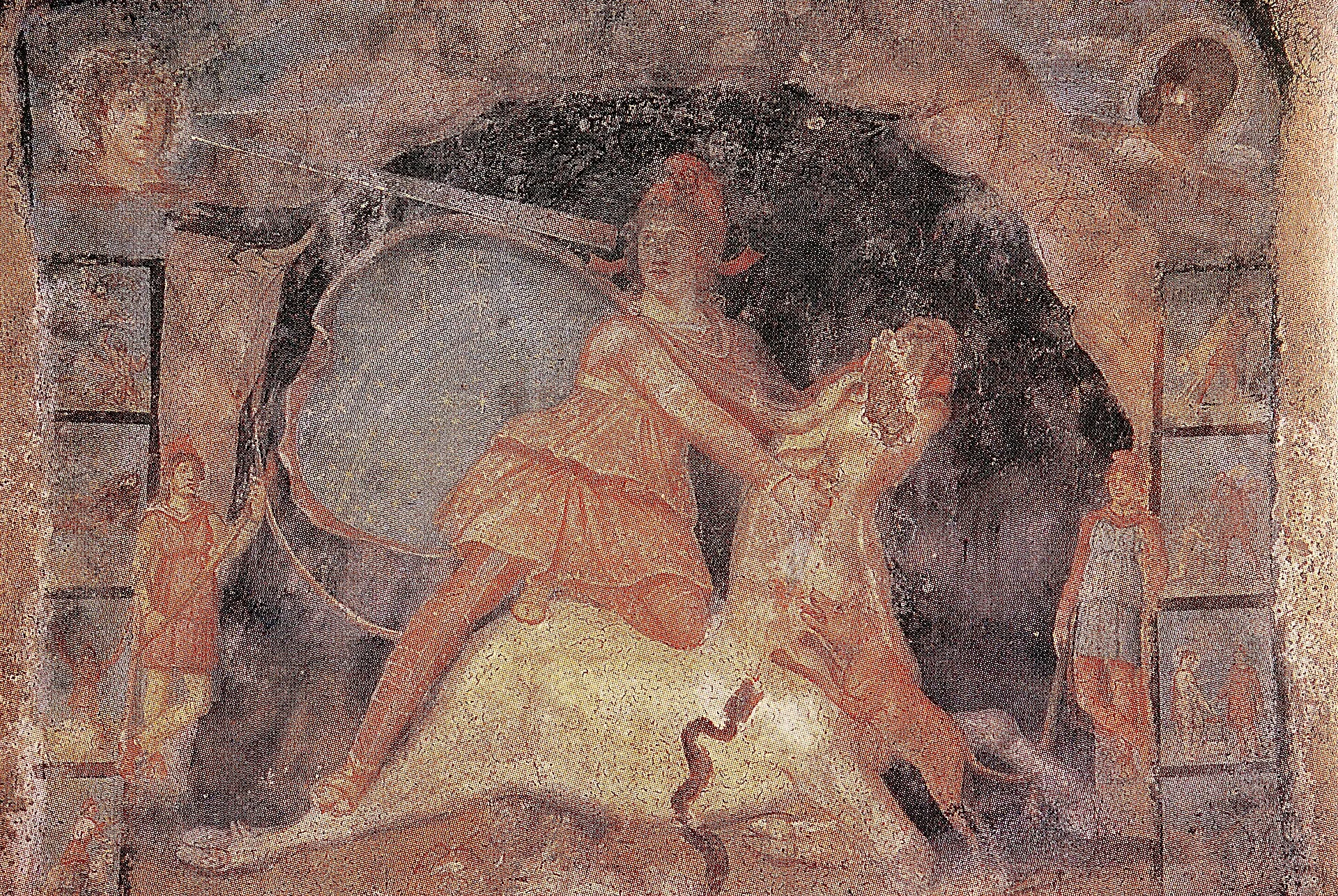
The Mitreo di Marino is at Via Borgo Stazione 12, in Marino (RM), inside a Roman cistern dug into the tuff under the town, and it can be visited only on some weekends of the month by reservation. Inside is a painted tauroctony, that is, the scene of Mithras killing the bull, painted in encaustic on the plaster and preserved much better than you'd expect from a damp space that stayed buried until 1962.
The distance from Rome is ridiculous compared with the fame of the place. The Marino Laziale train station is at Via Borgo Stazione 1, a few steps from number 12: you get off the train and you're almost there. Yet most Romans have never been inside, and many don't even know it exists. There are two reasons: the tight hours and the fact that the site has never had real promotion.
Where It Is and How You Really Get There
The address of the Mitreo is Via Borgo Stazione 12, 00047 Marino (RM), at the base of the cliff on which the historic center sits. The neighborhood is called Borgo Stazione precisely because it grew up around the railway: low houses, cellars dug into the tuff, the road that climbs toward the town. Anyone arriving by car finds parking in the area with relative ease, a condition that never happens in Rome.
The train is the sensible solution. The line is the FL4, which leaves from Roma Termini and at Ciampino splits into three branches: Frascati, Albano Laziale and Velletri. Marino Laziale is on the Albano branch, between the Pantanelle stop and the Villini one. The travel time varies a lot from run to run, so the timetable should be read before leaving: on the Albano branch you travel at the frequencies of a secondary line, not a subway.
Anyone who prefers rubber tires has the alternative of metro A to Anagnina and then the Cotral regional bus for the Castelli. It's the route commuters use and it works, and anyone without practice with tickets and connections will find the general picture in the page on how to get around Rome. Two drawbacks remain, though: the traffic on Via dei Laghi and on the Appia at rush hour, and the stops that unload at different points of the municipality, not necessarily near the Borgo. For the Mitreo the train remains more precise, because the station and the site share the same street.
A note on the difference in elevation, because it matters. The Borgo Stazione is down low, the historic center of Marino is up high, at 389 meters above sea level. Anyone planning to see the Mitreo and then walk up to the town should count on a real climb, not a stroll. With elderly people it's best to do that stretch by shuttle or taxi.
If You Come for the Day from the Castelli
Marino sits in the middle of everything. From Castel Gandolfo it's a few kilometers, from Grottaferrata the same, from Frascati you arrive by Via dei Laghi or by the provincial road. Anyone organizing a day in the Colli Albani can fit the Mitreo together with the Greek abbey of San Nilo without rushing, as long as they respect the fixed time of the underground visit.
The fitting together should be thought through backwards from how it's usually done. First you fix the time of the Mitreo, which doesn't move, then you build the rest of the day around it. Anyone who tries the opposite arrives late and stays outside, because the group leaves on time and the capacity is minimal. This also applies to anyone aiming for Lake Albano or Lake Nemi in the same afternoon.
Hours, Booking and Ticket: The Data as Checked on September 28, 2026
The basic rule is this: the Mitreo opens only on the weekends of the second, third and fourth week of each month, and only by reservation. There is no ticket office open continuously: you enter accompanied, in slots with a set number of places. Anyone who shows up without booking seriously risks staying outside, because the maximum number of participants per slot is 14 people according to the regional tourist listing.
The hours published by the reference portals differ from one another, and the fact should be stated rather than hidden. The tourist listing of the Castelli Romani gives, for individuals, the Saturday of the second and third week at 16:30 and the Sunday of the second and fourth week at 11:00, with groups on the fourth Saturday at 16:30 and the third Sunday at 11:00. A second museum portal instead reports slightly different time bands, Saturday afternoon and Sunday late morning.
Faced with a divergence like this, there is only one sound behavior: you write to the association that manages the visits and have the date and time confirmed before setting out. The reference body appears to be the Archeoclub Colli Albani, based in Marino at Corso Trieste 45, reachable at the address archeoclubcollialbani@gmail.com and with secretariat hours Monday through Friday from 9:30 to 19:00.
The price is the other point on which the sources don't coincide. The association's site and a national museum listing give the ticket at 10.00 euros per person. The reports of the reopening in September 2021 instead spoke of 8.00 euros, with free entry for residents in the first month. The correct reading is that the price rose after the reopening: the current figure published in clear is 10.00 euros, the old one should not be used.
The Booking Channel, Without Inventing Anything
In 2021 and 2022 reservations went through a national museum services platform, with two distinct products for individuals and groups, and the agreement was renewed at the end of 2022. At the check of September 28, 2026 those two addresses no longer respond with the product page: anyone looking for them ends up on the portal's home page. Which means one thing only, namely that that channel should no longer be cited as active.
The channel that does appear published is that of the local association, which on its own site lists the visit to the Mitreo as an event with a price. The Comune di Marino publishes for the Mitreo Office the number 06 93662462, which is a contact of the municipal office and not a ticket office. Rule of this directory: if a contact is not published by an institutional source or by the operator, the listing states that there isn't one rather than inventing it.
Anyone coming from outside the region and wanting a single certainty should do this: send an email at least a week ahead, ask for confirmation of date, time and price, and ask if the booked slot is for individuals or for groups. The distinction matters, because the slots for organized groups and those for individual visitors fall on different days of the same month.
What You See Below: The Gallery, the Cistern, the Painting
The entrance doesn't look like a monument. You enter through a room at street level and take a tunnel that runs in the tuff for about 29 meters, a little over three wide and just as high: it was a Roman cistern, dug to collect water, not to pray. The Mithraic sanctuary was carved out inside this preexisting structure, adapting a hydraulic container into a place of worship.
The gallery itself is the part that surprises most those who don't expect it. Walking for almost 30 meters below the level of the town, with the tuff half a meter from your shoulders, changes the perception of everything that comes after. At the end of the corridor you go down seven steps and find yourself in the main room, where on the back wall is the painted scene.
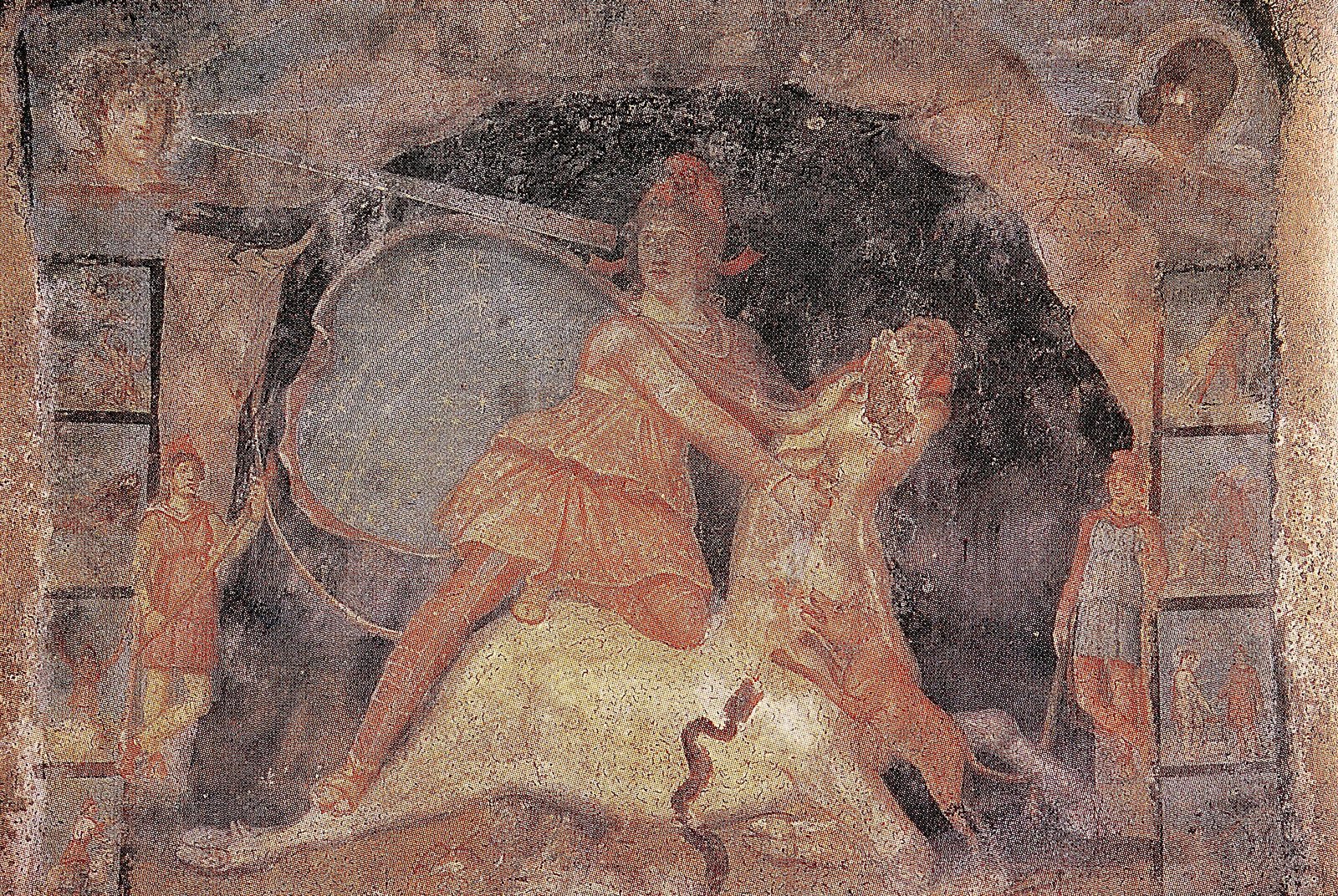
The tauroctony is the canonical scene of Mithraism: the god in the Phrygian cap holding the bull still and plunging the knife into its neck. Around it are the fixed characters of the story, the Sun and the Moon, the two torchbearers with torches pointing up and down, the dog, the snake and the scorpion. The technique stated by the sources is encaustic spread on signinum plaster.
On the sides of the central scene run eight smaller panels, with episodes from the god's mythic story. They are the part the public looks at least and that instead tells the most, because they turn a single cult image into a narrative sequence. Anyone who has seven minutes inside the chamber, and that's few, would do well to devote at least three to those side panels instead of to the figure of the bull alone.
The Dating, and Where the Sources Don't Agree
On the chronology the sources available converge on the second century AD, but not all with the same precision. The regional tourist listings and the popular presentations give the second half of the second century. Other entries limit themselves to writing second century with no further specification. No reliable source consulted proposes a date different from this span, so the reader can trust the century, less so the decade.
The most cited comparison is with the Roman mithraeum of Palazzo Barberini, whose painting is normally placed in the third century, that is, later. Those who have studied the two works also point out a curious difference in color: at Marino the god's cloak is red and the tunic light blue, in Rome the two colors are swapped. It's a minimal detail but it helps to understand how much these workshops worked on shared but not identical patterns.
On the state of conservation the formula that circulates is that the Marino painting is better preserved and artistically superior to that of the Barberini Mithraeum. It's a judgment taken up by several popular sources and it's reasonable, but it remains a judgment, not a measurement. Anyone who repeats it as if it were a certified fact is doing marketing, not archaeology.
A Curiosity About the Mitreo di Marino
The Mitreo di Marino was found by chance in 1962, while a cave was being dug in a cellar at the foot of the historic center. There was no excavation campaign, no scientific hypothesis to verify: someone was enlarging a basement room, as has always been done in Marino, and found himself in front of a Persian god killing a bull.
That gesture, enlarging the cellar, explains half the town. Under Marino run dozens of kilometers of cavities dug in the tuff starting in the Middle Ages, opened to quarry building material and then reused as wine cellars. During the Second World War the same caves served as shelter from the bombings. Anyone digging in that subsoil has a not negligible chance of finding something.
The funny thing is that the find concerns a cult that in Marino had left no other evident traces on the surface. No temple, no monumental inscription to signal it. Only a readapted cistern underground, exactly as the rules of Mithraism wanted, which asked for dark, low, artificially underground spaces even when it could have been done otherwise.
Why a Cistern, of All Things
Mithraea imitated a cave, because the cave is the place where according to the myth Mithras kills the bull. When no natural cavern was available, the faithful built one or recycled one. A disused cistern dug in the tuff was the cheapest possible solution: dark, cool, already ready, with the low vault and the narrow corridor that the rite required.
The same principle is seen in Rome in all the surviving mithraea. Under the Basilica of San Clemente the mithraeum occupies the rooms of an older building, and under the Aventine the sanctuary of Santa Prisca e Mitreo makes use of preexisting structures in the same way. Reuse, not construction from scratch: it was the norm, not the exception.
Something Nobody Tells You About the Mitreo di Marino
You stay very little in the chamber with the fresco. The visit lasts about 40 minutes overall, but the time in front of the painting is about seven minutes, and you enter in subgroups of seven people at a time. This is the fact nobody writes in the headlines and that completely changes how it's best to prepare.
Seven minutes are not enough to read eight side panels plus the central scene, if you get there without knowing what you're looking at. The difference between those who leave satisfied and those who leave with the feeling of having paid 10 euros for a corridor is made by the quarter hour of study they put in the night before. It's best to look at a diagram beforehand.
The other little-advertised element is the video mapping. The visit includes a projection on the painted wall, designed to explain the scene by lighting its parts one by one. It works with those who have never seen a mithraeum. On the level of perceiving the original, though, it opens a problem, addressed explicitly further on, on which the position here is not everyone's.
The Humidity and Temperature Factor
Underground the temperature is stable and low all year, even in August. Anyone who goes down in a T-shirt after walking in the Marino sun feels the blow after two minutes. A light sweatshirt in the backpack is the kind of detail no listing writes down and that instead changes the quality of the half hour. The same goes for the Roman houses of the Celio and for the underground basilica of Porta Maggiore.
Shoes matter as much as the sweatshirt. The floor of the tunnel is not a museum floor and the seven final steps are narrow. Anyone who arrives with a smooth sole goes down badly and watches their feet instead of the vault. Anyone with a delicate knee should allow for the fact that those steps have to be redone going up, on the way out, and that in the tunnel you can't pass each other comfortably.
The Advice I Give You for Visiting the Mitreo di Marino
Advice number one is to book well in advance and not trust the time found online. Write to the association, wait for written confirmation, save it on your phone. With three usable weekends a month and 14 places per slot, the arithmetic says the supply is minimal compared with the population of Rome, let alone the foreign visitors.
Advice number two concerns the time of day. The Saturday afternoon slot, which the Comune's site gives from 15:30 to 16:30, leaves after the visit an hour and a half of good light to go up to the town and see the historic center with the low sun. The Sunday slot, from 10:00 to 11:00 according to the Comune's site, leaves lunch ahead instead, which in Marino is a serious resource. Choose based on what you want to do afterward, not before.
Third piece of advice, the one nobody follows: read the scene before going in. 10 minutes on a description of the tauroctony is enough, with the names of the two torchbearers, Cautes with the raised torch and Cautopates with the lowered torch, and the function of the dog, the snake and the scorpion. Anyone who goes in knowing this uses the seven minutes to look, anyone who goes in empty uses them to listen and sees nothing.
Fourth, seriously consider the package with underground Marino. The visits to the cavities of the center, which leave from Piazza Matteotti area, tell the story of the system of caves, cisterns and cellars of which the Mitreo is only the most famous episode. The sanctuary alone lasts a short time, the sanctuary inside its subsoil becomes a coherent half day. Anyone who loves the genre already has underground Rome in the plans too.
With Groups, How to Handle It
With a group larger than 14 people the Mitreo can't be handled all at once, and this should be said to clients before selling the day. The workable solution is to split: half the group below and half in town, then switch. It takes a second guide and it takes the town, above, having something ready to show. In Marino it does.
The second precaution is about the meeting point. Setting the meeting at the Marino Laziale station and not in front of the site avoids dispersal, because the train unloads everyone at the same point and from there you walk together. Anyone who sets the meeting directly at number 12 always ends up with two or three people who got the street wrong and call from the historic center at the top.
Another Well-Known Fact, Yet Rarely Cited
The painted tauroctonies surviving in Italy can be counted on one hand. The regional reference sources give three examples: the one in Marino, the one of the Mitreo Barberini in Rome and the one in Santa Maria Capua Vetere in Campania. An encyclopedic source reduces the count to two surviving Roman wall paintings. The two formulations don't coincide, and anyone writing on this subject should state that rather than choose the more convenient number.
The reason for the scarcity is technical, not religious. Most mithraea had the tauroctony carved in relief on a slab of marble or stone, a transportable and reusable object. Wall painting instead stays attached to the wall, and when the space is abandoned, flooded or buried again, it disappears in a few decades. It survives only where conditions stay stable, that is, underground and dry.
This explains why a provincial cistern preserves what Rome has lost almost everywhere. In the capital the mithraea numbered in the dozens, and what remains to us is largely sculpture. At the museum of Palazzo Massimo alle Terme and at Palazzo Altemps you can see Mithraic reliefs of excellent quality, but the effect is different: marble is an object, the painted wall is an environment. The same gap is felt going from the Crypta Balbi to the Roman domus of Palazzo Valentini, where you walk the stratigraphy instead of looking at it in a display case.
What to Look for in the Side Panels
The eight compartments around the central scene tell the cycle of the god: birth from the rock, the hunt of the bull, the pact with the Sun, the banquet. None of those panels has a decorative function: they form a sequence to be read in order. Anyone who looks only at the bull leaves with a postcard, anyone who follows the panels leaves with a story, and the difference between the two experiences is enormous.
A second detail to look for is the raven, which appears in the central scene as messenger of the Sun. In Mithraism the raven also gives its name to the first of the seven initiatory grades. Finding it in the fresco and connecting it to the hierarchy of the faithful is the kind of passage that makes the visit alive, and takes 10 seconds for someone who already knows where to look.
The Right Photo to Take at the Mitreo di Marino
The photo that works is not the close-up of the fresco. It's the tunnel: a frontal shot from the end of the gallery toward the entrance, or vice versa, with the tuff walls converging and the light at the end. 29 meters of dug corridor give a perspective that no detail of the painting returns, and they tell what a mithraeum really was.
On the painting, if conditions allow, the best result is obtained by waiting for the projection to be off and letting the fixed lighting work. The video mapping lights saturate the colors and completely falsify the red of the cloak. Anyone who wants a photo that resembles the original has to give up the scenic effect and accept a poorer and more honest image.
On the filming rules a necessary clarification is due: the conditions for photographing do not appear to be published in clear by the operator as of the date of this check. So the question should be asked at the time of booking, and the staff's answer is worth more than any listing. In a space of that size, in any case, flash is to be excluded regardless, out of respect for the painting and for the other six in the subgroup.
The Photo Outside That Nobody Takes
On the way out, turn your back to the site and photograph the cliff with the town above. From Via Borgo Stazione you grasp the geography of Marino in one go: the historic center high on the tuff, the railway hamlet below, the rock wall in between pierced by caves and cellars. It's the image that explains why the mithraeum is there and not elsewhere.
If you then go up to the town, the Fountain of the Four Moors in Piazza Lepanto is the classic Marino subject, damaged in 1944 and rebuilt in 1969. It's not a monument that moves the day, but it closes well a photo story that began 30 meters underground. Anyone who collects Roman landscapes outside the gates finds material also along the Appian Way Park, at the Aqueducts Park and at the Villa of the Quintilii.
Some Important Events That Happened Here in History
The first event is the adaptation of the cistern into a place of worship, during the second century AD. Someone, in a community that had merchants, soldiers or officials tied to the eastern cult, decided that this buried tank would become a sanctuary. It was an intervention of reuse, with the staircase, the altar and the painted decoration covering the preexisting hydraulic plaster.
The second moment is the abandonment, which the sources don't date precisely and which therefore is not dated here. The cult of Mithras disappears from Italy between the end of the fourth and the beginning of the fifth century, under the pressure of the anti-pagan laws. What is known for certain about the Mitreo di Marino is that its closure guaranteed its survival: sealed and forgotten, the painting stopped degrading.
The third event is the centuries of tuff quarrying under the town, from the Middle Ages onward, which turned the hill into a Swiss cheese. Those galleries produced the Marino wine cellars and, in the twentieth century, the air raid shelters. It is inside that very long habit of digging that in 1962 the mithraeum was found, by chance, in a cellar.
The fourth is 1962 itself, that is, the discovery. From that moment the site enters the international scientific bibliography: in 1982 the Dutch scholar Maarten Jozef Vermaseren, the greatest specialist in Mithraism of the twentieth century, devoted a monograph volume to it in the series of preliminary studies on the oriental religions in the Roman empire. Not many provincial sites get a book of their own.
The fifth is the reopening to the public in September 2021, after a long work of redevelopment and fitting out. The project was coordinated by the architect Emanuela Todini with the support of the archaeologist Gabriella Serio of the competent Soprintendenza. Before that date the Mitreo was essentially inaccessible to the ordinary visitor, and that is the reason a whole generation of Romans doesn't know it exists.
The Real Bibliography, Without Invented Titles
The international reference text is Vermaseren's volume devoted to the mithraeum of Marino, published in 1982 in the series of preliminary studies on the oriental religions in the Roman empire and reviewed in the academic journals of the time. On the local side, a volume edited by Luigi Devoti in 1994 and one by Alessandro Bedetti from 2004 are listed as published, both dedicated to the site.
There is no official English guide distributed on site, as far as the available sources show. Anyone who arrives by air and still has to work out how to reach Termini will find the comparison among the options in the page on the connections from the airports to the center. Anyone arriving from abroad and wanting to go deeper has to make do with the Italian bibliography or with Vermaseren's volume, which, though, is a technical text for a university library, not a museum booklet. It's a real gap of the site, and it's worth saying so.
Who Has Passed Through the Mitreo di Marino
The first to pass through here are the only ones who truly matter, and we don't know what they were called. They were the initiates of the Mithraic cult of the imperial age, a restricted group, almost certainly of men only, organized in seven hierarchical grades. They gathered in this tube of tuff, ate together, celebrated, and left without leaving plaques with their names.
The second documented passage is that of the 1962 diggers, that is, private citizens enlarging a cellar. The history of Italian archaeology is full of discoveries of this kind, but rarely with an outcome so important. Their merit, which nobody remembers, is having reported the find instead of walling it up, which in the postwar period happened with some frequency.
The third name is Vermaseren's, who devoted his whole career to Mithraism and who in the corpus of Mithraic monuments gathered everything that was known about the cult. The fact that he devoted a monograph volume to Marino in 1982 says how much the site weighs in the discipline, much more than it weighs in tourism.
The fourth group is the technicians of the 2021 redevelopment, architects, archaeologists and restorers who made visitable a space that was not born to receive the public. Bringing 14 people at a time 30 meters into the tuff, with a fragile painting on the back wall, is a conservation problem before it is a fitting-out one.
The fifth group, today, is the school groups and weekend visitors, together with the volunteers of the local archaeological association who keep the site open. Without that associative structure the Mitreo would be closed, and this is a point often forgotten in Rome: outside the capital, many minor sites live on volunteering, not on public staff.
The Cult of Mithras Explained in Plain Words
Mithras is a god of Iranian origin who in the Roman empire becomes the center of an initiatory male cult, spread above all among soldiers, officials, merchants and freedmen. It wasn't a mass religion with temples in the square: it worked through small communities, in closed spaces, with rites reserved for initiates and seven grades of advancement, from the raven to the father.
The tauroctony scene is the core of everything. Mithras kills the primordial bull and from that sacrifice life is born: ears of grain sprout from the bull's tail, the dog and the snake drink the blood, the scorpion attacks the animal. The astronomical readings of this scene are many and conflicting among scholars, and anyone who tells it as if it had a single certain interpretation is simplifying.
The relationship with Christianity is the subject on which the most inaccuracy circulates. The outward similarities exist, the ritual banquet and the winter date above all, but from there to claiming a direct derivation is a long way, and contemporary research is much more cautious than some popular writing. Anyone who visits San Clemente finds themselves facing this physical overlap between the two cults, and anyone who wants to understand how Christianity occupied the Roman underground should start from the page on the catacombs of Rome.
Why in Marino, and Not Elsewhere in the Colli
Marino was crossed by the ancient route toward the Castelli and stood in a territory densely inhabited by Roman villas and settlements, the same area that includes Albano Laziale and Ariccia. A cult practiced by soldiers and service personnel found its natural audience here, near Rome but outside the city. The pre-Alban area worked the same way toward the east, where Palestrina concentrated around the sanctuary of Fortuna Primigenia a traffic of pilgrims and money.
The rest was done by geology. The tuff of the Colli Albani is easy to dig and holds up well, and it's the reason this territory is full of underground spaces of every era, from cisterns to columbaria to cellars. Anyone who has seen the Castelli Romani Park from above understands right away what material this area is made of.
The Contrarian Position: That Superlative Doesn't Hold
Here I take a position that won't please those who promote the site. The formula best preserved in Italy, repeated continuously, is advertising, not archaeology. The direct term of comparison is the mithraeum of Santa Maria Capua Vetere, which also preserves a painted tauroctony of great quality, with an intact worship space and a more generous visiting route.
The serious comparison between the two is made on the size of the space, on the surviving extent of the painted plaster and on the legibility of the scene, not on an adjective. Anyone who has seen both knows they are two different things: at Capua the space wins, at Marino the chromatic intensity of the central figure wins. Declaring an absolute winner is an operation of territorial communication, legitimate but to be recognized for what it is.
The second part of the reasoning concerns the video mapping, and it goes against the current opinion. A light projection on an ancient painting helps the uninformed public, but takes away from the visitor the possibility of seeing the original for what it is. Seven minutes in the chamber, with part occupied by the effect, leave very little time for direct observation.
The opposite is better: fixed light, spoken explanation, long time in front of the wall. It costs less and delivers more. I understand perfectly well why the operator chose differently, namely to make the site understandable to those who have no tools, but the price paid in perceptual authenticity is real and nobody writes it down.
Third uncomfortable position: 10 euros for 40 minutes, of which seven in front of the painting, is expensive in absolute terms. It becomes reasonable only if the visit is paired with underground Marino or inserted into a day in the Castelli. Anyone who comes down from Rome on purpose and leaves right after will make a two-hour trip for a 40-minute visit, and it should be said before, not after.
What You Don't See, and When It's Closed
You don't see the mithraeum outside the set hours, and there are no guaranteed extraordinary openings. The first week of each month, according to the published indications, stays out of the calendar: the usable weekends are those of the second, third and fourth week. Anyone who happens to be in Marino on the first weekend of the month finds the site closed and nobody will open it.
You don't see a free route. The formula of an entry ticket with an independent visit doesn't exist: you enter accompanied, in a group, at the set time. Anyone who likes to wander alone with the guidebook in hand has to accept it, and in a tunnel three meters wide with a fragile painting at the end the operator's choice is defensible.
You don't see the original altar in monumental condition, nor a complete apparatus of Mithraic furnishings: the space is a readapted cistern, bare, and the value lies almost entirely in the painted wall and the gallery. Anyone expecting a museum with display cases and finds will be disappointed, because the Mitreo is an environment, not a collection.
You don't see, finally, anything clearly signaled from the street for someone passing by chance. The site is at a street number on a residential street, and without a reservation it's a door like any other. Anyone who arrives hoping for a visitor center open all day will find a closed door and no useful hours posted.
Accessibility Conditions
A tuff tunnel with seven final steps is not an accessible route, and the sources consulted declare no solutions for those who move in a wheelchair. Anyone with mobility difficulties must ask the question at the time of booking and ask for a precise answer, because the layout of the site makes adaptation unlikely. It's a limit of the monument, not of the operator.
For children the situation is different. Kids love the tunnel, the story of the god killing the bull too, and 40 minutes is a bearable length even for the smallest. The only warning concerns anyone who suffers from claustrophobia, adult or child: 30 meters below the town, in a narrow space, is not for everyone.
Marino Above the Mitreo: What to Do in the Half Day
Marino counts about 46,000 inhabitants and its historic center reaches an elevation of 389 meters, with views that on clear days reach far. The town can be walked in an hour and a half without rushing: squares, churches, glimpses of the Roman countryside and a density of cellars under your feet that is the real local specialty.
The basilica of San Barnaba, built between 1640 and 1662, is the main building of the center. The Fountain of the Four Moors in Piazza Lepanto is the identity monument, damaged in 1944 and rebuilt in 1969. Outside the town is the sanctuary of Santa Maria dell'Acquasanta, a local destination little frequented by passing visitors and much by the people of Marino.
The Sagra dell'uva is the event that moves the town. Born in 1925 from an idea of the poet Leone Ciprelli, it's considered the first event of its kind in Italy and is traditionally held on the first Sunday of October, together with the feast of the Madonna del Rosario. On those days Marino is full, and the visit to the Mitreo should be booked even further in advance.
Anyone who wants to widen the day has the Castelli around. Genzano di Roma with the Palazzo Sforza Cesarini, Nemi above its lake, Rocca di Papa with the geophysical museum, Velletri farther south. In Ariccia the Palazzo Chigi deserves a visit of its own, and those who walk will appreciate the up and down between Ariccia and Rocca di Papa.
If Instead You Want to Stay on the Mithraic Theme
The Roman Mithraic route has three stops accessible in different ways. The Barberini Mithraeum opens by reservation through the municipal circuit, the mithraeum under Santa Prisca on the Aventine has its own calendars, and the mithraeum of the Circus Maximus is visited through the channel of the Sovrintendenza Capitolina. Add Ostia Antica, which preserves quite a few mithraea, and a mithraeum is also found under the Baths of Caracalla, though with access not always guaranteed. For Mithraic sculpture out of context a stop at the Centrale Montemartini remains useful.
Anyone building an itinerary like this has to resign themselves to one thing: four sites, four different booking channels, four calendars that don't talk to each other. There is no single ticket for the Roman mithraea and no common agenda. Lining up even just three of these places in a week takes real planning, as everyone who has tried it knows.
Eating in the Area
The first rule in Marino is the same as in Rome but with a geographic variant: the real risk is not the tourist restaurant, which here almost doesn't exist, it's the place that has stopped cooking and lives off the income of Sunday family lunches. The Borgo Stazione and the historic center up above are two different worlds, and it's good to know which one you're searching in.
The warning signs remain the classic ones, and they're recognized everywhere. Menus with photographs of the dishes: run, because the photograph serves those who can't explain what they cook. The lady rolling out pasta in the window or on the sidewalk is a theatrical lure, a number done to make you slow down, and says absolutely nothing about what will come out of the kitchen.
Third sign: the person at the door inviting you to sit down. A place that works doesn't need to recruit passersby, it has the phone ringing for reservations. Fourth: the kitchen open without a break from morning to night. A real kitchen has a pause between lunch and dinner, because someone has to clean, restock and prepare for the next service.
Fifth and costliest: the places set in front of a famous monument, which adjust the price to the customer's face. The tells are always the same, menu items with no price next to them, different price lists between the outside board and the sheet that reaches your table, surcharges that appear only on the bill. In Marino the phenomenon is limited, in the center of Rome it's systematic.
On the chains with repeated signs in the center of Rome I'm not a snob: they work, they're clean, they give a predictable service and to many visitors that is enough. They should be understood for what they are, though, that is, tourist attractions with a menu, not neighborhood restaurants. Romans don't set foot in them, and this is a statistical fact before it is a judgment of taste.
The criterion is only one and almost never fails: you look at who is seated and in what language they order. A place full of locals at 13:45, with the right noise and waiters who know the names, needs no other references. A place full only of foreigners with backpacks, at 18:30 in the afternoon, tells you everything.
In Marino there's one more advantage you don't find elsewhere: the wine. The territory produces whites of the Castelli and the cellars under the town are the historic reason for the tuff quarrying. Asking what is drunk locally, and getting a precise answer instead of a shrug, is an excellent test of the seriousness of whoever is serving you.
The list of places to eat, updated over time and without advertising, is here: Daniele's map on Google Maps. It's not a ranking and it's not sponsored: they are tried addresses, some in the center of Rome, others outside. Use it as a starting point and not as gospel, because places change management and judgment ages.
Kitchen Hours, the Detail That Ruins Days
Anyone leaving the Mitreo at 16:30 after the Saturday afternoon slot finds themselves in a dead time band: lunch finished, dinner not begun. In the Castelli dinner starts late and many kitchens open at 19:30 or at 20:00. The options are two: a long aperitivo while waiting, or return to Rome and eat in the city. Deciding beforehand avoids wandering aimlessly.
The Sunday slot, from 10:00 to 11:00 according to the Comune's site, is the one that fits best with lunch, and it's the reason it's preferable with groups. You come out around 11:00, go up to the town calmly, sit down at 13:00. On Sunday, though, the good places in the Castelli fill with Roman families: without a table reservation you stay outside, with the same mechanism as the Mitreo.
What to Bring and How Much Time to Allow
Allow 40 minutes for the visit, 10 of margin for meeting up and registration, and half an hour to arrive from the station calmly even if the stretch is short. In total, an hour and a half. Adding the round trip from Rome, the Mitreo alone takes up half a day, and that is the reason it's best to pair it with something else.
To bring: a light sweatshirt even in summer, shoes with a sole that grips, and your phone with the booking confirmation saved, not entrusted to the network, which doesn't exist underground. Anyone with trouble seeing up close should bring glasses, because the side panels of the fresco are small and the light is what it is.
To leave at home: bulky backpacks, tripods, big museum expectations. The space is narrow and seven people at a time with backpacks on bump into each other. Anyone traveling with large luggage should leave it at the station or in the car, because in the tunnel it becomes a problem for everyone, not only for the one carrying it.
Last recommendation, which holds for every reduced-capacity site in Lazio: if you can no longer come, cancel. 14 places per slot means your unannounced no-show takes the place of someone else on the list. At sites run by volunteers this courtesy counts even more, because the organizational machine is light and lives on mutual good faith.
Frequently Asked Questions
How Much Does It Cost to Visit the Mitreo di Marino?
The ticket is published at 10.00 euros per person both on the site of the association that manages the visits and on a national museum listing, as of the check of September 28, 2026. The reports of the reopening in September 2021 gave 8.00 euros with temporary free entry for residents: that figure is outdated and should not be used to do the math before leaving.
Do You Need to Book to Enter the Mitreo di Marino?
Booking is mandatory and there is no free entry. Visits are held only on the weekends of the second, third and fourth week of each month, with a maximum of 14 participants per slot according to the regional listing. The active channel appears to be the local archaeological association, reachable by email. The Comune di Marino publishes for the Mitreo Office the number 06 93662462.
What Are the Opening Hours of the Mitreo di Marino?
The sources diverge and the information should be verified before leaving. The regional tourist listing gives for individuals the Saturday of the second and third week at 16:30 and the Sunday of the second and fourth week at 11:00, with group slots on the fourth Saturday and the third Sunday. A museum portal reports slightly different hours, with afternoon entry on Saturday and morning entry on Sunday.
How Do You Get to the Mitreo di Marino from Rome?
The FL4 regional train leaves from Roma Termini and continues toward Ciampino, where the line splits among Frascati, Albano Laziale and Velletri. The Marino Laziale station is on the Albano branch and is at Via Borgo Stazione 1, on the same street as the Mitreo, which is at number 12. Alternatively you take metro A to Anagnina and then a regional bus.
What Era Is the Fresco of the Mitreo di Marino?
The sources consulted place the painting in the second century AD, and several listings specify the second half of the century. No reliable source proposes a dating outside this span. The most cited comparison is with the mithraeum of Palazzo Barberini in Rome, whose painting is normally assigned to the third century, therefore to a later moment.
Is It Really the Best-Preserved Mithraeum in Italy?
The formula circulates widely and is a judgment, not a measurement. The sources indicate that the surviving painted tauroctonies in Italy are three, in Marino, at the Mitreo Barberini in Rome and in Santa Maria Capua Vetere, while an encyclopedic source counts two. The comparison with the Campanian example is open, and anyone declaring an absolute winner is doing territorial promotion.
How Long Does the Visit Last and How Much Time Do You Spend in Front of the Painting?
The declared overall duration is about 40 minutes, including the route in the gallery that is 29 meters long. The time in the chamber with the fresco is about seven minutes, in subgroups of seven people, and includes a video mapping projection. Anyone who wants to make use of those minutes should arrive already informed about what the scene represents.
Is the Mitreo di Marino Suitable for Children or for People with Mobility Difficulties?
For children it works well: the tunnel dug in the tuff makes an impression and the duration is contained. For those who move in a wheelchair the situation is the opposite, because the route includes a narrow gallery and seven final steps, and no accessibility solutions appear to be declared. Anyone with mobility difficulties or who suffers from claustrophobia should ask the question when booking.
Can You Take Photos Inside the Mitreo?
The conditions for photography do not appear to be published in clear by the operator as of the date of this check, so the question should be asked at the time of booking. Flash is in any case to be excluded, for the conservation of the painting and out of respect for the other visitors in the subgroup. The light projection alters the colors: for a faithful photo it's best to wait until it's off.
Who Wrote This Page
This page is curated by the editorial team of Tour Leader Pro, the Roman outfit that designs and coordinates visits, itineraries and cultural events between Rome and Lazio. The hours, rates and booking channels reported here appear checked as of the publication date against the sources indicated in the text: before setting out it's best to check them again, because at reduced-capacity sites they change often and without notice.
Anyone lining up a day outside Rome has to make regional trains with non-urban frequencies, sites that open three weekends a month, capacities of 14 people and booking channels that change operator every two years all fit together. Working materials and planning diagrams for those who accompany groups, and for those who organize on their own, can be found on Tour Leader Pro.
For the general picture on rail connections, rentals, airports and destinations in Lazio outside the center of Rome, from the Castelli to the volcanic lakes to the coast, a useful resource is Italy Planner, which reasons by itineraries and real travel times instead of lists of places.