Sant’Anastasia al Palatino
In short. Sant’Anastasia al Palatino is at Piazza di Sant’Anastasia 1, in the corner between the flank of the Palatine Hill and the head of the Circus Maximus, a step from Via dei Cerchi.
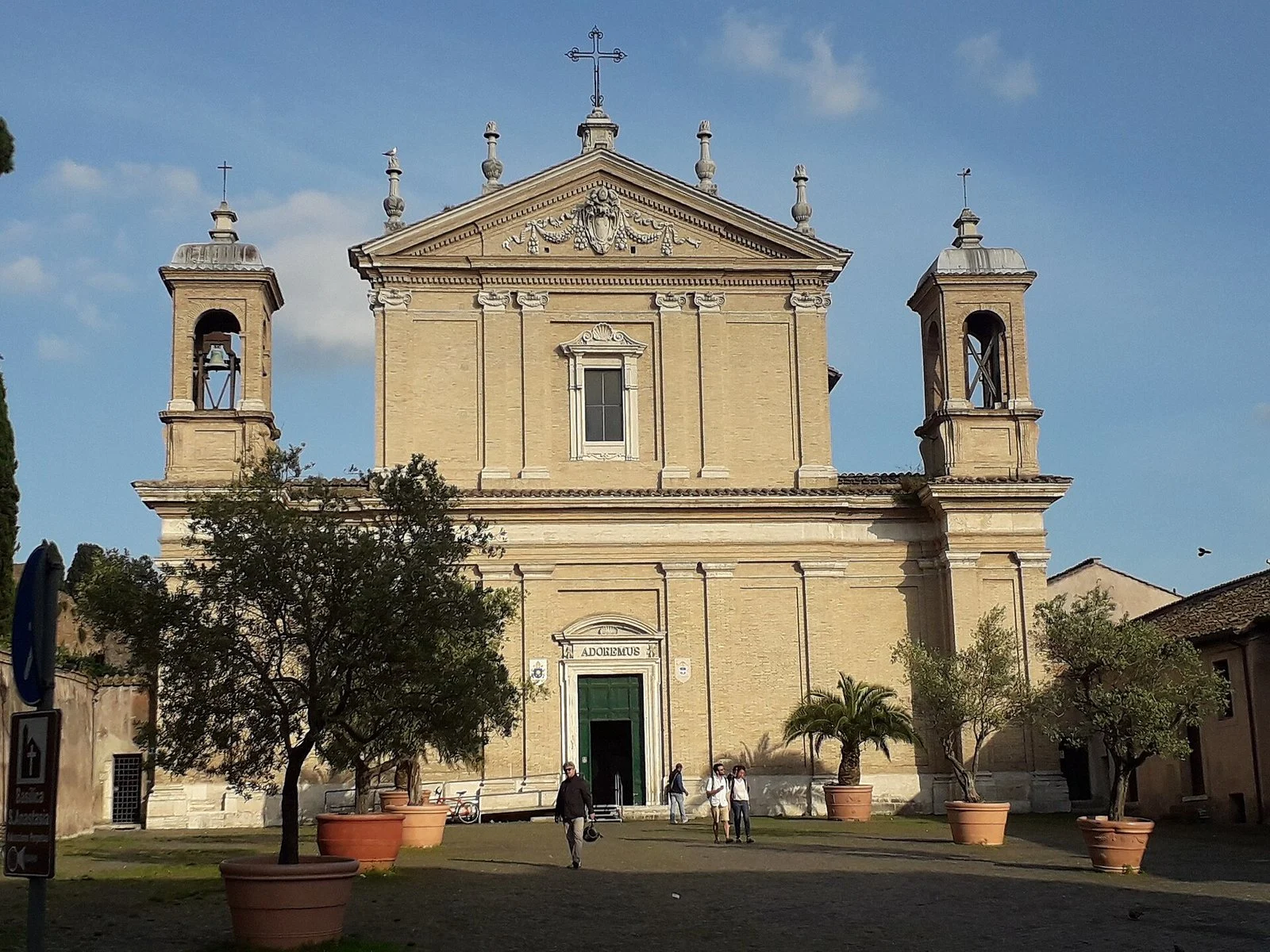
Sant’Anastasia al Palatino is at Piazza di Sant’Anastasia 1, in the corner between the flank of the Palatine Hill and the head of the Circus Maximus, a step from Via dei Cerchi. It is one of the oldest titular churches of Rome and has a liturgical peculiarity that no other church in the city can claim for itself: here, for centuries, the pope celebrated the second of the three Christmas Masses, the one of the dawn. The basilica is open every day from 9:00 to 18:00, entry is free, and on a normal day you'll find five people inside. 20,000 people a year walk past the door without noticing, because the facade looks onto a passing square and the Circus Maximus takes all the attention. This page explains what is inside, what is underneath and not visible, which stories hold up under checking and which do not.
Where Sant’Anastasia al Palatino Is and How to Get There
The address is Piazza di Sant’Anastasia 1, Campitelli district, in a fold of street that almost nobody calls by name. The church faces a widening between Via di San Teodoro, Via dei Cerchi and the rise leading toward the entrance of the Roman Forum. Coming down from the Palatine, you meet it on the left. Coming from the Forum Boarium, you see it appear suddenly after the bend, with the two twin bell towers rising above the walls.
By Metro
The right stop is Circo Massimo, line B. From the exit you cross the avenue, skirt the Circus along the long side, and in nine or 10 minutes on the flat you arrive in front of the church. The route is all sidewalk and without real climbs. Coming from Termini you take the B toward Laurentina and get off two stops after Colosseo. Coming from Piramide you do the same route in reverse, a single stop.
There is also the Colosseo option, again line B, which makes sense for those who want to enter from the Colosseum and walk down Via di San Gregorio. It's a good 20 minutes on foot, with the Arch of Constantine on the right and then the flank of the Palatine. On this side you arrive tired but you understand better where you are.
By Bus
The Circo Massimo quadrant is served by lines 51, 75, 81, 118, 160 and 628, which pass between Via dei Cerchi, Viale Aventino and Piazza di Porta Capena. The 118 is the one that then goes down onto the Appia, the 81 connects with the Celio and San Giovanni, the 160 and 628 come from the center. The routes of Rome's surface lines change because of construction, demonstrations and closures of the Circus Maximus, which are frequent here: check the same day on the transit company's app. The general picture of transport in the city is on our page on how to get around Rome.
On Foot, Which Is the Right Way
Sant’Anastasia works as a stop on a walk, not as an isolated destination. From the Mouth of Truth you climb Via dei Cerchi in eight minutes. From Santa Maria in Cosmedin it is 600 meters. From San Teodoro al Palatino it is 300, and the two churches should be seen in the same half hour because they tell the same piece of city. Coming down from the Orange Garden takes 12 minutes downhill.
By Car, Bike and Scooter
Parking here is a terrible idea and has to be said without beating around the bush. We are inside the limited traffic zone of the historic center, the few spaces are reserved or paid, and the square is narrow. Anyone coming from outside Rome leaves the car at a park-and-ride on line B and finishes by metro. By bike the stretch along the Circus Maximus is comfortable, with a bike lane and a decent surface. The problem starts on the cobbles of Via di San Teodoro. Anyone wanting to understand which Roman cycling routes really hold up will find the reasoning on the page Rome by bike.
Hours, Masses and Access Conditions
The hours published by the basilica's website, checked on September 28, 2026, indicate opening from 9:00 to 18:00 every day. Masses are Monday to Saturday at 8:00 and on Sunday at 10:00. Eucharistic adoration occupies the slot from 9:00 to 17:00, Monday to Saturday, in the chapel of Saints Jerome and Joseph at the beginning of the left aisle. Entry to the church is free, as in all Roman churches open for worship, and there is no ticket office.
Where the Sources Disagree
Mass times do not coincide among the portals that collect them. The basilica's website and one of the diocesan directories give 8:00 on weekdays and 10:00 on Sunday. Another directory instead gives 19:00 both on weekdays and on Sunday, and lists opening from 8:00 to 19:00. The divergence probably reflects schedules of different seasons, or the church's passage to the Syro-Malabar community in 2020, which reorganized the celebrations. Before leaving for a specific Mass, it's best to call the published number, 06 6782980.
What to Expect From the Adoration
Since March 2, 2001 the church has hosted continuous Eucharistic adoration, born as a rotation of volunteers. This changes the character of the visit compared with any monumental church. Inside there is almost always someone praying, in silence, and the voice volume has to be kept really low, not for show. Anyone coming in to take photographs has to adjust. Flash is out of the question, and in the adoration chapel it's best not to take out the phone at all.
What You See on Entering, Room by Room
The facade dates from 1636 and is by Luigi Arrigucci, a Florentine architect active in Rome, at the will of Urban VIII Barberini. It replaces a previous facade with a portico, commissioned between 1598 and 1618 by Cardinal Bernardo de Rojas y Sandoval and destroyed in 1634 by a whirlwind. The weather detail appears in several sources, the basilica's website included, and is one of those stories that sound like legend and yet hold up.
The Facade and the Two Bell Towers
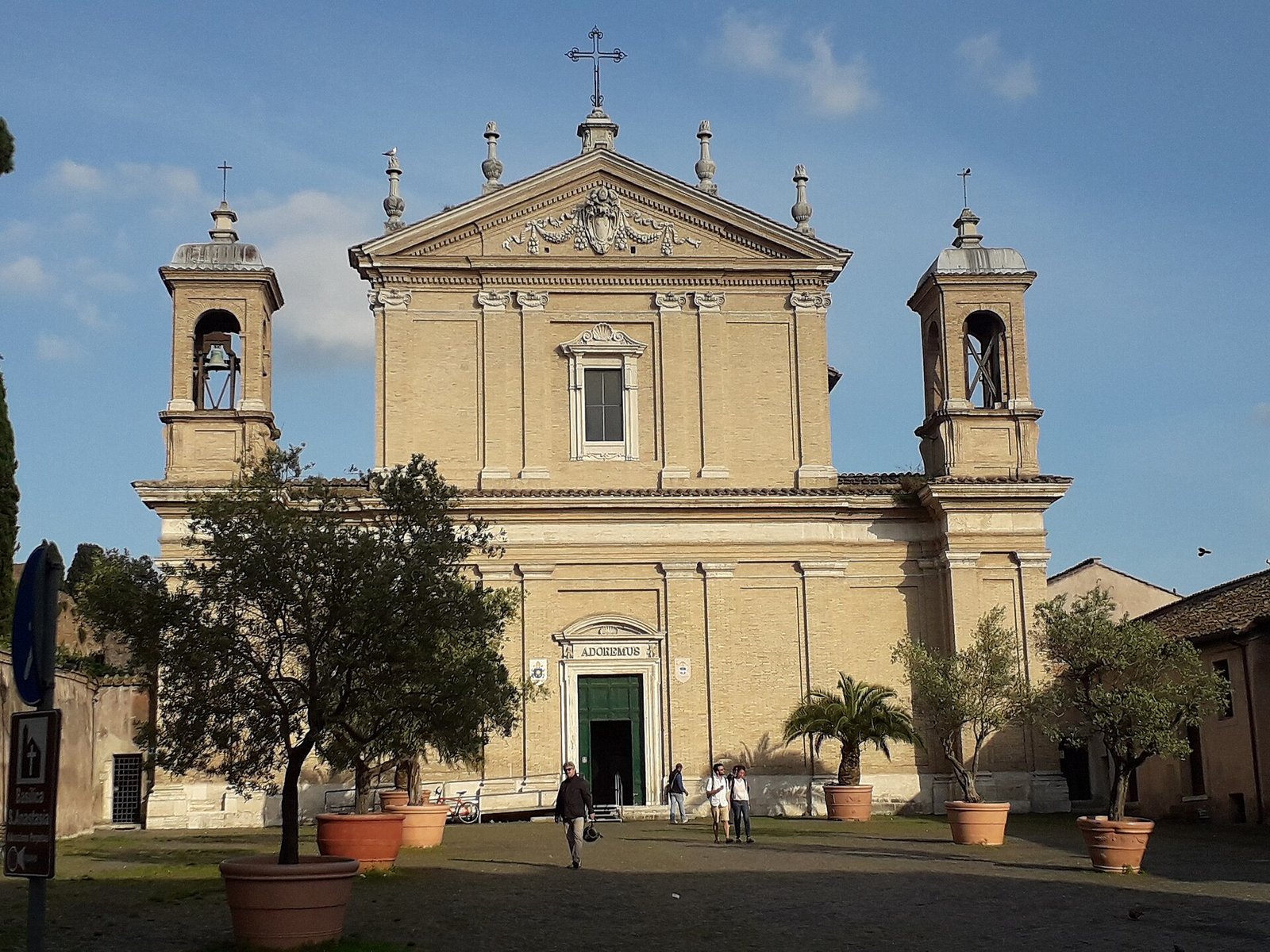
Two orders, Doric pilasters below and Ionic above, brick with limestone details, a single portal and a rectangular window. At the top the pediment bears the coat of arms of Urban VIII, with the Barberini bees, festoons and cornucopias. At the sides rise two twin bell towers, which in the Roman panorama are a rarity and which from afar make the church look bigger than it is. Look at it from the opposite sidewalk, not from below.
The Interior
Basilica plan with three aisles, semicircular apse, orientation to the east. The aisles are divided by reused Roman columns with Ionic capitals, set against six pilasters per side: the columns come from ancient buildings in the area and are the oldest thing you touch with your eyes on entering. The current decoration dates from 1721 and 1722, and is the work of the Maltese architect Carlo Gimach, commissioned by the Portuguese cardinal Nuno da Cunha e Ataíde. The effect is bright, orderly, not very theatrical.
The Ceiling
The coffered ceiling of the central nave carries at its center a canvas with the Martyrdom of Saint Anastasia of Sirmium, painted in 1722 by Michelangelo Cerruti. At the sides appear the coats of arms of Pius VII and Pius IX, the two popes who ordered restorations in the first half of the 19th century. Looking up is mandatory, because it is the part where the 18th-century project spent the most and because from the floor the painting is hard to read without stopping to look at it for a good minute.
The High Altar and the Reclining Statue
Under the table of the high altar is a marble statue of the saint stretched on the pyre of martyrdom, datable between 1685 and about 1690. The presbytery is raised by a few steps and the design is attributed to Onorio Longhi. On the altar frame there is an Adoration of the Shepherds by Lazzaro Baldi, from the second half of the 17th century. The statue is the piece for which this church enters the textbooks of Baroque sculpture, and the attribution deserves a separate discussion.
The Chapels and Paintings
In the left aisle, the chapel of Saints Jerome and Joseph preserves a Cosmatesque ciborium in marble and mosaic, dated between the mid-12th and the mid-13th century, a Saint Jerome Celebrates Mass attributed to Domenichino, a fresco Martyrdom of Saint Anastasia in a lunette attributed to Lazzaro Baldi and Domenico Ponti, and the Funeral of Saint Anastasia by the same Baldi. Halfway down the aisle, the chapel of Saint George houses a canvas by Étienne Parrocel with Saint George and Saint Publius.
In the right aisle, the chapel of Saint John the Baptist has as its altarpiece a Saint John the Baptist in the Desert by Pier Francesco Mola, from around 1658, which is the highest-quality painting in the church and which nobody looks at. At the beginning of the same aisle the Chapel of the Relics, 17th-century, preserves four canvases with stories of Saint Charles Borromeo and Saint Philip Neri attributed to Lazzaro Baldi and workshop, from around 1679.
In the transepts are the altar of the Madonna of the Rosary, with a canvas by Lazzaro Baldi prior to 1686, and the altar of Saint Turibius of Mogrovejo with the canvas by Francesco Trevisani of 1726. On the transept wall is the funerary monument of Cardinal Angelo Mai, of 1857, by the Neoclassical sculptor Giovanni Maria Benzoni. Mai was the philologist who rediscovered Cicero's De re publica by reading a palimpsest: a figure who would deserve more than a passing plaque.
What You Don't See
Under the floor are the Roman remains that make this place important for archaeology, and they are not included in the ordinary visit. There is no underground route open to the public with ticket office and hours. Anyone who reads somewhere that the tabernae or the so-called vestibule of the Lupercal can be visited is reading the description of an extraordinary opening, of a research permit or of an outing organized by speleo-archaeological groups, not of a permanent service.
The Titulus and the Origins: Where the Name Comes From Another Word
The church dates with every likelihood to the first decades of the 4th century, and some reconstructions date it around 325 or 326, in the Constantinian age. The name under which it appears in documents is titulus Anastasiae, recorded in the acts of the Roman synod of 499. So far the sources agree. The problem begins when you try to explain where that name comes from, because there are three explanations in play and they are not compatible with each other.
First Hypothesis: The Greek Word
One line of scholarship links the title to the Greek anastasis, that is, resurrection. It would then be a church named for a mystery and not a person, as happens with other ancient buildings. In support is the fact that the saint's name appears in the chronicles only from the 6th century onward, and that the area was frequented by Greek-speaking personnel tied to the imperial offices of the Palatine. The city's tourist portal reports this hypothesis as possible and not as certain.
Second Hypothesis: The Roman Foundress
A second reconstruction, which is the standard mechanism of Roman titles, attributes the name to a matron named Anastasia who would have financed the building. Titular churches come about like this: private houses of well-off Christian families become places of worship and take the name of whoever put up the money. Some 19th-century sources instead gave the name of an Apollonia. Neither variant today has strong documentary support.
Third Hypothesis: Constantine's Sister
The basilica's website reports that according to some scholars the name would come from Anastasia, half-sister of the emperor Constantine, who lived between 281 and after 314. The hypothesis makes sense inside the Constantinian chronology and explains why a Christian church rose, very early, at a point so close to political power. It remains a hypothesis, however, and whoever presents it as established simplifies. The three explanations coexist in the literature and none has won.
How the Saint of Sirmium Enters the Scene
Anastasia of Sirmium is a martyr venerated above all in the East, killed according to tradition on December 25 of 304 during the persecution of Diocletian, in the province of Illyricum. Her body was taken to Constantinople under the patriarch Gennadius, between 458 and 471. Toward the end of the 5th century the Roman church on the Palatine appears dedicated to her. The dedication thus comes later, and the saint enters a building that already carried that name.
What to Keep and What to Leave
The solid fact is this: a very ancient church, title attested in 499, dedication to Anastasia of Sirmium consolidated between the 5th and 6th centuries. The rest belongs to erudite reconstruction and hagiographic tradition, which tell of this martyr a novelistic life, with a pagan husband, care of Christians in prison and a torture on the pyre. The life is late devotional material. The church is an archaeological and documentary fact. The two things must be kept separate.
A Curiosity About Sant’Anastasia al Palatino
The three Masses of Christmas Day, in the Roman liturgy, have three different stations, and the second is this church. The midnight Mass was celebrated at Santa Maria Maggiore, the day Mass at Saint Peter's, and in between, at first light, the pope went down to the Palatine for the so-called Mass of the dawn. The custom is traced back at least to the time of Gregory the Great, between 590 and 604, and lasted for centuries.
Why Here
The reason is administrative before devotional, and this is the part that makes the story interesting. On the Palatine, after the end of the Western empire, the representatives of Byzantine imperial power in Rome continued to reside, with their Greek-speaking staff. Sant’Anastasia was the church of that court, its official place of worship. Anastasia of Sirmium was a martyr dear to the East, and her feast falls on December 25.
Put the two elements together. On December 25 the Byzantine court of Rome celebrated its own saint in its own church, and the pope went there to celebrate. From this comes a Mass that then remained in the calendar long after the court had disappeared, with the saint reduced to a commemoration inside a liturgy that speaks of something else. It is the case, rare and legible, of a liturgical custom born from a question of diplomatic protocol.
What Remains of It in the Missal
Sant’Anastasia entered the Canon of the Mass between the end of the 5th century and the beginning of the 6th, and for centuries the second Christmas Mass carried a commemoration of the martyr. As the Christmas solemnity grew, devotion to the saint shrank, and the dawn formulary was reread entirely on the theme of the Savior's birth. The trace, however, remained in the liturgical books and in the list of the stational churches.
And Today
The custom has not been entirely interrupted. The Pontificia Accademia Cultorum Martyrum, the institution that looks after the calendar of Roman stations, has resumed the celebration of the dawn Mass in this basilica on Christmas Day. It is no longer the pope who celebrates it, and nobody advertises it. It is an early Mass, in a small church, with a few dozen people. Anyone who wants to go must ask the basilica for confirmation, because the time changes from year to year.
This is why, among all the Roman churches open at Christmas, this one deserves a line of its own in the program of those spending the holidays in the city. The complete calendar of things happening in the city in the weeks around the holidays is on our page on Christmas in Rome. The dawn Mass remains a liturgy, with people praying inside, and as such it must be treated by those who go in.
Something Nobody Tells You About Sant’Anastasia al Palatino
Under this church is an entire Roman block, and the early Christian basilica rested on it instead of razing it to the ground. The archaeological descriptions speak of a portico dated between the end of the Republican age and the 6th century, and of a sturdy construction used as dwellings, an insula, with shops on the ground floor. The shops backed onto the flank of the Palatine and opened toward the Circus Maximus, that is, toward the flow of people.
The Shops
The most significant sector, according to those who have gone in, is a row of large shops of the 1st century AD, preceded by pillars in peperino blocks later reinforced with thicker brick pillars. They have marble thresholds, back rooms and small storerooms. They faced onto Via dei Cerchi, which follows the ancient route. Picture the Circus full, 200,000 people, and this row of stores on the flank: stadium commerce is not something we invented.
The Upper Floor
Above the shops, on the first floor of the insula, a meeting room used for worship is placed. If the reading holds, the sequence is the classic one of the first Roman Christian communities: a hall inside an apartment building, then a church built on top. The early Christian basilica was set on the whole archaeological base, reusing its walls as foundation. This explains why the walking level of the church is where it is, and why the building has that plan.
The Question of the Lupercal
Here comes the story that circulates most, and it is the one to go slowly on. Some sources, the basilica's website included, indicate among the underlying structures the remains of a 1st-century building identifiable with the vestibule of the Lupercal, the cave where according to myth the she-wolf nursed Romulus and Remus. The question stems from a discovery of 1526, a cave decorated with shells, and from there it has never closed.
Those who work on the subsoil of this sector point out that the prevailing reading today is another: it would be a nymphaeum, because shells are a normal Roman decorative motif for water-related rooms. In 2007 the Soprintendenza announced the discovery of a vaulted and decorated room at another point of the Palatine, under the Domus Augustana, also proposed as the Lupercal, and that identification too was contested. The Lupercal, at present, has no certain address.
Where You Can See Roman Layers Like This, Without Permits
Anyone who wants to understand how a Roman level incorporated into a later building works, without waiting for an extraordinary opening, has alternatives open every day a few minutes from here. Under Santa Maria in Cosmedin are the structures of the Statio Annonae. At Santa Prisca, on the Aventine, there is a visitable mithraeum. At the Palatine Museum you see the material excavated on the hill.
My Advice for Visiting Sant’Anastasia al Palatino
Don't come here on purpose. This church works as a stop inside a route and disappoints those who arrive at it alone expecting a monument. You spend 20 minutes inside, half an hour if you really look at the paintings. The right way is to fit it into a walk between the Forum Boarium and the Palatine, which is also the route anyone made in this city for 2,000 years.
The Right Time
Early morning, between 9:00 and 10:00. The church has just opened, the light comes in from the right side, and the Circus Maximus at that hour is empty and easy to cross. In the summer afternoon the square takes full sun and there is no shade until Via di San Teodoro. In winter the valley floor is damp and cold: put on one more layer than seems necessary.
The Recommended Itinerary
Start from the Mouth of Truth, with the Temple of Hercules Victor and the Temple of Portunus in front. Then the Arch of Janus and San Giorgio in Velabro, which are 100 meters away. Climb Via dei Cerchi with the Circus on your right, go into San Teodoro, arrive at Sant’Anastasia. It is barely two kilometers and three different centuries.
How Much Time It Takes
For the church alone 20 minutes are enough. For the complete route from the Forum Boarium to here, with stops, a morning is needed. Anyone adding the climb up the Palatine must allow another two and a half hours and a separate ticket. Anyone continuing toward the Aventine and the Rome Rose Garden, open only in spring and autumn, easily reaches evening.
With Whom It Doesn't Work
With small children this church gives little: no educational paths, no panels, sober interiors. Nor with those who have only two days in Rome and have never seen them, because other things come first. It works very well instead with those who return to Rome, with those who study Church history, with those interested in liturgy, and with those who have already seen everything else and are looking for the corner they're missing.
Another Well-Known Fact, Yet Rarely Cited
Until the 18th century, on Ash Wednesday, the pope's penitential procession started from here. The rite of the Ashes was celebrated at Sant’Anastasia, then the procession crossed the valley and climbed the Aventine to Santa Sabina, where the first stational Mass of Lent was celebrated. The route still exists, largely, and can be redone on foot in 25 minutes.
The Storage of the Crosses
This church also served as a depot for the insignia and crosses of the different ecclesiastical groups taking part in the stational liturgies. Put practically: it was the procession's warehouse. A logistic detail, not an elevated one, which explains the building's function better than much hagiography. Anyone who organizes parades knows that the real problem is not the parade, it is where things are kept before and after.
The Other Stations
Sant’Anastasia remains a stational church for the first Tuesday of Lent, with evening Mass, and was a station also for the Tuesday of Pentecost. The system of Roman Lenten stations is a calendar assigning a different church to each day of Lent, and it draws a map of the ancient Christian city that no tourist itinerary reproduces. Anyone following it ends up in places where they would not otherwise set foot.
The Procession Today
On Ash Wednesday the Roman procession is still held, but it starts from Sant’Anselmo all’Aventino and arrives at Santa Sabina, which is 200 meters away. The long stretch from the valley, the one that passed through here, has been abandoned. If you walk from Sant’Anastasia toward Santa Sabina on the first Wednesday of Lent, you are redoing a route that fell out of use three centuries ago.
The Right Photo to Take at Sant’Anastasia al Palatino
The photo that works is not the frontal facade. It's taken from Via dei Cerchi, walking north with the Circus Maximus behind you: at a certain point the two twin bell towers appear above the line of the walls, with the green of the Palatine behind. It's a frame that puts together three layers, the ancient valley, the Baroque church and the hill. Nobody takes it because everybody looks the other way.
The Light
The facade faces west, so it gets sun in the late afternoon. In summer, between 18:00 and 19:00, the brick turns orange and the limestone details stand out well. In the morning the facade is in shadow and flat: if you come early, take the photo inside or take it at the hill. In winter the useful window shortens considerably, because the sun goes down behind the Aventine much earlier.
Inside
Inside, the good frame is from the back of the central nave, low, with the coffered ceiling closing the top and the raised presbytery at the far end. You need a wide-angle lens and you need to hold the camera still, because the light is low. No flash, ever, and not only out of courtesy: in front of the altar there is almost always someone in adoration. A modern phone manages, if you rest it on a column.
The Detail Worth It
The coat of arms of Urban VIII on the pediment, with the Barberini bees, photographed from below with a telephoto lens, is the best detail of the facade and tells the 1636 building project by itself. The Barberini bees are found on half of Rome and this church is one of the places where you see them without a line and without a ticket. For the rest of the Barberini repertoire there is the whole center.
Some Important Events That Happened Here in History
The chronology of this church spans 1,600 years with a density few others can match. Some facts are well documented, others belong to tradition and we flag them as such. We put them in order, indicating each time what kind of news it is, because the difference between a synodal act and a devotional memory is everything.
4th Century: The Foundation
The construction is placed in the first decades of the 4th century, with proposals that go down to 325 or 326. It is the first basilica to rise in an area of maximum civic and political importance inside the city. The other churches, even after the edict of 313, were located in peripheral areas, out of caution by the authorities and to avoid friction. This choice of location is a political fact.
366 and 468: Damasus and Hilarus
During the pontificate of Damasus, between 366 and 383, the building was decorated with fresco wall paintings. Pope Hilarus, between 461 and 468, enriched it with mosaics. Of these decorations nothing remains in view today. They are items from documentary sources, reported by institutional listings and the literature, which say how much the church already mattered in the 5th century, long before the Middle Ages.
Mid-5th Century: Leo the Great
Tradition has it that Pope Leo the Great, between 440 and 461, delivered here some sermons against the archimandrite Eutyches and the Monophysite heresy. The fact appears in the basilica's listings and in the devotional literature. It is consistent with the church's role as the place of worship of the Greek and Eastern component of the city, that is, with the public that actually followed those controversies.
499: The Title in the Documents
In the acts of the Roman synod of 499 the church appears as titulus Anastasiae. It is the reference document, the one on which all the dating rests. From this date on the church is in the network of Roman presbyteral titles, with its own clergy and a precise position in the organization of the diocese. Everything told before 499 is reconstruction, however plausible.
Between the 6th and 9th Centuries: The Restorations
The documented interventions follow one another regularly: the Ostrogothic king Theodoric, then the popes John VII between 705 and 707, Leo III between 795 and 816, Gregory IV between 827 and 844. Then Innocent III, between 1198 and 1216. A church that is restored by six different authorities in six centuries is a church that someone uses, not a building forgotten in a valley.
1478: Sixtus IV and the Bell Tower
In 1478, at the will of Sixtus IV, the basilica was restructured and given a tall bell tower. He is the same pope as the Sistine Chapel project and the Ponte Sisto, a pontificate that remade half of Rome ahead of the Jubilee of 1475. The 15th-century bell tower is not the one you see today: the current facade, with the two towers, is 17th century.
1634 and 1636: The Whirlwind and Arrigucci
In 1634 a whirlwind destroyed the facade with portico built a few decades earlier. In 1636 Urban VIII commissioned Luigi Arrigucci to rebuild it in the present forms. Two years between destruction and reconstruction, in a 17th-century Roman building project, is a fast time: it means the church had a cardinal titular with money and haste, and that the Barberini was keen to put his coat of arms on the pediment.
1721 and 1722: The Gimach Project
Carlo Gimach redid the interior for Cardinal Nuno da Cunha e Ataíde, and in the same round Michelangelo Cerruti painted the ceiling canvas. This is the moment when the church takes on the look it has now. Anyone entering today sees the 18th century, with the reused Roman columns and the medieval Cosmatesque ciborium fitted inside, which are the two survivors of the earlier phases.
1847: The Excavations
The first systematic explorations of the subsoil began in 1847, with funding of Russian origin, and brought to light ancient structures and paving stones. It is 19th-century archaeology, with its methods and its limits, but it is the basis of what is known today. Modern research on this sector remains tied to the general topographic reconstruction of the area between the Circus Maximus and the slopes of the Palatine.
From 1963 to 2000: Closure and Reopening
In 1963 the church was restored at the will of Cardinal James Francis McIntyre, archbishop of Los Angeles, with the contribution of Californian faithful, recalled by an inscription in the floor of the central nave. In the 1980s structural decay led to a radical restoration by the Soprintendenza and a closure lasting more than 35 years. The basilica reopened daily for worship only in May 2000.
2001 and 2020: The Two Recent Turning Points
Since March 2, 2001 the church has hosted continuous Eucharistic adoration. On July 8, 2020 the cardinal vicar Angelo De Donatis assigned the basilica to the Syro-Malabar Church, an Eastern Catholic Church in full communion with Rome, based in Kerala. Since that decree Sant’Anastasia has in effect been the church of the Indian community of Syro-Malabar rite in Rome, which numbers several thousand people.
Who Passed Through Sant’Anastasia al Palatino
The list is long and should be taken with the caution it deserves, distinguishing documented presence from traditional memory. On a church of this age the list of famous passages tends to swell, because each century adds its own name. Here we keep those that appear in institutional sources, flagging each time what is involved.
Saint Jerome
Tradition has him residing nearby, celebrating in this church, and bringing relics from the Holy Land. Jerome resided in Rome between 382 and 385 as secretary to Pope Damasus, so the chronology holds. The attribution of the relics to him, however, is a matter of devotional tradition and not of documentation: the sources that report it, the Comune's portal included, use cautious formulas like “according to tradition”.
Leo the Great
The sermons against Eutyches delivered here belong to the same category: handed-down news, consistent with the context, without a document nailing it down. Leo the Great is the pope of the Tome to Flavian and of the Council of Chalcedon of 451, that is, the absolute protagonist of the controversy over the two natures of Christ. That he chose the church of Rome's Greeks to speak about it is plausible.
Gregory the Great and the Popes of the Dawn
From the end of the 6th century and for several centuries, the popes came here on Christmas morning. Here we are not talking about an isolated passage. We are talking about an institutional custom that involved dozens of pontiffs. Among them Gregory the Great, to whom tradition attributes the start of the practice. Whoever looks for the place in Rome where the greatest number of popes celebrated the same Mass on the same day of the year, for a millennium, this is it.
Cardinal Angelo Mai
Buried here in the monument by Giovanni Maria Benzoni of 1857. Mai was prefect of the Vatican Library and the greatest palimpsest hunter of the 19th century: he brought back to light ancient texts erased and rewritten in codices, including parts of Cicero's De re publica. Leopardi dedicated a canzone to him. The tomb of one of the most important philologists in Europe is in a church nobody enters.
The Titular Cardinals
Sant’Anastasia has been a cardinalitial title for centuries and the list of titulars runs through the history of the Church. Among the names that appear are English, Spanish, Portuguese, American cardinals. Cardinal Bernardo de Rojas y Sandoval built the facade with portico between 1598 and 1618, Nuno da Cunha e Ataíde paid for the interior remaking of 1721. The titulars are not just a list: they are the financiers of the building projects.
The Greeks of Rome, the Real Regulars
The most important passage has no names. For centuries this church was the place of worship of the Greek-speaking clerks and officials who worked in the imperial offices on the Palatine. People who came down from the hill on foot, every Sunday, for 200 meters. They left no famous inscriptions, but they are the reason the church stands where it stands and is called what it is called.
The Relics: What Is There and How to Take the News
The church preserves a 17th-century reliquary with what tradition indicates as the mantle of Saint Joseph and part of the veil of the Virgin Mary. Some sources add a fragment of the Cross. Tradition attributes the arrival of these objects to Saint Jerome, who would have brought them from the Holy Land in the 4th century. That is the news. Now let's see how much of it holds.
What the Sources Really Say
All the sources that report the news, institutional ones included, introduce it with a formula of tradition. The city's tourist portal writes that the relics are said to have been brought from Jerusalem by Saint Jerome. The Catholic press uses the conditional. The basilica's website speaks of the work of Saint Jerome according to tradition. No source presents a document, an analysis or a chain of custody.
How to Read It
A relic of Saint Joseph's mantle is not verifiable by definition, and nobody claims it to be: it belongs to the history of devotion, not to the material history of objects. The solid historical fact is another, and it is that a documented devotion to these relics exists here, with a 17th-century reliquary that materializes it, and that the adoration chapel is named precisely for Jerome and Joseph. That is the true thing to look at.
Our Opinion
The position I hold, and which not everyone agrees with, is that telling these relics as authentic harms the church more than it enhances it. A visitor who later discovers that nobody has ever been able to document anything stops believing even the true things, and about this church the true things are many and more interesting. Better to say it first: ancient devotional tradition, respectable, not verifiable. Period.
The Indian Church in the Middle of the Palatine
Since July 8, 2020 this basilica has been assigned to the Syro-Malabar Church, Eastern Catholic, originally from Kerala. In Italy the Syro-Malabar community numbers about 12,000 faithful according to figures released by the community itself, distributed among Rome, Milan, Genoa, Florence, Treviso and other cities. In Rome the Qurbana, that is, the Eucharistic liturgy of the Syro-Malabar rite, is celebrated in about 10 centers.
What Changes for the Visitor
The calendar and the hours change. Celebrations of the Eastern rite follow a cycle and a language of their own, and on the community's feast days the church may be taken up by a long and well-attended liturgy. Anyone who happens in at those moments witnesses something seen in few places in Rome. Going in is perfectly fine, photographing during the celebration is not.
Why I Find It the Most Beautiful Thing in the Recent History
A church born as the place of worship of the Greeks of the imperial court, that is, of a foreign community inside Rome, returns after 1,500 years to being the place of worship of a foreign community inside Rome. The hill is the same, the mechanism is the same, the origin and the language change. Whoever tells Rome as a closed city should come here on a Sunday morning.
What's Around, in Order of Distance
This corner is one of the densest in the city and in half an hour's walk you put together four eras. The church occupies the center of a triangle between the Circus Maximus, the Forum Boarium and the slopes of the Palatine, and from here you set off in every direction without ever taking a vehicle.
Two Minutes Away
The Circus Maximus is right there, and whoever has never seen it is left disoriented because it is a meadow, not a monument: the southern edge has the remains in view and the medieval tower, the rest is outline. San Teodoro is 300 meters away, in a rotunda sunk below street level, and is one of the oldest churches in the city.
10 Minutes Away
The Forum Boarium with its two Republican temples, the Arch of Janus, San Giorgio in Velabro, Santa Maria della Consolazione and San Nicola in Carcere, which has three Roman temples in its walls and a visitable crypt. A little farther the Theatre of Marcellus and the climb toward the Capitoline Hill with the Capitoline Museums.
On the Other Side
Climbing toward the Forum you reach Santa Francesca Romana and Santi Cosma e Damiano, with the 6th-century apse mosaic that is among the most beautiful in Rome and the 18th-century Neapolitan nativity scene. Higher still, the Colosseum and the Domus Aurea, which can be visited only by reservation and is under works.
Toward the Aventine and Testaccio
On the other side of the Circus begins the climb to the Aventine, with Santa Sabina, the Orange Garden, Santa Prisca with its mithraeum and the churches of Sant’Anselmo and Sant’Alessio. Going down the other side you enter Testaccio, with the Monte dei Cocci, the Pyramid of Cestius and Porta San Paolo.
The Other Two Stops I Recommend
The Baths of Caracalla are a quarter of an hour away and are worth the ticket. San Sisto Vecchio, a little farther, is another very ancient title almost always closed, and anyone who has done the whole valley deserves to know it exists. On the river, 10 minutes away, the Ponte Palatino looks at the Ponte Rotto and closes the loop.
Eating in the Area: Circus Maximus Frontage Versus Inner Streets
Around Sant’Anastasia, within a radius of 300 meters, you eat badly or you don't eat. The square is a passage, not a neighborhood, and the few businesses of the frontage work on people who pass once. The difference between the Circus Maximus frontage and the inner streets, here, is sharp and measured in 10 minutes of walking: on one side the price of the view, on the other the price of lunch.
The Frontage, That Is, Where Not to Stop
The side facing the Circus, Viale Aventino and the upper part of Via di San Teodoro concentrate the venues calibrated on passing tourism. The model is always the same: tables outside, view of the lawn, menu in six languages, fast service. The cooking is a secondary detail because the customer doesn't come back. There is nothing scandalous in it, it is a rational economic model, and it should simply be recognized for what it is.
The Signs That Say to Steer Clear
The menu with photographs of the dishes. The lady rolling fresh pasta in the window or on the sidewalk, which is a staged lure built on purpose and not a clue about the cooking. The person at the entrance who invites you to sit down. The kitchen open from morning to night without a break, that is, without a brigade working in defined services. And above all, in front of monuments, the price lists with unpriced items, the prices that change between the indoor room and the outdoor seating, and the bill that adapts to the customer's face.
The Repeated Signs of the Center
In the center of Rome a restaurant style with a repeated sign has grown, the same menu in several points of the city, queue with a number ticket, staff in uniform. It works as a tourist attraction and Romans don't go. It isn't snobbery, it's a matter of what one is looking for: that model sells a product identical to itself, predictable, and whoever lives here looks for the unpredictability of a kitchen that changes with the market. No names, because there's no need.
Where You Really Eat, by Direction
The inner streets that hold up all start from here and have to be looked for on foot. Toward the Forum Boarium and the Ghetto, behind Via del Teatro di Marcello, you find neighborhood trattorias that live on regular customers. Climbing the Aventine the offering is sparse but honest, because it is a residential area and not a passing one. The most reliable direction remains Testaccio, 20 minutes on foot or two metro stops.
Testaccio, and Why Choose It
Testaccio is still the place where Roman cooking of tripe, oxtail and offal is found done well and at prices that make sense, even if prices have gone up there too. The Nuovo Mercato di Testaccio is useful for understanding what's eaten in season even before sitting down. The streets behind the market, away from the evening nightlife, are the part that holds up.
The Criterion, Just One
Look at who is sitting and in what language they order. If the tables have people speaking Italian who don't open the menu, the place holds up. If there are only backpacks and maps, move on. It's a crude criterion and it works almost always. Anyone who wants an already filtered reference can use the personal list of Daniele Dezi on Google Maps, a curated and unsponsored collection.
Two Readings to Go Deeper
The complete reasoning on how to choose a place in Rome, with reference prices and traps by area, is on our page on where to eat in Rome. For places that are 100 years old and keep working as they did then there is the page on cafés and historic shops of Rome. For groceries, the map of Rome's markets.
Frequently Asked Questions About Sant’Anastasia al Palatino
What are the opening hours of Sant’Anastasia al Palatino?
The basilica's website indicates opening every day from 9:00 to 18:00, with Eucharistic adoration from 9:00 to 17:00 Monday to Saturday. Figure checked on September 28, 2026. Other directories give different hours, up to 19:00, so for a visit tied to a precise time it's best to call the published number, 06 6782980, before setting out.
How much does it cost to enter Sant’Anastasia al Palatino?
Entry to the basilica is free, as in all Roman churches open for worship, and there is no ticket office. No fee is listed for the church or for the rooms below. If you find a price online referring to this church, it is a third-party operator's package that includes other things, not a basilica ticket.
Can you visit the underground of Sant’Anastasia al Palatino?
The Roman spaces under the church, portico, insula and shops, are not included in an ordinary visit and have no published hours. Access happens on extraordinary occasions, with speleo-archaeological research groups or specific permits. Those who care must follow the channels of whoever organizes these outings and allow for long waits and limited places.
What is the dawn Mass of Sant’Anastasia?
The dawn Mass is the second of the three Masses of Christmas Day in the Roman liturgy, and its station is precisely this basilica. From the time of Gregory the Great, and for centuries, the pope celebrated it here at dawn on December 25. The custom has been resumed by the Pontificia Accademia Cultorum Martyrum: times and arrangements must be asked of the basilica.
How do you get to Sant’Anastasia al Palatino by public transport?
The simplest solution is metro B to Circo Massimo, then nine or 10 minutes on foot along the Circus. On the surface lines 51, 75, 81, 118, 160 and 628 serve it, passing between Via dei Cerchi, Viale Aventino and Piazza di Porta Capena. Routes change often because of construction and events at the Circus Maximus: check the same day.
Who made the statue of Saint Anastasia under the altar?
The statue of the saint lying on the pyre, datable between 1685 and about 1690, was conceived and begun by Francesco Aprile and completed by Ercole Ferrata after Aprile's death. The formula “Bernini's pupil” that you read around is imprecise: Ferrata was a collaborator of Bernini, Aprile was a pupil of Ferrata. The work is declaredly inspired by Bernini's Blessed Ludovica Albertoni.
Does Sant’Anastasia al Palatino really preserve the relics brought by Saint Jerome?
The church preserves a 17th-century reliquary with what tradition indicates as the mantle of Saint Joseph and part of the Virgin's veil, brought from the Holy Land by Saint Jerome. All the sources, institutional ones included, use formulas of tradition and none produces documentation. It is ancient and respectable devotion, not a verifiable historical fact.
Why is the church called Anastasia if the name means resurrection?
There are three hypotheses about the name and they coexist: the Greek anastasis, that is, resurrection. A Roman matron named Anastasia who would have financed the building. Anastasia, half-sister of Constantine. The name of the martyr of Sirmium appears in the chronicles from the 6th century and the dedication to her consolidates toward the end of the 5th. None of the three explanations has prevailed.
Is Sant’Anastasia al Palatino suitable for a visit with children?
The basilica offers little to small children: no educational paths, no panels, sober interiors and the silence required by Eucharistic adoration. It works better as a short stop within an outdoor day that includes the Circus Maximus, where there's no lack of room to run, and the climb to the Aventine. The square in front of the church has traffic: hold children by the hand.
Who Wrote This Page
The page is edited by the staff of Tour Leader Pro, a Roman organization that designs and coordinates visits, itineraries and cultural events in Rome and Lazio. Hours, addresses and access conditions given here are checked against official sources at the date of publication, and they change more often than you'd think: before setting out, take a look at the phone numbers given. If you find an outdated detail, write to us.
Building a Roman itinerary means making things fit together: churches run by religious communities and not by tourist bodies, openings that depend on celebrations, undergrounds that can be seen only with a permit and distances that look short on paper and are not when uphill. Anyone facing this kind of problem, on their own or for a group, finds planning materials and tools on Tour Leader Pro, designed for those who lead visits and for those who organize alone.
For the wider picture, trains and connections, rentals, airports and destinations in Lazio outside the center of Rome, from the Castelli to the lakes to the coast, a useful resource is Italy Planner.