Monastery of Santa Rosa in Viterbo
In short. The Sanctuary of Santa Rosa in Viterbo, with the Poor Clares' monastery that surrounds it, has been open again since August 22, 2026, the day Bishop Orazio Francesco Piazza celebrated the reopening Mass after the restoration work on the dome.
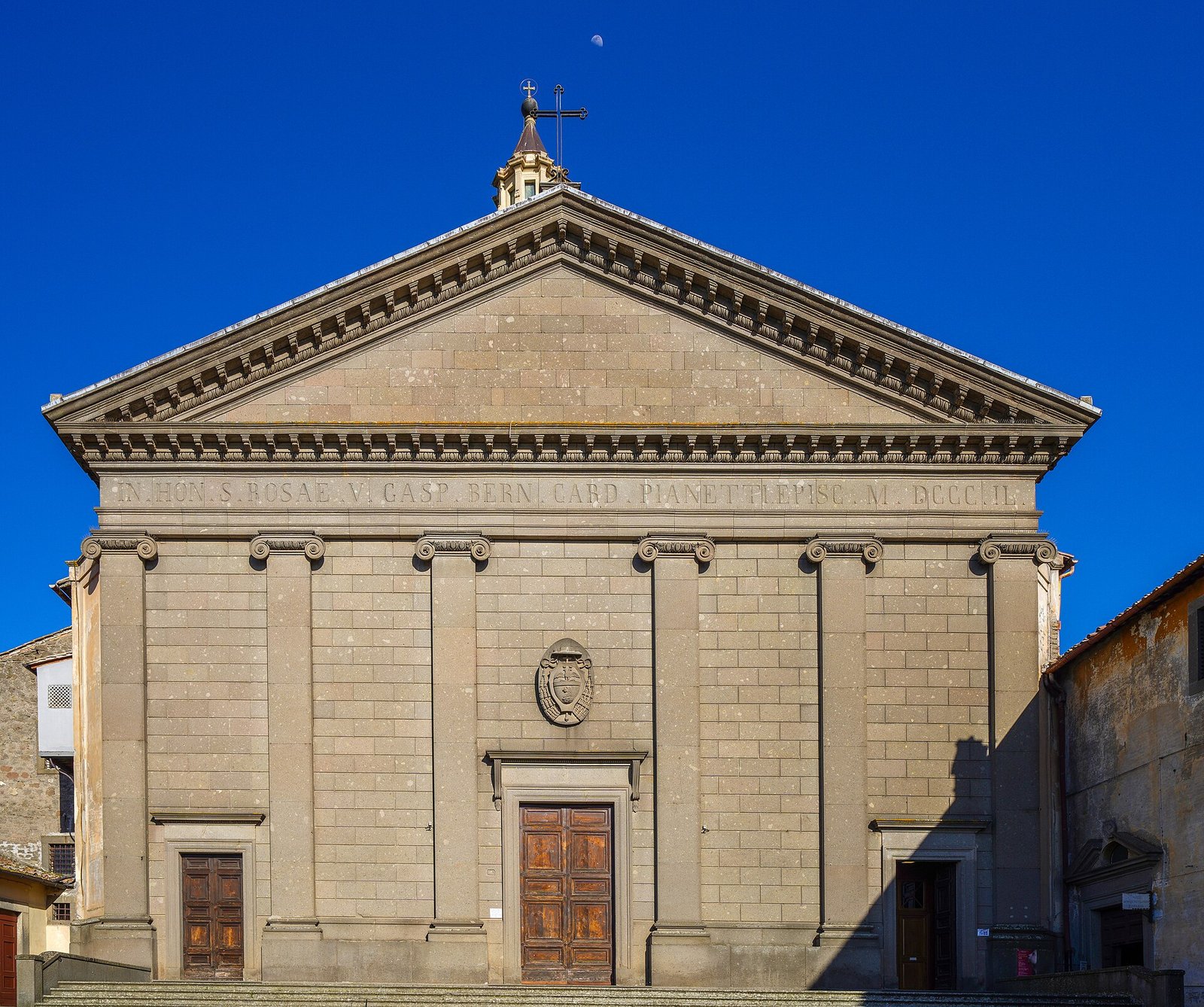
The Sanctuary of Santa Rosa in Viterbo, with the Poor Clares' monastery that surrounds it, has been open again since August 22, 2026, the day Bishop Orazio Francesco Piazza celebrated the reopening Mass after the restoration work on the dome. It stands in the historic center, on the square where the transport of the Macchina ends on the evening of September 3. The church is a place of worship and the diocesan sources give no ticket for entering and reaching the urn with the saint's body.
The complex has three parts that are worth keeping distinct. The church, rebuilt in 1850 in neoclassical forms, with the dome of 1913 designed by Arnaldo Foschini and covered in majolica. The Poor Clares' monastery, which keeps the Chapel of the Relics inaugurated in 2021 and the cell of Armida Barelli turned into a chapel in 2025. The saint's house, which according to tradition marks the place where Rosa was born and which has been part of the monastery since the 17th century.
Data checked on September 29, 2026 on the portal of the Diocese of Viterbo, on its press releases of 2024 and 2026, on the program of the 2026 feast, on the Mass schedule valid from June 1, 2026 and on the entry dedicated to the saint in the Dizionario Biografico degli Italiani. Hours of the museum route and of the house should be asked at the official website of the sanctuary, the channel the diocese indicates.
In brief: address, hours, ticket
- Address: Sanctuary and Monastery of Santa Rosa, historic center of Viterbo, on the square where the Macchina arrives. The street number is not published on the sanctuary's diocesan page.
- Operator: the Poor Clare Nuns of the Monastery of Santa Rosa, in the Diocese of Viterbo. Official channels: sanctuary website, Facebook page SRosaViterbo, Instagram profile santuariosantarosa.
- How to enter: church open for worship after the reopening of August 22, 2026. Monastic complex and the saint's house according to the terms set by the sanctuary.
- Price: for the church the diocesan sources indicate no tickets. Fares for the museum route and the house are not published by the diocese, ask the sanctuary.
- Masses: holidays at 11:00 and 18:30, pre-holiday at 18:30, weekdays at 7:30, according to the diocesan schedule valid from June 1, 2026. Visiting hours are not published by the diocese.
- How to get there: Trenitalia trains on the FL3 line Rome-Capranica-Viterbo, stations of Viterbo Porta Romana and Viterbo Porta Fiorentina.
- Accessibility: the information is not published by the operator.
Where it is and what you really see
The sanctuary stands in the historic center of Viterbo, at the top of the steep climb that the Macchina tackles almost at a run in the last stretch of its route. The rest of the year that climb goes back to being a street in the center, walked by the people who live in the neighborhood. The sign recognizable from afar is the majolica-covered dome. Below it opens the neoclassical facade on the square, and around the church spreads the Poor Clares' monastery, which shows the visitor mostly walls and doors.
The visit, in practice, has four stops. The square, with the facade and the dome. The nave, with the wooden crucifix, the polyptych and the tomb of Mario Fani. The saint's urn, where almost everyone stays longest. Then, if the sanctuary allows it that day, the route through the monastic complex and Rosa's house. The first three stops take a good half hour, the fourth depends on the terms set by the community.
The church has three aisles and works mostly from the 19th and 20th centuries. There are no great cycles of ancient frescoes: the 15th-century ones by Benozzo Gozzoli were destroyed with the rebuilding of 1632. What remains is a wooden crucifix from the 17th century and a polyptych by Francesco d'Antonio with the Madonna between Saint Rose and Saint Catherine. The emotional center of the visit remains the saint's urn, which draws almost all the attention of those who enter.
The tomb dates to 1699. It is a gilded bronze urn held up by two angels, inside which rests Rosa's body, described by the sources as practically intact almost eight centuries after her death. The nuns of the monastery periodically replace the silk habit that clothes it. Anyone who arrives prepared for a museum is thrown off. Here people pray, leave flowers, stand in silence, and the tourist visit takes place at the edge of a devotion that continues every day.
The church also holds the tomb of Mario Fani, who died in 1869 and is remembered as the founder of the Italian Catholic Action Youth. It is a detail most visitors don't notice. It does tell of the sanctuary's tie to the history of Catholic Action. The same thread leads to the chapel dedicated to Armida Barelli, blessed in May 2025 inside the monastery.
The monastery is the Poor Clares' cloistered house and cannot be freely walked through. The parts that can be visited, that is, the museum route and the saint's house, follow the terms set by the sanctuary. The house, according to tradition, stands on the spot where Rosa was born in 1233. The historical sources confirm that the family owned a house in the San Matteo in Sonza district, and that the birth house was incorporated into the monastery in 1661.
From the outside the best view is on the square, with the dome behind the facade. In the days after September 3, for some time, the Macchina stays set down on the same square, and the place changes completely: barriers, crowds, stalls, photographers. Anyone looking for the sanctuary as a place of recollection should choose another period. Anyone who wants to see the tower up close, with its lights on, finds the right spot here instead.
A curiosity about the Monastery of Santa Rosa in Viterbo
Rosa's heart is not in the urn with the rest of the body. It was removed in 1921, during an examination, and placed in a silver reliquary. Since then it has led a separate life. On September 2, the evening before the Macchina, a delegation of porters carries it on their shoulders in procession through the historic center, adorned with rosebuds, to the cathedral. In 2026 the diocesan program also included a visit of the heart to a nursing home on September 7.
This separation often creates confusion. It often happens that visitors from outside are convinced the Macchina carries something of the saint, a relic or even the body. It does not. The Macchina is a votive tower that carries a statue, and in the current version, Dies Natalis, a cross on top. The real relics move in another procession, more private, the day before. Anyone who wants to understand the feast has to see both things, not just the spectacle of September 3.
The second curiosity concerns the name of the church. Before becoming Santa Rosa, the building was known as Santa Maria, and it is cited for the first time under that title in 1235. It was the church of the monastery of the Damianites, as the nuns who followed the rule of Saint Clare were then called. The name changed after 1258, with the arrival of Rosa's body, and since then the church and the monastery have been tied to the city's saint.
A third curiosity comes from the Dizionario Biografico degli Italiani and demolishes a widespread idea. The monastery was already dedicated to the saint when, in December 1661, the birth house was joined to it. So it was not the house that gave the monastery its name, as you hear said. The opposite happened. A convent named for a venerated figure later acquired the place of her birth, completing a path of devotion in a single complex.
The last curiosity is recent. The chapel dedicated to Armida Barelli, blessed on May 28, 2025, is not a new construction. It is a cell of the monastery that the blessed woman used during her stays in Viterbo, turned into a place of prayer. Barelli, a historic figure of Italian Catholic Action, had visited and frequented the monastery many times. The sanctuary thus keeps, a few meters apart, the memory of two women who lived seven centuries apart.
Something nobody tells you about the Monastery of Santa Rosa in Viterbo
According to tradition, Rosa never entered the Poor Clares. That is the paradox of the place. The saint who now rests in their monastery, and whom the nuns watch over by changing her habit, was turned away by the community because of her fragile health. She died very young and was buried elsewhere, in the church of Santa Maria in Poggio. Only seven years later the pope had her body moved to the monastery that had not taken her in while she was alive.
Rosa's fragile health now has a name. The diocese's page speaks of a very rare and serious physical malformation, with the complete absence of the sternum. The encyclopedic sources link the scientific examination of 1996 to a diagnosis of Cantrell's pentalogy, a congenital syndrome involving the chest and the heart. It is a fact that changes how her life is read. The girl who preached in the streets with a cross in her hand was gravely ill from birth.
Another thing little said concerns the lost frescoes. In the 15th century the church was decorated by Benozzo Gozzoli with stories of the saint. The rebuilding of 1632 erased them. Before the destruction, the painter Francesco Sabatini made watercolor copies of them, which are now kept at the Museo civico of Viterbo. Anyone who wants to imagine how the medieval church looked has to look elsewhere, in a different museum, and not on the walls of the sanctuary.
In our judgment it's the most common mistake of those who come from outside: looking in the church for ancient art and being disappointed. The interior you see is largely 19th-century, orderly, without surprises. The value of the place lies elsewhere, in the continuity of worship and in the presence of the body. Anyone who measures the sanctuary by the criteria of a Roman basilica underrates it. Anyone who lives it as a place of the city's memory understands its weight.
Who was Rosa of Viterbo and what do the documents say?
The Dizionario Biografico degli Italiani places her birth in 1233, in Viterbo, in a modest family. From the depositions of the 1457 trial the probable names of her parents can be drawn, along with some detail on their possessions: a house in the San Matteo in Sonza district, a donkey, perhaps a plot of land outside the walls. They are minimal facts, but rare for a girl of the 13th century, and they allow Rosa to be placed in a precise social layer of the city.
For about six months Rosa preached in the streets of Viterbo with a cross in her hand, against heretics. These were years of conflict between the papacy and Emperor Frederick II, and Viterbo was contested. In 1250 the podestà Mainetto di Bovolo, who governed on behalf of the emperor, sent her into exile, according to the sources under pressure from the Cathars. Rosa took refuge first in the castle of Soriano, in the Cimini mountains, then in Vitorchiano.
Death came in the spring of 1251, according to the most probable reconstruction, although the documents leave a margin between December 1250 and November 1252. Rosa was buried in Santa Maria in Poggio, the church now called the Crocetta. In 1252 a papal bull started the first inquiry into her holiness, but the records of that trial have not come down to us. In 1258 the body was moved to the monastery of the Damianites.
The ancient sources on Rosa's life are few and of differing value. The first Vita, written in the middle of the 13th century, is considered the most reliable. The second, from the early 15th century, is less so. Then there are the documents of 1252 and the records of the trial ordered by Pope Callixtus III in 1457, with 264 testimonies that the Dizionario Biografico judges largely unreliable, collected two centuries after the events.
Among the documents of 1252 the Dizionario Biografico cites the bull Sic in Sanctis suis and the Forma interrogatorii, that is, the outline of questions to put to witnesses. They are texts that show how early the Church had taken an interest in Rosa: barely a year after her death, according to the most probable dating. The comparison with the 1457 trial, two centuries later, explains why historians distinguish so carefully between the early reports and those collected afterward.
The advice I give you for visiting the Monastery of Santa Rosa in Viterbo
The advice is to come on any weekday, far from September, and arrive mid-morning. Outside Masses the church is quiet, you can see the urn without hurry and there is time to ask the nuns or the sanctuary staff if the museum route and the house can be visited that day. Before leaving it's still best to write or phone through the channels given on the official website, because the visiting hours are not published by the diocese.
Avoid going in during services. The weekday Mass is at 7:30, the holiday ones at 11:00 and 18:30, with the Saturday pre-holiday Mass at 18:30. At those times the church is full of worshippers from the neighborhood and the visit becomes intrusive. On feast days, and in particular between August 25 and September 4, the sanctuary hosts the novena and the solemn celebrations, and free access to the urn may be regulated.
A second piece of advice concerns the order of the day. Start from below, from the church of Santa Maria in Poggio, where Rosa was first buried and from which the procession for the feast of the Transito leaves every March 6. Then go up to the sanctuary. The route retraces on a small scale that of 1258 and gives the visit meaning. Anyone who drives straight to the sanctuary square misses this step, which is short and says a lot.
Finally, dress as you would for a church where people really pray. Shoulders covered, voice low, phone on silent. In front of the urn there is almost always someone praying, often elderly people from the area. Take photos without flash and without standing in front of anyone kneeling. If a ban on photography is posted in the chapel, that rule applies, with no argument and no photos stolen from a distance.
If you want to complete the visit with the lost frescoes of Benozzo Gozzoli, you can include in the day the Museo civico of Viterbo, where Francesco Sabatini's watercolor copies are kept. Hours and fares of the museum should be checked on the city's channels, because they change with the seasons. Seeing the copies first and then the church helps you understand how much the building changed between the 15th and 19th centuries, and why the church today looks so different from the medieval account.
How much does it cost and how do you get in?
For the sanctuary church the diocesan sources indicate no ticket. It is a place of worship, reopened with the Mass of August 22, 2026, two years after the detachment of the dome fresco, and you enter during the church's opening hours. Those hours do not appear on the diocese's pages, which publish only the Masses. For the visit to the monastic complex, the museum route and the saint's house the terms decided by the sanctuary apply.
The official channel for knowing if the museum and the house are open, at what time and with what offering or ticket, if any, is the website of the Sanctuary and Monastery of Santa Rosa, along with the sanctuary's social pages indicated by the diocese. There are no sanctuary tickets sold by third-party platforms. Be wary of anyone offering a paid entrance to the church: the visit to the urn, according to the diocesan sources, takes place in the usual way for a place of worship.
When you contact the sanctuary, it's best to ask precise questions. Ask if the saint's house and the museum route are open on the planned day, in which time slots, if you need to book, and if an offering or a ticket is required and of what amount. Anyone traveling with elderly people or people with mobility difficulties should also ask about accessibility, because the information is not published. For a large group it's good to give notice in advance of the number of participants and the arrival time.
| Service | Time at the Monastery of Santa Rosa |
|---|---|
| Weekday Mass | 7:30 |
| Pre-holiday Mass | 18:30 |
| Holiday Masses | 11:00 and 18:30 |
The table reproduces the Mass schedule for the city of Viterbo published by the diocese, valid from June 1, 2026. In particular periods, such as the late-August novena or the feast of the Transito in March, the sanctuary adds celebrations, Vespers and the rosary. In March 2025, for example, the program included Masses at 7:30 and 18:30, Vespers at 17:30 and the rosary at 18:00. Before a visit in those days it's best to check the updated calendar.
Another well-known fact, yet rarely cited
Everyone in Viterbo knows that Rosa died at 18. It is the fact you read everywhere, including on the diocese's page. The Dizionario Biografico degli Italiani, however, classes it among the reports of tradition, not documented. The scientific examination of 1996, according to the encyclopedic sources, estimated an age between 18 and 20. The number 18 holds up, then, but as a compatible estimate and not as a certified date.
Even less cited is the state of the canonization. The diocese writes that Rosa was canonized following many miracles. The encyclopedic sources instead describe a process started in 1252, resumed in 1457 and never formally concluded, with an attempt at completion during the pontificate of Pope Francis. The sources do not agree on the point. The cult, in any case, is ancient, continuous and recognized by the Church, and for the city the question has never changed anything.
Then there is the fire of 1357, often cited to explain the scarcity of documents on Rosa. The Dizionario Biografico puts it among the reports of tradition. The same goes for Rosa's voluntary seclusion in a room of her father's house, told by the sources only from 1457, and for the miracles of Vitorchiano. These are episodes that have entered popular devotion, which the more cautious sources keep separate from established facts.
The right photo to take at the Monastery of Santa Rosa in Viterbo
The photo that tells the story of the place is the one from the foot of the climb, with the narrow street in the foreground and the majolica dome rising above the roofs. It is the framing every Viterbo native associates with the evening of September 3, when the Macchina arrives at a run. Taken on any ordinary day, with the street empty, it shows how short and steep that stretch is, and conveys the porters' effort better than the crowd does.
The second photo is on the square, in mid-afternoon, when the light hits the facade and the dome. With a normal lens you can stand back far enough to get both. In the days after September 3 the photo changes subject: the Macchina set down in front of the sanctuary, lit up in the evening. In 2026 the diocesan program had the church open from 21:00 to 23:00 on precisely those days, and the combined view of tower and facade lasts only a short time.
Inside, the most sensible choice is a general shot from the back of the nave, without approaching the urn with your phone pointed. The saint's body is an object of prayer, and many worshippers don't like to see it photographed up close. If the church is empty and there are no bans, a discreet image of the urn with the two gilded bronze angels is possible. The flash should always be off, also out of respect for the materials.
A pair of photos that tells the story of the feast without the crowd is taken at two moments of the same day. The first in front of the church of San Sisto at Porta Romana, where the Macchina departs. The second on the sanctuary square, where it arrives. In between is a little more than a kilometer of historic center. Placed side by side, the two images explain the meaning of the route better than any night shot, when the lights of the tower cover everything else.
How do you get there from Rome?
By train, the line is the FL3 Rome-Capranica-Viterbo, run by Trenitalia under the service contract with local authorities. The runs from Rome mainly serve Viterbo Porta Romana station, which takes its name from the same gate where, by the church of San Sisto, the Macchina departs. Viterbo Porta Fiorentina station is the formal terminus of the line, but the trains that reach it are concentrated at the beginning and end of the day.
Updated times and fares can be checked on the Trenitalia website, searching for Viterbo Porta Romana as the destination. From Porta Romana you cross the center on foot to the sanctuary, practically following the route of the Macchina: Piazza Fontana Grande, Piazza del Plebiscito, Piazza delle Erbe, Corso Italia, Piazza Verdi, then the final climb. It is the best way to arrive, because you understand the city by walking along that route.
By car from Rome the natural road is the Cassia. For limited traffic zones and parking in the historic center, the updated rules can be found on the channels of the Comune di Viterbo. For intercity buses the reference is the Cotral website, where you look up the runs from Rome to Viterbo. On the days of the September feast expect closed streets, detours and full parking lots from the afternoon on.
Some important events that happened here in history
The first record of the church dates to 1235, when it was dedicated to Santa Maria. In 1250 Rosa is exiled from the city, in 1251 she dies and is buried in Santa Maria in Poggio. On September 4, 1258 Pope Alexander IV has the body moved to the monastery of the Damianites. It is the date that still holds up the whole calendar of the feast: on September 4 the saint is celebrated, on the evening of the 3rd the city carries the Macchina.
In the mid-14th century the church is destroyed and in the following century rebuilt and frescoed by Benozzo Gozzoli. In 1457 Pope Callixtus III has the trial on Rosa's holiness reopened. In 1632 the church is redone and the frescoes disappear. In 1654 the first mention of the Macchina appears, in December 1661 the birth house becomes part of the monastery, in 1699 the gilded bronze urn is made.
In 1850 the church takes its current neoclassical form and is consecrated on August 25. In 1913 Arnaldo Foschini's dome is added. In 1921 an examination of the body leads to the removal of the heart, placed in the silver reliquary. In 1996 a new examination, this time scientific, studies the remains with medical methods. In 2013 UNESCO inscribes the Macchina, with the other great Italian shoulder-borne machines, on the intangible cultural heritage of humanity.
The most recent years have been eventful. On June 23, 2021 Bishop Lino Fumagalli inaugurates the Chapel of the Relics in the monastery. In August 2024 part of the fresco of the octagonal dome above the central nave comes loose: after the Fire Department inspection of August 20 the area is closed off and the main celebrations of September 4 are moved to the basilica of San Francesco alla Rocca. On May 28, 2025 the chapel of Armida Barelli is blessed.
The press release of August 2024, signed by the Episcopal Curia together with the Poor Clare Nuns of the Monastery of Santa Rosa, specified that visits to the saint's body and the monastic complex would continue regularly, in the usual way. In the church of Santa Rosa the minor celebrations remained, with access regulated to the side aisles only. The solemn Mass of September 4, 2024, presided over by the bishop, instead took place at San Francesco alla Rocca, away from the urn.
On August 22, 2026 the sanctuary reopens with a Mass presided over by Bishop Orazio Francesco Piazza, in the presence of priests, the Poor Clare sisters, authorities and worshippers. A few days later the novena begins, and the 2026 feast returns to take place in the saint's church: procession of the heart on September 2, transport of the Macchina Dies Natalis at 21:00 on September 3, solemn celebrations on September 4 in the sanctuary.
Who passed through the Monastery of Santa Rosa in Viterbo
The first name is that of Pope Alexander IV, who in 1258 has Rosa's body moved. The diocese's page explains that the pope no longer felt safe in Rome, the Dizionario Biografico describes him as about to return to the city. The sources don't agree on the circumstances, but both link the translation to the presence of the papal court in Viterbo. From that moment the monastery church changes name and destiny.
In the 15th century Benozzo Gozzoli worked here, one of the best-known painters of his time, with a cycle of frescoes on the saint's life. Also belonging to the church is the polyptych by Francesco d'Antonio da Viterbo with the Madonna between Saint Rose and Saint Catherine, which is still preserved. In the 17th century Francesco Sabatini copies Gozzoli's frescoes before their destruction. In 1913 Arnaldo Foschini, architect, designs the dome that today identifies the sanctuary.
The 20th century brings the world of Catholic Action to the sanctuary. Mario Fani, who died in 1869, is buried here, and Armida Barelli frequented the monastery here, with a personal cell that is now turned into a chapel. At the blessing of May 28, 2025 were present the Archbishop of Milan Mario Delpini, the Bishop of Viterbo Orazio Francesco Piazza and Sister Damiana, federal mother of the Urbanist Poor Clares, with civil and military authorities.
Then there are the names you don't read on the gravestones. The porters of Santa Rosa, about 100 men who every year carry the Macchina to this square. The Poor Clare nuns who have lived in the monastery for centuries and watch over the body. The people of Viterbo who every March 6 climb in procession from the Crocetta for the feast of the Transito. It is they, more than the illustrious names, who explain why the sanctuary has stayed alive for almost eight centuries.
Documents, tradition and legend: where is the boundary?
What the documents say is little and precise. Rosa is born in 1233, preaches in the city, is exiled in 1250 by a pro-imperial podestà, dies between 1250 and 1252, probably in the spring of 1251. She is buried in Santa Maria in Poggio and in 1258 moved at the will of Alexander IV. In 1252 and in 1457 two trials on her holiness are opened. The rest, for the most rigorous sources, belongs to other levels.
What tradition says mostly concerns daily life and places. The age of 18 at death, the voluntary seclusion in the room at home, the refusal by the Poor Clares, the first monastery founded between 1253 and 1255, the fire of 1357 that supposedly destroyed documents. The house incorporated in the monastery in 1661 as the birthplace also belongs to this level: plausible, remembered for centuries, not documented by the sources of the 13th century.
What is legend concerns miracles and apparitions. The sources tell of wonders performed during the exile, in particular at Vitorchiano, and of apparitions of the saint to Pope Alexander IV before the translation. In Viterbo tradition they are episodes known to everyone, depicted and repeated in the festivals. The Dizionario Biografico treats them as hagiographic material. Reading them knowing which level they belong to takes nothing away from their force.
A borderline case is the relationship with the Poor Clares. Rosa's rejection by the community, because of her fragile health, is a report of tradition. The translation of the body into the monastery of the Damianites in 1258 is instead documented. Between the two things is the story the people of Viterbo have told for centuries: the girl turned away alive who returns to the monastery dead, carried by the pope. It is a powerful tale, built however on two different levels of certainty.
The body itself is a case apart. Its preservation after almost eight centuries is a visible fact, described by the sources. Its interpretation depends on who is looking: for the faithful it is a sign, for medicine a subject of study, as the examination of 1996 showed. The sanctuary holds the two readings together without forcing them, and visitors can choose their own without anyone imposing it.
What is the relationship between the sanctuary and the Macchina of September 3?
The Macchina is born to commemorate the translation of 1258 and ends its run right here. It leaves from Porta Romana, in front of the church of San Sisto, crosses the center with its stops and ends with the climb to the sanctuary. The whole detailed account, from the story of the porters to the dimensions and the current model, is on our page on the Macchina di Santa Rosa in Viterbo.
Here only one point matters: the sanctuary is the destination, not the backdrop. The feast begins days earlier with the novena in the church, passes through the procession of the heart on September 2, arrives at the Macchina on the 3rd and closes with the solemn Mass of the 4th in the sanctuary. Anyone who sees only the transport sees the most spectacular part of a cycle of celebrations that all revolves around the urn and the monastery.
The contrary position, in our judgment, is this: visiting the sanctuary on September 3 is the least happy idea. The square is barricaded, access is regulated, the crowd makes any pause in front of the urn impossible. Better to split the two experiences. The Macchina is watched along the route, perhaps at Piazza del Plebiscito or on Corso Italia. The sanctuary is visited in another season, calmly, when the city has gone back to normal.
There is, however, a window in between that few people use. In the days following the transport, the Macchina stays on display on the sanctuary square. In 2026 the diocesan program had the church open in the evening too, from 21:00 to 23:00, for worshippers and pilgrims. It is the only moment of the year when you see the tower, the facade and the urn together, without the crush of September 3. It's best to check the year's program before planning.
Which other monasteries and sanctuaries of Lazio connect with this one?
To stay within the history of women's religious communities, in Rome the most direct comparison is the Monastery of Tor de' Specchi, the cloistered house of the Oblates of Saint Frances of Rome, open to the public only on March 9. There too, a city saint, an inhabited monastery and a feast that marks the year. The difference is in access: Viterbo opens the church with the saint's body every day, Rome opens the monastery once a year.
For Franciscan spirituality, which is Rosa's frame, Lazio offers places near and far. In the Rieti valley are the Sanctuary of Greccio and Poggio Bustone, reachable from Rieti. They are places tied to Francis himself, older in the telling and simpler in form. Set beside the Viterbo sanctuary they show two different ways of keeping a saint's memory.
For the great monasteries of Lazio the reference remains Benedictine and Cistercian monasticism. To the south, between Frosinone and Latina, are the Abbey of Casamari, the Certosa di Trisulti and the Abbey of Fossanova. In the Aniene valley is the Sacro Speco of Subiaco, in the Sabina the Abbey of Farfa. They are trips in their own right, not to be squeezed into the same day as Viterbo.
One last key is that of the popes' cities. Viterbo was the residence of the papal court in the 13th century, and that is what makes the translation of 1258 possible. Anagni, with the Palace of Boniface VIII, had the same role. Anyone interested in the history of the papacy outside Rome finds in the two cities two chapters of the same story, a few decades apart and with the same interweaving of faith and politics.
When is it closed and what shouldn't you expect?
The longest closure of recent years has just ended. In August 2024 the area under the central dome was closed off because part of the fresco came loose, and only the side aisles were accessible. The reopening of the sanctuary after the dome restoration was celebrated on August 22, 2026, and the church is fully back in use. Those who found the sanctuary partly closed in the past can return, knowing that information two years old no longer applies.
The daily opening hours of the church, the house and the museum route are not published by the diocese. It's possible that the house and the museum have reduced days and hours compared with the church, as happens in many sanctuaries run by religious communities. It's therefore best not to travel from Rome for a single goal without first contacting the sanctuary. The church can almost always be seen, the rest of the complex has to be confirmed each time.
Don't expect a museum in the full sense. The monastery remains a place of cloister, and the open parts are a small portion of the building. Don't expect great ancient frescoes in the church either: Gozzoli's have been gone for almost four centuries. Expect instead a living place of prayer, with the saint's body at the center, a community that watches over it and a city that comes back to it every week.
During celebrations the tourist visit stops. On feast days, from the end of August to September 4, and on the occasion of the Transito on March 6, the sanctuary is full and the services take precedence. The dates of the feast are fixed, the times of the individual celebrations change every year and must be read on the diocesan program. Anyone who comes to see the church calmly simply has to avoid those days and the Mass times.
One last warning concerns the information circulating online. After two years of works, old reviews and posts still describe the sanctuary as partly closed, with barriers under the dome and celebrations moved elsewhere. They apply to the period between August 2024 and August 2026. To know how things stand it's always best to start from the press releases of the Diocese of Viterbo and from the sanctuary's channels, which give the reopening dates and the program of the feasts.
Eating in the area
The center of Viterbo is not a mass destination like Rome, and the traps are fewer. They exist all the same, especially on the most photographed squares and along the route of the Macchina on feast days. The signals are always the same: multilingual menus with photographs of the dishes, someone at the door inviting you to sit, dishes with no price shown, a kitchen open at all hours with no break. In those cases it's best to go on a few streets.
The reason people in Viterbo avoid those places has nothing snobbish about it. Anyone who lives in the city knows that the place set in front of the monument lives off passing trade and not off regular customers, and so has no need to be remembered. On the days of the Macchina, moreover, prices rise and the kitchens work at full tilt, often at the expense of quality. Eating before or after the feast, away from the route, changes the experience.
The practical rule is simple: look at where local people sit at lunchtime on weekdays, prefer a short handwritten menu with prices, ask for the dish of the day. We don't name venues, because they change management and quality faster than any list. For those who want a reasoned starting point there is the list of addresses on Google Maps, to be supplemented with what you see on the spot.
What to combine in a day
The most natural combination is the rest of Viterbo itself, with the medieval San Pellegrino district and the area of the Palazzo dei Papi, reachable on foot from the sanctuary. A morning at the sanctuary and an afternoon in the center are enough to understand the city. Those with a car can add Villa Lante at Bagnaia, a short distance away, one of the most complete Renaissance gardens in Lazio.
To the west, toward the Lazio Maremma, the strongest destination is Tuscania, with its Romanesque basilicas outside the walls. Farther is Vulci, with the Etruscan archaeological park. To the north you reach Lake Bolsena, with Bolsena and Montefiascone, and farther up Grotte di Castro and Acquapendente, on the border with Tuscany.
To the east the choice is between Civita di Bagnoregio, the village on the crag reachable only on foot, and Castiglione in Teverina, overlooking the Tiber valley. To the south-east is the Park of the Monsters at Bomarzo, which with Villa Lante forms a pair of 16th-century gardens very different from each other. Three destinations in a day are too many: better to choose one and do it well.
Going down toward Rome, in the Cimini mountains, you meet Lake Vico and Caprarola, with the Palazzo Farnese. Farther south are Sutri, with the amphitheater carved in tuff, Bassano Romano and Civita Castellana. They are convenient stops for those driving back who want to break the trip without lengthening it too much.
Those heading back to Rome by way of Lake Bracciano can stop at Trevignano Romano and the Odescalchi Castle. In Rome, to stay on the theme of saints and their preserved bodies, the Basilica of Santa Cecilia in Trastevere is the most interesting comparison, with a different tradition and another idea of how to represent a martyr.
Frequently asked questions
Is the Sanctuary of Santa Rosa open?
Yes. The sanctuary reopened on August 22, 2026 with a Mass presided over by the Bishop of Viterbo, after the dome restoration work made necessary by the detachment of part of the fresco in August 2024. The church is fully usable again. The visiting hours of the house and museum route are not published by the diocese and should be asked of the sanctuary through the official website or its social pages before setting out.
Do you pay to see the body of Santa Rosa?
For the church, where the urn is, the diocesan sources indicate no ticket. It is a place of worship and the visit to the body takes place in the usual way for a church. For the museum route and the saint's house the fares are not published by the diocese: any tickets or offerings should be checked directly with the sanctuary. Be wary of outside platforms that sell a generic entrance to the church.
Is the saint's body really intact?
The sources describe Rosa's body as practically intact after almost eight centuries, kept in a gilded bronze urn of 1699 held up by two angels. The nuns periodically change its silk habit. The heart is not in the urn: it was removed in 1921 and placed in a silver reliquary. In 1996 a scientific examination studied the remains, estimating an age at death between 18 and 20.
What is the difference between the sanctuary, the monastery and Saint Rosa's house?
The sanctuary is the church, open for worship, where the urn with the body is. The monastery is the Poor Clares' house that surrounds the church, largely cloistered, with the Chapel of the Relics and the chapel of Armida Barelli. Saint Rosa's house is the place that tradition indicates as her birthplace, joined to the monastery in 1661 and visitable according to the terms decided by the sanctuary.
Is it worth visiting on September 3, the day of the Macchina?
In our judgment no, if the goal is the sanctuary. On September 3 the square is barricaded and crowded, and access to the church is regulated. The Macchina is better watched along the route in the center. The sanctuary is visited calmly on a weekday in another season. A middle way is the days after the transport, when the Macchina stays on display on the square and the church, according to the 2026 program, stayed open in the evening too.
When is Saint Rosa celebrated?
There are three main dates. On March 6 the Transito is celebrated, that is, the anniversary of her death, with a procession that leaves from the church of Santa Maria in Poggio and a solemn Mass at the sanctuary. On September 2 the saint's heart is carried in procession, on the evening of September 3 the Macchina is transported. September 4, the anniversary of the translation of 1258, is the liturgical feast with the solemn celebrations in the sanctuary.
How do you get to the sanctuary from Rome without a car?
With the Trenitalia trains on the FL3 line Rome-Capranica-Viterbo, getting off at Viterbo Porta Romana, the station best served by runs from Rome. From there you reach the sanctuary on foot across the historic center, along the route of the Macchina. Viterbo Porta Fiorentina is the formal terminus, with trains concentrated at the start and end of the day. Times and prices can be checked on the Trenitalia website, intercity bus runs on the Cotral website.
Who wrote it and from what sources
The text comes from the editorial team of Tour Leader Pro, the Rome-based organization that designs itineraries, visits and cultural events across Rome and Lazio. The fares, hours and reservation methods given here come from the official sources named in the text as of the date given at the start: pages and press releases of the Diocese of Viterbo, the diocesan Mass schedule and the program of the 2026 feast. Let us know what you find changed.
Organizing a visit to the sanctuary, for yourself or for a group, mostly means contacting in advance the community that keeps it, respecting the times of the celebrations and choosing the right period in relation to the September feast. For those preparing group trips in the Tuscia, with transport, timing and permits to fit together, a useful resource is Tour Leader Pro, designed for those who organize group trips in Italy.
The sanctuary is one of the many reasons to spend a few days among Viterbo, the volcanic lakes, the tuff villages and the Etruscan necropolises. The Tuscia rewards those who slow down, sleep on the spot and choose few destinations per day, instead of chasing an endless list by leaving Rome every morning. To combine Viterbo with Rome and the rest of Italy in a coherent trip, a useful resource for building a multi-day itinerary is Italy Planner.