Tor de’ Specchi Monastery
In short. The Tor de' Specchi Monastery, at Via del Teatro di Marcello 32, is not normally visited.
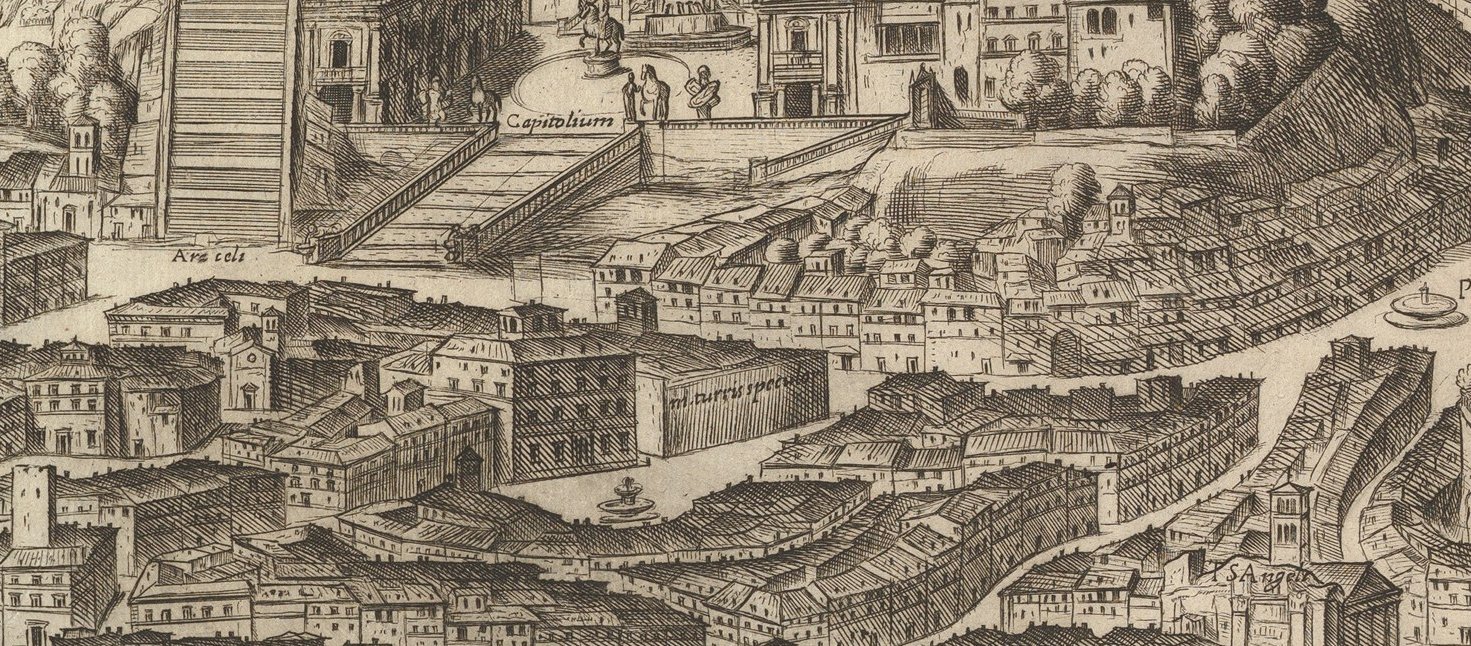
The Tor de' Specchi Monastery, at Via del Teatro di Marcello 32, is not normally visited. It is the cloistered home of the Oblates of Saint Frances of Rome, who have lived in it since 1433 and open it to the public on a single fixed day, March 9, the feast of the foundress. In 2026 entry that day was free, with visits to the oratory and the cell from 9 to 18 and Mass at 10. On other days the main door stays closed.
The complex is at the foot of the Campidoglio, between the Aracoeli staircase and the Theater of Marcellus, in the rione Campitelli. Inside are the oratory with 25 scenes from the life of the saint painted in 1468, attributed to Antoniazzo Romano, the cell where Francesca lived her last years, a frescoed refectory and two superimposed churches. Outside is a long, sober facade, which a great many people pass every day by car or bus without knowing what it hides.
Data checked on September 29, 2026 on the Roma Capitale tourism portal, which publishes the monastery's address, phone and email, on the announcements of the March 9, 2026 opening published by the Roman press and on the pages of cultural associations that organized visits on other dates. The Oblates do not publish an annual calendar of special openings. Anyone who wants certainty about a specific date has to ask the monastery directly, using the contacts given in the box below.
In brief: address, hours, ticket
- Address: Via del Teatro di Marcello 32, Rome, rione Campitelli. The old core has its main door at number 40.
- Operator: the community of the Oblates of Saint Frances of Rome, phone 06 6797135, email oblate@tordespecchi.it.
- How to get in: cloistered monastery, open to the public on March 9. On other dates only with visits organized by cultural associations, by reservation with them.
- Price: on March 9 entry is free. Association visits on other dates are paid, 10-12 euros in the published editions.
- Hours: on March 9, 2026 the oratory and cell could be visited from 9 to 18, Mass at 10. Arrangements for March 9, 2027 not yet published.
- How to get there: on foot from Piazza Venezia along Via del Teatro di Marcello, ATAC lines on the ATAC route planner.
- Accessibility: the information is not published by the operator. The old rooms have stairs and changes of level.
Where it is and what you actually see
The monastery occupies one side of Via del Teatro di Marcello, the broad road that descends from Piazza Venezia toward the Tiber and the Mouth of Truth. Behind it are the slopes of the Campidoglio, with the Capitoline Museums above. In front, across the roadway, is the archaeological area of the Theater of Marcellus. A few minutes' walk to the south, the old Jewish quarter begins with the Portico of Octavia.
From the street you see two entrances. The main door at number 40 leads to the 15th-century core and is topped by an 18th-century fresco with the Madonna and Child between Saint Frances of Rome with the angel and Saint Benedict. The main door at number 32, which opens onto the more recent part, has above it a marble high relief of 1756 signed by the sculptor Andrea Bergondi. They are the only two points where the complex presents itself as a religious place to passersby.
Whoever enters on March 9 follows, according to accounts of recent years, a fairly stable route. You start from the atrium, which was originally a stable and keeps a Roman sarcophagus lid used to distribute charity to the poor. You climb a frescoed staircase to the oratory with the 25 scenes from the life of the saint. Then you pass to Francesca's cell, where garments and objects attributed to her are displayed, and to the refectory decorated in green monochrome.
The modern part, from number 32, has an arcaded courtyard with the coat of arms of Monte Oliveto, the sign of the community's link with the Olivetan Benedictines. In the courtyard are walled-in plaques and fragments that come, according to accounts of the visits, from the church of Santa Maria Liberatrice. From here you reach the two superimposed churches: below, the chapel called Santa Maria de Curte, above, the church of the Annunziata, with a carved wooden ceiling and a floor of polychrome marbles.
The rest of the year from the street you see only a long, plastered facade, with regular windows and a few grilles. Traffic on Via del Teatro di Marcello is constant and the sidewalk is narrow. There is no tourist plaque explaining the building. Anyone who doesn't know what to look for passes in front of the monastery without noticing it, headed for the Campidoglio or the Theater of Marcellus. The contrast between the anonymous exterior and the painted interior is the first thing to keep in mind.
The two churches deserve a separate note. The lower chapel, Santa Maria de Curte, has three aisles with hexagonal pillars and a 17th-century apse with stucco panels. The Roma Capitale portal notes that during Holy Week 17th-century vestments worked with straw inlay are displayed there. The upper church, dedicated to the Annunziata to recall the day of the 1433 inauguration, is dated to 1596 and has a carved ceiling that an announcement of the 2026 feast dates to 1601.
A curiosity about the Tor de' Specchi Monastery
Under each panel of the 25 scenes in the oratory there is a caption in 15th-century Roman vernacular. Not in Latin, as you'd expect in a religious place, but in the language spoken in the city in Francesca's time. They are among the longest texts of old Romanesco still readable on the wall where they were written. Anyone interested in the history of the language finds a direct source here, and whoever doesn't think about it skips them to look at the figures.
The captions served the Oblates and whoever entered the oratory to follow the story of the miracles without needing a book. They describe healings, multiplications of food, visions and the death of the saint, dated precisely to March 9, 1440. The scenes also show houses, garments and streets of mid-15th-century Rome, and for this reason they interest historians of the city as much as art historians. It's a story in images designed to be read up close.
The second curiosity concerns the name. The sources don't agree on the origin of "Specchi." One version ties it to a Specchi family, owners of the medieval tower that gave the area its name. Another connects it to the round shape of the tower's windows. The Roma Capitale portal adds a third hypothesis, the tools for spinning and carding wool used by the neighborhood's craftsmen. The tower no longer exists and none of the three versions can be checked on site.
The third curiosity is the most practical. According to accounts published after the 2025 opening, the monastery has a lemon house, a greenhouse where lemons grow that are offered for sale during visits. It's a minimal detail, but it says a lot about the nature of the place. Tor de' Specchi is not a museum with a bookshop. It is a house lived in by a community that on that day opens its doors and also shows its daily activities, including the vegetable garden.
A fourth curiosity comes from encyclopedic sources and not from the monastery. According to these sources, the Oblates of Tor de' Specchi have the privilege of preparing the papal Agnus Dei, the wax discs with the image of the lamb that the pope blessed during Holy Week. The fact is not confirmed by an official source of the community. If confirmed, it would tie the Oblates' house once again to the liturgical life of the papacy, as well as to the life of the city.
Something nobody tells you about the Tor de' Specchi Monastery
Announcements of the March 9 opening, even those that came out in 2026, often speak of "frescoes by Benozzo Gozzoli." It's an attribution that has circulated for years in the press and on event sites, but the large majority of the sources describing the cycle attribute it to Antoniazzo Romano or his workshop. The Roma Capitale portal is even more cautious and speaks of an anonymous painter, perhaps from the circle of Antoniazzo. The sources, in short, don't agree, and the name of Gozzoli should be taken with caution.
In our judgment the question of the author is overrated. Anyone who enters expecting a masterpiece of the Florentine Renaissance risks disappointment. The scenes are narrative, at times naive, with figures repeating the same gestures. Their value is elsewhere: in the captions in the vernacular, in the details of 15th-century Roman life, in the fact that they tell the story of a saint who died a few decades earlier, with witnesses still alive. Looking at them as a document makes the visit more interesting than looking at them as an author's work.
The other thing almost nobody says is that the monastery is not limited to March 9. Roman cultural associations have organized paid visits on other dates too, for example May 25, 2024 and May 30, 2026. These visits are not advertised by the monastery, they are booked through the association and sell out quickly. March 9 remains the only free opening. The others are restricted occasions, tied to an agreement between the community and whoever organizes them.
Who was Francesca Romana and who are the Oblates?
Francesca Bussa de' Leoni was born in Rome in 1384. The website of the Diocese of Rome relates that at 12 she was given in marriage to Lorenzo de' Ponziani, of a noble family of Trastevere, and that she had three children. Her husband, commander of the papal troops, was gravely wounded in 1409 in the war against Ladislaus of Naples. In 1410 the family home was sacked and the first son taken hostage. Two children died during an epidemic.
Together with her sister-in-law Vannozza, Francesca devoted herself to the poor and the sick of the city. During the plague she opened the family palace to the ill. With her companions she farmed fields near the Basilica of San Paolo to feed those who had nothing. On August 15, 1425, before the altar of the Virgin in the church of Santa Maria Nova in the Forum, she and several women offered themselves to the Madonna. That is the birth certificate of the Oblates.
The Oblates did not take the solemn vows of nuns. They lived according to Benedictine spirituality, tied to the Olivetan monks of Santa Maria Nova, but stayed in contact with the world for works of charity. In March 1433 they came together under a single roof at Tor de' Specchi, and the monastery was inaugurated on March 25, the feast of the Annunciation. Francesca entered it only on March 21, 1436, after her husband's death, and became its superior.
She died on March 9, 1440. According to the broadcaster of the Italian bishops she died in the Ponziani palace in Trastevere, and was buried under the altar of Santa Maria Nova. Paul V canonized her on May 29, 1608. The website of the Diocese of Rome states that in 1950 Pius XII proclaimed her patron saint of motorists, because of the tradition of the angel who guided her on her journeys. The community still exists and Tor de' Specchi is its only house.
The community's name also has a history. The broadcaster of the Italian bishops reports that in 1425 Francesca's companions constituted themselves as Olivetan Oblates of Mary, aggregated to the Benedictine order, and that Eugene IV erected the congregation under the name Oblates of the Most Holy Virgin. Oblata means offered: the woman offered herself to the Madonna without becoming a nun in the strict sense. According to encyclopedic sources, only in 1958 did a decree of John XXIII recognize for the Oblates a canonical status equal to that of religious sisters.
What do the oratory frescoes tell?
The oratory, also called the old church, is a rectangular hall covered by a wooden ceiling with floral motifs. The walls are divided into 25 panels that follow the life and miracles of Francesca. The cycle is dated 1468, that is, 28 years after the saint's death and 140 years before the canonization. It was painted when the memory of the foundress was still alive among those who had known her in person.
The scenes alternate domestic episodes and prodigies. There are healings obtained with ointment, bread and wine that multiply, the dead who return to life, visions, the oblation at Santa Maria Nova and the funeral. In the death scene the caption fixes the hour with the precision of a police report: March 9, 1440, after vespers. It's a way of painting that wants to convince, more than to move.
Next to the oratory is the frescoed staircase, called the Scala Santa, with scenes of the Madonna and of Christ. These paintings too are attributed to Antoniazzo Romano and his workshop. One of the most cited images is the Madonna and Child between Saint Francesca and Saint Benedict, together with Christ rising from the tomb. According to accounts from those who took part in the visits, part of the staircase is seen through interior windows and is not walked in full.
The refectory is the other painted room. The walls have 10 panels in green monochrome, a terretta technique that imitates relief, with the temptations suffered by the saint. The sources don't agree on the date: two visit accounts give 1485, a tourist site speaks of the 17th century, another source places them generically after 1440. The color, a cold and unusual green, is the thing that stays most in the mind of those who see them for the first time.
Anyone who knows the Oratorio del Gonfalone, with its great cycle painted for a confraternity in the 16th century, finds something different here. Not the reception hall of a city confraternity, but a 15th-century story designed for a closed women's community, which had to recognize itself in its foundress. The dimensions are small, the figures are close, and the hall is covered in a few minutes if there's a line behind you.
The cell is the smallest room on the route and the one where devotion is felt most. Francesca lived there from 1436 to 1440, as superior of the community she had founded. The community keeps garments and objects attributed to the saint there, displayed for the feast. There is nothing monumental: walls, a few furnishings, the memory of a noblewoman who had chosen a nun's room. Whoever passes in line has a few seconds, and it's worth knowing beforehand what you're looking at.
My advice for visiting the Tor de' Specchi Monastery
The advice is to go on March 9 in the early hours, at the 9 opening, or in the early afternoon, avoiding the window around the 10 Mass and the lunch hour. The line forms on the sidewalk of Via del Teatro di Marcello, which is narrow and runs alongside traffic. In past years the Roman press has reported long lines in front of the door. In 2027 March 9 falls on a Tuesday, a weekday.
Before entering it's worth knowing what you want to see. The oratory with the 25 scenes is the most important room and the most crowded. The cell is small and is crossed in line. The refectory with the green monochromes is often underrated because it comes at the end of the route, when you're tired. It deserves a few more minutes instead, because the green panels can only be read up close. Always ask at the entrance if photographs are allowed.
If March 9 isn't workable, the alternative is to keep an eye on the visits organized by cultural associations, which in some years have been held in May. They are paid, with earpieces, and have the advantage of an orderly explanation of the frescoes. They have limited places, though, and sell out early. To find out if the monastery has openings planned other than March 9, the right channel remains the phone 06 6797135 or the email oblate@tordespecchi.it.
March 9 is first of all a religious feast. Whoever arrives during the 10 Mass finds the churches occupied by the celebration and the route slower. Church clothing, covered shoulders and a low voice are the rule of common sense. Bring little: big backpacks and wet umbrellas, in the narrow passages of a 15th-century building, become a problem for everyone. If it rains, the line on the sidewalk of Via del Teatro di Marcello has no shelter at all.
How much does it cost and how do you get in?
On March 9 there is nothing to buy and nothing to book: entry is free, you go in in order of arrival and follow the route indicated by the community. On other dates entry is possible only with a visit organized by an association, which sets the price and collects reservations. In the published announcements the cost ranged from 10 euros, plus 2 euros for the earpieces, to 12 euros with earpieces included.
There is no official ticket office of the monastery and no product sold by the big ticket platforms. The operator's reference is the Oblates' website, tordespecchi.it, together with the page on the Roma Capitale tourism portal, which gives the community's phone and email. Be wary of anyone selling an entry ticket for March 9: on that day access is free for everyone.
| Occasion | When | Cost |
|---|---|---|
| Feast of Saint Frances of Rome | March 9, in 2026 from 9 to 18 | free |
| Visits by cultural associations | variable dates, for example May 25, 2024 and May 30, 2026 | 10-12 euros depending on the association |
| Rest of the year | closed, cloistered | not visitable |
For Masses and for any visit conditions different from those of the feast, the Roma Capitale portal refers you directly to the monastery. The information is not published in calendar form. Anyone organizing a visit for a group of friends, a parish or a school must therefore contact the Oblates well in advance and accept that the answer may be no. Cloister is the rule, and the openings are concessions by the community.
Association visits generally follow the same route as the feast, with some extra explanation. The published announcements speak of the oratory, cell, refectory, courtyard, atrium with the manger of the original stable and the two churches, Santa Maria de Curte and the Annunziata. The meeting point is in front of number 32 and the stated duration is about an hour and a half. The earpieces let you follow the explanation without raising your voice in the community's rooms.
Another well-known fact, yet rarely cited
Everyone knows the monastery opens on March 9. Few know that that date has been tied for centuries to papal visits. According to the reconstruction published by the broadcaster of the Italian bishops, it was Innocent X, in 1645, who inaugurated the custom of going to Tor de' Specchi for the feast and celebrating Mass. The custom continued with later popes up to Pius IX, who had to suspend it after the breach of Porta Pia.
The tradition resumed in the 20th century. John XXIII visited the monastery on March 2, 1960, Paul VI on February 12, 1964. On March 9, 2009 Benedict XVI went up to Tor de' Specchi on the day of the feast, 400 years after the canonization, after the meeting with the administrators of the Campidoglio. The address of that visit, published on the Holy See's website, recalls the community's link with the Olivetan monks of Santa Maria Nova and the walls painted with the life of the saint.
The Comune also played a role. According to the same reconstruction, in 1494 the Roman Senate declared the day of Francesca's death a holiday, well before the canonization. The city's cult, therefore, preceded the Church's official recognition by over a century. The fact that Benedict XVI came from the Campidoglio, which stands right above the monastery, repeats that link between the religious community and the civil administration of Rome.
The right photo to take at the Tor de' Specchi Monastery
From the outside the right photo is the portal at number 32 with Andrea Bergondi's high relief of 1756. You shoot it from the opposite sidewalk, toward the Theater of Marcellus, when traffic leaves a gap. The best light comes in the afternoon, when the sun moves west and hits the front facing the Theater of Marcellus. In the morning the facade stays in shadow and the marble of the relief blends into the plaster.
A second outside frame puts together the monastery and its context. Going up a few meters along the street toward Piazza Venezia, you can hold in the same image the Oblates' facade and the arcades of the Theater of Marcellus on the other side of the roadway. It's the photo that best explains where the monastery is and why Via del Mare left it on a traffic front instead of in an alley.
Inside, the rules on photographs are not published by the operator and have to be asked at the entrance. If they're allowed, the most successful subject is a single scene of the oratory with its vernacular caption legible below. Better a sharp detail than a panorama of the hall, which with the crowd and the scarce light almost always comes out muddled. Flash should be avoided anyway, out of respect for the frescoes and for those praying in the churches.
Anyone who loves historical photography can search the Archivio Luce for shots of Via Tor de' Specchi before the demolitions, including one with the flank of the monastery at the intersection with Via Montanara. Redoing the same frame today is impossible, because that street no longer exists. The comparison between the old image and a photo taken from the current sidewalk shows, better than any explanation, how much Via del Mare changed the relationship between the monastery and the city.
How do you get there from the center of Rome?
The simplest way is on foot. From Piazza Venezia you take Via del Teatro di Marcello, leaving the Aracoeli staircase and the Campidoglio's Cordonata on your left. The monastery is a little farther on, on the same side. From Largo Argentina you get there via Via delle Botteghe Oscure. From the Ghetto you go back up from Piazza Campitelli or from the Theater of Marcellus, crossing the street on the crosswalk.
Piazza Venezia is the main bus hub of the center, and Via del Teatro di Marcello is also served by surface lines. Routes and stops change with construction and detours, though, and in the area works have not been lacking for years. To know which bus to take from your starting point, the right source is the ATAC route planner, to be consulted the same day as the visit.
By car it's not worth it. The area is inside the ZTL of the Historic Center and parking is rare. If you come from outside Rome by train, you can get off at Termini and reach Piazza Venezia by bus, or get off at the metro Line B stations near the Circus Maximus and the Colosseum and continue on foot. The walk from the Colosseum along Via dei Fori Imperiali takes about 20 minutes at an easy pace.
From Trastevere you cross Tiber Island on the Cestius and Fabricius bridges, pass beside the Theater of Marcellus and reach the monastery in about 20 minutes on foot. It's the most logical way to tie Tor de' Specchi to the places of Francesca's family life, since she lived for decades in Trastevere with the Ponziani. The route is all flat, except for the short climb of the bridges, and you can also do it on the way back, after the visit, to close the day on the other bank of the Tiber.
Some important events that took place here in history
The first event is the founding. In March 1433 Francesca and her companions gathered in a house near the Specchi tower, and on March 25, the feast of the Annunciation, the monastery was inaugurated. Pope Eugene IV recognized the community the same year. The sources don't agree on the exact day: one places it in March, another gives July 21, 1433 as the date on which the pope erected the congregation. On March 21, 1436 Francesca entered the monastery to live there.
In 1468 the oratory cycle was completed. In 1494 the Roman Senate made March 9 a holiday. On May 29, 1608 the canonization gave the community new prestige, and in the 17th century the Oblates reached 138, mostly daughters of noble Roman families such as the Orsini, the Colonna and the Cenci. In 1645 Innocent X inaugurated the papal visits of March 9. In 1756 Andrea Bergondi sculpted the relief above the portal.
Around the middle of the 18th century the tower that gave the place its name disappeared. The comparison between Giovanni Battista Nolli's map of Rome of 1748 and the present situation, reported by a source on the history of the rione, suggests a demolition around 1750. In 1870, with the end of temporal power, the papal visits stopped. The monastery remained inhabited, with the community continuing its life behind the grilles.
The 20th century changed the space around it. In the years of the Fascist regime Via di Tor de' Specchi disappeared with the opening of Via del Mare, the broad road that was to connect Piazza Venezia with Ostia, later renamed Via del Teatro di Marcello. The Archivio Luce photographs show the old narrow street, with the flank of the monastery at the intersection with Via Montanara, before the demolitions. The monastery survived, but found itself on a through road.
In 1958 John XXIII formally recognized the canonical status of the Oblates, who for five centuries had lived without the traditional vows. The papal visits of 1960, 1964 and 2009 followed. In 2017, according to encyclopedic sources, the community counted six sisters. Today's number is not published, but the March 9 opening continued in 2026 too, a sign that the community keeps the tradition of the feast alive.
Who has passed through the Tor de' Specchi Monastery
The first is naturally Francesca, who lived in the monastery from 1436 to 1440. With her was her sister-in-law Vannozza, companion in works of charity since the years of the marriage. In the following centuries the monastery took in daughters of the most powerful families of Rome. In the 17th century, according to the Roma Capitale portal, they were Orsini, Colonna, Cenci and other names of the patriciate. A cloistered community that was also, in fact, a piece of the city's aristocracy.
The painters passed through. The oratory cycle is attributed to Antoniazzo Romano or his workshop, a Roman painter of the second half of the 15th century, known above all for devotional images. For the Annunciation on the altar in the upper church the sources don't agree: one presents it as a work by Alessandro Allori, a Florentine painter, another as a copy of a painting of his. In the 18th century the sculptor Andrea Bergondi worked for the monastery.
The popes passed through, starting with Innocent X in 1645 and up to Pius IX, then John XXIII in 1960, Paul VI in 1964 and Benedict XVI in 2009. For ordinary Romans, instead, the monastery has been above all the place of March 9. According to tradition, women expecting a child came for the blessing of the ointment and the ribbons, a rite tied to the healings attributed to the saint, which is still repeated on the day of the feast.
Today a great many visitors pass in a single day, Romans and tourists, attracted by the rarity of the opening more than by devotion. For the community it's a demanding day, with the cloister suspended for a few hours. Keeping this in mind helps you visit with the right respect: you enter a house that is lived in, not a museum, and silence in the churches and in the cell is part of the conditions of entry.
Documents, tradition and legend: what can be said?
The documents say few things for certain. Francesca was born in 1384 and died on March 9, 1440. The monastery was inaugurated in 1433 and recognized by Eugene IV. The oratory cycle is dated 1468. The canonization took place on May 29, 1608. The papal visits, from 1645 on, are recorded. On these points the open sources agree, except for the exact day of the papal recognition and the date of the refectory monochromes.
Tradition adds the rest. It is tradition that Francesca saw her guardian angel and that the angel went ahead of her lighting the way. Hence the patronage of motorists, proclaimed in the 20th century. Also tradition is the use of the ointment, prepared according to the community's memory by the saint herself to cure the sick, and the blessing of the ribbons for women in labor. These are practices the monastery preserves, and they should be read as devotion.
Legend lives in the painted miracles. The bread that multiplies, the wine that never runs out, the dead who rise again are told in the frescoes as facts, with captions that give places and witnesses. They were part of the canonization cause, that is, of a procedure that sought to demonstrate holiness. Anyone looking at them today can read them as a devout tale and as a portrait of 15th-century Rome, without having to take them literally.
Between document and tradition also sits the Roman sarcophagus lid kept in the atrium. The Roma Capitale portal states that it served to distribute charity to the poor. The object is ancient and real, the charitable use is what the community has handed down for centuries. It's a good example of how at Tor de' Specchi a piece of ancient Rome, reused as a countertop, became part of the story of the saint and her concern for those who were hungry.
How does the monastery fit into the rione Campitelli?
The monastery belongs to the rione Campitelli, one of the 22 rioni of Rome, which includes the Campidoglio, the Forum and the Palatine. It is a rione that is largely archaeological and institutional, with few residents. The Oblates' complex is one of the rare buildings in the rione that keep from the 15th century the same function and the same inhabitants, a women's religious community that still lives by its rule.
A few meters away you meet the palaces of civic power. Above the monastery are the Palazzo dei Conservatori and the Palazzo Senatorio, seat of the mayor. Toward the river are the Theater of Marcellus, the church of San Nicola in Carcere and farther on the Forum Boarium. The monastery acts as a hinge between the ancient city and the Jewish quarter that begins beyond the Theater of Marcellus.
The link with the rest of the city runs through Francesca's places. Her family home was in Trastevere, the rione where today you visit the Basilica of Santa Cecilia and Santa Maria in Trastevere. She was confirmed in Sant'Agnese in Agone, according to the diocese. Her body is in the church of Santa Maria Nova, at the edge of the Roman Forum, which today bears her name. Whoever follows her traces finds in Tor de' Specchi the center of a route that crosses half of Rome.
Behind the monastery rises the staircase of Santa Maria in Aracoeli, and toward the Ghetto opens Piazza Campitelli with the church of Santa Maria in Campitelli. They are the easiest reference points for getting your bearings when you leave the main door. In a few steps you go from the 15th-century cloister to Michelangelo's Campidoglio, from the silence of the cell to the noise of Piazza Venezia. The density of the center of Rome, where different functions and centuries coexist on the same block, is understood well from right here.
When is it closed and what should you not expect?
The monastery is closed all year, except March 9 and the rare visits arranged with associations. There are no visiting hours for individual visitors, there is no ticket office and you don't get in by ringing at the door. The Roma Capitale portal says to contact the monastery directly for Mass times as well. Showing up without an arrangement on any day means finding the door closed and disturbing a cloistered community.
Even on March 9 not everything is visible. The route covers the historic rooms, that is, atrium, oratory, cell, refectory, courtyard and churches, while the spaces where the Oblates live remain closed. Don't expect panels, audio guides or a ticket office. When there's a line, stopping times are short and explanations are left to each person's preparation, or to whoever takes part in the associations' visits on other dates.
Don't expect the accessibility of a modern museum either. The information on access for people with reduced mobility is not published by the operator, and the 15th-century rooms have stairs, steps and narrow passages. Anyone with particular needs must ask the monastery beforehand, by phone or email. The same caution applies to strollers and big backpacks, which in the cell and the oratory slow everyone down. Better to arrive light.
The most common mistake is confusing the monastery with the church of Santa Francesca Romana, that is, Santa Maria Nova, at the edge of the Roman Forum. The saint's tomb is there, and it is a church with its own hours. Tor de' Specchi is something else: the home of the community Francesca founded, about 10 minutes away on foot. Whoever searches online for the saint's name often finds the two places mixed together, with the church's information attributed to the monastery and vice versa. Before setting out it's worth checking which of the two is being discussed.
Eating in the area
There are few venues around the monastery, because the stretch between Piazza Venezia and the Theater of Marcellus is almost entirely taken up by monuments and offices. To eat you move toward the Ghetto, Piazza Campitelli or Via dei Fori Imperiali. The traps are the typical ones of tourist thoroughfares: the barker on the sidewalk, the menus with photographs of the dishes in four languages, the items with no price and the different menus between the outside board and the menu at the table.
In front of the most photographed monuments there are places that adjust the price to the customer and others open continuously from morning to night, with no kitchen break. Romans avoid them for a practical reason: a kitchen that never stops rarely prepares dishes to order. The same goes for fresh pasta rolled out in the window or prepared in the street as a lure for passersby. It's not snobbery, it's the experience of those who live in the city.
The advice is to move a few streets away from the points of greatest foot traffic, look for a short menu with prices written out and places frequented by residents on weekdays. On March 9, with the line and lunch to fit in, it's worth deciding beforehand where to go. To start from already selected addresses among the Ghetto, Campitelli and Trastevere there is the list of addresses on Google Maps, to be always compared with what you see on site.
What to combine in a day
The most natural pairing is the Campidoglio. From the monastery you climb to Michelangelo's square and visit the Capitoline Museums, which from the terrace of the Tabularium look onto the Forum. Going down the opposite side you reach the Mamertine Prison and the Roman Forum, where the church of Santa Francesca Romana keeps the saint's body. In one day you thus close the circle between the community's house and the foundress's tomb.
The second pairing is the Ghetto. From the monastery you cross the street toward the Theater of Marcellus and enter Via del Portico d'Ottavia. Here are the Jewish Museum with the Synagogue, Piazza Mattei with the Turtle Fountain and the Crypta Balbi. Our page on the Jewish Ghetto of Rome helps put the stops in order.
The third route goes down toward the river. From the monastery you continue along Via del Teatro di Marcello to Santa Maria in Cosmedin with the Mouth of Truth, the Temple of Hercules Victor and San Giorgio al Velabro. Then you cross toward Tiber Island and enter Trastevere, the neighborhood where Francesca lived as a bride.
On March 9 the monastery is a free stop and pairs well with the other no-ticket stops collected on our page on free Rome. Anyone with more time can devote the afternoon to the Palatine Hill or the Circus Maximus, reachable on foot in a quarter of an hour. In the cold season of March the days are still short, and it's best to leave outdoor visits for the middle hours.
Anyone arriving from Piazza Venezia can instead start from the National Museum of Palazzo Venezia and Trajan's Column, then go down Via del Teatro di Marcello to the monastery. It's a short itinerary, suited to a March morning, that lines up the Rome of the Renaissance popes, the imperial one and that of women's religious communities. The descent is flat and the sidewalks, though narrow, are continuous along the whole way.
Frequently asked questions
Can the Tor de' Specchi Monastery be visited all year?
No. It is a cloistered monastery inhabited by the Oblates of Saint Frances of Rome and opens to the public on March 9, the feast of the foundress. On some other dates cultural associations have organized paid visits by reservation, for example in May. The rest of the year the main door stays closed. To ask for information about openings other than the feast, the contacts are the phone 06 6797135 and the email oblate@tordespecchi.it.
How much does entry cost on March 9?
Nothing. On March 9 entry is free, with no reservation. In 2026 the oratory and cell could be visited from 9 to 18, with Mass at 10. You go in in order of arrival, and at peak hours a line forms on the sidewalk of Via del Teatro di Marcello. Visits organized by associations on other dates do have a cost, which in the published announcements ranged between 10 and 12 euros.
When will the next opening be?
The next feast of Saint Frances of Rome falls on Tuesday, March 9, 2027. Hours and arrangements for that day have not been published yet. They are usually announced in the days before by the monastery and the Roman press. For special openings in other months there is no public calendar: it's best to follow the pages of Roman cultural associations and ask the community of the Oblates directly for confirmation.
Who painted the oratory frescoes?
The cycle of 25 scenes, dated 1468, is attributed by most sources to Antoniazzo Romano or his workshop. The Roma Capitale portal speaks of an anonymous painter, perhaps from the circle of Antoniazzo. Some articles cite Benozzo Gozzoli, but it is a minority attribution. The sources don't agree and no signed document settles the question. More certain is the value of the captions in 15th-century Roman vernacular.
What do you see inside the monastery?
The March 9 route includes the atrium, which was a stable, the painted staircase, the oratory with the 25 scenes from the life of the saint, the cell where Francesca lived from 1436 to 1440 with garments and objects attributed to her, the refectory with the green monochromes, the arcaded courtyard and the two superimposed churches. The community's living spaces stay closed. Association visits on other dates last about an hour and a half.
What is the ointment rite?
It is a blessing celebrated on March 9. According to the monastery's tradition, the ointment recalls the one Francesca used to treat the sick, and with it the ribbons intended for women close to giving birth are also blessed. The Roma Capitale portal defines it as an ancient rite. It is a devotional practice of the community, not an attraction, and whoever visits the monastery that day encounters it as part of the feast.
Can you take photographs inside?
The operator does not publish rules on photographs. It's best to ask at the entrance and in any case avoid flash in front of the frescoes and shoot discreetly in the churches and the cell. Outside there are no limits: the portal at number 32 with Andrea Bergondi's relief of 1756 photographs well from the opposite sidewalk, in the afternoon, when the light illuminates the facade.
Is the monastery accessible to people with mobility difficulties?
The information is not published by the operator. The rooms are those of a 15th-century building, with stairs, steps and narrow passages, and the March 9 route runs across several levels. Anyone with reduced mobility must ask the monastery in advance if alternative access exists, by phone at 06 6797135 or by email at oblate@tordespecchi.it, before getting in line.
What is the difference between the monastery and the church of Santa Francesca Romana?
The church of Santa Francesca Romana, also called Santa Maria Nova, is at the edge of the Roman Forum and is the place where the saint's body was buried, under the altar. The Tor de' Specchi Monastery, on Via del Teatro di Marcello, is instead the home of the community Francesca founded in 1433 and where she lived from 1436. The church keeps its own hours, the monastery is cloistered and opens to the public on March 9.
Who wrote this and from what sources
The text comes from the editorial team of Tour Leader Pro, the Roman outfit that designs itineraries, visits and cultural events in Rome and Lazio. Fares, hours and reservation arrangements given here come from the sources cited in the text as of the date indicated at the start: the Roma Capitale tourism portal, the website of the Diocese of Rome, the website of the Holy See, the announcements of the 2026 feast and the pages of the associations that organize visits. Let us know what you find changed.
Organizing a visit to Tor de' Specchi means working with a single fixed date a year, an unpredictable line and no reservation possible for the feast. For anyone who wants to bring friends, a class or a parish, the way is to contact the monastery first or join the associations' visits. For those who organize group trips to Rome, a useful resource is Tour Leader Pro, with materials on planning.
The monastery is one stop of a wider trip to Rome and Lazio, among the rioni of the center, the basilicas, the villas of the Castelli Romani and the villages of the Sabina and the Tuscia. A day in March can combine Tor de' Specchi, the Campidoglio and the Ghetto, but the rest of the region calls for an orderly program and a few more days. A useful resource for putting together a multi-day itinerary is Italy Planner.