Fondi
In short. Fondi can be visited in half a day on foot, and what sets it apart from the other towns of southern Lazio is not the castle: it's the layout.
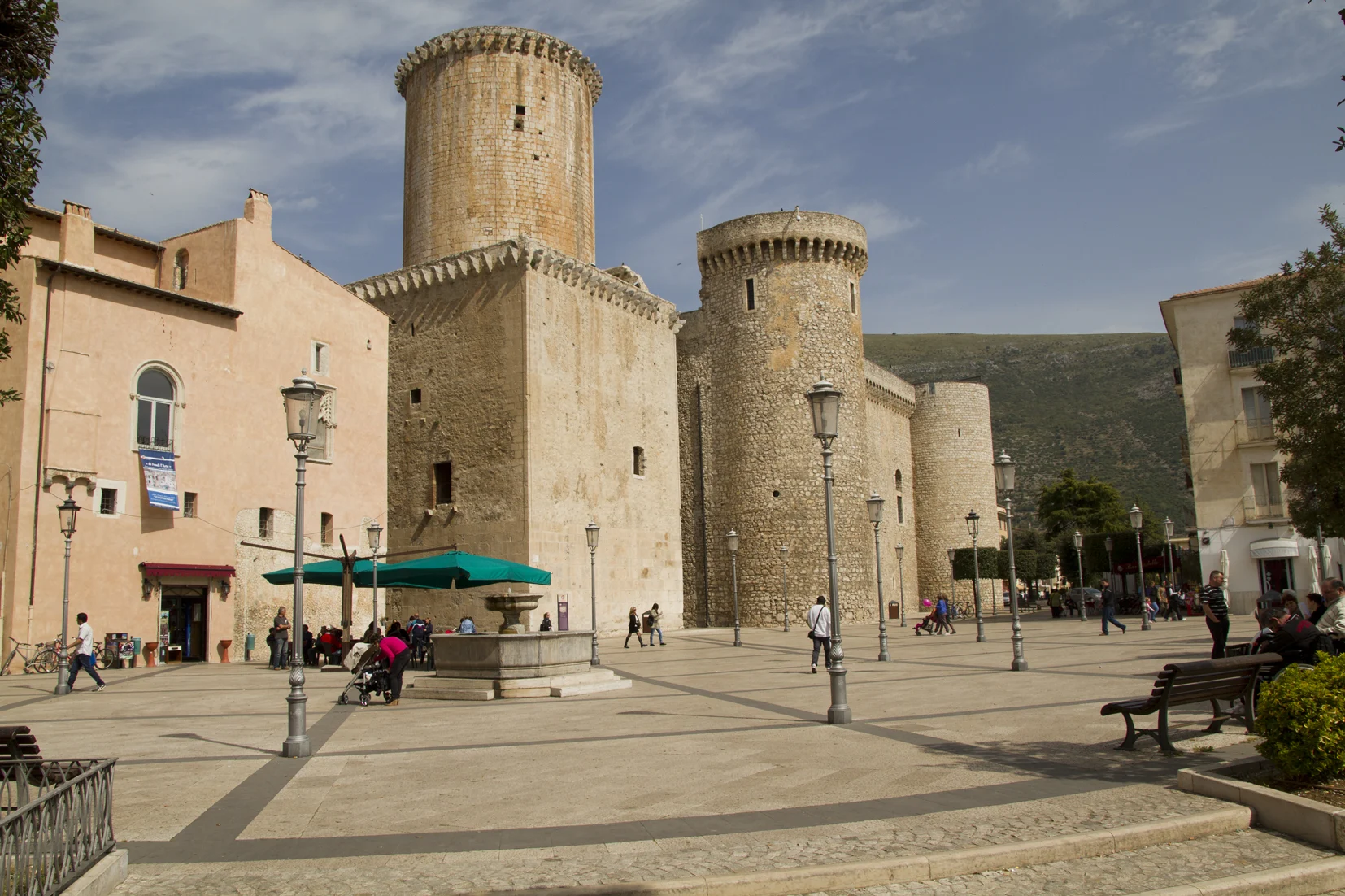
Fondi can be visited in half a day on foot, and what sets it apart from the other towns of southern Lazio is not the castle: it's the layout. The historic center still has the Roman grid, two perpendicular axes inside a quadrangular circuit of walls, and the main decumanus is the urban stretch of Via Appia that comes from Terracina and continues toward Itri. You walk down a small-town street and you're walking inside a land survey from the 3rd century BC.
The rest of the day is taken up by the baronial castle with the cylindrical tower you can see from all over the plain, the Caetani palace next to it, the Giudea quarter and, if you have a car, the coastal lake a few kilometers toward the sea. Plus the story of Giulia Gonzaga and the night of 1534, which they tell you here in novel form and which is best taken apart piece by piece.
Practical data and state of the checks: everything that follows was checked as of September 28, 2026 against the sources indicated in the text. Where an hour or a price isn't published by an official source I can consult, I say so instead of making it up. Fondi is a municipality of just over 40,000 inhabitants in the province of Latina, about 60 kilometers south of the provincial capital and roughly halfway between Rome and Naples.
Fondi in Half a Day: What You Really See
The useful loop takes three and a half hours of slow walking, stops included. You enter from the Porta Roma side, follow the decumanus to the square of the Collegiata that occupies the site of the ancient forum, climb to the castle, go down into the web of alleys toward the Olmo Perino, and come out on the side of Piazza dell'Unità d'Italia where the remains of the Roman baths emerge. That's the perimeter. The rest is countryside, greenhouses and the big fruit and vegetable market.
Anyone arriving expecting a postcard village is thrown off. Fondi is a working farming town, with traffic, rolling shutters and postwar buildings wedged into the ancient fabric, because between September 1943 and May 1944 the town was the end of the Gustav Line and suffered 59 bombings, with 750 civilians killed. What you see today is a stitched-back-together historic center, not one preserved under glass.
The plain around the town is closed on three sides by the Ausoni and Aurunci mountains and open to the south toward the Tyrrhenian. The peaks reach Monte delle Fate, 1,090 meters, and Monte Calvilli, 1,102. Water is plentiful: more than 20 springs and three coastal lakes, Lake Fondi, Lago Lungo and Lake San Puoto. For centuries the abundance of water meant malaria, and the land reclamation was completed only in the first half of the 20th century.
Anyone planning the day from Rome usually pairs Fondi with a second stop. The combinations that work are with Sperlonga, which is a few kilometers away and shares the train station, or with Itri along Via Appia toward the south. If you have the whole day you can push on to Gaeta or Formia.
The Roman Grid Layout, Still Readable
The grid is read by walking, not by looking at the map. The historic center keeps the Roman scheme of two perpendicular axes, decumanus and cardo, enclosed in a quadrangular ring of walls of which wide stretches remain in polygonal masonry and in opus incertum, reinforced by towers from the medieval period. The main decumanus coincides with the urban stretch of Via Appia. The ancient forum corresponds to today's Piazza della Collegiata.
You can touch the polygonal walls on Via Guglielmo Marconi, in the Porta Roma area. They are limestone blocks squared into irregular polygons, the technique that across southern Lazio precedes Roman opus quadratum and has nothing to do with the brick of Rome's Aurelian Walls, described at the Museum of the Walls, and that is found in the acropolises of the Lepini and Ausoni mountains. Anyone who has seen the walls of Priverno or Sermoneta will recognize the building kinship at once.
A second scrap of wall, the so-called Portella, is at the end of Via Vitruvio Vacca and is in opus incertum, so from the 1st century BC: a late rebuild on a much older structure. The street's name recalls Vitruvio Vacco, the local aristocrat who in 330 BC allied with Priverno against Rome and lost. The senators of Fondi convinced the consul Lucio Plauzio Vennone of the city's non-involvement.
Rome punished the leaders of the revolt anyway and sent 350 men off in chains. Fondi remained a prefecture. On the first legal recognition the ancient sources differ: the civitas sine suffragio, that is Roman citizenship without the right to vote, is dated to 338 BC by Livy and to 332 by Velleius Paterculus. Full citizenship came in 188 BC, with a government run by three aediles.
Via Appia changes everything starting in 312 BC. The road linking Rome to Capua, and then to Taranto and Brindisi, runs through the town and makes it a forced passage for traffic toward the South. Anyone who wants to understand how that road corridor worked before getting here will find the picture in the Appia Antica park in Rome, where the paving stones are continuous for kilometers between the Villa of the Quintilii and San Sebastiano.
Outside the walls, north of the gate that faced toward Rome, stood the amphitheater. Part of it re-emerged in 2021, during works along Via Mola della Corte. Don't expect signs or equipped paths. It's an excavation area wedged into the modern urban fabric. Anyone who wants a readable amphitheater has to go elsewhere, for example toward Anzio or toward the big monumental complexes of Lazio, from Tivoli on down.
Along Via Appia toward Itri survives the so-called Muro del Varronianum, in opus reticulatum from the 1st century AD. It was a property boundary wall. In the early 1500s Cardinal Francesco Soderini had it restored, convinced it belonged to a villa of the writer Marco Terenzio Varrone, and the inscription in large capital letters carved into the wall is also attributed to that intervention.
A Curiosity About Fondi
Livia Drusilla, wife of Augustus and mother of Tiberius, was born here according to Suetonius. The report is in the De vita Caesarum and is corroborated by some inscriptions found in the area. In the imperial age part of the Fondi countryside had become imperial domain, plausibly because of the holdings of Livia's family. No birthplace house, no monument: only texts and written stones.
The second curiosity is liquid. From the ager caecubus, the strip of plain between Fondi, Terracina and Formia, came the Caecubum, the red wine that Pliny the Elder places among the best of the empire and that Horace and Martial cite in verse. A Fundanum was also produced, less prestigious. Then the swamp and the malaria ate the vineyards, and for centuries that name survived only in books.
The third fact you wouldn't guess from looking at the alleys: Fondi hosts the second wholesale agri-food distribution center in Europe after Paris, with a volume of around 1,150,000 tons of fruit and vegetables a year. If you arrive at dawn and find lines of refrigerated trucks on the main road, it's not an accident: it's the real economy of the town.
The fourth concerns language. The Fondi dialect belongs to the upper southern group, not to the central group that Romanesco belongs to. The border between the Kingdom of Naples and the Papal States ran through here, and the break can still be heard in speech: a few kilometers apart, the final vowels change and the rhythm of the sentence changes. For a Roman, listening to two people from Fondi argue is already a small trip.
The Baronial Castle and the Tower You Can See From All Over the Plain
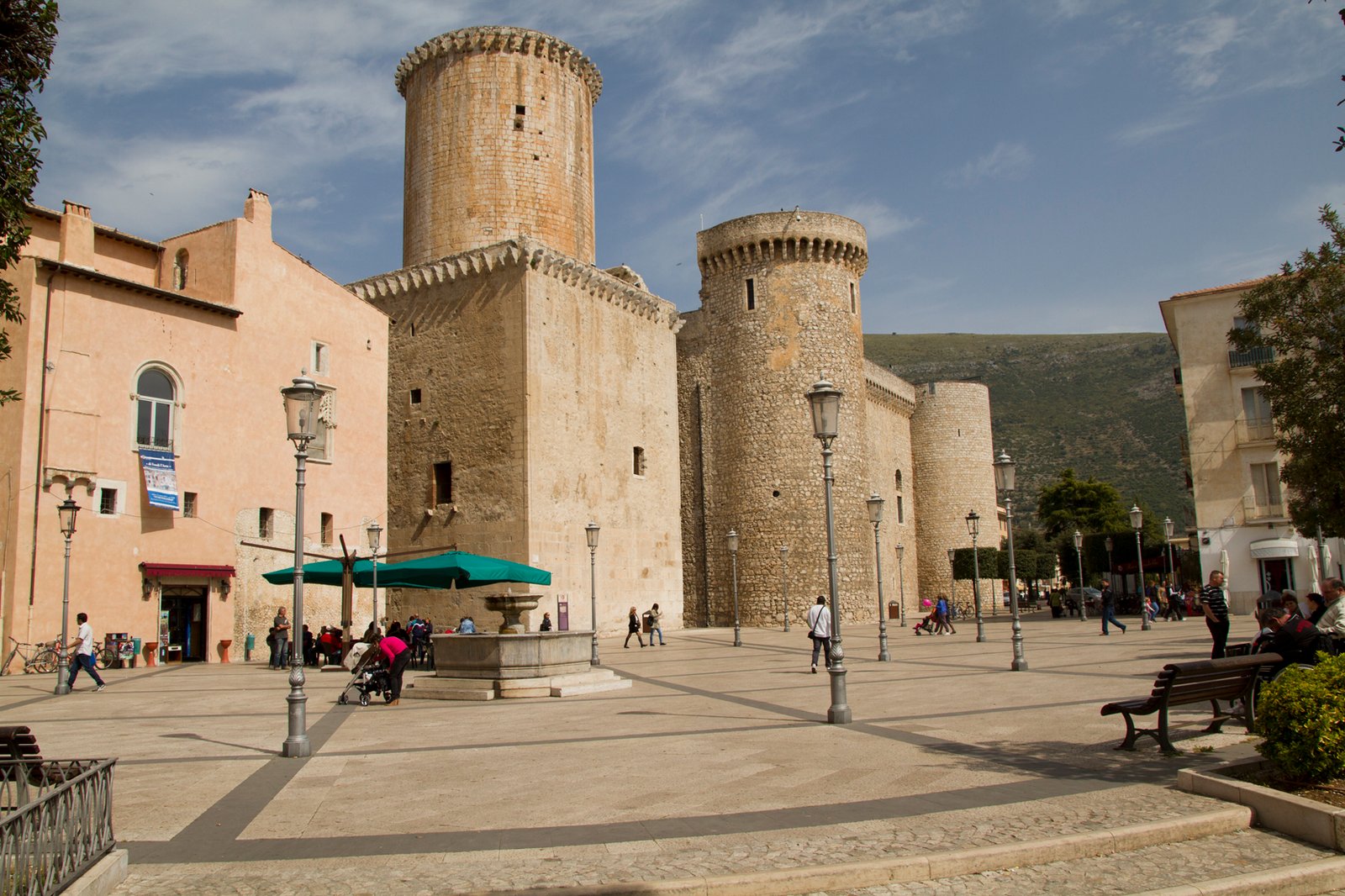
The baronial castle grew by successive additions on top of a stretch of the Roman walls, and it reads well precisely for that reason. The square tower of the keep dates to the 12th century and is the work of the Dell'Aquila, the Norman family the conquerors entrusted with the county created around 1142. On top of that tower, in the second half of the 1400s, the cylindrical tower was raised, which reaches 31 meters.
The Three Corner Towers and the Wooden Bridge
Next to the keep the Caetani built in the 14th century the fortress proper, with three cylindrical corner towers and crenellation. The two structures remain distinct and are connected by a wooden bridge. The distinction isn't a textbook detail: the keep is the tower of last defense, the fortress is the fortified residence, and the bridge was there to cut the connection when the fortress fell.
The Caetani arrived in Fondi in 1299 through a marriage and for about two centuries made it the capital of their Neapolitan fiefs. They are the same family as Pope Boniface VIII, and anyone who has seen the traces of their urban power in Rome finds the feudal and military version here. In Rome the reference is Palazzo Bonifacio VIII, on the Lazio side Sermoneta with its fortress and the Ninfa Garden at its feet. The Caetani pope is that Boniface VIII of the 1300 jubilee, the year Rome filled with pilgrims and the papal fortress of Castel Sant'Angelo guarded the only bridge toward St. Peter's.
The Castle as a Prison
From 1861 to 1931 the complex served as a district jail. In some rooms, before the modern restorations, the graffiti left by the inmates were visible. 70 years of use as a prison explain a lot about the state of the interiors: partition walls, redone plaster, openings closed and reopened. Anyone going in expecting frescoed rooms finds bare walls and recovered volumes instead.
On hours and tickets there's an uncomfortable thing to say. As of September 28, 2026, the official website of the Comune di Fondi can't be reached from the outside and there is no official page available that reliably publishes hours and fares for the baronial castle and the Museo civico. Anyone who wants certainty phones the Comune or the culture office before leaving, and does it a few days ahead, not the same morning.
The practical rule holds for groups and individuals alike: in southern Lazio the openings of municipal sites follow the staff's calendar, not the tourists'. Monday is the worst day. Afternoon slots are the most uncertain. In August and on long holiday weekends extraordinary openings exist but are announced a few days ahead on the Comune's social channels.
The Museo Civico Inside the Fortress
The Museo civico has occupied the fortress with the three towers since 1997. It's the oldest museum in the province of Latina, and here the sources differ on the year of founding: the reference encyclopedia entry gives 1887 in the section on military architecture and 1877 in the one on museums. The question remains open: the available evidence isn't enough to settle it.
The core is archaeological and local: materials from the area, from the pre-Roman phase of the Pianara hill up to the imperial age. It's not a two-hour museum. It's a 40-minute museum that serves above all to give context to what you then walk through in the street, which is exactly why it's best to visit it before the tour of the town and not after.
Anyone arriving after seeing richer collections in southern Lazio has to adjust expectations. The natural comparison is with the Priverno museums, the Frosinone archaeological museum and the Pontine Land Museum, which tell, respectively, the Volscian world, the Hernican world and the 20th-century land reclamation.
The Museo Tesori del Duomo and the Museo del Neorealismo
Fondi has two other museum collections, smaller in size and with even less predictable opening: the Museo tesori del duomo, linked to the church of San Pietro, and the Museo del neorealismo, which exists because De Santis shot two films here. Neither publishes stable hours in a verifiable institutional source as of the date indicated. They have to be asked about case by case.
The Palazzo del Principe, the Thing Visitors Skip
The Caetani palace, which the people of Fondi call the Palazzo del Principe, is the real architectural surprise of the town and almost nobody looks at it. Built in the 14th century, it was renovated by Count Onorato II between 1466 and 1477 by craftsmen who show the influence of the style of the Catalan architect Matteo Forcimanya. Portals, windows, courtyard and loggias mix Angevin, Catalan Gothic and Renaissance elements.
That mix has a precise political meaning. Onorato II governs a border fief of the Kingdom of Naples in years when the Aragonese crown brings Spanish architects and stonecutters to Naples, while a few tens of kilometers away the Papal States speak the Roman Renaissance language. The palace is a snapshot of that bilingualism: Catalan ogee arches and classical cornices in the same courtyard.
Look at the profiles of the windows and the capitals of the loggia. They are the most interesting piece of architectural sculpture in the whole town, more than the castle, and they sit there without panels and without signs. Anyone who has seen the 15th-century cloisters of Lazio, for example at Fossanova, will catch the difference in decorative grammar right away.
In 1378 in this palace Onorato I Caetani hosted the conclave that elected the antipope Clement VII against Urban VI. From there the Western Schism begins, 40 years of double and then triple papacy. Fondi is the physical place where that break takes place, and it's probably the weightiest historical event ever to happen in this town. There is no plaque proportionate to the event.
Something Nobody Tells You About Fondi
The 1378 conclave was not held in the castle, which is what everyone photographs, but in the palace next to it. The distinction always gets lost in local tellings, and I understand why: the cylindrical tower is the symbol of the town, the palace is a building that from the street looks like an old apartment block. The result is that visitors photograph the wrong place.
Second thing nobody says: the Roman walls of Fondi are not a fenced-off monument, they are somebody's house wall. The stretches in polygonal masonry are built into inhabited buildings, with windows opened above the ancient blocks and electric cables running across them. It's not decay, it's ordinary layering, and it's the way real towns have always treated their walls.
Third. The church of San Martino contains the remains of a Roman domus. No equipped archaeological route, though. It's a parish church with an ancient basement, and access depends on the availability of whoever opens it. Anyone traveling in a group must ask in writing weeks ahead, and even so the answer can be no, with no explanation.
Fourth, and it applies to the whole plain. The three coastal lakes of Fondi are not freshwater lakes. They communicate with the sea and the tides bring salt water in, so the ecosystem is brackish and changes from hour to hour. Anyone arriving with the model of Lazio's volcanic lakes in mind needs to reset expectations: the close relative of Lake Fondi is rather Lake Fogliano, inside the Circeo National Park.
The Giudea and What Remains of the Jewish Community
The Giudea of Fondi is a neighborhood, not a monument, and it's in the historic fabric of the Olmo Perino. It keeps its original structure: closed courtyards, covered passages, external staircases, houses leaning against each other. There are no surviving synagogues, no Hebrew inscriptions visible on facades, no marked route. There is a surviving urban layout, and for those who know how to read it, that's enough.
What Is Documented About the Jewish Presence
The Jewish presence in Fondi is attested from the Roman age to the mid-1500s. The oldest traces are two funerary inscriptions from the Roman period. After a very long documentary silence, the community reappears in the archives in 1280. In the 1300s one of the main activities of the Jews of Fondi was cloth dyeing, a technical and profitable trade that required running water in quantity.
At the end of the 1300s a group of Jews lived near the church of Santa Maria Assunta, so very close to the town's main square and not on the outskirts. It's a fact that contradicts the image of the segregated ghetto: Jewish urban segregation in Italy is a 1500s phenomenon, and in Rome it begins with the 1555 bull establishing the ghetto.
In the early 1500s the community counted 13 families, about 80 people. In 1511, the year of the first expulsion decree against the Jews of the Kingdom of Naples, they had fallen to three families. The last Jews of Fondi lived in the quarter called Giudea, near the square of the Olmo Perino, before the final migration of 1541. That's 30 years of expulsions in stages, not a single decree.
The Museo del Medioevo Ebraico
The Museo del Medioevo ebraico was inaugurated in 2016 in the so-called Casa degli spiriti, a building from between the 1700s and 1800s adjacent to the courtyard of the Giudea. It's the only museum facility dedicated to the history of the Jews in the province of Latina. For this museum too, as of September 28, 2026, no stable opening calendar with fares is published in a source I can consult.
Anyone who wants the comparison with the Roman case, which is documented incomparably more richly, will find the picture at the Jewish Museum of Rome and in the archaeological area of the Portico of Octavia, which is the physical boundary of the Roman ghetto. The comparison helps you grasp how little we know about the smaller communities of the Kingdom of Naples.
Giulia Gonzaga and the Night of August 1534
The story they'll tell you goes like this: the corsair Barbarossa lands at night, heads for the castle to kidnap the beautiful countess and give her to the sultan, she flees half-dressed on horseback and is saved. Half of this story holds up against the sources, half doesn't. It's best to separate the two levels, because the documented part is more interesting than the novelized part.
Who Giulia Gonzaga Was
Giulia Gonzaga was probably born in 1513 in Gazzuolo, near Mantua, to Ludovico Gonzaga and Francesca Fieschi. She was given in marriage to Vespasiano Colonna, Count of Fondi, when she was 13, with a dowry of 12,000 ducats. On the date of the marriage the sources differ: the Dizionario Biografico degli Italiani gives July 25, 1526, while the current encyclopedia entry says, generically, August 1526.
Vespasiano Colonna was more than 30 years older than she was and in poor physical condition. He died on March 13, 1528, leaving her a widow at 15. His will assigned her the fiefs on condition that she remain a widow: a new marriage would have transferred everything to his stepdaughter Isabella. It's a clause that explains many of Giulia's later choices better than any romantic legend.
From 1528 to 1535 she lived in her own county of Fondi. She became famous for her beauty and was cited by poets, Ludovico Ariosto included. A small intellectual circle formed around her, frequented among others by Vittoria Colonna and Sebastiano del Piombo. Her relationship with the Spaniard Juan de Valdés, which would mark the rest of her life, came later.
What the Record Shows About the Raid
The fact the sources agree in treating as having happened is the landing. Khayr al-Din, called Barbarossa, regent of Algiers, landed near Gaeta in August 1534. Fondi and Sperlonga were sacked, Itri held out. The current encyclopedia entry places the attack on the night between August 8 and 9. The Dizionario Biografico says only August without specifying the day.
The second documented fact is the failure of the attempt on Giulia: the sources of the time say the corsair tried in vain to kidnap the young countess. The third is the long-term effect. The 1534 sack caused the decline of the town, and within a few decades the crisis was made worse by the malaria epidemic of the early 1600s, which reduced the population from about 2,000 to 332.
What Is Instead Story
The supposed plan to hand Giulia over as a gift to Sultan Suleiman the Magnificent is interpretive tradition, not document. It serves to give a novelistic motive to an operation that had ordinary motives: Barbary raids on the Tyrrhenian coasts aimed at loot and prisoners to ransom, and Fondi was rich and poorly defended. A countess would have been a valuable hostage anyway.
The flight in scanty clothing toward Campodimele belongs to the same register. It appears in the tradition and has been repeated for centuries, but the nightgown detail is exactly the kind of particular that literature adds and documents don't record. That Giulia got to safety in the mountains is plausible: Campodimele clings to a ridge and was the natural refuge.
Then there's the insinuation, already circulating at the time, that the Colonna had solicited the kidnapping in order to regain possession of the estates. This too remains insinuation. But Vespasiano's will clause must be kept in mind: in the property dispute between Giulia and her husband's family there was a real economic motive, and in a century of poisons malicious gossip had material to work with.
After Fondi
In December 1535 Giulia moved to Naples, to the convent of San Francesco delle Monache, keeping her lay status. Between June and September of that year she had met Juan de Valdés for the first time and had joined his reformist circle. That, and not the corsair, was the turning point of her life: it put her in the sights of the Roman Inquisition for 30 years.
On the date of her death the sources differ by three days: the Dizionario Biografico degli Italiani gives April 19, 1566, the current encyclopedia entry April 16, 1566. They agree on everything else, including what followed: Pope Pius V, once he learned the news, ordered her papers seized. Whoever wanted the posthumous trial knew what they were looking for.
The reference 19th-century bibliography remains the volume by Bruto Amante, Giulia Gonzaga contessa di Fondi, published in 1896 and still cited today in scholarly apparatus. It's a late 19th-century book, with everything that implies in terms of narrative slant: many of the images circulating about Giulia, the flight one included, pass through there before reaching the brochures.
My Advice for Visiting Fondi
Call ahead. It's not generic advice: in Fondi the castle, the Museo civico and the Jewish museum don't publish a stable, verifiable calendar online, and anyone who arrives without calling risks finding everything closed and limiting themselves to the outside loop. The number to look for is that of the Comune's culture office, and it's best to call two or three days ahead.
Go in the morning, and go on a Saturday. The morning because in the farming towns of southern Lazio life concentrates before noon and the historic center empties out after 14:00. Saturday because it's the day with the best chance of finding things open and people available. Monday is the worst day in the whole province.
Wear real walking shoes. The historic center is largely cobblestones and irregular paving stones, with continuous level changes between the street and the inner courtyards. The full route is about three kilometers, which seems like nothing and on that surface isn't. Anyone with ankle problems should cut the loop down to the stretch on the decumanus.
Pair Fondi with just one other thing, not three. The typical mistake of people coming down from Lazio is to plan Fondi, Sperlonga, Terracina and Gaeta in the same day. You end up driving for six hours and seeing four parking lots. A town and a lake, or a town and a beach: that's the right load for one day.
If you come in summer, move the town tour to dawn or late afternoon. The plain of Fondi is closed in by mountains on three sides and in July and August the sultry heat stagnates, with high humidity and little wind. The middle hours are spent at the lake or on the coast, not among the alleys. Anyone leading groups of older people should take this seriously.
Lake Fondi and How to Get There
Lake Fondi is shaped like a crescent moon with the tips pointing toward the sea, which is a few kilometers away. The surface is around 380 hectares, a little under four square kilometers. The average depth is about nine meters, the maximum exceeds 21. The water surface sits just about 30 centimeters above sea level.
Two canals connect it to the Tyrrhenian, the Sant'Anastasia and the Canneto. Through those canals the tides bring in salt water, and the alternation between fresh and salt defines everything else: which fish live in it, which plants grow on the shores, why the color of the water changes from one hour to the next. A brackish coastal lake works more like a lagoon than like a lake.
Fauna, Flora and Protection
On the shores you can count about 80 wild plant species, among them rare ferns like Osmunda regalis and the marsh vegetation typical of southern Lazio. Among the birds you can see gray herons, mallards, cormorants and migratory ducks. In the water there are carp, eels and above all the thinlip mullet, which has a weight in local cooking that nobody in Rome imagines.
The lake has been a natural monument since 2006 and now falls within the Monti Ausoni e Lago di Fondi Regional Natural Park. Protection came after decades of eutrophication caused by urban discharges and pesticides from the farming plain, and the recovery work has produced results. Anyone arriving thinking of crystal-clear water has the wrong genre: it's a lagoon environment, murky by nature.
Access Points
Access to the lake is by farm roads and dirt tracks leaving from the plain, not an equipped lakefront. There are no ticket offices, no continuous walkways, no visitor center open at fixed hours. Anyone arriving by car parks where they can and continues on foot. Anyone looking for an organized experience must turn to the regional park or the area's environmental guides.
The right time for the lake is between October and March, when the migratory birds arrive and the low light works well. In summer the lake is hot, the water stagnates and mosquitoes are a real problem. Anyone who wants better-equipped wetlands in Lazio will find marked trails at Circeo, along the Rio Martino canal, under the promontory of San Felice and in the Torre Astura grove.
The coast of Fondi deserves a paragraph of its own. It's a strip of dunes between Terracina and Sperlonga, with long stretches of beach and few beach clubs compared with the rest of the Pontine coast. Anyone who has in mind the equipped coast of Latina or the coves of Sant'Agostino at Gaeta finds something barer and windier here, closer to the character of Torre Paola at Sabaudia or of Fontana at Sperlonga.
Another Well-Known Fact, Yet Rarely Cited
Alberto Moravia and Elsa Morante hid in this area. Fleeing the racial laws and then the German occupation, they found shelter in the farmhouses Mosillo and Marrocco, on the slopes above the plain. On the farmhouse that sheltered them there is a plaque of the Civic Righteous. From those months spent among the shepherds comes the material of La Ciociara, published in 1957.
The detail lost in the summaries is geographic. La Ciociara, in the title and in the imagination, points to Ciociaria, that is the hinterland of Frosinone. The real places of the flight are instead here, on the border between the Ausoni and Aurunci, in the province of Latina. The novel moved the geography for reasons of sound, and the public followed the title instead of the facts.
Fondi also appears in three films. Giuseppe De Santis set Non c’è pace tra gli ulivi and Giorni d’amore here, in the neorealism years, when the plain was still shepherding and misery. Michela Andreozzi shot Brave ragazze here many decades later. The town’s Museo del neorealismo comes out of exactly this cinematic legacy.
The hardest chapter of recent history concerns May 1944. On May 18, and for the following 50 hours, French and Moroccan troops were responsible in Fondi, as in other towns of southern Lazio, for mass violence against the civilian population. The term used for those events is marocchinate. In 1998 the town received the silver medal for civil valor.
How to Get There From Rome and How Long It Takes
Public transport means the train to the Fondi-Sperlonga station, on the Rome-Formia-Naples line. The station is served by regional trains of the FL7 line and has a café, parking and elevators. It's a station that serves two municipalities, Fondi and Sperlonga, and it isn't in the center of either: from the platform to the historic center of Fondi you need a second vehicle.
The local connection exists and is documented: the station has an interchange with the Piazzoli city bus stop. The line number, frequencies and hours of that service are not published, as of September 28, 2026, in an official source I can cite: they have to be asked of the operator. They have to be asked of the Comune or checked at the station.
For bus connections from Lazio the reference is Cotral, which covers the province of Latina with intercity lines and provides a timetable search on its website and a toll-free number. Schedules change between the school period and summer, and on these routes the calendar change in September and in June shifts entire runs. Check the week of your departure.
By car from Rome the natural road is State Road 7 Via Appia, which enters the town and forms its decumanus. From the coast you arrive on Regional Road 213 Flacca, which links Terracina to Formia passing above Sperlonga, and is one of the scenic roads of the Tyrrhenian. Toward the interior, State Road 637 leaves for Lenola and the Amaseno valley.
The real travel time depends on farm traffic. During the hours when the fruit and vegetable market is moving goods, State Road 7 near the town clogs with heavy vehicles, and what on paper is a 20-minute stretch becomes 40. Anyone with a train to catch on the way back should allow a margin, because the station is outside the town.
For anyone building a wider itinerary, southern Lazio can be covered entirely along the Appian axis: from Fondi heading south you meet Itri, Formia and Minturno, and farther inland Santi Cosma e Damiano and the Garigliano plain toward Cassino and the Montecassino abbey.
Toward the mountain interior, from the state road to Lenola you climb to the ridge villages. Lenola and Campodimele sit between 400 and 600 meters of elevation, inside the perimeter of the Aurunci Mountains, and the regional natural park manages marked trails that start right there.
The Right Photo to Take in Fondi
The photo that works isn't the castle from the front. It's the cylindrical tower shot from below, from a narrow alley of the historic center, with laundry hanging and plastered facades closing the frame on both sides. The tower rises above ordinary roofs, and that contrast between fortress and small-town house says far more about the town than a clean frontal shot.
The right hour is the first of a winter morning or the last before sunset. The local stone is light gray and burns out at noon, while with raking light the textures come out: the polygonal blocks of the walls, the ashlars of the tower, the cornices of the Caetani palace. If you shoot digital, expose for the highlights and recover the shadows afterward.
The Second Photo
The second shot is inside the Giudea, in the courtyard of the Olmo Perino. You need the wide-angle, because the spaces are very tight and the houses touch. Look for the play of the external stairs and the passage arches. Don't photograph the windows of private homes up close: people live here, and in Fondi they point it out more bluntly than in Rome.
The Third Photo
At the lake the good image is at autumn dawn with low fog and the Ausoni mountains in the background. You need the telephoto to compress the planes and you need patience: the fog lifts in 20 minutes. If you want the birds, bring at least a 300 millimeter lens and shoot against the raking light, without getting close to the reed beds where they nest.
A note on the castle from above. Drones over inhabited areas and over protected areas are subject to precise rules and bans, and the lake falls within a regional park. Before lifting anything off the ground, check the zones and authorizations on the channels of the national civil aviation authority. The land-based alternative is the climb toward the sanctuary of the Madonna della Rocca.
Some Important Events That Happened Here in History
In 338 BC according to Livy, in 332 according to Velleius Paterculus, Fondi receives Roman citizenship without voting rights, together with Formia. It's the entry into the Roman system. In 330 the revolt of Vitruvio Vacco together with Priverno ends with the execution of the leaders and with 350 men sent in chains to Rome. In 188 full citizenship arrives.
In 915 Pope John X formally donates the town to the hypatus John, son of Docibilis I, founder of the Duchy of Gaeta. For a few decades Fondi is part of the Duchy of Gaeta, then from 984 to 1140 it is the center of an autonomous entity, the Duchy of Fondi, ruled by a cadet branch of the Docibilids. In 1130 the Normans annex the area to the Kingdom of Sicily.
Around 1142 the Normans create the County of Fondi and grant it to the Dell’Aquila. In 1299, through marriage, the county passes to the Caetani, who for two centuries make it the capital of their Neapolitan fiefs and fill it with building sites. It's the period when Fondi becomes a city of art, and almost everything you see today belongs to that season.
In 1378 the conclave hosted in the Caetani palace elects the antipope Clement VII and opens the Western Schism. In August 1534 the raid of Khayr al-Din Barbarossa sacks the town and marks its decline. In the early 1600s a malaria epidemic, fed by the spreading marshes, reduces the population from about 2,000 inhabitants to 332.
In 1861 Fondi enters the Kingdom of Italy, remaining in the province of Terra di Lavoro. In 1927 the Fascist reorganization abolishes that province and assigns the town first to Frosinone and then to Rome. In 1934 the province of Littoria is born, today Latina, and Fondi joins it together with Itri, Sperlonga, Formia, Gaeta and the other municipalities of the former district of Gaeta.
Between 1926 and 1937 the reclamation works change the face of the plain and defeat malaria. Between September 1943 and May 1944 the German occupation and the Gustav Line bring 59 bombings and 750 civilians killed. In May 1944 comes the mass violence of the colonial troops. In 1998 the town receives the silver medal for civil valor.
Who Passed Through Fondi
Livia Drusilla, if you follow Suetonius, was born here. Horace, Martial and Pliny the Elder wrote about it because of the wine of the ager caecubus, and Horace really did pass along the Appia, on the journey to Brindisi told in the Satires. Anyone who traveled the consular road toward the South in Roman times passed through here, because there were no comfortable alternatives.
The Caetani were here for two centuries. Onorato I hosted the schismatic conclave of 1378, Onorato II was the patron who between 1466 and 1477 redid the palace and rebuilt the church of Santa Maria in Piazza from scratch. Count Cristoforo Caetani has his 15th-century tomb in the church of San Pietro. The family left more works here than in its Lazio fiefs.
Giulia Gonzaga held court here from 1528 to 1535, and Vittoria Colonna and Sebastiano del Piombo passed through her circle. Cardinal Francesco Soderini, in the early 1500s, had the Roman wall on the Appia restored believing it to be Varro’s. Antoniazzo Romano and Cristoforo Scacco worked for the church of San Pietro, where their paintings still are.
In the 20th century Alberto Moravia and Elsa Morante passed through, hidden in the farmhouses above the plain, and Giuseppe De Santis, who shot two films here. For anyone who wants to follow the Roman thread of these presences, the starting point is the churches of Antoniazzo in the city and the rooms of the Galleria Colonna, which is the home of the family of Giulia’s husband.
A Contrarian Position on Fondi
The castle of Fondi is overrated and the town knows it. The cylindrical tower works as a logo, ends up on every brochure and attracts the visitor who then, inside, finds largely bare rooms, the result of 70 years of use as a prison and of necessary but cold restorations. If someone tells you Fondi is visited for the castle, they are steering you toward disappointment.
What's worth the trip is the urban fabric, and it has no ticket office. The Roman grid still readable, the polygonal walls built into inhabited houses, the courtyard of the Caetani palace with its Catalan arches, the closed courts of the Giudea: that's four free things, always accessible, and none of the four makes the cover of the promotional materials.
I'll add the part people around here don't like hearing. The story of Giulia Gonzaga is sold as the main attraction and in the form in which it circulates it is half 19th-century literature. Continuing to tell the flight on horseback in a nightgown as historical fact takes space away from a more solid and more singular story, that of a woman who at 22 leaves the fief and spends 30 years under inquisitorial surveillance for religious reasons.
One last uncomfortable position, on logistics. Fondi is not a day trip from Rome by public transport, however much some people sell it as one. Between the train, an undocumented city connection, openings that aren't guaranteed and the evening return, the math doesn't work. With a car it does, and paired with a second nearby destination. Without a car it's best to sleep over one night or give it up.
Eating in the Area
The first criterion in Fondi is dictated by agriculture. This is the plain that supplies half of Italy with vegetables and the buffalo mozzarella area, so the baseline level of raw ingredients is high and whoever cooks badly does it by choice, not for lack of material. What to look for are seasonal vegetables, lake fish and the citrus of the old citrus-grove vocation.
The warning signs are the same everywhere, but here you see them mostly on the coast and on the Flacca. A menu with photographs of the dishes means they don't want the customer to read the text, so the text isn't the point. A person at the entrance inviting you to sit down means the dining room doesn't fill by itself and has to be filled by hand.
The lady rolling out pasta dough behind the glass or even on the sidewalk is theatrical staging. It works wonderfully in photographs and says nothing about the real cooking, which happens in back, where nobody looks. In tourist towns the scenic draw and the quality of the dish run on separate tracks, and often in opposite directions.
Be wary of the place that stays open from morning to the middle of the night without ever closing the kitchen. A real kitchen has a break between lunch and dinner because the staff has to clean, restock and prep. A sign that serves at any hour is working with ready-made products to be reheated, and it's a legitimate model but not the one you travel for.
On the seafront and in front of the most photographed spots, pricing adapted to the customer is at work. The symptoms are the item with no price on the menu, fish sold by weight without anyone showing you the scale, and two different price lists for inside and outside. Ask the price first, out loud, and ask to see the whole fish. Anyone working honestly doesn't take offense.
In the center of Rome, and by now in the popular coastal towns too, repeated signs have appeared, the ones you find identical in five different cities. It's not a moral problem: they work as tourist attractions in their own right, with the line out front and the standardized product. Romans simply don't go because they eat something else and pay less for it. Knowing what you're buying is enough.
There's just one criterion and it almost never fails: look at who is sitting at the tables and in what language they order. If at two on a Tuesday in November the dining room is full of locals who don't look at the menu because they know it by heart, you're in the right place. If at noon in August there are only foreigners with backpacks, you're not.
For anyone who wants an already filtered starting point, the recommended addresses are collected in a public list on Google Maps. It's a list I update when something changes and from which I remove addresses as soon as they expire, which in this business happens more often than you'd think.
What You Can't See, and When It's Closed
You can no longer see Giuseppe Quinto's sculpture dedicated to Giulia Gonzaga. The Serenata a Giulia Gonzaga, made in 1971, stood in the upper basin of the monumental fountain in Piazza dell’Unità d’Italia and was stolen in the late 1970s. The fountain is still there, the upper basin too, the sculpture isn't. Nobody will tell you this on the spot.
You can't see the Roman amphitheater, except as a scrap of excavation along Via Mola della Corte, which re-emerged in 2021. You can't visit the ruins of the minor churches scattered across the area, from the rock-cut church of San Pancrazio with the hermitage cave to that of Sant’Angelo del Peschio: they are ruins in the countryside, with no routes and no custodian.
Access to the basement of the church of San Martino with the remains of the Roman domus isn't guaranteed, and depends on the parish. There is no visiting route for the polygonal walls, which are walls of private buildings. The 15th-century coffered ceiling that adorned the central nave of Santa Maria in Piazza, the work of master Giacomo Pignetore, no longer exists in its entirety.
On closing days the honest answer is that there is no institutional source I can consult, as of September 28, 2026, that publishes the opening calendar of the baronial castle, the Museo civico, the Museo del Medioevo ebraico, the Museo tesori del duomo and the Museo del neorealismo. Anyone who writes otherwise elsewhere is copying old data.
The churches follow the parish rhythm: open for services, closed in the afternoon, with hours that change between summer and winter. San Pietro, which contains the Cosmatesque pulpit of the 1200s, the marble episcopal chair, the painted wooden cross of the 11th century and the paintings of Antoniazzo Romano and Cristoforo Scacco, is the church to press on when you phone.
The dates of the feasts, on the other hand, are stable and I list them because they change the town. Sant’Onorato, patron saint, on October 10, with the town fair. San Rocco on August 16. The Madonna del Cielo on June 7. The Palio dell’Assunta in August, since 2011. And a procession every 25 years with the 17th-century statue of the Madonna del Cielo, the last in 2004.
Frequently Asked Questions
How Much Time Do You Need to Visit Fondi?
Half a day is enough for the historic center. The full walking loop covers about three kilometers and takes three and a half hours with stops. Adding the Museo civico brings it to four and a half hours. The lake and the coastal strip require a car and another two or three hours, so the full day is needed only if you also want to cover the plain.
Can You Get to Fondi by Train From Rome?
The station is Fondi-Sperlonga, on the Rome-Formia-Naples line, served by the FL7 regional trains. The station isn't in the center and you need a second vehicle to reach the historic center: an interchange with the Piazzoli city bus stop is documented, but the line number and frequencies are not published in an official source I can consult and have to be asked about on the spot.
How Much Does It Cost to Enter the Baronial Castle?
The fare is not published, as of September 28, 2026, in an institutional source that can be consulted from the outside. The website of the Comune di Fondi doesn't respond to requests and third-party pages report data that can't be dated. Anyone who wants a reliable number phones the Comune’s culture office a few days ahead. Be wary of prices you find on travel portals with no update date.
What Remains of the Giudea of Fondi?
What remains is the urban layout of the Olmo Perino quarter, with its original structure of courtyards, passages and external stairs. There are no surviving synagogues. The community, attested from the Roman age, counted 13 families in the early 1500s, three in 1511 after the first expulsion decree from the Kingdom of Naples, and left Fondi for good in 1541. The Museo del Medioevo ebraico, opened in 2016, tells its history.
Is the Story of Giulia Gonzaga and Barbarossa True?
In part. The landing of Khayr al-Din near Gaeta in August 1534, the sack of Fondi and Sperlonga and the failed attempt to capture the countess are attested by the sources of the time. The plan to hand her over as a gift to Sultan Suleiman, the flight on horseback in scanty clothing and the alleged commission by the Colonna belong instead to the narrative tradition, not to the documents.
Can You Swim in Lake Fondi?
The lake is a brackish lagoon environment, murky by nature, protected as a natural monument since 2006 and included in the Monti Ausoni e Lago di Fondi Regional Natural Park. It's not an equipped swimming lake and the shores are largely reed beds. For swimming you move to the coast, which is a few kilometers away, among the dunes toward Terracina and toward Sperlonga.
Is Fondi Good for Kids?
The historic center works well as a short stroll, with the tower that kids recognize from afar, but there are no educational routes or dedicated activities. The cobblestone surface makes a stroller hard work. The lake and the dune strip, in autumn and spring, are the part kids remember: open space, birds and no traffic.
Is It Better to Sleep in Fondi or on the Coast?
Anyone traveling without a car sleeps in Fondi, because the historic center is walkable and in the evening there's small-town life. Anyone with a car who comes in summer sleeps on the coast, between Sperlonga and Terracina, and reaches Fondi in 20 minutes. In July and August coastal prices go up a lot and the interior remains the economically sensible choice.
What Is Typical to Eat in Fondi?
The plain produces vegetables in quantity and the area is buffalo mozzarella country, so the register is vegetable and dairy. From the lake comes the thinlip mullet, which has a precise role in local cooking and which you don't find in Rome. The old citrus-grove vocation survives in sweets and preserves. The wine of the coastal strip descends from the ager caecubus celebrated by Pliny.
Who Wrote This Page
The page is curated by the editorial team of Tour Leader Pro, which in Rome designs and coordinates visits, itineraries and cultural events in Lazio. The dates, attributions and practical data reported here were checked, as of the date indicated in the text, against the sources cited. Where an official source doesn't exist or can't be reached, we say so: we prefer a missing fact to an invented one.
Anyone who has to build an itinerary in southern Lazio runs into problems that don't exist in Rome: municipal sites with no published calendar, churches run by parishes and not by tourism bodies, train stations far from the towns and bus connections that change with the school calendar. Tools and materials for planning this kind of day can be found on Tour Leader Pro, designed both for those who lead groups and for those who organize on their own.
For the big picture on regional trains, rentals, airports and destinations in Lazio outside Rome, from the Pontine coast to the lakes to the villages of the interior, the resource to keep open is Italy Planner, which lines up real distances, times and connections.