Fondazione Memmo
In short. Fondazione Memmo is open, with free entry, at Via della Fontanella di Borghese 56b, in the spaces of the Scuderie di Palazzo Ruspoli, a few steps from Via del Corso.
Fondazione Memmo is open, with free entry, at Via della Fontanella di Borghese 56b, in the spaces of the Scuderie di Palazzo Ruspoli, a few steps from Via del Corso. According to the official website, the current exhibition, Like Flowers We Fade by Portia Zvavahera, curated by Alessio Antoniolli, runs from April 29 to November 1, 2026, every day from 11:00 to 18:00, closed Tuesday. No reservation is needed and there's no ticket.
It's a private foundation created in 1990 at the wish of Roberto Memmo. For almost two decades it brought major exhibitions of ancient art and archaeology to Palazzo Ruspoli, from Nefertari to Alexander the Great, from Velázquez to the Borgias. Since 2012 it has changed course and deals only with contemporary art, with solo shows by artists invited to work on Rome, an annual group show and a residency program abroad. The palace remains the Ruspoli family's, the foundation uses its spaces.
Data checked on September 29, 2026 on the Fondazione Memmo website, in the contacts, history and current exhibition pages, on the Rome city tourism portal for Palazzo Ruspoli and on the other sources cited further on. The operator does not publish the title or the dates of the exhibition that will follow in November. For information, the phone answers at 06 68136598 and the email is info@fondazionememmo.it, both listed on the contacts page.
At a glance: address, hours, ticket
- Address: Via della Fontanella di Borghese 56b, 00186 Rome, Scuderie di Palazzo Ruspoli, Campo Marzio district.
- Operator: Fondazione Memmo, a private foundation, phone 06 68136598, email info@fondazionememmo.it.
- How to get in: free entry during exhibitions, no reservation.
- Price: free. Workshops for children ages 4 to 11 cost €10, donated to Fondazione Theodora.
- Hours: every day from 11:00 to 18:00, closed Tuesday, for the current exhibition through November 1, 2026.
- Getting there: from Via del Corso at Largo Goldoni, lines and stops on the ATAC route planner.
- Accessibility: the operator does not publish information, so it's best to ask by phone before your visit.
Where it is and what you really see
The entrance is not on the Corso. Palazzo Ruspoli has its main facade on Via del Corso, at number 418 according to the Rome city tourism portal, but you reach the foundation from the side, at Via della Fontanella di Borghese 56b. It's the street that starts from Largo Goldoni, opposite the mouth of Via dei Condotti, and continues toward Piazza Borghese. The number with the letter b is the right one.
The spaces are the palace's former stables. The foundation itself says so, on the page about Sara VanDerBeek's 2012 exhibition, and so does the magazine Artribune, which in its directory of art venues calls the site Fondazione Memmo, Scuderie di Palazzo Ruspoli. The operator doesn't publish a floor plan, a surface area or an architectural description of the rooms. Whoever walks in finds a space designed to host a single exhibition at a time, often installed by the artist specifically for that space.
So what do you see? It depends entirely on the current exhibition. There's no permanent collection, no fixed works to look for, no stable route. Through November 1, 2026 the rooms host Portia Zvavahera's first institutional exhibition in Italy, with an installation designed for the foundation's spaces and a new body of paintings, according to the official website. Outside exhibition periods, the venue usually offers nothing to see.
The rest of the palace isn't part of the visit. The Rome city tourism portal specifies that Palazzo Ruspoli is a private venue and that the first floor can be seen only during temporary exhibitions. The foundation's exhibition today is held in the stables, not in the state rooms. Martino Longhi the Younger's grand staircase, the loggia frescoed by Jacopo Zucchi, the gallery of the piano nobile therefore stay outside the route of someone who comes for contemporary art.
A curiosity about Fondazione Memmo
The foundation was born from a collector of ancient art. The official history page tells how Roberto Memmo, always interested in ancient art in every form, decided in 1990 to establish a private foundation, of which he was president with three vice presidents. Among them was Claudio Strinati, then a superintendent. Two decades later, the same name has become one of the reference names for contemporary art in the historic center. The leap is sharp, and it's what makes the story interesting.
The second detail concerns the family. In 2001, according to the foundation's website, leadership passed to Daniela Memmo d'Amelio and Patrizia Memmo Ruspoli, while Roberto Memmo became honorary president. The Ruspoli surname in the presidency explains the tie to the palace on the Corso well. It isn't just any rented venue, but the home of a family related to the people leading the foundation. That tie made 30 years of exhibitions in the same building possible.
Third detail: the foundation also had a branch in Lecce. In the early 2000s, the official website writes, Roberto Memmo decided to open one in the Salento capital. Among the initiatives it recalls are a major exhibition coming from the Galleria Borghese, titled Immagini degli Dei, and the restoration of Lecce's Roman Theater. The operator doesn't say if that branch is still active. In Rome, today, everything is concentrated on Via della Fontanella di Borghese.
The last curiosity concerns the name of the current exhibition. In the page address and in some entries on the site the form Like Flower We Fade appears, singular, while in the heading of the exhibition page the title is Like Flowers We Fade, plural. The second is the one to use when searching for information or reviews. The title, like the dates and the curator's name, should always be checked on the official exhibition page, where the data is complete.
One thing nobody tells you about Fondazione Memmo
The big Palazzo Ruspoli exhibitions are gone, and they won't return in their old form. Many Romans still remember the lines for Nefertari or for the treasures of the Aztecs, and look for the foundation expecting to find an event of that kind. Since 2012 the program has been devoted only to the contemporary, according to the official website. Anyone who arrives with the idea of a blockbuster show of ancient art finds instead a solo exhibition by a living artist, often with few works.
In our judgment, nostalgia for the mega-exhibitions is overrated. They were important shows, with loans from major foreign museums, but they were also ticketed events, with lines and crowded rooms. Today's program is smaller, free and crowd-free, and lets you see international artists who have no other chance to exhibit in Rome. This is the contrary position worth keeping in mind: today's foundation is worth more for what it discovers than for how much it shows.
Second thing rarely said: between one exhibition and the next the venue can stay closed. The official website gives the hours tied to the current exhibition, but doesn't publish an annual calendar or the dates of the next opening. Anyone passing along Via della Fontanella di Borghese after November 1, 2026 might find the door shut for the change of installation. Before going, especially in the months between one exhibition and the next, check the website or phone.
Third thing: the address on the Corso is misleading. Many guides and maps list Palazzo Ruspoli at Via del Corso 418, and anyone who arrives there looks for an entrance that isn't the foundation's. The right door is at Via della Fontanella di Borghese 56b, on the flank of the palace. Anyone short on time, maybe between one shop and the next in the Tridente, loses a few minutes circling the block without finding the door.
How did the foundation move from the big exhibitions to the contemporary?
The first phase runs from 1990 to the end of the 2000s. The official website lists the exhibitions at Palazzo Ruspoli with their foreign partners: Expressionism, from Van Gogh to Klee, with the Thyssen-Bornemisza Foundation of Lugano, then drawings from the Ashmolean Museum of Oxford, Canova and the Farsetti collection with the Hermitage of Saint Petersburg. Then Caravaggio in 1992, Nefertari in 1994 with the British Museum, the Louvre, the Egyptian Museum of Turin and the Getty, Alexander the Great in 1995 with the Greek Ministry of Culture.
In the following years came the Pergamon Altar with the Berlin museums and the Metropolitan, the Fayum portraits and Cleopatra with the British Museum, the Italian Baroque of Sir Denis Mahon's collection with London's National Gallery, Velázquez with the Prado in 2001. The website also recalls the Borgias, Christina of Sweden, the treasures of the Aztecs, Picasso, Paul Klee, Jean-Michel Basquiat in 2008 and, in 2009, The Years of Grace Kelly with the Grimaldi Forum of Monaco.
The foundation itself draws the balance: in less than two decades its exhibitions were visited by over 3 million people. Then the turn. According to an Artribune article of October 29, 2012, the new course was led by Anna d'Amelio together with her cousin Fabiana Marenghi Vaselli, with a program based on residencies in Rome for international artists and exhibitions designed for the stables' spaces. The first was Sara VanDerBeek's, curated by Cloè Perrone.
The same source explained the sense of the choice. MAXXI and MACRO are outside the historic center, and the foundation wanted to become the institutional reference for the contemporary inside the ancient city, bringing even the audience used to its classical exhibitions toward today's art. Since then, among others, Sterling Ruby, Shannon Ebner, Camille Henrot, Latifa Echakhch, Oscar Murillo, Amalia Pica, Sin Wai Kin and Wynnie Mynerva have followed, according to the website's list.
The advice I give you for visiting Fondazione Memmo
Go in the first hours after opening, shortly after 11:00, on a weekday. The venue is small and entry is free, so on weekends, when Via del Corso and the Tridente fill up, more people can get in than the space handles well. An exhibition designed for one room should be looked at slowly, walking around the works and going back. Half an hour almost always does it, but it's half an hour you'd rather not spend in line.
Read something about the artist first. The exhibition page on the official website summarizes the project, the curator and the theme, which in Portia Zvavahera's case interweaves the autobiographical dimension with a reflection on memory, loss and transcendence, according to the press release. On site the wall texts may be short. Having two or three facts about the work in your head changes a lot about how you look at an installation made for that precise space.
Avoid Tuesday. It's the closing day given by the website for the current exhibition, and it often happens that people planning a day in the center forget it, since many state museums close on Monday instead. The advice is to pair the foundation with another place in Campo Marzio with compatible hours, for example the Ara Pacis or a church in the area, and treat the visit as a free break between two paid stops.
Come back more than once over the year. The foundation's formula works through changes of exhibition, and the value lies precisely in following a program that renews itself, with a different artist each time. If you live in Rome or pass through often, you can sign up for updates from the official website or follow the foundation's channels. For those coming from out of town, the advice is to check before departure that the dates of your trip fall within an open exhibition.
Do you pay anything, and do you need to book?
No. The official website lists free entry for the current exhibition, every day from 11:00 to 18:00, closed Tuesday. There's no ticket office, no need to register, and no entry slots appear. The operator lists no ordinary guided tours of the exhibitions and no paid tour dedicated to the foundation that's worth mentioning. For that reason there is no sales channel to point to: the only reference is the Fondazione Memmo website, with up-to-date contacts.
| Day | Hours of the current exhibition |
|---|---|
| Monday | 11-18 |
| Tuesday | Closed |
| Wednesday to Sunday | 11-18 |
Only the educational workshops are paid. According to the dedicated page on the official website, they're aimed at children ages 4 to 11, take place at the exhibition venue and cost €10 per child. The entire proceeds go to Fondazione Theodora, which since 1995 has brought entertainment activities to pediatric wards. The children try to create their own works inspired by those on display. Booking is done by email at the address given on the workshops page itself.
If you want to follow the program over time, the reference is the exhibitions section of the official website, divided into current and past exhibitions, and the contacts on the dedicated page. The site also lists catalogs among its activities, but doesn't publish a price list or a point of sale. Anyone looking for the catalog of a past exhibition, for study or collecting, does well to ask the foundation directly by email, giving the title and the year.
Anyone organizing a visit with a class, an association or a large group does well to phone 06 68136598 first. The operator doesn't publish rules on groups, maximum capacity or visits on request, and the venue is small. Then there are the special days: in May 2026 the foundation took part in Open House Roma, according to the event's website, and in May 2024 in the national day of the Associazione Dimore Storiche Italiane, with a visit to the current exhibition.
What's on show through November 1, 2026?
The exhibition is titled Like Flowers We Fade and is devoted to Portia Zvavahera, curated by Alessio Antoniolli. It runs from April 29 to November 1, 2026, according to the official page. It's the artist's first institutional exhibition in Italy. It presents a site-specific installation, that is, designed and made for the foundation's spaces, and a new body of paintings, developed after a residency period in Rome according to the same page.
The press release presents the project as an important phase of the artist's recent research, with the autobiographical dimension interwoven with a reflection on memory, loss and transcendence. The title itself, which speaks of flowers that wither, goes in that direction. The operator doesn't give the number of works, the techniques or the materials used. If you want to prepare, you can read the exhibition page, where the press office contacts also appear for anyone writing about art.
After November 1 the website doesn't yet announce the next exhibition. In past years the foundation has alternated solo shows with the group show Conversation Piece, which the website describes as an annual event since 2015. It isn't certain that the next round will follow the same pattern, and the dates are not published. Anyone planning a visit for winter 2026-2027 should therefore check the current exhibitions section of the official website in the weeks beforehand.
A note on audience. An exhibition by a contemporary woman artist in a small venue isn't designed for people seeking a spectacular effect, and in our judgment it shouldn't be pitched as a must-do stop for anyone who comes to Rome looking only for antiquities. It works for those who have already seen the big museums, for those who follow today's art, for those with half an hour free between one stop and the next in the Tridente who want to step into a place different from the usual ones, without spending anything.
Another well-known fact, yet rarely cited
Many people remember that Nefertari was an enormously successful exhibition. Few know the numbers. According to the foundation's website, Nefertari, Light of Egypt, in 1994, was visited by 500,000 people, the exhibition with the highest attendance in Italy and the seventh in the world. The show came together with loans from the British Museum, the Louvre, the Egyptian Museum of Turin and the Getty Museum. It was staged at Palazzo Ruspoli, on the Corso.
The second fact, known to enthusiasts and rarely cited, concerns the 2009 Grace Kelly exhibition. The foundation's website lists it among the last of the classical phase, in collaboration with the Grimaldi Forum of Monaco, and among the collaborators of those seasons it names Frédéric Mitterrand, then French Minister of Culture, as curator. A foundation born for ancient art thus closed its historic cycle with an exhibition on the princess of Monaco.
Third fact: before becoming a name in the contemporary, the foundation had already brought to Rome a 20th-century artist much loved by young audiences. In 2008, according to the official list, Palazzo Ruspoli hosted Jean-Michel Basquiat, with the title Fantasmi da scacciare, in collaboration with the Fundación Botín. In 2006 there had been Paul Klee with the Berggruen collection, in 2004 Picasso and His Era. The bridge to the contemporary, judging by the dates, was already under construction.
Fourth fact, tied to the loans. Many of the historic exhibitions came out of agreements with foreign museums that rarely lend in bulk: the Prado for Velázquez in 2001, the National Museum of Stockholm for Christina of Sweden in 2003, the Anthropological Museum and the Templo Mayor of Mexico City for the Aztecs in 2004, according to the official list. For years a private foundation, in a family palace on the Corso, did a job that in Rome usually falls to public institutions.
The right photo to take at Fondazione Memmo
The operator doesn't publish rules on photographs inside the rooms. The works on display belong to the artist or to the lenders, and conditions can change from one exhibition to the next. The rule is to ask the staff at the entrance if you can take photos, without flash and without a tripod, and respect the answer. If the answer is yes, the right image is the one that shows the installation in its space, with the walls and the ceiling of the stables, not the isolated detail.
Outside, the photo that tells the place is the flank of Palazzo Ruspoli along Via della Fontanella di Borghese, with the foundation's door. It works vertical, from the opposite sidewalk, with the street stretching toward Piazza Borghese. In the middle hours little sun gets into this narrow street, so look for late-afternoon light or a cloudy day, which evens out the facades and removes the harshest contrasts.
The second choice is the palace's facade on Via del Corso, attributed to Bartolomeo Ammannati by the Rome city tourism portal, photographed from Largo Goldoni, with the corner toward Via dei Condotti. Here the foot traffic is constant, and it's best to wait for a moment of clear space or accept the moving figures as part of the image. Recognizable people should be left out of the frame or shot only with their consent.
Third option, for those who like urban perspectives: the view of Via della Fontanella di Borghese taken from Piazza Borghese side, with the flank of Palazzo Ruspoli on the right and the Corso in the background. It's an image that explains the geography of the place better than any map, and clarifies why the foundation's entrance isn't on the main street. The best season is autumn, with the low sun cutting across the facades in the late afternoon.
One recommendation applies to all three images. The foundation's staff and the people who work in the palace aren't part of the scenery, and the door of a private venue shouldn't be photographed as if it were an open monument. Shoot from the sidewalk, without blocking the entrance and without stepping into the palace's courtyards, which are not part of the visit. For the works on show, if photography is allowed, always credit the artist's name when you post.
How do you get there from central Rome?
The operator doesn't publish directions for public transport. The simplest reference is Largo Goldoni, where Via dei Condotti meets Via del Corso: the foundation is on the street that starts from there toward the west, on the side of Palazzo Ruspoli. For bus lines and the day's stops, use the route planner on the ATAC website, entering Via della Fontanella di Borghese 56b as the destination, or call 060608.
On foot is the most convenient way. From Piazza di Spagna you walk down Via dei Condotti to the Corso and cross. From Piazza del Popolo you come down Via del Corso to Largo Goldoni. From the Pantheon you head north through Piazza Colonna or through the streets of Campo Marzio. These are short routes, all inside the historic center.
By car it's not worth it. The Tridente falls under the historic-center traffic restrictions, to be checked on the Roma Capitale website, and street parking is almost impossible. If you're coming from outside Rome, leave the car outside the center and continue by public transport or on foot. By bike or scooter you get there easily, but Via del Corso and the nearby streets are very crowded with pedestrians, and the operator doesn't mention bike racks at the entrance.
If you arrive by train at Termini, you have a city trip ahead of you, combining public transport and a stretch on foot, which is best worked out with ATAC. If you prefer the metro, choose on the ATAC website the most convenient station for Piazza di Spagna or Piazza del Popolo, checking first for any closures for works. In any case the last stretch is done on foot, along Via dei Condotti or along Via del Corso, among pedestrian streets and crowded sidewalks, up to the corner of Largo Goldoni.
Some important events that happened here in history
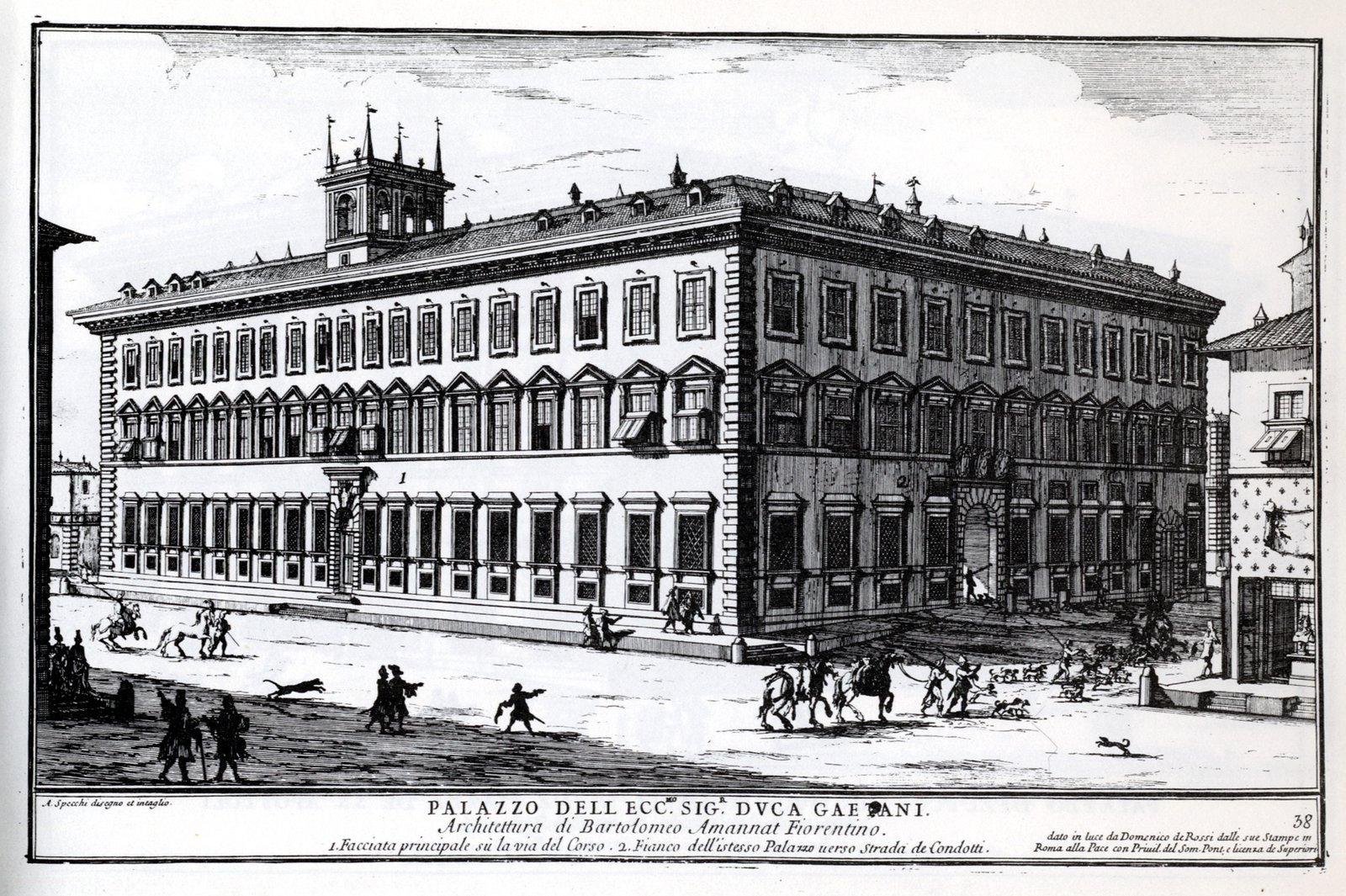
The palace's history begins in the mid-16th century. According to the Rome city tourism portal, the building was built by the Jacobilli family and in 1583 sold to the Rucellai, a Tuscan family that entrusted Bartolomeo Ammannati with the completion, with the facade on Via del Corso and a loggia frescoed by Jacopo Zucchi. In 1629 it passed to the Caetani, who altered the facade. Around 1640 Martino Longhi the Younger designed the staircase of over 100 steps and the belvedere tower.
Then came the Ruspoli. The Rome city tourism portal gives 1776 as the year it passed to the family, which is still partly its owner today. Since then the Ruspoli name has stayed tied to the building and the street. In the palace, according to the same source, Georg Friedrich Händel composed the oratorio La Resurrezione, as the household's maestro di cappella. Later Hortense, Queen of Holland and Napoleon's stepdaughter, stayed there with her children, one of whom became Napoleon III.
The 20th century brings the foundation. In 1990 Roberto Memmo establishes it and the series of exhibitions at Palazzo Ruspoli begins, with major international loans. In 1994 Nefertari reaches 500,000 visitors. In 2001 the presidency passes to Daniela Memmo d'Amelio and Patrizia Memmo Ruspoli. In 2009 the Grace Kelly exhibition closes the classical phase, according to the list on the official website. In all, over 3 million visitors in less than two decades.
In 2012, the change of course. From October 31 to November 24 of that year, according to the website, the Scuderie di Palazzo Ruspoli host the Sara VanDerBeek exhibition, ahead of the new contemporary art program. In 2015 the group show Conversation Piece begins, curated by Marcello Smarrelli. Since 2019 the foundation has run residencies in London with Gasworks for Italian artists. Since April 29, 2026 the Portia Zvavahera exhibition has been on, closing November 1.
Who passed through Fondazione Memmo
The first names are the family's. Roberto Memmo, founder in 1990 and later honorary president. Daniela Memmo d'Amelio and Patrizia Memmo Ruspoli, at the helm since 2001. Anna d'Amelio and Fabiana Marenghi Vaselli, who according to Artribune started the contemporary art program in 2012. Among the first-hour vice presidents the website recalls Claudio Strinati, then a superintendent, confirming how close to the world of heritage protection the foundation was born.
Then the scholars and collectors of the big exhibitions. The foundation's website names among its consultants and collaborators Morris L. Bierbrier, Christopher White, Catherine Whistler, Felipe Garin Llombart and Sir Denis Mahon, the collector of Italian Baroque whose collection was exhibited in 1998 with London's National Gallery. Alongside them Frédéric Mitterrand, named as curator of the 2009 Grace Kelly exhibition, when he was Minister of Culture in France.
The contemporary chapter brings artists from all over the world. Sara VanDerBeek in 2012, Sterling Ruby in 2013, Shannon Ebner in 2014, Camille Henrot in 2016, Giuseppe Gabellone in 2017, Latifa Echakhch in 2019, Oscar Murillo in 2021, Amalia Pica in 2022, Sin Wai Kin in 2023, Wynnie Mynerva in 2024, according to the website. Among the curators cited are Cloè Perrone, Francesco Stocchi, Marcello Smarrelli and Alessio Antoniolli, curator of the 2026 exhibition.
Finally the Italian artists of the London residencies. According to the page on the foundation's history, since 2019 the program with Gasworks has hosted Diego Marcon in 2020, Adelaide Cioni in 2022, Francis Offman in 2023, Alice Visentin in 2024 and Alessandro Di Pietro in 2025. It's a movement in two directions: foreign artists who come to Rome to work for the stables, Italian artists who leave for London with the foundation's support.
One last point concerns expectations. The foundation doesn't comment on its own exhibitions in promotional tones and doesn't chase the general public with spectacular installations. Whoever walks in often finds essential rooms, with few works and short texts. It's not a flaw. It's a choice consistent with a program that gives space to one artist at a time, and that asks the visitor for a bit of attention in exchange for free entry in the middle of one of Rome's most expensive areas.
What is the relationship between Palazzo Ruspoli and Fondazione Memmo?
They are two different things that share a building. Palazzo Ruspoli is a private noble residence, still partly owned by the Ruspoli family according to the Rome city tourism portal. Fondazione Memmo is a private body that since 1990 has organized exhibitions inside the palace, first in the first-floor rooms, today in the stables with a side entrance. On this site you'll find a dedicated page on Palazzo Ruspoli, with the history of the building and of the families who lived in it.
The link also runs through the family. Among the two presidents named by the foundation's website since 2001 is Patrizia Memmo Ruspoli, and the surname is enough to explain why the exhibitions stayed for more than 30 years in the same palace. Whoever visits the foundation, however, doesn't enter the lived-in rooms or the reception spaces. The tourism portal recalls that the palace can be seen on the first floor only during temporary exhibitions, and that it remains a private venue.
For anyone looking for the palace's history, there are only a few names to keep in mind. Bartolomeo Ammannati for the facade on the Corso, Jacopo Zucchi for the loggia frescoes, Martino Longhi the Younger for the staircase and the belvedere tower, according to the tourism portal. Then Händel, who composed La Resurrezione here, and Queen Hortense with her children. These are all presences of the palace, not of the foundation, and they should be told as such.
What are Conversation Piece and the London residencies?
Conversation Piece is the foundation's group exhibition. According to the official website it began in 2015, curated by Marcello Smarrelli, and 10 more annual editions have followed. The idea is to take stock of artistic presences in Rome, involving in particular the artists hosted by the capital's foreign academies and cultural institutes, such as the American Academy in Rome, the British School at Rome or Villa Medici.
For anyone following contemporary art in Rome it's a useful event, because it gathers in a few rooms works by artists who spend a fellowship or residency period in the city. Many of them also exhibit at their own academies' venues, such as the Academia Belgica, the Danish Academy, the Istituto Svizzero or Villa Massimo. The foundation's group show lets you see them in one place, in the center.
The London residencies work in reverse. Since 2019, according to the website, the foundation has run with Gasworks, in London, a program for Italian artists, who spend a period in the English capital. The website also mentions curricular internships, catalogs and special projects among its activities, without public details on calls or deadlines in the pages consulted. Those interested as artists or students must write to the foundation.
How does the foundation fit into Campo Marzio and into today's art in Rome?
The foundation is in the Campo Marzio district, described on the page Rione Campo Marzio: What to See, between Via del Corso, the Tiber and Piazza del Popolo. Around it are the Mausoleum of Augustus, the Ara Pacis, the church of San Rocco all’Augusteo and the Basilica of San Lorenzo in Lucina. It's a quarter where the ancient and the modern touch every few steps.
On the contemporary front, the foundation is one of the few venues in the historic center with a continuous institutional program. The big public collections are elsewhere: MAXXI in Flaminio, MACRO on Via Nizza, the National Gallery of Modern and Contemporary Art at Valle Giulia. Another private foundation devoted to today's art is Rhinoceros of the Fondazione Alda Fendi.
Along the Corso axis there are other venues for temporary exhibitions, such as Palazzo Bonaparte in Piazza Venezia, with a ticket and big names. Not far away, the Chiostro del Bramante hosts exhibitions often designed for the general public. The difference with Fondazione Memmo is clear: there the paid blockbuster, here the free solo show by a contemporary artist, for a narrower but attentive audience.
Anyone who wants to build a day entirely devoted to today's art can start from the foundation in mid-morning, continue on foot toward Piazza del Popolo and reach Flaminio for MAXXI in the afternoon, checking hours and closing days on the museum's website first. Alternatively, head up to Villa Borghese for the Galleria Nazionale at Valle Giulia. In our judgment the sequence works better than the reverse: the small exhibition first, the big museum after, when your eye is already trained.
When is it closed and what not to expect?
The venue is closed on Tuesday, according to the official website for the current exhibition, and after November 1, 2026 it may stay closed until the next exhibition opens, whose dates the operator has not yet published. The website lists no holiday closures. If you're thinking of going at Christmas, on New Year's Day or on long holiday weekends, phone 06 68136598 first or write to info@fondazionememmo.it, the official contacts.
What not to expect? A permanent collection: there isn't one. The state rooms of Palazzo Ruspoli: the exhibition is held in the stables, and the palace is a private venue. A big exhibition with dozens of works: contemporary solo shows are often concentrated on a few works or a single installation. A bookshop or an internal café: the operator lists none. And not an audio guide either, which the website doesn't mention among the services.
Don't expect accessibility information published online either. The operator doesn't say if the entrance is step-free, if there are accessible restrooms or routes for people with visual disabilities. Anyone with specific needs does well to ask by phone first. The same goes for those coming with a stroller or with an elderly person: details of the entrance, the steps and the doors are not published by the operator.
One last warning concerns days of heavy crowds in the center. On December weekends, during the sales and on Sundays with events on Via del Corso, the area around Largo Goldoni fills up to the point where even a short walk slows down. The foundation stays open at the stated hours, but getting there can take longer than expected. Allow wide margins and, if possible, choose a weekday.
Eating in the area
The foundation sits between Via del Corso, Via dei Condotti and Piazza di Spagna, one of the areas most frequented by tourists in all of Rome. The traps here are many. The signals are always the same: the barker on the sidewalk, the menu with photographs of the dishes in four languages, items with no price, a different menu outside and inside, the kitchen open nonstop from morning to evening, the lady making fresh pasta in the window to catch your eye.
Romans avoid these places without snobbery, for a practical reason. A place that lives off passing trade doesn't need regulars, and quality tends to follow that logic. In the streets of the Tridente you also run into places that adjust prices to whoever is in front of them, especially on drinks and the cover charge. The rule is to read the full menu with prices before sitting down and ask for the itemized bill at the end.
It's best to move a few streets toward the Tiber or toward Via della Scrofa, where the crowd is more mixed, and choose places with a short menu, printed or written each day, and clear prices. At lunchtime on weekdays the places frequented by people who work in the area fill up early. To find addresses selected with care there's the list of addresses on Google Maps, useful for building your day in the center.
For a short break, without sitting down at a table, the piazzas of Campo Marzio offer a few benches and public drinking fountains, but in the streets of the Tridente free seats are few. On the steps of Piazza di Spagna the rules of conduct set by the city apply, and it's better not to use them as a picnic area. Inside the foundation, as in any exhibition venue, it's best not to go in with food and open drinks.
What to combine in a day
The most natural pairing is Palazzo Ruspoli itself, looked at from outside, and then the Tridente. From Largo Goldoni you go up Via dei Condotti to Piazza di Spagna, with the Barcaccia Fountain, the Keats-Shelley House and the stairway up to Trinità dei Monti. On the Corso, heading north, you find the Casa di Goethe, a small museum devoted to the writer's stay in Rome.
Toward the Tiber, a few minutes away, are the Ara Pacis, with its paid museum, and the Mausoleum of Augustus. If you want to stay with contemporary art you can continue toward Piazza del Popolo and from there toward Villa Borghese and the Galleria Nazionale. On the Corso you also meet the basilica of Santi Ambrogio e Carlo al Corso, and toward Piazza del Popolo the church of Santa Maria del Popolo, with Caravaggio's canvases.
Heading south the route leads to Piazza Colonna, with the Column of Marcus Aurelius, and to Montecitorio, with the obelisk in front of the Chamber of Deputies building. Farther on, the Pantheon and the churches of the Pigna district. If you're interested in the history of the big Palazzo Ruspoli exhibitions, you can follow the page Caravaggio in Rome, devoted to the paintings you can see in the city.
For more zero-cost ideas there are the pages devoted to Free Rome and to free museums in Rome, where the foundation sits alongside public places with free entry. In the nearby Trevi district, described on the page Rione Trevi: What to See, the Accademia Nazionale di San Luca offers another way of looking at the history of artists in Rome.
Frequently asked questions
Is Fondazione Memmo at Palazzo Ruspoli or on Via della Fontanella di Borghese?
Both, because they're the same building seen from two sides. The official website gives the seat and the exhibition spaces at Via della Fontanella di Borghese 56b, and several sources, including the foundation itself and Artribune, call those spaces the Scuderie di Palazzo Ruspoli. The palace's main facade is on Via del Corso, but the foundation's entrance is on the flank, in the side street.
Is admission to Fondazione Memmo free?
Yes. The official website lists free entry for the current exhibition, with no ticket and no reservation. The published hours are from 11:00 to 18:00 every day except Tuesday, through November 1, 2026. Only the educational workshops for children ages 4 to 11 are paid, €10 per child according to the website, with the proceeds donated to Fondazione Theodora. For confirmation you can call 06 68136598.
What exhibition is on now at Fondazione Memmo?
Through November 1, 2026 it's Like Flowers We Fade, an exhibition by Portia Zvavahera curated by Alessio Antoniolli, open since April 29 according to the official website. It's the artist's first institutional exhibition in Italy, with an installation designed for the foundation's spaces and a new group of paintings made after a residency in Rome. The operator has not yet published the title and dates of the next exhibition.
Can you visit the state rooms of Palazzo Ruspoli?
Not with the foundation visit. The Rome city tourism portal specifies that Palazzo Ruspoli is a private venue and that the first floor can be seen only during temporary exhibitions. The foundation's exhibition is held today in the stables, with an entrance from Via della Fontanella di Borghese. Martino Longhi the Younger's grand staircase and the loggia frescoes are not part of the route open to visitors.
How much time does the visit take?
Half an hour is usually enough, sometimes less. The venue hosts a single exhibition at a time, often concentrated on a few works or a single installation. Whoever reads the wall texts and looks slowly can stay longer, but Fondazione Memmo works well as a short stop in a day in Campo Marzio, between Piazza di Spagna, the Corso and the Ara Pacis, rather than as the destination for a whole morning.
Are there activities for children at Fondazione Memmo?
Yes, the educational workshops. According to the official website they're aimed at children ages 4 to 11, take place at the exhibition venue and serve to bring the youngest closer to contemporary art: the children create their own works trying to reproduce those on display. They cost €10 per child and the proceeds go to Fondazione Theodora. Booking is by email, with the address given on the workshops page.
What were the big Palazzo Ruspoli exhibitions?
Between 1990 and 2009, according to the foundation's website, Palazzo Ruspoli hosted exhibitions such as Expressionism, from Van Gogh to Klee, Caravaggio, Nefertari, Alexander the Great, the Pergamon Altar, Cleopatra, Velázquez with the Prado, the Borgias, Christina of Sweden, the treasures of the Aztecs, Picasso, Paul Klee, Basquiat and Grace Kelly. Nefertari, in 1994, passed 500,000 visitors. In all, over 3 million visitors.
How do you get to Fondazione Memmo by public transport?
The operator doesn't publish transport lines. The reference is Largo Goldoni, where Via dei Condotti meets Via del Corso, from which Via della Fontanella di Borghese starts. The area can be reached on foot from Piazza di Spagna, from Piazza del Popolo and from the Pantheon. For buses and stops, use the route planner on the ATAC website or call 060608. By car, best to give up.
Who wrote this and from what sources
The text comes from the editorial team of Tour Leader Pro, the Rome-based outfit that designs itineraries, visits and cultural events across Rome and Lazio. Rates, hours and access arrangements given here come from the official sources cited in the text as of the date stated at the top: for Fondazione Memmo the pages of the official website are authoritative and, for the palace, the Rome city tourism portal. Tell us what you find changed.
Organizing an art day in the center for a group means working on the fit: the foundation closes on Tuesday, many museums on Monday, the spaces are small and it's best to phone first to arrange the entry of several people together. For anyone planning outings of this kind among museums, foundations and foreign academies, a useful resource for people who organize group trips is Tour Leader Pro, with tools designed to coordinate visits and itineraries.
Fondazione Memmo is also a doorway to the Rome that exhibits today's art, among the foreign academies, the museums of Flaminio and the galleries of the center, a face of the city that many travelers don't consider. Putting together the contemporary, the Tridente, the state museums and perhaps a day trip out of town in Lazio takes a few days and some planning, and a useful resource for putting together a multi-day itinerary is Italy Planner.