Academia Belgica
In short. The Academia Belgica, at Via Omero 8 in Valle Giulia, can't be visited freely: it's the Belgian center for history, the arts and sciences in Rome, and the public gets in only two ways.
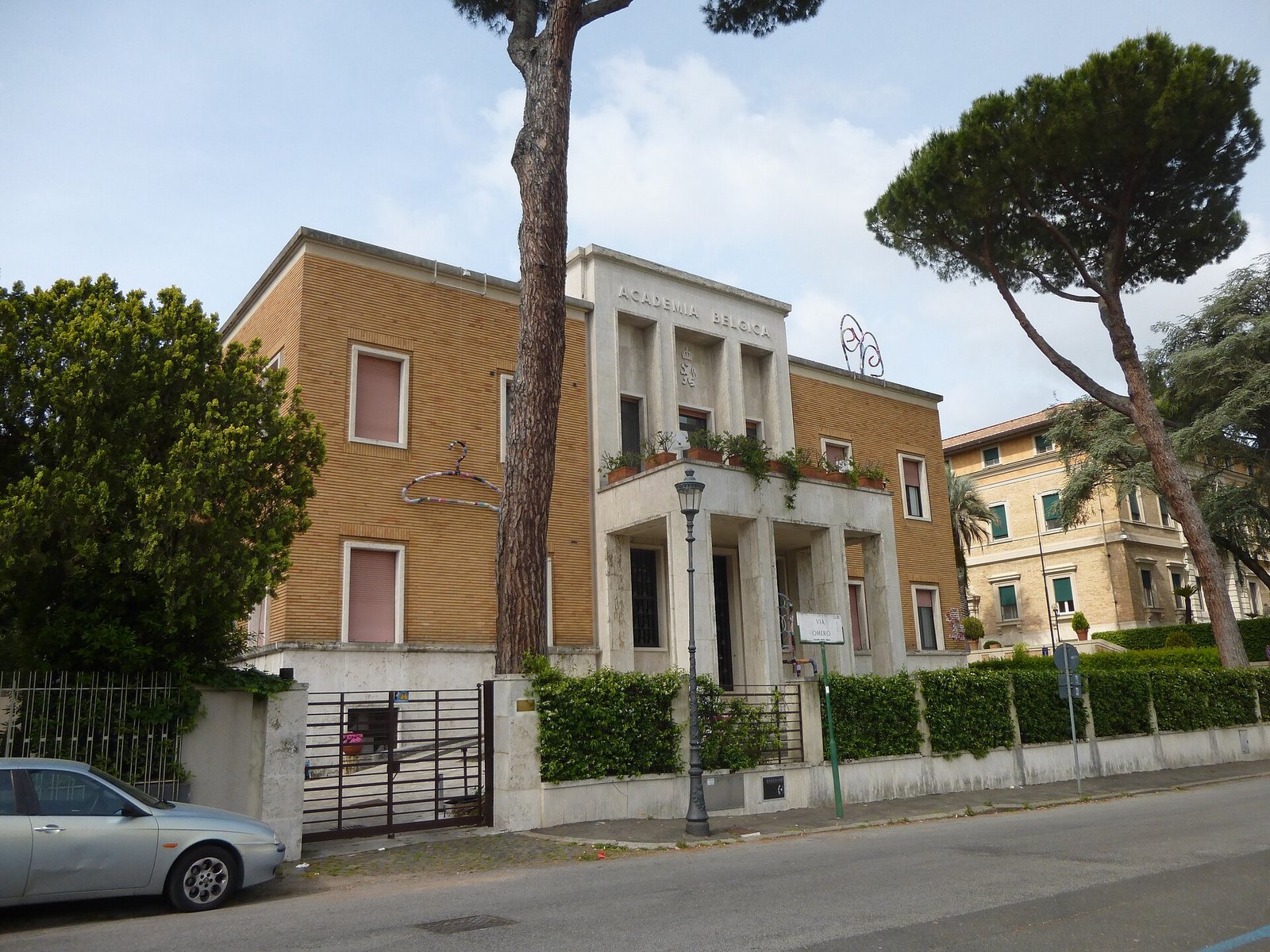
The Academia Belgica, at Via Omero 8 in Valle Giulia, can't be visited freely: it's the Belgian center for history, the arts and sciences in Rome, and the public gets in only two ways. The first is the library, by appointment and reserved for university-level researchers, Monday to Friday from 10:00 to 13:00 and from 14:00 to 17:00. The second is the lectures, concerts and exhibitions announced by the institute. There is no ticket office.
The building was constructed between 1937 and 1939 to a design by the Italian architect Gino Cipriani and the Belgian Jean Hendrickx-Van den Bosch, and inaugurated in 1939 in the presence of Princess Marie-José of Belgium and Umberto of Savoy, according to the institute's official website. Inside work the Belgian Historical Institute of Rome, founded in 1902, and the Princess Marie-José Foundation, merged with the Academia into a single institution at the end of 2017.
Data checked on September 29, 2026 on the pages of the library and of the institute's history on the official website, on the tourism portal of Roma Capitale and on the other sources cited in the text. The operator doesn't publish prices for events or visiting hours for the building. For any request the contacts are the phone 06 20398631 and the email info@academiabelgica.it, while for the library you write to biblioteca@academiabelgica.it, giving dates and the volumes to consult.
In brief: address, hours, ticket
- Address: Via Omero 8, 00197 Rome, in Valle Giulia, on the side toward Villa Borghese.
- Operator: Academia Belgica, Center for History, Arts and Sciences in Rome, phone 06 20398631, email info@academiabelgica.it.
- How to get in: library only by appointment for researchers, public events announced by the institute, no free visit of the building.
- Price: no ticket for the venue, the operator doesn't publish fees for events.
- Library hours: Monday to Friday, 10:00-13:00 and 14:00-17:00, by appointment.
- How to get there: the nearby Etruscan Museum of Villa Giulia lists trams 2, 3 and 19 and metro A Flaminio.
- Accessibility: the operator doesn't publish information, ask the secretariat before the visit.
Where it is and what you really see
Via Omero is a short, quiet street in Valle Giulia, on the northern edge of Villa Borghese. The Roma2pass portal places the Academia between the Egyptian Academy and the Swedish institute, while the online guide Romeing points out the view of the British School at Rome. It's one of the streets in the city densest with foreign institutions, and you tell from the plaques on the gates more than from the signs.
From outside you see a squared, compact volume. Il Talento di Roma describes it as an imposing cubic structure, Roma2pass speaks of a brick and travertine facade. No frieze like a noble palace, no scenic staircase. The language is that of the 1930s, which the tourism portal of Roma Capitale defines as a meeting of modernist simplicity and Art Deco refinement. Anyone who arrives expecting a historic villa is left disoriented.
Inside, when you enter for an event or for the library, the spaces open to the public are few and precise. The Roma Capitale portal lists rooms for conferences and meetings, a studio for artists, a reception room, the reading room and the library. Romeing mentions green and black marbles, furnishings from the 1930s and the copy of a Flemish arras at the top of the grand staircase. The rest is made up of offices and rooms for the residents.
The residents are the heart of the institute. According to the official website the building has 16 rooms and two mini apartments, and Roma2pass specifies that Belgian researchers and artists stay from a few days to a year, with a shared kitchen and living room. For this reason the Academia shouldn't be thought of as a museum. It's a working house, where those who study live for weeks or months, and the public is a guest only at defined moments.
The neighborhood around explains the rest. Valle Giulia is the green basin between the northern edge of Villa Borghese and the Parioli, and according to Il Talento di Roma it owes its vocation to the 1911 international fine arts exhibition, housed in the building by Cesare Bazzani that today hosts the National Gallery. Within a few hundred meters you meet academies, research institutes and national museums, each with its own entry rules.
A curiosity about the Academia Belgica
The building began as a wedding gift. In 1930 Princess Marie-José of Belgium married Umberto of Savoy, and according to the tourism portal of Roma Capitale she directed the funds collected for the wedding presents to the creation of a national foundation that bears her name and of the Academia. Roma2pass adds that the princess expressly asked the guests to finance a fund instead of giving personal gifts.
Then there is the Latin name. Belgium has two large language communities, Flemish and French-speaking, and the institute works with both: the Belgian federal science policy website mentions the meetings organized under the cultural agreements between Italy and the country's communities. In our judgment a name in Latin has the merit of not choosing between French and Dutch, and in Rome it also sounds like a tribute to the language of the city.
Third curiosity: the furnishings. The exhibition staged between November 2023 and January 2024 to tell the story of the building site, according to Itinerari nell'arte, displayed furniture designed by the architects or commissioned from Italian manufacturers of the time such as Bega, Liporesi and Cavatorta. The same source defines the building as a notable example of global art, where architecture, furniture and finishes were designed together as a single work.
The last concerns the two designers. Gino Cipriani and Jean Hendrickx-Van den Bosch were of the same age, both born in 1890, according to Itinerari nell'arte and RomaToday. Cipriani died in 1972, Hendrickx-Van den Bosch in 1961. A joint effort between a Roman and a Belgian, in the years when Italy was living through the season of regime architecture, produced a sober building, far from the monumental rhetoric of many contemporary public projects.
One thing nobody tells you about the Academia Belgica
In our judgment the most common mistake is showing up at the gate expecting to visit the building. Many guides online describe it with enthusiasm, talk about marbles and period furnishings, and make you think of an open place. It isn't. The official website describes a library by appointment and scientific and cultural activities, not a visiting route. Anyone who arrives without an appointment or an event on the calendar stays on the sidewalk.
The second thing rarely said is about the library. It's open only to researchers at university or postgraduate level, as the official page indicates, with a valid ID and a request sent in advance to the librarian. There is no lending, you consult on site. A curious student or a visitor passionate about Belgian history, without a research project, has no right to enter the reading room.
Third point: the hours circulating online don't agree. The library's official page lists Monday to Friday with a break between 13:00 and 14:00, while the Romeing guide reports continuous hours from 9:00 to 18:00 for offices and library. What the institute publishes is what counts. Anyone booking a study day must allow for the lunch break and the barely five hours of actual opening.
The last is about the catalog. Before writing to the librarian it's best to search for the volumes online: the official page indicates that the catalog can be consulted through URBiS, the network of the libraries of Rome's research institutes, and the search-libnet.org portal. The access request must contain the shelf marks of the books to consult, so without a preliminary search of the catalog the email risks being incomplete and lengthening the wait.
From an institute of 1902 to an academy of 1939: how did the Academia Belgica come about?
The story begins before the building. According to English-language Wikipedia, the Church historian Alfred Cauchie, a professor at the Catholic University of Leuven, published a pamphlet in 1896 proposing a Belgian institute in Rome. The idea came true in 1902 with the founding of the Belgian Historical Institute of Rome, first directed by Ursmer Berlière and housed at the time in Palazzo Rusticucci-Accoramboni, far from Valle Giulia.
The purpose was precise: to search the Italian archives, and above all the Vatican ones, for sources on the history of Belgium. From that work came the series Analecta Vaticano-Belgica, devoted to publishing documents. The institute's bulletin, according to the same source, stopped appearing in 2010, replaced by a digital journal, Forum Romanum Belgicum. It's a slow line of research, made of transcriptions and critical editions.
Why Rome in particular? Wikipedia describes the institute as a study center devoted to the history and antiquities of Rome and, more generally, of Italy, with particular attention to Italian sources on Belgian history. The series Analecta Vaticano-Belgica says in its title where they were looking: in the Vatican archives. For a Belgian historian of the early 1900s, working in Rome meant having direct access to documents that didn't exist at home, and being able to transcribe and publish them.
The second piece arrives with the 1930 wedding. The official website tells that, after Princess Marie-José's wedding, the Princess Marie-José National Foundation was created. With the funds collected the Academia also took shape, conceived to encourage scientific and cultural dialogue between Italy and Belgium. The Valle Giulia building site started in 1937 and closed in 1939, according to the tourism portal of Roma Capitale.
For almost 80 years the three entities lived under the same roof with separate identities. At the end of 2017, according to the official website, their respective fields of action were merged into a single institution, the Academia Belgica, Center for History, Arts and Sciences in Rome. Today the declared mission is to support Belgian research, encourage international scientific exchange and promote cultural relations between the two countries.
The advice I give you for visiting the Academia Belgica
The advice is to start from the calendar, not from the address. The institute publishes its initiatives in the events section of the official website and on its social profiles, Instagram academia_belgica and the Facebook page indicated by the Roma Capitale portal. Past events show lectures, conferences, book presentations, workshops and exhibitions, in Italian, French or English. Pick the initiative, check the language, then organize the day in Valle Giulia around that time.
Language matters more than you'd think. The announcements published by the institute indicate case by case Italian, French, English or a combination, and some conferences are held entirely in French. For a concert nothing changes, for a specialist lecture it does. Read the announcement carefully and, if it isn't indicated, ask the secretariat before booking a seat that you risk not really using.
Exhibitions are the easiest way to see the interiors. The one devoted to the history of the building, between November 9, 2023 and January 9, 2024, was open Monday to Friday from 10:00 to 18:00 and Saturday from 10:00 to 13:00, according to Itinerari nell'arte. It isn't a fixed calendar, but it gives an idea of how the institute opens the rooms when it exhibits: weekdays, office hours, a few hours on Saturday.
Different rules apply to lectures. In the past some meetings required mandatory booking with a limited number of seats, as shown on the events pages of the official website. If the announcement gives an email or a form, it's best to book right away. If it gives nothing, write to the secretariat anyway: the capacity of the rooms isn't published, and a confirmation avoids finding the door closed with a full room.
Anyone coming to study must move in advance. The request to the librarian, as the official page indicates, must contain last name, first name, home institution, shelf marks of the books and preferred dates and times. Send it at least a few days before, attaching or preparing your ID. Anyone working on the old holdings, with incunabula and 16th-century printed books, does well to ask in advance if the volumes can be consulted and with what precautions.
How much does it cost and how do you book the library?
The Academia doesn't sell tickets. There is no paid entrance to the building, and the operator doesn't publish fees for lectures, concerts or exhibitions. The Belgian federal science policy website writes that the events are regularly open to the Roman public, but the free admission of individual events is not confirmed by an official source. The right approach is to read the event announcement and, if in doubt, write to info@academiabelgica.it.
The official channel for the library is the page Library of the Academia Belgica, which gives hours, requirements and how to apply. On tour and ticket portals no product dedicated to the venue appears, and that is consistent with the nature of the place: it's a research institute, not an attraction with a visiting route, so there is nothing to buy in advance.
| Day | Library, by appointment |
|---|---|
| Monday-Friday | 10:00-13:00 and 14:00-17:00 |
| Saturday and Sunday | not listed |
| Public events | time given in the announcement |
The contacts don't fully match across sources. The tourism portal of Roma Capitale and Itinerari nell'arte give the number 06 20398631 and the email info@academiabelgica.it. Informagiovani Roma reports the same phone with the email segreteria@academiabelgica.it. The library's entry on the Roma Capitale portal gives biblioteca@academiabelgica.it and the name of the librarian, Pamela Anastasio, the same one given by the library's official page.
Anyone who isn't a researcher has no way into the reading room, and it's worth knowing that before writing. For everyone else the opportunity is the events. For a study group or a university class that wants to visit the building, the operator doesn't publish a procedure, so the request should go to the secretariat well in advance, explaining the reason for the visit, the number of people and the possible dates.
Another well-known fact, yet rarely cited
Many people know that the Academia is tied to the wedding of Marie-José and Umberto of Savoy. Few remember that the Belgian Historical Institute had already been in Rome for almost 30 years. The Valle Giulia building didn't create the Belgian scientific presence in the city, it gave it a home. The official website, in fact, starts its own history in 1902, not in 1939, and the current name includes history even before the arts.
The second fact known to scholars and rarely cited concerns the library. According to Wikipedia and Roma2pass, in 1947 the historian of religions Franz Cumont donated his personal collection to the Academia, and the official page speaks of more than 15,000 volumes. Roma2pass adds that the collection is rich in texts on the history of religions and on ancient astrology. The heart of the library, to put it differently, is one scholar's library.
Third fact: the building has been thoroughly renovated. The tourism portal of Roma Capitale mentions work begun in 1997 and resumed between 2002 and 2007. French-language Wikipedia speaks of cleaned facades, redesigned gardens and updated interiors, with rooms, meeting rooms and a library adapted to digital technologies. The building you see today is the one from the 1930s, but with the systems and workspaces of the 2000s.
Finally, a detail on funding. The website of Belgium's federal science policy, Belspo, indicates that the Belgian State contributes to support the institute, alongside collaborations with conservatories, universities and cultural institutions of the country. The Academia is therefore not a private association of enthusiasts, but a structure supported by the Belgian public research system, with a precise scientific mission.
The right photo to take at the Academia Belgica
The photo that tells the story of the place is the one of the building's volume taken from the street, at three-quarter view, so that the front and the side read together. It's the cubic form that Il Talento di Roma talks about that gives the character, not a decorative detail. The raking light of morning or late afternoon brings out the contrast between brick and travertine mentioned by Roma2pass.
The second useful image is about context. Via Omero is short, and with a few steps you frame in sequence the facades of the neighboring institutes, according to Roma2pass the Egyptian Academy and the Swedish institute. A series of shots along the street, one per building, explains Valle Giulia better than a single wide image. Avoid summer midday, when the high light flattens the squared volumes of the 1930s.
Inside, the institute decides the rules. During lectures and concerts it's best to ask before photographing, always without flash. In exhibitions, limits tied to artists' rights may apply. Don't photograph the rooms, the offices or residents at work: 16 rooms and two mini apartments, according to the official website, mean people who live there, and their privacy comes before any framing.
On the street, common-sense rules apply. Via Omero is narrow and residential, with institute gates and driveways, and foreign missions may have security staff. Shoot from the sidewalk without stopping in front of the entrances and without leaning on the fences. No drones, no bulky tripods. If someone asks you not to photograph an entrance or a plaque, it's best to go along without arguing and move a few meters.
If the occasion allows you to see the grand staircase, the image to look for is the one of the Flemish arras copy pointed out by Romeing, with the dark marbles around it. It's the point where the building declares its Belgian origin. Anyone who can't get in can settle for the exterior in autumn, when the green of Villa Borghese behind it changes color and gives depth to a deliberately severe facade.
How do you get there from central Rome?
The operator doesn't publish public transport directions. The nearest reference is the Etruscan Museum of Villa Giulia, at Piazzale di Villa Giulia 9, which on its website lists trams 2, 3 and 19 and metro A with the Flaminio stop, about 14 minutes' walk from the museum. From there Via Omero is reached on foot in a few minutes. Lines and routes should be checked on the day itself on the ATAC website.
On foot the most pleasant route crosses the park. From Piazza del Popolo you climb to the Pincio, continue north inside Villa Borghese and descend toward Valle Giulia on the side of the National Gallery of Modern Art. It's a walk of a good half hour almost all in the green, with many places to see along the way and little traffic.
From Via Veneto you enter the park through Porta Pinciana and follow Villa Borghese north, passing near the Galleria Borghese. From the Flaminio district, instead, you climb up from below, along Viale delle Belle Arti. The last stretch is slightly uphill, nothing demanding, but to be taken into account in the evening, leaving a lecture or a concert.
By car the area is residential and the spots near the academies and museums are few, especially on event evenings. The operator doesn't list dedicated parking. From Termini the most direct solution remains metro A to Flaminio, then the tram or the climb on foot. Anyone with time can get off at the Spagna stop and cross Villa Borghese, lengthening the trip but gaining the walk.
The bicycle is a good solution for the area, with short climbs inside Villa Borghese and along Viale delle Belle Arti. The operator doesn't list bike racks in front of the building, so it's best to lock the bike at a spot that doesn't block gates and driveways. Anyone coming from St. Peter's or the Vatican can take metro A in the opposite direction to Flaminio, and from there continue like someone coming from Termini.
Some important events that happened here in history
In 1896 Alfred Cauchie proposed a Belgian institute in Rome in a pamphlet, and in 1902 the Belgian Historical Institute was born, according to English-language Wikipedia. In 1930 the wedding between Marie-José of Belgium and Umberto of Savoy led to the Princess Marie-José Foundation, as the official website recalls. Between 1937 and 1939 Gino Cipriani and Jean Hendrickx-Van den Bosch built the Valle Giulia building, inaugurated in 1939 in the presence of the princely couple.
The Academia's first director, according to the list published by Wikipedia, was Jules Vannerus, in office from 1939 to 1940. The list resumes in 1945 with Fernand De Visscher. The war years therefore remain without a name at the helm in the source. In 1947 came the donation of Franz Cumont's library, which changed the scientific weight of the institute and steered its collection toward the history of religions.
In the following years the institute consolidated as a meeting point for Belgian, Italian and foreign scholars, according to the formula used by the federal science policy website. The sequence of directors shows a prevalence of historians of the Middle Ages and the early modern period, archaeologists and philologists. Public activities, made of conferences and concerts, were added over time to the work of editing sources that remains the root of the institute.
From 1997, according to the tourism portal of Roma Capitale, renovation work began, resumed between 2002 and 2007. In 2010 the series of the Belgian Historical Institute's bulletin closed, replaced by the digital journal Forum Romanum Belgicum. At the end of 2017 the Academia, the Historical Institute and the Foundation were merged into a single institution, according to the official website, with the name Center for History, Arts and Sciences in Rome.
Between November 9, 2023 and January 9, 2024 the Academia devoted an exhibition to its own building, The Academia Belgica in Rome 1937-1939, with period photographs, documents, drawings, floor plans and furnishings. With the exhibition came the first monograph on the building, published by Yale University Press London and Fonds Mercator, according to Itinerari nell'arte. In 2024, as the official website indicates, the directorship passed to Cécile Evers.
Who has passed through the Academia Belgica
First of all the couple who gave it origin. Marie-José of Belgium, sister of Leopold III according to French-language Wikipedia, and Umberto of Savoy, future King Umberto II according to Roma2pass, were present at the 1939 inauguration, as the official website writes. Then the two architects, Gino Cipriani and Jean Hendrickx-Van den Bosch, authors of a project that also included furnishings and interior finishes, as the 2023 exhibition showed.
Then the directors. The list published by Wikipedia includes, among others, Fernand Vercauteren, William Lameere, Charles Verlinden, in office from 1959 to 1977, Louis Godart, Jozef Mertens, Jacqueline Hamesse, Walter Geerts, Wouter Bracke and Sabine Van Sprang, listed from 2018. The official website today presents Cécile Evers as director, since 2024. They are for the most part historians, archaeologists and philologists from Belgian universities.
The library bears the names of those who built it with their own collections. The official page cites the donations of Franz Cumont, with more than 15,000 volumes, of the historian Henri Pirenne, of Pierre Bautier, of Cécile Dulière and of Nicole Dacos. Each collection steered the holdings in a different direction, from medieval history to archaeology and art history, and explains why the catalog is so specialized.
Alongside the books there are the papers. The Romeing guide mentions photographic archives and collections of correspondence, and the library's entry on the Roma Capitale portal counts about 1,500 photographs. The operator doesn't publish an online inventory of these holdings nor consultation rules different from those of the library. Anyone working on archival documents must say so in the request, specifying the material they intend to see and the purpose of the research.
Finally the residents. Belgian researchers and artists pass through the rooms on Via Omero from a few days to a year, according to Roma2pass, and the institute organizes for them and with them conferences, seminars, masterclasses, summer schools and concerts with Belgian musicians, as the official website indicates. The federal science policy website mentions collaborations with conservatories and universities. They are the ones who fill the public calendar.
What does the Academia's library hold?
The numbers vary depending on the source. The official page speaks of about 80,000 titles, the tourism portal of Roma Capitale of more than 80,000 volumes, while the library's entry on the same portal gives a range between 60,000 and 80,000 volumes, with 600 periodicals and 1,500 photographs. The sources don't agree on the detail, the order of magnitude is clear. It's a research library, not a neighborhood reading room.
According to the official page, 70 percent of the holdings concerns history, art history, archaeology, the history of religions and the history of science. Alongside are Belgian, Italian and international scientific journals, an up-to-date collection of Belgian literature and a fund of old books with incunabula and 16th-century printed books. The Roma Capitale entry adds among the themes Italo-Belgian relations and religious history.
The Cumont collection is the best-known core. Roma2pass describes it as rich in precious texts on the history of religions and on ancient astrology, and the official page credits it with more than 15,000 volumes, the highest figure among the donations it cites. For anyone working on the cults of the Roman world, the library on Via Omero is a specialist address, alongside the collections of the other foreign institutes linked through the URBiS network.
The services are basic. Consultation is on site, there is no lending, according to the official page, and the Roma Capitale entry lists a photocopy service. Anyone used to the big public libraries of Rome, such as the Biblioteca Angelica, will find here a more intimate setting and stricter rules, designed for a few researchers at a time and not for a broad public.
The princess's wedding gift: what do the documents say and what is told?
The first level is that of the institutional sources. The official website writes that in 1930, after Princess Marie-José's wedding, the national foundation bearing her name was created, and that the building was inaugurated in 1939 in the presence of the princely couple. The tourism portal of Roma Capitale adds that the funds from the wedding gifts were allocated to the foundation and to the Academia.
The second level is the more widespread story. Roma2pass and Romeing present it this way: the princess asked the guests, in place of gifts, to contribute to a fund to support Belgian scholars and artists in Rome. It's a version consistent with the official one, but more personal and anecdotal. The exact text of the appeal, with the princess's words, doesn't appear in the open sources.
The third level concerns the interpretations. In the current narrative the Academia is presented as a symbol of the union between Italy and Belgium, and French-language Wikipedia uses exactly this formula. It's a political and celebratory reading, tied to a dynastic marriage celebrated in the middle of the Fascist regime. There is no real legend attached to the building, and in our judgment it's best to be wary of anyone who tells one.
One fact remains not to be forgotten. The wedding was a public event of great importance, but the institute that came out of it has had a long life, independent of the affairs of the Italian monarchy. The Academia kept working after the war and after 1946, under the direction of scholars, with a scientific mission. The wedding gift, in this sense, is the origin, not the meaning of the place.
Where does the Academia stand among the academies of Valle Giulia?
The valley of the academies was born with the 1911 international fine arts exhibition, for the 50th anniversary of Italian Unification, according to Il Talento di Roma. The same source lists on the Villa Borghese side the seats of Belgium, Egypt, Denmark, the Netherlands, Sweden and Romania, and toward the Parioli those of Great Britain, Japan and Austria. The Academia Belgica belongs to the generation of the 1930s, alongside the Romanian Academy, inaugurated in 1933.
The comparison helps read the building. The British School occupies the former British pavilion of 1911, the Danish Academy dates from the second postwar period, Romania chose a sober neoclassical style. Belgium, with Cipriani and Hendrickx-Van den Bosch, bet on a modern, compact volume. Walking along the valley you can thus read, side by side, four different ways of representing a country in Rome.
Outside Valle Giulia the picture widens. The Villa Medici of the French Academy, the American Academy in Rome, Villa Massimo and the Hungarian Academy at Palazzo Falconieri each have their own entry rules. Among Italian institutions, the National Academy of San Luca and the Bosco Parrasio of the Arcadia complete the picture of the city's academies.
In our judgment the valley should be experienced as a working neighborhood, not as an open-air museum of nations. The academies are research and artistic production institutes, with their own calendars and closed doors most of the time. You look from outside, you follow one calendar at a time, you go in when there is an event. Anyone who claims to see them all in one afternoon sees only gates.
For anyone who wants a common thread, the simplest is chronology. The British pavilion of 1911, today the British School, is the first stone. The Romanian academy of 1933 and the Belgian one of 1939 tell the story of the years between the wars. The Danish academy belongs to the postwar period. Walking from one seat to another, along Viale delle Belle Arti and Via Omero, you thus cross about 60 years of foreign representational architecture in Rome.
When is it closed and what shouldn't you expect?
Saturday and Sunday don't appear in the library hours published by the institute, so they should be considered closed except for announced events. The official page doesn't indicate summer closures or those for Italian and Belgian holidays. Many foreign cultural institutes in Rome reduce activity in August, and here too it's best to ask the librarian before setting a study day in the summer months.
Don't expect a visit to the building. The operator doesn't publish a service of visits to the venue, and the rooms open during events are those needed for the event itself. Don't expect to wander the floors, see the residents' rooms or enter the garden either. The Academia welcomes the public in some rooms, and the rest of the house stays reserved for those who work and live there.
Don't expect seats always available. The capacity of the rooms isn't published, and in the past some meetings required mandatory booking with a limited number of participants, as shown in the events section of the official website. For exhibition openings and for concerts attendance can be high. Arriving a bit early, having booked when required, avoids being left outside at the last minute.
Don't expect a library to consult in passing. You need a reasoned request, a researcher profile and a booking. The procedure indicated by the official page goes through email to the librarian, not through a request made at the gate. Don't expect lending either: the volumes are consulted only on site. For people doing research it's a valuable service, for the curious visitor it's a closed door.
One last warning concerns online portals. Several sites report continuous hours, different contacts or entries frozen a few years ago, and the library number published on a municipal entry doesn't match the general one. If in doubt, what the institute publishes on its own website counts. For event evenings bring an ID, which at the seats of foreign institutions may be requested at the entrance.
Eating in the area
Valle Giulia is not a restaurant area. Among academies, museums and the green of the park the offer is scarce, and inside the Academia no service open to the public is listed. Anyone leaving a lecture in the late afternoon will more easily find food by heading down toward Flaminio or up toward the Parioli, two residential neighborhoods with places meant for those who live and work there.
The traps are concentrated at the points with the most tourist traffic, at Piazza del Popolo and around the busiest avenues of Villa Borghese. The signs are always the same: the barker at the door, the menu with photographs of the dishes, items without a price, a menu outside that differs from the one brought to the table, a kitchen open nonstop without a break. Romans avoid them because there quality depends on passing trade, not on regular customers.
The practical rule is to look for where residents eat during the lunch break, with a short menu, handwritten or printed every day, and clear prices. In the hours when offices let out, neighborhood places fill up quickly, so it's best to go earlier or later. For carefully selected addresses, also useful for organizing the day between Valle Giulia and the center, there is the list of addresses on Google Maps.
Anyone who prefers to stay outdoors has Villa Borghese a few minutes away. A packed lunch, with water and something picked up at a bakery or a grocery store before entering the park, works well on the lawns around Piazza di Siena. The park is very busy on weekends, so it's best to choose areas away from the main avenues and leave everything clean, taking your trash away.
What to combine in a day
The natural pairing is with the museums of the valley. The Etruscan Museum of Villa Giulia is open Tuesday to Sunday from 8:30 to 19:30, with last entry at 18:30, and closed on Monday, according to the museum's website, with a full-price ticket at 13 euros. The National Gallery of Modern Art is on Viale delle Belle Arti. A museum in the morning and an event at the Academia in the afternoon make up a day without transit.
Anyone who prefers the park has Villa Borghese at hand. From the Valle Giulia side you reach the Museo Pietro Canonica, the Casina di Raffaello for anyone traveling with kids and the Casa del Cinema. The Galleria Borghese requires booking, and the Secret Gardens have their own openings, to be checked before leaving.
Anyone coming to the Academia for the history of ancient religions, a strong theme of the library, can round out the day with the places of the cult of Mithras in the city. Among our pages you'll find the Mithraeum Barberini, the Mithraeum of the Circus Maximus and the Basilica of Santa Prisca with its mithraeum, as well as the page on underground Rome. Many can be visited only by booking.
Toward the north the day stretches into 20th-century architecture, consistent with the building on Via Omero. From Flaminio you reach the MAXXI, the Auditorium Parco della Musica and Milvian Bridge. Toward the Parioli there are Villa Glori, Villa Ada and the small museum of Villa Poniatowski.
Anyone starting from the center can begin at Santa Maria del Popolo, climb to the Pincio and cross the park to Valle Giulia. Anyone following the thread of the Savoys, tied to the founder, can add a visit to the Quirinal Palace, with visiting arrangements to be checked on the official website. For low-cost days, on the site you'll also find free Rome and the free museums in Rome.
Frequently asked questions
Can you visit the Academia Belgica?
Not with a free visit. The Academia is a Belgian research institute, not a museum, and the operator doesn't publish a service of visits to the building. The public gets in for the events announced on the official website and on the social profiles, that is, lectures, conferences, book presentations, concerts and exhibitions. The library is open by appointment only to university-level researchers, Monday to Friday.
How much does it cost to enter?
There is no ticket for the venue. The operator doesn't publish fees for events, and the Belgian federal website Belspo writes that the initiatives are regularly open to the Roman public. The free admission of individual events, however, is not confirmed by an official source. It's best to read the announcement of each event and, in case of doubt, write to the email info@academiabelgica.it or call 06 20398631.
Who can use the library and when is it open?
According to the official page, the library is reserved for researchers at university or postgraduate level, with a valid ID. It's open Monday to Friday, from 10:00 to 13:00 and from 14:00 to 17:00, by appointment only. The request must be sent by email to the librarian with name, institution, shelf marks of the volumes and preferred dates. There is no lending.
Where exactly is it?
At Via Omero 8, postal code 00197, in Valle Giulia, on the side toward Villa Borghese. According to Roma2pass the building stands between the Egyptian Academy and the Swedish institute. The best-known reference in the surroundings is the Etruscan Museum of Villa Giulia, which for public transport lists trams 2, 3 and 19 and metro A with the Flaminio stop, about 14 minutes' walk away.
Who designed the building?
The Italian architect Gino Cipriani, born in 1890 and died in 1972, and the Belgian Jean Hendrickx-Van den Bosch, born in 1890 and died in 1961, according to Itinerari nell'arte. The building work took place between 1937 and 1939. The tourism portal of Roma Capitale describes the language of the building as a meeting of modernist simplicity and Art Deco refinement. The building was inaugurated in 1939.
What does Princess Marie-José have to do with it?
Marie-José of Belgium married Umberto of Savoy in 1930. According to the tourism portal of Roma Capitale she directed the funds collected for the wedding gifts to the national foundation that bears her name and to the Academia. Roma2pass adds that she asked the guests to finance a fund instead of giving gifts. The official website recalls that the building was inaugurated in 1939 in the presence of the princely couple.
What is the Belgian Historical Institute of Rome?
It's the research institute founded in 1902 to study, in the Italian archives, above all the Vatican ones, the sources on the history of Belgium. According to Wikipedia it was proposed by Alfred Cauchie, a professor at Leuven, and first directed by Ursmer Berlière. It publishes the series Analecta Vaticano-Belgica. Since the end of 2017, according to the official website, it has been merged with the Academia and the Princess Marie-José Foundation into a single institution.
What kind of events does the Academia organize?
The official website lists conferences, workshops, seminars, masterclasses, summer schools, public lectures and concerts with Belgian musicians. The events section also includes exhibitions and book presentations, in Italian, French or English. The program changes often, and some meetings require booking. The calendar should be followed on the institute's website and social profiles, not on portals that copy old entries.
Who wrote this and from which sources
The text comes from the editorial team of Tour Leader Pro, the Roman company that designs itineraries, visits and cultural events across Rome and Lazio. The fares, hours and access arrangements given here come from the official sources cited in the text, as of the date indicated at the start. For the Academia Belgica the reference points are the library and history pages on the institute's website and the tourism portal of Roma Capitale. Tell us what you find has changed.
Organizing a day in Valle Giulia for a group means working on how the pieces fit together: booking the museums with fixed hours, checking the dates of the academies' events, which change often and have limited seats, and planning an alternative when the gates stay closed. For anyone planning outings of this kind, a useful resource for people who organize group travel is Tour Leader Pro, with tools designed to coordinate visits and itineraries.
Valle Giulia is also a starting point for a longer trip, one that lines up Rome's foreign academies, 20th-century architecture between Flaminio and Parioli and, outside the city, the villas and abbeys of Lazio. Anyone who loves the interweaving of different cultures finds here an original thread for several days, and a useful resource for building a multi-day itinerary is Italy Planner.