Flaminio
In short. You see Flaminio on foot and almost all of it is free: streets, squares, bridges and facades are public space, and you only pay to get into the museums.
You see Flaminio on foot and almost all of it is free: streets, squares, bridges and facades are public space, and you only pay to get into the museums. The MAXXI is at Via Guido Reni 4 and until September 20, 2026 charged €15 at the ticket desk or €12 online. The Museo Etrusco di Villa Giulia, at Piazzale di Villa Giulia 9, costs €13. The Auditorium Parco della Musica, at Viale Pietro de Coubertin 30, has guided tours at €15 by reservation.
The neighborhood is the long strip of city that follows Via Flaminia from Piazzale Flaminio northward, between the Tiber and the hills of Parioli, all the way to Milvian Bridge. Here Rome built a large part of its public 20th century: the facilities for the 1960 Olympics, the athletes' village, then Renzo Piano's Auditorium and Zaha Hadid's museum. The Renaissance stays at the edges, with Villa Giulia and the little temple of Sant'Andrea, and antiquity looks out onto the river with Constantine's bridge.
Data checked on September 29, 2026 on the websites of the MAXXI, the Auditorium and the Etruscan Museum, on the Turismo Roma pages dedicated to the individual places, on the Roma Servizi per la Mobilità website, and in the press cited in the text for Stadio Flaminio and for the former barracks on Via Guido Reni. MAXXI rates change with the exhibitions: the published formula was valid until September 20, so for the fall it's best to check the museum's website before you go.
At a glance: address, hours, ticket
- Address: Flaminio neighborhood, Rome, along Via Flaminia between Piazzale Flaminio and Ponte Milvio, with the MAXXI at Via Guido Reni 4 and the Auditorium at Viale Pietro de Coubertin 30.
- Operators: the museums and halls have different operators. Streets, squares and bridges belong to Roma Capitale, and the church of Santa Croce is a parish of the Diocese of Rome.
- How to get in: on foot and freely in the public spaces, with a ticket in the museums, with mandatory reservation for the Auditorium's guided tours.
- Price: MAXXI €15 at the desk or €12 online until September 20, 2026, Villa Giulia €13, Auditorium tour €15, streets and churches free.
- Hours: MAXXI Tuesday to Sunday 11-19, Villa Giulia Tuesday to Sunday 8:30-19:30, both closed on Mondays.
- How to get there: metro A to Flaminio, then tram line 2 toward Piazza Mancini, replaced by buses in summer 2026 because of works on Viale delle Belle Arti.
- Accessibility: Turismo Roma reports the Auditorium as wheelchair accessible and accessible restrooms at the MAXXI. For the other places the information isn't published.
Where Flaminio is and what you really see
Flaminio begins just outside Porta del Popolo. Behind you is Piazza del Popolo with the Flaminian Obelisk, ahead opens Piazzale Flaminio, with the metro A stop and the terminus of tram 2. From there Via Flaminia heads straight north, almost parallel to the Tiber. On the right rise the greenery of Villa Borghese and the Villa Giulia valley, on the left the river with its tree-lined embankments.
The first part of the neighborhood is made of apartment buildings from the early decades of the 20th century, regular blocks and barracks. The second changes scale. After Via Guido Reni come the MAXXI, the church of Santa Croce, the Palazzetto dello Sport, Stadio Flaminio, and farther up the Olympic Village with the Corso di Francia viaduct and the Auditorium. It all holds together in a flat walk, long but without climbs, which you can break up with the tram or the bus.
On the other bank of the Tiber you see the Foro Italico, with the Stadio Olimpico and the hill of Monte Mario behind it. The Ponte della Musica links them on foot in a few minutes. Farther north the road reaches the square of Ponte Milvio, the ancient bridge tied to Constantine's victory, and a little beyond it the Ponte Flaminio, the big travertine bridge of Corso di Francia.
Don't expect a historic center. Flaminio is a residential neighborhood, with heavy traffic on Via Flaminia and Viale Tiziano, schools, offices and gyms. The places worth seeing are scattered and separated by stretches of ordinary street. That is exactly the appeal: you go from a national museum to a 1950s apartment block, from a concrete dome to a five-a-side soccer field, and you understand how the city spread north over the last century.
The river side is the most pleasant part to walk. Lungotevere Flaminio runs tree-lined along the neighborhood side, up to the Ponte della Musica and beyond, with the view over the Tiber and the Foro Italico bank. From here you reach Via Guido Reni and the MAXXI without going through the traffic of Via Flaminia. Farther upstream the embankment continues toward Ponte Milvio, and on weekday mornings it's used mostly by runners and cyclists.
Most of what is worth seeing, you look at from outside. The Palazzetto dello Sport opens only for matches and events. Stadio Flaminio is closed and in a state of serious decay. The Olympic Village is a private, lived-in neighborhood. The MAXXI and the Auditorium too are better understood by walking around them than by going into a single hall. That's why Flaminio suits a morning on foot, with one or two interiors chosen in advance.
A curiosity about Flaminio
The church of Santa Croce on Via Guido Reni has a bell tower with six bells all tuned to the same note. Turismo Roma writes that the set is in A-flat and that it's the only church in Rome with a set of bells of this kind. The bell tower has six floors and is inspired by that of Santa Maria in Cosmedin, and from the street you immediately recognize the resemblance to the medieval model.
At the base of the bell tower there is a marble statue of the Madonna. According to Turismo Roma it was placed there as an ex voto because the church came through the 1943 bombings unscathed, which hit Rome repeatedly in that year of war. Anyone passing along Via Guido Reni sees it without going into the church, and most passersby don't know why it stands exactly there.
The church itself came about because of an anniversary. Pope Pius X wanted it for the 16th centenary of the Edict of Milan of 313, the measure by which Constantine and Licinius recognized freedom of worship for Christians. The first stone was laid on October 17, 1912, and the inauguration took place on December 29, 1913. The choice of place is not random: Via Flaminia leads straight to Ponte Milvio, where in 312 Constantine won the battle that opened Rome to him.
Something nobody tells you about Flaminio
Across from the MAXXI, on the other side of Via Guido Reni, there is a fenced area of former military sheds that many mistake for a forgotten construction site. According to Artribune, which wrote about it on May 22, 2026, they are 23 former industrial buildings on five hectares, abandoned since 2019. The MAXXI itself was born on part of the same history: Turismo Roma recalls that in its place stood the workshops and pavilions of the former Montello barracks.
Flaminio, that is, long had a military soul. Barracks, warehouses and plants occupied the strip between Via Flaminia and the river, and today's big pieces of architecture grew where the army left space. Look at the neighborhood with this key and you understand its island-like shape: large closed lots, perimeter walls, straight streets, and between one lot and the next the residential buildings.
The biggest change of the coming years concerns the former barracks across from the MAXXI. According to Artribune, the project is led by Cassa Depositi e Prestiti and COIMA Sgr, with the participation of the Abu Dhabi company Eagle Hills. The project includes a Science Museum of 19,000 square meters designed by the Roman firm ADAT, residences, social housing with the City, a hotel, public green space, a library and a civic hub run by Roma Capitale.
The published figures are 400 million in total investment and 75 million for the Science Museum. Demolition and remediation are announced for October 2026, the construction site is expected to last five years with completion scheduled in 2031. A public passage from Via Guido Reni to Piazza Perin del Vaga is also planned. For anyone visiting the neighborhood in the meantime, it means fences, construction vehicles and noise along Via Guido Reni for several years.
The MAXXI stays open, and the square will keep working, but the landscape around it is bound to change. Anyone who wants to see military Flaminio, with its sheds and perimeter walls, has little time. From the street you can clearly see the volumes of the workshops lined up along Via Guido Reni. You can't go in, and you shouldn't look for a gap: the area is fenced and private.
The second thing you discover on the spot is that many 20th-century places can't be visited. The Palazzetto opens for matches, Stadio Flaminio is closed, the Olympic Village is made of private homes. There is no single ticket office and no signposted route. It's good to know this beforehand, so you don't look for entrances that don't exist and don't walk into the courtyards of apartment buildings, which are private property and should be respected as such.
MAXXI and Auditorium: what can you see without a ticket?
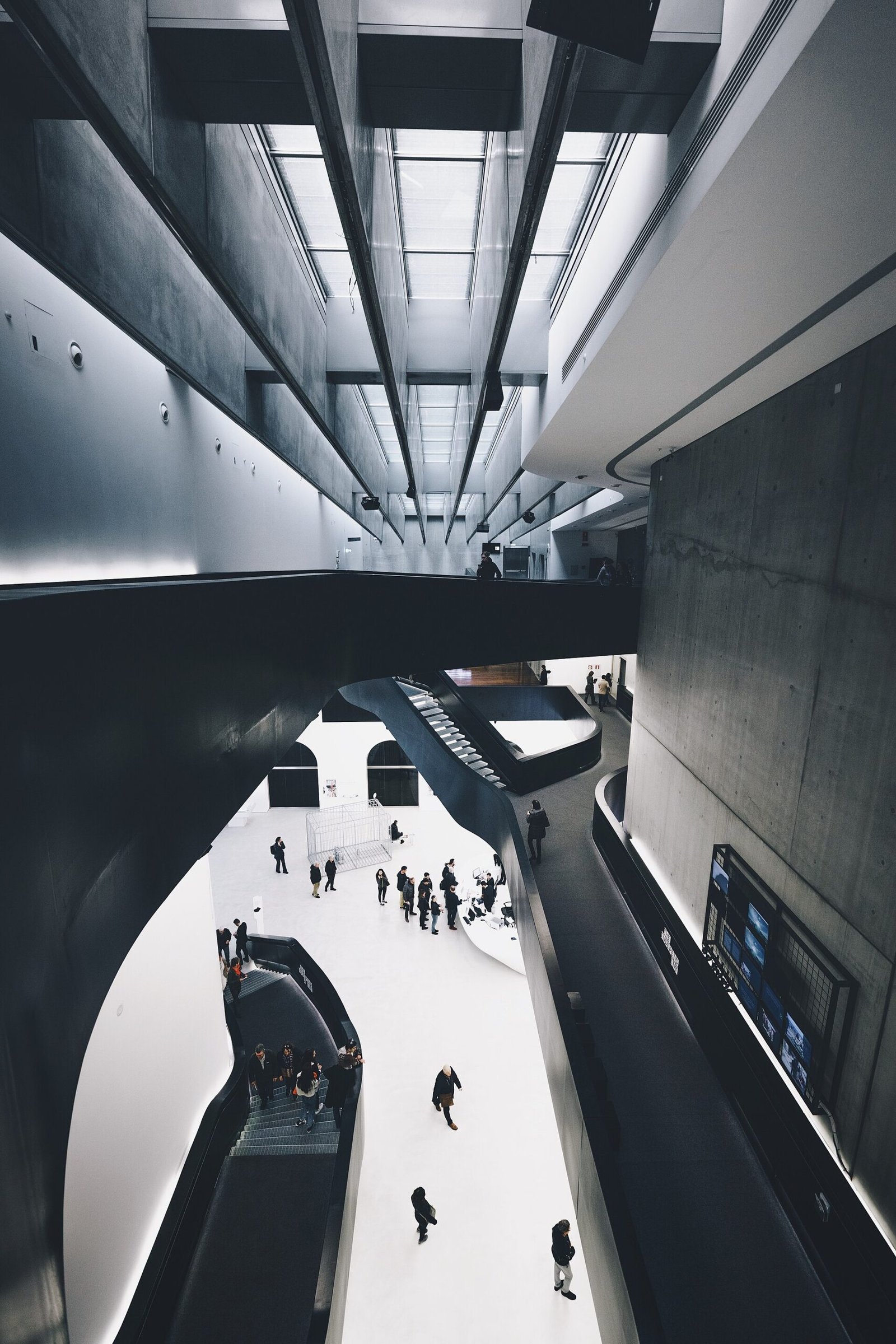
The MAXXI, the national museum of 21st-century arts, is the most obvious starting point. Turismo Roma reconstructs the stages: the idea came from the Ministry of Cultural Heritage in 1997, the international competition of 1998 drew 273 projects and was won by Zaha Hadid, and the inauguration came in 2010. The building is a series of curved volumes that intertwine, with black ramps and stairs suspended in the large entrance hall.
Outside there is a large open square, which Turismo Roma puts at about 29,000 square meters of total area. It's the part of the museum you enjoy without paying: you cross it, you sit, families and students stop there, and on sunny days it becomes a kind of neighborhood courtyard. From the square you can read Hadid's volumes well, in particular the overhang of the highest gallery that juts out toward Via Guido Reni.
Inside, contemporary art and architecture are on display, rotating with the temporary exhibitions. Turismo Roma mentions permanent works by Anish Kapoor, Sol LeWitt and Maurizio Mochetti. The museum produces exhibitions of art, architecture, design, photography and fashion, and hosts film, theater and dance series. There are a library, an auditorium, a cafeteria and educational workshops. The program changes often, and it's best to look at it on the website before deciding.
In our view the MAXXI is overrated as a museum and underrated as a piece of city. The exhibitions are of varying quality, and some are over in half an hour. The building, on the other hand, carries the visit by itself, and the square has changed the way the neighborhood uses its streets. If time is short, it's better to walk around the building, step into the hall and decide there if the ticket is worth the current exhibition.
The Auditorium Parco della Musica Ennio Morricone is the complex of concert halls designed by Renzo Piano and handed over to the city, according to Turismo Roma, on December 21, 2002. Three large halls are arranged around an open-air cavea, and from outside they look like three enormous closed shells. The halls are named Santa Cecilia, Sinopoli and Petrassi. The open-air cavea is named after Luciano Berio.
The capacities published by Turismo Roma give the measure of the complex: 2,742 seats in the Santa Cecilia hall, 1,133 in the Sinopoli, 673 in the Petrassi, 2,782 in the cavea, 350 in the Teatro Studio named after Gianni Borgna. Around it is the Claudio Abbado garden, about 38,000 square meters of public green space with Mediterranean plants and urban vegetable gardens. The complex also houses a media library with about 130,000 volumes and historical archives.
The common areas follow the hours published by the operator: from October to March from 11 to 18, Sundays and holidays from 10 to 18, from April to October from 11 to 20, Sundays and holidays from 10 to 20. The archaeological finds that emerged during construction are displayed in the Archaeological Museum set up in the foyer. The operator warns that access to museums and halls varies according to the calendar.
The official guided tours cover the complex's structure, acoustics, art, music and archaeology. On Saturdays they start at 11:30 in Italian and at 12:30 in English, on Sundays and holidays at 11 with the family route, at 11:45 in Italian and at 12:45 in English. You book by email at visiteguidate@musicaperroma.it or at the number 06 80241281, for individuals by 12 noon on the preceding Thursday. They may be canceled because of performances or lack of sign-ups.
The simplest way to get into the halls remains buying a ticket for a concert. The calendar and sales are on the Auditorium's website. According to Turismo Roma's description, the Santa Cecilia hall is designed for symphonic music, the Sinopoli for symphonic and chamber music, the Petrassi for chamber concerts, theater and cinema. The cavea works both as an open-air theater and as a square, and between one show and the next you cross it like a public space.
Palazzetto, Stadio Flaminio and the Olympic Village: what can you see from outside?
The Palazzetto dello Sport in Piazza Apollodoro is the most beautiful building in the neighborhood, and you get it in five minutes. A ribbed reinforced-concrete dome rests on a ring of inclined Y-shaped struts, which hold it up like an open umbrella. Wanted in Rome credits the design to Annibale Vitellozzi and the structure of the dome to Pier Luigi Nervi, with inauguration in 1957. In Rome it's also called PalaTiziano, after Viale Tiziano.
At the 1960 Games the Palazzetto hosted several disciplines, basketball in particular, and later volleyball matches. It stayed closed from 2018 because of damage from neglect and vandalism. Wanted in Rome tells of the reopening on October 15, 2023, after works begun with a budget of 3 million and completed with another 2 allocated by the City. At the reopening Roma Volley and the Luiss basketball team played there. You can only enter for matches and events.
The best way to understand it is to walk around it. From Piazza Apollodoro you see the dome resting on the inclined supports, from Viale Tiziano the low, wide profile that leaves room for the sky. Anyone who goes in for a match sees the inner face of the dome, with the ribs that made Nervi's structure famous. Without an event scheduled you stay outside, and the doors are closed.
Stadio Flaminio is a few minutes' walk from the Palazzetto. It was designed by Pier Luigi Nervi and his son Antonio, inaugurated in 1959 for the 1960 Olympics, intended for soccer and able to hold about 50,000 spectators, with gyms and a swimming pool. The website of the conservation plan drawn up by Sapienza, with a contribution from the Getty Foundation's Keeping It Modern program, describes it as in a state of serious decay after years of neglect.
The state of things in 2026: the stadium remains closed, and Lazio has proposed turning it into its own ground. On September 11, 2026 the city councilor for Major Events and Sport Alessandro Onorato declared the Conferenza dei servizi concluded, according to the Corriere dello Sport, with the resulting administrative acts still to be completed. Timing and construction have not been announced. You look at it from the street, above all the grandstand canopy, without looking for gaps to get in.
The conservation plan was approved on June 1, 2017 and came out of the work of two Sapienza departments, one of structural engineering and one of architecture, with the support of the Getty Foundation's Keeping It Modern program. The plan treats the stadium as a work to be preserved, and not as an old facility to be replaced. Any reuse project will have to deal with the protection that covers the building and with its original reinforced-concrete structure.
The Olympic Village occupies about 35 hectares between Flaminio and Parioli, near Villa Glori and the Tiber. Turismo Roma attributes it to five main designers, Vittorio Cafiero, Adalberto Libera, Amedeo Luccichenti, Vincenzo Monaco and Luigi Moretti, and dates it to 1958-1959. It was built to house about 8,000 people among athletes, coaches, organizers and journalists of the 1960 Games.
There were 1,348 housing units, divided among small two-story buildings called crocette, four- or five-story buildings and long blocks raised on pilotis. After the Olympics the INCIS assigned the homes to public employees. When the agency was dissolved in 1972, they passed to the IACP, which put them up for sale in 1985. Since then the Village has been almost entirely private property. You cross it on the public streets, without going into the courtyards and condominium gardens.
Above the Village runs the Corso di Francia viaduct, about one kilometer long, also signed by Pier Luigi and Antonio Nervi. Turismo Roma counts 112 pillars. Seen from below, among the houses, it is one of the most successful structures in the neighborhood: the pillars hold the deck above the houses and mark out the road like a colonnade. The viaduct leads toward the Ponte Flaminio and the Tor di Quinto bank.
Anyone who loves postwar architecture finds here the clearest comparison between a public neighborhood and big works. The other great public building site of 20th-century Rome is EUR, where you find the Palazzo dei Congressi and the Palazzo dello Sport. For public housing, on the other hand, the site has Corviale and Garbatella, two opposite ways of building homes for the city.
My advice for visiting Flaminio
My advice is to choose a single interior and give the rest of your time to the street. The most sensible combination, in our view, is the MAXXI in the morning, when the square is still quiet, then the walk to Piazza Apollodoro for the Palazzetto, the Olympic Village and the Auditorium. Anyone who prefers antiquity does the opposite: Villa Giulia at the 8:30 opening, then the 20th century on foot in the afternoon.
On Saturday and Sunday it's worth fitting in the Auditorium's guided tour, the only way to see the halls empty and understand how the acoustics work. It has to be booked by Thursday. Monday, on the other hand, is the wrong day: the MAXXI and Villa Giulia are closed, and only the exteriors remain. On match days at the Olimpico, on the other bank, the traffic and the crowd on the bridges make the walk along the Tiber much less pleasant.
Comfortable shoes and water. The distances are long, the neighborhood is flat but Via Flaminia is busy along its whole length, and in summer there is little shade between Piazza Apollodoro and the Auditorium. Bring your public transport ticket: to get back toward Piazzale Flaminio from the Olympic Village or from Ponte Milvio, it's better to hop on a bus than to walk the whole way again.
Anyone with a free evening can close the tour with a concert at the Auditorium. In the evening the complex changes face: the halls fill up, the cavea and the garden become the audience's meeting point, and the neighborhood around comes alive. It's best to buy the ticket on the official website a few days ahead and arrive by public transport, because on the nights of big concerts the access roads get congested.
How much does it cost and how do you book?
Streets, squares, bridges, the MAXXI square, the Auditorium garden and the churches are free to see. You only pay to get into the museums and for the Auditorium's guided tours. The table summarizes the rates and hours published by the operators. For the MAXXI the prices shown apply to the MAXXI Replay formula, with unlimited entries for 15 days, in force until September 20, 2026. Later rates should be checked on the museum's website.
| Place | Published price | Published hours |
|---|---|---|
| MAXXI, Via Guido Reni 4 | €15 at the desk, €12 online, free under 18 (until September 20, 2026) | Tuesday-Sunday 11-19, closed Monday, May 1, December 25 |
| Museo Etrusco di Villa Giulia, Piazzale di Villa Giulia 9 | €13 full price, €2 reduced, free the first Sunday of the month | Tuesday-Sunday 8:30-19:30, last entry 18:30, closed Monday |
| Auditorium, guided tour | €15, €12 over 65, €7 under 26 and students | Saturday, Sunday and holidays, by reservation by Thursday |
| Santa Croce in Via Flaminia | Free | Weekday Masses 9 and 18:30, Saturday 19, Sunday 9, 10:30, 12, 19 |
There are three official channels. For the MAXXI, the museum's website sells online and answers at the toll-free number 800266300, every day from 10 to 19. For Villa Giulia, the Etruscan Museum's website and the number 06 3226571. For the Auditorium, the Auditorium's website, which also publishes the concert calendar. At the MAXXI the online ticket cost €3 less than the one at the desk.
Another well-known fact, yet rarely mentioned
Everyone knows that Rome hosted the Olympics in 1960. It is less often remembered that Flaminio is the neighborhood where those Games can still be read as a whole. The Palazzetto, Stadio Flaminio, the Olympic Village and the Corso di Francia viaduct were conceived together and built between 1957 and 1959, a few minutes' walk from one another. The Foro Italico and the Olimpico, on the other bank, already existed before.
Seen in sequence, the four interventions tell a precise idea of the city. Exposed reinforced concrete, structures that show how they carry their own weight, quality public housing designed by leading architects. Then the neighborhood took different paths: the Palazzetto came back into use, the Stadium stayed closed, the Village became a piece of private city. Anyone who comes here for Olympic architecture finds all three outcomes.
The second rarely cited fact concerns names. The Auditorium bears the name of Ennio Morricone, the pedestrian bridge over the Tiber that of Armando Trovajoli, since May 2013, after the composer's death in February of that year. In a few years Flaminio has become the music neighborhood of Rome, with Renzo Piano's concert halls, the Teatro Olimpico and the bridge that carries the title.
The right photo to take in Flaminio
The most successful photo is the Palazzetto dello Sport seen from Piazza Apollodoro, slightly on the diagonal, so that the Y-shaped struts repeat toward the back of the frame. The best light comes in the late afternoon, when the raking sun draws the ribs of the dome's edge. A wide-angle lens helps, but isn't needed: even with a phone the rhythm of the supports carries the composition by itself.
The second is the MAXXI from the far end of the square, with the overhang of the upper gallery cutting across the sky. Early in the morning the square is almost empty and the pale concrete surfaces catch a soft light. Inside, if you have a ticket, the hall with the suspended black stairs is the shot everyone takes, and with good reason. Respect the staff's indications about the exhibitions, where photography is not always allowed.
The third is the Ponte della Musica at sunset, photographed from the quay or from Lungotevere Flaminio, with the two inclined steel arches and the outline of Monte Mario in the background. Alternatively, from the middle of the bridge you frame the Tiber toward the north, with Ponte Milvio in the distance. Avoid photos inside the Olympic Village that capture windows, balconies and people: they are lived-in homes.
How do you get there from central Rome?
The starting point is Piazzale Flaminio, the Flaminio stop of metro A, just outside Porta del Popolo. From there line 2 leaves toward Piazza Mancini, going up the neighborhood along Via Flaminia. In summer 2026 Roma Servizi per la Mobilità reported the line replaced by buses because of works on Viale delle Belle Arti. Before leaving, check the service status on the Atac website or on romamobilita.it.
From Termini station, metro A in the direction of Battistini reaches Flaminio in a few stops, with no changes. From St. Peter's and the Vatican Museums you take the same line in the direction of Anagnina and always get off at Flaminio. Anyone staying in the historic center can walk to Piazza del Popolo and exit through the gate. For the Auditorium, the Olympic Village and Ponte Milvio it's then best to hop on a surface vehicle along Via Flaminia.
On foot from Piazza del Popolo to the MAXXI you walk along Via Flaminia, a straight, busy road without big stops. It's more pleasant to go down to Lungotevere Flaminio, in the shade of the plane trees, and climb back up toward Via Guido Reni. From Villa Borghese you instead come down through the Villa Giulia valley, passing in front of the Etruscan Museum, the Galleria Nazionale d'Arte Moderna and the Romanian Academy, to reach Via Flaminia.
By car the neighborhood is not advisable, especially on match days at the Olimpico and on concert nights at the Auditorium, when the streets around Viale Tiziano and Viale de Coubertin fill up. Turismo Roma lists a parking lot among the Auditorium's services. By bike, the Lungotevere bike path and the Ponte della Musica, designed for pedestrians, bikes and public transport, make the tour much more comfortable.
Some important events that happened here in history
The oldest concerns Ponte Milvio. In 312 Constantine defeated Maxentius in the battle that takes its name from the bridge, and the next year, with Licinius, he issued the Edict of Milan on freedom of worship. Here it helps to distinguish three levels. The documents speak of the battle and the victory. Christian tradition adds the vision of the cross before the clash. Legend, repeated over the centuries, makes the bridge the very place of the prodigy.
The second event is from November 30, 1527, the feast of St. Andrew, during the Sack of Rome. A cardinal held hostage by the troops of Charles V managed to escape from the city. Having become pope under the name Julius III, he had the little temple of Sant'Andrea built around 1553 on Via Flaminia, entrusting it to Jacopo Barozzi da Vignola, and in the same years his suburban villa, today Villa Giulia.
The 20th century brings closer dates. The church of Santa Croce was inaugurated on December 29, 1913, consecrated in 1918, and raised to minor basilica by Paul VI in 1964. In 1943 the church came through the bombings unscathed. Between 1957 and 1959 the Palazzetto, Stadium and Village were built, and in the summer of 1960 thousands of athletes lived here during the Games. On December 21, 2002 the Auditorium was handed over to the city, and in 2010 the MAXXI opened.
The most recent years have added more milestones. In May 2013 the pedestrian bridge was named after Armando Trovajoli. In 2017 Sapienza approved a conservation plan for Stadio Flaminio funded by the Getty Foundation. In 2018 the Palazzetto closed, reopening on October 15, 2023. In September 2026 the Conferenza dei servizi on Lazio's project for Stadio Flaminio closed, and for October the start of demolition and remediation in the former barracks on Via Guido Reni is announced.
Who has passed through Flaminio
The first name is Constantine, who after the victory at Ponte Milvio entered Rome along Via Flaminia. Many centuries later Julius III chose this area for his suburban villa and for the little temple entrusted to Vignola. Villa Giulia today houses the National Etruscan Museum, and not far away is Villa Poniatowski, which has a separate page on the site. The little temple of Sant'Andrea was restored by Giuseppe Valadier between 1826 and 1830.
In the 20th century the architects and engineers arrive. Aristide Leonori designed Santa Croce for Pius X, Biagio Biagetti made its facade mosaic with Constantine's victory and the baptistery mosaics. Then Annibale Vitellozzi, Pier Luigi and Antonio Nervi, Adalberto Libera, Luigi Moretti and the other designers of the Village. Later Renzo Piano for the Auditorium and Zaha Hadid for the MAXXI, two international names arriving a few years apart.
In the summer of 1960 the Olympic Village housed about 8,000 athletes, technicians, officials and journalists who had come for the Games. In the neighborhood there is also the Hendrik Christian Andersen Museum, dedicated to the sculptor who gives it its name, with a separate page on the site. Ennio Morricone and Armando Trovajoli, finally, entered the neighborhood with their names on the Auditorium and on the bridge.
Ponte della Musica, Foro Italico and Ponte Milvio
The Ponte della Musica Armando Trovajoli links Piazza Gentile da Fabriano, on the Flaminio side, to Lungotevere Cadorna in front of the Foro Italico swimming stadium. Turismo Roma reports a 1999 design won in an international competition by Buro Happold of London, with Carlo Lotti e Associati, and works begun in 2008. The deck measures 190 meters, 22 wide at the center and 14 at the ends, and rests on two lowered, inclined steel arches.
The bridge is reserved for pedestrians, bicycles and public transport, with a protected central corridor for vehicles. The cost given by Turismo Roma is about 8 million euros. For anyone visiting the neighborhood it is above all a shortcut: in a few minutes it takes you from Flaminio to the Foro Italico, where you see the 1930s sports complex, the Stadio dei Marmi and, in the background, the Stadio Olimpico. You can cross the bridge for free at any hour.
On match days at the Olimpico the Ponte della Musica fills with fans heading to the stadium, and the walk loses all its calm. It's best to cross it at another time, in the morning or at sunset, when you mostly meet runners, cyclists and people walking their dogs. On the other side is the Foro Italico, with a dedicated page on the site that tells its history and how to visit.
Ponte Milvio is reached by going up the embankment or Via Flaminia to the square that bears its name. It is the bridge tied to the battle of 312, rebuilt and restored several times over the centuries. Today it is pedestrian, and the square around it is one of the places of evening life in northern Rome. On the site you'll find a page dedicated to Milvian Bridge, with the history of the bridge and the square.
Villa Giulia, Sant'Andrea and Santa Croce: what remains of Flaminio from before the 20th century?
The National Etruscan Museum is in the suburban villa of Julius III, at Piazzale di Villa Giulia 9. It is open Tuesday to Sunday from 8:30 to 19:30, with the rooms closing at 19 and last entry at 18:30. The museum reports works in progress: since August 11, 2026 the Castellani Gold room and the piano nobile are closed, and since September 15 the route changes in rooms 11, 12, 13 and 14. For information there is the address mn-etru@cultura.gov.it.
The little temple of Sant'Andrea, also called Sant'Andrea del Vignola, stands between Via Luigi Canina, Via Enrico Chiaradia and Viale Tiziano. Turismo Roma describes it as a brick parallelepiped with a peperino facade and an oval dome on an inner drum. Today it is a subsidiary place of worship of the parish of Sant'Eugenio, which you should ask for opening hours and services. The operator does not publish a fixed visiting schedule.
The little temple is small, but it matters a great deal for the history of architecture. Turismo Roma reads it as a synthesis between the central plan dear to the humanists and the longitudinal church that would take hold with the Counter-Reformation. Giuseppe Valadier restored it between 1826 and 1830, and in the 1950s the polychrome floor was redone. From outside you can clearly see the peperino facade and the oval dome emerging from the brick block.
The basilica of Santa Croce in Via Flaminia, at Via Guido Reni 2/D, has a Romanesque-style facade with a portico of six granite columns and Ionic capitals. Inside, three naves divided by granite columns, a ciborium in early Christian taste over the high altar, stained glass by Giuseppe Moroni and the octagonal baptistery designed by Carlo Stopponi in 1961. It has been the seat of the cardinal title of Santa Croce in Via Flaminia since February 5, 1965.
The facade deserves a few minutes even with the church closed. A mosaic frieze recalls the occasion of its construction, and Biagio Biagetti's mosaic stages Constantine's victory and the Edict of Milan. It is a story told in images of the same history that ends farther north, at Ponte Milvio. Read this way, Via Flaminia becomes a Constantinian route, from the church to the bridge, which you can walk in an unhurried morning.
The Masses according to Turismo Roma: on weekdays at 9 and 18:30, on Saturday at 19, on Sunday at 9, 10:30, 12 and 19. In summer the times change, and the parish invites you to ask by phone at 06 3240509. Anyone entering during services stays at the back and waits for the end. Anyone arriving from the center can first go into Santa Maria del Popolo, right before Porta del Popolo.
When is it closed and what not to expect?
Monday is the day to avoid: the MAXXI is closed, as is Villa Giulia. The MAXXI also closes on May 1 and December 25. The Auditorium's guided tours are held only on Saturdays, Sundays and holidays, and can be canceled because of rehearsals, performances or lack of sign-ups. The Palazzetto dello Sport opens only for matches and events. Stadio Flaminio is closed to the public and has no scheduled tours.
Don't expect tourist signage. Flaminio has no signs for visitors and no numbered route. Many places are looked at from outside and some, like the Olympic Village, are lived in. Concert nights at the Auditorium and match days at the Olimpico completely change the neighborhood: crowds, traffic, full buses. Anyone looking for calm picks a weekday morning away from big events.
Don't expect to see everything at once, either. The Etruscan Museum alone needs at least two hours, and with the works under way on the piano nobile the route is reduced. The MAXXI depends on the exhibition. Anyone who tries to do everything, from the museums to the bridges, arrives at Ponte Milvio tired and with no desire to look. Better two visits done well and one long walk than six rushed stops.
On the first Sunday of the month Villa Giulia is free, and free entry brings more visitors than usual. It's best to arrive at the 8:30 opening and start with the less crowded rooms. At the MAXXI, exhibition opening days and evening events change the hours of the spaces, and some rooms may stay closed for installations. Before leaving the usual rule applies: check the operator's website the evening before.
Eating in the area
Flaminio is a neighborhood of offices and residents, and this helps: the restaurants live off everyday customers more than off tourists. The traps are concentrated at the points of passage, around the Auditorium on concert nights and in the square at Ponte Milvio. These are the places with the photo menu in several languages, the barker on the sidewalk and the kitchen open nonstop, with no break between lunch and dinner.
Also be wary of menus without prices, of items priced by word of mouth and of different price lists inside and outside. On match days the places near the bridges change their crowd and sometimes their offering too. The Romans of the area avoid these places for a simple reason: they know that the same amount, a few streets farther on, buys a better meal in a neighborhood place.
The rule is to move two or three blocks away from the big hubs, go in where office workers and families eat and read the written menu before sitting down. At weekday lunch the neighborhood mostly offers quick solutions for people who work in the area. For addresses chosen with care, with no advertising, there is the list of addresses on Google Maps.
What to combine in a day
The most natural combination is with Villa Borghese. From the Etruscan Museum you go up toward the Galleria Nazionale and from there toward the Galleria Borghese, the Museo Pietro Canonica and Piazza di Siena. In the same valley are the British School at Rome and the Romanian Academy, two foreign academies overlooking the valley, to be seen at least from the street.
Anyone arriving from the center can start from Piazza del Popolo, with the twin churches and the climb to the Pincio, then head down toward Flaminio. Anyone coming for the 20th century can add the Ara Pacis, with the contemporary case on the Lungotevere, or move to the Coppedè district, reachable by public transport.
Toward Parioli the greenery of Villa Glori, above the Olympic Village, and farther east that of Villa Ada offer a break after so much concrete. Anyone with children finds ideas in Rome with kids, anyone who wants to spend little in Free Rome, and anyone looking for another neighborhood to walk can read Monteverde, Ostiense or Torpignattara.
Frequently asked questions
Can you visit Flaminio for free?
Yes, for the most part. Streets, squares, bridges, the MAXXI square, the Auditorium garden and the churches are freely accessible during the published hours. You pay to get into the MAXXI, the Etruscan Museum of Villa Giulia and for the Auditorium's guided tours. On the first Sunday of the month Villa Giulia is free, and at the MAXXI the ticket was free under 18 in the formula valid until September 20, 2026.
How long does it take to see Flaminio?
A morning is enough for the exteriors, from the MAXXI to the Palazzetto, the Olympic Village and the Auditorium. Adding a museum takes a whole day. The Etruscan Museum needs at least two hours, the MAXXI from one hour to three depending on the exhibition. Anyone who wants to reach Ponte Milvio and the Foro Italico too must allow for a long walk, to be broken up with line 2 or the replacement bus.
Can you go inside Stadio Flaminio?
No. The stadium designed by Pier Luigi and Antonio Nervi is closed, and the conservation plan website describes it as seriously decayed. In 2026 the administrative process on the project presented by Lazio is under way, and on September 11 the city councilor for Sport declared the Conferenza dei servizi concluded. You only look at it from the street, without trying to get in.
Can you visit the Palazzetto dello Sport?
Only during matches and events. It is a sports facility in use, reopened on October 15, 2023 after five years of closure and restoration works. There are no scheduled tours of the interior. The exterior, with Nervi and Vitellozzi's dome and Y-shaped struts, is easy to see from Piazza Apollodoro and Viale Tiziano, at any hour and without a ticket.
How do you book the Auditorium's guided tour?
By email at visiteguidate@musicaperroma.it or at the number 06 80241281. Individual visitors must book by 12 noon on the preceding Thursday, organized groups on any day of the week. The tours take place on Saturday at 11:30 in Italian and at 12:30 in English, on Sundays and holidays at 11 for families, at 11:45 in Italian and at 12:45 in English. The full price is €15.
Can you visit the Olympic Village?
The Village is a private residential neighborhood. Since 1985 the homes have been almost all owned by the residents. You cross it on the public streets and look at the buildings from outside, with the two-story crocette and the long blocks on pilotis. You don't go into the courtyards and gardens of the apartment buildings, and you avoid photos of windows, balconies and people. Nervi's viaduct is easy to see from below.
Is the MAXXI suitable for children?
Yes, with a few precautions. In the formula valid until September 20, 2026 those under 18 got in free, and Turismo Roma lists educational workshops among the museum's services. The outdoor square is an open space where children move freely, always with an adult close by. The exhibitions change often and some work better than others with the little ones, so it's best to look at the program on the website before going.
What is the best time to go?
A weekday morning between Tuesday and Friday, outside match days at the Olimpico and big concert nights. On Monday the MAXXI and Villa Giulia are closed. In spring and fall the walk is pleasant, in summer there is little shade between Piazza Apollodoro and the Auditorium. Saturday and Sunday are worth it mainly for the Auditorium's guided tours.
Who wrote this and from what sources
The text comes from the editorial team of Tour Leader Pro, the Roman company that designs itineraries, visits and cultural events across Rome and Lazio. The rates, hours and booking methods reported here result from the official sources cited in the text as of the date given at the opening: the websites of the MAXXI, the Auditorium and the Etruscan Museum, Turismo Roma, Roma Servizi per la Mobilità, dated press for Stadio Flaminio and the former barracks. Tell us what you find changed.
Organizing a tour of Flaminio means keeping different operators together: a national museum with online ticketing, a music complex with tours only on weekends, a state museum with works under way, sports facilities open only for matches. For anyone putting together a group trip booking times matter, and a useful resource for people organizing group trips is Tour Leader Pro.
Flaminio is a good chapter for anyone who wants to see the Rome of the 20th century after the ancient and Baroque one, perhaps on a multi-day trip that takes in EUR, Garbatella and the postwar neighborhoods. The rest of Lazio adds villas, villages and lakes a short distance from the city, and a useful resource for building a multi-day itinerary is Italy Planner.