Garbatella
In short. You go to Garbatella to see something that doesn't exist anywhere else in Rome: a piece of the city built all at once starting in 1920 as a garden borgata, made of numbered lots that close around courtyards, external staircases, wash…
You go to Garbatella to see something that doesn't exist anywhere else in Rome: a piece of the city built all at once starting in 1920 as a garden borgata, made of numbered lots that close around courtyards, external staircases, wash houses and vegetable gardens. You arrive by Metro B, Garbatella stop, and you cover it on foot in two or three hours. There are no tickets to buy, no museum, no line. There's an inhabited neighborhood, with people at the windows, and that is both the reason to go and the reason it's worth behaving well.
The founding date is February 18, 1920, the laying of the first stone in Piazza Benedetto Brin. The name, on the other hand, nobody really knows where it comes from: the hypotheses in circulation are four and none is proven. Below you'll find what to look at lot by lot, where Innocenzo Sabbatini’s suburban hotels are, how the Teatro Palladium in Piazza Bartolomeo Romano works, and an unpopular position on the TV-set tourism that over the last 20 years has changed the way Garbatella is looked at.
What Garbatella Is and Where It Really Begins
Garbatella is not a neighborhood of Rome in the administrative sense, however much everyone calls it that. In the municipal place-name system it corresponds to urban zone 11C of Municipio VIII and falls within the Ostiense quarter (quartiere X). This is the first thing that jars for anyone arriving with the idea of an autonomous entity: on paper it's a portion of Ostiense, in the minds of Romans it's a place of its own, with its own birthday and an identity the maps don't record.
The real boundaries are drawn by geography, not by regulation. The historic Garbatella climbs the hills overlooking the Basilica of San Paolo fuori le Mura, those that for centuries were called the Colli di San Paolo. To the north it is closed by Circonvallazione Ostiense, to the east by Via Cristoforo Colombo with the Regione Lazio building, to the south by Via delle Sette Chiese and the front toward Tor Marancia, to the west by Via Ostiense and the tracks.
The elevation change matters more than it seems on the map. From the metro station, which is at the bottom, you climb: stairs, ramps, streets that wind around the contour lines. Anyone arriving thinking they will walk on the flat finds themselves going up and down for two hours, and anyone pushing a stroller quickly discovers that the courtyards of the oldest lots were designed when nobody worried about steps.
Why the Streets Have Sea Names
The streets of Garbatella almost all bear names tied to navigation, missionaries and explorers: Benedetto Brin was a naval engineer and Navy minister, Bartolomeo Romano a sea captain, Luigi Fincati an admiral. It's not a whim. The borgata was born inside a project that included a navigable canal from the Tiber to Ostia and a river port right up against the Aurelian Walls, and the houses were meant to lodge the port workers.
The canal was never dug and the port was never born. What remained were the houses, the residents and a nautical street-name scheme that no longer explains anything to someone reading the signs. Walking through Garbatella reading the street names means reading the industrial project of a Rome that was never realized, laid over a neighborhood that instead came out very well and in a completely different way.
How to Get to Garbatella: Metro, Bus, On Foot
The stop is Garbatella on Metro Line B, and this is the simplest way to get there from Termini or from the Circus Maximus. The current station faces Via Giacinto Pullino and is at street level: opened in 1990, it replaced an earlier facility from 1955 that stood about 200 meters farther on, toward Piazza Giancarlo Vallauri. Coming out, the historic neighborhood is all uphill on the right.
The buses are listed on the website of the Teatro Palladium, the only public body in the area to publish them openly: lines 670 and 715 go along Via Edgardo Ferrati and Via Enrico Cravero, the 673 along Via Francesco Passino. For schedules and detours it's always best to look at the official Atac service, because on these narrow streets roadworks move the stops with little notice. Data checked in September 2026.
On foot, it's an easy approach from Ostiense and Testaccio. From the Pyramid of Cestius and Porta San Paolo you follow Via Ostiense past the Centrale Montemartini, go by the gasometers, and in 25 minutes you're at the foot of the climb. It's an ugly walk in the first stretch and an interesting one in the second, and it helps you understand why this part of the city is called industrial.
By car and by bike
You can drive up, but parking inside the lots is a feat, and a large part of it is reserved for residents. The blue-line spaces on the edge streets fill up early in the morning. If you come by car, it's quicker to leave it near the Ostiense ring road and walk up.
The founding: February 18, 1920, Piazza Benedetto Brin
On February 18, 1920, Ash Wednesday, King Victor Emmanuel III laid the cornerstone in Piazza Benedetto Brin. The mayor of Rome was Adolfo Apolloni, who had followed the project closely and pushed for greenery to be part of public housing. The date wasn't reconstructed after the fact by some historian: it's written on the plaque set into the central building of the square, which is why Garbatella knows the exact day of its own birth.
The inscription names three parties: the king's hand, the Ente autonomo per lo sviluppo marittimo e industriale, and the Istituto delle Case popolari di Roma, with the collaboration of the Cooperative di lavoro. The wording says the neighborhood exists to offer quiet and healthy lodging to the makers of the economic renaissance of the Capital. Translated: decent homes for people who worked, in a Rome that after the Great War was growing faster than it knew how to handle.
The declared model was the English garden city. Low houses, two or three floors at most, private greenery out of all proportion to the built area, real vegetable gardens inside the lots. The reasoning was social too: the workers arriving from the Lazio countryside had to be able to rebuild a form of village life in the city, with the courtyard in place of the square and the garden in place of the field. For 10 or so years it worked almost to the letter.
The name the neighborhood didn't get
Until around 1930 the final name was still under discussion. The alternatives were Concordia, which hoped for social peace, and Remuria, which picked up the tradition that Romulus founded the city on this hill and not on the Palatine. The popular nickname won, which was already on everyone's lips and which nobody had designed. Few urban foundations of 20th-century Italy let themselves be beaten like this by the name of a tavern.
Where the name Garbatella comes from: four hypotheses, none proven
The origin of the name remains open, and anyone who tells it to you as certain is selling you a single version. Four circulate, with very different weight. I report them all as hypotheses, because none has documentary proof that settles the question, and because the confidence with which they're repeated on guided tours is inversely proportional to the papers that support them.
First hypothesis: the gracious innkeeper
The most widespread version tells of an innkeeper who supposedly ran an inn on the rocky spur above San Paolo, on the left side of Via Ostiense coming from Porta San Paolo. She was called Carlotta, or Maria in other accounts. She was so gracious (garbata) to the pilgrims of Via delle Sette Chiese that she earned the name garbata ostella, later shortened to Garbatella. The bas-relief in Piazza Geremia Bonomelli is said to depict her.
Second hypothesis: the pleasantness of the place
A second explanation, weaker, derives the name from the pleasantness of the spot: garbati lands, agreeable, well kept. It's the hypothesis that holds up least, because it rests on no document and looks very much like a late rationalization, built when the name was already in use and a presentable explanation was being sought. I mention it for completeness, not because I support it.
Third hypothesis: the vine grown a garbata
The third is the one with some agronomic basis. On the lands of the so-called Tenuta dei dodici cancelli (Estate of the 12 Gates), which included today's Via delle Sette Chiese, a type of vine cultivation called a barbata or a garbata was used, in which the vines lean on maple or elm trees. In the 19th century the lands belonged to Monsignor Alessandro Nicolai, minister of agriculture under Pope Gregory XVI.
Fourth hypothesis: the mother's surname
The fourth is the most recent and also the most interesting from the point of view of method. In the volume Garbatella 100, il racconto di un secolo, published by Iacobelli in 2019 and edited by Gianni Rivolta, Giorgio Guidoni's study identifies the innkeeper as Clementina Eusebi, who ran the tavern between 1835 and 1850, and derives the nickname from her mother's surname, Maddalena Garbata, widow Eusebi: Garbata the mother, Garbatella the daughter.
The sources also differ on the position of the tavern. The traditional version puts it on the spur above San Paolo, level with the Ostiense burial ground. The 2019 reconstruction places it on Via Ostiense halfway between the pyramid and the basilica, where Via degli Argonauti begins today. Two different places, two different chronologies. Anyone who tells you the exact spot is known is improvising.
A curiosity about Garbatella
The garden suburb was designed for the workers of a port that never existed. The navigable canal that was supposed to link Rome to Ostia, promoted by the planners led by Paolo Orlando, would have run parallel to the Tiber and brought commercial ships to less than 200 meters from the Aurelian Walls, around today's Via del Porto Fluviale. The houses were built, the canal wasn't.
The result is a working-class neighborhood born with the wrong center of gravity. Its residents weren't dockworkers but laborers, railway workers, civil servants, and later families displaced from the historic center. The streets kept being named as if the port were there, though, and even today you can read a maritime geography in the middle of an area with no water. Few cities have an urban fossil this legible out in the open.
The lots: how Garbatella is laid out, courtyard by courtyard
Garbatella is counted in numbered lots, not blocks. Each lot is a group of buildings arranged around one or more courtyards, with outside stairs, walkways, covered passages, and originally with wash houses, drying areas, workshops, and cellars. The courtyard wasn't decorative: it was the place where laundry was hung, clothes were washed, chairs were kept, people talked. Anyone who enters a courtyard today is entering someone's shared living room.
The numbering doesn't follow a clean geographic order, and this is disorienting. The low-numbered lots broadly correspond to the oldest phases around Piazza Benedetto Brin, but there are exceptions everywhere, and some of the oldest lots were demolished in the 1970s during the season of building speculation. The plaques with the lot number are still fixed at the entrances, and it's the simplest way to get your bearings.
Lot 24, the model houses
Lot 24 is the one I recommend to anyone short on time. 13 villini, also called casette modello, between Via delle Sette Chiese, Via Giustino de Jacobis, and Via Borri. They were built for the 12th International Congress on Housing and Town Planning in 1929, meaning to be shown to an audience of foreign specialists, and it shows: the care in the detail is above the neighborhood average.
At the entrances there are slabs set into the walls with the names of the architects who designed the individual buildings, which makes lot 24 a kind of signed open-air catalog. The competition was won by the corner building between Via delle Sette Chiese and Via Borri, designed by Mario De Renzi. Stop and read the marbles: it's the only spot in Garbatella where working-class architecture signed itself the way a prestige building does.
Lot VIII and the change of scale
Lot VIII, on Via Luigi Fincati, tells the story of the moment when the project changes face. As Fascism takes hold, the ratio of green to built space drops, the idea of the river port is abandoned, and housing is needed for many more people. Construction starts to go taller and denser, with buildings that look more like modern apartment blocks than the little houses of the early years. The comparison a few hundred meters away is brutal.
The transitional lots and the modern ones
Lot 27 is the intermediate step: the decorative apparatus thins out, the courtyard layouts remain, but the language gets drier. The last lots built, 39 and the series 57, 58, 59, and 60, reach openly declared experiments of the modern movement. In less than two square kilometers you therefore cross the whole arc of Italian architecture between the wars, from barocchetto to rationalism, without taking public transport.
Two plaques to look for
At lot 28, at Via Guglielmo Massaia 22, a travertine slab remembers Iole Zedde, 16 years old, killed on September 12, 1944 by a burst of fire from a German soldier guarding the railcars at Ostiense station. At lot 31, near the Carlotta fountain, a second plaque remembers the singer Alvaro Amici. They were unveiled on September 8, 2007, during the notte bianca, on the initiative of a neighborhood association.
Barocchetto and the Roman school: Giovannoni, Sabbatini, and the others
The style of the first lots is called barocchetto, and the name was given to it by the designers themselves. Gustavo Giovannoni and Innocenzo Sabbatini used it to indicate a repertoire of moldings with a medieval flavor, animals in the friezes, floral and botanical decoration, applied however to public housing and therefore poor: instead of marble, stucco and white lime. It's baroque by citation, not by materials.
Alongside Giovannoni and Sabbatini worked Costantino Costantini, Massimo Piacentini, Mario De Renzi, and Felice Nori. Massimo Piacentini, not to be confused with the better-known Marcello, whose second cousin he was, spent his whole career inside the Istituto per le Case Popolari and after World War II became its director general. This is the team the textbooks call the Roman school, and Garbatella is the place where you see it at work in full.
Sabbatini, though, had a complicated relationship with barocchetto. The biographical sources describe him as critical of that language, even though he worked within it in the first interventions at Garbatella and then at Montesacro, and his later output goes in the opposite direction. Anyone who presents Garbatella as a compact stylistic block is simplifying: inside the building site there was a debate, and the late lots bear its mark.
Who Innocenzo Sabbatini was
Innocenzo Sabbatini was born in Osimo on March 19, 1891 and died there on October 7, 1983. He joined the design office of the Istituto per le Case Popolari and in 1927 became its head. In those years he signed the works at Garbatella that are studied today: the buildings of 1920 completed in 1922, the public housing of lot 10, five buildings of lot 13, the public baths building with artists' studios finished in 1929.
On the end of his relationship with the Istituto the sources differ. The encyclopedic biography has him resigning in 1929 and leaving for good in 1931. The profile in the Dizionario Biografico degli Italiani places the resignation in 1931, attributing it to clashes with Alberto Calza Bini, president of the Istituto, and notes a resumption of relations in 1940. The two versions can't be reconciled and it's best to report both. The profile can be read on Treccani.
The suburban hotels, the neighborhood's most radical invention
The suburban hotels are the most serious thing you see in Garbatella and the least understood. They are four buildings, known as Albergo Rosso, Bianco, Giallo, and Beige, designed by Sabbatini starting in 1927 and completed in 1928, near Piazza Eugenio Biffi. They weren't hotels in the commercial sense: they were temporary collective housing for families thrown out of their homes by the demolitions in the historic center.
The logic is that of an emergency turned into a building type. People evicted for the demolition of the Spina di Borgo, which would make room for Via della Conciliazione, or for the opening of Via dei Fori Imperiali, ended up here waiting for a settlement. Shared services, rooms, collective spaces. The idea of designing a temporary structure for the poor with architectural dignity is, in 1927, rather out of the ordinary.
The value recognized in these buildings is not a recent reappraisal. At the first Esposizione Italiana di Architettura Razionale, held in Rome in 1928, the first of the suburban hotels was one of only three built works brought to the show. The following year, at the international congress of 1929, the visit to the hotels received explicit praise, together with the kindergarten building in Garbatella, also by Sabbatini.
On the number, the sources don't agree, and it's worth saying so. The most detailed reconstruction speaks of four lots called Alberghi, with the Beige next to the three most often cited, while part of the local popularization counts only three, Rosso, Bianco, and Giallo. The architectural bibliography on Sabbatini indicates four suburban hotels completed in 1928. I report the divergence without resolving it.
What you see today
Today the hotels are inhabited residential buildings and can't be visited inside. The Albergo Rosso is the one you recognize at once, with its curved front and the color that gives it its name, and it's also the one with the most specialist literature. You look from the street and the square, you photograph from outside, and you stop there. Ringing doorbells to see the entrance hall is bad manners, not curiosity.
Near Piazza Eugenio Biffi there is also a little bridge of medieval appearance, one of those scenic elements the neighborhood built onto itself in the early years. It's not an ancient bridge reused: it's part of the scenic repertoire of the garden suburb. Anyone who photographs it thinking they've found a medieval survival is making a mistake the neighborhood has encouraged for a century.
One thing nobody tells you about Garbatella
The houses of the historic lots are, to a very large extent, public residential housing, managed today by the regional agency that inherited the Istituto per le Case Popolari. They aren't private buildings with a doorman and an ornamental gate. Assigned families live inside, often for three generations, and the courtyards are the shared spaces of those families, not courts open to the public.
This information changes the way you visit. The boundary between street and courtyard in Garbatella is often physically nonexistent: there's no main door, you just walk in. But the fact that you can enter doesn't mean you should. It's best to stay on the threshold, look, explain from there, and enter only where there's no laundry hanging and no open windows a meter away.
The second thing that doesn't get said concerns the demolitions. Part of the oldest lots around Piazza Benedetto Brin no longer exists: it was torn down in the 1970s, in the season that Rome remembers as the sack of the city. What you visit today as an intact neighborhood is a neighborhood already mutilated, and the comparison with period photographs is merciless.
The third concerns the original social context. A few hundred meters away, where Tor Marancia is today, stood the shantytown the Romans called Shangai. Garbatella, with its courtyards and its gardens, was the good version of working-class housing, and it stood within sight of the terrible version. Pasolini set the pages of Una vita violenta around there, and he wasn't inventing a geography.
Piazza Benedetto Brin, ground zero
Piazza Benedetto Brin is the place of the cornerstone and the spot from which it's best to begin the visit, even though it isn't the most beautiful square. The plaque of 1920 is set into the central building: read it, because it's the neighborhood's founding document and can be consulted free, outdoors, with no reservation. Around it remain some of the oldest lots to have survived the demolitions.
The ratio of green surface to built surface, in these first lots, was among the highest in Italy at the time. You can still see it, even though time and upkeep have eaten away quite a bit. Look at the proportions between the house and its piece of land: that's the building translation of a political idea, namely that the worker should have a garden and not just a bed.
Piazza Bartolomeo Romano and the Teatro Palladium
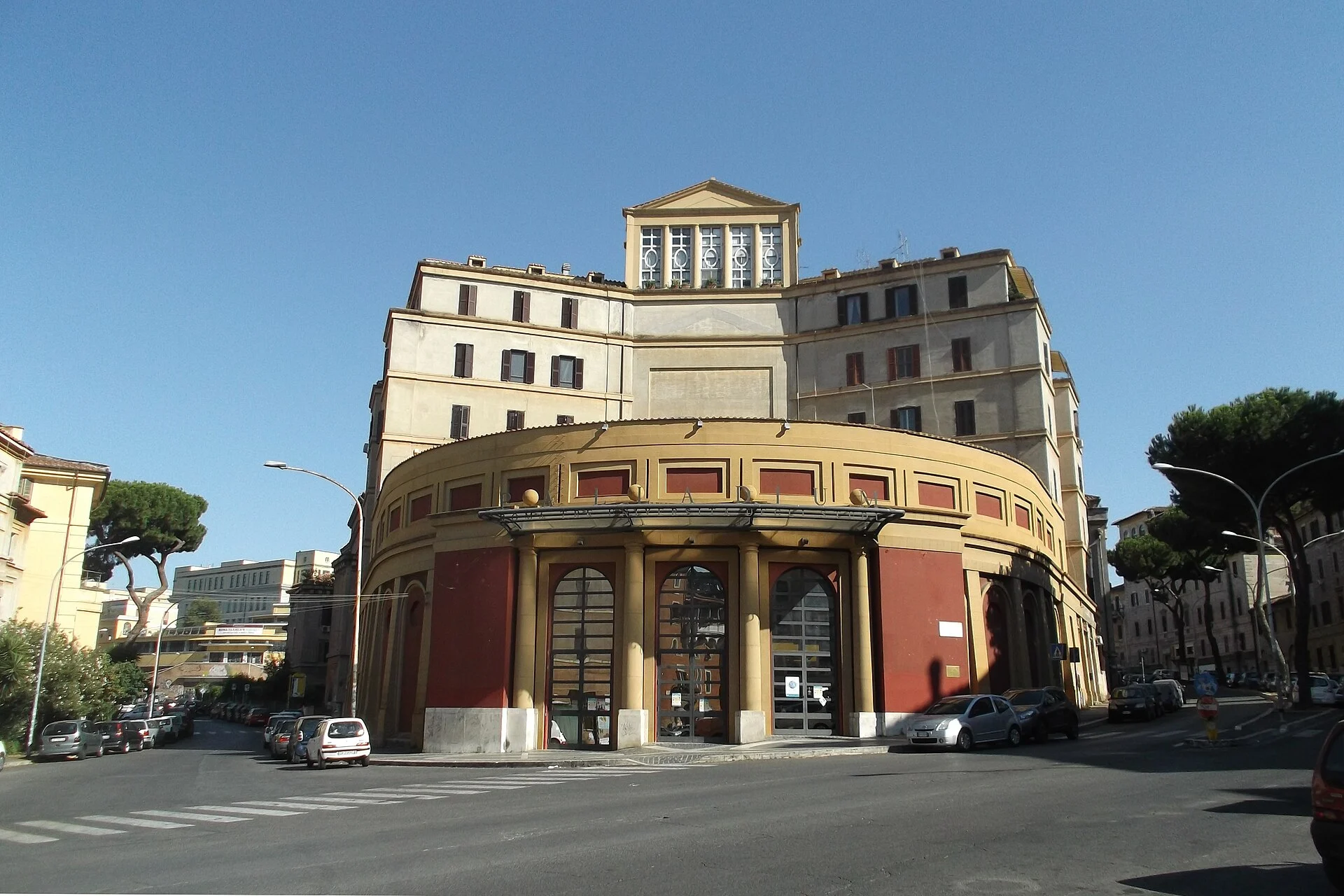
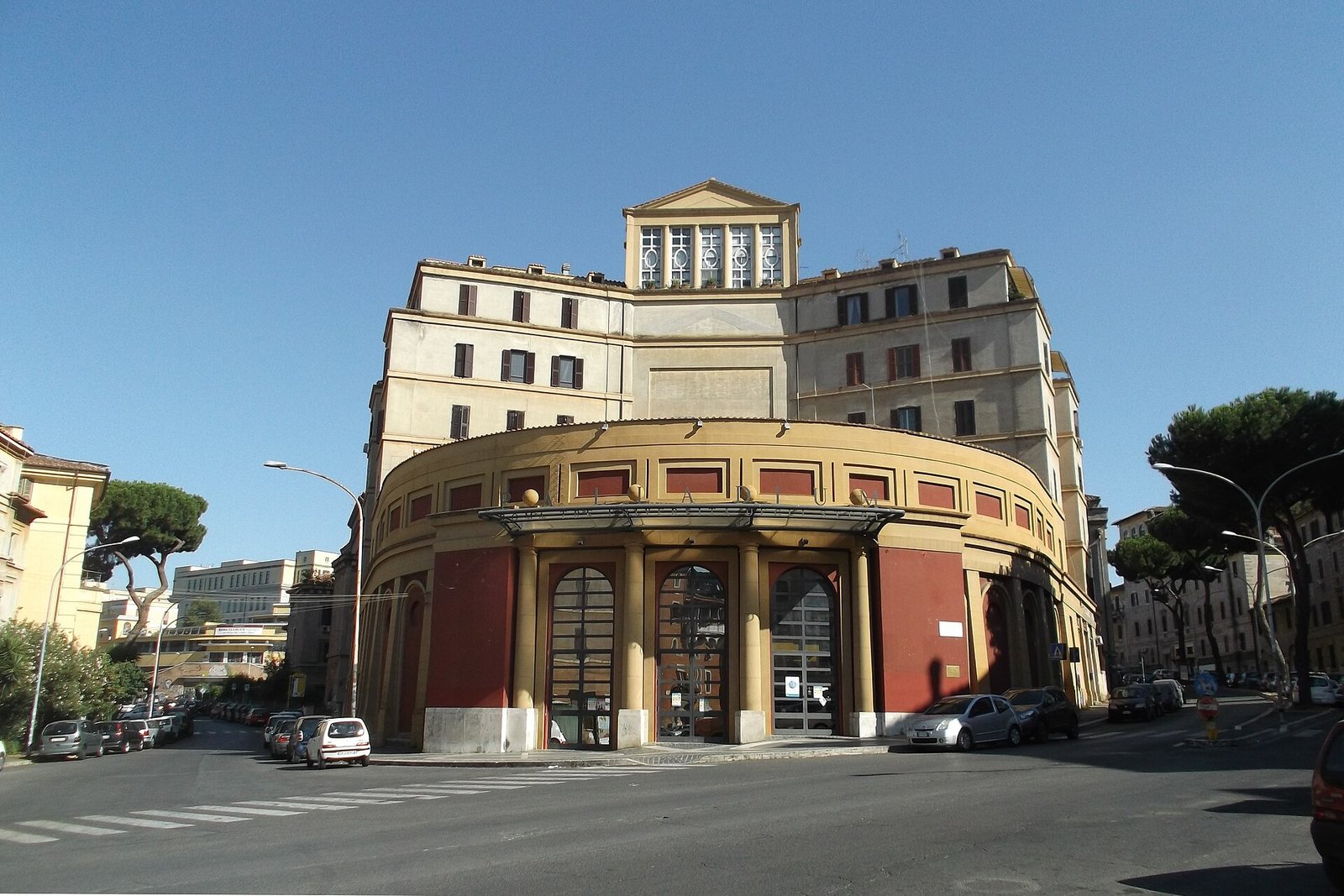
Piazza Bartolomeo Romano is the square where Garbatella becomes a city. It's dominated by the Teatro Palladium, at Piazza Bartolomeo Romano 8, postal code 00154. The building began as an Istituto per le Case Popolari complex that held together a movie theater and apartments: a project by Innocenzo Sabbatini from 1927, completed in 1930. Its original name was Cinema Teatro Garbatella.
From neighborhood cinema to university
The hall closed in the summer of 2000 and risked becoming a gaming room. The Università degli Studi Roma Tre first rented it and then bought it in 2001, starting a restoration and adaptation project overseen by Luciano Scacchi and Richard Peduzzi, which brought back the original reddish-brown color outside and inside. The official reopening took place on October 15, 2003, in the presence of President Carlo Azeglio Ciampi.
For 10 years, from 2003 to 2014, the programming was run by the Fondazione Romaeuropa. Today the Palladium is the university's hall, tied to the activities of the degree program in arts and performance, and at the same time a theater open to the public with a season of drama, dance, cinema, and music. The program can be checked on the official site of the Teatro Palladium.
Tickets and hours
Tickets have a full price that runs from 5 to 20 euros depending on the show, a reduced price at 12 euros, and a reduced student price at 8 euros. Reductions apply only at the theater box office and not online, and on 5 euro shows there are no reductions. The box office opens two hours before each performance. Prices checked on the official tickets page in September 2026.
Online sales go through an outside platform named by the theater, while for some dance series the sales circuit changes. You can't reserve seats: you buy and that's it. A refund is provided only in case of cancellation or suspension before the intermission. Anyone who arrives without a ticket on a night with a strong lineup risks being left out, because the hall isn't big.
It's worth planning the visit to Garbatella for an evening when something is on at the Palladium. You walk the neighborhood in the afternoon light, have dinner nearby, and go into the theater at nine. It's the only way to see Sabbatini's building from the inside with a ticket of 8 or 12 euros, and to see the square when it fills up with students.
The advice I give you for visiting Garbatella
Go early in the morning on a weekday, between 8 and 10. It's the only time slot when the neighborhood really works: kids go into school in Piazza Damiano Sauli, the shutters go up, people come out of the courtyards with their shopping. After 11 Garbatella empties out and turns into a stage set, which is exactly what visitors photograph and what tells you nothing.
The second piece of advice is not to do the tour of the sets. There's an informal route, passed along online, that touches the locations of a very popular TV series and of a Nanni Moretti film. It works like a treasure hunt and is used up in 40 minutes, leaving you with the idea of having seen Garbatella. You haven't seen it: you've seen four shots. The neighborhood is something else and takes more effort.
Third: bring shoes that grip. The outside stairs, the slopes, and the paving of the lots are uneven, often wet in the morning hours, and without handrails. The two things that cause the most trouble are smooth soles and the expectation of doing the whole route in an hour. You need at least two and a half.
How much time you need
For the minimum loop, meaning Piazza Benedetto Brin, lot 24, Piazza Bartolomeo Romano, and back to the metro, 90 minutes is enough if you walk briskly. For a loop that also includes the suburban hotels, Piazza Damiano Sauli, the Carlotta fountain, and Via delle Sette Chiese, you need three hours. Anyone who wants to add the Catacombs of Commodilla has to allow half a day and a reservation.
What to pair it with
The pairing that works best is with the Basilica of San Paolo fuori le Mura, which is one metro stop away and which closes the story about the pilgrimages and Via delle Sette Chiese. The second sensible pairing is with the Museo della Via Ostiense inside Porta San Paolo, which explains the road on which all this took shape and costs little.
Another well-known fact, yet rarely cited
Everyone knows that Garbatella is historically a left-wing, working-class neighborhood, and that during the German occupation the Resistance found support there, as in Ostiense, Portuense, and Testaccio. What is rarely cited is that the neighborhood's vote, in the elections of the last 30 years, has shifted a lot, with major results for very different political forces.
The fact is useful for taking apart a postcard. Garbatella is told as an immobile social block, with the party branch, the choir, and the street festival, and this image is liked because it's reassuring. The reality is that the neighborhood has changed its makeup quite a few times: the would-be dockworkers, the displaced from the center, immigration from Lazio, civil servants, the students of Roma Tre, and in the last 20 years, those who bought.
A second fact rarely cited concerns women. In the postwar period a mutual aid society called Le Sgarbatelle was born here, formed spontaneously by the women of the neighborhood: with the dues each one paid, they helped families in difficulty. In 2018 the neighborhood dedicated a public memorial initiative to them. It's a story of welfare from below that in accounts of the neighborhood almost always ends up in a footnote.
The right photo to take in Garbatella
The photograph everyone takes is the staircase known as the Innamorati, with the Carlotta fountain in Piazza Ricoldo da Montecroce. It's beautiful and worth doing, but it's also the most predictable and the one that fills every feed. If you take it, take it early in the morning, when the light comes in low and there aren't six other people waiting their turn on the same step.
The photograph that tells more is another: the curved front of the Albergo Rosso from the square, in mid-afternoon, with the color glowing and the windows lived in. In a single frame you have the social project, Sabbatini's architecture, and the fact that people live inside. It's an image that doesn't work as a postcard, and for that reason it's more honest.
What not to photograph
Don't photograph inside the courtyards with recognizable people, don't photograph windows up close, don't use a drone. The courtyards are spaces of domestic life, and in Rome the residents' patience on this point has worn out. A camera pointed at a walkway where someone is hanging sheets is not urban documentation: it's walking into someone else's home without knocking.
Sets, postcards, and gentrification: a position
Here the position goes against the dominant narrative. Garbatella is sold as the authentic Rome, the last real working-class neighborhood, and this label has become the main engine of its change. Every time a guide, a TV series, or a video presents it as authenticity to be consumed, demand rises from people who want to live in it, rent in it, photograph it. Declared authenticity is the first step toward its end.
Set tourism is the poorest form of this dynamic. The TV series that for years used a club in Piazza Giovanni da Triora for the exteriors of a wine bar, and the elementary school in Piazza Damiano Sauli for the high school, has brought thousands of people here looking for a place that doesn't exist. They come for a fiction, stay 40 minutes, and look at neither the lots nor the hotels.
The uncomfortable thing to say is that this fiction also did some good. It made the neighborhood known, brought attention, and helped keep some buildings from ending badly. I'm not against it out of snobbery. I'm against it because the set visit produces consumption of an image with no understanding at all, and because the bill for that consumption is paid by the residents in the form of pressure on rents.
On the gentrification front, Garbatella has a defense that other neighborhoods don't have: public ownership of a large share of the historic housing. It can't be freely bought and resold, and this slows the replacement of residents. The turnover then goes through the margins, through private houses on the edges of the neighborhood, through apartments put to short-term rental, through ground floors that have been converted.
The forecast, in our judgment, is that Garbatella won't become Trastevere. It will become something more insidious: a neighborhood that keeps the shell and loses the content, where the courtyards stay identical in the photographs and the people who live in them are different ones. If you want to be decent visitors here, shop at a neighborhood store, spend your money at the theater, and don't go into the courts.
One last unpopular thing. Paid guided tours that bring groups of 20 people into the courtyards of the inhabited lots are a wrong practice, even when respected guides run them. A group that size in a shared residential space is an invasion, however polite. Large groups should be kept on public streets and let in only where there's no domestic life right on top of them.
Some important events that happened here in history
The laying of the cornerstone on February 18, 1920 remains the founding event, with the king, Mayor Adolfo Apolloni, and the two sponsoring bodies. From that day the neighborhood has a written birth certificate, and the plaque in Piazza Benedetto Brin is the material proof of it. No other piece of modern Rome has a founding ceremony documented with this precision.
The international congress of 1929 on housing and town planning was the second decisive moment. Rome hosted specialists from all over Europe and took them to see Garbatella: lot 24 was built for that occasion, and the suburban hotels and Sabbatini's kindergarten received explicit praise. For a few years this suburb was an international reference on public housing, and not a local curiosity.
The demolitions in the center between the 1920s and 1930s poured into this area the families driven out of the Spina di Borgo and Via dei Fori Imperiali zone. It was a forced transfer that changed the makeup of the suburb and gave it the reputation as a neighborhood of long-time Romans that it still carries. The suburban hotels were the architectural answer to that emergency.
During the German occupation the neighborhood was a base of support for the Resistance, together with Ostiense and Portuense. The plaque for Iole Zedde at lot 28 remembers one of the episodes of those months: a 16-year-old girl killed on September 12, 1944 at Ostiense station. The stories of that period are still told here in the courtyards, and it's one of the few cases where oral memory holds up.
On December 3, 1978 John Paul II chose the church of San Francesco Saverio in Garbatella, in Piazza Damiano Sauli, as the first Roman parish to visit after his election. He said that a particular memory tied him to that place: in 1946 he had been a confessor there. The church, from 1933 to a design by Alberto Calza Bini, is a cardinal's titular church and remains the neighborhood's main religious building.
In the 1970s the demolitions came. Some of the oldest lots around Piazza Benedetto Brin were torn down in the season of Roman building speculation, and what you visit today is what was left. In the 1990s Piazza Damiano Sauli was renovated within the city's program of the 100 squares, with an outcome that still divides residents.
On October 15, 2003 the Palladium reopened after the restoration promoted by Roma Tre, with the President of the Republic in the hall. It was the moment when the neighborhood stopped being only residential and gained a metropolitan cultural function, with the university settled in the former glassworks at the foot of the climb and a student population that has crossed the lots every day since.
Who passed through Garbatella
Nanni Moretti is the name cited first here. In Caro diario the Vespa ride crosses the streets of Garbatella and the protagonist points to it as the neighborhood he likes more than any other. In Bianca some scenes are set against the monumental Cesare Battisti elementary school that faces Piazza Damiano Sauli. Two films that built the neighborhood's cinematic image.
Pier Paolo Pasolini passed through as a writer before he did as a director. In Una vita violenta the protagonist kills a rival nicknamed lo Shangaino in a lot of Garbatella, because he came from the nearby borgata of Shangai, present-day Tor Marancia. Pasolini knew this geography of the margins and used it with precision: the lots, the shacks next to them, the minimal distance between the two conditions.
Alberto Sordi shot some sequences of one of his films in the oratory of the Chiesoletta, on Via delle Sette Chiese. On the same oratory soccer field Agostino Di Bartolomei began to play and, many years later, Aleandro Rosi. It's the kind of detail that in a Roman neighborhood weighs as much as a plaque, and that interests the residents more than the history of architecture.
Alvaro Amici, interpreter of Roman song, was born and lived at lot 31, near the Carlotta fountain, where his plaque is today. John Paul II arrived as pope in 1978 but had already been there in 1946 as a confessor. And then the architects passed through: Giovannoni, Sabbatini, De Renzi, Costantini, Piacentini, Nori, who left more works here than in any other area of Rome.
What you can't see, and when it's closed
You can't visit the interiors of the houses, in any lot. You can't visit the interiors of the suburban hotels. There is no neighborhood museum, no documentation center open to the public with regular hours, no ticket office. Anyone looking online for an entrance to Garbatella won't find one because there isn't one: the visit is outdoors and free, and ends there.
The Catacombs of Commodilla, inside the park of the same name, are the only significant archaeological site and have limited access. They preserve a small underground basilica datable to the end of the 4th century, with paintings of biblical subjects and the images of the saints Felix and Adauctus. They don't have free opening like the Catacombs of Domitilla: you need advance contact and patience.
The churches keep parish hours, meaning open for services and closed in the afternoon. San Francesco Saverio in Piazza Damiano Sauli follows the liturgical calendar and not the tourist one. The Chiesoletta of Saints Isidore and Eurosia on Via delle Sette Chiese, erected in 1818 at the wish of Nicola Maria Nicolai, opens erratically. Call ahead, or be prepared to find it closed.
The Teatro Palladium can't be visited outside performances. The box office opens two hours before the performance and there are no daytime tours of the building. Anyone who wants to see Sabbatini's hall has to buy a ticket for something, which as a constraint is entirely reasonable. Checked in September 2026: it's worth rechecking, because university seasons change the calendar every year.
In summer the neighborhood switches off. Between the second half of July and the end of August many shops close, the theater is shut, the schools are empty, and the courtyards stay half deserted. Garbatella in August is a nice place to photograph and a terrible place to understand how it works. If you have only one chance, use it between October and June.
Eating in the area without getting ripped off
In Garbatella the risk of a trap is lower than in the center, but it isn't zero, and it grows every year on the most photographed streets. The signs to recognize are always the same. The menu with photographs of the dishes printed next to the prices: it means the place is aimed at people who don't read Italian and will never come back, and the kitchen is calibrated to that expectation.
The lady rolling fresh pasta behind the window or right on the sidewalk should be read for what it is: a scenic lure, not a hint of quality. It's a setup that works well on social media and says zero about what ends up on the plate. Serious places make the pasta inside, where it's served, and don't need to put it in the window as an attraction.
The person at the entrance inviting you to sit, menu in hand and a joke ready, is the most reliable signal of all. A place that needs to hook you in the street has no regular customers. No place where Romans eat sends someone onto the sidewalk to intercept passersby, because the tables fill anyway and the effort goes into the kitchen.
Another signal: the kitchen open without interruption from morning to late at night. In a trattoria working with fresh ingredients there's a break between lunch and dinner, because the kitchen gets cleaned, prepped, and the staff rests. Continuous hours are for those who intercept passing flows, and those who intercept passing flows have no reason to care about the dish.
On the photographed squares of the neighborhood, and all the more in front of the monuments in the center, there's a practice of adjusting the price to the customer: items with no price on the menu, fish or tagliata quoted by weight in a vague way, different price lists between the dining room inside and the tables outside. Ask the price before ordering anything that isn't priced. It's a normal question, and anyone who takes offense is already telling you everything.
In the center of Rome there are also the repeated chains, the ones you find on every corner with the same decor and the same menu. I don't name them and there's no need. They work as a tourist attraction more than as dining: they're part of the circuit, they give reassurance to people who don't know the city, they serve a constant product. Romans don't go there, but there's nothing scandalous in that. They're a service, and you should know it.
The criterion is just one and almost never wrong: look at who is sitting and in what language they order. If at half past seven in the evening a place has only foreigners inside, that place works on passing trade. If at nine it has neighborhood families inside speaking romanesco, the minimum level is guaranteed even without knowing anything else.
In Garbatella the ratio between price and quality is still reasonable precisely because the main clientele is local. Outside the neighborhood, for the overall picture, there's a guide on where to eat in Rome without falling into the tourist trap, and it's worth knowing how the markets of Rome and the Nuovo Mercato Testaccio work, which is 20 minutes away.
The places I go to myself in Rome and Lazio I keep in a public list, updated when I change my mind: our list on Google Maps. It's not a ranking and it's not sponsored. It's the only list of names you'll find here.
What's around: how to build a day
Garbatella by itself fills half a day. To build a full day it's worth using the location, because this corner of Rome has a density of notable things and very little competition from visitors. Metro line B and Via Ostiense act as the backbone and let you move around without ever taking a taxi.
Heading north, going down, you meet industrial Rome: the Centrale Montemartini with the ancient statues among the thermoelectric machines, the gasometers, and then the street art in Ostiense, which is the most serious concentration of murals in the city. Anyone who wants the overall picture of the phenomenon can read the overview of street art in Rome.
Continuing, you reach Piramide, the Non-Catholic Cemetery, and the Testaccio district, with Monte dei Cocci, the former Mattatoio, and the museo diffuso del rione. It's the route I recommend to anyone with two days who wants to understand how Rome fed and housed its workers between the 19th and 20th centuries.
Heading south the other axis opens up. Via delle Sette Chiese leads toward the Appia Antica, the church of Domine Quo Vadis, and the Basilica of San Sebastiano fuori le mura. It's the same road the pilgrims of the seven churches walked, and it's the historical reason why the Garbatella tavern stood where it stood.
Heading east are the Abbey of Tre Fontane and then EUR, which with Garbatella forms the most instructive pair in Rome: two opposite ways of building a new city in the same two decades, one on the scale of the courtyard and one on the scale of the regime. For the full picture of the rationalist district there's the entry on the Esposizione Universale Roma.
Inside the neighborhood, anyone interested in urban agriculture can look at the Garbatella Urban Gardens, which are a contemporary collective experience and not the remnant of the gardens of 1920, though the thread between the two exists. In February, in the days of the anniversary, and in summer with series like L'Aperossa, the neighborhood opens up.
If you're staying in Rome for several days
To organize your getting around, start from the guide on how to get around Rome, and for choosing the area to sleep in there's the overview of where to sleep in Rome. Anyone traveling with children will find the entry on Rome with kids useful and, nearby, the Luneur Park at EUR.
Anyone who wants to spend little can start from Free Rome, because Garbatella fully belongs among the things that cost nothing. For evenings there's Rome at night, and for the city's summer calendar the entry on Estate Romana explains how to find your way among hundreds of events.
Anyone comparing neighborhoods will do well to read also Trastevere, rione Monti, the Aventine with Santa Sabina, the Quadraro, and the Coppedè. They are five different answers to the same question about how people live in Rome, and lined up they're easier to understand.
Frequently asked questions about Garbatella
When was Garbatella founded?
The founding date of Garbatella is February 18, 1920, the day King Victor Emmanuel III laid the cornerstone in Piazza Benedetto Brin, with Mayor Adolfo Apolloni. It was Ash Wednesday. The date is certified by the plaque set into the central building of the square, which names the Ente autonomo per lo sviluppo marittimo e industriale, the Istituto delle Case popolari, and the Cooperative di lavoro.
Where does the name Garbatella come from?
The origin of the name is not proven and there are four hypotheses in circulation: the gracious innkeeper called garbata ostella, the pleasantness of the place, the cultivation of the vine a garbata on maple and elm, and the surname Garbata of the mother of the innkeeper Clementina Eusebi, proposed in 2019. None has definitive documentary proof. Anyone who gives you one as certain is choosing one version among four.
How do you get to Garbatella by public transport?
The stop is Garbatella on metro line B, above ground on Via Giacinto Pullino, opened in 1990. The buses indicated by the Teatro Palladium are the 670 and the 715 on Via Edgardo Ferrati and Via Enrico Cravero, and the 673 on Via Francesco Passino. The information was checked in September 2026: for detours and schedules it's best to consult the official Atac service before leaving.
Can you visit the courtyards of the lots?
The courtyards of the lots are shared spaces of inhabited buildings, largely public residential housing. There is no formal ban on crossing them and many have no gate, but they are places of domestic life. The correct behavior is to look from the threshold, not photograph people, and not enter courtyards where there's laundry hanging, children's games, or open windows a few meters away.
How much time do you need to visit Garbatella?
For the essential loop, between Piazza Benedetto Brin, lot 24, and Piazza Bartolomeo Romano, 90 minutes is enough. For a visit that includes the suburban hotels near Piazza Eugenio Biffi, Piazza Damiano Sauli, the Carlotta fountain, and Via delle Sette Chiese you need three hours, with continuous changes in elevation. Adding the Catacombs of Commodilla, which require advance contact, brings you to a full half day.
What are the suburban hotels?
The suburban hotels are four buildings designed by Innocenzo Sabbatini starting in 1927 and completed in 1928, near Piazza Eugenio Biffi, meant to temporarily house the families evicted by the demolitions in the center of Rome. They are known as Albergo Rosso, Bianco, Giallo, and Beige, although part of the local popularization counts three. Today they are inhabited residences and can't be visited inside.
Can you visit the Teatro Palladium?
The Teatro Palladium, at Piazza Bartolomeo Romano 8, can be seen only by buying a ticket for a show: there are no daytime tours of the building. The box office opens two hours before the performance, the full price runs from 5 to 20 euros depending on the title, the reduced price is 12 euros and the reduced student price 8 euros, applicable only at the box office. Prices checked in September 2026.
Is Garbatella safe in the evening?
Garbatella is an inhabited residential neighborhood and in the evening it presents no particular problems, also thanks to the university presence around Piazza Bartolomeo Romano. The streets of the lots are poorly lit and the routes among outside stairs and covered passages can confuse anyone who doesn't know the area. If you leave the theater late, take the main road toward the metro instead of cutting through the lots.
Is Garbatella suitable for people with mobility difficulties?
Garbatella has continuous changes in elevation, outside stairs without handrails, ramps, and uneven paving: it's one of the least comfortable areas of Rome for anyone who moves in a wheelchair or has trouble walking. The most practicable route remains the one along the main streets, from Piazza Bartolomeo Romano toward Piazza Damiano Sauli, avoiding the inner courtyards. The metro station is above ground, which helps.
Who wrote this page
This page comes from the work of the editorial team of Tour Leader Pro, the Rome-based project office that designs visits, itineraries, and cultural events in Rome and Lazio. The hours, prices, and transport lines given above were checked in September 2026 against the official sources cited in the text. They change often, especially theater seasons and bus routes: recheck them before you set out. Reports of data that don't match are welcome.
Anyone who has to build a Roman itinerary made of inhabited neighborhoods, churches with parish hours, catacombs that open only by appointment, and changes in elevation that you can't see on paper, for themselves or for a group, will find working tools on Tour Leader Pro, where we collect materials designed for those who lead visits and for those who organize on their own without wanting to improvise.
For the wider picture, meaning rail connections, airports, rentals, and destinations in Lazio outside the center of Rome, from the Castelli to the lakes to the coast, a useful resource is Italy Planner, which handles trip planning in Italy from the point of view of someone who has to fit together trains, schedules, and real distances.