Romanian Academy in Rome
In short. The Romanian Academy in Rome is at Piazza José de San Martín 1, in Valle Giulia, and it is the cultural institute of the Romanian state in Italy.
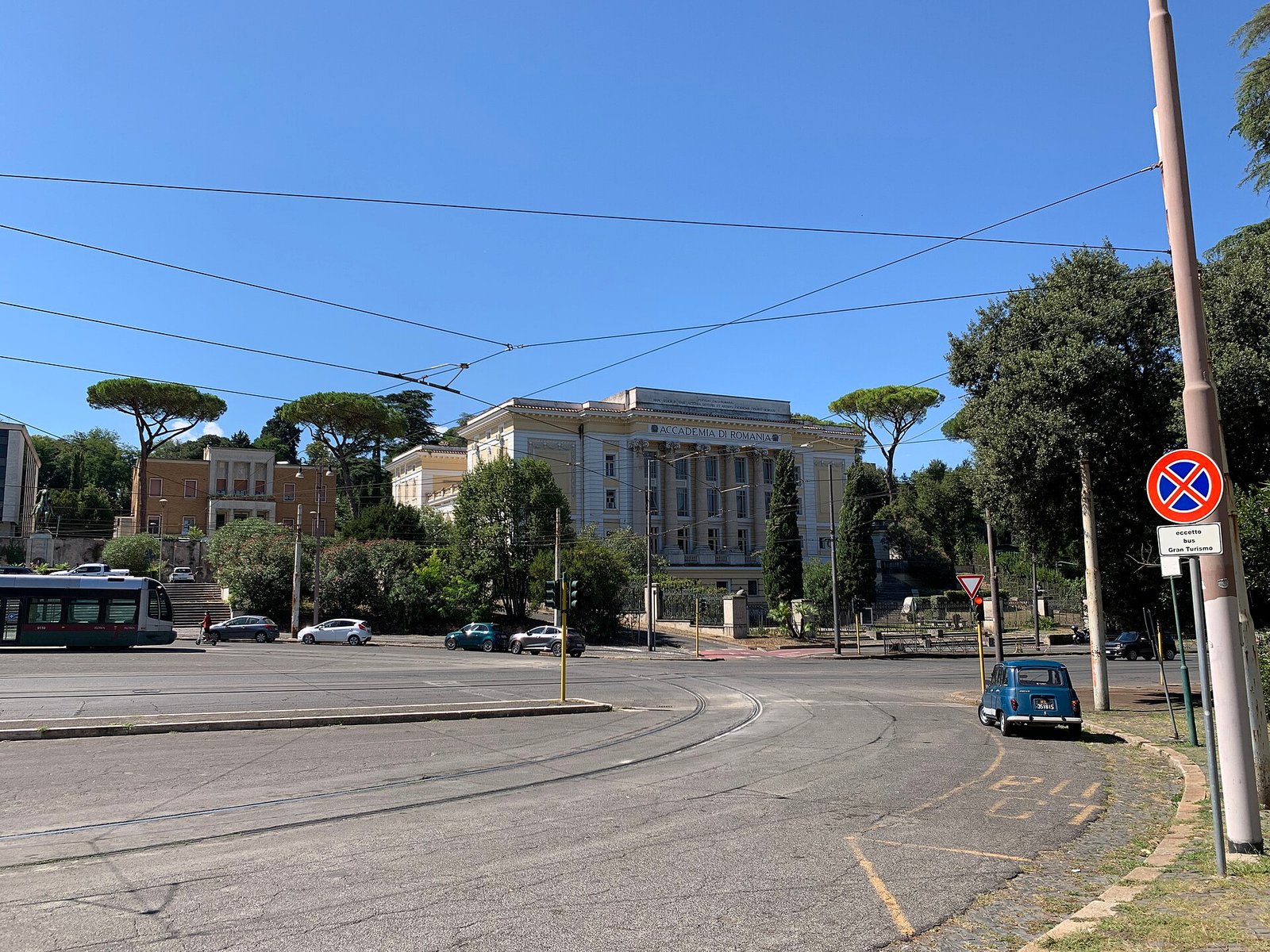
The Romanian Academy in Rome is at Piazza José de San Martín 1, in Valle Giulia, and it is the cultural institute of the Romanian state in Italy. It is not a museum with a ticket office: you go in for exhibitions, concerts, conferences and presentations announced by the institute. The public access hours given by the operator run Monday to Friday, from 9 to 17. The price of individual events is not published, and for any question the channel is the secretariat, by phone at 06 3208024.
The building was inaugurated in January 1933 to a design by the Romanian architect Petre Antonescu, with the construction costs paid by the National Bank of Romania. Behind the neoclassical facade, light and sober, there are a library of Romanian history, archaeology and literature, a hall for conferences and concerts, an exhibition hall and the rooms for the fellows, that is the Romanian scholars and artists who spend a period of research in Rome.
Data checked on September 29, 2026 on the contacts page of the Romanian Cultural Institute, on the Rome city tourism portal and on the other sources cited in the text. The program changes from week to week and some services, such as the library, have had temporary closures. Before you set out, the advice is to call or write to the secretariat, saying which event interests you and the date you plan to go.
At a glance: address, hours, ticket
- Address: Valle Giulia, Piazza José de San Martín 1, 00197 Rome, behind Villa Giulia and close to Viale delle Belle Arti.
- Operator: Romanian Academy in Rome, the Italian seat of the Romanian Cultural Institute, phone 06 3208024, email accadromania@accadromania.it.
- How to get in: on the occasion of exhibitions, concerts, conferences and events announced by the institute.
- Price: the operator does not publish a ticket for the events, ask the secretariat.
- Public access hours given by the institute: Monday to Friday, from 9 to 17.
- How to get there: the nearby Etruscan Museum of Villa Giulia lists trams 2, 3 and 19 and metro line A to Flaminio.
- Accessibility: the operator does not publish any information, ask before the visit.
Where it is and what you actually see
Valle Giulia is the green hollow between the northern edge of Villa Borghese and the Parioli, crossed by Viale delle Belle Arti. The Romanian Academy is on a quiet square a few meters from the avenue, just behind the Etruscan Museum of Villa Giulia, in a stretch of the city where almost every building houses a foreign cultural institution or a museum.
From the square you see a compact building, with a neoclassical front and soft colors. The Rome city tourism portal describes it as a building marked by delicate colors, friezes and stuccoes, with a garden. There are no flashy signs and no ticket offices. Anyone who arrives without knowing what they are looking for risks mistaking it for a private villa, and in fact the first impression is of a residence more than of a public body.
Inside, when you enter for an event, the spaces open to the public are few and precise. There is the conference hall, which also hosts concerts, there is the library's reading room and there are the rooms used for exhibitions. The rest of the building is made up of offices and lodgings for the fellows. There is no free visitor route, and it's better not to expect one.
The audience that frequents the Academy is mixed. There are scholars of history and archaeology looking for a book in the library, the Romanian community of Rome that follows concerts and presentations, contemporary art lovers who come for an exhibition, the residents of the neighborhood. The calendar is made for all of them together, and you can tell from the variety of the offerings, which range from chamber music to experimental theater.
The most interesting view, though, is the overall one. Within a few hundred meters you come across the Romanian academy, the British School at Rome, the Danish academy, the Belgian one, the National Gallery of Modern Art and the Etruscan museum. It is rare to find so many different national institutions in such a small space, and walking from one facade to the next you feel it without needing any explanation.
Even the name of the square tells you something. José de San Martín is the Argentine general who led the South American wars of independence in the early 19th century, and his name in the address of a Romanian institution is one of the small short circuits in the place names of the area, where streets and squares recall countries and figures from half the world. If you look up the address on maps, it's best to type the full name with the accent, or to search directly for Accademia di Romania.
A curiosity about the Romanian Academy in Rome
The neoclassical facade was not the architect's first idea. According to a study by Irina Baldescu published in the journal Engramma, in the early variants Petre Antonescu had proposed a building in the Neo-Romanian style, the national idiom that was spreading in Romania in those years. The neoclassical design was imposed on him. The result is a building that speaks the language of Rome, not that of the Carpathians.
The Neo-Romanian style was Antonescu's specialty. Trained at the École des Beaux-Arts in Paris, where he graduated in 1899, he was among the first to apply that idiom to large public buildings. In Bucharest he designed, among others, the city hall and the Arch of Triumph. Seeing a neoclassical building of his in Rome is like hearing a composer known for one genre play a different repertoire, with craft but without his most recognizable voice.
There is also a link with another Roman institution. In 1927, a few years before the inauguration of Valle Giulia, Antonescu was named a corresponding member of the Accademia Nazionale di San Luca, the old Roman academy of artists. The designer of the Romanian academy, in short, was already inside the city's academic world when the construction site took shape.
The idea of friendship between the two countries was written on the walls. The same Engramma study recalls that in the atrium of the building a commemorative inscription was placed, dedicated to the friendship between the two peoples and the two governments. It is a detail to look for when you enter for an event: it says a lot about the political climate in which the building was born, in the early 1930s.
One thing nobody tells you about the Romanian Academy in Rome
In our view the building, taken on its own, is overrated by those who look for it as a monument. It is a correct, orderly neoclassical, in line with the neighboring buildings, but it does not have the architectural force of the British School or the radicalism of the Danish academy. Coming all the way to Valle Giulia just to look at the facade is a mistake. The reason to come is the program: an exhibition, a concert, a conference.
The second thing that almost nobody mentions concerns the library. The Rome city tourism portal presents it as open to everyone, with lending reserved for specialists in Romanian language, literature and culture, but on the same page it lists it as temporarily closed. Anyone who plans to go there to study must therefore ask the secretariat first if the reading room is accessible again, and under what rules.
Third point, often ignored. The Academy is not an embassy and it is not a consulate. Anyone looking for documents, paperwork or administrative information for Romanian citizens must go to the diplomatic offices, not to Valle Giulia. It seems obvious, but the confusion happens, because the institute is often mentioned next to the embassy and the Rome city portal lists it as run by the Romanian Ministry of Foreign Affairs.
Finally, today's seat is not the first. Activity began on November 1, 1922 in a temporary house at Via Emilio de' Cavalieri 11, in the Parioli, according to the reconstruction published by Arsity. The Rome city portal confirms the first steps in the winter of 1922 in a temporary seat in the neighborhood. For more than 10 years the Romanian school therefore worked in a temporary seat, a short distance from the land where the building would later rise.
From a house in the Parioli to Valle Giulia: how was the Academy born?
It all starts with a law. In 1920 the Romanian Parliament approved the creation of two academies abroad, one in Paris and one in Rome, on the initiative of the archaeologist Vasile Pârvan and the historian Nicolae Iorga. The aim was to offer the best Romanian graduates in archaeology, history, letters, fine arts and architecture a period of study in the two capitals considered decisive for the country's culture.
Rome had a particular meaning. For the Romanian historiography of those years, continuity with Roman Dacia was a central theme, and studying in Rome meant working on the Latin roots of the nation. Pârvan, an archaeologist of Dacia, directed the school from 1922 to 1927, the years in which the yearbook, the series of archival documents and the public lectures open to Rome's scholars took shape.
The land came early. In 1921, according to the reconstructions published by Arsity and by EZ Rome, the administration of Rome made available to the Romanian state an area of about 5,000 square meters in Valle Giulia. Arsity also gives the precise date, July 8, 1921. The construction, however, took more than a decade, and was possible thanks to the National Bank of Romania, which according to the same sources paid all the expenses.
In the meantime the school kept working. In 1923 the first volume of the yearbook Ephemeris Dacoromana came out, devoted to history and archaeology. From 1924 the public lectures began, and in 1925 the number of fellows reached 10, according to EZ Rome. Also in 1925 the Diplomatarium Italicum series started, which until 1939 published documents from Italian archives on the history of the Romanian countries.
The two series say a lot about the school's program. The yearbook collected studies of ancient history, archaeology and philology, the Diplomatarium published documents found in Italian archives, from the Vatican to the cities that had had commercial and diplomatic relations with Eastern Europe. It was slow, methodical work, made of transcriptions and index cards, very different from the romantic image of the young artist traveling to Rome that is often associated with foreign academies.
The building in Valle Giulia was inaugurated in January 1933, a date on which the Rome city portal, Abitare a Roma, Arsity and Roma2pass agree. From that moment the Academy finally had a seat of its own, with a library, study rooms and lodgings. It was a short season. After the war and the change of regime in Romania, the institute closed in 1947 and remained inactive for more than two decades.
My advice for visiting the Romanian Academy in Rome
My advice is to choose the event first and then the date, never the other way around. The Academy publishes its events on the website of the Romanian Cultural Institute and on its own social channels, and often announces them at short notice. Showing up at the door on any given day, even during public opening hours, means finding offices at work and little to see.
The evening events are the simplest way in. The Propatria festival, for example, organized by a Romanian-Italian cultural association in collaboration with the Academy, opened its 16th edition right in Valle Giulia on September 8, 2026 at 18:30, with a piano and clarinet recital dedicated to the 150 years of Brâncuși. On September 15, at the same time, a theater piece about Marin Sorescu was staged.
For exhibitions it pays to check the dates carefully. Many exhibitions last two or three weeks at most. Artribune, for example, recorded between November and December 2025 the installation by Luminița Țăranu devoted to Ovid and the Metamorphoses, open from November 26 to December 7. 11 days in all. If you put it off by a week, you risk finding the rooms already empty.
One last practical tip. The events are often held in Romanian and Italian, sometimes only in Romanian. If the language matters, ask the secretariat beforehand or look for the indication in the event announcement. For a concert it changes nothing, for a lecture or a book presentation it does, and knowing in advance how it runs saves you an evening spent looking at slides without understanding.
Another useful rule concerns the season. The available examples, from September 2018 to September 2026, show the cultural year opening at the end of summer, with exhibitions and series that start in exactly those weeks. If you pass through Rome in autumn, you have a good chance of finding something on the calendar. If you arrive in the middle of August, on the other hand, you do well to treat the Academy as an outside stop on a walk through the valley.
How much does it cost and how do you get in?
The starting point is simple: the Academy has no ticket office and does not sell entry to the building. The operator does not publish a price for exhibitions, concerts and conferences, and in many cases the events of foreign cultural institutes in Rome are free, but for this venue it is not confirmed by an official source. The right way is to ask the institute's secretariat, event by event.
The official channel is the page of the Romanian Academy on the website of the Romanian Cultural Institute, which gives the address, phone numbers, email and public access hours. On the big tour and ticket portals there is no product dedicated to this venue, and that is normal: there is nothing to sell, because it is a cultural institute and not a paid attraction.
The contacts page gives a single public access schedule. The Rome city tourism portal, on the other hand, gives no hours and refers you to the official website. Exhibitions and evening events follow their own hours, set each time in the announcement: the Propatria festival of September 2026, for example, started at 18:30, outside the range given for the offices.
| Day | Public access given by the institute |
|---|---|
| Monday-Friday | 9:00-17:00 |
| Saturday and Sunday | not given |
| Evening events | time given in the announcement |
To contact the institute, the official page lists three landline numbers, 06 3208024, 06 3201594 and 06 3236772, as well as the email accadromania@accadromania.it. The director named is Professor Cristian Luca. A short email, with the name of the event and the date, usually gets a more useful answer than a phone call made at lunchtime, when the offices of a small institute are often unstaffed.
There are two channels for following the program. The first is the section devoted to Rome on the website of the Romanian Cultural Institute, where the announcements of events appear, often in Romanian and Italian. The second is the Academy's social profiles, which according to Arsity can be found as accadromania on Facebook and Instagram. The domain accadromania.it, also used for the official email, is the address cited by many portals, but for the most recent announcements it's best to start from the institute's network.
Another well-known fact, yet rarely cited
Many people know that the Academy stayed closed during the communist regime. Few remember for how long and in what way. From 1947 the institute stayed closed, and the building, according to the reconstruction by EZ Rome and Roma2pass, went into a long decline. The reopening came only after more than two decades, and not as an academy, but as a library.
On the exact date the sources do not agree. Abitare a Roma speaks of a closure until 1968, EZ Rome, Arsity and Roma2pass give 1969. In any case, on reopening the building became the Romanian Library of Rome, a more limited function, in the middle of the Cold War. The scholarships for young researchers and artists did not resume then.
The turning point comes with 1989. After the fall of the regime, from 1990 the institution gradually returns to its original mission as an academy, as the Rome city portal reports. According to Roma2pass the scholarship program and the yearbook restart in 1999, according to Arsity the Ephemeris Dacoromana resumes in 2000. From 2003 the Academy also serves as a Romanian cultural institute abroad.
There is one last detail rarely cited. According to Roma2pass, in 1945 the Academy was among the founding members of the International Union of Institutes of Archaeology, History and History of Art in Rome, the network that links the city's foreign academies and research institutes. Two years later the institute closed. It is one of the bitterest coincidences in its history.
The library period, between the late 1960s and 1989, is often dismissed as a parenthesis. In our view it deserves more attention. The reopening came after a restoration, according to EZ Rome, and gave the building a function again after years of neglect. The continuity of the book collection also explains why the library remains, even now, the service most described by the sources about the institute.
The right photo to take at the Romanian Academy in Rome
The photo that tells the story of the place is the one of the facade taken from the square, horizontal, with the greenery around. The square is small and has little traffic, so you can work calmly. The best light is late afternoon, when the light colors of the plaster warm up and the friezes pick up a bit of relief. At noon, with the sun high, the facade tends to flatten out.
The second photo is for context. Moving toward Viale delle Belle Arti you can frame, in sequence, other foreign institutes and the bulk of the National Gallery of Modern Art. A series of three or four images taken on foot along the avenue tells Valle Giulia better than a single shot, and makes clear why the neighborhood is called the valley of the academies.
Inside, the rules are set by the institute. During concerts and conferences it's best to ask before photographing, and in any case without flash. Exhibitions often have their own indications, tied to the rights of the artists. Don't photograph the offices, the fellows' lodgings or the staff at work: the venue is a workplace, and those who live there for a few months have a right to their privacy.
A less obvious shot is the garden, if the event lets you see it. The Rome city portal lists it among the spaces of the venue, and in spring the greenery surrounding the building changes the character of the photos a lot. If the garden is not accessible, the edge of the greenery seen from the square is enough to give depth to the image of the facade, without going where you're not supposed to.
Anyone photographing in the evening, on the way out of a concert, finds another possible image. The square is poorly lit and the greenery around turns dark, while the lit windows of the hall show the building at work. You need a phone held steady or a support, no bulky tripods on the sidewalk. It is a less perfect photo than the afternoon one, but more faithful to what the Academy really is.
How do you get there from central Rome?
The operator does not publish directions for public transport. The nearby Etruscan Museum of Villa Giulia, a few minutes away on foot, lists trams 2, 3 and 19 and metro line A with the Flaminio stop, about 14 minutes' walk from the museum. From there to the Academy the stretch is short. Before leaving, though, it's best to check updated routes and stops on the website of Rome's transport company.
On foot, the most pleasant route goes through the park. From Piazza del Popolo you climb to the Pincio, cross Villa Borghese heading north and come down into Valle Giulia on the side of the National Gallery of Modern Art. It's a good half hour's walk, almost all of it among greenery, and it has the advantage of lining up many places to see along the way.
From Via Veneto and from Porta Pinciana you enter Villa Borghese and follow the park to the side of Viale delle Belle Arti, passing close to the Galleria Borghese. From the Flaminio area, instead, you climb up from below, along Viale delle Belle Arti. In both cases the last stretch is slightly uphill, nothing demanding, but worth factoring in for the evening, after an event.
By car the area is outside the most central zone, but the parking spaces around the academies and the museums are few and in high demand on event evenings. If you come from outside Rome, it's quicker to leave the car in a park-and-ride lot and continue on metro line A to Flaminio. By bicycle Villa Borghese is a good solution, with short climbs.
From Termini the most direct option is metro line A to Flaminio, then one of the trams listed by the Etruscan museum or the walk up toward Viale delle Belle Arti. From St. Peter's and the Vatican you take the same line in the opposite direction, again to Flaminio. If you have time you can get off at Spagna and cross Villa Borghese on foot, lengthening the route but gaining the walk in the park.
Some important events that happened here in history
In 1911, for the 50th anniversary of Italian Unification, Rome hosted a large exposition, with an international fine arts show right in Valle Giulia. From that occasion came the valley's vocation for hosting foreign institutions, as Il Talento di Roma reconstructs. 10 years later, in 1921, the land where the Romanian Academy would rise was made available to the Romanian state.
In January 1933 Antonescu's building was inaugurated, and the Romanian school left its temporary seat in the Parioli. In the following years the Academy published the yearbook and the series of archival documents, until 1939. In 1945 it became one of the founders of the international union of institutes of archaeology and art history in Rome, according to Roma2pass. In 1947, with the change of regime in Bucharest, it closed.
The reopening as the Romanian Library came in 1968 or 1969, according to the different reconstructions, after a restoration of the building. In 1990, after the revolution of December 1989, the institute gradually took back the name and function of an academy. In the late 1990s the scholarships and the yearbook returned, and since 2003 the Academy also serves as a Romanian cultural institute in Italy.
In more recent years the Academy has hosted exhibitions, conferences and series. In September 2018, according to Radio Romania International, it opened the season with two documentary exhibitions on the Great Union of 1918 and on women in the First World War, and with an international conference on the Balkans. In September 2026, according to the Romanian press in Italy, it hosted the opening of the 16th edition of the Propatria festival.
Who has passed through the Romanian Academy in Rome
First of all Vasile Pârvan, archaeologist and founder, who directed the school from 1922 to 1927 and set its working method. With him, the idea of Nicolae Iorga, historian and leading public figure in the Romania of the time, who supported the creation of academies abroad. After Pârvan the directors who followed, according to Arsity, were G. G. Mateescu, Emil Panaitescu, Dumitru Găzdaru and Scarlat Lambrino.
In the 1920s and 1930s the school invited foreign scholars to give lectures. Arsity recalls among the speakers the French historian Jérôme Carcopino, the French art historian Émile Mâle and, among the Italians, the art historian Adolfo Venturi and the historian of antiquity Ettore Pais. Names that show how much the institute was part of the European debate on ancient Rome and on the Middle Ages.
Then there are the fellows, generations of young Romanian archaeologists, historians, philologists, artists and architects who spent a period of study in Rome. Abitare a Roma recalls that the institute hosted the best graduates in archaeology, history, letters, fine arts and architecture. A complete list of the fellows is not published by the operator, and the names have to be looked up case by case in the institute's publications.
In recent years artists and musicians have passed through. Artribune records in 2023 the retrospective of the graphic artist Mihail György and in 2025 the installation by Luminița Țăranu. In September 2026 the Propatria festival brought to the Academy's stage the pianist Oxana Corjos, the clarinetist Petru Pane and the director Mateea Marin with the actor Richard Butler. The artistic direction of the festival is entrusted to the pianist Mara Dobrescu.
Today the institute is directed by Professor Cristian Luca, as the official contacts page indicates. Those who frequent the venue meet mostly scholars, fellows, concert audiences and members of Rome's Romanian community. It is an audience that doesn't show up in tourist guides, and for that very reason it makes the Academy an interesting observatory on contemporary Romanian culture.
Why Romania looked to Rome: what do the documents say and what does tradition say?
The first level is that of the documents. The 1920 law wanted a Romanian academy in Rome next to the one in Paris, and Pârvan's program focused on ancient history, on the archaeology of Roman Dacia and on the documents of the Italian archives. The yearbook and the Diplomatarium are there to prove it. For the school, Rome was a place of research, before it was a symbol.
The second level is national tradition. In Romanian culture Trajan's conquest of Dacia and the language of Latin origin have long been read as the foundation of the country's identity. Trajan's Column, with its scenes of the Dacian wars, is often presented in Romania as a sort of birth certificate of the Romanian people. It is a rhetorical formula, effective and very widespread, not a historical fact.
The third level is legend, and it concerns the idea of a direct, uninterrupted descent from the Roman colonists. It is a story that historiography has debated for a long time and with different positions, also in a political key. The Academy of Valle Giulia was born inside that climate, and the inscription on the friendship between the two peoples recalled by Engramma bears the mark of it, but the work of the school remained tied to the documents.
For those visiting Rome with this thread in mind, the most sensible pairing is with the places of Trajan's Rome. The Column in the Imperial Forums, with its spirals of reliefs, and the Roman Forum not far away, help you understand why for so many Romanian scholars the city was an archive of their own history as well as a capital of art. The Colosseum completes the picture.
Library, hall and garden: what is inside the Academy?
The heart of the venue is the library. The Rome city tourism portal describes it with about 35,000 volumes, 11 periodicals in the original language and 86 videos, and with a catalog devoted mostly to history, archaeology, art history, classical and modern philology, Romanian literature and culture, political science and geography. EZ Rome gives a lower number, about 33,230 volumes. The sources do not agree, the order of magnitude is clear.
The library offers, according to the same portal, a video library, photocopies, lending, multimedia stations and internet access. Lending is reserved for specialists in Romanian language, literature and culture, consultation is open to everyone. The portal, however, lists the library as temporarily closed, with no dates. Before going for research, a phone call to the secretariat is a must.
The conference hall is the space the public sees most often. It hosts conferences, book presentations, chamber concerts, readings and small-scale performances. Next to it is the exhibition hall, used for exhibitions by Romanian artists, for documentary exhibitions and, in the past, also for works from the Academy's picture gallery, like the one recorded by Artribune in April 2021.
The garden, cited by the Rome city portal among the spaces of the venue, surrounds the building and separates it from the square. It is not a public garden and has no opening hours of its own. The operator does not publish any indications on the use of the garden during events, so it's better not to count on it and to consider it a space reserved for the institute and its guests.
There is also a picture gallery, that is a collection of artworks owned by the institute, which Artribune recorded on show in April 2021, from the 15th to the 29th of the month. It is not on permanent display and the operator does not publish a consultable catalog. When the works become visible again, usually in a temporary exhibition, it is a rare chance to see 20th-century Romanian painting in Rome without taking a plane to Bucharest.
Valle Giulia and the foreign academies: where does the Romanian Academy fit?
The valley of the academies comes from the 1911 exposition. The British School at Rome occupies the building constructed as the British pavilion for that show, and from the following year it became the school's seat, according to Il Talento di Roma. The Academia Belgica, an imposing cubic volume, was built in the 1930s and inaugurated in 1939, in connection with the wedding between Princess Marie-José of Belgium and Umberto of Savoy.
The Danish academy is the most recent of the three. The Atlas of Contemporary Architecture of the Ministry of Culture attributes it to Kay Fisker, Svend Høgsbro, Søren Georg Jensen and Duelund Mortensen, and places it between the 1960s and 1970s. Next to these buildings the Romanian Academy, inaugurated in 1933, represents the intermediate generation, the one between the two wars.
Comparing it with other foreign seats in Rome helps you understand the differences. The Villa Medici of the French Academy and the American Academy in Rome have visiting programs and openings of their own. Among our entries there are also Villa Massimo, seat of the German academy, and the Hungarian Academy at Palazzo Falconieri, which opens on announced occasions, like the Romanian one.
In our view the most common mistake is treating Valle Giulia as an open-air museum of nations, to be walked through in a line like a theme park. The academies are research institutes and centers of artistic production, with entry rules that differ from one to the next. The valley is best appreciated on foot from the outside, then you go in only where the calendar allows, one venue at a time, choosing carefully.
For the Romanian Academy this means one precise thing. In our view its program, made of concerts, theater and presentations that often start in the late afternoon, suits a city audience well. Someone who lives in Rome or stays a few days can fit it into an evening easily, more so than with venues that open only on a few dates a year.
There is also a network aspect. The Academy's membership in the union of foreign research institutes in Rome, recalled by Roma2pass for 1945, says that the Romanian seat was never an island, and that its history is intertwined with that of the city's other academies. Whoever follows one of the venues soon ends up knowing the calendar of the others, and the valley reveals itself that way, one invitation at a time.
When is it closed and what should you not expect?
Saturday and Sunday do not appear in the public access hours published by the institute, so they should be considered closed except for announced events. Italian and Romanian holidays can affect the opening of the offices. In the summer months many foreign cultural institutes in Rome reduce their activities, and for this venue too it's best to check the calendar before planning a visit in August.
Don't expect a guided tour of the building. The operator does not publish a tour service for the venue, and the rooms open during events are the ones needed for the event itself. Don't expect to be able to wander freely through the rooms, to see the fellows' lodgings or to go up to the upper floors either. The Academy is a working house, and it hosts the public in its reception spaces.
Finally, don't expect a library that is always open. The Rome city portal lists it as temporarily closed, and even when it is open the reading room follows the institute's hours and rules. Anyone coming from far away to consult a volume must write first to the official email, giving the title or the topic of the research and asking for confirmation of availability.
For event evenings a common-sense rule applies. The capacity of the halls is not published, and some events may require booking or have a limited number of seats. If the announcement says nothing, arrive a little early and bring an ID, which at the seats of foreign institutions may be requested at the entrance.
One last warning concerns online portals. Several information sites still report old phone numbers, email addresses that are no longer in use or hours from years ago. For example, some give an email on a domain that no longer appears on the official contacts page. In case of doubt, what counts is always what the Romanian Cultural Institute publishes on the Rome venue's page, not what you find copied elsewhere.
Eating in the area
Valle Giulia is not a restaurant area. Around the academies and the museums the offer is thin, and if you leave an evening event you will find food more easily by heading down toward Flaminio or up toward the Parioli. In the more touristy zones of Villa Borghese and Piazza del Popolo, on the other hand, the usual signs apply, the ones to recognize before sitting down.
The signs are always the same. The menu with photos of the dishes translated into 10 languages, the waiter at the door inviting you in, the kitchen open nonstop from morning to late at night. Menu items with no price, the menu displayed outside different from the one brought to the table, places in front of monuments that adjust the bill to the customer. Romans avoid them out of experience, not snobbery.
The time matters too. The evening events of the Propatria festival of September 2026 started at 18:30, a time that leaves room to have dinner the Roman way, without rushing. In the residential streets of the nearby neighborhoods you find places frequented by residents, with handwritten menus that change with the season. A useful resource, built street by street, is the list of addresses on Google Maps kept by the editorial team, with no sponsorships.
For those who spend the day in Villa Borghese there is a simple alternative to the tables at the kiosks: a picnic, with water and something picked up at a bakery or a neighborhood grocery before entering the park. The lawns around Piazza di Siena and the little lake are well suited, as long as you leave everything clean. Anyone who instead wants to sit down at a table after an evening event does better to choose beforehand, calmly, and to book.
What to pair it with in a day
The natural pairing is with the museums of the valley. The Etruscan Museum of Villa Giulia is a few minutes away on foot, and the National Gallery of Modern Art is on Viale delle Belle Arti. A morning at the Etruscan museum, an afternoon at the National Gallery and an evening event at the Romanian Academy make a full day, without ever taking a vehicle.
Those who prefer the park have Villa Borghese at hand. From the Valle Giulia side you reach the Museo Pietro Canonica, Piazza di Siena, the Casina di Raffaello for those traveling with children and the Casa del Cinema. For the Galleria Borghese you need a reservation, and the Secret Gardens have openings of their own.
Those following the thread of the foreign academies can line up the British School, a few steps away, and then head down toward the center as far as Villa Medici, above Trinità dei Monti. For a comparison with Italian institutions there are the Accademia di San Luca, near the Trevi Fountain, and the Bosco Parrasio of the Arcadia on the Janiculum, both reachable in a day.
Toward the north the day stretches into 20th-century architecture. From Flaminio you reach the MAXXI, the Auditorium Parco della Musica and, farther on, Milvian Bridge. Toward the Parioli there are the parks of Villa Glori and Villa Ada, and the small museum of Villa Poniatowski.
Those arriving from the center can instead start from Piazza del Popolo, with Santa Maria del Popolo and the twin churches, climb to the Pincio and cross the park to Valle Giulia. To build other low-cost days, on the site you will also find Free Rome and the roundup of free museums in Rome.
On timing, the most sensible combination puts the museums in the morning, when the rooms are less crowded, the park in the middle hours and the Academy at the end, with the evening event. Anyone with only one afternoon can limit themselves to the National Gallery and an outdoor walk among the academies. Anyone with two days can give one to the valley and one to the center, with Trajan's Rome as a counterpoint to the Romanian theme.
Frequently asked questions
Can you visit the Romanian Academy every day?
No. The Academy is a cultural institute, not a museum. The public access given by the institute runs Monday to Friday, from 9 to 17, but it mainly serves the offices and the library. You really go in on the occasion of exhibitions, concerts, conferences and presentations announced on the website of the Romanian Cultural Institute and on the venue's social channels. Saturday and Sunday do not appear in the published hours.
How much does it cost to get in?
The operator does not publish a ticket for the venue and does not give prices for individual events. Many events at foreign cultural institutes in Rome are free, but for the Romanian Academy this is not confirmed by an official source. It's best to ask the secretariat, by phone at 06 3208024 or by email at accadromania@accadromania.it, saying which event interests you.
Where exactly is it?
At Piazza José de San Martín 1, in Valle Giulia, postal code 00197. The square is a few meters from Viale delle Belle Arti, just behind the Etruscan Museum of Villa Giulia and close to the British School at Rome and the National Gallery of Modern Art. For public transport, the Etruscan museum lists trams 2, 3 and 19 and metro line A to Flaminio.
Who designed the building?
The Romanian architect Petre Antonescu, trained at the École des Beaux-Arts in Paris, a leading figure of the Neo-Romanian style and the author, among other things, of the Bucharest city hall. For Rome, according to a study published by Engramma, he had initially proposed a design in that style, but a neoclassical idiom was imposed on him. The building was inaugurated in January 1933.
Is the library open to the public?
The Rome city tourism portal describes a library of about 35,000 volumes open to everyone for consultation, with lending reserved for specialists in Romanian culture. The same page, however, lists it as temporarily closed. Before going, it's best to write to the secretariat to find out if the reading room is accessible and with what hours and consultation rules.
Why are there so many foreign academies in Valle Giulia?
The valley's vocation began with the 1911 exposition, which hosted an international fine arts show here. The British School at Rome still occupies the former British pavilion of that event. In the following years other countries obtained land in the area. Romania got its own in 1921, the Academia Belgica was inaugurated in 1939, and the Danish academy dates from the 1960s and 1970s.
Why did the Academy stay closed for so many years?
After the Second World War and the change of regime in Romania, the institute closed in 1947. It reopened only in 1968 or 1969, according to the different reconstructions, as the Romanian Library of Rome and not as an academy. The original function as a seat for fellows and researchers gradually returned after 1989, with the scholarships resuming in the late 1990s.
What kind of events does it organize?
Contemporary art and documentary exhibitions, classical and chamber music concerts, theater performances, history and archaeology conferences, book presentations. In September 2026 it hosted the opening of the Propatria festival with a recital dedicated to Brâncuși and a performance about Marin Sorescu. The program changes often and should be followed on the website of the Romanian Cultural Institute.
Who wrote it and from what sources
The text comes from the editorial team of Tour Leader Pro, the Rome-based outfit that designs itineraries, visits and cultural events across Rome and Lazio. The rates, hours and booking arrangements reported here come from the official sources cited in the text, as of the date given at the top: the contacts page of the Romanian Cultural Institute, the Rome city tourism portal, the Etruscan Museum of Villa Giulia. Tell us what you find changed.
Organizing an evening at the Romanian Academy means following a calendar that changes often, with events announced at short notice and a hall capacity that the operator does not publish. For a group the most realistic solution is to build the day around the museums of the valley and Villa Borghese, and add the event only when the date is confirmed. A useful resource for people who organize group trips is Tour Leader Pro.
Valle Giulia is a good starting point also for a longer trip, one that lines up Rome's foreign academies, the 20th-century museums and, outside the city, the villas and abbeys of Lazio. Anyone who loves the interweaving of different cultures finds here an original thread for several days. A useful resource for putting together a multi-day itinerary is Italy Planner.