Trio Concept for the Filarmonica Romana at Teatro Argentina, December 10, 2026
In short. Trio Concept plays for the Accademia Filarmonica Romana on Thursday, December 10, 2026 at 21:00 at Teatro Argentina, at Largo di Torre Argentina 52, in Rome's historic center.
Trio Concept plays for the Accademia Filarmonica Romana on Thursday, December 10, 2026 at 21:00 at Teatro Argentina, at Largo di Torre Argentina 52, in Rome's historic center. On stage are Edoardo Grieco on violin, Francesco Massimino on cello and Lorenzo Nguyen on piano, with Antonín Dvořák's Trio No. 4 «Dumky» op. 90 and Pyotr Ilyich Tchaikovsky's Trio in A minor op. 50. The theater is reached on tram 8, Torre Argentina stop, on the many bus lines that cross the square, or on foot from the Pantheon and Piazza Venezia. The nearest Metro B stations are Colosseo and Circo Massimo. Prices are published on the authorized presale circuit linked from the official concert page on the Filarmonica's website. Tickets are bought there or at the theater box office.
Three musicians from Turin, a piano trio that changed its name after 11 years of working together, and two masterpieces of the Slavic repertoire: one of the two, Tchaikovsky's Trio, was written right here in Rome. Playing it in an 18th-century hall a few steps from the Pantheon means bringing it back to the city where it was born, for one December evening.
Trio Concept at Teatro Argentina: date, time and tickets
Trio Concept's concert is scheduled for Thursday, December 10, 2026 at 21:00 at Teatro Argentina, as part of the Accademia Filarmonica Romana's 2026/2027 season. It's a single date.
The time
21:00 is the usual time for the Filarmonica's evening concerts at Teatro Argentina. The running time isn't given. Tchaikovsky's Trio alone, in the most common performances, lasts more than 40 minutes, and with the «Dumky» the evening is that of a full chamber concert.
Where to buy tickets
From the concert page on the Filarmonica's website, a purchase button leads to the authorized presale circuit, where prices are shown. Alternatively you can go to the Teatro Argentina box office. If you're thinking of attending several concerts, the Filarmonica's website also has a section on subscriptions.
The series at Teatro Argentina
Trio Concept's concert is the third in the series the Filarmonica holds at Teatro Argentina this season: after the opening on November 5 with I Solisti della Filarmonica and Mahler's Fourth and the recital by pianist Anna Fedorova on November 19, before the February 2027 dates with percussionist Adélaïde Ferrière and baritone Thomas Oliemans in Winterreise.
The program: Dvořák and Tchaikovsky
For the Filarmonica, Trio Concept has chosen two piano trios written 10 years apart, both built in a way far removed from the classical four-movement form: Dvořák's «Dumky», from 1891, and Tchaikovsky's Trio op. 50, composed between 1881 and 1882.
Dvořák, the «Dumky» Trio
The Piano Trio No. 4 in E minor op. 90 is one of Dvořák's best-known works. The title is the plural of dumka. The Filarmonica's presentation explains that it's a Slavic word meaning to meditate, to reflect, and it's also a poetic form, an epic song celebrating the great heroes of the past. In the 19th century Slavic composers took the duma as a form indicating a meditative, melancholy piece, interrupted by cheerful sections.
Six dumky
The trio is made of six episodes, each a dumka with pensive parts and fast parts. The first three are linked without a break and in effect form a long first movement. The last three are in unrelated keys, and the result gives the impression of four movements. Dvořák, the Filarmonica writes, conceived op. 90 as a musical form with a melancholy background, interspersed with serene, pleasant, lighter sections.
The dumka in Dvořák's work
Dvořák used the dumka form in several compositions: the Dumka for piano op. 35, the second of the Slavonic Dances, the String Sextet and the Piano Quintet op. 81. He probably came to know it through Leoš Janáček, author of a choral duma in 1876, and through a collection of Ukrainian folk songs published in 1862. The term, according to musicological reconstructions, is of Ukrainian origin: the diminutive of duma, the epic ballad or the lament of prisoners.
Tchaikovsky, the Trio op. 50
The Trio in A minor op. 50 bears the subtitle «À la mémoire d'un grand artiste», to the memory of a great artist: the great artist is Nikolai Rubinstein, pianist and teacher, a close friend and supporter of Tchaikovsky, brother of the more famous Anton, who died on March 23, 1881. Tchaikovsky wrote it in Rome after learning of his death.
Two movements
The Trio has only two movements. The first, «Pezzo elegiaco», opens with a theme given to the cello that returns at the end as a funeral march. The second is a theme with variations, including a waltz, a fugue and a mazurka, which after an increasingly bright final variation plunges back into the minor key and takes up the opening theme with even greater gravity, closing with another funeral march. Altogether it lasts about three quarters of an hour.
Why hear them together
Placed side by side, the two trios tell two opposite ways of breaking classical form. Dvořák multiplies the movements, six short episodes that alternate shadow and light. Tchaikovsky reduces them to two, an elegy and a long cycle of variations that ends where it began, in mourning. The first is a trio of moods, the second a funeral monument. In our view it's a smart pairing: Slavic melancholy in two different doses, first light and changeable, then full and declared.
Who Trio Concept are
Trio Concept is a piano trio formed by three young musicians from Turin: violinist Edoardo Grieco, cellist Francesco Massimino and pianist Lorenzo Nguyen. They have played together since 2013.
From Trio Chagall
The three met in 2013 and founded Trio Chagall. After 11 years of activity the ensemble chose to change its name to Trio Concept, to underline, the Filarmonica explains, the cohesion of an artistic path of more than 10 years.
The name and Michelangelo
The new name is inspired by verses by Michelangelo Buonarroti: «Non ha l'ottimo artista alcun concetto c'un marmo solo in sé non circoscriva», the best artist has no concept that a single block of marble does not contain within itself. Just as the sculptor finds the perfect form inside the block of marble, the Trio means to seek the beauty held in every work and bring it to life again in performance. Concetto, in English concept: the name contains a program.
A stable lineup
A piano trio that has worked together for more than 10 years has, in our view, an obvious advantage in a program like this. In the «Dumky» the changes of character are sudden, from meditation to dance within a few bars, and they ask the three instruments to breathe together. In Tchaikovsky's variations each episode has a different color, from the waltz to the fugue to the mazurka. These are pages where understanding counts as much as technique.
Tchaikovsky's Trio variation by variation
The second movement of the Trio op. 50 is a theme with 11 variations, followed by a final variation and a coda: the longest and most varied part of the work, the one where Trio Concept will have to change character most often.
The theme
The movement opens with an almost classical-flavored melody that recalls the Variations on a Rococo Theme Tchaikovsky himself had written for cello and orchestra. It's a serene beginning, very far from the mourning of the first movement, and that's exactly why the final return of grief hits harder.
The variations
After the first variation, the second is livelier, the third and seventh are Allegro moderato, and the fourth and fifth continue at the same tempo. The sixth is a waltz, the eighth a fugue, the ninth an Andante «flebile, ma non tanto», the tenth a mazurka, the 11th a Moderato. It's a small catalog of forms and dances, from the salon to the church, that puts each of the three instruments to the test.
The finale
The final variation, Allegro risoluto e con fuoco, rises toward a luminous apotheosis. Then a sudden modulation brings back the minor key, the theme of the first movement returns and the coda, Andante con moto, marked «lugubre», closes the work with a funeral march. If you listen knowing this, you wait for that moment, and you're not disappointed.
A curious fact about Trio Concept for the Filarmonica Romana at Teatro Argentina, December 10, 2026
The most Roman curious fact of the evening is that Tchaikovsky's Trio was born in Rome. The composer wrote it in the city between the end of 1881 and January 1882, after the death of his friend Nikolai Rubinstein. Work began between November and December 1881, and the first version was completed at the end of January 1882. Exactly 145 years later, on December 10, 2026, the Trio is heard again in Rome in the same days of the year it was written.
The second curious fact is that Tchaikovsky didn't want to write it. In 1880 his patron, Nadezhda von Meck, had asked him for a trio, and he had refused in a letter of November 5: he couldn't stand, he wrote, the combination of the piano with the violin or cello, because the timbres don't blend. For him the piano worked only alone, with the orchestra or as accompaniment. A year later he composed the trio without anyone asking him. It's the only work he ever wrote for this combination.
Then there's a thread that links the two works on the program: the cellist Hanuš Wihan. It was he who played in the first performance of the «Dumky», in Prague, alongside violinist Ferdinand Lachner and Dvořák himself at the piano. A few years later, Wihan would be the dedicatee of Dvořák's Cello Concerto.
Teatro Argentina, the concert venue
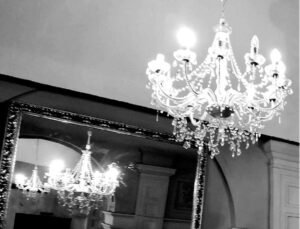
Teatro Argentina is a horseshoe-shaped Italian-style hall with 720 seats, 354 in the stalls and 366 in six tiers of boxes, according to the figures of the Teatro di Roma, which runs it. Red and gold, with a decorated green ceiling and a great 16-arm chandelier, it's one of the most beautiful historic halls in the city.
A name that comes from Strasbourg
The name has nothing to do with the South American country. It comes from the tower of the palazzo of Johannes Burckardt, known as Burcardo, a papal master of ceremonies born in Strasbourg, Argentoratum in Latin, who signed himself episcopus argentinensis. The tower, the square and the theater took their name from him. The palazzo of Burcardo, built between 1491 and 1500, still stands on Via del Sudario, next to the theater.
The Sforza Cesarini and Theodoli
The Sforza Cesarini family started construction in 1730. The hall was designed by the architect and marquis Gerolamo Theodoli, who chose the horseshoe shape for acoustics and visibility. Originally it was almost entirely in wood, with 186 boxes.
The facade and the restoration
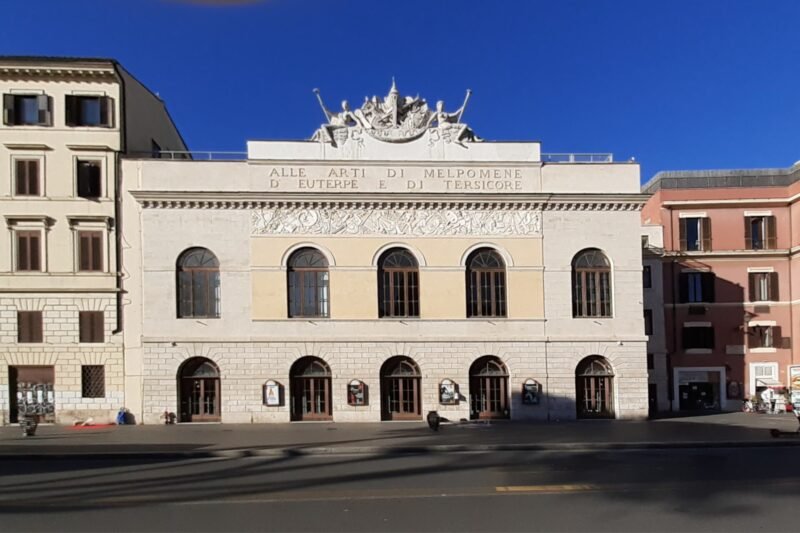
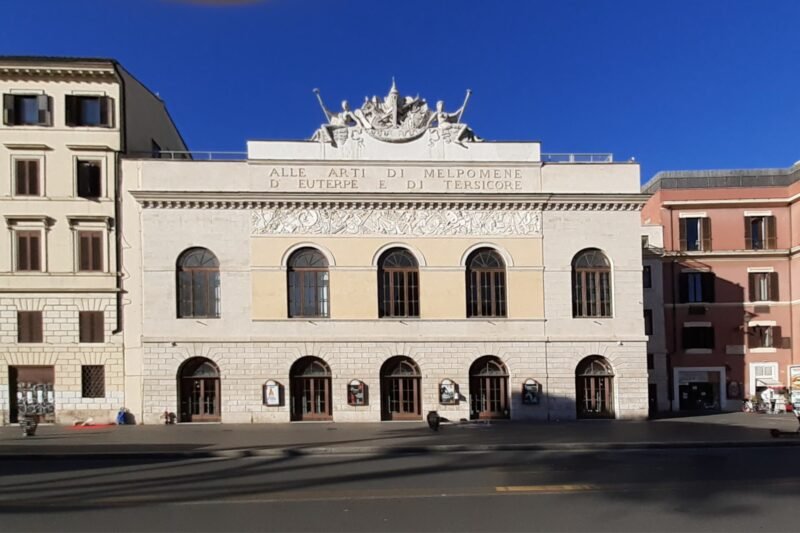
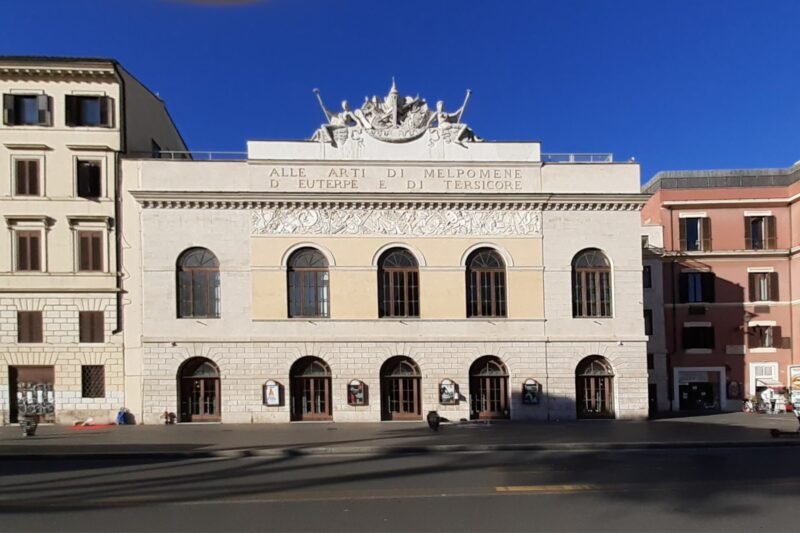
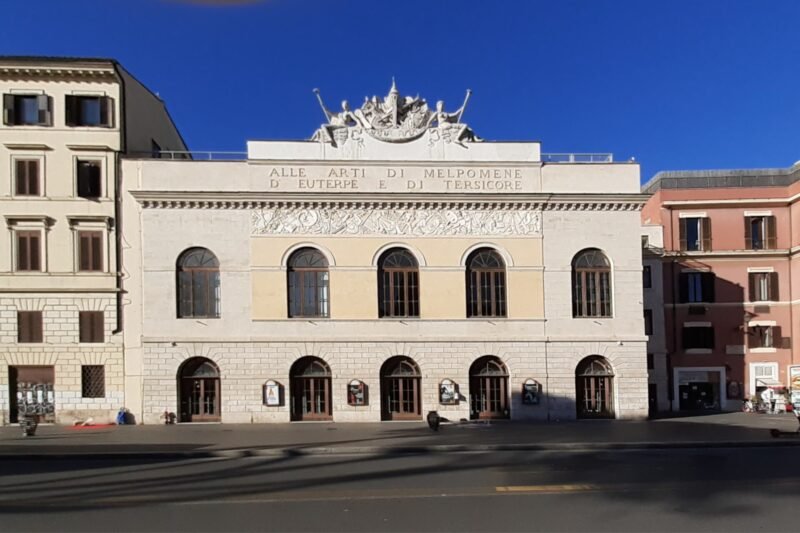
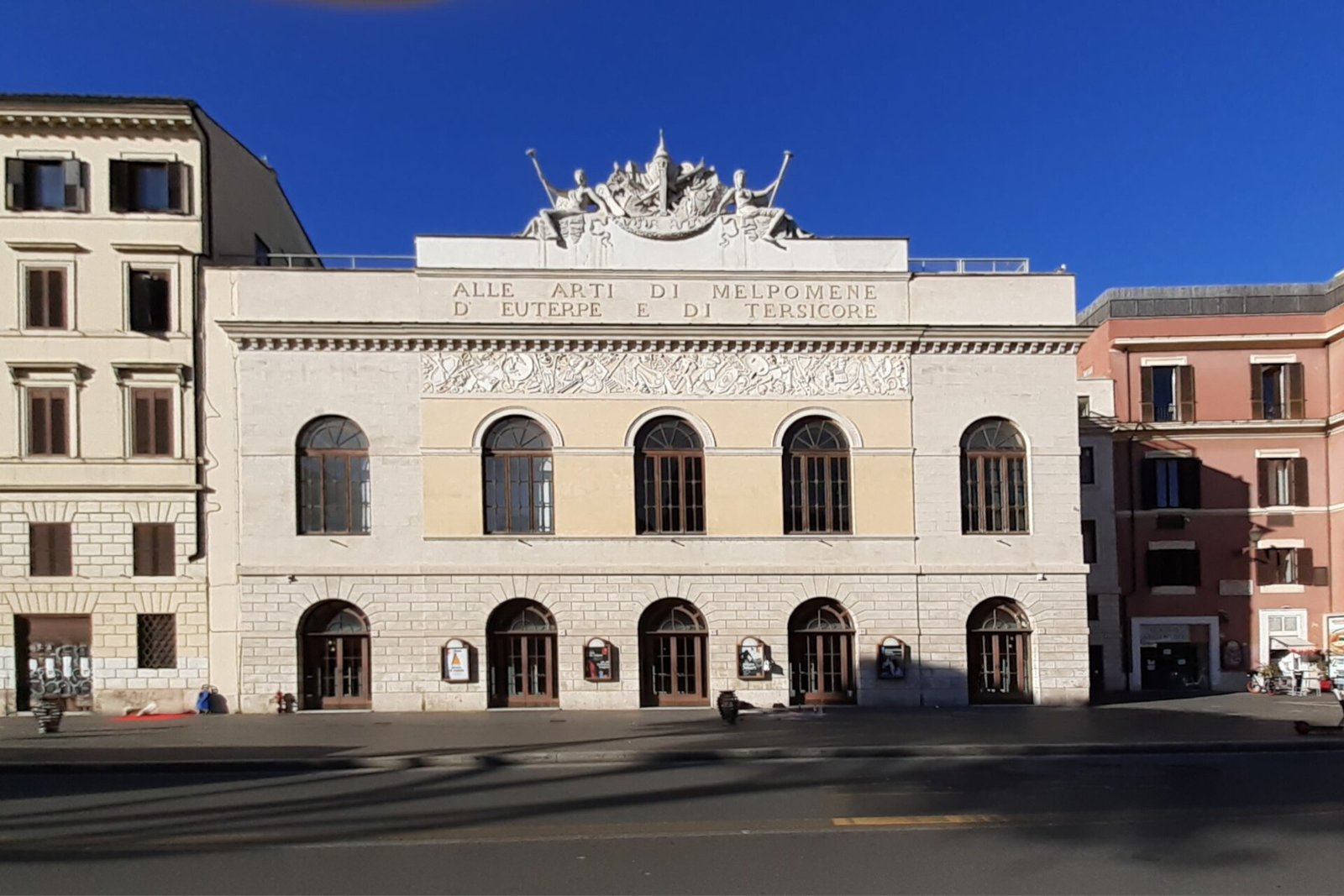
The neoclassical facade, with its dedication to the muses Melpomene, Euterpe and Terpsichore, was built in 1826 to a design by Pietro Holl. In 1993 Paolo Portoghesi restored the theater, bringing back the red of the coverings and the original shape of the box valances: the hall owes its 18th-century look to that restoration.
Something nobody tells you about Trio Concept for the Filarmonica Romana at Teatro Argentina, December 10, 2026
What few people say is that Teatro Argentina, today the home of the Teatro di Roma's drama, was born as an opera and music theater. It opened in January 1732 with Domenico Sarro's Berenice. Rossini's Barber of Seville premiered there on February 20, 1816, Niccolò Paganini played there in 1827, and Verdi brought two premieres there. A chamber concert at Teatro Argentina is a return to the building's original vocation.
The second thing concerns listening. In a horseshoe hall of this size a piano trio comes across directly, without the distance of big symphonic halls: every line of the violin and cello stands out. For chamber music, in our view, even the highest boxes work well, because here listening matters more than the view.
The third is practical: the theater is in the limited traffic zone and has no parking. If you come by car you have to leave it outside the ZTL and take tram 8, which stops in front of the sacred area, or walk.
My advice for visiting Trio Concept for the Filarmonica Romana at Teatro Argentina, December 10, 2026
The advice is to arrive at Teatro Argentina on foot, crossing the historic center from the Pantheon or Piazza Navona. There's no need to look for the address where Tchaikovsky worked: just knowing that the Trio you'll hear at 21:00 was written in this same city, in the same days of the year, is enough to hear it differently.
Second piece of advice: listen beforehand to the first movement of Tchaikovsky's Trio, the «Pezzo elegiaco», with its theme given to the cello. In the hall you'll recognize it when it returns, turned into a funeral march, at the end of the second movement: it's the most moving moment of the evening.
Third: for the «Dumky», read two lines beforehand about what a dumka is. Knowing that each episode alternates meditation and dance helps you not get lost in the sudden changes of tempo and character. Finally, arriving half an hour early lets you look at the hall with the lights on, before they go down.
The Accademia Filarmonica Romana, the organizer
The Accademia Filarmonica Romana is a private nonprofit institution founded in Rome in 1821, which organizes chamber and symphonic concerts, ballets and music theater: one of the oldest musical institutions in the city.
Its origins
It was founded by some amateur musicians gathered around the composer Raffaele Muti Papazzurri, to perform chamber and symphonic music and operas in concert form when censorship banned their staging. In 1824 it became an official institution of the Papal States. Its activity was interrupted between 1849 and 1856 for financial reasons and between 1860 and 1870 for political reasons, because many academy members held liberal views.
From the Pantheon to Via Flaminia
After 1870 it became a choral society, and from 1878 it provided the music for official commemorations at the Pantheon. In 1946 it was refounded with Alfredo Casella as artistic director, and its headquarters moved to the Casina Vagnuzzi, at Via Flaminia 118, where the Sala Casella is today. Since 1980 the Filarmonica has owned Teatro Olimpico.
Premieres and great guests
The history published by the Accademia recalls the Italian premiere of L'assedio di Corinto in 1827 and Anna Bolena conducted by Donizetti in 1833, performers such as Adolf Busch, Rudolf Serkin, Alfred Cortot and Jascha Heifetz between the wars, and after 1946 Bartók, Britten, Messiaen, Stravinsky, Berio and Boulez. Its artistic directors have included Goffredo Petrassi, Luciano Berio and Hans Werner Henze, and since 2024 the director has been Domenico Turi.
The Filarmonica's other venues
Teatro Argentina is one of the venues of the Accademia's season. Alongside the series of concerts in this hall, the Filarmonica programs chamber concerts and music lessons in the Sala Casella, at Via Flaminia 118, and dance and music theater shows at Teatro Olimpico. If you follow the season, you can build a route between the historic center and Flaminio, with very different offerings.
How to get to Teatro Argentina
Teatro Argentina is at Largo di Torre Argentina 52, in front of the sacred area, in the historic center. Tram 8 is the most convenient option.
By tram
Tram 8 stops at Torre Argentina, a few steps from the entrance: there and back, it's the simplest solution if you're coming from Trastevere or Monteverde.
By metro and bus
No metro station is near the theater: the most convenient are Colosseo and Circo Massimo, on line B, from which you continue on foot or by surface transit. Largo Argentina and Corso Vittorio Emanuele II are crossed by many bus lines linking Termini, Piazza Venezia, the Vatican and Trastevere. Evening times should be checked on Rome's public transit information service.
On foot and by car
From Piazza Venezia, along Via delle Botteghe Oscure, a few minutes are enough, and the same goes from the Pantheon, Piazza Navona, Campo de' Fiori and the Ghetto. By car you have to park outside the ZTL: the theater has no parking.
Another well-known fact, yet rarely mentioned
It's well known that the «Dumky» is one of the most loved trios in the repertoire. The occasion it was born for is less often remembered. Dvořák completed it on February 12, 1891 and presented it in Prague on April 11, playing the piano himself: the concert celebrated the honorary degree Charles University had awarded him on March 17 of that year.
The success was such that Dvořák took it on a farewell tour of 40 concerts in Bohemia and Moravia, shortly before leaving for the United States, where he would direct the National Conservatory in New York. The trio was published while the composer was already in America, and the proofs were corrected by his friend Johannes Brahms.
Tchaikovsky's Trio also has a little-told premiere. After private performances in March and April, and a thorough revision, it was presented in public on October 30, 1882 in Moscow, at a concert of the Russian Musical Society, with Sergei Taneyev at the piano, Jan Hřímalý on violin and Wilhelm Fitzenhagen on cello. A Moscow premiere for a work born in Rome.
The right photo to take at Trio Concept for the Filarmonica Romana at Teatro Argentina, December 10, 2026
The right photo is taken from the stalls, before the lights go down, pointing upward: the six tiers of red and gold boxes, the green ceiling, the 16-arm chandelier. It's the shot that tells the story of Teatro Argentina better than any description, and it works even with a phone, as long as you keep the whole hall in the frame.
The second is the stage before the start: an open grand piano, two chairs, two music stands, in the middle of a hall built for opera. An image that conveys at a glance the difference in scale between the place and chamber music.
The third is taken outside, in the evening, from the opposite side of the square: the neoclassical facade with its dedication to the muses and, in the foreground, the lit columns of the sacred area. During the concert, on the other hand, your phone stays off: in the finale of Tchaikovsky's Trio a cello pianissimo is worth more than any photo.
Around Teatro Argentina
Teatro Argentina is a few minutes' walk from the Pantheon, Piazza Navona, Campo de' Fiori and the Ghetto: a concert here goes naturally with a walk through the historic center.
The sacred area
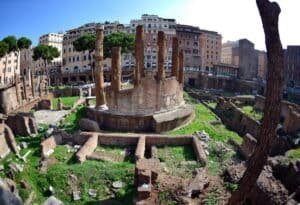
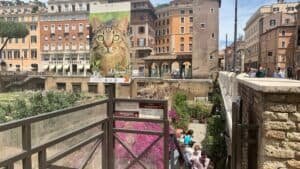
In front of the theater opens the sacred area of Largo Argentina, with the remains of temples and structures linked to the Theater of Pompey complex. Among the ruins lives the cat colony of the Largo Argentina cat sanctuary.
The Pantheon and Piazza Navona
To the north, in five minutes, you reach the Pantheon. To the west, beyond Corso Vittorio Emanuele II, are Piazza Navona and Campo de' Fiori.
The Ghetto
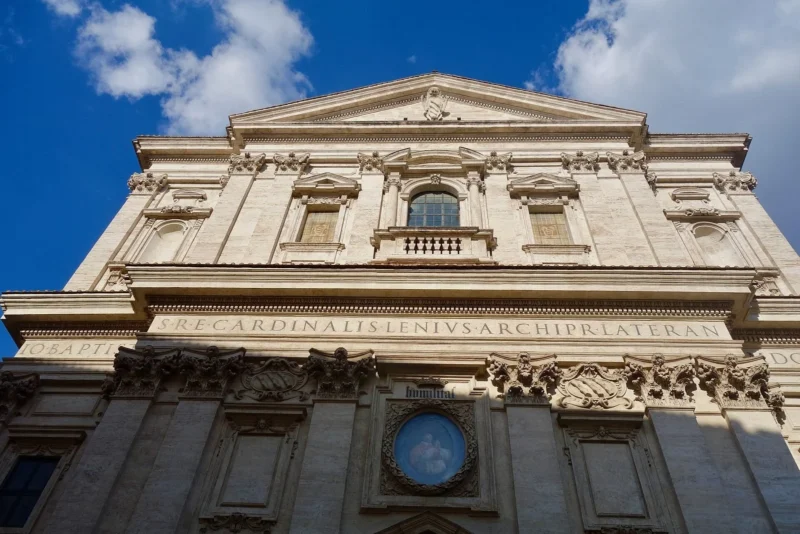
Toward the Tiber you enter the Jewish Ghetto and reach the Theater of Marcellus. A few steps from Teatro Argentina there's also the Church of the Gesù.
Some important events that happened here in history
Teatro Argentina opened in January 1732 with Domenico Sarro's Berenice, and since then its history has been intertwined with that of Italian music and Roman politics. In the 18th century foreign travelers considered it the most important of the city's theaters.
On February 20, 1816 the premiere of Rossini's Barber of Seville took place here, with Manuel García: it was a fiasco, because many admirers of Paisiello's Barber sat in the stalls, but from the second evening the opera triumphed. On January 28, 1822 Teatro Argentina hosted the world premiere of Donizetti's Zoraida di Granata, and in 1827 a concert by Niccolò Paganini.
Verdi brought I due Foscari there in 1844 and La battaglia di Legnano in 1849. According to the Teatro di Roma's account, it was precisely on the occasion of the latter that the Romans began the demonstrations that led to the Roman Republic. After 1870 the opening of Corso Vittorio Emanuele II put the theater at the center of the new city, and the building passed to the City. In 1993 came Paolo Portoghesi's restoration. Since 2022 it has been the main venue of the Fondazione Teatro di Roma, and it also hosts the concerts of the Accademia Filarmonica Romana.
Who has passed through Trio Concept for the Filarmonica Romana at Teatro Argentina, December 10, 2026
Gioachino Rossini with The Barber of Seville and Manuel García, Gaetano Donizetti with Zoraida di Granata, sung by Domenico Donzelli and Luigia Boccabadati, Giuseppe Verdi with two premieres and Niccolò Paganini in concert have passed across Teatro Argentina's stage. In the 20th century the hall saw the works of Gabriele D'Annunzio and Luigi Pirandello, and the directors of the Teatro di Roma, from Vito Pandolfi to Luca Ronconi.
The history of the Filarmonica, which brings Trio Concept to this hall on December 10, includes Raffaele Muti Papazzurri, the founder, Alfredo Casella, Goffredo Petrassi, Luciano Berio, Hans Werner Henze and Giuseppe Sinopoli, as well as performers such as Serkin, Cortot and Heifetz.
And in spirit, the two composers on the program also pass through here: Tchaikovsky, who wrote his only trio in Rome, and Dvořák, with the trio he played himself in Prague. On December 10, Edoardo Grieco, Francesco Massimino and Lorenzo Nguyen take the stage.
Accessibility and practical information
Teatro Argentina is a historic building where architectural barriers can't be removed entirely. According to the Teatro di Roma, the building has elevators and reserved seats in the stalls for people with disabilities. For availability on the evening of the concert, it's best to contact the Filarmonica or the theater box office in advance.
With teenagers
A piano trio is a good opportunity for a teenager studying an instrument: three solo voices, easy to recognize, and two works with strong character. The 21:00 time and the length make the evening demanding for younger children.
Clothing
At Teatro Argentina there's no dress code, but the 18th-century hall invites a little care. In December a coat and umbrella are almost always useful.
Where to eat before or after the concert
The historic center around Teatro Argentina has every kind of place: Roman trattorias in the streets toward Campo de' Fiori, Roman Jewish cooking in the Ghetto, bakeries and pizza-by-the-slice shops along Corso Vittorio Emanuele II for a quick meal before 21:00, wine bars and bistros around the Pantheon for after the concert. With a 21:00 start, it's best to have dinner early, around 19:30, or book for afterward, bearing in mind that many kitchens close around 23:00. In December, with pre-Christmas dinners, booking is almost a must.
A concert in mid-December
On December 10 the historic center is already in the holiday spirit, and a walk between the Pantheon and Piazza Navona before the concert is part of the evening. What the city offers in these weeks is described on our page about Christmas in Rome.
The weather and getting back
Mid-December evenings are cool and sometimes rainy, and the beauty of a concert at Teatro Argentina is precisely the walk through the historic center: it's best to have comfortable shoes, a coat and a folding umbrella. On the way out, tram 8 and the buses in the square take you back toward Trastevere, Termini and Piazza Venezia. If you're staying in the center, you can end the evening with a walk to the lit-up Pantheon, five minutes from the theater.
Frequently asked questions about Trio Concept at Teatro Argentina
When does Trio Concept play at Teatro Argentina?
Trio Concept plays at Teatro Argentina on Thursday, December 10, 2026 at 21:00, in the Accademia Filarmonica Romana's season. The theater is at Largo di Torre Argentina 52, in Rome's historic center.
What does Trio Concept play?
At Teatro Argentina, Trio Concept performs Antonín Dvořák's Trio No. 4 in E minor op. 90 «Dumky» and Pyotr Ilyich Tchaikovsky's Trio in A minor op. 50, written in Rome between 1881 and 1882 in memory of Nikolai Rubinstein.
Who are the musicians of Trio Concept?
Trio Concept is made up of three musicians from Turin: Edoardo Grieco on violin, Francesco Massimino on cello and Lorenzo Nguyen on piano. They have played together since 2013, first under the name Trio Chagall, changed after 11 years as a tribute to verses by Michelangelo.
Where do you buy tickets for Trio Concept?
Tickets for Trio Concept at Teatro Argentina are bought from the concert page on the Accademia Filarmonica Romana's website, which links to the authorized presale circuit where prices are published, or at the theater box office.
How do you get to Teatro Argentina?
Teatro Argentina, at Largo di Torre Argentina 52, is reached on tram 8, Torre Argentina stop, and on the many bus lines that cross the square. The nearest Metro B stations are Colosseo and Circo Massimo. The theater is in the ZTL and has no parking.
Why is Tchaikovsky's Trio linked to Rome?
Tchaikovsky's Trio op. 50, on the program at Teatro Argentina, was composed in Rome between the end of 1881 and January 1882, after the death of his friend Nikolai Rubinstein, to whom it is dedicated with the subtitle «to the memory of a great artist». It's the composer's only piano trio.
Final advice on Trio Concept at Teatro Argentina
A trio from Turin that took its name from Michelangelo, a masterpiece written in Rome 145 years ago, a hall from 1732 where The Barber of Seville premiered: in our view it's the most Roman chamber concert of December in the city. Arrive on foot from the Pantheon, listen beforehand to Tchaikovsky's «Pezzo elegiaco», have dinner early or book for afterward, and take 10 minutes to look at the hall before the lights go down.
Article written by the editorial team of Tour Leader Pro, contact them for Private/Corporate/V.I.P. Tours and Experiences.
Planning a trip to Rome? The English guides for visiting the city are on ItalyPlanner.com.
Contact Information
Nearby
 Teatro Argentina100 m
- Teatro Centrale100 m
- Largo Torre Argentina – Sacred Area of Campo Marzio100 m
- Cat Sanctuary at Largo Argentina100 m
- San Carlo ai Catinari200 m
- Santa Maria in Publicolis200 m
Upcoming events nearby
- Othello at Teatro Argentina, November 4 to 29, 2026100 m
- The Madness of King George with Massimo Popolizio at Teatro Argentina in Rome, January 9 to 31, 2027100 m
- Una delle ultime sere di Carnovale at Teatro Argentina, February 2 to 14, 2027100 m
- Lo zar by and with Stefano Massini at Teatro Argentina in Rome, March 16 to 25, 2027100 m
You might also like
- Thomas Oliemans, Winterreise at Teatro Argentina, February 11, 2027
- Adélaïde Ferrière for the Filarmonica Romana at Teatro Argentina, February 4, 2027
- Samuele Rizzuto, Il pianista dell’anima at Teatro Sala Umberto, March 31, 2027
- Filippo Gorini for Filarmonica Romana at Teatro Argentina, March 18, 2027
- Quartetto Prometeo and Claudio Pasceri at Teatro Argentina, March 4, 2027
- Amedeo Minghi, Anniversari Tour at Teatro Sistina, January 18, 2027