Adélaïde Ferrière for the Filarmonica Romana at Teatro Argentina, February 4, 2027
In short. French percussionist Adélaïde Ferrière plays for the Accademia Filarmonica Romana on Thursday, February 4, 2027 at 21:00 at Teatro Argentina, Largo di Torre Argentina 52, in the historic center of Rome.
French percussionist Adélaïde Ferrière plays for the Accademia Filarmonica Romana on Thursday, February 4, 2027 at 21:00 at Teatro Argentina, Largo di Torre Argentina 52, in the historic center of Rome. The program is a journey through 20th and 21st century percussion music, with works by Philip Glass, Meredith Monk, Andrew Thomas, Carlos Roque Alsina, Agata Zubel, Javier Álvarez, Keiko Abe, John Psathas and Emmanuel Séjourné. The theater is reached by tram 8, Torre Argentina stop, by the many bus lines that cross the square, or on foot from the Pantheon and Piazza Venezia. The nearest Metro Line B stations are Colosseo and Circo Massimo. Prices are published on the authorized presale network to which the official concert page on the Filarmonica website refers. Tickets are bought there or at the theater box office.
Marimba and percussion: a single musician at the center of a stage full of instruments, in an 18th-century hall built for opera. After her Roman debut in March 2025, welcomed by a large audience, Ferrière returns for the Filarmonica with a program that crosses the 20th century and arrives at today's music.
Adélaïde Ferrière at Teatro Argentina: date, time and tickets
The Adélaïde Ferrière concert is scheduled for Thursday, February 4, 2027 at 21:00 at Teatro Argentina, in the 2026/2027 season of the Accademia Filarmonica Romana. It is a single date.
The time
21:00 is the usual time for the Filarmonica's evening concerts at the Argentina. The overall length is not stated. With nine composers on the program, the evening is the size of a full recital.
Tickets
From the concert page on the Filarmonica website, the purchase button leads to the authorized presale network, where prices and sections are listed. Alternatively, you can go to the Teatro Argentina box office. If you plan to attend several events, the Filarmonica website has a section dedicated to subscriptions.
The series at the Argentina
Ferrière's recital is part of the series the Filarmonica holds at the Argentina this season, opened on November 5 by I Solisti della Filarmonica with Mahler's Fourth and continued with the recital by pianist Anna Fedorova. A week later, on February 11, baritone Thomas Oliemans brings Schubert's Winterreise to the same hall.
The program: percussion from the 20th century to today
Adélaïde Ferrière's program for the Filarmonica includes Opening by Philip Glass, Railroad by Meredith Monk, Merlin by Andrew Thomas, Reflets by Carlos Roque Alsina, Monodrum by Agata Zubel, Temazcal by Javier Álvarez, Marimba d'amore by Keiko Abe, One Study, One Summary by John Psathas and, by Emmanuel Séjourné, "Elyl & Tap" and "Attraction."
Glass and Monk
The recital opens with Opening by Philip Glass and Railroad by Meredith Monk, two American composers. For Monk, the Filarmonica recalls the Golden Lion for Lifetime Achievement received at the 2025 Venice Biennale: a recent honor, which gives this choice a flavor of current events.
The heart of the program
Mexican composer Javier Álvarez is present with Temazcal, Agata Zubel with Monodrum, Carlos Roque Alsina with Reflets, Andrew Thomas with Merlin. These are pieces less known to the general public, and for that very reason the heart of the evening: the repertoire a percussion soloist builds piece by piece.
Marimba d'amore
The marimba is the instrument that made Ferrière famous, and the program devotes specific pieces to it: Marimba d'amore by Keiko Abe, and the music of Emmanuel Séjourné, which closes the program. One Study, One Summary by John Psathas completes the picture.
A note on the program
The Filarmonica's sources do not agree on one name. The list of pieces gives Marimba d'amore by Keiko Abe, while the presentation text cites the Japanese composer Michio Kitazume. The final program will be the one handed out in the hall.
The sense of the journey
The Filarmonica presents the concert as a discovery of the lively world of percussion in today's music. In our view it is the right description: few solo recitals in Rome bring together American, European, Japanese and Latin American composers in a single evening.
Who Adélaïde Ferrière is
Adélaïde Ferrière is a French percussionist and marimba player born in Dijon in 1996. At 20 she won the Victoire de la Musique Classique as instrumental soloist revelation, and in 2026 she received the same award as instrumental soloist of the year.
Her training
She began piano and percussion at age eight at the Dijon Conservatory, in the class of her father, Didier Ferrière. At 15 she entered the Conservatoire national supérieur in Paris in the class of Michel Cerutti, where she earned her master's degree with the jury's congratulations in 2017. In 2016 she studied at the Royal College of Music in London with Samuel Walton.
Awards
In 2014 she won the Annelie Prize at the Tromp International Percussion Competition in the Netherlands. In 2015 she won the Grand Prix, the audience prize and other awards at the FMAJI competition in Paris. In 2017 she won the Victoire de la Musique Classique as revelation and first prize at the Virtuoso International Competition in Salzburg. In 2026 came the second Victoire.
Repertoire
As at home with contemporary music as with classical, she plays Bach, Rameau and Piazzolla on the marimba. In 2019 she recorded on video her marimba version of Gershwin's Rhapsody in Blue on the rooftops of New York. She has played with the Radio France Philharmonic Orchestra conducted by George Benjamin and with orchestras throughout France. In 2022 she was associate artist of the Orchestre des Pays de Savoie.
The festival and the Paris Concert
Since 2022 she has directed the Musique en Chambertin festival, succeeding Thierry Caens. On July 13, 2026 she played Fazil Say's Percussion Concerto, written for Martin Grubinger, with the Orchestre National de France at the Paris Concert.
Recordings
For Evidence Classics she recorded an album of contemporary music with pieces by Hurel, Mantovani, Donatoni, Bennett and Xenakis (2020), Bach's Chaconne in Busoni's transcription (2022), a Fandango by Soler (2023) and Marimba Rhapsody with the Orchestre Dijon Bourgogne conducted by Joseph Bastian (2026). For Mirare, Messiaen's Des canyons aux étoiles. For Deutsche Grammophon, in the Musical Moments series, Bach and Saint-Saëns's Danse macabre with pianist Sarah Tysman.
A curiosity about Adélaïde Ferrière for the Filarmonica Romana at Teatro Argentina, February 4, 2027
The nicest curiosity concerns the press. The Filarmonica recalls that Le Monde called Ferrière a phenomenon, The Times praised her impressive touch and the magazine Classica predicted a brilliant future for her. Three verdicts, three countries, for a musician who has made the marimba a full solo instrument.
The second is a Roman coincidence. The same evening, a few kilometers away, at the Auditorium Parco della Musica, pianist Bertrand Chamayou plays with Tarmo Peltokoski. As a boy, Chamayou was encouraged to enter the Paris Conservatoire by Jean-François Heisser, and Heisser is the conductor with whom Ferrière recorded Messiaen's Des canyons aux étoiles with the Orchestre de Chambre Nouvelle-Aquitaine. Two French musicians tied to the same teacher play in Rome on the same night.
Third: in 2019 Ferrière played Gershwin's Rhapsody in Blue, arranged for marimba, on the rooftops of New York, recording it on video. A percussionist who takes the marimba onto rooftops is the right person to bring it into a theater where The Barber of Seville debuted.
Teatro Argentina, the recital hall
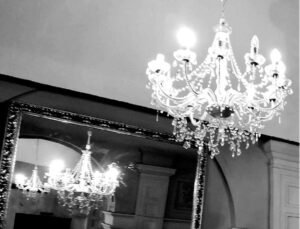
Teatro Argentina is a horseshoe-shaped Italian-style hall with 720 seats, 354 in the orchestra and 366 in six tiers of boxes, according to the figures of the Teatro di Roma, which runs it. Red and gold, with a decorated green ceiling and a 16-arm chandelier, it is one of the most beautiful historic halls in Rome.
The name
Argentina has nothing to do with the South American country. The name comes from the tower of the palace of Johannes Burckardt, the Burcardo, a papal master of ceremonies born in Strasbourg, in Latin Argentoratum, who signed himself episcopus argentinensis. The tower, the square and the theater took their name from him. The Burcardo palace, built between 1491 and 1500, is still on Via del Sudario.
The construction
Work began in 1730 by the Sforza Cesarini family. The architect and marquis Gerolamo Theodoli designed the horseshoe-shaped hall to favor acoustics and visibility. Originally it was almost entirely wood, with 186 boxes.
Facade and restoration
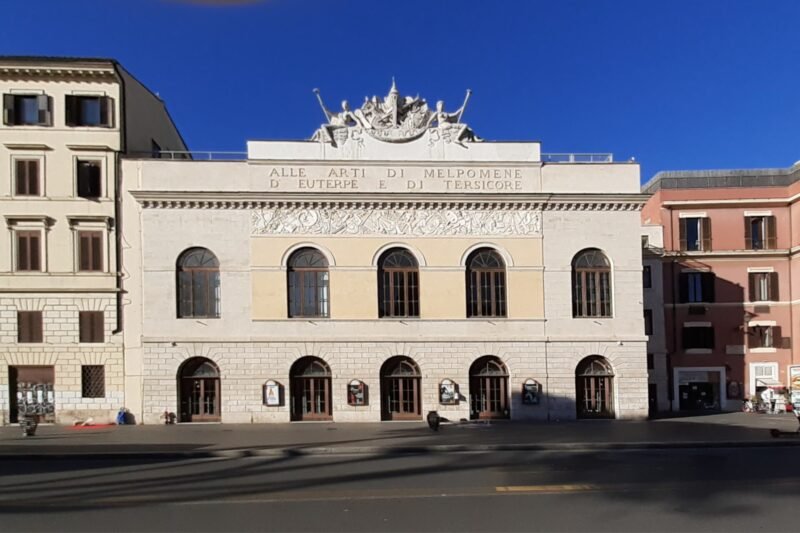
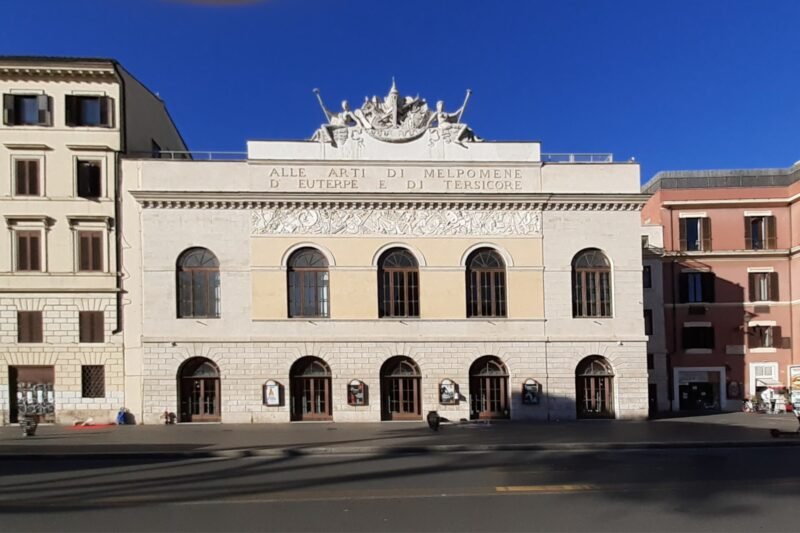
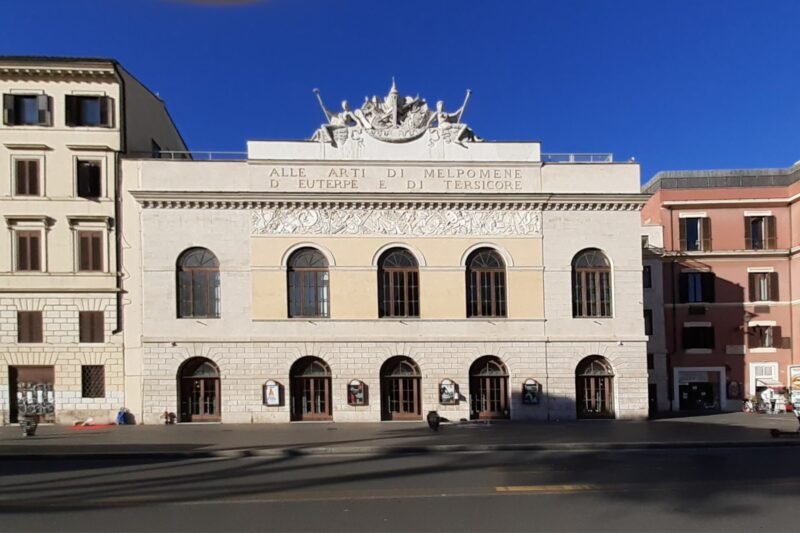
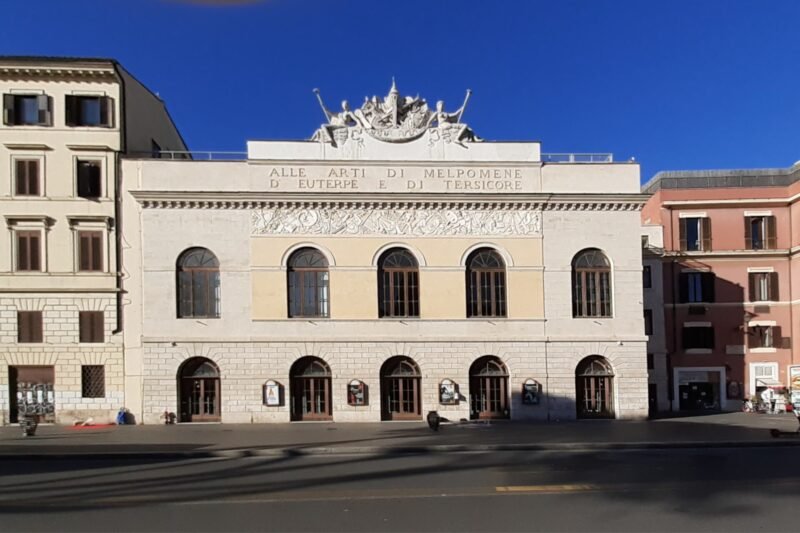
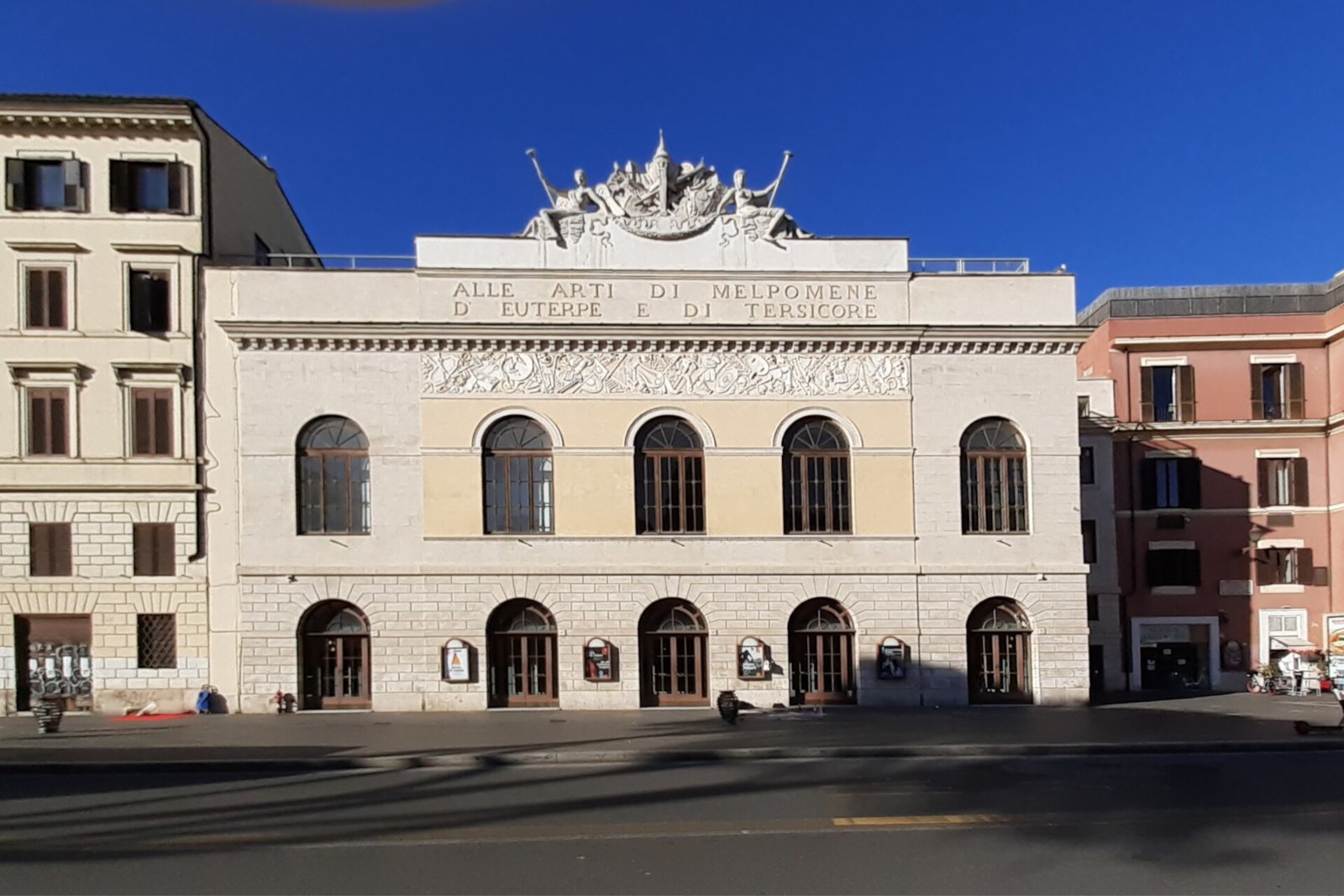
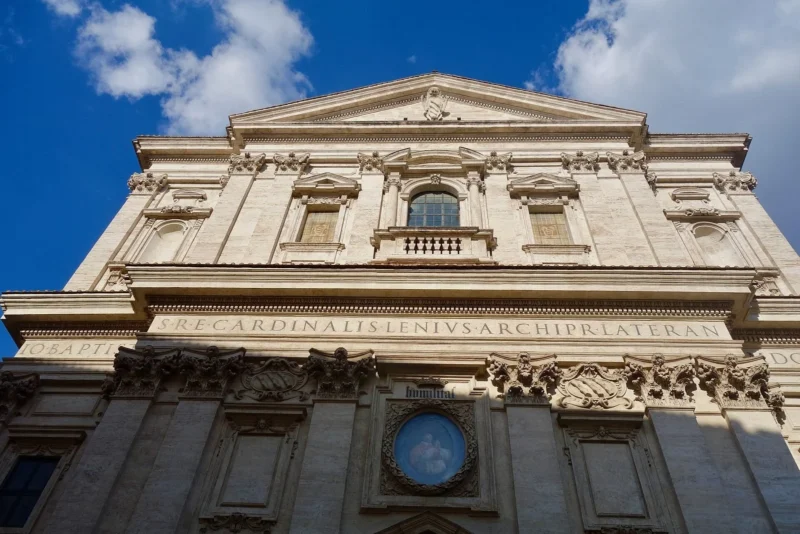
The neoclassical facade, with its dedication to the muses Melpomene, Euterpe and Terpsichore, dates from 1826, designed by Pietro Holl. In 1993 Paolo Portoghesi restored the theater, bringing back the red of the upholstery and the original shape of the box valances.
One thing nobody tells you about Adélaïde Ferrière for the Filarmonica Romana at Teatro Argentina, February 4, 2027
What few people say is that a percussion recital is also a show to watch. The instruments fill the stage, and a program of nine composers asks the soloist to change instruments and mallets, so the view matters more than at a piano recital. In a horseshoe-shaped hall, the seats in the central orchestra and the boxes of the first tiers facing the stage are the ones from which you see hands and mallets best.
The second concerns the acoustics. Teatro Argentina is not a concert hall built for percussion, but an 18th-century horseshoe-shaped opera hall, designed by Theodoli with acoustics and visibility in mind. In our view its compact size favors clarity of timbre: even a marimba pianissimo reaches the back of the hall.
The third is practical: the theater is in a limited traffic zone and has no parking. If you come by car, you have to leave it outside the ZTL and continue by tram 8 or on foot.
The advice I give you for visiting Adélaïde Ferrière for the Filarmonica Romana at Teatro Argentina, February 4, 2027
My advice is to come without prejudice. People who have never heard a percussion recital often think of a noisy concert. Ferrière's program, between minimalism, marimba and pages of great timbral refinement, tells a world more varied and often more delicate than you might imagine.
Second piece of advice: listen beforehand to at least one piece by Philip Glass and one by Meredith Monk, to get into the language of repetition on which the evening opens. The rest of the program is discovered in the hall.
Third: choose a seat from which you can see the hands. In a percussion recital, watching how mallets, instruments and postures change is part of the experience.
Finally, arrive at the Argentina on foot, crossing the historic center from the Pantheon or Piazza Navona, and look at the hall with the lights on before they go down: it is one of the most beautiful theaters in Rome.
The Accademia Filarmonica Romana, the organizer
The Accademia Filarmonica Romana is a private nonprofit institution founded in Rome in 1821. It organizes chamber and symphonic concerts, ballets and music theater shows, and is one of the oldest music institutions in the city.
The origins
It was founded by amateur musicians gathered around the composer Raffaele Muti Papazzurri, to perform chamber music, symphonic music and operas in concert form when censorship forbade staging them. In 1824 it became an official institution of the Papal States. Its activity was suspended between 1849 and 1856 for economic reasons and between 1860 and 1870 for political reasons.
From the 20th century to today
In 1946 it was refounded under the artistic direction of Alfredo Casella. The headquarters moved to the Casina Vagnuzzi, at Via Flaminia 118, where the Sala Casella is today. Since 1980 the Filarmonica has owned the Teatro Olimpico. Its artistic directors include Goffredo Petrassi, Luciano Berio and Hans Werner Henze. Since 2024 the direction has been in the hands of Domenico Turi.
Illustrious guests
The history published by the Accademia recalls the Italian premiere of The Siege of Corinth in 1827 and Anna Bolena conducted by Donizetti in 1833. Between the wars, performers such as Adolf Busch, Rudolf Serkin, Alfred Cortot and Jascha Heifetz. After 1946, Bartók, Britten, Messiaen, Stravinsky, Berio and Boulez. Today's music, the kind in Ferrière's recital, is at home here.
How to get to Teatro Argentina
Teatro Argentina is at Largo di Torre Argentina 52, in front of the sacred area, in the historic center. The most convenient way is tram 8.
The tram
Tram 8 stops at Torre Argentina, a few steps from the entrance, and connects the square with Trastevere and Monteverde. Going and coming back, it is the simplest solution.
Metro and bus
No metro station is near the theater: the most convenient are Colosseo and Circo Massimo, on line B, from which you continue on foot or by surface transit. Largo Argentina and Corso Vittorio Emanuele II are crossed by many bus lines linking Termini, Piazza Venezia, the Vatican and Trastevere. Evening times should be checked on Rome's public transit information service.
On foot
From Piazza Venezia, along Via delle Botteghe Oscure, it takes a few minutes. The same from the Pantheon, Piazza Navona, Campo de' Fiori and the Ghetto. If you come by car, you have to park outside the ZTL.
Another well-known fact, yet rarely mentioned
It is well known that Teatro Argentina is today the home of prose theater for the Teatro di Roma. It is less often remembered that it was born as an opera and music theater. It was inaugurated in January 1732 with Berenice by Domenico Sarro, Rossini's Barber of Seville debuted there on February 20, 1816, Niccolò Paganini played there in 1827, and Verdi brought two premieres there. An instrumental recital at the Argentina is a return to the original vocation of the building.
A second fact, known to those who follow the Filarmonica: the institution was founded in 1821 in part to get around censorship, performing in concert form the operas that could not be staged. Two centuries later, the Filarmonica brings to an opera hall an avant-garde repertoire that, for other reasons, struggles to find room in traditional seasons.
Third fact: since 2022 Adélaïde Ferrière has directed a festival, Musique en Chambertin. Alongside her solo career, she is also a music organizer, and the choice of such a varied program for Rome bears that mark.
The right photo to take at Adélaïde Ferrière for the Filarmonica Romana at Teatro Argentina, February 4, 2027
The right photo is taken before the start, from the orchestra: the stage covered with instruments, the marimba in the foreground, and behind and above it the six tiers of red and gold boxes, the green ceiling, the chandelier. The contrast between a contemporary percussion set and an 18th-century hall is the image of the evening.
The second, still with the lights on, is taken by pointing upward: the boxes and the 16-arm chandelier in a single frame tell the Argentina better than any description, and they work even with a phone.
The third is taken outside, in the evening, from the opposite side of the square: the neoclassical facade with its dedication to the muses and, in the foreground, the lit columns of the sacred area. During the recital the phone stays off: with percussion, every extraneous sound is heard.
Around Teatro Argentina
Teatro Argentina is a few minutes' walk from the Pantheon, Piazza Navona, Campo de' Fiori and the Ghetto. A concert here naturally pairs with an evening stroll through the historic center.
The sacred area
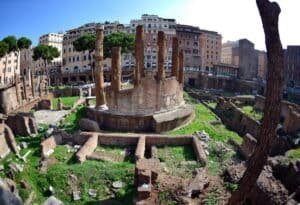
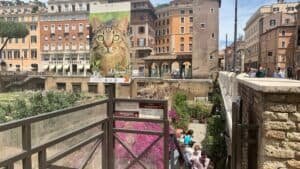
In front of the theater is the sacred area of Largo Argentina, with the remains of the temples and of the structures tied to the Theater of Pompey complex. Among the ruins lives the cat colony of the cat sanctuary at Largo Argentina.
Toward the Pantheon and Navona
In five minutes to the north you reach the Pantheon. To the west, beyond Corso Vittorio Emanuele II, are Piazza Navona and Campo de' Fiori.
The Ghetto
Toward the Tiber you enter the Jewish Ghetto. A few steps from the Argentina is also the Church of the Gesù.
Toward Piazza Venezia
Along Via delle Botteghe Oscure you reach Piazza Venezia in a few minutes. From the Ghetto, along the river, you reach the Theater of Marcellus, lit in the evening. If you arrive early, you can turn the wait for the concert into a walk among ancient ruins and Renaissance palaces, without ever going more than a quarter of an hour from the theater.
An evening on foot
The nice thing about a concert at the Argentina is that the evening is built on foot: aperitivo in a square in the center, recital at 21:00, return through half-empty streets. A Thursday in February, with the historic center out of season, is the ideal time to experience it this way.
Some important events that took place here in history
Teatro Argentina was inaugurated in January 1732 with Berenice by Domenico Sarro. In the 18th century foreign travelers considered it the most important of the Roman theaters, and since then its history has been intertwined with that of Italian music and the politics of the city.
On February 20, 1816 the premiere of Rossini's Barber of Seville took place here, with Manuel García: it was a fiasco, because many admirers of Paisiello's Barber sat in the stalls, but from the second evening the opera triumphed. On January 28, 1822 Teatro Argentina hosted the world premiere of Donizetti's Zoraida di Granata, and in 1827 a concert by Niccolò Paganini.
Verdi brought The Two Foscari there in 1844 and The Battle of Legnano in 1849. According to the Teatro di Roma's reconstruction, it was on the occasion of the latter that the Romans began the demonstrations that led to the Roman Republic. After 1870 the building passed to the Comune. In 1993 it was restored by Paolo Portoghesi. Since 2022 it has been the main venue of the Fondazione Teatro di Roma, and it also hosts the Filarmonica's concerts.
Who has played Adélaïde Ferrière for the Filarmonica Romana at Teatro Argentina, February 4, 2027
On the Argentina stage have come Gioachino Rossini with The Barber of Seville and Manuel García. Gaetano Donizetti with Zoraida di Granata. Giuseppe Verdi with two premieres. Niccolò Paganini in concert, in 1827. In the 20th century the hall saw works by Gabriele D'Annunzio and Luigi Pirandello, and Teatro di Roma directors such as Vito Pandolfi and Luca Ronconi.
In the history of the Filarmonica, which brings Ferrière to this hall, appear the founder Raffaele Muti Papazzurri, Alfredo Casella, Goffredo Petrassi, Luciano Berio, Hans Werner Henze and Giuseppe Sinopoli, and performers such as Serkin, Cortot and Heifetz.
Among the Filarmonica's recent guests at the Argentina is Ferrière herself, who made her Roman debut there in March 2025 before a large audience, according to the Accademia's account. On February 4, 2027 she returns with marimba and percussion to where, two centuries earlier, Paganini's violin played.
Accessibility and practical information
Teatro Argentina is a historic building where architectural barriers can't be removed entirely. According to the Teatro di Roma, the building has elevators and reserved seats in the stalls for people with disabilities. For availability on the evening of the concert, it's best to contact the Filarmonica or the theater box office in advance.
With kids
A percussion recital is one of the concert forms best suited to kids: visible gestures, curious instruments, rhythm. For a teenager who plays drums or studies at a conservatory, seeing a soloist of this level up close is a rare experience. The 21:00 start should be weighed for younger children.
Dress
There is no dress code at the Argentina, but the hall invites a minimum of care. In February a coat and umbrella are almost always useful.
Where to eat before or after the concert
The historic center around the Argentina offers every kind of place: Roman trattorias on the streets toward Campo de' Fiori, Roman-Jewish cooking in the Ghetto, bakeries and pizza-by-the-slice places along Corso Vittorio Emanuele II for a quick meal before 21:00, wine bars and bistros around the Pantheon for after the concert.
The hours
With a 21:00 start it is best to eat early, around 19:30, or book for later, bearing in mind that many kitchens in the center close around 23:00. A Thursday in February is generally quieter than a weekend, but booking is still advisable.
A concert in early February
The first week of February is low season in Rome: a less crowded historic center, museums you can enjoy, concert halls in the middle of their seasons. If you are in the city, you can build yourself a week of music.
The music week
On the same February 4, at the Auditorium Parco della Musica, Tarmo Peltokoski conducts Bertrand Chamayou in Liszt's First Concerto and Shostakovich's "Leningrad," with repeats on the 5th and 6th. On Saturday, February 6 at 20:30, flutist Lucie Horsch plays at the Aula Magna of the Sapienza for the IUC Season.
The return
At the exit, tram 8 and the buses on the square take you back toward Trastevere, Termini and Piazza Venezia. If you stay in the center, you can end the evening with a walk to the lit Pantheon, five minutes from the theater.
How to listen to a percussion recital
A solo percussion recital asks for different listening than a piano or violin recital: here timbre counts as much as melody, and each piece builds its own sound world with different instruments and techniques.
Watching as well as listening
In Ferrière's program each composer asks for different instruments and mallets. Following the instrument changes, the way the soloist prepares the set between pieces, the different postures in front of the marimba or the other instruments, is part of the concert. That is why, in our view, the choice of seat matters more than usual.
Repetition
The pieces by Glass and Monk that open the evening work on repetition. If you are not used to it, you may find them static in the first minutes. The advice is to let yourself be carried along, without waiting for a traditional development, and notice the small changes that accumulate.
Timbre
In the more recent pieces of the program the color of the sound is the real protagonist: the wood of the marimba, the skins, the metals. A simple way to listen to them is to close your eyes for a few minutes and follow only the timbre, then reopen them and watch how that sound is made.
Applause
In a recital with nine composers it is natural to wonder when to applaud. The rule of the classical concert applies here too: you applaud at the end of each piece, not between the sections of a single composition. When in doubt, wait for the soloist to lower the mallets.
Frequently asked questions about Adélaïde Ferrière at Teatro Argentina
When does Adélaïde Ferrière play in Rome?
Adélaïde Ferrière plays at Teatro Argentina on Thursday, February 4, 2027 at 21:00, in the season of the Accademia Filarmonica Romana. The theater is at Largo di Torre Argentina 52, in the historic center of Rome. It is her return to Rome after the debut of March 2025.
What does Adélaïde Ferrière play?
At Teatro Argentina, Adélaïde Ferrière plays 20th and 21st century percussion music: Philip Glass, Meredith Monk, Andrew Thomas, Carlos Roque Alsina, Agata Zubel, Javier Álvarez, Keiko Abe, John Psathas and Emmanuel Séjourné.
Who is Adélaïde Ferrière?
Adélaïde Ferrière is the French percussionist and marimba player born in Dijon in 1996, a graduate of the Paris Conservatoire, winner of the Victoire de la Musique Classique in 2017 as revelation and in 2026 as instrumental soloist of the year. She also records for Deutsche Grammophon.
Where do you buy tickets?
Tickets for Adélaïde Ferrière at Teatro Argentina are bought from the concert page on the website of the Accademia Filarmonica Romana, which links to the authorized presale network where prices are published, or at the theater box office.
How do you get to Teatro Argentina?
Teatro Argentina, at Largo di Torre Argentina 52, is reached on tram 8, Torre Argentina stop, and on the many bus lines that cross the square. The nearest Metro B stations are Colosseo and Circo Massimo. The theater is in the ZTL and has no parking.
Is the concert suitable for teenagers?
Adélaïde Ferrière's recital is among the concerts best suited to kids in the Filarmonica's season, because percussion is something you both hear and watch: different instruments, visible gestures, rhythm. The 21:00 start on a Thursday should be weighed for small children.
Has Adélaïde Ferrière played in Rome before?
Adélaïde Ferrière made her Rome debut for the Accademia Filarmonica Romana in March 2025, welcomed, according to the Accademia, by a large audience. The concert on February 4, 2027 at Teatro Argentina is her return in the Filarmonica's season, with a program entirely from the 20th and 21st centuries.
How long is the concert?
The length of Adélaïde Ferrière's recital at Teatro Argentina is not stated by the Filarmonica. With nine composers on the program and a 21:00 start, the evening is the size of a full recital. If you need to take late-night public transport, check the schedules in advance.
The final advice on Adélaïde Ferrière at Teatro Argentina
A percussionist with two Victoires de la Musique Classique, a program that goes from Glass and Monk to the Japanese marimba, a hall from 1732 where The Barber of Seville debuted: in our view it is the most unusual concert of the Filarmonica's season, and one of the best suited to those who do not usually go to classical music. My advice is to choose a seat from which you can see the hands, listen to a piece by Glass beforehand, walk over from the Pantheon and eat early.
Article written by the editorial team of Tour Leader Pro, contact them for Private/Corporate/V.I.P. Tours and Experiences.
Planning a trip to Rome? The English guides to visiting the city are on ItalyPlanner.com.
Contact Information
Nearby
 Teatro Argentina100 m
- Teatro Centrale100 m
- Largo Torre Argentina – Sacred Area of Campo Marzio100 m
- Cat Sanctuary at Largo Argentina100 m
- San Carlo ai Catinari200 m
- Santa Maria in Publicolis200 m
Upcoming events nearby
- Othello at Teatro Argentina, November 4 to 29, 2026100 m
- The Madness of King George with Massimo Popolizio at Teatro Argentina in Rome, January 9 to 31, 2027100 m
- Una delle ultime sere di Carnovale at Teatro Argentina, February 2 to 14, 2027100 m
- Lo zar by and with Stefano Massini at Teatro Argentina in Rome, March 16 to 25, 2027100 m
You might also like
- Thomas Oliemans, Winterreise at Teatro Argentina, February 11, 2027
- Trio Concept for the Filarmonica Romana at Teatro Argentina, December 10, 2026
- Samuele Rizzuto, Il pianista dell’anima at Teatro Sala Umberto, March 31, 2027
- Filippo Gorini for Filarmonica Romana at Teatro Argentina, March 18, 2027
- Quartetto Prometeo and Claudio Pasceri at Teatro Argentina, March 4, 2027
- Amedeo Minghi, Anniversari Tour at Teatro Sistina, January 18, 2027