Terme di Suio
In short. The Terme di Suio are on Via delle Terme, in the thermal area of the Suio district of Castelforte, 04021, province of Latina, on the Lazio bank of the Garigliano.
The Terme di Suio are on Via delle Terme, in the thermal area of the Suio district of Castelforte, 04021, province of Latina, on the Lazio bank of the Garigliano. They are not a single facility: they are a group of private establishments, each with a paid entrance, its own price list and direct reservation with the operator. To give a concrete reference, Terme Sant'Egidio publishes its daily price lists month by month on its website and answers at 0771 672212.
Suio is a river valley floor, not a spa town. One road, a few hotels, outdoor pools, the smell of sulfur that arrives before the signs and, on the other side of the water, Campania. The Romans called it Aquae Vescinae, armies clashed here twice, four and a half centuries apart, and Castelforte, the main town on the hill, was almost leveled to the ground in 1944.
The season, contacts and entry arrangements given here come from the official pages of the Comune of Castelforte and of the operators, consulted on September 29, 2026, that is with the summer season almost over. The outdoor thermal pools work mostly between spring and autumn, the price lists change from one month to the next and each establishment decides its own openings and closures. Before leaving, phone the operator you've chosen and have the day, time and price confirmed.
Where it is and what you actually see
Suio is in the far south of Lazio, in the territory of Castelforte, where the Garigliano forms the border with the province of Caserta. The thermal area stretches along the valley floor, down low, while the old core of Suio Alto sits on the hill. On one side the ridges of the Aurunci Mountains, on the other the plain that descends toward Minturno and the sea of Scauri.
The Comune's page defines it as the area where several thermal hotels stand with attached treatments and thermal pools, and the description is accurate. Arriving you see hotel signs, gates, parking lots, outdoor pools behind hedges, umbrellas. There's no spa square, no monumental building, no public park equipped with the pools. Anyone expecting Saturnia or Bagno Vignoni finds something else, simpler and more everyday.
Why does the water come out hot right here? The explanation most often read links the springs of the lower Garigliano valley to the volcanic area of Roccamonfina, which rises on the Campania bank a few kilometers away, and to the fractures between the limestones of the Aurunci and the alluvial plain. The Comune doesn't go into geological detail. For those looking, the result is what counts: hot sulfurous water rising along a precise line of the valley floor.
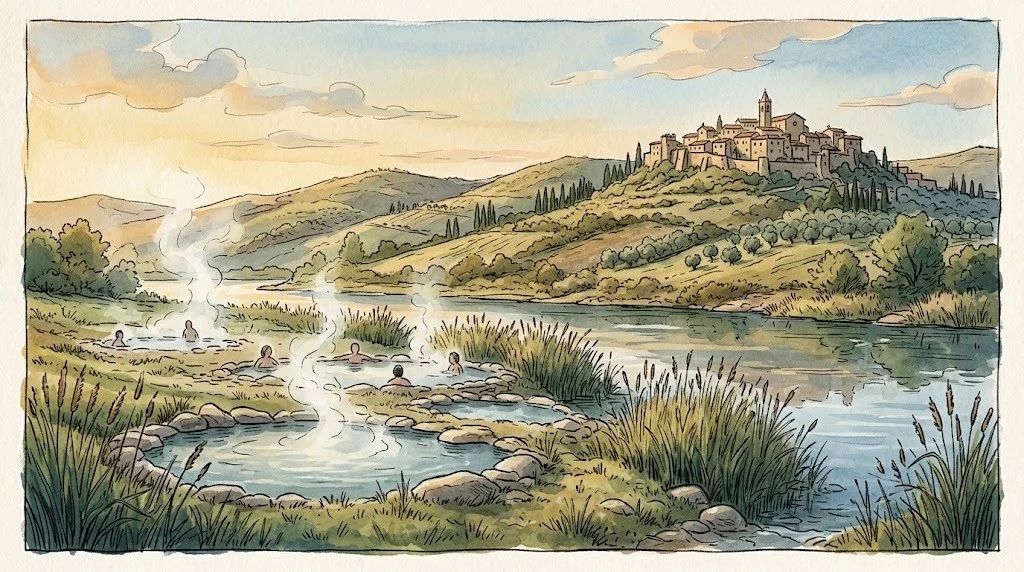
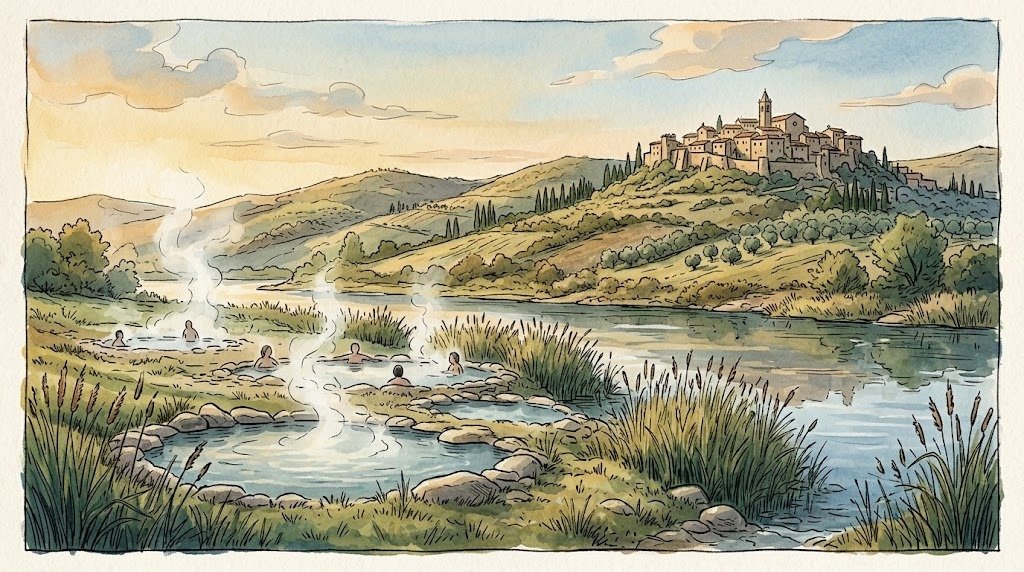
What you actually see is the river. The Garigliano flows wide and slow, with banks covered in reeds and poplars, and in some stretches the sulfurous water surfaces along the shore leaving whitish deposits and a smell you can sense from a distance. It's the landscape that gave the place its name in Roman times, and it's the only part of Suio that no establishment can fence off entirely.
The Comune indicates the area as having guaranteed access even for people with a disability and reachable both by car and by public transport. In the individual establishments, though, accessibility depends on the operator: ramps, lifts for entering the pool and adapted changing rooms are not declared uniformly. If you need it, ask by phone before booking, with precise questions about the pool and not generically about the facility.
A curiosity about the Terme di Suio
The ancient name comes neither from an emperor nor from a deity, but from a vanished city. Aquae Vescinae means the waters of Vescia, one of the centers of the Ausones, the people who lived in this valley before the Roman conquest. Of Vescia today not even the position is known with certainty. The Comune of Castelforte ties the name of the waters to that city, and the ancient sources recall it together with Minturnae and Ausona.
The real curiosity is that the name of the lost city survived thanks to hot water. Of Vescia there remain a handful of citations in the Latin historians and an adjective stuck to the springs. Today you find that adjective on the sign of a private establishment, Terme Vescine, and in the names of hotels and associations. An Ausonian city reduced to a commercial brand: it happens often in Lazio, but rarely so sharply.
The second curious detail concerns temperatures. The Comune's entry speaks of springs with waters up to 60 degrees. Put like that it sounds like a textbook figure, but it means that in the same valley nearly cold pools and boiling outflows coexist, a few meters apart. For this reason the establishments' pools mix or cool the water, and for this reason along the river the temperature changes from one step to the next.
Third detail: the Comune claims that the waters of Suio are the first in Italy and the third in Europe for iodine content. It's an institutional claim, published on the Comune's website, but the scientific source supporting it is not cited on the page. Take it for what it is, that is a regional-promotion phrase repeated for years, until someone publishes the comparison with the data of the other European springs.
The water: what the Comune and the operators say
The Comune of Castelforte classifies the waters of Suio as sulfurous, bicarbonate-calcium and alkaline-earth. These are the definitions you find repeated on the establishments' websites, each with its own analyses and its own commercial names for the springs. For the exact composition of the water in the pool you'll enter, only what the operator states applies, because each establishment draws from different intakes and mixes them differently.
On health effects the rule is simple. The Comune writes that sulfur acts through the skin, the lungs and the mucous membranes, and indicates the waters for balneotherapy and mud therapy, irrigations and treatments of the respiratory system. These are statements by those who promote the territory, not prescriptions. Real thermal treatments are done with a doctor, and some establishments offer them under agreement with the health service: ask the operator which services are covered.
Contraindications must be asked of the establishment, which is bound to know them for its own waters. The questions to ask are always the same: pregnancy, blood pressure, heart problems, minimum age for children in the hot pools, maximum recommended time in the water. If the operator doesn't publish guidance and on the phone can't answer, that's a signal. A serious facility has a written regulation and hands it to whoever enters.
The smell of rotten eggs you notice as soon as you get out of the car is hydrogen sulfide, the gas that accompanies sulfurous waters. In the outdoor establishments it disperses and only a background note remains. Along the river, in sheltered hollows and on windless days, it concentrates more. It isn't a reason to be afraid, it's a reason not to stay bent over the hottest outflows for long and not to take children there to play.
One thing nobody tells you about the Terme di Suio
The free hot springs of Suio, the ones that circulate on social media with photos of steaming pools along the river, are not a public thermal park. In the pages the Comune of Castelforte devotes to Suio there is no equipped free bathing area, with an operator, a regulation and services. There are outcrops of hot water on the bank, known to those who live here, and a group of enthusiasts who document them. It's something else.
In our judgment, and it's an unpopular position, the free pools of Suio are overrated. Anyone arriving from Rome after two hours on the road to bathe for free often finds muddy banks, access through brambles, water that changes level with the river and no services. The comparison with the free and managed pools of the Tuscia, like the Piscine Carletti, doesn't hold at Suio.
The river, then, is not a mountain stream. The Garigliano upstream is blocked by the Suio dam, and the Comune publishes notices on the dam's alert phases, with vigilance levels that change according to flow. Translated for those who bathe: the level and the current of the bank where you are sitting can change without your doing anything, and smooth rocks covered in deposits are slippery as soap.
Paying for an establishment is not a surrender. It means having temperature-controlled water, a lifeguard, showers, a regulation, a place to leave your car keys. Anyone who wants direct contact with the river can take a walk along the bank in daylight, look at where the sulfur surfaces, and then get into a pool. It's the most sensible compromise, even for an organized group.
Establishments, prices and how to get in
At Suio entry to the waters goes through the private establishments, which sell the daily or half-day ticket for the pools, the passes and the thermal treatments. Among the facilities with their own website are Terme Vescine, Terme Sant'Egidio, the Albergo Terme Alba, the Piscine Termali Luval and the Piscine Termali Arcobaleno. Openings, season and prices of each should be read on the operator's website or asked by phone, because no body publishes a single calendar.
The ticket is bought only from the operator, at the desk or with the reservation indicated on its website. Terme Sant'Egidio publishes its price lists on the Terme Sant'Egidio price list page, and Terme Vescine presents entry and umbrellas on the Terme Vescine thermal pools page. There is no product dedicated to the Terme di Suio on the big tourist-activity portals: offers and gift boxes should be compared with the official price list.
A concrete example of how it works. As of September 29, 2026 Terme Sant'Egidio publishes three documents in PDF format: the daily price list for August 2026, the one for September 2026 and the 2026 passes. Prices are therefore monthly, and August costs differently from the other months. The hours page indicates the park open from 9:00 to 18:00, with evenings from 20:00 to 24:00 on Monday, Wednesday and Saturday. For October the price list is not yet published.
Three things to ask when you phone. If the ticket includes a lounger and umbrella, or if they're paid separately. If the half-day entry also exists on weekends, because many establishments reserve it for weekdays. If on summer evenings there are events with music, which some organize at the pool and which completely change the kind of experience. It's best to call during office hours, not on Sunday at noon.
Covered thermal treatments are a different channel from the pool ticket. They require the doctor's prescription and a reservation with the accredited establishment, under the rules of the regional health service. Which facilities are covered in 2026 and for which treatment cycles must be asked directly of them or of your own health authority. I don't list them here, because they change and because a wrong piece of information about a treatment is costly.
How to choose the right establishment
The first question to ask is not about price but about the temperature of the pools. Some establishments have a large lukewarm pool and a smaller, hotter one, others keep all the pools at the same value. Anyone traveling with small children or elderly people wants the first solution. Anyone coming to stay long in hot water looks for the small pool and asks about the less crowded hours.
The second is shade. In summer, among the outdoor pools of the valley floor, the difference between a lawn with trees and a concrete solarium is felt after the first hour. Look at the photographs on the operator's website with a critical eye, looking for real trees and not umbrellas arranged for the shot. The third is water turnover: ask how it happens and when the pools are emptied for cleaning, a piece of information the operator should be able to give.
The last concerns the type of clientele. Thermal hotels with a pool work a lot with guests doing treatment cycles, and on weekdays have a quiet air, almost like a rest home. Establishments with only pools and green area aim at families and weekend groups. Neither is better in absolute terms. It depends on what you're looking for, and it's best to know before you arrive.
The advice I give you for visiting the Terme di Suio
Go in September, on a weekday, and choose the establishment based on the pool and not the hotel. In August Suio fills up with families from the Caserta area, the Pontino and the Cassino area, the pools become beach clubs, and hot water under the noon sun is more an endurance test than a pleasure. In September the air cools, the price lists drop and the pools go back to being pools.
Bring flip-flops, a swim cap and an old swimsuit. Sulfurous water leaves a smell on fabrics and yellows some elastic, and a silver bracelet comes out blackened. Take off jewelry and watches before getting in. Keep in mind that after an hour soaking at 35 degrees and above your head spins: get out, drink water, sit in the shade. It's the part young people always ignore and grandparents know very well.
With children it's best to be careful. Hot water tires the little ones quickly, and the hottest pools are often not suited to the youngest, with age limits that the operator indicates in its regulation. Choose the establishment that has a separate lukewarm pool, bring something to drink and something to eat for the breaks, and count on frequent stops in the shade. A well-done morning is worth more than a whole day with an exhausted child.
Arrive early. Almost all establishments work with the daily ticket, and whoever enters at opening chooses the spot, finds clean pools and has the hottest water of the day, before the turnover settles. In early afternoon the groups arrive. If you want the half day, take the morning one and go out to lunch, which is also the best way not to spend double at the establishment's bar.
Don't do the spa day solo coming from Rome. It's more than two hours on the road each way and after four hours in hot water driving in the evening on the Pontina or the Appia is not a good idea. Sleep in the area or split the driving. Alternatively, pair the spa with half a day on the coast of Formia or Gaeta and head back the next day.
The free springs along the Garigliano: rules and safety
Who manages the hot banks of the Garigliano? Nobody, in the sense of an operator who opens and closes. The data is not published: the Comune's institutional pages don't indicate a free bathing area with regulation, hours or services, and no orders dedicated to the pools appear published on those pages. To know if bans or limitations apply on a certain stretch, the only safe channel is the Comune's Ufficio relazioni con il pubblico, at 0771 607923.
The common-sense rules are those of any riverbank. No glass, no fires, no music, no trash left on the shore. Don't park in front of farm gates and don't cross fenced fields to reach the water. Dogs should be kept away from the hot outflows, which are more dangerous for them than for us. Don't go at night: the bank is dark, slippery and right next to a river regulated by a dam.
On safety you need to be direct. The water coming out of the spring can be much hotter than that of the pool you immerse yourself in, and the bottoms are mud and limestone rock that gives way under your feet. The Garigliano has current even when on the surface it seems still. Don't enter the river itself, don't let children do it, and if you feel dizzy get out into the open air right away.
Anyone looking for free waters with a public operator or a clear organization has to look elsewhere. In the Viterbo area there's the Bullicame, at Civitavecchia the Terme Taurine and the Ficoncella, near Viterbo the Bagnaccio run by an association. They are far from Suio but answer a need that here finds no organized public offering.
Another well-known fact, yet rarely cited
Suio has been Lazio for only a century. Until the reorganization of the provinces in the 1920s and 1930s, Castelforte was part of the Terra di Lavoro, that is of the province of Caserta, and before that of the Kingdom of Naples. The border on the Garigliano that today divides two regions was, for centuries, a river inside a single kingdom. It's a detail that explains much of the valley's character.
The name of the river also tells a border story. The Romans called it Liris, the same name as the Liri that comes down from the Valle Roveto and passes through Isola del Liri and below Arpino. The Garigliano is born from the union of the Liri with the Gari, in the plain below Cassino, and from there takes its modern name to the sea. At Suio, then, the water of the Ciociaria, of Abruzzo and of the Cassino area flows together.
This explains many things that the Roman visitor notices without understanding. The dialect, which resembles that of Sessa Aurunca more than that of Latina. The cooking, with buffalo mozzarella and Campanian pastas. The kinships and trade, which have always crossed the river. Suio looks south, and its thermal public comes in good part from the other bank.
The same story can be read on the coast. Gaeta was the stronghold where the Kingdom of the Two Sicilies came to an end in 1861, and from Scauri to Formia the names, churches and fortifications speak Neapolitan. Anyone who wants to understand the area has to think of it as the northern frontier of a southern kingdom, not as the last periphery of the province of Latina. It changes the way you look at everything else.
The right photo to take at the Terme di Suio
The right photo isn't taken in the pool, where photographing other bathers is rude and often forbidden by the establishment's regulation. It is taken on the bank of the Garigliano early in the morning, when the air is cool and the hot water that surfaces on the shore steams. Backlit, with the low sun behind, that steam becomes visible and tells the place better than a hundred images of blue pools.
Frame horizontally and put the river in the lower half, with the white sulfur deposits in the foreground. The Monti Aurunci in the background give the scale. You need little zoom and a lot of patience: the steam comes and goes with the air currents, and the good photo arrives on the third or fourth try. In the middle hours of the day, with the sun high, the steam disappears and an ordinary bank remains.
The second image is from above. Climb toward Suio Alto or toward Castelforte and look at the valley: the ribbon of the river, the cultivated plain, Campania on the other side. From the main town, rebuilt after the war, you understand why this hill was a military position. Take the photo with a person seen from behind at the edge of the road, safely, to give the measure of the space that opens below.
A rule that holds for all spas, and here more than elsewhere: don't photograph people in the pool. The public at Suio is made up of families and elderly people in treatment, people who come to relax and not to appear on a stranger's profile. If you want the image of the pool, ask the operator to let you shoot it before opening or in the last hour, when the pools empty. Some grant it, to those who ask politely.
Getting there from Rome
By car the most used route is the coastal one: Pontina or Appia to Formia, then the coast road toward Minturno and the turn-off for Castelforte and Suio. Alternatively you take the highway toward Naples and exit at Cassino, then go down toward the coast. The distance is around 160 kilometers and the time, without traffic, exceeds two hours. On summer weekends the Pontina adds an hour.
By public transport the route requires a change. The train from Rome reaches Formia on the line for Naples via Formia, and along the same line there's the Minturno Scauri stop. From Formia depart direct Cotral runs into the Suio valley, with stops indicated as Suio Terme and Sant'Egidio. Frequencies and times change with the seasons and with school: check the day before on the Cotral website.
The Comune indicates the thermal area as reachable by public transport, and it's true, but the runs are few and designed for residents and students. On holidays the service thins out. Anyone arriving by train intending to do the spa day and return to Rome in the evening has to count carefully on the last return run toward Formia, which may leave early.
Anyone traveling south can fit Suio into a longer itinerary. From Suio to Cassino and the Abbey of Montecassino it's less than an hour, and farther south the Royal Palace of Caserta is a good hour away. These are all roads where on Sunday evening the return toward Rome gets clogged: plan to leave after dinner or on Monday morning.
Some important events that happened here in history
In 314 BC, according to Livy's account, the Ausonian cities of Ausona, Minturnae and Vescia were handed over to Rome by betrayal and their inhabitants exterminated. It is the end of the world of the Ausones in this valley and the beginning of the Roman colonization, which brings to Minturnae, at the mouth of the Garigliano, a colony and a river port. The hot waters of Suio enter history as an appendix to that conquest.
In the imperial age the springs are frequented and built up. The Comune recalls the remains of the Roman baths, among them the pool that local tradition calls Nero's, and cites Pliny among the authors who speak of the waters. In the Middle Ages the baths appear, according to the Comune, in the papal bulls of Adrian IV and in the chronicles of the abbey of Montecassino of the 11th and 12th centuries, which had landholdings along the river.
On December 29, 1503, after weeks of stalemate on the two banks of the river, the Spanish army of Gonzalo Fernández de Córdoba crosses the Garigliano upstream, on a bridge of boats, and surprises the French camped toward the mouth. The battle of the Garigliano ends the war for the Kingdom of Naples, which will remain Spanish for two centuries. Many reconstructions place the crossing of the bridge in the Suio area.
In the 19th century, under the Bourbons, the Garigliano is crossed near the mouth by the Real Ferdinando bridge, the first iron suspension bridge built in Italy, inaugurated in 1832. The baths of Suio remain a local place of cure, frequented by families of the Kingdom and then of the Kingdom of Italy. In 1861, with the fall of Gaeta, the frontier that ran through this valley ceases to exist.
Between October 1943 and May 12, 1944, according to the Comune, Castelforte lives eight months of shelling on the Gustav line, the German defensive line that ran along the Garigliano. The confirmed destruction was 95 percent of the built-up area, the civilian victims 812, a tenth of the population. The Allied breakthrough of May 11, 1944 opens the way toward Rome, which is liberated on June 4.
In the postwar period Castelforte is rebuilt and the baths start again with the hotels and outdoor pools you see today. The Comune received the Silver Medal of Civil Valor in 1961 and the Gold Medal of Civil Valor in 2002 for the sufferings endured by the population. In the area there are memorial initiatives on the Gustav line run by local associations: if and when they can be visited should be asked of the Comune before going.
The 1503 Battle of the Garigliano: documents, tradition, legend
What the documents say. In December 1503, the French and the Spanish had been facing each other for weeks on opposite banks of the Garigliano, under constant rain, with the French camp reduced to a swamp. The Spanish commander, Gonzalo Fernández de Córdoba, known as the Gran Capitano, had a boat bridge built in secret upstream and threw it across the river on the night between December 28 and 29. The French withdrew toward Gaeta.
During the retreat Piero de’ Medici, son of Lorenzo the Magnificent, drowned in the Garigliano. He was fighting with the French after being driven out of Florence. An overloaded boat, according to the chroniclers, sank at the mouth of the river. His body was buried in Montecassino Abbey, where the funerary monument was rebuilt after the destruction of 1944. This is documented.
What tradition says. Locals say the boat bridge was thrown right at the height of Suio, and that the Spanish troops passed next to the hot waters. Modern reconstructions point to a spot upstream of the French camp, and Suio fits this account, but the exact location on the ground is not precisely documented. The sources do not agree on the crossing point.
What is legend. The French knight Bayard, the chevalier sans peur et sans reproche, supposedly defended a bridge on the Garigliano by himself against 200 Spanish horsemen. The episode is told by his biographer, a servant who wrote to celebrate him, and the numbers grow with every new edition. It's a fine chivalric tale, and the French still love it. Don't take it for chronicle.
The Gustav Line at Castelforte
The Gustav Line was the main German defensive line in central Italy between the end of 1943 and the spring of 1944. It started at the mouth of the Garigliano, went up the valley toward Cassino and crossed the Apennines to the Adriatic. Castelforte and Suio lay on the southern part, the one the Allies attacked first when, in January 1944, the British troops crossed the Garigliano near the mouth.
For civilians those months were a catastrophe. The municipality writes of eight months of harsh, incessant shelling, of 95 percent of the town confirmed destroyed and of 812 civilian victims. Whoever looks at Castelforte today sees a rebuilt town, with postwar houses in place of the historic center, and should know that what looks like anonymous modernity is actually the sign of a wound.
The link between that period and the baths is direct. The valley floor of Suio, with the river, the roads and the springs, was a front-line zone, and the thermal buildings of the time suffered the same fate as the town on the hill. What you see today, hotels and open-air pools, is almost entirely postwar. This is also why Suio doesn't look like a historic spa town: the war erased its built past.
On May 11, 1944 the Allied offensive broke through the front. In the Castelforte sector it was the colonial troops of the French Expeditionary Corps who entered the town first. The municipality recalls, on its page about the Gustav Line, looting and violence committed by those units against the population. It is a painful memory that families and associations throughout the valley keep alive, and it should be treated with respect.
If you want to go deeper into the wartime season between the Garigliano and Rome, you can follow a thread that starts here and passes through Cassino and the Anzio Landing Museum, and arrives at the Historical Museum of the Liberation on Via Tasso. They are four stops that tell the same winter from different points of view: the front, the landing, the occupation, the liberation.
Who has passed through the Terme di Suio
The Ausones, first of all, and the Roman colonists of Minturnae, who went up the river to bathe in the hot waters. Local tradition adds Nero, because one of the ancient pools carries his name, but there is no documentary trace of a visit by the emperor. It is the mechanism by which, all over Italy, every thermal ruin becomes the bath of a famous emperor: a grand name for a place that didn't need one.
Gonzalo Fernández de Córdoba and his Spanish soldiers, in December 1503, and on the other side the French with their Italian allies, among them Piero de’ Medici, who did not leave the Garigliano alive. With them the knight Bayard, who entered legend for a bridge defended alone. It is the moment when this provincial valley decides the fate of the Kingdom of Naples for the next two centuries.
The monks of Montecassino, throughout the Middle Ages, who administered lands and rights along the river and who left in their chronicles the first written news of the baths after antiquity. Then the doctors and holidaymakers of the Kingdom of Naples, who came to take the cure from Gaeta, from Capua, from Terra di Lavoro. Suio has always been a local spa, not one of great society.
The soldiers of half the world, between 1943 and 1944: Germans on the Gustav Line, British from the corps that crossed the river in January, French and North Africans from the Expeditionary Corps that broke through in May. And with them the inhabitants of Castelforte, displaced into caves and countryside, who paid the highest price. Today's town is built on top of that memory.
Today the people who come here are mostly families and people following courses of treatment, arriving from the nearby provinces between Lazio and Campania and, to a lesser extent, from Rome. The establishments sell season passes, which is the sign of a clientele that comes back. First-time visitors are well advised to ask questions at the ticket desk: umbrellas, pool shifts and rules change from one facility to another.
When it's closed and what not to expect
The municipality gives the access season as April or May through September or October, and that is the window when the open-air pools really work. In winter a few thermal hotels stay open for treatments and for their guests, but most of the outdoor pools are shut. If you're picturing a hot bath under the snow, as in the Tuscan hot springs, Suio is not the right place.
Then there is the river, which follows the weather. After days of rain in the Apennines the Garigliano swells, the water turns muddy and the low banks, where the springs surface, can end up underwater. On those days the walk along the shore should not be done. The establishments, which have their own water intakes and pools separate from the river, remain usable: ask the operator for confirmation anyway after a spell of bad weather.
Don't expect a luxury spa. The establishments of Suio are family-run facilities, some renovated and others left in the 1980s, with large pools, lawns, umbrellas and a bar. The value is in the water and the price, not in the furnishings. Don't expect silence either: on summer weekends there are children, music and organized groups, and some establishments schedule evenings at the pool.
Don't expect an archaeological site you can visit, either. The remains of the Roman baths exist, the municipality points them out, but there is no equipped archaeological area with a ticket office, panels and opening hours. Anyone who wants to see ancient Rome in this valley has to go to Minturnae, with the theater, the forum and the museum, where the Roman presence can be read at the scale of a city and not as a fragment of a pool.
Eating in the area
The Garigliano valley is a land of buffalo, vegetables, Aurunci olive oil and border cooking between Lazio and Campania. You eat well if you step out of the circuit of the establishments. Inside the thermal facilities the food service is designed for people who don't want to move, with set menus and dishes that have to suit everyone. It works, but it is not the reason to come all the way down here.
The first signal to avoid is the menu with photographs of the dishes, laminated and translated into four languages. In the border towns it is rare, but along the coast between Formia and Minturno, in the summer months, it shows up in front of places that live off passing trade. A place that has to show you the picture of pasta with clams is talking to someone who doesn't know what it is, and that audience doesn't come back.
The second is the person at the door inviting you in. A place that needs to stop people on the street has no regular clientele, and a regular clientele is the only guarantee that it exists. The same goes for places that work without a break from morning to late at night: a real kitchen stops in the afternoon, because it has to prepare. The lady rolling out pasta in the window is show, not quality.
The third concerns prices. On seafronts and in front of scenic viewpoints you find items with no price, fish of the day by an undeclared weight, sometimes different price lists between the dining room and the outside tables. It is not widespread dishonesty, it is the way places work that don't expect to see you again. Ask the price before ordering. Residents always do, and nobody gets offended.
The criterion is to look at who is sitting. Workers at lunch, local families on Sunday, tables talking to each other in dialect. In the inland towns, from Castelforte to Santi Cosma e Damiano, the trattorias keep tight hours and often close one day a week: call ahead. So you don't have to go by trial and error, here is our list of the places where we eat ourselves.
What to combine in a day
The most natural pairing is Minturno with the archaeological area of Minturnae at the mouth of the Garigliano, about 20 minutes away. The Roman theater, the stretch of the Appian Way that crosses the forum and the Bourbon bridge over the river tell the story of the same valley as Suio from the side of history. Then there is the coast: the Gianola and Monte di Scauri Park and the Gianola Blue Oasis.
For a longer day you head inland. The Aurunci Mountains Natural Park has trails that start from the valley and reach viewpoints over the gulf. To the northwest there are Itri, Campodimele and Fondi. Toward the Cassino area, Pico and Aquino, less visited but full of history.
If you prefer the sea, you are spoiled for choice on the Riviera di Ulisse. The Sant’Agostino beach in Gaeta, the Trecento Gradini beach, and farther north Sperlonga with the Villa of Tiberius. From Formia the ferries leave for Ponza and Ventotene, which however ask for at least a separate day.
If you are touring the waters of Lazio, you can compare Suio with the Terme di Cotilia in the Rieti area, the Terme di Fiuggi, the Terme dei Papi in Viterbo, the Terme di Stigliano and the Acque Albule of Tivoli. In Rome, for history, the Baths of Caracalla and the Baths of Diocletian.
If you head back to Rome at a leisurely pace, you can break the trip by going up the coast. Terracina with the Temple of Jupiter Anxur, then the Fossanova Abbey at the edge of the Pontine plain, are two stops that turn a return from the baths into a day of sightseeing. If instead you return by the highway, you have Cassino on the way and the climb to the abbey, which alone is worth the detour.
Frequently asked questions
Is entry to the Terme di Suio free?
Not in the thermal pools. The pools of Suio belong to private establishments that sell daily, half-day or season admission, each with its own price list. Along the bank of the Garigliano there are outcrops of hot water that people use freely, but the municipality does not publish an equipped free bathing area, with an operator, services and rules. To find out if there are bans on a given stretch, ask the municipality.
How much does it cost to get into the thermal pools?
Each establishment publishes its own prices, and they change month by month. Terme Sant’Egidio, for example, as of September 29, 2026 publishes on its website the daily price lists for August and September 2026 and the 2026 season passes, in PDF format. Before leaving, check the price list for the month and ask by phone if the lounger and umbrella are included, because they are often paid separately.
When are the Terme di Suio open?
The municipality of Castelforte gives the access season as April or May through September or October. Each establishment, however, decides its own opening and closing dates, and some thermal hotels also work out of season for treatments. There is no single calendar: confirmation has to be asked of the operator of the facility you choose, by phone or through its website.
Is the water of Suio good for your health?
The municipality presents the waters as sulfurous, calcium bicarbonate and alkaline earth and indicates them for mud therapy and respiratory treatments, and the operators publish their own analyses. These are indications from the municipality and the operators, not a prescription. For a course of treatment you need a doctor's opinion, and contraindications, such as pregnancy or heart problems, should be asked directly to the establishment before getting into the pool.
Can you get there from Rome by public transport?
Yes, with one change. You take the train from Rome to Formia on the line to Naples via Formia, and from Formia the Cotral buses that go up the valley to Suio, with stops marked as Suio Terme and Sant’Egidio. The runs are not frequent, especially on holidays, and the last one back can leave early: check the times on the Cotral website the day before.
Are the free pools along the river safe?
They require care. The water can come out very hot, the bottoms are muddy and slippery, the Garigliano has a current and is regulated upstream by the Suio dam, for which the municipality publishes alert notices. Hydrogen sulfide concentrates in windless hollows. Don't get into the river, don't go at night, keep children and dogs away from the hottest outlets.
How much time do you need for the Terme di Suio?
A swim in the pool takes half a day, because after a couple of hours of hot water the body asks for a break. From Rome, though, the road takes more than two hours each way, so a full day is the reasonable minimum. The best solution is to sleep in the area and split the time between the morning at the baths and the afternoon at Minturnae, on the coast or in the Aurunci Mountains.
Are the Terme di Suio good for children?
Yes, if you choose the right establishment. Some facilities have lukewarm pools separate from the hotter ones and wide lawns, and on summer weekends they are full of families. The hottest pools may have age limits stated in the operator's rules. The river banks, on the other hand, are not a place for children: slippery bottoms, hot water and current.
What does the Battle of the Garigliano have to do with Suio?
In December 1503 the Spanish under Gonzalo Fernández de Córdoba threw a boat bridge across the Garigliano upstream of the French camp and won the battle that decided the fate of the Kingdom of Naples. Local tradition places that crossing in the Suio area, and the reconstructions are compatible, but the sources do not agree on the exact crossing point on the ground.
Who wrote this page
This page comes from the editorial team of Tour Leader Pro, the Rome-based outfit that designs itineraries, visits and cultural events between Rome and Lazio. The season, contacts and entry arrangements given here come from the official sources of the municipality and the operators at the date indicated at the opening: since these are private establishments with monthly price lists, recheck them before leaving. Tell us what you find changed.
Lining up a day in southern Lazio means fitting together thermal seasons that change from one facility to another, Cotral runs that thin out on holidays, distances from Rome that look short on paper and are not on the Pontina, for yourself or for a group of 40 people. Whoever faces this kind of puzzle will find on Tour Leader Pro working materials designed for those who lead groups and for those who organize on their own.
For the wider picture, that is regional trains and seasonal timetables, rentals, airports, moving between one province and another and destinations in Lazio outside central Rome, from the thermal baths of the Tuscia to the Riviera di Ulisse and the villages of the Aurunci and Ciociaria, a useful resource for putting together a multi-day itinerary is Italy Planner.