Teatro Palladium
In short. The Teatro Palladium is at Piazza Bartolomeo Romano 8, 00154 Rome, in Garbatella, and is open and active: it is run by the Fondazione Roma Tre Teatro Palladium, established by Roma Tre University.
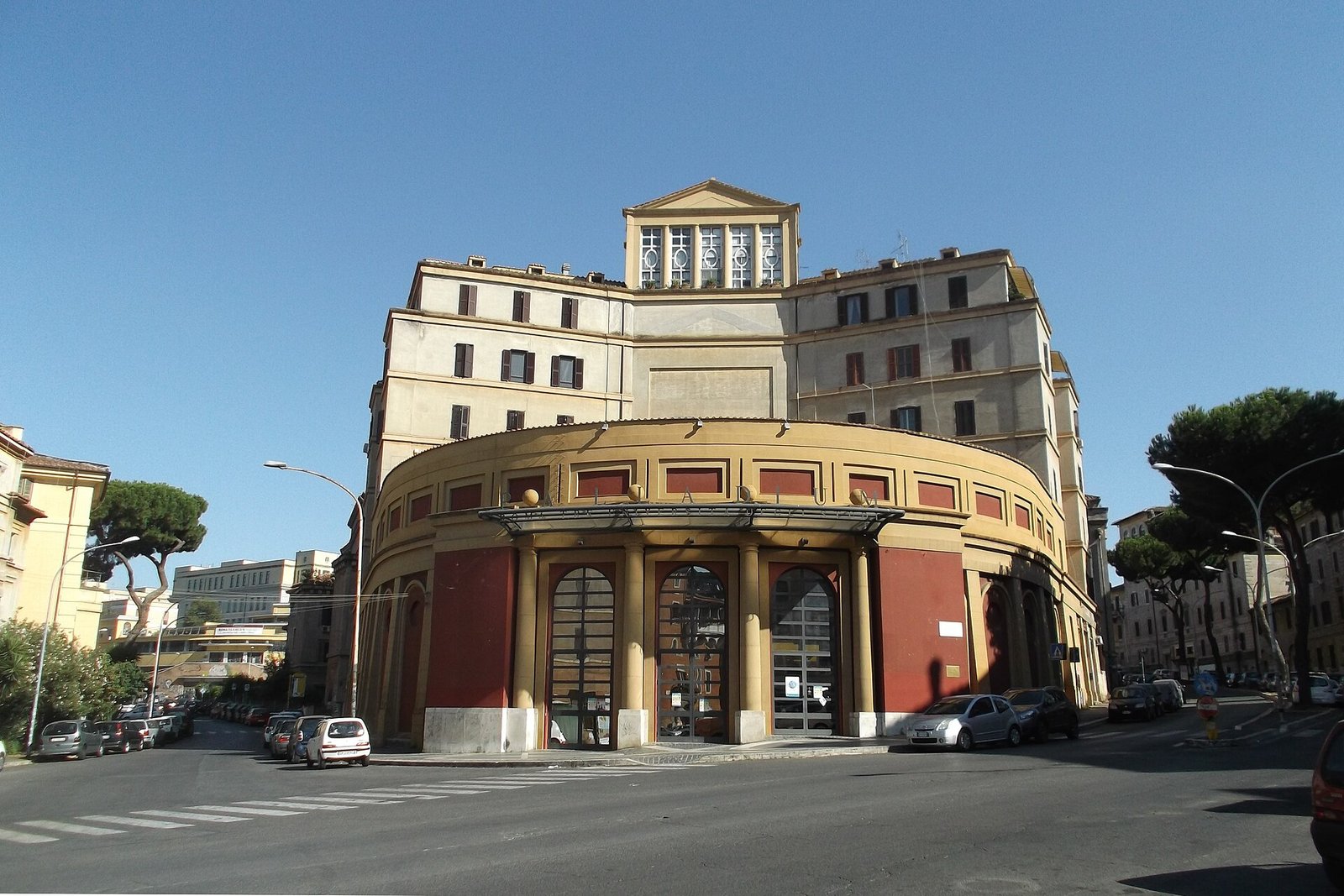
The Teatro Palladium is at Piazza Bartolomeo Romano 8, 00154 Rome, in Garbatella, and is open and active: it is run by the Fondazione Roma Tre Teatro Palladium, established by Roma Tre University. You enter only with a ticket for a show, a concert or an event. Full price runs from €5 to €20 depending on the title, the student discount costs €8, and you buy online on the Boxol circuit or at the box office, which opens two hours before the start.
It is not a monument with visiting hours. It is a cinema-theater designed by Innocenzo Sabbatini for the Istituto Case Popolari in the 1920s, with six floors of housing built around the hall, restored by the university and reopened as a university theater. On evenings without a show the doors stay closed and from the square you see the arcades of the facade, the columns, the rounded front that forms the backdrop for the whole open space.
Data checked on September 29, 2026 on the Teatro Palladium website, in the pages on ticketing, contacts and the theater's history, and on the tourism portal of Roma Capitale. The program for the 2026-2027 season has not yet been published: the Foundation announced the presentation press conference, titled Accordi, for September 30, 2026 at 11:00. Before setting out, check the page of the individual event, because prices and times change from one title to another.
At a glance: address, hours, ticket
- Address: Piazza Bartolomeo Romano 8, 00154 Rome, Garbatella neighborhood.
- Operator: Fondazione Roma Tre Teatro Palladium, established by Roma Tre University. Switchboard 06 57332772.
- How you enter: only with a ticket for a scheduled show or event. No free visits of the building.
- Price: full price from €5 to €20, reduced from €12, student reduced €8. Discounts only at the theater's box office.
- Hours: the box office opens two hours before every show. Ticket office phone 06 57332768, active only during those hours, email biglietteria.palladium@uniroma3.it.
- How to get there: Metro B stop Garbatella, buses 670 and 715 on Via Edgardo Ferrati and Via Enrico Cravero, 673 on Via Francesco Passino.
- Accessibility: the operator doesn't detail it on the ticketing and contacts pages. For seats and access it's best to write to the ticket office before buying.
Where it is and what you really see
Piazza Bartolomeo Romano is one of the main open spaces of Garbatella, the neighborhood born in the 1920s as a garden city of the Istituto Case Popolari. The theater occupies the side at the corner between Via Enrico Cravero and Via Francesco Passino, and the building's layout, according to the entry in the ArchiDiAP architecture archive, follows precisely the bisector of the angle between the two streets. For this reason the facade seems to look at the square head-on, with no privileged sides.
From outside you recognize it right away. The tourism portal of Roma Capitale describes a facade that recalls classical constructions inspired by ancient Rome, and the free encyclopedia speaks of a rounded front with three large arches marked by four columns. ArchiDiAP lists pediment, thermal window, portico, loggia, simplified pillars and arches cut into the wall. They are the elements of ancient Rome reduced to the bone, as Sabbatini used them in his public housing buildings.
Above and around the theater people live. The complex was born, the operator writes, as a cinema-theater with residences spread over six floors, and the apartment windows are an integral part of the facade. Anyone arriving in the evening before a show sees the lights of the homes on above the entrance. The detail is not folklore: it explains a good part of the building's recent history and some rules that still apply to the public today.
Inside, the hall has a circular shape, with a double gallery and the vaults of the roof, according to the description published by the Foundation. The Roma Capitale portal insists on the reinforced concrete structure that holds up galleries and vaults, with beams that cross to form a star. The foyer is semicircular, as the free encyclopedia recalls. Don't expect the velvet of a traditional Italian theater in the center: the charm is the 1920s engineering left in view.
The capacity is not given by the operator on the official pages. The free encyclopedia speaks of a hall that can hold up to 500 spectators, a figure plausible for the size but to be taken as an order of magnitude. The city's tourism portal lists the bar and air conditioning among the services. For a neighborhood hall it's a rare amenity, and in summer, when the theater is open, the difference from a hall without a system is felt.
All around is the Garbatella of the lots, the outdoor stairs, the shared courtyards. The theater is not isolated, it is part of a system of public buildings designed together: on the same square Sabbatini also designed the public baths, today turned into a cultural center with a library. Anyone who comes for a show and arrives an hour early has time to read the square as a single project, something almost no one does.
A curiosity about the Teatro Palladium
Look up at the ceiling before the lights go down. The tourism portal of Roma Capitale describes the roof beams that cross to form a star. The ArchiDiAP entry is more precise and speaks of a weave in which the beams draw two six-pointed stars, two Stars of David overlapping in the vault. It is a structural geometry, not a religious symbol declared by the designer, and no official source attributes any meaning to the figure.
The reason is practical. A circular hall covered with no pillars in the middle calls for a network of beams that unloads the weight onto the perimeter, and reinforced concrete made it possible to do so with a regular design. The result, seen from the stalls, is a kind of concrete rose window. Many spectators leave without having noticed it, because during shows the vault stays dark. It's worth looking at it in the minutes when the audience is taking their seats.
The second curiosity concerns the name. The theater was born as the Cinema Teatro Garbatella, as the free encyclopedia and the Lazio Region's portal dedicated to the neighborhood recall. The name Palladium came later, but in what exact year the change happened the operator doesn't say. For those who grew up in the area it is simply the Palladium, and the original name survives mostly in historical accounts of the neighborhood.
One thing nobody tells you about the Teatro Palladium
You can't reserve a seat here. The ticketing page says so plainly: it is not possible to reserve seats. Anyone used to phoning, holding two seats and picking them up that same evening has to change method. Either you buy online on the circuit the theater indicates, or you go to the box office, which opens two hours before the start. For much-requested titles the difference between the two routes can be the seat itself.
Second little-known rule: discounts apply only at the theater's ticket office. Online you pay full price. Anyone entitled to the €8 student discount, or to the ordinary reduced rate, must therefore show up at the box office with an ID. For events with a price equal to or below €5 no discounts are offered. It's a simple system, but it catches off guard anyone who buys on the phone thinking they'll find the discount at the desk.
Third thing, the strictest: access to the event venue is allowed up to 5 minutes before the start. Not at the start time, five minutes before. Anyone arriving in a rush from the metro risks being left outside even with a ticket in their pocket. And the admission ticket, if lost, is not duplicated. With an e-ticket on your phone it's best to have a charged battery, or print the ticket at home, as the online circuit provides.
Refunds, finally, are provided only in case of cancellation or suspension of the show before the first interval. If the show is interrupted after that, the ticket is not refunded. These are conditions common to many venues, but at the Palladium they are written in black and white on the ticketing page, and it's worth reading them before buying, especially if you're buying for a group of friends or colleagues.
How was the Garbatella cinema born?
Garbatella was founded on February 18, 1920, as recalled by an epigraph in Piazza Benedetto Brin cited by the Lazio Region's portal. In the early years the neighborhood was called Concordia, a hopeful name after the First World War. The Istituto Case Popolari built it in lots, with low houses and gardens, and in the following decade added the collective buildings: hotels for the displaced, public baths, schools. The cinema-theater was born within this second phase.
The designer is Innocenzo Sabbatini, architect of the Institute, and on this the sources agree. On the date they don't. The operator and the tourism portal of Roma Capitale indicate construction between 1926 and 1927. The free encyclopedia speaks of a 1927 project. The ArchiDiAP entry extends project and construction to the period 1927-1931 and cites the collaboration of the engineer Costantini. The Lazio Region's portal places Sabbatini's buildings on the square in the 1930s.
The underlying idea remains clear in all the accounts. A single building was to hold together the hall for cinema and theater and the public housing apartments, with the body of the hall, ArchiDiAP writes, mediating between the square and the residential volumes. It was a way of giving the neighborhood a place for entertainment without sacrificing homes. In a borgata built from scratch, the performance hall became the center of evening life.
The architectural language is the one Sabbatini used in many buildings of Garbatella: simplified elements of Roman antiquity, arches, columns, pediments, thermal windows. The Roma Capitale portal defines the style as eclectic and stresses the contrast between the classical-style facade and the reinforced concrete interior. It's the key to reading the theater: a box that was modern for its time, with an ancient dress designed for a working-class neighborhood.
The opposing view, in our judgment, concerns precisely the most repeated label. The free encyclopedia and the Lazio Region's portal speak of a theater in Liberty style. But the more technical descriptions say something else: the Roma Capitale portal speaks of a facade inspired by the classical constructions of ancient Rome, ArchiDiAP lists pediment, thermal window, loggia and simplified columns. They are elements of Roman classicism, not the curving, floral lines of Liberty.
The dates also work against it. Liberty in Italy is the style of the first two decades of the 20th century, and a building constructed between 1926 and 1931 belongs to another season. The rounded front and the columns can fool someone looking in passing, but Sabbatini worked on an ancient repertoire reduced to the essential, the one found in his other buildings in Garbatella. Calling it Liberty is a convenient and mistaken shortcut.
It's not nitpicking. Understanding the right language helps in reading the whole neighborhood, where Sabbatini and the other architects of the Istituto Case Popolari used ancient forms to give dignity to public housing. The theater is the most monumental version of that discourse. Look at it next to the public baths on the same square and the parallel becomes evident: same hand, same vocabulary, two different collective functions for the same neighborhood.
My advice for visiting the Teatro Palladium
The advice is to choose the Palladium for the music even before the drama. The circular hall with the double gallery was designed for cinema and live performance, and the Foundation's music projects, from the Roma Tre Orchestra to the Roma Tre Jazz Band, are the most recognizable part of the program. A concert here has a modest price and puts you inside the hall in a way that drama, at times, doesn't.
Buy online if the title is in demand and if you're not entitled to discounts. If instead you're a student, go to the box office with an ID: the €8 reduced rate is available only there. In both cases arrive in the square at least 20 minutes early. Access closes five minutes before the start, and seats can't be reserved: whoever goes in first chooses better, especially in the gallery, where the view of the vault is better.
Come by metro. The Garbatella stop on line B is given by the operator as the main reference, and parking on the neighborhood's streets, made of narrow roads and residents, is a gamble. From the station you walk up toward the neighborhood, and the trip is already a way of understanding where you are. On the way out, late in the evening, check the time of the last run before stopping to chat in the square.
One last note. The Palladium is a university theater, and the audience reflects it: many students, professors, neighborhood residents, fans of music and contemporary theater. The atmosphere is informal and there is no dress code. If you want to see the living Garbatella, not the postcard one, an evening here works better than any daytime stroll among the lots, when the streets are empty and the courtyards closed.
How much does it cost and how do you buy a ticket?
The official ticketing page gives a range of prices rather than a single fare: full price from €5 to €20, reduced from €12, student reduced €8. The exact price depends on the event and appears on the show's page. For appointments with a price equal to or below €5 discounts do not apply. For the 2026-2027 season the fares of each title will be published with the program.
You really buy in three ways, all listed on the page of the Teatro Palladium ticket office. Online on the Boxol circuit, on the page dedicated to the theater, with printing at home or an electronic ticket. At the authorized points of sale of the same circuit, listed on its website. Or at the box office in Piazza Bartolomeo Romano, open two hours before every show. For the Orbita dance season the theater also gives Ciaotickets. The Palladium does not mention TicketOne or Vivaticket.
| Fare at the Teatro Palladium | Price |
|---|---|
| Full price | €5 to €20, depending on the event |
| Reduced | from €12 |
| Student reduced | €8 |
| Events up to €5 | no discounts |
For information the Foundation gives the email biglietteria.palladium@uniroma3.it and the phone 06 57332768, which however answers only during box office hours, that is in the two hours before shows. For everything else there is the switchboard 06 57332772. The advice is to write a few days ahead if you need precise information, for example on comfortable seats for people with mobility difficulties.
For the Roma Tre Orchestra concerts the tourism portal of Roma Capitale also refers to the orchestra's website for presales and information. It's therefore worth checking both channels when the title is a symphonic or chamber concert. For drama, dance and cinema the page of the individual event on the theater's website is authoritative, giving the price, time and sales channel of that specific appointment.
Which channel to choose? Online if the title has a big name, if the evening is Friday or Saturday and if you have no discounts. Box office if you're a student, if the performance is midweek or if you want to pay on the spot. A group of friends who want to sit together must remember that seats can't be reserved: better to arrive together and early, instead of buying separately at different times.
What is on the program in 2026-2027?
At the end of September 2026 the program for the 2026-2027 season has not yet been published. The theater's home page announces for September 30, 2026, at 11:00, the press conference presenting the new season with the title Accordi. Titles, dates and prices will arrive from then on. The last event on the calendar before the presentation is The Peace Concerto by the Roma Tre Orchestra, on September 28, 2026 at 20:00, already past.
To understand what to expect it's worth looking at the previous season. The Foundation had titled 2025-2026 Atlanti and presented it as a moving map of contemporary creativity, across theater, music, dance, cinema and visual arts. Among the concluded events the site lists the DAMS Music Festival of March 2026, the Lusofonie series and the Spiritual Jazz of the Roma Tre Jazz Band. The theater's profile is this, and it's unlikely to change suddenly.
In drama the recent examples published by the theater help in understanding the tone. In May 2025 the venue hosted Heresias by José Sanchis Sinisterra, from May 6 to 8, in a national premiere directed by Ferdinando Ceriani, with Elisa di Eusanio and Andrea Lolli and music by Giovanna Famulari and Riccardo Eberspacher. In the same month ¡Ay, Carmela! by the same author was scheduled.
Dance has its own season, Orbita, which the theater also sells on Ciaotickets. Music revolves around the university's projects that the Foundation lists among its activities: DAMS Music Festival, Vite in musica, Roma Tre Jazz Band, Coro Roma Tre Palladium, as well as the Roma Tre Orchestra. When the Accordi program comes out, the advice is to lock in the dance titles and the concerts first, which usually have a single date.
Another well-known fact, yet rarely cited
Everyone knows the Palladium is the theater of Roma Tre University. Few know it is so in a very concrete sense. The operator writes that the Foundation, established by the university in 2016, offers students the chance to build professional skills by involving them in production and artistic management. On October 5, 2026, for example, a call for internships at the theater closes, aimed at students of bachelor's and master's programs.
Translated: behind the box office, in the control booth, in communications, there are often students in training. It's one of the reasons prices stay low and the program risks titles that a commercial hall wouldn't stage. The Foundation's presidency is entrusted to Riccardo Chiaradonna, full professor of History of Ancient Philosophy at Roma Tre, and the stated mission holds together training of young people, tradition, research and relationship with the area.
The second known and overlooked fact is that the theater, before the university, had come within a step of becoming something else. The free encyclopedia tells that Roma Tre rented the structure when it risked turning into a bingo hall, and bought it outright in 2001. That story is still talked about in the neighborhood, but is rarely remembered when you go in for a concert or a show.
Third element: the closeness to the university is not only administrative. The Ostiense district, with Roma Tre's campuses, is a few minutes' walk away, and the theater hosts, alongside its seasons, the university's projects that the Foundation lists among its activities, from the DAMS Music Festival to the Coro Roma Tre Palladium. The audience that fills the hall in the evening is in large part the same one that attends classes by day, and you can feel it in the tone of the evenings.
The right photo to take at the Teatro Palladium
The photo that works is head-on, from the middle of Piazza Bartolomeo Romano, with the whole facade in the frame: the arcades, the columns, the rounded front and, above, the windows of the homes. It's the only perspective that shows what the theater really is, a public housing building with a hall inside. Best in the late afternoon, when the low-angled light brings out the color of the facade, which the restoration returned to the original reddish-brown.
In the evening, with the audience in front of the entrance and the lights on, the same frame tells the story of the living theater. Avoid flash on people and remember that above the entrance there are lived-in apartments: no close-up photos of the windows, no drones, no zooming in on balconies. The square is public, the homes are not. A phone wide-angle is enough, and with a step back you also catch the corner between Via Cravero and Via Passino.
Inside the hall, before the show, the shot to take is upward, at the vault with its weave of star-shaped beams. From the gallery the angle is better. Always ask the hall staff if photography is allowed, because the operator doesn't publish a specific rule for shooting. During the show, as in any theater, no photos and no video, unless the individual production says otherwise.
A third framing, less obvious, puts the theater in dialogue with the rest of the square. Move toward the side of the public baths, Sabbatini's other building on the same open space, and look for an angle that holds the two facades together. You understand at once that they came from the same hand and the same neighborhood project. By day, with the square less crowded, it's the shot that best tells the story of the Garbatella of collective buildings.
How do you get there from central Rome?
The simplest way is the metro. The operator gives line B, Garbatella stop, as the public transport reference. From the center you take line B, which also passes under the Circus Maximus, and get off at Garbatella. From there you walk up toward the neighborhood and Piazza Bartolomeo Romano. The route from the station is not given by the operator: it's worth plotting it on your phone before leaving.
By bus the theater lists three lines. The 670 and 715 stop on Via Edgardo Ferrati and Via Enrico Cravero, right next to the square. The 673 stops on Via Francesco Passino, on the other side of the building. For times, detours and last runs the operator refers to the Rome transport company's website, and it's the right advice: neighborhood lines often change route because of works, and word of mouth goes stale fast.
By car the Palladium is reachable, but parking is another story. The theater lists no parking of its own, and the streets of Garbatella are narrow, residential, full of residents' cars from late afternoon. If you have no alternative allow for a few laps and a bit of walking. Double-parking in front of the theater, in a lived-in square, is the quickest way to make the neighborhood hate you.
Those coming from Testaccio or from the Pyramid can also do it all on foot, passing through Ostiense. The route along Via Ostiense, with the Gasometer in the background, is a good introduction to the neighborhood. On the way back, at night, first check the time of the last Metro B run on the transport company's website, because it changes depending on the day and the works in progress.
Some important events that happened here in history
1920: on February 18 Garbatella is founded, as the epigraph in Piazza Benedetto Brin recalls. Between 1926 and 1927, according to the operator and the tourism portal of Roma Capitale, Innocenzo Sabbatini builds for the Istituto Case Popolari the cinema-theater with six floors of housing in Piazza Bartolomeo Romano. The sources don't agree on the end of the works: ArchiDiAP gives 1931. The hall is born with the name Cinema Teatro Garbatella.
Late 1920s: the neighborhood fills with collective buildings signed by Sabbatini. The Lazio Region's portal dates to 1928-1929 the four suburban hotels, Rosso, Bianco, Terzo and Giallo, built as temporary housing for those displaced from the Spina di Borgo. On the same square as the theater the public baths go up. The cinema becomes the evening gathering place of a neighborhood of families who came from all over the city.
2000: in the summer the venue closes, the free encyclopedia tells, because of the noise pollution complained of by those living in the same building. The concrete risk is conversion into a bingo hall. Roma Tre University rents the structure and in 2001 buys it. The restoration follows, attributed by the same source to the architect Luciano Scacchi and to Richard Peduzzi, which returns the facade to its original reddish-brown color.
2003: on October 15 the Teatro Palladium is inaugurated by the President of the Republic Carlo Azeglio Ciampi, according to the free encyclopedia. For about 10 years management is entrusted to the Fondazione Romaeuropa, an experience that ends in February 2014. In that period the hall hosts the Roma Tre Orchestra, the Roma Tre Film Festival, the Teatro Dams Fest, Radio 3 Scienza, Cortoons, the Festad'Africa Festival and Teatri di Vetro.
2016: Roma Tre University establishes the Fondazione Roma Tre Teatro Palladium, which has run the theater since then. 2026: on September 28 the Roma Tre Orchestra plays The Peace Concerto, on September 30 the Foundation presents the 2026-2027 season with the title Accordi. A century after the neighborhood's first stone, Sabbatini's hall is still working at its original trade: putting on a show for those who live around it.
Who passed through the Teatro Palladium
The first name is that of the designer, Innocenzo Sabbatini, who in Garbatella also signed the public baths and the suburban hotels. Alongside him ArchiDiAP cites the engineer Costantini. The second name, for institutional weight, is Carlo Azeglio Ciampi, who according to the free encyclopedia inaugurated the restored theater on October 15, 2003. In the restoration, the same source recalls the architect Luciano Scacchi and Richard Peduzzi.
Then there are the cultural institutions that have inhabited the hall. The Fondazione Romaeuropa ran it for about 10 years, until 2014. The Roma Tre Orchestra has played there since then, and on September 28, 2026 held The Peace Concerto there. Festivals like Cortoons, Festad'Africa and Teatri di Vetro, and radio programs like Radio 3 Scienza have passed through this stage, according to the free encyclopedia's chronology.
In recent drama the theater's website documents, for May 2025, the national premiere of Heresias by José Sanchis Sinisterra, directed by Ferdinando Ceriani and starring Elisa di Eusanio and Andrea Lolli. Music has collective names more than soloists: the Roma Tre Jazz Band, the Coro Roma Tre Palladium, the students of the DAMS Music Festival. It's a hall where the name on the program counts less than the project.
Not far away, outside the theater but in the same neighborhood, passed a guest that Garbatella remembers with pride. The Lazio Region's portal writes that in 1931 Mahatma Gandhi visited Sabbatini's suburban hotels. There are no sources that bring him inside the cinema-theater, and it shouldn't be written that he went in. But it tells well how much the neighborhood's urban project, of which the theater is part, was observed from outside as well.
Facts, tradition and legend: what is documented?
What the documents say: the designer is Innocenzo Sabbatini, the client the Istituto Case Popolari, the building joins hall and homes over six floors, the operator is the Fondazione Roma Tre Teatro Palladium, established in 2016. These are data published by the theater and by the Roma Capitale portal. The address, prices, sales channels and transport lines also come from the Foundation's official pages, and are the base to start from.
What tradition says, that is widespread but unofficial accounts: the exact date of the works, which ranges between 1926 and 1931 depending on the source, the capacity of about 500 seats, the closure of 2000 for noise, the bingo risk, the names of the restorers. These are data reported by the free encyclopedia and by architecture archives, consistent with each other, but the operator doesn't publish them on its pages about the theater's history.
What is legend, or at least interpretation without support: that the star in the vault has a symbolic meaning intended by the designer. The sources describe the weave of the beams, one star according to the Comune, two six-pointed stars according to ArchiDiAP, but none attributes a symbolic intention to Sabbatini. The simplest explanation is structural. Whoever tells you otherwise in the square is telling you a nice story, not a fact.
What place does the Palladium have in Garbatella?
The theater is one of the vertices of a triangle of public buildings that defines the Garbatella of the 1920s and 1930s. On the same square Sabbatini's public baths have become, since 2016, a cultural center with a library, periodicals room and book exchange space, according to the Lazio Region's portal, which also recalls the free Italian school Penny Wirton hosted in the same spaces. Not far away are the suburban hotels.
Anyone coming for the theater should therefore devote an hour to the neighborhood. The outdoor stairs, the lots with shared courtyards, the gardens and the urban gardens of Garbatella tell the same city project that the Palladium stages in monumental form. Respect those who live there: the courtyards are private condominium spaces, to be looked at from the street. And in the evening, when the audience comes out, lower your voice under the windows.
The theater is also the point of contact between historic Garbatella and the Rome of the university and industrial archaeology. Going down toward Ostiense you meet Roma Tre's campuses, the Centrale Montemartini with ancient sculptures among the machines, the Gasometer, the former Porto Fluviale. On the other bank of the Tiber is the Teatro India, the other hall of this part of the city.
In the system of Rome's theaters the Palladium has a precise place. It is not a city public theater like the Argentina, nor a large private hall like the Teatro Olimpico. It is a university theater with a neighborhood vocation, closer in spirit to the Vascello in Monteverde. Those who follow contemporary work put it on the agenda together with those halls, not in their place.
When is it closed and what not to expect?
The theater is closed whenever there is no scheduled event, and the box office opens only two hours before shows. There are no daytime opening hours for the public. In the periods between one season and the next, like the end of September 2026, the calendar is almost empty while waiting for the presentation of the new program. Before going check the site's home page, which lists the events of the following days.
Don't expect free visits of the hall or foyer. The operator doesn't publish visits to the building outside shows, and the hall can be seen only by entering with a ticket. Don't expect a neighborhood cinema museum or panels on the history of Garbatella either: the Palladium is a working theater, not an exhibition space. The history, here, is read in the architecture and in the vault.
Don't expect to be able to reserve and pick up: seats can't be reserved. Don't expect to get in after the show has started: access closes five minutes before. And don't expect online discounts, because reductions apply only at the box office. These are rules written on the ticketing page, and whoever knows them has a calm evening. Whoever doesn't risks being left in the square with the ticket in hand.
On accessibility the operator publishes, on the ticketing and contacts pages, no information on barrier-free entrances or reserved seats. The tourism portal of Roma Capitale refers to its own section dedicated to accessibility. Those with specific needs should write to biglietteria.palladium@uniroma3.it before buying, and ask for confirmation on entrance, seat and services. Better one more email than a surprise on the night of the show.
Don't expect, finally, that the theater is always devoted to drama. In the same week the hall can host a concert by the university's orchestra, a screening, a public meeting, a dance evening. It is the nature of a university theater, and for the spectator it's an advantage. But anyone looking for a specific title has to read the calendar by type of event, because the word show, here, covers very different genres.
Eating in the area
Garbatella has a tradition of neighborhood trattorias and Ostiense, a little farther down, is one of the areas with the most places open in the evening. For this very reason the traps exist here too. Be wary of places with a barker, of laminated photo menus in several languages, of handwritten items with no price, of places that present a different menu inside and outside. None of these things has to do with the neighborhood's cooking.
Another sign not to underestimate: a kitchen open nonstop, from lunch to midnight, rarely means dishes prepared on the spot. Residents choose the places where the kitchen closes and reopens, where the menu changes with the season and where the bill holds no surprises. It's not snobbery, it's the habit of those who eat out often and don't want to pay for being near a place that has become trendy.
On show nights it's best to have dinner early, around 19:00, and ask for the bill in time: entry to the hall closes five minutes before the start. After the show, around 23:00, many kitchens are already closed. To find your way around Garbatella, Ostiense and the rest of the city there's the list of addresses on Google Maps, also useful for anyone looking for a quiet place before going into the hall.
What to combine in a day
The natural pairing is an afternoon in Garbatella, among the lots, the stairs and the urban gardens, and then the theater in the evening. Those with more time go down toward Ostiense for the Centrale Montemartini, where ancient statues live alongside turbines, and return to Piazza Bartolomeo Romano in time for the box office opening, two hours before the show.
Those who prefer churches and archaeology can start from the Basilica of San Paolo fuori le Mura, farther south along Via Ostiense, and continue to the Abbey of Tre Fontane or the Catacombs of Commodilla, on the days they are open. From San Paolo to Garbatella it's a short hop, and the evening ends with a concert or a show.
A more classic day holds together Porta San Paolo, the Pyramid of Cestius, the Museo della Via Ostiense and the Non-Catholic Cemetery, then goes down along Via Ostiense toward the Gasometer and the former Porto Fluviale. From there to Garbatella is a few minutes by metro or an uphill walk.
For street art lovers the right direction is Tor Marancia, with the painted facades of the public housing blocks, to be looked at from the street with respect for those who live there. It's a good counterpoint to Garbatella: two public housing neighborhoods, two different eras, the same theme of public housing treated as architecture. In summer bring a water bottle and use the nasoni along the way.
Those who want a day devoted entirely to ancient Rome can begin from the Aventine, with the Basilica of Santa Sabina, go down to the Circus Maximus and the Baths of Caracalla, and then reach Garbatella by Metro B. Work out the trip before leaving, so as to arrive in time to have dinner before the show.
For a week at the theater, finally, the Palladium pairs with the other halls you'll find among our entries: the Teatro India on the Tiber, the Teatro Argentina in the center, the Teatro Valle, the Quirino, the Teatro Parioli. For music there's the Auditorium Parco della Musica, for art-house cinema the Nuovo Cinema Sacher and the Cinema Troisi.
With children the Palladium works when the program offers short concerts or afternoon shows, to be looked for on the events page. For the rest of the day you'll find ideas on the page about Rome with kids, and to keep spending down on the one about Free Rome. The theater itself, with tickets from €5 for some events, remains one of the cheapest cultural evenings in the city.
Frequently asked questions
Is the Teatro Palladium open?
Yes, the theater is active and is run by the Fondazione Roma Tre Teatro Palladium, established by Roma Tre University. You enter only for shows, concerts and events, with a ticket. The box office opens two hours before every show. At the end of September 2026 the calendar is waiting for the new 2026-2027 season, presented by the Foundation on September 30 with the title Accordi.
How much does a ticket cost at the Palladium?
The official ticketing page gives full price from €5 to €20 depending on the event, a reduced rate from €12 and a student reduced rate of €8. Discounts apply only at the theater's box office and are not valid for events with a price equal to or below €5. The exact price of each appointment appears on the page of the individual event on the theater's website.
Where do you buy tickets?
Online on the Boxol circuit, on the page dedicated to the Teatro Palladium, with printing at home or an electronic ticket, at the authorized points of sale of the same circuit or at the box office at Piazza Bartolomeo Romano 8, open two hours before every show. For the Orbita dance season the theater also gives Ciaotickets. For information there is the email biglietteria.palladium@uniroma3.it, or 06 57332768 during box office hours.
Can you reserve a seat?
No. The ticketing page says it is not possible to reserve seats. You buy online or at the box office, and access to the hall is allowed up to five minutes before the start. Anyone who wants to sit near friends or choose a seat in the gallery must therefore arrive early. A lost ticket is not duplicated, and a refund is provided only for cancellation or suspension before the first interval.
How do you get to the Teatro Palladium by public transport?
The operator gives Metro B, Garbatella stop, and three bus lines: the 670 and 715 with stops on Via Edgardo Ferrati and Via Enrico Cravero, the 673 on Via Francesco Passino. For times and detours it refers to the website of Rome's transport company. By car parking on the neighborhood's residential streets is difficult, and the theater lists no parking of its own.
Who designed the Teatro Palladium?
The architect Innocenzo Sabbatini, for the Istituto Case Popolari, as the operator and the tourism portal of Roma Capitale indicate. The ArchiDiAP archive also cites the collaboration of the engineer Costantini. The dates don't agree: the operator gives 1926-1927, other accounts go as far as 1931. The building was born as the Cinema Teatro Garbatella and joins the hall to six floors of public housing apartments, still lived in today.
Is the theater accessible to people with disabilities?
The operator publishes, on the ticketing and contacts pages, no information on barrier-free entrances or reserved seats. The tourism portal of Roma Capitale refers to its own section on accessibility. The advice is to write to biglietteria.palladium@uniroma3.it before buying, asking for confirmation on entrance, seat in the hall and services, or to call the theater's switchboard, 06 57332772.
Can you visit the hall without attending a show?
The operator doesn't publish visits to the building outside scheduled events. The circular hall, the double gallery and the vault with its weave of star-shaped beams can be seen by entering with a ticket, best in the minutes before the start. Outside shows the theater is looked at from the square, along with Sabbatini's public baths on the same open space.
Who wrote this and on what sources
The text comes from the editorial team of Tour Leader Pro, the Roman company that designs itineraries, visits and cultural events across Rome and Lazio. Rates, hours and booking procedures reported here come from the official sources mentioned in the text, as of the date given at the opening: for the Teatro Palladium the pages of the Fondazione Roma Tre Teatro Palladium and the page of the individual event are authoritative. Let us know what you find changed.
Organizing an evening at the Palladium, for yourself or for a group, means dealing with seats that can't be reserved, discounts only at the box office and access that closes five minutes before the start. For a group it's best to write to the ticket office well in advance and ask about conditions and availability. A useful resource for those who organize group trips is Tour Leader Pro.
The Garbatella theater fits well into a wider trip through 20th-century Rome, among public housing, industrial archaeology and places of the contemporary city like the MAXXI and the circuit of the Aurelian Walls. For those with more days who want to hold together city and surroundings, a useful resource for building a multi-day itinerary is Italy Planner.