Teatro Parioli Costanzo
In short. The Teatro Parioli Costanzo is open and in season: it is at Via Giosuè Borsi 20, in the Parioli district, it is run by Enzo Gentile and Fabrizio Musumeci, and the artistic director is Massimiliano Bruno.
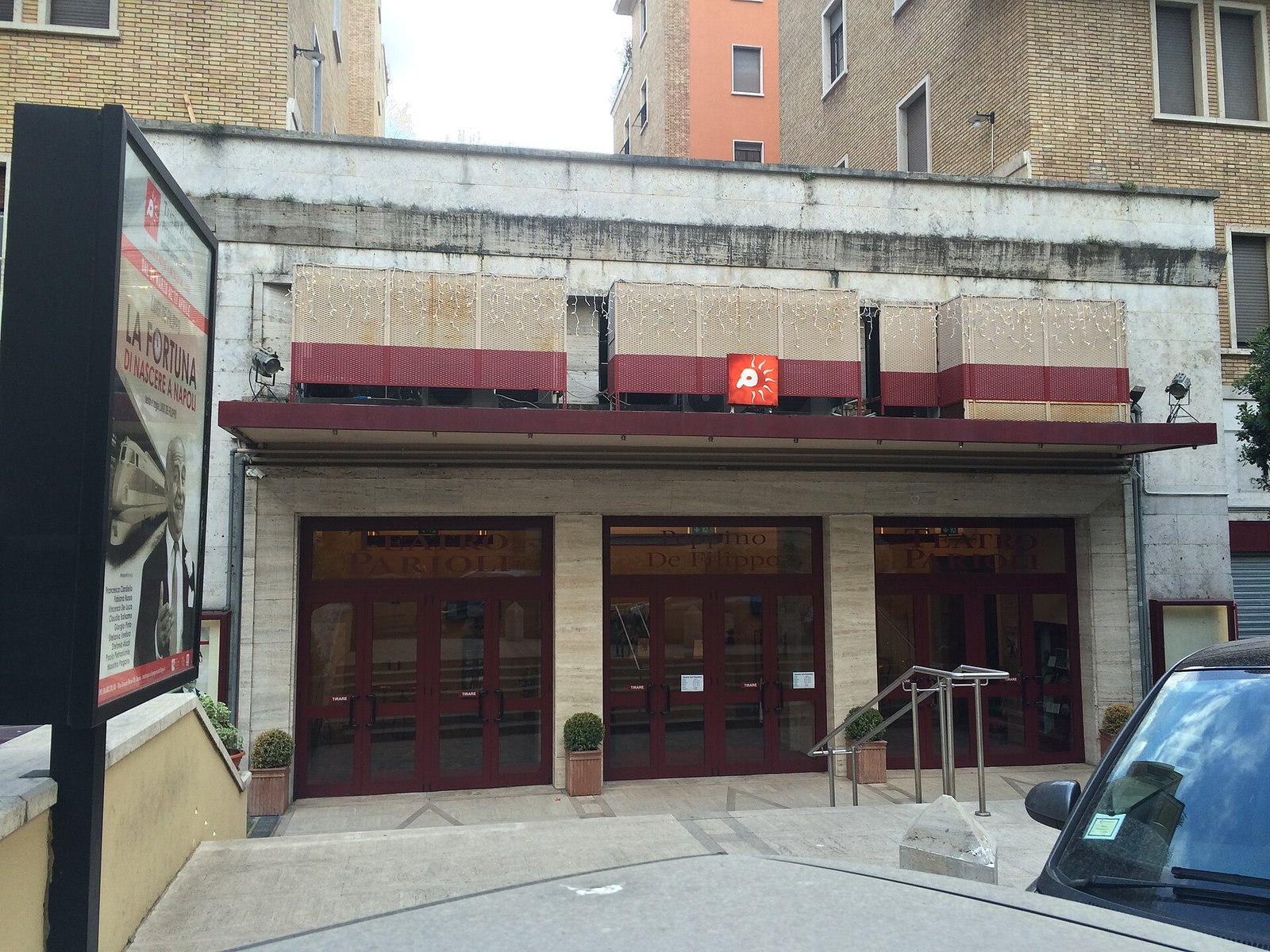
The Teatro Parioli Costanzo is open and in season: it is at Via Giosuè Borsi 20, in the Parioli district, it is run by Enzo Gentile and Fabrizio Musumeci, and the artistic director is Massimiliano Bruno. For the 2026-2027 season a ticket starts at €23 in the orchestra and €20 in the gallery. You buy it at the box office, by phone at 06 5434851, by email or WhatsApp, or online on the Vivaticket circuit named by the theater.
It is the hall where the Maurizio Costanzo Show was taped for decades, and since February 2024 it has carried the journalist's name. Today the theater presents itself as a large private hall for production and hosting, with comedy, drama, family musicals, concerts and event evenings. Anyone arriving expecting a television studio instead finds an orchestra and gallery of a city theater, on a residential street among villas and apartment buildings.
Data checked on September 29, 2026 on the official website of the Teatro Parioli Costanzo, on the pages about ticketing, history, rules for entering the hall and directions, and on the other sources cited later in the text. The theater does not publish the capacity of the hall on the page about events. For anything that does not appear online, the channel to use is the box office, at 06 5434851 or at biglietteria@ilparioli.it.
At a glance: address, hours, ticket
- Address: Via Giosuè Borsi 20, Parioli, Rome.
- Operators: Enzo Gentile and Fabrizio Musumeci, artistic direction by Massimiliano Bruno.
- Price 2026-2027: orchestra from €23, gallery from €20, Il Parioli Kids shows from €18 to €22.
- Box office: Tuesday to Saturday 14:30 to 19:30, Sunday 14:30 to 18:30, closed Monday. Phone 06 5434851, WhatsApp 351 7211283.
- Getting there: buses 52, 53 and 223 stopping at Piazza Santiago del Cile, where there is also a taxi stand.
- Parking: four partner garages in the neighborhood, three of them closed on Sunday.
- Accessibility: no elevator, the orchestra is reached by a stairlift. The theater asks you to book by phone.
Where it is and what you actually see
Via Giosuè Borsi is a short street in the Parioli, the residential district that stretches north of Villa Borghese. The theater itself, on its page about where it is, notes its closeness to the villa, to Via Veneto and to the historic center. The reference point for anyone arriving by public transport or taxi is Piazza Santiago del Cile, where the buses stop and where the taxi stand is.
From the outside the Parioli does not have the facade of a nineteenth-century theater. No colonnade, no grand staircase. It is a street entrance carved out of a building that began as a cinema in 1938, with a sign that since 2024 carries Costanzo's name. Anyone looking for stucco and gilded boxes will be disappointed. Anyone who knows the hall from television recognizes it at once, even if they are seeing it for the first time from a seat and not from the camera frame.
Inside, the theater's page on events describes a hall with orchestra, gallery, stage and proscenium, and speaks of acoustics designed for every type of show. Next to the main hall are three smaller spaces named after Giorgio Albertazzi, Marina Malfatti and Alberto Lionello, used for rehearsals, readings and workshops. The foyer hosts private parties, corporate dinners and exhibitions, and there is an in-house bistro that the site lists among the services of the house.
What you actually see, then, is the show. The Parioli is not a monument to visit outside performance hours and it does not publish tours of the building. You get in with a ticket, in the evening or on Sunday afternoon, and the foyer fills up in the half hour before the start. Anyone who wants to understand the place should pick a date on the program and arrive a little early, to look at the hall while the lights come up.
The theater, on the page about its own history, describes itself as a large private hall that wants to become a multipurpose cultural center, with in-house productions and hosted shows. In the site menu there is in fact a Produzioni Il Parioli section, a La Factory section and a page for anyone who wants to organize an event in the theater's spaces. For the spectator the practical result is a dense calendar, with many different offerings in the same week.
The neighborhood around it is quiet, made of apartment buildings, doorman lodges, condominium gardens and trees along the sidewalks. There are no tourist flows like in Trastevere or at the Pantheon. In the evening, before and after the show, the street comes alive for an hour and then goes silent again. It is a detail to keep in mind if you are counting on finding open shops or places full of life at midnight: the Parioli, after dinner, is a neighborhood that sleeps.
To the east the neighborhood borders the large parks of Villa Ada and, farther north, the hill of Villa Glori, which slopes down toward the Tiber and the Auditorium Parco della Musica. To the south you reach the walls at Porta Pinciana. The theater sits inside this network of avenues, halfway between the parks and the twentieth-century city, far from the usual routes of people visiting Rome for a few days.
A curiosity about the Teatro Parioli Costanzo
The theater's small rooms carry the names of actors, and one of these names returns in the history of the hall. Alberto Lionello, after whom the soundproofed, carpeted room used for readings is named, was the actor and director who in 1977 took over the direction of the Parioli together with the impresario Lucio Ardenzi, according to the chronology published by the theater. Giving his name to an interior space means remembering a management, not only a famous performer.
Another curiosity concerns the services. On its page about how to get there, the theater mentions a dog sitting and dog walking service during performances, called Bau Theater. It is a tiny detail, but it says a lot about the neighborhood's audience, made of residents who arrive on foot, often with the dog on a leash. Anyone traveling with an animal can ask the box office how it works, because conditions and prices are not published on the page.
The name too has had several versions. The official site signs itself Teatro Parioli Costanzo, some pages use the form Teatro Il Parioli Costanzo and the shortened brand is simply Il Parioli. Before that, from 2011, the hall was called Teatro Parioli Peppino De Filippo. To look it up on a map or a navigator, it's best to type the full address, Via Giosuè Borsi 20, and not rely on the name alone, which in old listings may appear in an outdated form.
One thing nobody tells you about the Teatro Parioli Costanzo
Umbrellas are banned in the hall. The rules on entering put them in the same list as bottles, cans, alcohol and blunt objects. On rainy evenings it's best to ask at the entrance where to leave them, because the page does not mention a coat check. In the same rules the theater bans photographing and recording, eating and drinking in the hall, and smoking, including e-cigarettes.
The second little-known thing: if you arrive late, you lose your seat. The rules say latecomers lose the right to use the seat assigned in advance sales. It is not a formality. In a theater where many shows are comedies with a tight rhythm, coming in after the curtain is up disturbs, and the house may seat you elsewhere. Allow for Parioli traffic in the evening and for the search for parking, which on weekends takes time.
The ban on food and drink applies to the hall. The theater's site also lists an in-house bistro in its menu, and the events page presents the foyer as a space for parties and corporate dinners, so a snack before the start is not ruled out, as long as it stays out of the orchestra. The rules also ask you to turn off phones and to deactivate devices with a ringtone. These are rules common to many theaters, but here they are written explicitly and it's best to know them before going in.
Third thing: on Sunday three of the four partner garages are closed. According to the theater's page, RTM Garage Parioli, Autorimessa Parioli 31 and First Garage work Monday to Saturday. Only F2 Parking at Via Eustachio Manfredi 6 is listed as open every day, at all hours. Anyone who picks a Sunday matinee and arrives by car should know this beforehand, or else leave the car at home and use a bus or taxi.
From neighborhood cinema to drama theater: how did the Parioli begin?
The story begins in 1938, when a movie theater opens on Via Giosuè Borsi. Until the end of the 1950s the hall remains a cinema, and the stage as we know it today does not yet exist. The transformation into a drama theater comes in 1958, according to the theater's chronology. Wikipedia gives the date of December 29, 1958 for the inauguration of the theater hall.
The first show, according to the same Wikipedia entry, was Girotondo by Arthur Schnitzler, staged by the company of Ernesto Calindri and Vivi Gioi. In the 1960s the Parioli becomes one of the places of Roman revue and cabaret. The theater's history page cites Alighiero Noschese, Antonella Steni and Elio Pandolfi, and recalls Scanzonatissimo, the 1963 show by Dino Verde that later also had a film version.
The following decade brings the harshest turning point. On December 8, 1977, according to Wikipedia, the theater suffered a fascist attack and was set on fire, with heavy damage. It reopened on April 28, 1978 with L'anatra all'arancia. In the same period, going by the official chronology, the direction passes to Alberto Lionello and Lucio Ardenzi, two names tied for years to Italian drama and comedy theater.
In 1985 television arrives. From September of that year the Maurizio Costanzo Show is taped at the Parioli, and in September 1989 Costanzo also becomes its artistic director. For many Italians from that moment the theater coincides with the program, with the audience seats on camera and the talk show stage. The theater does not publish how the evenings were divided, in those years, between television tapings and live shows.
Recent managements change quickly. In 2011 Luigi De Filippo takes over the theater and names it after Peppino De Filippo. In 2020 Michele and Enzo Gentile take it over with Giovanni Vernassa, with the support of Banca del Fucino, and the artistic direction goes to Piero Maccarinelli. After Costanzo's death the name changes again. Today the site lists as operators Enzo Gentile and Fabrizio Musumeci, and Massimiliano Bruno as artistic director.
The latest phase has added activities that go beyond the hall. In 2024, according to the official chronology, the theater opens a theater school with Rocío Muñoz Morales and Raoul Bova as artistic directors. In the same year Massimiliano Bruno arrives as artistic director. The management of Enzo Gentile and Fabrizio Musumeci has focused on its own productions, on a series for children and on renting the spaces for events, with a model closer to that of a cultural enterprise than to that of a hosting-only hall.
The advice I give you for visiting the Teatro Parioli Costanzo
My advice is to choose the gallery before thinking about the orchestra. It costs less, from €20 against €23 for the orchestra according to the ticket office, and in a hall built for comedy and for television the view from above lets you take in the whole stage. Anyone who has trouble with stairs must instead stay in the orchestra, the only area reachable by the stairlift, and mention it to the box office at the time of purchase.
In the cards, the orchestra is divided into poltronissima and poltrona, with a difference of a few euros per show. Anyone buying a single ticket can ask the box office in which row their seat falls and if it's worth moving up a section. The student discounts apply only on weekdays, while the discount for people over 65 or under 25 is smaller but does not have the same limitation on the ticket office page.
Second rule: arrive at least 20 minutes before the start. The rules do not state the time the doors open, but warn that latecomers lose their assigned seat. The margin also serves for parking, which on weekend evenings in the Parioli is never immediate. Anyone coming from the center by public transport should count on one change between metro and bus, and check the ATAC site for the late return runs.
Third rule, in our judgment the most useful: read the program as a calendar of short events and not as a season of long runs. Many titles stay on for two or three evenings, some for just one. If you have few days in Rome, start from the theater's dates and build the rest of the day around the show, not the other way around, otherwise you risk finding on the calendar only the dates when the hall is closed.
How much does it cost and how do you book?
For the 2026-2027 season the official ticket office lists prices starting at €23 in the orchestra and €20 in the gallery. The shows of the Il Parioli Kids series cost from €18 to €22 depending on the section. The exact price changes from title to title and can be read on each show's page. After issue, the theater warns, tickets can no longer be replaced or canceled, including those of the cards.
The channel to use is the official ticket office of the Teatro Parioli Costanzo, which sells at the box office on Via Borsi, by phone at 06 5434851, by email at biglietteria@ilparioli.it and by WhatsApp at 351 7211283. Online the theater points to its own space on the Vivaticket circuit and also cites authorized points of sale. The theater accepts the Carta della Cultura e del Merito and the Carta del Docente. For discounts, the safest route remains direct contact.
Anyone planning to see several shows can choose one of the Parioli Easy cards, for 6 or for 10 titles. The prices published by the ticket office depend on the section and include a reduced rate. The table gives the figures stated by the theater for the 2026-2027 season. The cards suit people who live in Rome or pass through often, less so those visiting the city for a week who want a single evening at the theater.
In the ticket office menu the theater also presents a Gift Card to give as a present and a page of agreements with organizations and companies. The conditions of the Gift Card, that is, amounts, expiration and terms of use, must be read on the dedicated page or asked at the box office before buying. The same rule applies to the agreements: they change from season to season, and those of previous years are no guarantee for 2026-2027.
| Section | Parioli Easy card, 6 shows | Parioli Easy card, 10 shows |
|---|---|---|
| Poltronissima | €180, reduced €162 | €285, reduced €260 |
| Poltrona | €168, reduced €150 | €270, reduced €245 |
| Gallery | €144, reduced €132 | €230, reduced €210 |
The discounts published by the ticket office are these. Students get 50 percent off, excluding weekends and holidays. People over 65 or under 25 get 10 percent. For groups of at least 15 people the discount is 20 percent, and about 20 percent also for people with disabilities who present documentation. The conditions apply according to the rules of each show, so it's best to ask for confirmation.
The box office is open Tuesday to Saturday from 14:30 to 19:30 and on Sunday from 14:30 to 18:30. It is closed on Monday. On show evenings, according to the ticket office, it stays open until half an hour after the start, but only for that evening's performance. Anyone who wants to buy a ticket for another date must therefore come by in the afternoon or use the phone, email, WhatsApp or the online circuit.
The theater's online ticketing goes through Vivaticket, and the search for "Teatro Parioli" on Vivaticket shows in a single list the shows on sale, the Parioli Kids titles and the Parioli Easy cards for 6 and for 10 shows. It is an affiliate link: if you buy from there Estate Romana receives a small commission, while the price for you stays the seller's. Before paying, check the date and section.
What is on the program in the 2026-2027 season?
In the 2026-2027 season the program announces a very varied lineup for the fall. The theater's home page lists, among others, Brava, bravissima... anche meno with Anna Mazzamauro and Paolo Bonanni on October 29 and 30, Pesci ad aprile from November 12 to 22, Venerdì 13 directed by Roberto Ciufoli on November 25 and 26 and the family musical Sherlock Elf e il mistero di Babbo Natale on December 12 and 13.
Alongside drama and comedy, the fall calendar puts concerts, themed evenings and shows produced by the Compagnia Nuovo Teatro Parioli, such as the event Los Días de los Muertos Experience straddling October 31 and November 1. The program changes often and is updated over the months, so the dates should always be rechecked on the official site before organizing the evening. On the site you will also find some show proposals in this hall.
The Il Parioli Kids series is the part of the programming designed for families, with prices from €18 to €22 according to the ticket office. The children's shows are concentrated on weekends and in the holiday period, like the Christmas musical in mid-December. For anyone traveling with small children it is a chance for theater in Italian designed for them, in a neighborhood easy to reach by taxi, and it's best to prefer the afternoon performances to the evening ones.
The profile of the programming is clear. The Parioli bets on comedy, humor, children's musicals and its own productions, with short runs. It is not the theater of experimentation and it is not the one for the big long-running musical. Anyone looking for experimentation finds more material at the Teatro Vascello or at the Teatro India, anyone looking for the classic musical looks to the Teatro Sistina.
Another well-known fact, yet rarely cited
Almost everyone knows that the Maurizio Costanzo Show was taped here. Less remembered is that the theater had a long life before television, and that Roman cabaret of the 1960s passed through this hall. The official chronology lines up Noschese, Steni, Pandolfi and Scanzonatissimo even before getting to 1985. Television fame has covered that season, which for the history of Roman entertainment weighs at least as much as the talk show.
A second fact that is known but rarely connected to the theater concerns May 14, 1993. That evening, around 21:35, a car bomb exploded on Via Ruggero Fauro, in the Parioli, as the car carrying Maurizio Costanzo and Maria De Filippi passed. The Wikipedia entry on the attack recalls that in the preceding evenings Costanzo had been followed after the taping of the program. The wounded numbered 24.
For the attack, perpetrators and masterminds of Cosa Nostra were convicted, including, according to the same entry, Salvatore Riina, Bernardo Provenzano and Matteo Messina Denaro. The link with the theater is therefore direct: the attackers had studied the host's movements right as he left the tapings on Via Borsi. Anyone walking in the neighborhood in the evening passes through places with a precise public history, worth knowing before sitting down in the orchestra.
The right photo to take at the Teatro Parioli Costanzo
You can't take photos inside. The rules on entering the hall say that photographing or recording events is absolutely forbidden, and the rule also holds for the empty stage before the start, unless the staff says otherwise. The right photo, then, is the one of the sign on the street, with the name Parioli Costanzo lit up, taken from the opposite sidewalk when daylight fades and the hall prepares to open.
The best moment is the half hour before an evening show. The sign is lit, there is movement in front of the entrance and the street still has a bit of blue light on long days. In winter, with dark at five, it's best to shoot during a Sunday matinee, when the audience comes out. Avoid framing people in line in the foreground without asking, because it is a residential neighborhood and many spectators are locals.
Anyone who wants an image that tells the relationship with television can look for another perspective: the foyer before the hall opens, if the staff allows it, or the facade taken at an angle from the corner of the street, which puts together sign, apartment buildings and trees. It is a less obvious photo than the usual frontal shot and conveys the idea of a theater inside a neighborhood, not of an isolated studio.
One last warning about images. The photographs of the stage with the historic talk show set that circulate online are often owned by the television productions or the photo agencies, and cannot be freely reproduced. Anyone writing a blog or preparing a travel story can use their own photos of the exterior, which are always the safest choice, or look for freely licensed images in public archives, checking author and license on the page of each file.
How do you get there from central Rome?
The theater lists as its main connection buses 52, 53 and 223, stopping at Piazza Santiago del Cile, where there is also a taxi stand. From the square to the theater it is a walk of a few minutes. Lines and evening schedules change often, and before leaving it's best to check the updated route on the ATAC site, especially for the return after the show, when runs thin out.
Tram 19 does not appear among the connections listed by the theater. Anyone thinking of using it to get close to the Parioli should know that in September 2026 line 19 Prati-Centocelle is served by shuttle buses because of works on the temporary terminus, as written by Roma Servizi per la Mobilità. ATAC has announced a gradual reactivation of the trams between September 7 and November 23. Check the status of the service on the same day.
The theater does not list a metro station among its connections. Anyone arriving from Termini or from the historic center who doesn't want to take a taxi must therefore combine the metro with one of the listed buses, or choose directly a bus that goes through Piazza Santiago del Cile. The most convenient route changes depending on the starting point and the hour, and the ATAC trip planner is the most reliable tool to work it out the same evening.
The same Roma Servizi per la Mobilità note reports, from September 14, a reorganization of the network around the Grand Mosque that also involves line 52. It does not mean that the stop at Piazza Santiago del Cile has changed, but it is one more reason to check the route on the ATAC app or site before heading out. The taxi remains the simplest solution for the return at the end of the show, especially if you are staying in the center or near Termini.
By car, the theater lists four partner garages. RTM Garage Parioli, at Via Alberto Caroncini 50, is about 300 meters away, opens Monday to Saturday from 6:30 to one in the morning and applies a discount of one euro. Autorimessa Parioli 31, at Viale Parioli 31, is about 400 meters away, with a discount of around 20 percent. First Garage, at Via Tommaso Salvini 2/F, is about 650 meters away. All three are closed on Sunday.
The fourth, F2 Parking at Via Eustachio Manfredi 6, is the only one the theater lists as open every day, at any hour. The hourly rates published range from 3 to 10 euros depending on the garage and the size of the car, and it's best to ask at the moment you drive in because they can change. Phone numbers and hours of each garage are on the official page on where the theater is.
On foot the theater can also be reached from the side of Villa Borghese, crossing the park from the area of Piazza di Siena or from the Etruscan Museum of Villa Giulia and climbing toward the Parioli. It is a good walk by day. In the evening, on the way back, the park's avenues are dark and little frequented, and it's best to return by the streets of the neighborhood or by taxi.
Some important events that happened here in history
1938 is the year of the movie theater, 1958 that of the theater, with the premiere of Girotondo on the date of December 29 given by Wikipedia. In 1963 Dino Verde's Scanzonatissimo goes on stage. On December 8, 1977 the fascist arson fire, then the reopening on April 28, 1978. In 1977, according to the official chronology, the direction passes to Alberto Lionello and Lucio Ardenzi, a few months before the fire.
September 1985 marks the arrival of the Maurizio Costanzo Show, broadcast by the Mediaset networks. September 1989 is the date Costanzo becomes artistic director of the theater. On May 14, 1993 the mafia attack on Via Fauro hits the host in the neighborhood, after the evenings of taping. These are years in which the name of the theater enters Italian homes every week, tied to a program taped in front of the audience in the hall, evening after evening.
In 2011 Luigi De Filippo takes over the theater and names it after Peppino De Filippo. In March 2020, according to Wikipedia, Michele and Enzo Gentile arrive with Giovanni Vernassa. On February 24, 2023 Maurizio Costanzo dies, and a year later the theater is named after him with an evening broadcast on Canale 5 on February 20, 2024. In 2024 Massimiliano Bruno becomes artistic director and the theater opens the theater school directed by Rocío Muñoz Morales and Raoul Bova.
Who has passed through the Teatro Parioli Costanzo
The list is long and mixes theater, revue and television. In the early years there are Ernesto Calindri and Vivi Gioi, with the Girotondo of the debut. In the 1960s the theater's chronology recalls Alighiero Noschese, Antonella Steni and Elio Pandolfi, protagonists of the season of Roman cabaret. From 1977 Alberto Lionello ties his name to the hall as actor, director and manager, together with the impresario Lucio Ardenzi.
Then comes Maurizio Costanzo, first as host and from 1989 as artistic director. On the stage of his program, actors, singers, journalists, politicians and debuting comedians passed for decades, so much so that for many spectators the hall remains tied to those evenings. In 1993, on the evening of the attack, Maria De Filippi was in the car with him. After him the theater had the management of Luigi De Filippo and then the artistic direction of Piero Maccarinelli.
Recent seasons also bring well-known names. In the 2021-2022 season, according to the program still viewable on the site, Glauco Mauri and Roberto Sturno, Lina Sastri, Enzo Decaro, Nancy Brilli and Chiara Noschese, Ale e Franz, Stefano Fresi and Filippo Dini with Valerio Binasco passed through. Today the direction is Massimiliano Bruno's, and the theater school opened in 2024 has Rocío Muñoz Morales and Raoul Bova as artistic directors.
In that same season the site's program also lists the authors of the texts: Dario Fo with Mistero buffo performed by Matthias Martelli, Hanif Kureishi with The Spank, Eric-Emmanuel Schmitt with Variazioni enigmatiche, Peppino De Filippo with Non è vero ma ci credo and Margaret Mazzantini with Manola. These are titles different from one another, from Neapolitan comedy to contemporary English theater, and give the idea of a theater that hosts companies and productions from all over Italy.
Why does the theater carry Costanzo's name?
The documents say little but clearly. Costanzo taped his program here from 1985 and was artistic director from 1989, according to the official chronology. He died on February 24, 2023. A year later the theater was named after him, with a ceremony broadcast on Canale 5 on February 20, 2024 and with the new sign that joins the two names. The theater's page dedicated to the evening can still be consulted on the official site.
The change of name has a logic of its own within the history of the hall. In recent decades the theater has been named twice after people tied to the stage: in 2011 to Peppino De Filippo, by choice of Luigi De Filippo, and in 2024 to Costanzo, during the management that took over in 2020. The first naming looked to the tradition of Neapolitan comic theater. The second looks to television, that is, to the reason the hall is known all over Italy.
Around the program, then, many anecdotes circulate about guests, debuts and memorable evenings. A large part of these stories circulates without a verifiable source, and should be taken as part of the television tale more than as documented chronicle. What remains certain is the basic fact, written in the official chronology: for decades one of the best-known broadcasts of Italian television had as its studio a neighborhood theater in the Parioli, and not a shed built for the purpose.
Alongside the theater, the site also presents an Associazione Maurizio Costanzo, with its own entry in the menu. Its activities are not part of what the audience of an ordinary evening sees in the hall, and anyone who wants to know more must consult the dedicated section on the official site directly. For the visitor the name remains above all a key to interpretation: the hall is a real theater, with its own program, but it carries a television memory decades long, which you sense as soon as you enter the orchestra.
How does the Parioli fit into the Rome of theaters and villas?
In the theatrical geography of Rome the Parioli occupies the northern quadrant, together with the Teatro Olimpico and the halls of the Auditorium Parco della Musica. The bulk of the historic theaters is instead in the center, from the Teatro Argentina to the Teatro Valle, from the Teatro Quirino to the Eliseo. Anyone who lives in the north reaches the Parioli without crossing the center, and this explains a lot about its audience.
Its programming competes above all with the comedy and entertainment halls. The Teatro Brancaccio and the Sistina bet on the big musical titles, the Teatro Ghione and the Teatro Palladium in Garbatella have profiles that are different again. The Parioli has an identity of its own: comedy with well-known actors, shows for families and its own productions, with cards designed for people who return several times in the same season.
The neighborhood around it then offers another Rome, made of villas and twentieth-century museums. A short distance away are the Galleria Borghese, the National Gallery of Modern and Contemporary Art, the Pietro Canonica Museum and the Casa del Cinema. Toward the Tiber are the Stadio Flaminio, the MAXXI and Milvian Bridge.
For anyone visiting Rome from outside, the Parioli has a practical advantage over the theaters of the center: the neighborhood can be reached by taxi in a short time from the area of Via Veneto, the Flaminio or the Parioli itself, and around the theater there is a network of partner garages that is harder to find in the historic center. The limit is the opposite: anyone sleeping near Termini or in Trastevere takes longer, and on the way back must count on a taxi or night buses.
When is it closed and what should you not expect?
The theater has no opening hours for the public outside the shows. The box office is closed on Monday and works in the afternoon from Tuesday to Sunday. On days without performances the hall cannot be visited, and the site does not publish guided tours of the building or open-house days. Between one title and the next there are often gaps without shows, so the calendar must be read carefully before fixing an evening.
The site does not publish a summer closing period for the theater or the box office. The season, as can be seen from the program, starts in the fall. Anyone passing through Rome in July or August should check the calendar before counting on an evening at the Parioli, and in case of doubt write to biglietteria@ilparioli.it to find out if and when the box office is open.
Don't expect to attend television tapings. The Maurizio Costanzo Show is no longer taped, and the theater does not publish a calendar of broadcasts with an audience in the hall. Some event evenings may be filmed, like the one for the naming in February 2024 that went on Canale 5, but they are exceptions tied to particular occasions. Anyone looking for a place as a television audience member must turn to the productions, not to the theater's ticket office.
The opposing view, in our judgment, is this: the television myth is the wrong reason to go to the Parioli. Anyone who goes in to see the program's studio again finds an ordinary hall, with no memorabilia on display and no dedicated routes. The right reason is the show on the program that evening. If the title doesn't interest you, Costanzo's name on the sign is not enough to justify the ticket and the evening.
Don't expect an elevator either. The ticket office writes that the theater doesn't have one and that access to the orchestra for people with motor disabilities is by stairlift. The gallery, therefore, cannot be reached by anyone who can't climb stairs. The theater asks you to book by phone the seats reserved for people with disabilities, and it's good to do so a few days ahead.
Eating nearby
The Parioli is not an area of tourist traps like Piazza Navona or the Trevi Fountain. There are no barkers and no photo menus hung outside. The risk here is different: prices of a well-off neighborhood, places designed for the business lunch that in the evening have different hours and a different crowd. Anyone dining before the show must book and say right away that they have a time to keep.
The general rules apply here too. Be wary of places open all day with no kitchen break, of menu items without a price and of menus that differ between inside and outside. Anyone short on time before the start can fall back on a quick meal and put off the real dinner until after the show. For a real dinner it's best to look in the neighborhood's streets or head down toward Milvian Bridge, or consult the list of addresses on Google Maps.
What to pair it with in a day
The evening show pairs well with an afternoon in the museums of Villa Borghese. The Galleria Borghese requires a reservation and takes a couple of hours, then you can walk to the Secret Gardens and the Casina di Raffaello, if you are traveling with children. From the Pincio the sunset over the city closes the day before you head up to the Parioli for the show.
Anyone who prefers less crowded greenery can choose Villa Ada or Villa Glori, two parks of the northern quadrant where on Sunday you mostly meet Romans from the neighborhood. Farther east, along Via Salaria, you can visit the Catacombs of Priscilla, and toward the Nomentana the complex of Villa Torlonia and the Coppedè district, which pairs well with a Sunday matinee.
For a day entirely devoted to entertainment, you can start from the Casa del Cinema, where there are film series and screenings, and end the evening at the Parioli. Anyone who loves the link between the city and the screen will also find on the site a route on Rome in the movies and the entry on Cinecittà. For families, the suggestions in Rome with kids pair with the musicals of the Kids series.
Frequently asked questions
Where is the Teatro Parioli Costanzo?
The theater is at Via Giosuè Borsi 20, in the Parioli neighborhood, north of Villa Borghese. The reference point for public transport is Piazza Santiago del Cile, where buses 52, 53 and 223 stop and where there is a taxi stand. From the square you reach the theater on foot in a few minutes. For the navigator it's best to enter the full address and not just the name of the hall, which has changed several times over the years.
How much does a ticket for the Teatro Parioli Costanzo cost?
For the 2026-2027 season the official ticket office lists prices starting at €23 in the orchestra and €20 in the gallery. The shows of the Il Parioli Kids series cost from €18 to €22. The Parioli Easy cards for 6 shows range from €144 to €180, those for 10 from €230 to €285, with reduced rates. The price of each title can be read on the show's page on the theater's site.
When is the ticket office open?
The box office is open Tuesday to Saturday from 14:30 to 19:30 and on Sunday from 14:30 to 18:30, while on Monday it stays closed. On show evenings it stays open until half an hour after the start, but only for the performance in progress. You can also buy by phone at 06 5434851, by email at biglietteria@ilparioli.it, by WhatsApp at the number given by the theater and online on the Vivaticket circuit.
Why is it called Teatro Parioli Costanzo?
The theater was named after Maurizio Costanzo a year after his death, which occurred on February 24, 2023, with an evening broadcast on Canale 5 on February 20, 2024. Costanzo had taped the Maurizio Costanzo Show here from 1985 and had been the hall's artistic director since 1989. Before this name, from 2011, the theater was called Parioli Peppino De Filippo, by choice of Luigi De Filippo, then the operator.
Is the theater accessible to wheelchair users?
In part. The ticket office writes that the theater has no elevator and that access to the orchestra for people with motor disabilities is by stairlift. The gallery therefore cannot be reached without stairs. The theater asks you to book by phone at the box office the seats for people with disabilities, and grants a discount of about 20 percent with documentation. It's best to call a few days ahead.
Where do you park near the theater?
The theater lists four partner garages: RTM Garage Parioli at Via Alberto Caroncini 50, Autorimessa Parioli 31 at Viale Parioli 31, First Garage at Via Tommaso Salvini 2/F and F2 Parking at Via Eustachio Manfredi 6. The first three are closed on Sunday, the fourth is listed as always open. The discounts for people who show the ticket vary from garage to garage and should be asked about at the entrance, together with the updated hourly rate.
Can you take photos during the show?
No. The rules on entering the hall explicitly forbid photographing and recording events, and ask you to turn off phones and deactivate ringtones. In the hall, eating, drinking and smoking are also forbidden, e-cigarettes included. Bottles, cans, alcohol and umbrellas are not allowed. For a memento of the evening, the right photo remains the one of the lit sign on the street, before the start.
Are there shows for children?
Yes. The theater has a series called Il Parioli Kids, with tickets from €18 to €22 according to the official ticket office. In the 2026-2027 season the fall program announces, among others, the musical Sherlock Elf e il mistero di Babbo Natale on December 12 and 13. The December musical falls on a weekend. For recommended age and running time it's best to read the page of each title on the theater's site.
Can you visit the theater without attending a show?
The theater does not publish guided tours of the building or opening hours for the public outside the shows. You can stop by the box office during the stated hours to buy tickets, but the hall is seen only as a spectator. The foyer and the small rooms inside are rented for private and corporate events, with requests to affitti@ilparioli.it or at 06 5434514, according to the dedicated page on the official site.
Who wrote this and from what sources
The text comes from the editorial team of Tour Leader Pro, the Rome-based outfit that designs itineraries, visits and cultural events across Rome and Lazio. Fees, hours and booking methods given here come from the official sources cited in the text, as of the date stated at the top: for the Teatro Parioli Costanzo, the authority is the theater's official site and its pages on ticketing, history and the chronology of the hall. Tell us what you find changed.
Organizing an evening at the Parioli for several people means working on timing more than on the ticket: choosing the right performance, using the discount for groups of at least 15 people, booking early the seats for anyone who needs the stairlift and deciding how to get back after the show. A useful resource for anyone organizing group trips is Tour Leader Pro, with tools designed to coordinate visits, events and itineraries.
The Parioli is also a way to see Rome from the side of the twentieth-century neighborhoods, with Villa Borghese, the museums of the Flaminio and the villas of the northern quadrant as the frame for an evening at the theater. Putting together the city of shows, the museums, the Castelli Romani and the rest of Lazio takes a few days and a minimum of planning, and a useful resource for building a multi-day itinerary is Italy Planner.