Hypogeum of the Aurelii
In short. The Hypogeum of the Aurelii is at Via Luigi Luzzatti 2, at the corner with Viale Manzoni, and it isn't open to the public at regular hours.
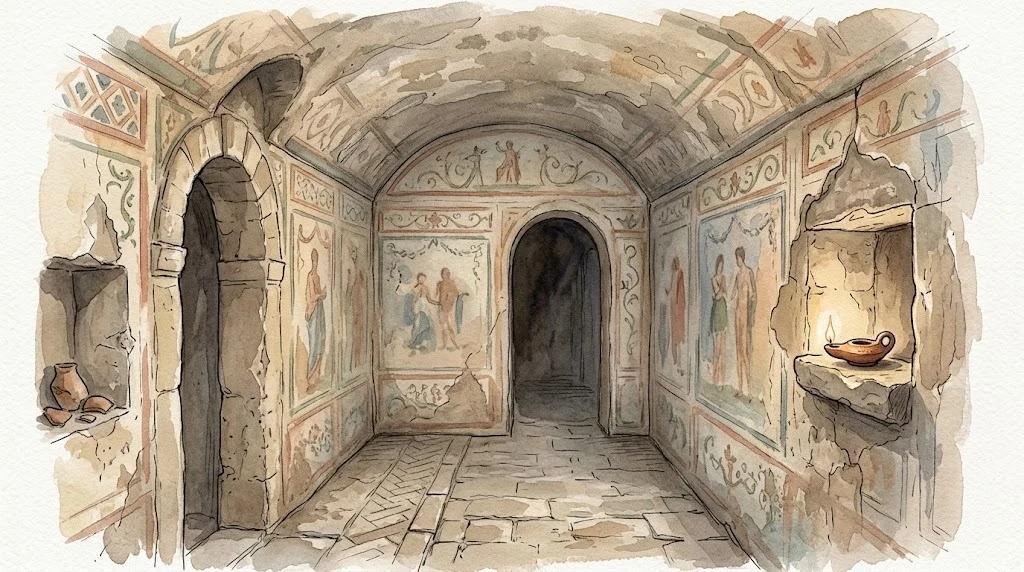
The Hypogeum of the Aurelii is at Via Luigi Luzzatti 2, at the corner with Viale Manzoni, and it isn't open to the public at regular hours. It's run by the Pontifical Commission for Sacred Archaeology, which opens it only as a special visit on request. The request is sent by email to protocollo@arcsacra.va and the published fee is 250 euros for the whole group, up to a maximum of 15 people, with an archaeologist who explains the monument and a fossor who looks after the site.
The tomb is not a catacomb in the usual sense of the word. It's a small private funerary complex from the first half of the 3rd century, built along the ancient Via Labicana by a family of imperial freedmen and discovered by chance in 1919, during work on a garage. You go down two levels, to a depth of about five meters, and on the walls remain paintings that scholars have been debating for a century without agreeing.
The practical information given here comes from the check made on September 29, 2026 on the official page of the site run by the Pontifical Commission for Sacred Archaeology, on the section of the same portal devoted to catacombs open on request, and on the page of Turismo Roma, the tourism portal of Roma Capitale. If something changes, the channel through which all news passes remains the Commission's protocol mailbox, together with the two phone numbers listed below.
In brief: address, hours, ticket
- Address: Via Luigi Luzzatti 2, 00185 Rome, at the intersection with Viale Manzoni, Esquilino district.
- Operator: Pontifical Commission for Sacred Archaeology, portal Catacombe d'Italia.
- How to get in: only with a special visit on request, by email to protocollo@arcsacra.va.
- Price: 250 euros for the group, maximum 15 people, archaeologist and fossor included.
- Hours: no regular opening hours, date and time are agreed with the operator.
- Phone: 06 4465610 or 06 4467601.
- Accessibility: the operator doesn't publish information, the lower level is about five meters below the street.
Where it is and what you really see
The entrance is on Via Luzzatti, in the stretch that crosses Viale Manzoni, in the part of the Esquilino that looks toward San Giovanni. The tourism portal of Roma Capitale places it a few hundred meters from Porta Maggiore, that is, from the point where the ancient Via Labicana left the city. From the street you see little or nothing: the tomb is below street level, and the outside gives no hint of what is underneath.
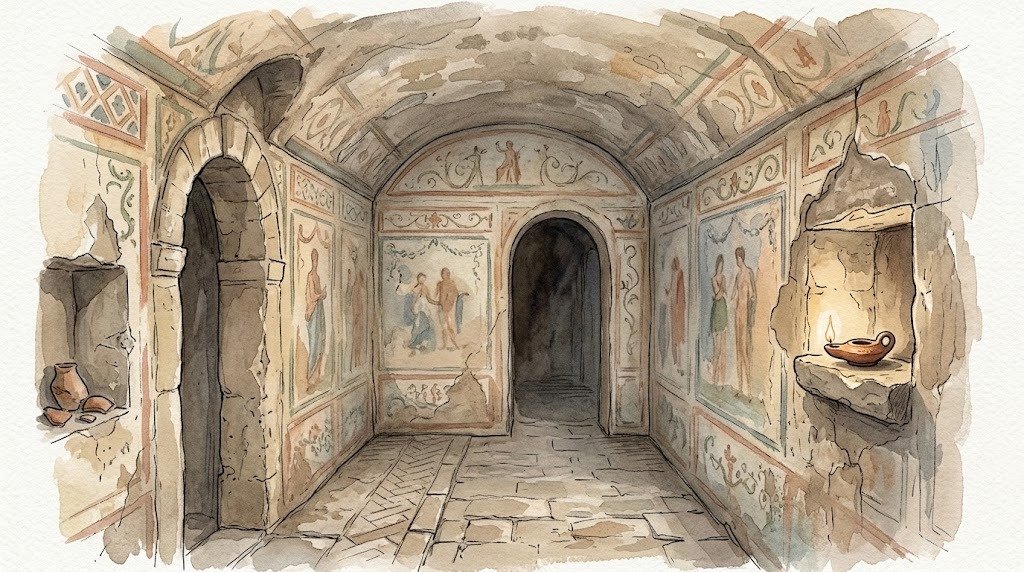
The complex has two levels. The upper one was originally a semi-underground hall, that is, only partly buried, and today its lower half survives. The level below is made up of two fully underground rooms, built as mirror images. One of the two is the so-called cubiculum of the Aurelii, the one with the floor mosaic bearing the family's names, which gave its name to the whole monument.
What you come to see are the paintings. The city's tourism portal lists figures around a serpent, a group of 12 people in togas, a bearded man reading in front of a flock, scenes tied to Ulysses and Penelope, a banquet with many diners, and then animals, genii and peacocks, which in funerary painting allude to the immortality of the soul. The rooms are small and the visit takes place a few meters from the walls.
Don't expect galleries, burial niches as far as the eye can see or kilometers of tunnels. Anyone who arrives here after seeing the big catacombs of the Appia finds an intimate place, made of a few rooms, where you spend your time looking closely at one wall at a time. It's precisely this reduced scale that makes the hypogeum interesting: the decorative program is the one wanted by a single family, readable as a whole, and not a sum of interventions from different centuries.
The neighborhood above tells another story. The Esquilino district, as you see it today, is largely the result of the urban expansion after the Unification of Italy, with buildings from the late 1800s and early 1900s, porticoes, wide avenues. The garage under construction in 1919 was part of that growth. It's a contrast worth keeping in mind as you go down: a few meters from the traffic of Viale Manzoni you enter a family tomb 18 centuries old.
A curiosity about the Hypogeum of the Aurelii
The monument's name comes from a mosaic. In the floor of the cubiculum of the Aurelii an inscription records that Aurelius Felicissimus dedicated the tomb to his brothers Aurelius Onesimus, Aurelius Papirius and Aurelia Prima. It's a short text, but it's the most solid document we have about the place: it says who built it and for whom, and makes clear that this is a family tomb and not a communal cemetery open to a church or an association.
Next to the mosaic there is a second voice, carved in marble. An epigraph commemorates Aurelia Mirsina, daughter of Aurelius Martinus and Julia Lydia, who mourn her. This family also bears the name Aurelius, and it isn't clear what link it had with Felicissimus and his brothers. The tomb, in short, took in more than one family group, a sign that it was really used and not built only as a showpiece monument.
Then there is a detail that often gets missed. The hypogeum doesn't appear in any ancient, medieval or Renaissance literary source. No pilgrim itinerary names it and no church is recorded as built over it. That's why it stayed intact until 1919: nobody knew it existed, and so nobody looked for it, stripped it or turned it into a place of worship in the centuries when the martyrs' catacombs were visited and reworked.
One thing nobody tells you about the Hypogeum of the Aurelii
Many pages online present it as a Christian catacomb, others as the sanctuary of a Gnostic sect. The Commission that runs it uses a more cautious formula: a funerary complex under private law, with a decoration that mixes Christian and pagan elements, Homeric references and philosophical themes. Anyone who books expecting confirmation of one of the two theories is left disoriented, because the monument itself doesn't offer a solution and the visit ends up telling mostly the story of the debate.
The second point is about numbers. The visit is designed for groups of up to 15 people and the fee is fixed for the group, not per person. The bill therefore changes enormously depending on how many of you there are: for a couple it's a high expense, for a full group it becomes reasonable. It's worth knowing right away that the most sensible route, for someone traveling alone, is to join a visit that's already organized.
The third point is practical. The operator writes that the site has no regular hours and that the visit is arranged case by case. There is no ticket office to show up at, and no custodian to find on site on any given day. Anyone who passes by Viale Manzoni out of curiosity finds a closed door, and the only way in remains the formal request sent to the Commission's protocol mailbox, with the details the rules require.
Finally, the hypogeum isn't an isolated case. In the list of Roman sites that the Commission opens on request there are 10 entries: besides the Aurelii, the catacombs of Novatian, of Santa Tecla, of Generosa, of Commodilla and of Vigna Chiaraviglio, the anonymous catacomb of Via Anapo, the museum of Domitilla with the region of the Bakers, the museum of the Torretta with the crypts of Lucina and the museum and catacomb of Praetextatus. Anyone organizing for a group can think about more than one site.
Who were the Aurelii and why did they have themselves buried here?
The Commission defines them as a family of imperial freedmen, that is, former slaves of the emperor's household who, once freed, had kept roles and financial means. They weren't aristocrats, but they weren't poor either: a private tomb dug on two levels and frescoed by capable painters cost money. The city's portal describes Aurelius Felicissimus as a wealthy freedman, and the quality of the paintings confirms that the family could afford good craftsmen.
The choice of location follows an ancient rule. In Rome the dead were buried outside the city's sacred boundary, and the consular roads were lined with tombs. Via Labicana, which left the city at the point of today's Porta Maggiore, was one of them. Here, in the first half of the 3rd century, the land was still outside the urban boundaries, and a family could buy a plot and build its own tomb on it.
The dating given by the operator is the first half of the 3rd century, and other sources place the decoration around 230. These are years in which traditional cults, Eastern religions, philosophical schools and Christian communities still without official recognition coexisted in Rome. The tomb of the Aurelii was born in this climate, and the difficulty of classifying it depends in large part on the fact that its patrons lived in a religiously very mixed city.
The legal definition matters too. A tomb under private law belonged to a family, which decided who was buried in it and how it was to be decorated. The large communal catacombs, by contrast, were collective cemeteries, run by a community and open to many. In the first case the walls speak the language of a few patrons, with their tastes and their reading. In the second they speak that of a whole community, more codified and easier to recognize.
The advice I give you for visiting the Hypogeum of the Aurelii
The advice is to arrive prepared. Before the visit it's worth looking at the photographs of the paintings published by the operator or by the institutional portals, and fixing in your mind two or three scenes to look for: the banquet, the bearded man with the flock, the Homeric episodes. Underground time passes quickly, the rooms are small and the lighting is what conservation requires, not what an art gallery would have.
The second piece of advice is about questions. The archaeologist included in the fee is the real wealth of the visit, and precise requests make the difference. Ask which scenes have been read in a new way since the restorations, what the mosaic says and how to tell the phases of the decoration apart. A visit of this kind isn't a tour with an audio guide: it gives much more if you turn it into a conversation with someone who knows the monument.
Our opinion, against the grain of many guides online, is that the Hypogeum of the Aurelii is not the right place for someone seeing underground Rome for the first time. Anyone who has never seen a catacomb would do better to start with the ones open at regular hours, and keep this tomb for a second trip, when the eye is already familiar with funerary painting of the early centuries and can recognize what makes these walls different.
One last note is about timing. Since the visit depends on the availability of an archaeologist and a fossor, don't leave the request for the last days of the trip. Write as soon as you've set your dates in Rome, propose two or three alternatives and keep half a day free around the appointment. If the reply comes with a different date from the one you hoped for, it's easier to move a church or a museum with regular opening than to give up on this tomb.
How much does it cost and how do you book?
The site is part of the list of monuments that the Pontifical Commission for Sacred Archaeology opens on request, along with catacombs such as those of Santa Tecla, of Commodilla, of Generosa and the museum and catacomb of Praetextatus. The same procedure applies to all: a written request, a group of no more than 15 people, a fee of 250 euros for the whole group, with archaeologist and fossor included in the price.
There is only one official channel: the page of catacombs open on request on the Commission's portal, from which you reach the rules, and the mailbox protocollo@arcsacra.va that you write to. No tickets appear to be sold by online platforms for this site, and no dedicated product appears on the big booking portals. Be wary of anyone offering a single entry without going through the operator.
In the email the operator asks for the full personal details of the person making the request, the reason for the visit, the desired date and time, the number of participants and any need for a guide in a foreign language. It's best to propose more than one date, because the visit has to be fitted around the staff's availability. Response times and the length of the visit aren't published by the operator: to find out you can call 06 4465610 or 06 4467601.
There is another route too. Cultural associations and archaeological groups periodically organize group visits, gathering participants and splitting the fee. It's the most practical solution for anyone traveling as a pair or alone. In this case the price is set by the organizer, and it's worth checking that the visit has really been agreed with the Commission, because a site like this isn't opened without its staff.
A well-made request is short and complete. In the subject line the name of the site, Hypogeum of the Aurelii in Viale Manzoni. In the body the first name, last name and contact details of the writer, the reason for the visit, for example cultural interest or a study trip, two or three possible dates with a time slot, the exact number of participants and the language in which you want the explanation. Add your questions about photographs and accessibility, so that a single reply clears everything up.
Another well-known fact, yet rarely cited
Almost all enthusiasts of ancient Rome know that the Aurelian Walls were built in the 270s of the 3rd century. Few, though, connect those walls with the end of this tomb. The city's tourism portal explains that, with the construction of the Aurelian Walls between 270 and 275, the area ended up inside the city perimeter, where burials were forbidden, and the hypogeum stopped being used.
Between the decoration, around 230, and the construction of the walls, therefore, only 40 years pass. The tomb of the Aurelii is a monument with a very short life, used for one or two generations and then abandoned. That's also why the paintings have reached us so coherent: nobody had the time to add layers, repaint walls or open new tombs, as happened instead in the catacombs used for centuries.
Anyone who wants to see up close the circuit that closed the tomb's story can walk to Porta Maggiore, where the walls incorporated the arches of the aqueducts, or go as far as the Museum of the Walls at Porta San Sebastiano. They are two different ways to understand how much those walls changed the geography of Rome, moving outward the boundary between the city of the living and the city of the dead.
The right photo to take at the Hypogeum of the Aurelii
The operator's page doesn't say if photographs can be taken during the visit, or under what conditions. The simplest thing is to ask in the same booking email, specifying if you want to use a flash or a tripod. In painted underground spaces light is a matter of conservation, and it would be wrong to assume that the rules of churches or open-air museums apply. The operator's written reply counts for more than any custom.
The photograph that best tells the story of the place, therefore, is taken outside. Leaving Via Luzzatti and walking toward Porta Maggiore you reach the point where the ancient Via Labicana left the city: the arches of the aqueducts, the Aurelian circuit, the traffic of the trams that passes through them. A photo of the arches, in the raking light of late afternoon, says more than many words about where Roman tombs stood.
If the operator allows photos inside, aim for a detail and not the whole. The rooms are small, a wide-angle lens distorts the walls and the scenes get lost. Better to focus on a face, a group of figures in togas, a symbolic animal. They're more useful images afterward too, when at home you want to find again the scene discussed with the archaeologist and compare it with the published reproductions.
A photo that often gets overlooked is the one of the intersection itself, between Viale Manzoni and Via Luzzatti, taken after the visit. There is nothing spectacular about it, and that is exactly the point: an ordinary corner of a residential neighborhood, with parked cars and buildings from the early 1900s, under which lies one of the most debated painted tombs in Rome. Placed next to the images of the paintings, it tells well how the ancient city is hidden beneath today's.
How do you get there from central Rome?
The nearest metro stop is Manzoni, on Line A, which also carries the name of the Museo della Liberazione and is located along the same avenue. From there it's a few minutes' walk to Via Luzzatti. Alternatively you can get off at Vittorio Emanuele, in Piazza Vittorio, or at San Giovanni, where Line A crosses Line C, and continue on foot through the Esquilino.
From Termini station the simplest route is metro A in the direction of Anagnina, with very few stops to Manzoni. Anyone who prefers to walk can cross Piazza Vittorio and head down toward Viale Manzoni: the route passes next to the Porta Alchemica and Sant'Eusebio. For surface lines and updated schedules, check the website of the Roman public transport company before leaving.
By car it's a choice I'd advise against. The area is central and busy, restrictions on traffic apply in several nearby areas, street parking is scarce and the appointment with the Commission's staff has a precise time. Arriving late because you circled for half an hour looking for a spot means taking time away from a visit that you pay for per group and that can't simply be extended.
Anyone coming from San Giovanni can leave the metro and head back up toward Viale Manzoni through the neighborhood's streets, or make a detour to the Holy Stairs and the Lateran palace. Anyone coming from Porta Maggiore, on the other hand, has ahead of them the route most consistent with the history of the place: you start from the ancient exit of Via Labicana and walk toward the tomb, that is, along the same direction followed by the funeral processions of the 3rd century.
Some important events that happened here in history
The first event is the construction, in the first half of the 3rd century, when Aurelius Felicissimus had the tomb built for his brothers and had it decorated with a complex painted cycle. The second is the abandonment: between 270 and 275 the Aurelian Walls brought the area inside the city, burials were forbidden and the hypogeum dropped out of history. For more than 16 centuries no written source mentions it.
The third event is the discovery, in 1919. During work on building a garage at the intersection of Viale Manzoni and Via Luzzatti, workers found the underground rooms with the paintings still in place. The news immediately drew the attention of scholars. In the early 1920s the first publications on the monument came out, and since then the interpretation of the scenes has never stopped dividing the specialists.
The fourth is the restoration. According to the press of the time, the Pontifical Commission for Sacred Archaeology carried out a conservation campaign for about 10 years, using laser to clean the frescoes, completed and presented in 2011. In the same year the Commission published a volume edited by Fabrizio Bisconti, devoted to restorations, protection and interpretive updates, with 340 illustrated pages and 79 plates outside the text.
The fifth event is more recent and less visible. Today the tomb is among the sites that the Commission opens on request, with a single set of rules, a per-group fee and the mandatory presence of its own staff. It's a choice of protection more than of promotion: the press in 2011 already explained that visits were limited to very small groups for conservation reasons, and since then the formula has remained that of the special visit by arrangement.
Who has passed through the Hypogeum of the Aurelii
The first to pass through here are the names written on the walls and the floor. Aurelius Felicissimus, the patron. The brothers Aurelius Onesimus, Aurelius Papirius and Aurelia Prima, to whom the tomb is dedicated. And then Aurelius Martinus and Julia Lydia, who on a marble slab remember their daughter Aurelia Mirsina. They are ordinary people of 3rd-century Rome, known only thanks to these few lines.
After 1919 came the scholars. In 1922 the archaeologist Goffredo Bendinelli published one of the first studies devoted to the monument, and since then the bibliography has grown for decades. In recent years the broadest work is the one coordinated by Fabrizio Bisconti for the Commission, published in 2011 together with the end of the restorations, which made updated images and readings of the painted cycle available.
Today it's mostly small groups who pass through. The Commission's rules set a maximum of 15 people, and the press in 2011 already wrote that visits were possible only for very small groups, for conservation reasons. The result is that the Hypogeum of the Aurelii stays outside the mass tourist flows: whoever goes down here does so by choice, after writing an email and waiting for a reply.
The formula suits students of archaeology and art history, groups organized by cultural associations, enthusiasts of underground Rome who have already seen the better-known catacombs. It's an audience that usually arrives with precise questions, and the format of the visit, with an archaeologist dedicated to a small group, is built exactly for this. Anyone who goes down with the same curiosity comes out with much more than a few photographs.
Christians, Gnostics or pagans? What the documents say and what the legend says
The documents say little, but clearly. The mosaic names the patron and the brothers, the epigraph names another family, the dating falls in the first half of the 3rd century and the use of the tomb stops with the Aurelian Walls. No inscription in the monument declares a religious faith explicitly. Everything else, that is, the meaning of the painted scenes, is interpretation.
On the interpretations the sources don't agree. Some read the group of 12 people in togas, the bearded man reading in front of the flock and the scene with the serpent in a Christian key. Some have thought of a Gnostic group, which fused Christian texts and pagan philosophy. Some see mainly themes from classical culture, with Ulysses, philosophers and banquets. The most recent reading reported by the press speaks of a syncretic program.
According to this reading, which emerged after the restorations, the three brothers would be depicted as shepherds, philosophers and banqueters in an idealized afterlife. Among the novelties reported in 2011 are a scene of funeral lament and an episode of the Odyssey with Circe turning Ulysses' companions into pigs. The Commission itself, on the page of its site, chooses to list Christian and pagan elements together, without forcing the monument into a single label.
Then there is the legend, which circulates mostly online. The banquet with many diners has been presented as one of the oldest painted Last Suppers, and the hypogeum as the secret temple of an initiatory sect. These are readings that no document supports. The funerary banquet is a common theme in Roman sepulchral art, and a family tomb is not a place of collective worship. Anyone looking for mysteries finds better material elsewhere.
In our judgment the value of the tomb lies precisely in the fact that it can't be labeled. A tomb in which philosophers, shepherds, Homeric heroes and perhaps biblical scenes appear on the same walls says a lot about the Rome of the 3rd century, where a well-off family could draw on several traditions without feeling the need to choose. Demanding a clear answer, Christian or pagan, means looking at the monument with categories born later.
The paintings room by room: what can you recognize?
The decoration is spread between the upper hall, of which the lower part remains, and the two lower rooms. The cubiculum of the Aurelii, with the dedicatory mosaic, is the best known. The portal of Roma Capitale points out in particular the figures around the serpent, which some interpret as Adam and Eve and others as a mythological episode, and the 12 people in togas whom some of the scholars identify with the apostles.
Among the most debated scenes is the one of the bearded man with a book, seated in front of a flock. For the Christian reading he is Christ preaching, for others he is a philosopher or a teacher instructing, a frequent figure in the funerary culture of the time. Nearby, the episodes tied to Ulysses and Penelope lead straight into the Homeric world, and according to the press in 2011 the restoration also made the scene of Circe legible.
The banquets, the figures of shepherds, the animals and the peacocks complete the cycle. The peacock, in Roman funerary art, is a symbol of immortality, and the city's portal reads it in this sense together with the figures of genii. These are elements found in pagan tombs as much as in Christian contexts, and precisely this shared language makes it so hard to give a sure name to the faith of whoever had these walls painted.
The restoration changed the way these walls are seen. According to the press in 2011, cleaning with laser gave back colors and details that had been covered by deposits and alterations, and made it possible to read scenes that before could barely be guessed at. For anyone visiting today it means seeing a more legible cycle than the one described by 20th-century scholars, and it's one of the reasons why the older interpretations should be taken with caution.
A useful observation during the visit concerns style. The figures don't have the symbolic rigidity of many later catacomb paintings, and resemble instead the domestic and funerary painting of Rome in that period, with people in togas, landscapes, scenes of life and reading. Anyone who has seen the frescoes in the museum of Palazzo Massimo alle Terme recognizes a close language, even if here it's applied to a funerary program and not to the decoration of a house.
Where does it fit in underground Rome?
The Hypogeum of the Aurelii is part of a system of underground places in the Esquilino and San Giovanni that can be read together. A short distance away is the Underground Basilica of Porta Maggiore, another decorated hypogeal space, older by about two centuries. Further toward the Laterano, the excavations under the Basilica of San Clemente and the Roman Houses of the Celio show other layers of the ancient city.
For anyone following the theme of painted private tombs, the natural comparison is with the Hypogeum of Via Dino Compagni, on Via Latina, where biblical and mythological subjects live together in the same tomb. Other examples of family or collective burial are the Columbarium of Pomponius Hylas, the Columbaria of Vigna Codini and the Tomb of the Scipios, all in the area of the urban Via Appia.
To understand the religious climate of the 3rd century you also need the places of the Eastern cults. The Mithraeum of the Circus Maximus, the Mithraeum Barberini and the mithraeum under Santa Prisca tell of another of the faiths that coexisted in Rome in the same decades. The Jewish catacombs of Villa Torlonia complete the picture of a city in which the cemeteries spoke different religious languages.
Anyone who wants a general overview will find on the site the guide to underground Rome and the one to the catacombs of Rome, with the regular openings of the big catacombs such as Priscilla, San Callisto and Domitilla. They are the right starting point before tackling a monument as particular as the one on Viale Manzoni.
The Celio and the Laterano also offer useful supports to round out the picture. Santo Stefano Rotondo and the Basilica of the Santi Quattro Coronati show how the Christian city organized itself in the centuries after the Aurelii, when a faith now recognized built churches inside the walls. The comparison helps measure the distance between a private tomb of the 3rd century and the great buildings of worship of the later centuries.
When is it closed and what shouldn't you expect?
The short answer is that it's always closed, except for arranged visits. The operator doesn't publish an opening calendar and doesn't indicate closing days, because the whole operation is on request. The information isn't published even for the summer months or for holidays. Anyone with a fixed date in mind must write well in advance and accept that the reply may propose a different day from the one requested.
Don't expect services. The operator doesn't list restrooms, a cloakroom, a bookshop or refreshment points on site, and the site is not an equipped museum. Don't expect a long visit through many rooms either: the spaces are few and small. And don't expect a definitive answer to the mystery of the paintings, because the specialists themselves haven't found one. What you get is a direct look at a monument that almost nobody sees.
On accessibility the operator doesn't publish information. Knowing that the lower level is about five meters below the street, it's reasonable to expect stairs to go down. Anyone with mobility difficulties, or traveling with a stroller, should ask for details in the request email, before committing to payment. The same goes for anyone who suffers in enclosed spaces: these are underground, intimate spaces, with no openings to the outside.
A common mistake is confusing the Hypogeum of the Aurelii with other underground sites in the area and showing up at the wrong address, or vice versa. The Underground Basilica of Porta Maggiore has a different operator, a different procedure and a different entrance, and the same goes for the undergrounds of the churches of the Laterano and the Celio. Before heading out, check the address written in the Commission's confirmation, Via Luigi Luzzatti 2, and the time of the agreed appointment, and save the Commission's phone numbers for any unforeseen problems.
Eating in the area
The Esquilino is one of the most varied neighborhoods in Rome at the table, with cuisines from half the world next to Roman neighborhood trattorias. The traps, though, are concentrated along the axes that lead to Termini and toward the most visited monuments: laminated menus with photographs of the dishes in 10 languages, someone at the door inviting you in, places open nonstop from morning to night without a real kitchen break.
Other signs to keep in mind apply across the whole city. Be wary of dishes without a price on the blackboard, of menus that differ between the one displayed outside and the one handed to you at the table, of fresh pasta rolled out in the window as a show for passersby. Romans don't avoid these places out of snobbery, but because they know you pay for the scenery more than for the dish. A practical resource for finding your way is the list of addresses on Google Maps kept by the editorial team.
For anyone short on time before or after the visit, the Nuovo Mercato Esquilino is a good place to understand the neighborhood and stock up on fruit, spices and products that are hard to find in other parts of Rome. It's not a place to sit down for a stop, but it tells the story of today's Esquilino better than any restaurant, and it's a short walk from Via Luzzatti.
A practical tip on timing. In painted underground spaces it's good practice not to bring food or drinks, and the operator doesn't list refreshment points on site. It's best, then, to set lunch after the visit, not before, so you don't have to watch the clock while the archaeologist explains. If the visit is early in the morning, a coffee at the counter in one of the neighborhood's side streets remains the simplest and least expensive solution.
What to combine in a day
The most natural combination is with Porta Maggiore and with Holy Cross in Jerusalem, reachable on foot in a few minutes. Next to the basilica you can see the Amphitheatrum Castrense, incorporated into the same Aurelian Walls that closed the tomb's story. From here you can continue toward St. John Lateran and the Holy Stairs, building a half day entirely on foot.
The second possibility is toward the north, inside the Esquilino. Santa Bibiana, with its Bernini facade, is near the Termini tracks, and Piazza Vittorio offers the Porta Alchemica and Sant'Eusebio. For a picture of the neighborhood, our guide on what to see in the Esquiline Hill lines up churches, markets and ancient remains, and the one on the Rione Monti extends the walk toward the Forums.
Anyone who wants to stay on the theme of the end of the ancient world can go along Via Casilina, which follows the ancient Labicana, as far as the Mausoleum of Sant'Elena and the catacombs of Saints Marcellinus and Peter. Further southeast, toward the Appia Nuova, opens the Aqueducts Park. For those who like routes among symbols and mysteries, the page on esoteric Rome collects places with sounder documentation than the legends about the hypogeum.
A day entirely devoted to the undergrounds can combine the visit on request on Viale Manzoni with a site that has regular opening. The Domus Aurea on the Colle Oppio and the Roman domus of Palazzo Valentini are both at a reasonable distance. For painted and sculptural materials of the same period, the museum of Palazzo Massimo alle Terme is near Termini station and easy to fit into the route.
A well-built day doesn't put two on-request sites on the same day. The time of an arranged visit can slip, and the second booking risks falling through. Better to pair the Hypogeum of the Aurelii with places of regular opening or churches, which can be moved by an hour without consequences. If the group is interested in several of the Commission's sites, it's best to spread them over different days and request them in a single email, specifying the order of preference.
Frequently asked questions
Can you visit the Hypogeum of the Aurelii without a reservation?
No. The operator, the Pontifical Commission for Sacred Archaeology, indicates that the site has no regular opening hours for the public and is visited only as a special visit on request. The request must be sent by email to protocollo@arcsacra.va with the details of the person booking, the reason, the desired date and the number of participants. Showing up at the entrance on Via Luzzatti without an appointment means finding the door closed.
How much does the visit cost?
The fee published by the Commission for sites open on request is 250 euros for the group, not per person, with a maximum of 15 participants. The price includes an archaeologist who explains the monument and a fossor who takes care of custody and assistance. For a full group the individual share becomes modest, for a couple it stays high. Visits organized by associations may have different fees, set by whoever proposes them.
Is it a Christian catacomb?
The operator defines it as a funerary complex under private law, belonging to a family of imperial freedmen, with a decoration that mixes Christian and pagan elements, Homeric references and philosophical themes. The sources don't agree on the faith of the patrons: there are Christian, Gnostic, pagan and, after the restorations, syncretic readings. No inscription in the monument declares a religion explicitly, so the label of Christian catacomb is a simplification.
When was it discovered?
In 1919, during work on building a garage at the intersection of Viale Manzoni and Via Luzzatti. Until then the tomb had remained unknown, because it isn't cited by any ancient, medieval or Renaissance literary source. This silence explains the good state of the paintings: nobody visited it, stripped it or transformed it in the centuries when the martyrs' catacombs were destinations of pilgrimage and subject to continual reworking.
How long does the visit last?
The operator doesn't indicate the length on the site's page or in the rules for visits on request. The spaces are few, two levels with three main spaces, so it isn't a long route. The actual length depends on how long the group lingers on individual scenes and how many questions it asks the archaeologist. For a precise figure, ask the Commission directly, at 06 4465610 or 06 4467601.
Can you take photographs inside?
The operator's page doesn't specify. In painted underground spaces the rules on light and flash depend on conservation needs, and can't be taken for granted. My advice is to ask in the same email in which you request the visit, saying if you want to photograph with a flash or a tripod, and to follow the written reply. During the visit, in any case, the instructions of the staff present apply.
Is the site accessible to people with mobility disabilities?
The operator doesn't publish accessibility information. The tomb's lower level is about five meters below street level, and the rooms are underground and intimate. Anyone with mobility difficulties or traveling with small children in a stroller should describe their needs in the visit request and wait for the Commission's reply before organizing the rest of the day and before committing to payment.
Who runs the Hypogeum of the Aurelii?
The site is run by the Pontifical Commission for Sacred Archaeology, the body that also looks after visits to the Roman catacombs closed to the public. Official information is on the Catacombe d'Italia portal, on the page devoted to the hypogeum and on the one about visits on request. The contacts given are the mailbox protocollo@arcsacra.va and the numbers 06 4465610 and 06 4467601. The visit request must be sent to the Commission, and not to other bodies.
How do you get there by public transport?
The nearest stop is Manzoni, on metro Line A, along the same avenue onto which the intersection with Via Luzzatti opens. From Termini it's just a few stops in the direction of Anagnina. The Vittorio Emanuele and San Giovanni stops are also useful, both reachable on foot with a short walk. For surface lines and service changes, it's best to check the website of the Roman transport company before leaving.
Who wrote this and from which sources
The text comes from the editorial team of Tour Leader Pro, the Roman company that designs itineraries, visits and cultural events across Rome and Lazio. The fares, hours and booking arrangements given here come from the official sources cited in the text, as of the date indicated at the start: the site page and the rules for visits on request of the Pontifical Commission for Sacred Archaeology, and the tourism portal of Roma Capitale. Tell us what you find has changed.
Organizing this visit, for yourself or for a group, means thinking the opposite way from a museum: first you put the group together, then you write to the operator, then you build the day around the date granted. With 15 people and a single fee, logistics matter as much as history. A useful resource for people who organize group travel, among underground Rome and sites open on request, is Tour Leader Pro.
The tomb of the Aurelii fits well into a trip that looks at Rome in the first Christian centuries, from the catacombs of the Appia to the shrines of the martyrs, all the way to the abbeys of Lazio where the same story continues in the Middle Ages. Anyone with more days available can alternate the city and the surroundings, balancing sites that need booking with those that open regularly. A useful resource for building a multi-day itinerary is Italy Planner.