Catacombs of Pretestato
In short. You don't visit the Catacombs of Pretestato by showing up at the gate: they are an underground Christian cemetery at via Appia Pignatelli 11, run by the Pontifical Commission for Sacred Archaeology, and as of September 28, 2026 the…
You don't visit the Catacombs of Pretestato by showing up at the gate: they are an underground Christian cemetery at via Appia Pignatelli 11, run by the Pontifical Commission for Sacred Archaeology, and as of September 28, 2026 the official page gives a single formula for hours, namely special visit to be requested. Whoever arrives hoping for an open ticket office finds a closed door and nobody to ask.
This is the difference that matters compared with the two catacombs everyone knows on the Appian Way. A few hundred meters away, the Catacombs of San Callisto and the Catacombs of Domitilla have ticket offices, shifts in six languages and parked tour buses. Pretestato does not. You enter on written permission, in a group, paying a sum that is divided among the participants.
Where the Catacombs of Pretestato are and how to get there
The address is via Appia Pignatelli 11, postal code 00178, and it is given by the page of the Pontifical Commission for Sacred Archaeology. We are at the second mile of the Appian Way, on the left side coming from the city, in a stretch where the modern road follows the line of an ancient road. A third-party page gives the postal code 00187: it's a typo, the district is Appio Latino.
By public transportation the line that really serves the street is the 118. It runs along via Appia Pignatelli and stops, among others, at Appia Pignatelli/Erode Attico, Appia Pignatelli/Quarto Miglio and Appia Pignatelli/S. Urbano. The 660 too, a loop line with its terminus at Arco di Travertino, turns onto Appia Pignatelli after via dell'Almone and stops at S. Urbano and at the intersection with the Appia Antica.
Whoever arrives by subway has two options. Line A to Arco di Travertino gives direct access to the 660, and it's the quickest solution if you come from the southeast neighborhoods. Line B to Circo Massimo or Piramide puts you on the 118, which first passes by the Baths of Caracalla and Porta San Sebastiano and then goes down along the Appia.
Going by car seems convenient and isn't. Via Appia Pignatelli is narrow, two-way, with tuff walls and fences flush with the roadway and no pull-out where you can leave a car without being a nuisance. Through traffic between the Appia Nuova and the Appia Antica uses it all day. If you absolutely must drive, leave the car near the Appian Way Regional Park and do the last few minutes on foot.
On foot the area reads better than any other way. From the Church of Domine Quo Vadis? you walk up along the Appia Antica to the fork with Appia Pignatelli, turn left and in five minutes you are in front of number 11. It's a walk of fewer than 20 minutes on paving that in some points has no sidewalk: closed shoes, and watch out for cars cutting the curves.
Open or closed? The visiting arrangement, without beating around the bush
The most frequent question deserves a clear answer. As of September 28, 2026 the official site catacombeditalia.va places the Museum and Catacomb of Pretestato in the list of catacombs open on request, and under opening hours it writes a single line: special visit to be requested. There is no calendar, no fixed shift, no ticket office.
This arrangement puts Pretestato alongside other Roman cemeteries withdrawn from daily visits: the same list includes the Catacombs of Commodilla, the Catacombs of Santa Tecla, the catacomb of Novatian, the anonymous one of via Anapo, the catacomb of Vigna Chiaraviglio and the museum of the Catacombs of Generosa. They are fragile places, with reduced lighting systems and routes that hold up under few visitors at a time.
On June 27, 2026 the museum and the catacomb opened to the public starting at 17:00, with guided visits run together with the Pontifical Commission. It was an opening announced as an event, and the institutional page did not change as a result: it continues to give the formula of the visit on request. Translated, that evening did not turn Pretestato into a free-entry site.
The point that is almost never written plainly concerns the difference between an extraordinary opening and the ordinary arrangement. Extraordinary openings exist, they happen on days devoted to the Appia or on initiatives of the Commission, and they are announced a few days ahead on the institutional channels. Counting on one of these to plan a trip means building an itinerary on sand.
How to book and what it really costs
The procedure is written in black and white on the page of the Pontifical Commission devoted to the visiting arrangements for the catacombs open on request. You send an email to protocollo@arcsacra.va with the full personal details of the applicant, or on the letterhead of the institution, specifying the reason for the visit, the day, the time, the number of participants and any need for an archaeological guide in a foreign language.
The cost declared on the same page is €220, for groups of no more than 15 people, and includes the presence of a fossor for custody and assistance and that of an archaeologist who illustrates the monument. Figure checked on September 28, 2026. Divided by 15 it comes to a little under €15 a head, that is less than many commercial guided visits in the center of Rome.
Careful how you read that figure. It's not an individual ticket: it's the cost of the opening, and it stays the same if you are three people or 15. Whoever shows up as a couple pays €220 for two. This is why the visit to Pretestato works well for school classes, parish groups, cultural associations and groups of colleagues, and works badly for the solo traveler.
The telephone contact published for the complex is +39 06 4465610, with a second number +39 06 4467601. The site also has a form titled Request your visit, which channels the same request. With the Vatican offices a well-written email, with alternative dates, gets faster answers than a phone call.
On timing, the regulation doesn't set an explicit minimum notice, and here you have to use your head. For a group with fixed dates, three or four weeks is the reasonable minimum, better two months if you need an English-language guide or a specific weekday. August and the weeks around holidays are the periods when replies get longer.
What the cemetery of Pretestato is
The ancient name is Coemeterium Praetextati and it comes, in all likelihood, from the founder of the burial ground or from whoever donated the land. There is no Roman saint Pretestato who holds the title of the place, and this disorients those who arrive used to cemeteries named for martyrs, as in the case of the Catacombs of Priscilla. Here the name is that of an owner.
The land was part, plausibly, of the Pago Triopio, the great estate of Herodes Atticus, the very rich and cumbersome Greek figure of the Rome of Marcus Aurelius. After his death the area passed to the imperial property. In the last decades of the 2nd century a rich pagan necropolis was set up there, with fine monuments and burials of families who could afford imported marbles.
At the beginning of the 3rd century, inside that same area, the Christian burial settlement begins. There is no abrupt replacement, there is coexistence: pagans and Christians bury in the same sector for decades. It's one of the reasons archaeologists hold Pretestato in very high regard, much more than tourism does.
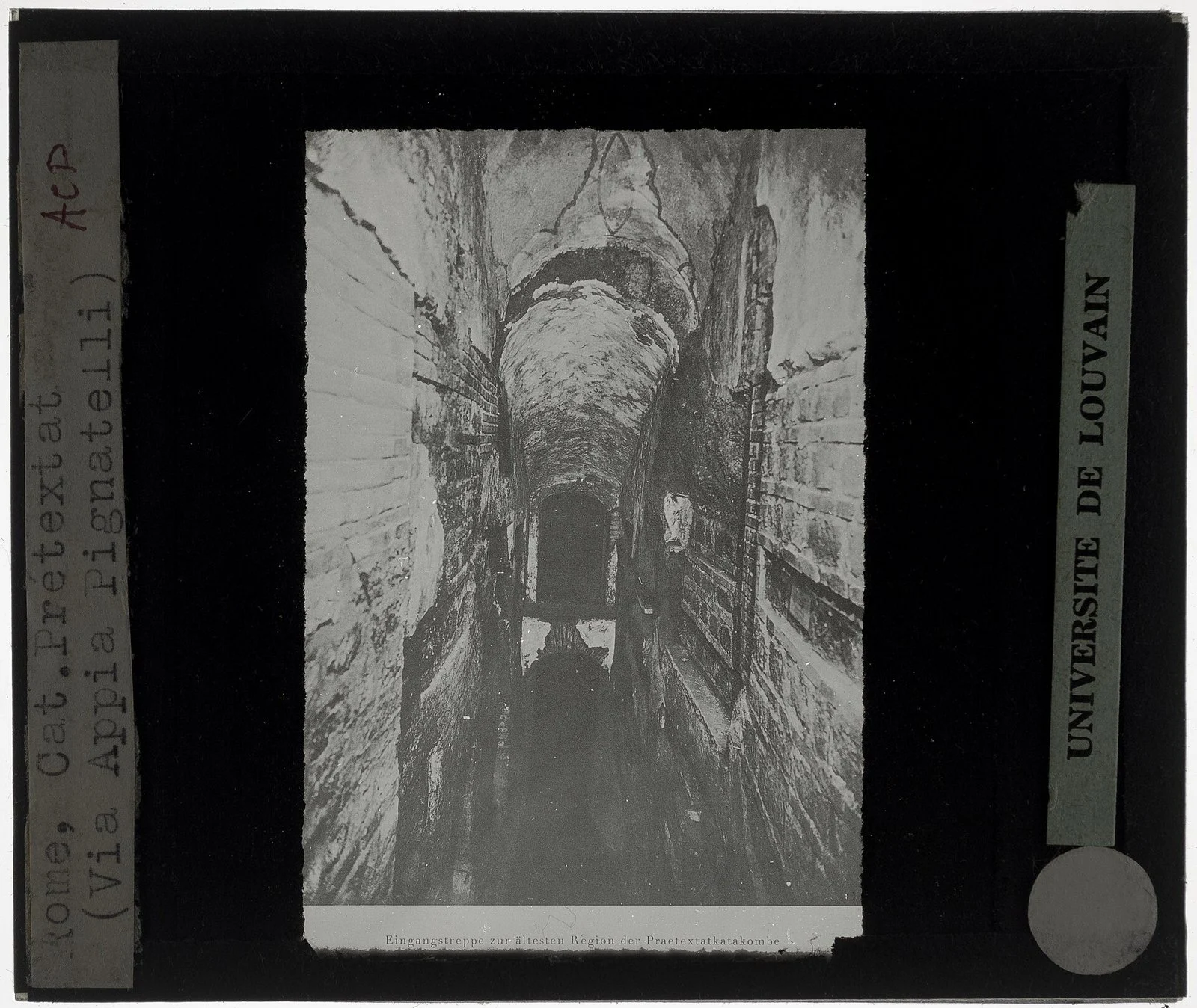
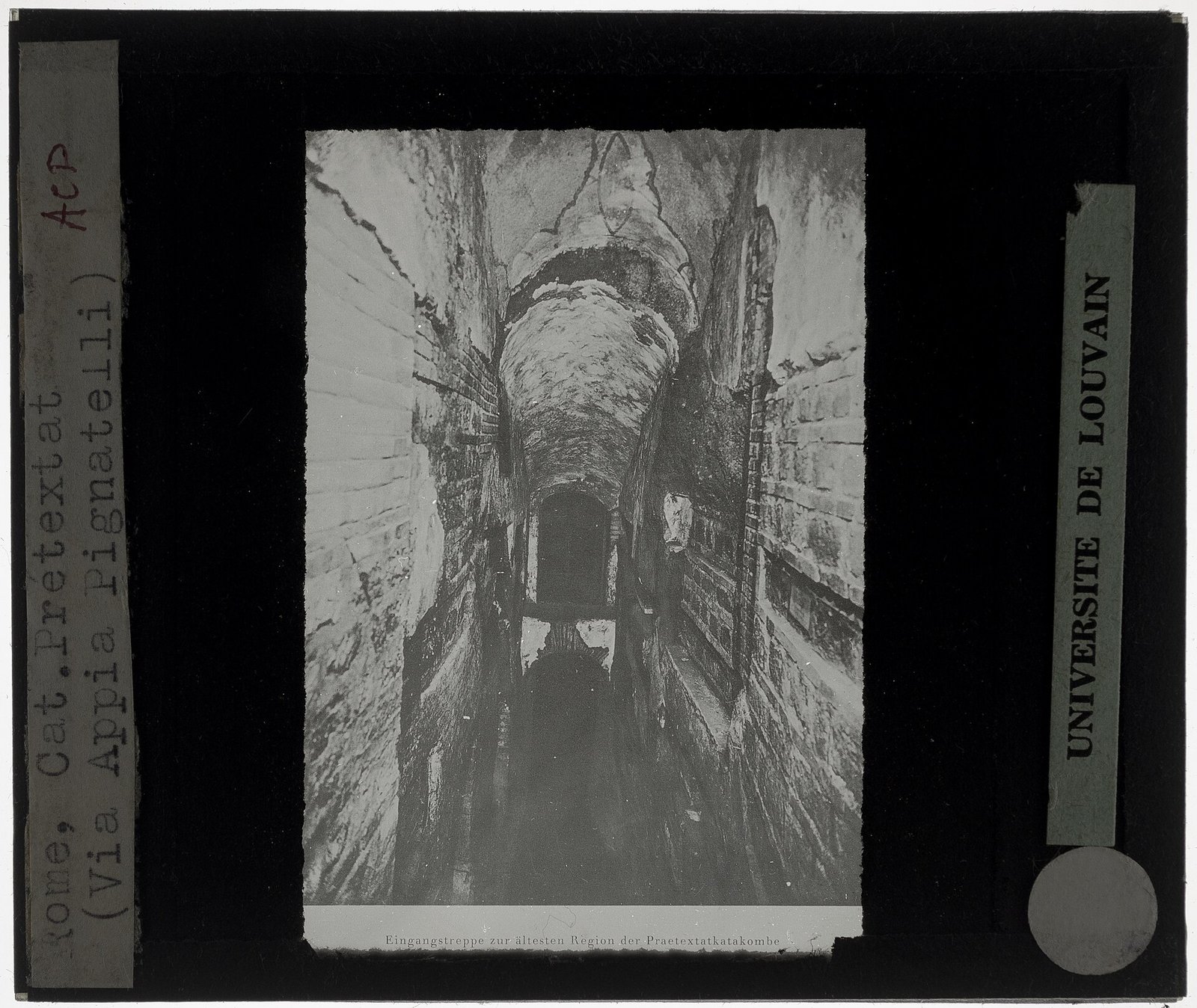
The main underground structure develops on two levels. The first includes the long gallery that began as a cistern and the region that starts from the so-called major staircase. The second, deeper level was dug in the 4th century with its own access. Whoever has visited the regular galleries of the Catacombs of San Sebastiano finds here a less linear and more layered layout.
On the surface the complex had two commemorative places of worship, tied to the martyrs Tiburtius, Valerian, Maximus and Zeno. Of the above-ground part little can be read today, and this is one of the things the visitor must take into account: the emerged part of the cemetery is largely lost or inaccessible, and what you visit is the underground plus the museum.
The Spelunca Magna, a cistern turned into a shrine
The most famous gallery of the complex is called Spelunca Magna and did not begin as a tomb. It was a hydraulic cistern dug in the 2nd century to serve the property on the surface, with a wide section and a straight course that no fossor would ever have made to bury people. In the 3rd century it was converted into a burial place.
The reuse explains the shape. Whoever enters finds themselves in a space higher and wider than normal galleries, where the burial niches were carved in the walls of an already existing chamber. It's an effect found in very few other places in Rome, and whoever knows the Underground Basilica of Porta Maggiore recognizes the same logic of a monumental hypogeal space.
Along the Spelunca Magna open the historic crypts, that is the venerated tombs. The official page of the Pontifical Commission names Pope Urban, in office between 222 and 230, the deacons Felicissimus and Agapitus, martyred in 258 together with Pope Sixtus II during the persecution of Valerian, and Januarius, indicated as one of the seven sons of the Roman matron Felicitas.
The decorations of these tombs were polychrome and monumental in character, and some descriptions speak of porphyry columns near the burial of Januarius. Porphyry is not just any material: it is the imperial stone par excellence, the same as the sarcophagi of Saint Helena and Constantina, and finding it in a 3rd-century Christian cemetery says a lot about the rank of those who financed those tombs.
A curiosity about the Catacombs of Pretestato
The best-known curiosity concerns the caretaker's house. According to the documentation on the complex, Pretestato is the only Roman catacomb that has preserved the lodging of the person who watched over it, with a monumental entrance, a vestibule and a space where pilgrims could stop. It is not a detail of color: it is the material proof of a stable organization.
Think what it means. In the 4th and 5th centuries these cemeteries received pilgrims who arrived on foot from the ports and the consular roads, and someone had to open up, escort, sell oil and flasks, repair the lamps. The caretaker's structure at Pretestato is what remains of that trade.
The second curiosity concerns the name of the street. Via Appia Pignatelli is not ancient: it was opened in the 1600s at the will of Cardinal Antonio Pignatelli, future Pope Innocent XII, as a link between the Appia Antica and the via Appia Nuova. The route, however, follows a pre-existing Roman road, and the catacomb lies along that one, not along the Baroque street.
The martyrs buried here: who is certain and about whom the sources diverge
On this point the sources don't say the same thing, and it's right to point it out. The page of the Pontifical Commission for Sacred Archaeology lists in the Spelunca Magna Pope Urban, Felicissimus, Agapitus and Januarius. Italian Wikipedia and the Cathopedia entry add a fifth name, Quirinus, speaking of four devotional stations with five martyrs.
There are no elements to say who is right, and neither does whoever writes tourist pages with more confidence than the documentation allows. The presence of Quirinus in the complex is handed down by hagiographic sources and appears in popular literature, while the institutional page doesn't name him. If someone tells you the opposite as a certainty, they are simplifying.
Januarius, on the other hand, has a more solid documentary base than average. From his crypt come marble fragments traceable to a dedicatory inscription of Pope Damasus, that is to the great program of monumentalizing martyrs' tombs of the second half of the 4th century. Damasus did the same thing across half of underground Rome, and his poems are often the only chronological handhold we have.
Felicissimus and Agapitus belong to an episode dated with precision. On August 6, 258 Pope Sixtus II was surprised and killed while presiding over an assembly in the cemetery of Callixtus, and with him died his deacons. It is the same persecution of Valerian that a few days later strikes Lawrence, later buried at San Lorenzo fuori le mura.
One thing nobody tells you about the Catacombs of Pretestato
The burial of Pope Urban is the subject of one of the longest controversies in Roman Christian archaeology, and in commercial visits it is never mentioned. The Acts of Saint Cecilia and the Liber Pontificalis place the pope at Pretestato. In the excavations of San Callisto, however, Giovanni Battista de Rossi found a fragment of a sarcophagus lid with the Greek inscription Ourbanos episkopos.
De Rossi, who in the 19th century practically founded the discipline, deduced that the pope was the one at San Callisto and that at Pretestato rested a bishop of the same name from another diocese. Later scholarship overturned the reading: today the majority of scholars place Pope Urban at Pretestato and attribute the inscription at Callisto to a later bishop from elsewhere.
This story is worth a thousand anecdotes, because it shows how the trade really works. An inscription of six letters, read by one of the greatest scholars of the century, moved a pope from one cemetery to another for decades. Whoever visits the Catacombs of Rome expecting textbook certainties soon realizes that the ground is shakier.
The second element that almost nobody tells concerns the continuity of use of the complex well into the early Middle Ages. Pope John III resided at Pretestato between 561 and 574, in very hard years for Rome, between the just-ended Greek-Gothic war and the arrival of the Lombards. A pontiff living in a cemetery outside the walls says how unsafe the city was.
The Cubiculum of the Coronatio and the oldest crown of thorns
In the western sector, in the region that starts from the so-called major staircase, is the chamber that gives Pretestato its iconographic primacy. The official page calls it the cubiculum of the Coronatio and describes it as decorated with the oldest known image of Christ being crowned with thorns. The current dating places it in the first decades of the 3rd century.
The scope of this has to be understood. In the 3rd century Christian painting almost systematically avoids the Passion: it paints the Good Shepherd, the orant, Jonah, the multiplication of the loaves, that is images of salvation and escaped danger. A scene of mockery and torture, in that context, is an anomaly that scholars have debated for more than a century.
In the same chamber the descriptions note other New Testament scenes: the resurrection of Lazarus, Christ's meeting with the Samaritan woman at the well, the healing of the woman with the hemorrhage. They are subjects we find in much of underground Rome, from the Hypogeum of Via Dino Compagni to the oldest regions of Callisto, and they serve as a point of stylistic comparison.
The cubiculum underwent a conservation intervention documented in the archaeological literature, which tells you two things. The first: the paintings were in a condition that required restoration. The second: what you see today is the result of modern work on a very fragile surface, and flash photos are not forbidden simply on a whim.
The cubiculum of the seasons, and why almost nobody sees it
The square crypt, also known as the cubiculum or crypt of the seasons, is described as a square-plan chamber with three large niches per side and a monumental Carrara marble entrance, with columns and capitals. On the vault four moments of the year are depicted: the harvest, the grape harvest, the olive picking and the flower gathering.
Here I have to be precise about what the sources say and what they don't. The description of the cycle of the seasons appears on Italian Wikipedia, on the Cathopedia entry and in the popular documentation devoted to the complex. The page of the Pontifical Commission, which is the institutional source, describes the visiting route citing the museums and the cubiculum of the Coronatio, and doesn't name the crypt of the seasons.
Translated into practice: don't take for granted that you'll see the seasons. The route granted depends on conservation conditions, on the number of people and on the availability of staff that day. If the seasons are the reason you want to go in, write it in the visit request and ask for confirmation before booking 15 people and a bus.
The subject, in any case, deserves some thought. The four agricultural labors are not neutral decoration: in the Roman funerary repertoire the cycle of the seasons alludes to the return of life, and it is a theme that pagans and Christians shared without too many problems. In a mixed cemetery like Pretestato this iconographic ambiguity is exactly the point.
The advice I give you for visiting the Catacombs of Pretestato
The operational advice is only one: don't think of Pretestato as a visit, think of it as an organization. Put the group together before writing the email. 15 people, a weekday date, two alternative dates, a single contact who answers the phone. With these elements the request to protocollo@arcsacra.va has a very different chance of going through.
Choose the morning if you can. The catacombs have a constant temperature of around 15 degrees Celsius, the humidity is high and in summer the contrast with the outside is brutal: you go in sweaty and come out with chills. In the morning the temperature jump is smaller, and you also have the afternoon left for the Appia on the surface, which is half the reason to come all the way here.
Bring a sweatshirt even in August, wear shoes with a treaded sole and leave heels and open sandals at home. The floors are packed earth, damp, with uneven steps and slopes. Bulky backpacks and tripods have no room in galleries a little more than a meter wide, and the fossor will point it out to you politely but firmly.
Don't expect museum lighting. In the catacombs open on request the systems are reduced to the bare minimum, and this is a conservation choice: light feeds algae and microorganisms that eat the painted plaster. A headlamp with warm light, kept low and used discreetly, changes the experience more than any audio guide.
Last tip, the most important. Ask the archaeologist to take you to the pagan sector before the Christian one. Understanding that above and around the Christian burials there was a necropolis of very rich families explains everything else: the porphyry, the sarcophagi of the museum, the choice of the place. Done in reverse, the story loses half its sense.
The Classical Museum and the Christian Museum, the real reason to come
The visiting route includes two museums side by side, the Classical Museum and the Christian Museum, which house the collection of sarcophagi recovered in the area. The official page defines it as one of the most precious testimonies of Roman sculptural production, local and imported, between the 2nd and the 5th century AD, and for once the institutional formula is measured.
A vast porticoed atrium holds the main pieces. The value of this collection is measured by continuity: you pass from pagan funerary sculpture of the full imperial age to the Christian chests of the 4th and 5th century without leaving the same courtyard, and the shift in language is visible to the naked eye, chest after chest. It's something that at Palazzo Massimo alle Terme is studied on pieces coming from half of Italy.
Whoever knows the funerary sculpture section of the Crypta Balbi or the collections of the Centrale Montemartini already has a trained eye for reading these marbles. The others should do one simple thing: look first at the lids, then at the portraits of the deceased, then at the scenes. In that order the sarcophagi tell their own story.
The museum is the part of the complex that suffers least from the lack of light and the fragility of the plaster, and for this reason it is also the part you can count on most in an arranged visit. If the group includes people with walking difficulties, the time spent here pays off much more than a breathless descent into the galleries.
The so-called sarcophagus of Balbinus, and the attribution that wobbles
The most famous piece in the museum is the sarcophagus attributed to Emperor Balbinus, killed in 238 after a few months of reign together with his colleague Pupienus. It comes from the area of the major staircase, intercepted between 1848 and 1850, and the fragments were recovered between 1907 and 1909, when the galleries were cleared of the fill earth.
The chest has a continuous frieze with the life of the commissioning couple: the wedding ceremony, a sacrifice with a crowning by Victory, a procession and a dance. On the lid the two deceased are reclined, in a scheme that has few such well-preserved parallels in Rome. The male portrait is placed on stylistic grounds between 235 and 260.
The attribution to Balbinus, however, is by no means settled. The laurel wreath suggests a figure of the highest rank, but part of the critics consider it more plausible to recognize a general of equestrian class and not a senator, and read the resemblances to imperial portraiture as workshop conventions rather than real physiognomy. The specialist literature on the case is extensive.
It has to be presented as the so-called sarcophagus of Balbinus, and that so-called has to be kept. Being told that a famous piece bears an uncertain name is more instructive than any invented certainty, and it also works as a vaccine against the self-assured captions you read around Roman museums.
Another well-known fact, yet rarely cited
That the catacombs were not born as refuges from persecutions is by now known to many. What is forgotten is the practical corollary: they were legal cemeteries, recognized by Roman law, which enjoyed the protection reserved for burial places. Hiding inside would have been the quickest way to be found, because the address was known to everyone.
Pretestato shows it better than other sites. A Christian cemetery that arises inside a pagan necropolis on imperial land, with monumental burials and expensive marbles, is not the seat of a clandestine community. It is the funerary property of a social group that has money, contacts and a recognized public existence, at least until imperial power decides otherwise.
Persecution, when it comes, strikes precisely the visibility of these places. In 257 and 258 the edicts of Valerian forbid Christians access to their cemeteries, and the death of Sixtus II happens exactly in violation of that ban. The link between catacomb and persecution exists, but it is upside down compared with the standard version.
I add a second fact that is taken for granted and told badly: the bodies of the martyrs, for the most part, left the catacombs. Between the 8th and 9th century the translations to the urban basilicas systematically emptied the suburban cemeteries. Whoever goes down to Pretestato or to Sant'Agnese fuori le Mura visits venerated tombs, not inhabited tombs.
Restorations, popes and a cemetery that never fully closed
The complex of Pretestato has a very long life, never truly interrupted until the early Middle Ages. Pope Gregory III had work done here in 731 and Pope Hadrian I intervened at the end of the 8th century. They are the same hands that in those years put half of Christian Rome back in order, from the walls to the suburban basilicas, in a season of restorations dictated by emergency.
The early medieval pilgrimage itineraries, that is the handwritten guides that oriented those arriving in Rome to visit the tombs of the martyrs, mention the cemetery on the Appia and its saints. They were eminently practical texts, with the order of the stops and the names to look for: the oldest form of what today we would call a marked itinerary.
Then silence. With the abandonment of the suburbs and the translation of relics inside the walls, the cemetery leaves the active memory of the city and is rediscovered only in the 15th century, in that season of antiquarian curiosity that leads the first visitors to go down into the galleries with torches. Scientific recognition arrives with Giovanni Battista de Rossi in 1852.
This arc is not exclusive to Pretestato: it is found with few variations in the Catacombs of Domitilla and in almost all suburban cemeteries. But here the sequence is particularly legible, because the two museums keep precisely the materials that came out of the 19th- and 20th-century excavations, instead of having seen them leave for other collections.
The right photo to take at the Catacombs of Pretestato
Inside the catacomb photography is normally forbidden, and in arranged visits the ban is repeated at the entrance. It's not a question of image rights: the flash accelerates the deterioration of the painted plaster and the 3rd-century paintings of Pretestato are exactly the kind of surface that doesn't forgive. Put your heart at rest and ask before raising your phone.
The photograph you can take, and that I recommend, is outside. The front of the property on via Appia Pignatelli, with the wall, the gate and the pines you see beyond the fence, tells exactly the condition of the site: a huge and closed place, in the middle of a through road. Horizontal framing, with the street entering the frame from the left.
Look for the second photo in the museum, if it is allowed and in ambient light. On the so-called sarcophagus of Balbinus the lid with the two reclined deceased works better than the whole chest: a low diagonal, at the height of the faces, brings back the relief that a frontal photo flattens. No flash, rest the phone on something stable and shoot three frames.
The third is outside, and it's the best of the day. Heading back toward the Appia Antica, at the intersection between via Appia Pignatelli and the ancient paving, the Roman road opens up with the boundary walls and the tombs in the background. In the late afternoon, with the low sun, the ancient paving takes on a raking light that no photo of the Colosseum will ever give you.
One warning. On Appia Pignatelli you don't stop in the middle of the roadway to take photos: cars come fast around the curves and have no visibility. Look for a widening, a recessed driveway, and always have the group get out on the same side.
Some important events that took place here in history
The last decades of the 2nd century mark the start of the pagan necropolis on the area that had belonged to Herodes Atticus and passed to the imperial property after his death. It is the phase in which the sector fills with fine funerary monuments, and in which many of the sarcophagi now in the two museums of the complex are deposited.
At the beginning of the 3rd century the Christian burial settlement begins, with the setting up of the first underground funerary structures in the western sector and the region originating from the major staircase. In this phase the cubiculum of the Coronatio is decorated, and the pre-existing hydraulic cistern begins the path that will transform it into the Spelunca Magna.
On August 6, 258, during the persecution of Valerian, Pope Sixtus II is killed with his deacons. Felicissimus and Agapitus, according to the official page of the complex, find venerated burial precisely in the Spelunca Magna. It's the year that gives Pretestato its status as a shrine and no longer a simple cemetery.
In the second half of the 4th century Pope Damasus monumentalizes the martyrs' tombs of underground Rome, and fragments of a dedicatory inscription of his can be traced to the crypt of Januarius. In the 4th century the second, deeper level is also dug, equipped with an entrance independent of the upper floor.
Between 561 and 574 Pope John III resides at Pretestato, in a Rome that came out of the Greek-Gothic war in pieces. The restorations of Gregory III in 731 and Hadrian I at the end of the 8th century follow, that is the same season in which the Aurelian Walls and the basilicas outside the gates are put back on their feet.
In the 15th century the complex is rediscovered by antiquarians, and in 1852 Giovanni Battista de Rossi identifies it on documentary and topographical grounds. Between 1848 and 1850 the area of the major staircase is intercepted, and between 1907 and 1909, with the galleries cleared of earth, the fragments of the so-called sarcophagus of Balbinus are recovered.
On June 27, 2026 the museum and the catacomb opened to the public from 17:00, with guided visits run in collaboration with the Pontifical Commission for Sacred Archaeology. An opening announced as an event, which did not change the ordinary arrangement reported by the institutional page as of September 28, 2026.
Who has passed through the Catacombs of Pretestato
Herodes Atticus, the Greek sophist and patron richer than anyone of his time, is the first name tied to this land, even though his property precedes the cemetery by decades. The Pago Triopio was his Roman estate, and whoever knows the Church of Sant'Urbano alla Caffarella knows that the temple in the park was part of the same property.
Pope Urban, in office between 222 and 230, is the first pontiff tied to the place, with all the reservations on the identification already set out. Pope Damasus, at the end of the 4th century, passes through here with his stonecutters and leaves the poems that still today serve archaeologists to date and recognize the crypts.
Pope John III lived here for 13 years in the middle of the 6th century. Gregory III and Hadrian I send workmen here in the 8th century. In between pass thousands of anonymous pilgrims who go down with oil lamps, the same ones who wore down the steps and filled the walls of suburban cemeteries with graffiti.
Giovanni Battista de Rossi is the man who in 1852 gives Pretestato back to scientific knowledge. He is not a minor figure: he is the scholar who invented Christian archaeology as a discipline, and his reading of the inscription of Urban, later corrected, remains an example of how even the masters get it wrong.
In the 20th century the archaeologists of the Pontifical Commission pass through, who clear the galleries and reassemble the fragments of the so-called sarcophagus of Balbinus. And today the groups that obtain permission pass through: high school classes, seminaries, associations, a few groups of Romans who discover at 60 a catacomb a stone's throw from home.
A contrarian position on Pretestato
I'll say something that it doesn't pay to say on the guided-visit market. Pretestato is overrated as an experience and underrated as a document. Whoever comes to Rome for three days and chases the label of the least-trodden catacomb is making the wrong choice: they will struggle, spend €220 for the group, and see less than they would elsewhere.
The truth is that San Callisto, which everyone snubs because it's full of buses, has a richer, longer and better explained route. Domitilla has a semi-underground basilica that doesn't exist anywhere else. San Sebastiano has painted pagan mausoleums and a forecourt that tells the story of devotion. Pretestato, for the generic visitor, offers less than all three.
The argument reverses for those who have already seen the others. If you know Callisto, Domitilla and Priscilla, then Pretestato becomes the piece that makes the picture add up: the coexistence of pagan necropolis and Christian cemetery, the reused cistern, the museum of sarcophagi, the question of Urban. It's a visit for the second or third round, not for a debut.
I add one more uncomfortable point, which concerns the trade. The rhetoric of the secret place sells very well and informs very badly. A site closed to the public is closed because it is fragile, not because it is more authentic than the others, and treating it as a trophy to collect is the quickest way to help ruin it.
What you don't see, and when it's closed
Of the complex on the surface very little can be read today. The two cemetery basilicas tied to Tiburtius, Valerian, Maximus and Zeno are not a monument open to visit, and whoever imagines an emerged archaeological area in the manner of the Villa of Maxentius will be disappointed. What you see is the underground plus the two museums.
The second level, dug in the 4th century and equipped with independent access, is generally not part of the route granted. The reasons are safety and conservation: deep galleries, poor ventilation, unstable stretches. If someone promises you the descent to the second floor, ask the Pontifical Commission for confirmation before paying anyone anything.
On closures there is a rule that applies to all Roman catacombs: they are places of burial and worship, and they follow the liturgical calendar before the tourist one. Requests in the weeks of Holy Week, at Ferragosto and between Christmas and Epiphany are less likely to be accepted, and replies arrive more slowly.
Then there is the weather variable, which nobody takes into account. After days of heavy rain the humidity in the galleries rises and certain sectors are closed by authority. A group arriving from outside Rome should always have a plan B nearby, and the most obvious plan B is the Caffarella Park five minutes away.
How to fit Pretestato into a day on the Appia
The day I build most often starts from Porta San Sebastiano and ends at Cecilia Metella. You begin with the Tomb of the Scipios and the walls, come out onto the Appia, make a short stop at the Quo Vadis church, then climb toward San Callisto and turn onto Appia Pignatelli for the arranged time at Pretestato.
In the afternoon you return to the Appia Antica and continue toward the Mausoleum of Cecilia Metella, with the possibility of stretching to the Villa of the Quintilii for those with legs and time. It's four or five kilometers in all, almost entirely flat, on mixed ground between asphalt and ancient paving stones.
The short variant, for groups with elderly people or small children, cuts the upper part. Bus 118 to the nearest stop, arranged visit, then a walk down toward San Sebastiano fuori le mura and back to the center on the same bus. Barely two and a half hours, with no elevation changes and no stretches exposed to the sun.
The long variant, for those who want to understand the topography, adds the Caffarella. You go down from the park along the Almone river, reach the little temple of Sant'Urbano and climb back up to Appia Pignatelli. This way you physically cross what was the Pago Triopio, and the position of the catacomb inside the property of Herodes Atticus stops being an abstraction.
Whoever has only one day and wants to understand underground Rome as a whole would do better to build a different route, with the Roman Houses of the Celio, the Basilica of San Clemente and the mithraeum of Santa Prisca. The overview of underground Rome is there precisely to help you choose.
The surroundings, worth the trip as much as the catacomb
Less than a kilometer away is the Fosse Ardeatine Mausoleum, and whoever brings school groups should plan that stop. It's not a light visit and it shouldn't be squeezed in a hurry between two archaeological stops: it deserves its time and its silence, and it changes the tone of the day.
Toward the north the Caffarella park opens into real countryside inside the Grande Raccordo, with flocks of sheep, the Almone, the nymphaeum of Egeria and the Constantinian columbarium. It's the most beautiful open space of the southern quadrant, and for those arriving with children it solves the afternoon better than any museum. Free entry and no hours to respect.
To the east, beyond the Appia Nuova, the Park of the Aqueducts completes the picture of the Roman countryside. You reach it with metro line A from Arco di Travertino in a few stops, and it's the place to understand why all these burial grounds lie outside the walls, along the roads, in the middle of the fields.
On the Appia toward the center there remain to see the Basilica of Santa Sabina on the Aventine for those coming up from the other side, and San Sisto Vecchio, the Dominican church facing viale delle Terme di Caracalla that almost nobody ever opens. Whoever wants to close the circle on the persecution of Valerian finds there the titular church dedicated to Pope Sixtus.
Eating in the area
Eating well between Appia Pignatelli and the Appia Antica takes some care, because the area lives on passing trade and passing trade attracts traps. The first warning sign is the menu with photographs of the dishes displayed at the entrance: whoever has to show you the picture of the carbonara does it because they count on customers who will never come back, and on a kitchen that has nothing to defend.
The second sign is the lady rolling out pasta in the window or directly on the sidewalk. It's a theatrical scene built to make you slow down, not a clue to the quality of what arrives on the plate. Fresh pasta done well in Rome is made in the kitchen, at 7:00 in the morning, with nobody watching.
Third sign, the person at the door inviting you in. A restaurant that lives on neighborhood customers doesn't need to send someone to stop passersby: its tables are full of people who booked. Fourth sign, hours running nonstop from morning to late at night, with no closing between lunch and dinner. It means a kitchen that reheats, not a kitchen that cooks.
Then there are the places in front of monuments, and on the Appia you find several. There the price adapts to the customer: unpriced items on the menu, different price lists between the inside room and the tables outside, the cover charge appearing at the bottom of the bill with figures that were written nowhere. Ask the price before ordering, always, without embarrassment.
On the chains with repeated signs in the center, I say something that usually irritates. They work as tourist attractions, not as restaurants: they have a recognizable visual identity, trained staff and an identical product in every location, and for many visitors this is reassuring. There is nothing shameful. It's simply that Romans don't go, and whoever wants to eat the way people eat here has to look elsewhere.
The criterion is only one and almost never fails: look at who is seated at the tables and in what language they order. If at 14:00 on a Tuesday the place is full of people speaking Roman dialect and ordering without looking at the menu, you are in the right place. If you hear six different languages and nobody from the neighborhood, change street.
In practice, on the Appia it's best to move a little toward the interior. The residential neighborhoods between Appia Nuova, Furio Camillo and the Quadraro have local trattorias that work with their regular customers, and you get there by metro line A or with a few minutes of bus. On the Appia Antica instead it makes more sense to bring your lunch and eat it on a low wall.
For those who want to start from an already filtered list, there is a public list on Google Maps: the list of places to eat in Rome. It's not a ranking and it's not sponsored.
One last practical warning for those visiting in a group. With 15 people and an entry time set by the Commission, lunch has to be settled before or after, never right up against it. The trattorias of the area don't gladly handle sudden big tables and the times stretch, and arriving late to an arranged visit means missing it.
Accessibility, children, clothing
On accessibility the official page doesn't publish a dedicated route, and Roman catacombs are in general difficult environments for those with walking problems. Steep stairs, uneven steps, packed-earth floor, narrow passages. Whoever has specific needs must state them in the visit request and ask for written confirmation of which areas can be reached.
The museum with the sarcophagi is the part of the complex it's most reasonable to count on for those who can't go down. A vast porticoed atrium on the surface holds the main pieces, and a visit limited to this section still makes full sense, above all for those interested in funerary sculpture more than in cemetery topography.
With children the assessment changes with age. Under seven the dark and narrow galleries frighten more than they intrigue, and there are no dedicated educational routes as at other sites. From eight up, with an archaeologist who knows how to tell the story, the effect is excellent, as long as you limit the duration and get outdoors right afterward.
On clothing: layers, not sweaters. Inside it is around 15 degrees Celsius all year, with high humidity, and the summer difference with the outside can exceed 20 degrees Celsius. A light sweatshirt and a long-sleeved shirt work better than a heavy jacket that then has to be carried on your arm.
For those who suffer from claustrophobia the advice is to say so beforehand, not halfway down a gallery. In the catacombs open on request the groups are small and the staff has room to manage an early exit, but they must know in advance. The galleries of Pretestato are in some stretches wider than average, which helps, but is not always enough.
Frequently asked questions about the Catacombs of Pretestato
Are the Catacombs of Pretestato open to the public?
The Catacombs of Pretestato do not have an ordinary opening to the public. As of September 28, 2026 the page of the Pontifical Commission for Sacred Archaeology places the complex among the catacombs open on request and under hours gives the formula special visit to be requested. Access is by group, with prior written permission obtained by email.
How much does it cost to visit the Catacombs of Pretestato?
The cost published by the Pontifical Commission for visits to the catacombs open on request is €220 per group, with a maximum of 15 people, and includes a fossor for custody and assistance and an archaeologist to illustrate the monument. Figure checked on September 28, 2026. There is no individual ticket at a reduced rate.
How do you book a visit to the Catacombs of Pretestato?
The request is sent to protocollo@arcsacra.va indicating the full personal details of the applicant or the letterhead of the institution, the reason for the visit, the day, the time, the number of participants and any need for an archaeological guide in a foreign language. On the site catacombeditalia.va there is also a dedicated form. The published phone contacts are +39 06 4465610 and +39 06 4467601.
Which bus gets you to via Appia Pignatelli?
Line 118 runs along via Appia Pignatelli and stops, among others, at Appia Pignatelli/Erode Attico, Appia Pignatelli/Quarto Miglio and Appia Pignatelli/S. Urbano. Line 660, a loop with its terminus at Arco di Travertino on metro line A, turns onto Appia Pignatelli after via dell'Almone and stops at S. Urbano and at the intersection with the Appia Antica. Routes change often: check them the same day.
Which martyrs are buried in the Catacombs of Pretestato?
The page of the Pontifical Commission indicates in the Spelunca Magna the venerated tombs of Pope Urban, of the deacons Felicissimus and Agapitus, martyred in 258 with Pope Sixtus II, and of Januarius, one of the seven sons of the matron Felicitas. Other popular sources add the name of Quirinus, speaking of five martyrs: on this point the documentation does not agree.
What is the cubiculum of the Coronatio?
The cubiculum of the Coronatio is a chamber in the region originating from the so-called major staircase, decorated in the first decades of the 3rd century. The official page describes it as home to the oldest known image of Christ crowned with thorns. In the same chamber other New Testament scenes are described, including the resurrection of Lazarus and the meeting with the Samaritan woman at the well.
Do you see the cubiculum of the seasons on the visit?
The cubiculum of the seasons, or square crypt, is described by popular sources as a chamber with three large niches per side, a monumental Carrara marble entrance and a vault frescoed with harvest, grape harvest, olive picking and flower gathering. The institutional page of the complex does not include it among the chambers of the visiting route: it's best to ask for confirmation when making the request.
Is the sarcophagus of Balbinus really that of Emperor Balbinus?
The attribution to the emperor killed in 238 is not shared by all scholars. The laurel wreath indicates a figure of very high rank, but part of the critics prefer to recognize a general of equestrian class, reading the resemblances to imperial portraiture as workshop conventions. For this reason the current name remains the so-called sarcophagus of Balbinus.
How long does the visit last and how many people can enter?
The regulation of the Pontifical Commission sets groups of no more than 15 people. The actual duration depends on the route granted that day and on the presence of the two museums, which alone take time: for a group that wants to see the sarcophagi and the galleries it's best to allow at least two hours, without tight connections before or after.
Who wrote this page
This page is maintained by the editorial team of Tour Leader Pro, the Roman organization that designs and coordinates visits, routes and cultural events in Rome and Lazio. Hours, rates and access conditions reported here come from the official sources cited in the text and were checked on September 28, 2026: recheck them before leaving, because on these sites they change without notice. If you find an outdated figure, let us know.
Building a Roman itinerary that includes catacombs closed to the public means dealing with written permits, group rates and not per-person rates, liturgical calendars, granted routes that vary from day to day and walking distances that look short on the map and are not under the July sun. Whoever organizes for themselves or for a group finds planning tools and operational materials on Tour Leader Pro, designed for those who lead visits and for those who move independently.
For the wider picture, that is trains and connections, rentals, airports and destinations in Lazio outside the center of Rome, from the Castelli to the lakes and the coast, a useful resource is Italy Planner, which gathers schedules, routes and travel directions for those arriving from outside and wanting to understand how much time it really takes to move between one stop and the next.