Frosinone
In short. Frosinone can be visited freely: the old town on the hill, the piazzas, the cathedral and the monument to Nicola Ricciotti have no ticket, and the only paid entrance that matters is the Museo Archeologico di Frosinone, which has its own page.
Frosinone can be visited freely: the old town on the hill, the piazzas, the cathedral and the monument to Nicola Ricciotti have no ticket, and the only paid entrance that matters is the Archaeological Museum of Frosinone, which has its own page. The City Hall is in Piazza VI Dicembre, phone 0775 2651, PEC pec@pec.comune.frosinone.it. From Rome you arrive by train on the Roma-Cassino line, with the FL6 regional service, at the station in the lower part of the city.
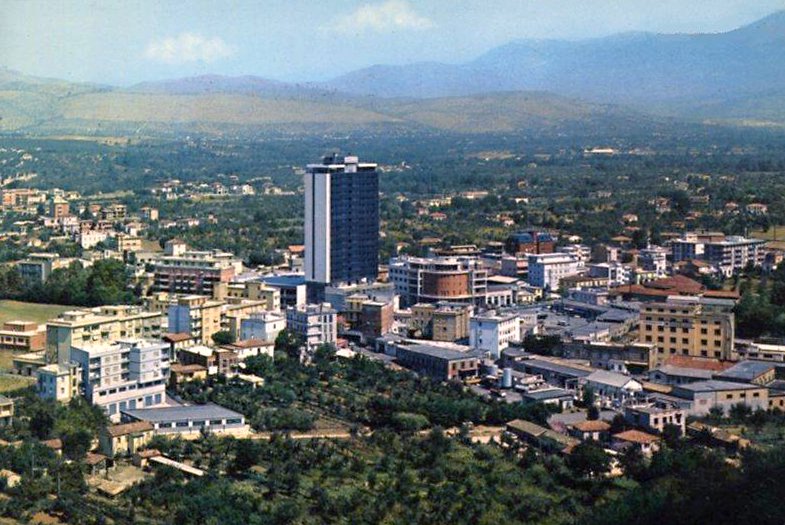
It's the capital of Ciociaria and of the province established in 1927, a city of about 43,000 inhabitants built on a hill that overlooks the Sacco valley. Anyone who knows it only from the highway or the station has the wrong idea of it. The upper part, rebuilt almost entirely after the war, can be toured in a morning. Below is the modern city. Its value, for someone coming from Rome, is its position: from here you reach Anagni, Alatri, Veroli, Ferentino, Fiuggi and the abbeys.
Data checked on September 29, 2026 on the City of Frosinone website, on the RFI page devoted to the station, on the city notice about works at the railway station and on the encyclopedia entries devoted to the city, the station and the city carnival, for the historical part. Hours of the churches and the Villa Comunale do not appear to be published in a stable form: anyone who needs certainty for a specific date does well to call the City Hall switchboard before leaving, especially on holidays and in summer.
At a glance: address, hours, ticket
- City Hall: Piazza VI Dicembre, Frosinone, phone 0775 2651, PEC pec@pec.comune.frosinone.it.
- How to get in: the old town, piazzas, viewpoints and Villa Comunale are public spaces with free access.
- Price: no ticket for the city. The Museo Archeologico has its own rates, given on its page.
- Hours: the City does not publish opening hours for the churches in the center or for the Villa Comunale.
- By train: Frosinone station on the Roma-Cassino line, Trenitalia regional trains of the FL6 service, schedules on trenitalia.com.
- Bus: urban bus lines and Cotral intercity lines stop at the station, schedules on cotralspa.it.
- Station accessibility according to RFI: four passenger tracks, step-free route only for track 1, no elevators, assistance on request.
Where it is and what you really see
Frosinone occupies a hill overlooking the Sacco valley, inside the Latin Valley, with the Ernici mountains to the north and the Lepini to the west and south. In the city there have always been a high Frosinone and a low Frosinone. The first is the old core, gathered around the cathedral and the prefecture. The second grew in the 20th century toward the station, opened in the 19th century, and toward the Rome-Naples highway, whose local stretch dates to 1962.
What do you really see, climbing the hill? A rebuilt city. The Allied bombings between September 1943 and May 1944 razed about 80 percent of the buildings, according to historical reconstructions, and Frosinone is reported to be the provincial capital most devastated in proportion to its inhabitants. Anyone looking for an intact medieval village like Alatri or Anagni is disappointed. Anyone trying to understand how a provincial capital in Lazio is lived in finds instead a real city.
The fixed points of the hill are few and clear. The cathedral of Santa Maria Assunta, on the highest point, with its Romanesque bell tower 68 meters tall. The Palazzo della Prefettura, built between 1825 and 1840 where the medieval fortress stood. Piazza della Libertà, with the monument to Nicola Ricciotti. The Palazzo della Provincia, from the 1930s. Around them, uphill streets, stairways and openings toward the valley, which on clear days reach all the way to the mountains.
The lower part has something else to offer. Here are the Villa Comunale named for Countess De Matthaeis, opened in 2002, the Palazzo Tiravanti, seat of the Academy of Fine Arts, the Edera skyscraper and the railway station area. It isn't the part to photograph, but it's where you arrive, park and take the train or the bus to the villages. It's best considered the starting point and not the reason for the trip.
The climate matters more than you'd think. Frosinone has cold winters for Lazio, with a January average around 5°C, hot summers with August above 24°C on average and abundant rain, more than 1,200 millimeters a year. Snow is not rare: in February 2012 more than 60 centimeters fell in the upper part. Spring and early autumn are the best seasons for going up the hill and touring the surrounding villages without effort.
A curiosity about Frosinone
Frosinone gave the Church two popes who were father and son. Hormisdas, pope at the beginning of the 6th century, and Silverius, his son, who rose to the throne a few years later, are both named as natives of the city and are its patron saints. It's a unique case in the history of the papacy, cited in every reconstruction of the city. Hormisdas had been married before entering the clergy, and that is what made the succession possible, without any scandal for the time.
The memory of the two patrons is also found in the churches. In the church of San Magno, also called della Madonna della Delibera, octagonal in plan and with origins the sources trace to the 9th century, the frescoed altarpiece shows Saint Magnus with Saint Hormisdas and, between the two saints, an image of the city. It's one of the rare portraits of Frosinone before the wartime destruction, and for that reason deserves a longer stop than the size of the church suggests.
One thing nobody tells you about Frosinone
The tallest building in the city is not the bell tower but the Edera skyscraper, inaugurated on May 18, 1968: 21 floors, 90 meters from the foundations, among the tallest in Lazio. The structural calculations bear the signature of Riccardo Morandi, one of the greatest Italian engineers of the 20th century. Few know it, and even fewer know that inside the skyscraper is the seat of the Archivio di Stato di Frosinone, with parchments ranging from the 10th to the 18th century.
The Archivio di Stato, established in 1956, holds documents from the territories that belonged to the Papal State and the Kingdom of Naples, because the province was born in 1927 by joining municipalities taken from the province of Rome and that of Terra di Lavoro. Among the holdings is the archive of the Confraternity of the Holy Spirit of Ferentino. For anyone studying the history of Ciociaria it's a more useful stop than many monuments. To consult the holdings you need to contact the Archivio, which sets its own access rules.
Another 20th-century building that goes unnoticed is the Palazzo Tiravanti. Born as an elementary school, it was begun in January 1925 and finished on June 15, 1929, and is remembered as one of the first Italian buildings of that size built in earthquake-resistant reinforced concrete. It carries the name of the gold medal winner Pietro Tiravanti, fallen in Libya. Since 2014 it has been the seat of the Academy of Fine Arts, and since 2015 it hosts the MACA, the city's contemporary art museum.
In the old town, in Piazza Valchera, there's also the Teatro delle Vittorie, a single hall of about 350 seats carved out of an old underground space of the hill. Originally it was called Cinema Teatro Vittoria, in honor of the victory in the First World War, and it changed its name in the years of the regime. In the lower part, on Viale Mazzini, the Nestor, built between 1957 and 1960, has a large hall of over a thousand seats. For shows and programming, the channels of the individual venues apply.
What to see, from the upper part to the lower part?
The cathedral of Santa Maria Assunta is the first reference. The interior was redone in the 18th century on the model of the Roman church of Sant'Andrea della Valle, while the Romanesque bell tower, with three orders of mullioned windows, is considered the city's most representative monument. The church has been a cathedral since 1986, the year the current diocese was born. Hours are not published by the City: it's best to go up in the morning, when the churches of the center are more likely to be open.
A little below is the Palazzo della Prefettura, born as the seat of the papal apostolic delegation and damaged several times: by the Marsica earthquake of 1915, by a fire in 1927 and by the war. It preserves a portal that oral tradition attributed to Michelangelo. No document supports the attribution, and historical reconstructions report it only as a popular rumor. It is a public building still in operation, so it's looked at from the piazza and not visited.
Piazza della Libertà hosts the monument to Nicola Ricciotti, a bronze by the sculptor Ernesto Biondi inaugurated in 1910. Around the figure of the patriot appear other protagonists of the Risorgimento, among them Pietro Sterbini, Luigi Angeloni and Francesco Arquati. Farther down, the Palazzo della Provincia, built between 1930 and 1933, holds the bronze statue of the Danzatrice by Amleto Cataldi. The facade can be seen freely, the interior follows the hours of the provincial offices.
Going down toward the lower part you meet the churches of San Benedetto, erected in 1134 and rebuilt in late Baroque forms between 1750 and 1797, with canvases from the 17th to the 19th century, and of Santa Maria delle Grazie, from the 18th century, with a 14th-century fresco of the Madonna nursing the Child. The sanctuary of the Madonna della Neve, demolished and rebuilt in the 1950s after the bombings, keeps the memory of an event held to be miraculous in 1675.
The sanctuary's history is well marked. A first church dated to 1586. On May 10, 1675 occurred what devotion calls the sweating of the Madonna, and on the site of a rural chapel a new building with sacristy and bell tower was built in a little over a year, solemnly consecrated on May 8, 1678. What you see today is the postwar reconstruction, but the feast and the devotion have remained tied to those dates.
In the same Piazza della Madonna della Neve is the fountain designed by Alessandro Specchi in 1711, commissioned by Marquis Livio de Carolis, postmaster general of the papal post. Those who know Rome will notice the similarities with the Clementine fountain of the port of Ripetta, on the Tiber, also tied to Specchi's name. It's one of the few Baroque elements that have come down to us, and alone it tells of the close bond between the city and the Rome of the popes.
More hidden, under the viaduct of Viale Roma, is the Bussi fountain, datable to 1774 but with much older origins, held to be among the oldest constructions in the city. Nearby a stone cippus was found dated to the time of Gaius Marius, between 104 and 101 BC. Not far away, the Ponte della Fontana, rebuilt in 1665 over the remains of a Roman bridge, marked the crossing of the river Cosa by Via Latina, the road that ran down from Porta Latina toward Campania.
The Villa Comunale Contessa De Matthaeis is the largest park in the lower part: an entrance laid out as an Italian garden and then a mixed woodland of oaks, maples and hornbeams. It's where the people of Frosinone walk and bring their children, and it works well as a break before picking up the train again. There are also the Parco delle Colline, inaugurated in 2007 on about a hectare of terraces with an archaeological area, and the Giardino dei Cinque Sensi, on Corso Lazio. Opening hours not published.
Can you really see the Roman amphitheater?
The Roman amphitheater of Frosinone was built between the end of the 1st and the beginning of the 2nd century, in brickwork, with an elliptical plan whose major axis measures about 80 meters and an estimated capacity of about 2,000 spectators. It was discovered in 1965, during excavations to build some apartment buildings, which then rose over the remains. This is the point to know before leaving: it is not an isolated monument like the Colosseum.
The City does not publish an archaeological area of the amphitheater with visiting hours. Anyone who wants to understand what the building was like will find the answer in the city's archaeological museum, which displays a reconstruction model of the amphitheater together with the finds of the city. The most sensible choice is therefore to do the museum first, and then look from outside for the visible remains. In Rome, a useful comparison for size and materials is the Amphitheatrum Castrense, also in brick and absorbed into later structures.
Roman Frosinone does not end with the amphitheater. The city, which Silius Italicus called Bellator Frusino for its resistance to Hannibal, was a municipium and then a colony, and its territory was crossed by Via Latina. A statue of Mars found in 1744 in the area called Colle Marte is now in the collection of Villa Albani Torlonia in Rome. Historical reconstructions also recall that Cicero owned an estate in the Frosinone territory.
The advice I give you for visiting Frosinone
The advice is not to treat Frosinone as a trip in itself, but as half a day within a stay in Ciociaria. You arrive in the morning by train, go up the hill, see the cathedral, Piazza della Libertà and the archaeological museum, and after lunch move on to one of the nearby villages. Anyone sleeping in the city for two or three nights has the advantage of the station and the services of a provincial capital, with prices often lower than in the more touristy towns.
The contrary position, in our judgment, is this. Frosinone is often described as an art city to discover, but as a destination in itself it doesn't hold up against Anagni, Alatri or Veroli, and whoever presents it that way does a disservice both to the city and to the villages. The opposite mistake, however, is skipping it entirely: as a logistics base, with the railway to Rome and the buses to the province, it's the most practical choice for anyone without a car.
Comfortable shoes are essential. Between the station and the old town the climb is considerable, and even inside the upper part the streets go up and down constantly. Anyone with difficulty moving would do well to reach the hill by car or bus and limit themselves to the area between the cathedral and Piazza della Libertà. In summer the middle hours of the day are hot even here, and a visit to the hill works better early in the morning or toward evening.
It's worth thinking about the day of the week. On weekdays the city is alive, the businesses in the center are open and the buses to the villages have more runs. On Sunday regional trains and intercity lines thin out, and anyone counting on public transport risks long waits. Shrove Tuesday, on the other hand, is the day the historic part fills up for the Radeca: great to experience, less suited to anyone who wants to see the monuments in peace.
How much does it cost and what do you book?
For the city there's nothing to book. Streets, piazzas, viewpoints and parks are public and free, and the churches follow the parishes' hours. The only visit with a ticket is the Museo Archeologico: rates, hours and booking arrangements are given on the museum's page and on the museum's official website, which the City names as the reference. No Frosinone-specific products appear on the big ticketing portals.
Where do you really buy what you need? The train ticket is bought on the Trenitalia channels or at the station ticket office. The intercity buses to the villages of the province are run by Cotral, which publishes schedules and fares on its website. For the museum the channel is the official one already given. No intermediary sells packages worth the money for a city you visit on foot and for free.
For the churches, hours are asked of the parishes. For the carnival and the Radeca there's no ticket: it's a street festival in the Giardino district, open to all. The year's program is released by the organizers, the Associazione culturale Rione Giardino, and by the City's channels in the weeks before. Anyone who wants to be sure of the date and the start time of the parades does well to check close to Shrove Tuesday.
Another well-known fact, yet rarely cited
That Frosinone was bombed is known. How much is less often remembered: the reconstructions speak of 56 Allied bombings between September 11, 1943 and the end of May 1944, starting with a RAF raid at 10 at night and an American attack with B-17s the next day. The census afterward counted 3,050 rooms completely destroyed, 4,880 seriously damaged and 8,500 people homeless. The first Allied troops entered the city on May 31, 1944.
This explains the look of the old town. Many churches, from the Santissima Annunziata to the sanctuary of the Madonna della Neve, are reconstructions from the 1950s. The urban landscape you see walking around is therefore almost all postwar, with a few facades and a few portals surviving. Anyone who arrives knowing this looks at the city differently: not as a failed old town, but as a city that had to rebuild itself from scratch in a few years.
On Corso della Repubblica, at the Zallocco curve, a cippus inaugurated on May 31, 2009, the 65th anniversary of the liberation, commemorates Everett M. Simm, named as the first Canadian Allied soldier to fall in the liberation of the city. It's a small sign, easy to miss from a car. Anyone following the traces of the war in southern Lazio can link it to the events of the Gustav Line, farther south toward Cassino, and to the places of memory in Rome.
The right photo to take at Frosinone
The photo that tells the city is the one of the cathedral's Romanesque bell tower, taken from below, from the streets climbing toward the highest point of the hill. The tower's 68 meters, with the three orders of mullioned windows, hold a vertical frame better than any other building in the center. The best light comes in the late afternoon, when the sun drops toward the Lepini and lights the stone from the west. In the morning the most visible side often stays in shade.
The second photo looks outward. From the viewpoints of the old town the view opens onto the Sacco valley and the Ernici mountains, and on crisp days you can make out the ridges behind which lie Alatri, Veroli and Collepardo. In winter, after a storm, the peaks may be snow-covered. The third, for those who like contrasts, is the Edera skyscraper seen from the upper part, with the rebuilt postwar houses in the foreground.
Anyone who prefers details to panoramas finds the right subject in Piazza della Madonna della Neve, with Alessandro Specchi's fountain in front of the sanctuary. The framing works best from the opposite side of the piazza, with the basin in the foreground and the facade in the background. In Piazza della Libertà, on the other hand, Ernesto Biondi's bronze should be photographed from three-quarters, to read the figures of the patriots around Ricciotti. In both cases early morning avoids cars and passersby.
How do you get there from Rome by train or car?
By train you leave from Roma Termini with Trenitalia regional trains of the FL6 Roma-Cassino service, which stop at Frosinone. The line passes through the stops of the eastern Castelli, such as Colonna, and through the Sacco valley. Travel times and frequencies change depending on the train and the time of day: the reference is the official timetable on the Trenitalia website, to be checked the day before, especially on Sundays and holidays.
The station is in the lower part of the city. According to RFI it has a ticket office, waiting room, restrooms, a café, a newsstand, a tobacconist and a railway police post. In January 2025 the City announced requalification works on the whole complex carried out by RFI, with Piazzale Kambo closed to traffic and parking relocated: long-term parking in the former Frasca area, short-term parking in Piazza Giovanni XXIII and Via Licinio Refice. For traffic updates the City points to the local police, 0775 2656265.
For those who need assistance, RFI states that the station falls under the service for people with disabilities, with the Sala Blu of reference in Rome: the service is requested up to 12 hours before departure. The passenger tracks are four, but only track 1 has a step-free or ramped route, there are no elevators and there are no raised platforms for boarding the train at level. It's best to mention this when making the request.
From the station to the old town the stretch is uphill. Urban bus lines and Cotral intercity lines stop at the station, and the taxi has a dedicated stand. Anyone arriving by car from Rome takes the Rome-Naples highway, Frosinone exit, or Via Casilina, which starts in Rome at Porta Maggiore and crosses the Sacco valley. In the old town parking is limited: better to leave the car in the lower-part parking lots.
The railway changed the shape of the city. The sources don't agree on the exact year the station opened, given as 1862 or 1863, but they agree that the Stazione district grew right around the stop. That's why the modern city stretches down the valley, away from the hill. Anyone arriving by train understands this right away: the first Frosinone you meet is the 20th-century one, and the old town is discovered only after the climb.
Some important events that happened here in history
The origins lie between the Volsci and the Hernici: tradition speaks of a Volscian city, more recent hypotheses consider it Hernican, with the name Frusna or Frusino. Rome subdued it in 386 BC. In 306 it took part in the revolt of the Hernican League, and the punishment was harsh: territory reduced by a third, city sacked, leaders deported to Rome and beheaded in 303. Then the municipium, enrolled in the Ufentina tribe, and in the imperial age the colony.
In the Middle Ages Frosinone was the capital of a duchy assigned to the Caetani in the 13th century and suffered the earthquake of 1349. In 1527, during the Sack of Rome, it was devastated by the Landsknechts and by French and Florentine troops. In 1556 the Spanish occupied it in their war against Paul IV, and after the Treaty of Cave in 1557 it became permanently the seat of the papal governors. This is where the administrative role the city keeps to this day comes from.
The 20th century too, before the war, left heavy marks. The Marsica earthquake of 1915 damaged the Palazzo della Prefettura, which in 1927 was also hit by a fire, in the same year the city became a provincial capital. Between the wars the buildings that still mark the administrative city were built, from the Palazzo Tiravanti to the Palazzo della Provincia. Many of these were then damaged again by the bombings of 1943 and 1944.
Around 1798 the city rebelled against French troops and was put to fire and sword. On September 17, 1870, three days before the breach of Porta Pia, it was annexed to the Kingdom of Italy, and the next year it had the first mayor of unified Italy. In 1927 it became the capital of the new province. In 1943 and 1944 the bombings destroyed it almost entirely. On February 4, 2012 an exceptional snowfall left over half a meter of snow in the upper part.
Then there are minor but revealing events. Pius IX visited the city in May 1863 and promised to fund an aqueduct, inaugurated on December 8, 1869. In June 1982 the Palazzo della Provincia hosted what the sources call the first Italian celebration of Bloomsday, the day devoted to Joyce's Ulysses. In 2014 the Palazzo Tiravanti, born as an elementary school in the 1920s, became the seat of the Academy of Fine Arts, and since 2015 it has hosted the contemporary art museum.
Who passed through Frosinone
The name most tied to the city is Nicola Ricciotti, a patriot from Frosinone who died in 1844 in Calabria together with the Bandiera brothers. The monument in Piazza della Libertà has celebrated him since 1910. Beside him, in the city's Risorgimento memory, appear Giuseppe De Matthaeis and Luigi Angeloni, tribunes of the Roman Republic of 1849. Anyone who wants to follow the Roman thread of that season will find in Rome the Museo della Repubblica Romana e della memoria garibaldina.
Two later popes also passed through. The future Benedict XIII visited the sanctuary of the Madonna della Neve in 1675, the year of the event held to be miraculous, and Pius IX stopped there on May 14, 1863, during his visit to the city. In the church of Santa Maria delle Grazie, entrusted since 1776 to the Redemptorist fathers, Saint Clement Mary Hofbauer celebrated his first Mass, later proclaimed a saint.
In June 1873 Urbano Rattazzi, a former prime minister, died suddenly in Frosinone while a guest of a friend in a farmhouse on Via Armando Fabi, now abandoned. Closer to us, the city named its new hospital after Fabrizio Spaziani, a doctor from Frosinone and gold medal winner for civil merit, who died in August 2009 on Monte Cristallo during a mountain rescue operation. Two different stories, both little known outside the province.
At the edges of the city's history remain the two popes Hormisdas and Silverius, natives of Frosinone according to ecclesiastical tradition, and the first mayor after Unification, Domenico Diamanti, elected in 1871. These names too are found in the streets and churches of the center. Whoever visits the city with a minimum of preparation thus recognizes, among plaques and monuments, the main passages of a history that the war made hardly visible in the buildings but that remains written in the names of the places.
The carnival and the Radeca: what do documents, tradition and legend say?
The Radeca festival takes place on Shrove Tuesday, from early afternoon, in the Giardino district, one of the oldest areas of the city, between Piazza Garibaldi, Viale Roma and Via Ferrarelli. The name comes from the radeca, in dialect the large agave leaf that participants wave to the rhythm of the music. The parades arrive from the four historic districts, with period costumes, band, saltarello and distribution of wine and traditional dishes. It is organized by the Associazione culturale Rione Giardino.
At the center of the festival is a horse-drawn cart with the dummy of a drunken French general, identified as Jean Étienne Championnet, carrying a plate of fini fini, the traditional dish tied to the festival. At the end of the day the dummy is burned, after the satirical reading of his will, and the festival ends. Participants take part in the street, without tickets and without reserved places, and it's best to arrive early to find a spot to see the parades.
The Giardino district owes its name to the hill of the same name, once covered with orchards and kitchen gardens, and is considered the center of the city's cultural life. Besides the Radeca, in June the Cantine Aperte event is held here, with the district's old cellars open to the public. The seat of the so-called casa di Carnevale is at the church of Santa Elisabetta, from which the organization of the festival starts. Anyone passing through the city on any ordinary day can still walk the district and see where it all takes place.
What is documented? Historical reconstructions report that around 1798 Frosinone rebelled against the French occupation and that the city was sacked as punishment. What does tradition say? That the following year the people of Frosinone celebrated carnival anyway to mock the powerful, inviting Championnet into the city, and that the general, understanding the joke, took part in the festival. This passage is not confirmed by an official source and should be taken as a folk tale, handed down from generation to generation.
And the legend? It concerns the agave leaves, which according to the reconstructions go back to very ancient fertility rites and the cycle of life, and which only at the end of the 18th century would have taken on the meaning of the rebellion and the expulsion of the French. It's a suggested interpretation, not a fact. For those who love Lazio's popular festivals, an interesting comparison is the Macchina di Santa Rosa in Viterbo, even if the spirit is the opposite.
Does Frosinone work as a base for Anagni, Alatri, Veroli and the abbeys?
Yes, with one condition: having a plan for getting around. Anagni, the city of the popes with the Palazzo di Bonifacio VIII, and Ferentino, with its walls and acropolis, lie along the same line toward Rome. For both, check on the Trenitalia timetable if the train stops at their station, before passing through Frosinone and doubling back. Alatri and Veroli, by contrast, are in the hills to the northeast, off the railway, and are reached by car or with Cotral buses.
The abbeys are a chapter of their own. The Abbey of Casamari, in the territory of Veroli, and the Certosa di Trisulti, above Collepardo, are the two destinations that alone justify a day in Ciociaria. Without a car they get complicated: buses exist on some routes, but with infrequent runs. Anyone who doesn't drive does well to check Cotral schedules the night before and leave a margin for the return.
Fiuggi, with its spa, and the Hernican towns like Trevi nel Lazio are farther north, toward the Monti Simbruini. From there the road continues toward Subiaco and the Sacro Speco, and toward the Villa of Trajan at Arcinazzo Romano. It's an itinerary for a car, which from Frosinone can be done in a day only by choosing two stops at most.
Toward the southwest, beyond the Lepini, you instead descend into the province of Latina, with the Abbey of Fossanova, Priverno and Sermoneta. Casamari and Fossanova are the two great Cistercian abbeys of southern Lazio, and comparing them on two different days is one of the most sensible itineraries in the region. From Frosinone, however, Fossanova requires a car and a crossing of the mountains not to be underestimated.
How many days do you need? A realistic formula, for someone sleeping in Frosinone, is three days: one for Anagni and Ferentino, one for Alatri, Veroli and Casamari, one for Collepardo, Trisulti and Fiuggi. Anyone with only one day who arrives from Rome by train does better to choose a single town, Anagni or Frosinone with the museum, rather than chase three villages between connections and climbs. Ciociaria rewards those who slow down.
Sleeping in Frosinone makes sense above all for people traveling by train. Anyone with a car can choose to stay directly in one of the villages, in Veroli, Alatri or Anagni, and gain quieter evenings in preserved old towns. Anyone arriving without a car finds in the provincial capital the most convenient combination of station, intercity buses, services and open shops. The choice depends on this, not on the beauty of the place: on that score the villages win.
When is it closed and what not to expect?
The city never closes, but many of its places do. The churches follow the hours of services and don't publish stable tourist openings. The Palazzo della Prefettura and the Palazzo della Provincia are seats of offices and not museums. The archaeological museum has its own closing days, given on its page. In the middle hours of the day and on Sunday afternoon the old town can seem deserted, with few businesses open.
What not to expect? An intact medieval center, because the war erased it almost entirely. A Roman amphitheater visitable as an equipped archaeological area, because the remains are largely under and beside modern buildings. A tourist office with long hours: the City's website lists no dedicated information desk. And a city built for tourism: Frosinone is a provincial capital that works, and it should be taken for what it is.
Some places cited in the historical reconstructions are not in a condition to be visited. The Laghetto di Maniano, an estate documented as early as 959, when the bishop of Veroli granted it to a consul, and with a fishing permit attested in 1854, is reported to be in a state of decay. The farmhouse on Via Armando Fabi where Urbano Rattazzi died is in complete abandonment. They are places of interest for local history, but shouldn't be put into an itinerary as if they were equipped stops.
The railway station also has to be factored in. With the RFI works announced by the City in January 2025, the forecourt and traffic layout have undergone changes in phases, and anyone arriving by car to catch the train may find routes and parking different from what they remembered. The advice is to arrive at the station with time to spare, and to check the City's updated information or call the local police at the published number.
Eating in the area
In a provincial capital that doesn't live on tourism the traps are fewer than in Rome, but they exist, especially near the station and along the through streets. The signals are always the same: menus with photos of the dishes, a barker at the door, a kitchen open at all hours without a break, items with no price or marked s.q., a different menu between the one displayed outside and the one handed over at the table. Anyone who sees two of these signals together does well to keep walking.
Ciociaria cooking has specific dishes, and the fini fini of the Radeca festival are one example. A place that offers the same list of Roman and international dishes found everywhere hardly has anything to say about the cooking of the area. The people of Frosinone eat where the menu changes with the season and where the local dishes are few and well made. To find addresses chosen without surprises there's the list of addresses on Google Maps.
What to combine in a day
The simplest combination, without a car, is Frosinone with Anagni. You leave Rome early, visit Anagni in the morning, with the cathedral and the Palazzo di Bonifacio VIII, and arrive in Frosinone in the early afternoon for the archaeological museum and a walk on the hill. The return to Rome is from the station. Anyone with a car can replace Anagni with Fiuggi or with Ferentino, depending on what interests them most.
Anyone who loves archaeology can build a day on the cities along the road to Rome. Palestrina, with the National Archaeological Museum of Palestrina and the sanctuary of Fortuna Primigenia, ideally opens the day, Ferentino and Frosinone close it. It's a dense day, which works only by car. Alternatively, Alatri with its acropolis and polygonal walls pairs well with Frosinone on the same day, with the museum visit in the afternoon.
Anyone who comes for spirituality can link Frosinone with Casamari and Trisulti in one full day, or choose just one of the two abbeys and complete it with Veroli or Collepardo. Anyone looking for the sea can push on, on a longer stay, toward the Circeo National Park, Sabaudia and the Lido di Latina, even though from the Ciociaria capital it's not an outing to do in a few hours.
Anyone returning to Rome by train can also break the trip. The line to Cassino crosses the Sacco valley and the eastern Castelli, and a stop of a couple of hours at Colonna, with its compact center on the hill, fits well into an afternoon return. Alternatively, anyone with a car can return along the Casilina and stop at Castel San Pietro Romano, above Palestrina, for sunset over the Roman countryside before heading back to the city.
Frequently asked questions
Is Frosinone worth a visit?
It's worth half a day, in our judgment, and above all as a base for Ciociaria. The old town is small and largely rebuilt after the war, but the cathedral with its Romanesque bell tower, Piazza della Libertà, the views over the Sacco valley and the archaeological museum justify the stop. Anyone looking for a preserved medieval village does better to choose Anagni, Alatri or Veroli and use Frosinone for sleeping and getting around.
How much does it cost to visit Frosinone?
The old town, the piazzas, the viewpoints and the Villa Comunale are free with open access. The churches have no ticket and follow the parishes' hours. The only expense for the cultural visit is the ticket to the Museo Archeologico di Frosinone, with rates and hours given on the dedicated page and on the museum's official website. To these items add the train or bus from Rome and, for those arriving by car, any paid parking.
How do you get to Frosinone from Rome without a car?
By train from Roma Termini with Trenitalia regional trains of the FL6 Roma-Cassino service, which stop at Frosinone station, in the lower part of the city. Travel times and frequencies vary with the type of train and the time of day, and are checked on the official Trenitalia timetable. From the station to the old town the route is uphill, and both urban bus lines and Cotral intercity lines for the province's villages stop at the station.
Can you visit the Roman amphitheater of Frosinone?
The amphitheater, built between the end of the 1st and the beginning of the 2nd century and discovered in 1965 during the construction of some apartment buildings, lies largely under and beside modern buildings. The City does not publish an archaeological area with visiting hours. The best way to understand it is the reconstruction model displayed in the Museo Archeologico di Frosinone, where the finds of the Roman city are also found. For specific inspections, it's best to ask the City.
When is the Radeca festival held?
The Radeca festival takes place on Shrove Tuesday, starting in early afternoon, in the Giardino district, in the historic part of the city. The parades of the four districts march with period costumes, band and agave leaves, and the day ends with the burning of the dummy of the French general. The date changes every year with the carnival calendar: the program is released by the Associazione culturale Rione Giardino and by the City's channels close to the festival.
Can you reach Casamari and Trisulti from Frosinone by public transport?
With difficulty. Cotral intercity lines also leave from the Frosinone station, but for the abbeys the runs are few and not always suited to a visit with a return the same day. For Casamari, in the territory of Veroli, the situation is better than for Trisulti, isolated above Collepardo. Anyone who doesn't drive does well to check the schedules on the Cotral website the night before, or to consider a taxi for the final stretch.
How many days do you need for Frosinone and the surroundings?
For the city alone half a day is enough. To use it as a base and see the main places of Ciociaria you need at least three days: one for Anagni and Ferentino, one for Alatri, Veroli and Casamari, one for Collepardo, the Certosa di Trisulti and Fiuggi. With one more day you can add the Hernican towns or a detour toward Subiaco. Without a car, cut the stops and choose the ones best served by public transport.
Is Frosinone station accessible?
According to RFI the station falls under the assistance service for people with disabilities, with the Sala Blu of reference in Rome and requests up to 12 hours before the trip. Of the four passenger tracks only track 1 has a step-free or ramped route, there are no elevators and the platforms don't allow boarding the train at level. Accessible restrooms and reserved parking spaces are available. It's best to flag your needs when you book.
Who wrote this and from what sources
The text comes from the editorial team of Tour Leader Pro, the Rome-based outfit that designs itineraries, visits and cultural events across Rome and Lazio. Rates, hours and booking arrangements given here come from the official sources cited in the text as of the date stated at the top: the City of Frosinone website and its notice about the works at the station, the RFI page on the station, the Trenitalia and Cotral websites. Tell us what you find changed.
Organizing a few days in Frosinone for yourself or for a group means dealing with an uphill center, churches with no published hours, a station without elevators and buses to the abbeys with few runs. It's best to fix the museum visit first, check trains and buses the evening before and keep a car or a transfer for Casamari and Trisulti. A useful resource for people who organize group trips in Lazio is Tour Leader Pro.
Frosinone gives more within an itinerary on Ciociaria than as an isolated trip: the Hernican cities and the polygonal walls, the Cistercian abbeys, the city of the popes, the spas and the mountains together tell a Lazio different from that of the Castelli and the coast. Anyone with a week can split it between Ciociaria and the province of Latina. A useful resource for putting together a multi-day itinerary is Italy Planner.