Sabaudia
In short. Sabaudia is a city built from scratch between 1933 and 1934 on the dune that divides the sea from Lake Paola, and from Rome you can go and come back in a day without effort.
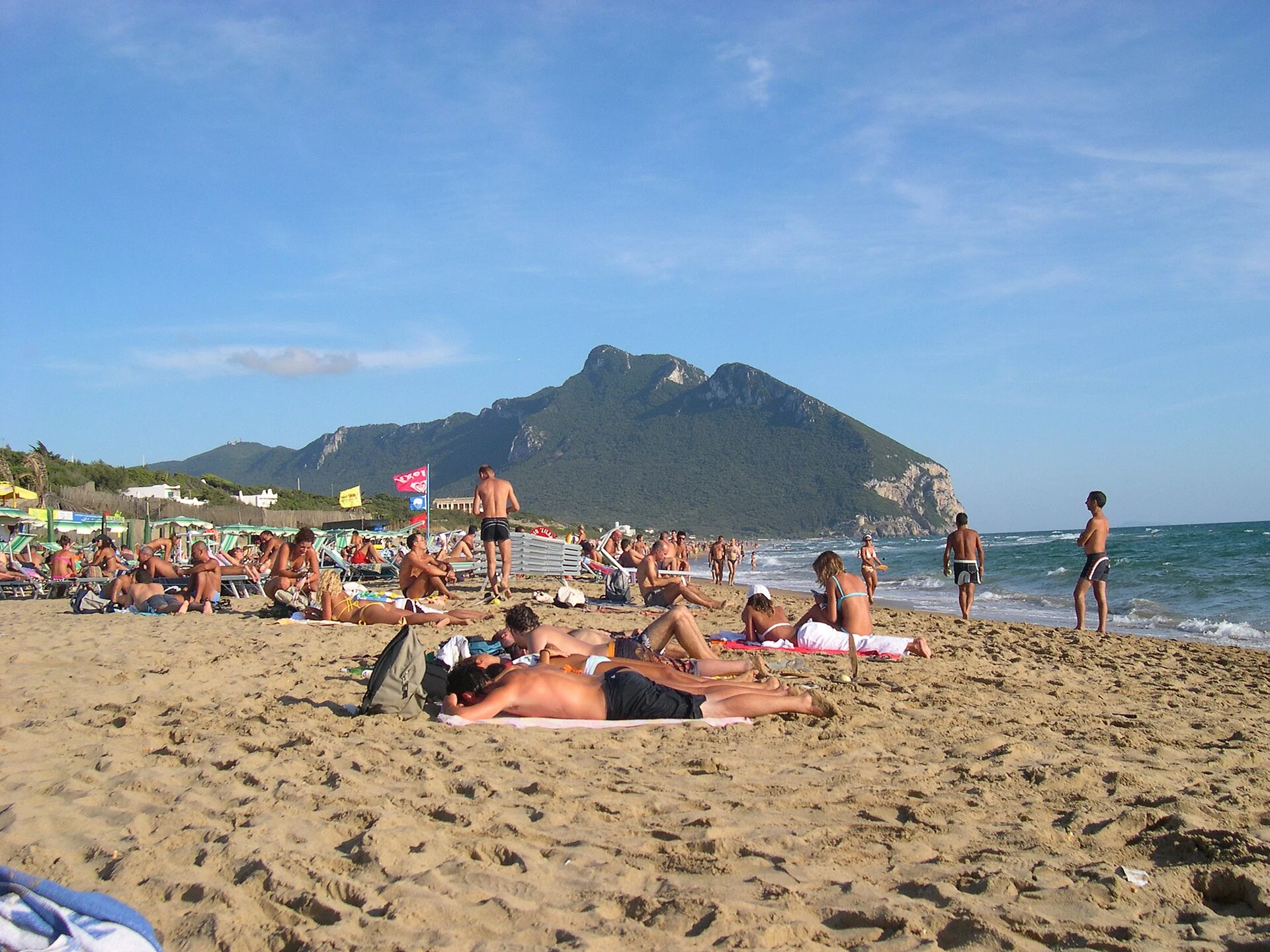
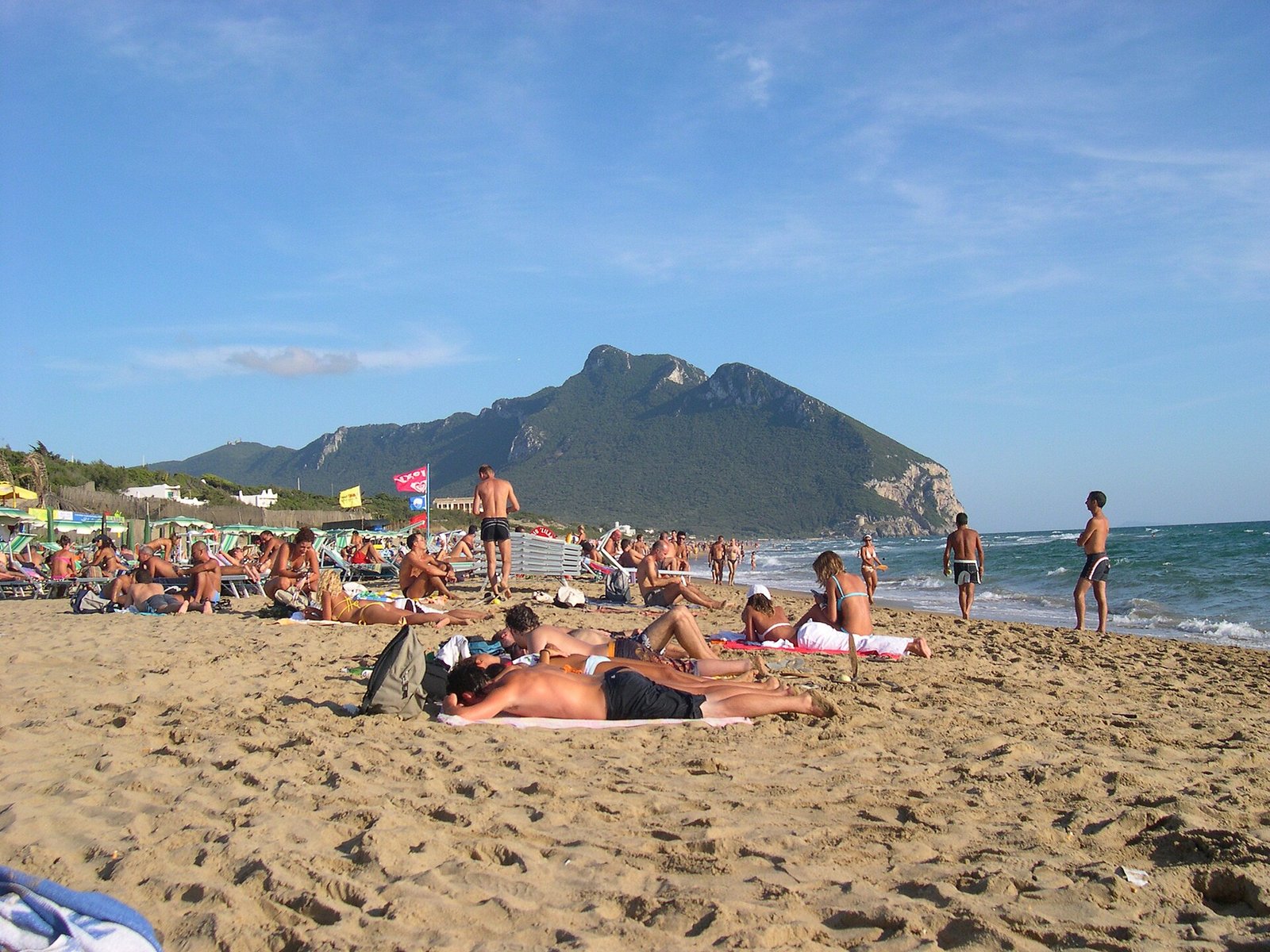
Sabaudia is a city built from scratch between 1933 and 1934 on the dune that divides the sea from Lake Paola, and from Rome you can go and come back in a day without effort. 109 kilometers of road, a little over an hour by train to Priverno-Fossanova plus a bus, or barely two hours on the Pontina if you leave early. The center is small and you walk around it in an hour.
What stays with you after the visit, though, is not the center. It's the relationship among three things that in Rome you never see together: a founding-era city of the 1930s still readable in its layout, a coastal lagoon almost seven kilometers long with an imperial villa inside it, and 22 or 25 kilometers of sandy dune inside a national park established in 1934.
What Sabaudia Is and Why You Go
Sabaudia is the municipality of about 20,000 inhabitants that occupies the central strip of the Pontine coast, in the province of Latina, with the town hall at Piazza del Comune 1. It was born as the second city wanted by the Fascist regime in the reclaimed Pontine marshes, after Littoria, today Latina. The difference from the other founding-era cities is that here the urban layout and the individual buildings have come down almost intact to today.
The municipal territory is wide. It includes the urban center, the state forest, a good part of Lake Paola, the coastal dune with its free beaches and a substantial slice of the Circeo National Park, whose administrative seat Sabaudia hosts. That's why a day here can be spent in very different ways, from the museum to bird watching.
Whoever arrives expecting some ordinary seaside town is thrown off. The houses are white, low, with sharp corners and ribbon windows. The central square is enormous relative to the number of inhabitants, and the 42 meter civic bell tower can be seen from kilometers away along Migliara 53, the road that cuts through the forest and leads into town. The effect, in the height of August as in January, is that of a place designed for a crowd that isn't there.
The best seasons are spring and autumn. In summer Sabaudia is a seaside place like many, with traffic on the waterfront and full parking lots. From October to May it's another city: you cross the square diagonally without meeting anyone, the lake is full of birds, and the dune has that low light you never see in summer.
A Curiosity about Sabaudia
The figure everyone repeats about Sabaudia is 253 days of construction. The count works, but only if you take as endpoints August 5, 1933, the day the first stone was laid, and April 15, 1934, the day of the inauguration. Between the two dates exactly 253 days pass. Some sources write 254 because they also count the first day.
The divergence is minimal and says more than it seems. That figure works as a slogan, not as a construction-site statistic. It was constructed after the fact, polished by the newsreels and repeated for 90 years. The competition notice had come out on April 21, 1933, the winning group was announced in the summer, and the city inaugurated in April was a civic center with a few finished buildings, not the city you see today.
The winning group was made up of four architects: Gino Cancellotti, Eugenio Montuori, Luigi Piccinato and Alfredo Scalpelli. None of the four was yet 40. Piccinato would later become one of the major names of Italian postwar urban planning, and his signature on Sabaudia remains the project that made him known.
Whoever visits Priverno or Sermoneta on the same round understands the difference better. Those are centers layered over 1,000 years. Sabaudia is a single decision taken in a room, drawn in a few weeks and built in less than a year, and you can see this at every intersection.
How to Get to Sabaudia from Rome
The train is the most reliable way. From Roma Termini you take the regional trains of the line to Naples via Formia and get off at Priverno-Fossanova. The trip takes between 51 and 60 minutes depending on the run, with departures roughly every hour during daytime bands, checked against the Trenitalia timetable on September 28, 2026. From Priverno-Fossanova the Cotral regular buses to Sabaudia leave.
This is exactly the route the park authority indicates on its own page How to get there: Rome-Naples line via Formia, stop at Priverno-Fossanova, connection with the Cotral bus. The station, it must be said right away, is in the middle of the countryside and is not Sabaudia. The transfer exists and has to be factored in.
The Direct Bus from Rome
The alternative is the bus from the Cotral terminal at Eur Fermi, on Metro Line B. From there leave connections to the Sabaudia terminal, some direct and others with a change at Latina. The urban terminal of Sabaudia is about a kilometer from the park's Visitor Center, and the runs that continue to San Felice Circeo or Terracina pass along Via Carlo Alberto with a request stop in front of the entrance.
Cotral timetables change between the school period, summer and holidays, and they change often. They should be checked on the official site the day before departure, not a week before. Whoever travels on Sunday will find fewer runs. It's the classic trap of those who organize the beach trip out of season and then are left stranded at six in the evening.
By Car
By car you leave Rome on the SS 148 Pontina toward Latina, continue on the Mediana bypass toward Terracina and leave the state road at the turnoff for Sabaudia, taking Migliara 53, which crosses the state forest to the built-up area. Two hours with normal traffic. On a summer Sunday the Pontina on the way back to Rome in the late afternoon is a long, stopped line. Go back before 16:00 or after 20:00.
Parking in town is not a problem from October to May. From June to September it is, especially on the waterfront. The paid areas fill up by 10:00 in the morning and wild parking on the dune is fined, rightly, because the dune ridge is protected and every car that crosses it damages it.
Something Nobody Tells You about Sabaudia
Lake Paola is not free public land. It has been privately owned since 1888, when it was bought by the Scalfati family, and this explains the gates, the fenced banks, the accesses that seem arbitrary and the fishing run under concession. The municipality's page on the lake describes the environment and the hydrological data but does not address the question of ownership.
Whoever arrives with the idea of walking around the lake along the shore quickly finds out it can't be done. The perimeter measures 20 kilometers and for long stretches is closed or crosses private areas, farmland, fish-farming plants. The full circuit is done by rowboat or canoe by those who rent on site, and even then the accessible stretches have limits.
The peninsula that stretches into the lake hosts the Villa of Domitian, and that is included in a strict nature reserve area of about 46 hectares. The site is managed by the Superintendency of Archaeology, Fine Arts and Landscape for the provinces of Frosinone and Latina, and for the access arrangements you write to the address of the Sabaudia office. It is not an archaeological area with a ticket office and a turnstile.
The practical point is this: in Sabaudia the most important archaeological piece is not visited by walking in, it is visited by asking. Whoever comes for the imperial villa without writing first sees a wooded peninsula from the other shore and nothing else. Better to know it the week before than on Saturday morning.
The Founding: Dates, Designers, Construction Site
The national competition for the master plan of the new city was announced on April 21, 1933. It was won by the group made up of Gino Cancellotti, Eugenio Montuori, Luigi Piccinato and Alfredo Scalpelli, with a layout organized on two main roads perpendicular to each other and a very high share of public green space relative to the total area, around 10 percent.
The laying of the first stone was on August 5, 1933. The official inauguration was on April 15, 1934, in the presence of Mussolini. The name comes from the House of Savoy, and the choice was anything but neutral: it served to tie the monarchy to the reclamation enterprise, at a moment when the regime was building its own narrative of land wrested from the marsh.
What Was Really There on April 15, 1934
On the day of the inauguration the city delivered was the civic nucleus: the town hall with the tower and the arengario, the arcade of the square, the main public buildings, the first homes. The church of the Santissima Annunziata, designed by Gino Cancellotti, dates from 1935, so it came later. The Post Office building bears the signature of Angiolo Mazzoni, the engineer-architect of the Ministry of Communications who in those years designed stations and post offices all over Italy.
The official sources consulted do not report a certain number of workers employed on the construction site, and the figures that circulate on popular sites differ greatly from one another. On this, caution is advisable: the propaganda of the time inflated numbers as a trade, and serious historiography prefers not to use them without documents.
The Architectural Debate of 1934
Sabaudia arrives in the middle of the Italian battle between Rationalist architecture and regime monumentalism. The white, squared city, without columns or triumphal arches, was attacked by those who considered it foreign, northern, not very Italian, and defended by those who saw in Rationalism the only possible architecture for its time. The debate ended up in the newspapers and never really closed.
Anyone who knows EUR understands the difference in temperature at once. Eur, designed a few years later, goes back to marble, to the arch, to declared symmetry. Sabaudia remains white plaster and pure volumes. Between the two, the most modern is the oldest, and this is one of the reasons architects still come here today. A comparative walk between Eur in Rome and Sabaudia is worth a course.
The Pontine Reclamation, No Discounts
The integral reclamation of the Agro Pontino is the operation that makes Sabaudia possible, and it has to be told in full. Attempts to drain the marshes had begun centuries earlier. The 1700s works of Pius VI along the Appia are the best known, and the Pontine reclamation Consortium was already working from the 1920s. The Fascist regime inherits open construction sites, speeds them up and takes the whole credit.
The body that leads the operation is the Opera Nazionale Combattenti, which digs canals, builds pumping stations, assigns farms and farmhouses. The settlers come mainly from Veneto, Friuli and Emilia, entire families moved by train to a land they didn't know, where malaria still killed. Conditions in the first years were very harsh and mortality high.
What the Propaganda Didn't Say
Malaria was not defeated by the reclamation. It was reduced by the draining, then returned with violence during the Second World War, when the retreating Germans deliberately flooded part of the plain, and it was ended only after 1945 with DDT disinfestation campaigns and systematic prophylaxis. The regime's narrative stops at 1939 because the hard part comes afterward.
The Documentation Center on Education and Health in the Pontine Marshes, inside the forest at the Cocuzza locality, is the place where this story is read without rhetoric. It gathers documents on the first teachers, the first doctors and the fight against the anopheles mosquito, inside one of the few masonry buildings that predate the reclamation. Free admission, open every morning on weekdays according to the park authority, data checked on September 28, 2026.
Whoever wants the full museum version of this story will find it at the Pontine Land Museum in Latina, which documents the arrival of the settlers, the farm tools, the houses of the Opera Nazionale Combattenti. It's the visit I recommend to those coming back a second time, because it changes the way you look at the same roads.
How to Tell It
There's no need to pretend nothing happened or to moralize. I say three things: that the reclamation was a real public work that changed a malarial plain forever, that it was used as an instrument of consensus by a dictatorship, and that the two statements stand together without canceling each other. Whoever tells it only as propaganda gets the facts wrong. Whoever tells it only as progress gets the history wrong.
Then the square: notice where the arengario looks, the balcony from which the crowd was addressed. The urban layout of Sabaudia is not neutral: it provides for a gathered public, an authority speaking from above and a tower that can be seen from afar. Rationalist architecture here served a specific power, and recognizing it takes nothing away from the quality of the design.
The Advice I Give You for Visiting Sabaudia
Come on a weekend between October and May and organize the day the opposite of how everyone does. First the lake and the dune early in the morning, when the light is low and the water birds are moving, then the center after lunch, when the civic tower and the municipal museums are open. Whoever does the reverse route finds the city closed and the dune backlit.
The civic tower, named after Dante, opens only on Saturday and Sunday. From October to May from 10:00 to 13:00 and from 16:00 to 19:00. In June and September from 10:00 to 13:00 and from 17:30 to 20:30. In July and August from 19:00 to 23:00. Hours published by the Municipality of Sabaudia and checked on September 28, 2026. If you arrive midweek, the tower stays closed: it's the most frequent disappointment.
The Museo Emilio Greco, on the ground floor of the town hall, opens Tuesday to Sunday with hours that change by season: from October to May 16:00 to 19:00 on weekdays and 10:00 to 13:00 with 16:00 to 19:00 on weekends, in June and September afternoons 17:30 to 20:30, in July and August only in the evening 19:00 to 23:00. The Museo del Mare e della Costa Marcello Zei has its own hours, different again.
The park's Visitor Center, at Via Carlo Alberto 188, opens all year from 9:00 to 15:00 with free admission. It's the first place to send anyone who arrives without a plan, because there you understand in half an hour how the territory is laid out and which trails are open. Telephone 0773 511385. From there to the city center you can walk.
The contrary position I hold
Against almost every guide, I say that in Sabaudia the beach is not the main attraction. The beach is long, sandy and wide, and in August it's a crowded stretch of coast like many others in Lazio, with lines along the seafront and queues for parking. Anyone who comes from Rome just to swim spends three hours traveling for a sea they can find closer to Capocotta.
What you can't find anywhere else is the combination of lake, dune and lowland forest within the same five-kilometer radius, plus an intact 1930s town. If you spend the whole day under a beach umbrella, you've gone 109 kilometers for the least rare thing there is. It makes sense to focus on the dune and the forest, and to stay in the water an hour at most.
I'll add a second uncomfortable opinion: the stretch of seafront built in the 1960s and 1970s did more damage to the dune than the land reclamation ever did. The buildings on the dune ridge interrupted a system that depends on continuity, and today public money is being spent to fix urban planning choices made in a hurry, when mass tourism seemed like a promise with no consequences.
Lake Paola, numbers and constraints
Lake Paola, also called Lake Sabaudia, is the southernmost of the four coastal lakes of the Pontine area. The data published by the Municipality of Sabaudia describe it as 6.7 kilometers long, with a surface area of about 400 hectares, a perimeter of 20 kilometers, a volume of around 14 million cubic meters and an average depth between 4 and 4.5 meters.
On the maximum depth the sources diverge. The Municipality indicates points of about 10 meters in the Molella trench. The Treccani Encyclopedia, in its entry on Sabaudia, gives 15 meters. The difference probably depends on when the surveys were done and on the points measured, and neither source explains its method. If you want the certain figure, ask the park authority.
How it connects to the sea
A dune about 200 meters wide separates the lake from the Tyrrhenian Sea. The water exchange happens through two channels. To the south is the mouth of Torre Paola, at the foot of the promontory, which is the channeled link that already existed in Roman times and was restored in 1721. To the north is the mouth of the Caterattino, dug during the twentieth-century land reclamation. The lake has five inlets called arms, remnants of ancient watercourses.
This double mouth explains the salinity and the life of the lake. The water is brackish, and the extensive farming of the clam known as vongola verace along the shores is the most important economic activity, together with fishing with nets and with the lavoriero, the fixed trap that takes advantage of the movements of fish between lake and sea. If you pass by boat you see the poles and the nets. They are working equipment, not decoration.
Morandi's bridge
The bridge that crosses the lake, on the road to the sea, was built in 1963 and 1964 to a design by the engineer Riccardo Morandi, the same man behind the Genoa viaduct that collapsed in 2018. Here the structure is different and much simpler, but the name remains, and people who work in structural engineering look for it. It's also the point with the best view of the lagoon.
The environmental problem nobody tells tourists about
Until 1980 the pollution load of the lake consisted largely of the sewage of Sabaudia and the discharges of some livestock farms. Since 1980 the sewage has been diverted and treated before being discharged into the sea, and today what ends up in the lake is the town's stormwater and that of the catchment basin. The memory of that phase still weighs on the quality of the water.
Add to this that the supply of fresh water from the springs has dropped because groundwater is drawn for irrigation. A coastal lake with less fresh water coming in becomes saltier and more fragile. Anyone looking at the lagoon from the bridge sees a calm sheet of water. What you don't see is a hydraulic balance held together by canals and sluice gates.
For a useful comparison, just go 20 kilometers north, to Lake Fogliano, where the shores are largely public and use is organized by the park authority. The difference between the two basins tells of two management models, and it's no accident that birdwatching works better at Fogliano.
Circeo National Park: what you really visit
Circeo National Park was established by law 285 of January 25, 1934, and reorganized by law 179 of July 31, 2002. Its land area is 8,917 hectares, spread over the municipalities of Latina, Ponza, Sabaudia and San Felice Circeo. The code in the official list of protected areas is EUAP0004. The headquarters is in Sabaudia, at Via Carlo Alberto 188.
The protected environments are five and they should be kept distinct, because they are visited in different ways: the coastal dune, the lowland forest, the wetlands with the four lakes, the Circeo promontory that rises to 541 meters, and the island of Zannone, which entered the park in 1979. One day is not enough for all five, and anyone who tries sees nothing.
The Visitor Center and the park museum
The Visitor Center at Via Carlo Alberto 188 houses a natural history museum of about 350 square meters that welcomes more than 10,000 visitors a year. The display is educational and interactive, designed to introduce the five environments before you head out into the territory, and it also includes a small library that can be consulted by phone reservation.
Open year-round from 9:00 to 15:00, free admission, phone 0773 511385, data published by the park authority and checked on September 28, 2026. The schedule is awkward for anyone who arrives late: it closes at three in the afternoon, so it has to go in the morning. Many people stop by on their way out and find it closed.
The state forest
The Circeo forest is the largest natural lowland forest left in Italy, with an extent of around 3,300 hectares. You can go through it on foot and by bike on marked trails, with equipped areas for a packed lunch, except for three strict nature reserve zones that stay closed to the public. In the Cerasella area there is a wildlife enclosure with fallow deer and wild boar.
Anyone who arrives in summer and heads straight for the sea doesn't imagine that three kilometers away there is a forest of oaks and ash trees with seasonal pools of water, the piscine, where amphibians breed. In spring it's the most interesting place in the park and there is almost nobody there. Wear closed shoes and bring repellent, because the mosquitoes are still here, even if they no longer carry malaria.
The wetlands and the birds
The four coastal lakes, Paola, Caprolace, Monaci and Fogliano, together with the seasonally flooded areas, form the most important marsh complex in Italy, declared a Wetland of International Importance under the Ramsar Convention. The park lies on major migration routes: more than 260 species of waterbirds populate these bodies of water in spring and autumn.
For birdwatching you need little: binoculars, a field guide and the patience to stay still. The good months are October to March, and the good hour is the first of the morning. Anyone who arrives at noon in August sees water and nothing else, and then writes that there was nothing. Birdwatching done wrong produces wrong reviews.
The Borgo di Fogliano
The Borgo di Fogliano, in the municipality of Latina, is a complex of historic buildings from the late 1700s, long a possession of the Caetani family, who also created a botanical garden there with species from half the world. Inside the village there are an environmental education lab on wetlands and an ornithological museum. The inner route can be visited only by reservation, by contacting the park management, while the rest of the area is freely accessible.
The Caetani are the same family as the Ninfa Garden and the Sermoneta castle. Anyone who puts Fogliano, Ninfa and the reclaimed plain in sequence understands how a single family shaped the Pontine landscape for centuries, before the State reshaped it in the 1930s.
The dune, the beaches and the rules nobody reads
The park's coastal dune develops in a crescent from the limestone slopes of the promontory northward to Capo Portiere. On the length the sources don't agree: the park authority says 25 kilometers, other informational sheets say 22. The dune ridge reaches 27 meters in height in some places, and it is also protected by European legislation.
The seaward side hosts halophytic vegetation, adapted to the salty wind. The inland side is covered by Mediterranean scrub. A road runs along the top, and the stretch at the Monaci lake can only be traveled on foot or by bike. The wooden walkways are not a whim: they serve to stop continuous foot traffic from destroying the plants that hold the sand together.
Which beaches and by what criterion
The beaches of Sabaudia are long, wide and sandy, with a still significant share of free shoreline. The Bufalara beach is the one inside the park with access from the pine forest, and it remains the most frequented by people looking for sand without services. At the far south is the Torre Paola beach, below the promontory, with the coastal tower and the mouth of the canal.
Going south you enter the territory of San Felice Circeo, with a different character: rocks, small coves, a medieval old town on the promontory. To the north instead you reach the Lido di Latina and the Rio Martino seafront, where the coast becomes more built up and less interesting.
The criterion for choosing is trivial and it works: look at the wind. With an offshore wind the sea at Sabaudia is flat and clear. With the scirocco the sand rises and the water turns murky for two days. Just look at a decent forecast the day before, instead of setting out blind and then complaining about the dirty sea.
The rules that really apply
Inside the park you don't light fires, you don't pick plants, you don't leave the marked trails, and dogs must be kept on a leash, with dedicated routes indicated by the authority. On the dune you walk on the walkways. These are elementary rules that are constantly ignored in summer, and the fine comes more often than people think.
A note on trash: the free beaches don't have organized collection like the beaches under concession. What you bring, you take back. Anyone who leaves the bag next to the full bin thinking they've done the right thing has done the wrong thing, because the night wind opens it and spreads it over the dune.
Another well-known fact, yet rarely cited
Sabaudia is the second of the Pontine founding cities, and many people know that. What is cited less is the complete sequence, which helps to understand the project: Littoria in 1932, Sabaudia in 1934, Pontinia in 1935, Aprilia in 1937, Pomezia in 1939. Five cities in seven years, each with a different layout and a different architect.
Sabaudia is the only one of the group where the rationalist language is applied consistently from the urban layout down to the details of the public buildings. The others swing between modernity and a return to order, and some were largely rebuilt after the bombings of World War II. Aprilia was almost leveled in 1944, during the fighting that followed the landing.
That is why Sabaudia became the case study: not because it was the best, but because it is the most legible one left. Anyone who wants to understand how an Italian city was built in the 1930s finds here the least tampered-with example. The preservation, in this case, is the result of its out-of-the-way position and the lack of building pressure in the historic center.
The link with the 1944 Allied landing can be touched by going to Anzio and Nettuno, 60 kilometers farther north, where the Museo dello Sbarco reconstructs the months of fighting that turned the newly reclaimed plain into a front.
What to visit in town
The center of Sabaudia can be walked in a little under an hour, and that's an advantage for anyone arriving without a car. Everything that matters is around Piazza del Comune: the town hall with the civic tower and the arengario, the portico, the church of the Santissima Annunziata, the post office building, and the municipal museum spaces.
The civic tower, called Torre di Dante
The tower is 42 meters tall and is the symbol of the city. It stayed closed for more than 10 years and reopened on April 13, 2025, after a redevelopment that also covered the arengario and the portico, funded by the Ministry of Culture. You go up by elevator to the top and come down on foot along the stairs.
On the way down you pass through a permanent exhibition of paintings by the maestro Lorenzo Indrimi dedicated to the three canticles of the Divine Comedy, which gives the tower its name, Torre di Dante. The view from the top is the real reason to climb: you see at once the orthogonal layout of the town, the lake, the dune and the outline of the promontory. Open only on Saturday and Sunday.
The Museo Emilio Greco
The Museo Emilio Greco was established in 1985 after the donation of some works by the Catania-born sculptor to the town, and it is the first Italian museum dedicated to the artist. It occupies the ground floor of the town hall and was renovated and expanded by Giulio Savio in 2001. The collection exceeds 100 works among sculptures, prints, engravings, coins, medals and archive materials.
The chronological span covered runs from 1947 to 1984. Among the pieces on display are the Central Door of Orvieto Cathedral from 1962, the Grande Bagnante N.1 from 1956 and Maria Baldassarre from the same year. Inside you can also consult the artist's private archive, with period photographs, catalogs, writings and poems from his local studio.
30 minutes are enough for a careful visit. Even those who don't know Greco recognize him: his elongated female figures, with long necks and small heads, are among the most reproduced Italian sculptures of the second half of the twentieth century, and the Orvieto door is his best-known public work.
The Museo del Mare e della Costa Marcello Zei
The civic sea and coast museum is dedicated to Marcello Zei and collects natural history materials tied to the marine and coastal environment. Its hours are the most complicated among the municipal facilities: from September 16 to May 31, Tuesday to Friday 10:00-12:00 and 15:30-17:30, Saturday 14:30-18:30, Sunday 9:30-13:30. From June 1 to September 15, Tuesday to Friday 10:00-12:00 and 17:00-19:00, Saturday and Sunday 16:00-20:00.
The practical advice holds for all three municipal facilities: the Municipality publishes the seasonal hours, but actual openings depend on the staff available. A phone call to the Municipality's switchboard, 0773 1849001, before leaving Rome, saves you a wasted trip. Monday is the worst day by far: almost everything is closed.
The church of the Santissima Annunziata
The church dates from 1935, designed by Gino Cancellotti, one of the four authors of the plan. The interior is essential and the light comes in from high openings. Anyone expecting a Roman Baroque church is puzzled for five minutes and then understands that this is the point: here rationalism takes on a theme that in Italy had 1,500 years of codified solutions, and tries to redo it from scratch.
The right photo to take in Sabaudia
The photo that works is only one and it isn't the square: it's the civic tower seen from the lake shore, with the water in the foreground and the white volume rising out of the trees. You take it from the lakefront on the side of the town, in the late afternoon, when the sun comes from the west and lights the front of the tower instead of putting it against the light.
The second good shot is taken from the bridge over the lake looking toward the Circeo promontory: lagoon, dune, sea and the mountain at 541 meters in the same frame. It's the geographic summary of the whole area in one photo. You need a clear day, because in the summer haze the promontory disappears into the white.
From the top of the tower, instead, the best photo is toward the interior, not toward the sea: the orthogonal layout of the town with streets crossing at right angles and the forest closing the horizon. It's the image that explains the 1933 plan better than any caption. Wide-angle lens or a phone with a wide lens, because the space is tight.
What to avoid: the backlit photo of the tower at 11 in the morning, which is the one everybody takes and always comes out gray, and close-ups of the rationalist buildings taken from below, which squash the proportions. These volumes should be photographed from the front and from a distance, because the design works on the relationships between solids and voids.
Light and the seasons
From November to February the low sun works in your favor all afternoon and the white plaster takes on a warm light that you never get in summer. In July and August the only useful window is between 19:00 and sunset, which coincides with the tower's evening hours. The rest of the day is flat light and blown-out white.
Some important events that happened here in history
On August 5, 1933 the first stone of the city was laid, on land that until a few years earlier was marsh and scrub. On April 15, 1934 the city was inaugurated by Mussolini in front of a crowd brought in from elsewhere for the occasion. Between those two dates pass the 253 days that became a slogan, and construction continued for years after the ceremony.
On January 25, 1934, three months before the inauguration, law 285 established Circeo National Park. The simultaneity of the two decisions says a lot: while the marsh was being drained, a decision was also made to save a portion of it, a choice that at the time was anything but obvious and that deserves to be acknowledged regardless of who made it.
The war
Between 1943 and 1944 the Pontine plain goes back 20 years. The retreating German troops damage the drainage pumping plants and deliberately reflood large reclaimed areas, with the effect of bringing malaria back among a population that had lost its immunity. The Allied landing at Anzio in January 1944 turns the plain into a front for months.
Sabaudia suffers less damage than Aprilia, which is almost destroyed, and this is one of the reasons why its layout has come down intact to today. In the postwar period the reclamation is rebuilt, malaria is definitively ended with disinfestation campaigns, and the Pontine plain becomes one of the most productive agricultural areas of Lazio.
The second half of the twentieth century
Between 1963 and 1964 the bridge over the lake designed by Riccardo Morandi is built, which connects the town to the dune and opens the phase of beach tourism. From there the development of the seafront begins, which in the 1970s comes to occupy stretches of the dune ridge, with environmental consequences that are still being paid for.
In 1979 the island of Zannone becomes part of Circeo National Park, extending the protected area to a stretch of sea and an island of the Pontine archipelago. Anyone who wants to see it leaves from Ponza, because there is no direct connection from Sabaudia, and the same goes for Palmarola, which is not part of the park but belongs to the same archipelago.
In 1980 the sewage that until then ended up in the lake is diverted and treated, a decisive step for the quality of the water. In 1985 the Museo Emilio Greco is born, after the sculptor's donation. In 2002 law 179 reorganizes the structure of the national park.
Recent years
In April 2025 the civic tower reopens after more than a decade of closure, with the ribbon cutting on April 13 in the presence of mayor Alberto Mosca and superintendent Alessandro Betori. The work, funded by the Ministry of Culture, also covered the arengario and the portico, and gave the city back its most recognizable element.
In the same month of April, the celebrations of the 90th year since the inauguration close, with three days of events starting on April 11. The next appointment is the centenary in 2034, and the city gets there with a substantial part of its 1930s building stock still to be restored.
Who passed through Sabaudia
Pier Paolo Pasolini is the name that weighs the most. In a television appearance in 1974 filmed right here he argued a contrarian thesis: the architecture of Sabaudia was not Fascist, and what he recognized in it was rather the character of a rural and provincial Italy that the regime had not managed to erase. That position is still today the starting point of every discussion about the town.
Alberto Moravia had a house on the sea here and spent long working periods in it, and the same is true of part of the Roman literary world between the 1960s and the 1980s. For two decades the Sabaudia coast was the vacation place of an intellectual bourgeoisie that saw each other every day in Rome and kept seeing each other here, on a different schedule.
Emilio Greco, a Catania-born sculptor trained as a stonecutter's apprentice, tied his name to the town with the 1985 donation that gave rise to the first Italian museum dedicated to him. Angiolo Mazzoni, author of the post office building, and Riccardo Morandi, author of the bridge over the lake, complete the list of designers who left a recognizable piece of work here.
High-level rowing and canoeing have been trained on Lake Paola for decades, because the body of water is long, sheltered from the sea wind by the dune, and free of motor traffic. Anyone who arrives at dawn in winter sees boats training on the empty lake. It's one of the reasons why getting up early is worth it.
And then, of course, the settlers passed through. Thousands of Venetian, Friulian and Emilian families transferred here between 1932 and 1939 by the Opera Nazionale Combattenti, whose surnames you can still read on the doorbells and on the signs of the farms in the area. They are the human group that made this plain, and they rarely appear in guides.
Eating in the area
Sabaudia has two dining zones with opposite logics: the center, which works year-round on residents too, and the seafront, which from June to September works almost only on vacationers and for the rest of the year largely closes. The average quality is higher in the center and the price difference goes in the same direction.
The signs that tell you to change street are always the same. The menu with photographs of the dishes is the first: photographing the food serves someone who has to sell to someone who will never come back. The woman rolling out pasta in the window or on the sidewalk is theater, not cooking, and it's a staging that arrived here too from the historic centers of the art cities.
The second sign is the person at the entrance who invites you to sit down as you walk by. A place that does well on a summer evening doesn't need to stop you in the street, it needs you to book. The third is continuous hours from morning to night with no break between services: a real kitchen stops in the afternoon, because it has to clean, tidy up and prepare dinner.
The fourth sign concerns the places set in front of the best views, on the seafront and near the bridge over the lake. There the price adjusts to the customer: menu items with no price written, fish sold by weight without anyone telling you the weight before cooking it, price lists that change between the indoor room and the outdoor tables. Asking for the itemized bill before ordering is not rude, it's normal administration.
On the chains with a repeated sign, the ones you recognize in 10 different cities, my position is without snobbery. They work as a tourist attraction, offer the same product everywhere at a predictable price, and for certain travelers that has value. The point is another: residents don't go there, and so they say nothing about the place where you are. If you have only one meal available, spending it there means giving up on getting to know the area.
The criterion is one and it applies here too. I look at who is sitting at the tables and in what language they order. If at half past eight in the evening in low season there are local families inside speaking Italian with a Pontine accent, the place holds up. If at half past seven they are all foreigners with a camera around their neck, the kitchen is calibrated for a passing customer.
One last thing on local products. The vongola verace of Lake Paola and the lagoon fish are the things that really make sense here, together with the artichokes and the buffalo mozzarella of the Pontine plain, which has been buffalo-breeding land for a century. Asking where it comes from is legitimate, and the answer, or the embarrassment that precedes it, tells you everything you need to know.
To get your bearings without going at random, Daniele's personal list of checked places in Rome and Lazio is public: the selection on Google Maps. Use it as a starting point and update it with your own head, because management changes and a list two years old is worth little.
A day trip from Rome, well organized
Leave from Termini on the regional train at around 8, arrive at Priverno-Fossanova around 9, take the Cotral bus and arrive in Sabaudia between 9:45 and 10:15 depending on the connection. First stop is the park Visitor Center on Via Carlo Alberto, which closes at 15:00 and has to be done right away. Half an hour inside, free, and you come out knowing where you are.
From 10:45 to 13:00 a walk: lakefront, the bridge over the lake for the view of the promontory, and a stop on the dune if the day is good. Lunch in the center between 13:00 and 14:30. Afternoon devoted to the town: civic tower if it's Saturday or Sunday, Museo Emilio Greco, the square, the church of the Santissima Annunziata, the post office building.
Return to Rome with the bus toward Priverno-Fossanova in the late afternoon and a train in the evening, or the direct Cotral toward Eur Fermi. If you have a car, you can extend the day with a detour to the Fossanova Abbey, which is a few minutes from the station and closes the circle between Cistercians and rationalists in the same day.
The variants I suggest most often
Archaeological variant: Sabaudia in the morning and in the afternoon Privernum with the Priverno museums, which are close to the train station and so convenient for anyone returning by train. It's the combination that works best without a car, because everything revolves around the same hub.
Medieval variant: Sabaudia plus the historic center of Priverno, or the climb to Norma and Bassiano, the two villages overlooking the plain from the Lepini Mountains. From up there you see the geometry of the reclamation from above: straight canals, regular farms, the line of the dune in the background. It's the geography lesson that no information panel can give.
Coastal variant: Sabaudia in the morning and Sperlonga in the afternoon, with the Villa of Tiberius and the archaeological museum. It's 50 kilometers along the coast and you need a car, but the contrast between the white medieval village and the white city of 1934 is the kind of pairing that stays in your mind.
Long variant for those with two days: add Terracina with the temple on the mountain, or go down toward Gaeta and the Sant'Agostino beach. With two days you can also devote a whole morning to the forest and the wetlands, which is what the park would always deserve.
What I would leave out
I would leave out the attempt to see the Circeo promontory and Sabaudia in the same afternoon without a car. The connections between the two centers exist but are few, and the risk of being left on foot is real. I would also leave out the idea of doing the full loop around the lake: it can't be done on foot and anyone who tries ends up in front of a gate.
Frequently asked questions
Can you get to Sabaudia from Rome without a car?
Yes, in two ways. The Rome-Naples regional train via Formia stops at Priverno-Fossanova in 51 to 60 minutes from Termini, and from there Cotral buses leave for Sabaudia. Alternatively there are Cotral buses from the Eur Fermi terminal, direct or with a change at Latina. The Sabaudia terminal is about one kilometer from the park Visitor Center. Check the schedules the day before.
How much time do you need to visit Sabaudia?
A full day is enough for the center, the lakefront and a stretch of dune. The town center alone can be walked in an hour and a half, museums included. To add the state forest, the wetlands and a serious visit to the park you need two days, and anyone who also wants the Circeo promontory and Punta Rossa has to allow a third day.
Is the civic tower open every day?
No. The civic tower, named after Dante, opens only on Saturday and Sunday, with hours that change by season: 10:00-13:00 and 16:00-19:00 from October to May, 10:00-13:00 and 17:30-20:30 in June and September, 19:00-23:00 in July and August. Data published by the Municipality of Sabaudia and checked on September 28, 2026. It's best to call the switchboard, 0773 1849001, before leaving.
Can you swim in Lake Paola?
The lake is a brackish lagoon largely in private ownership, with fenced shores, fish farming facilities and limited access, and it doesn't work as a body of water open to the public for swimming. If you want the water, go to the dune, where the open sea is 200 meters from the lake. On the lake, canoeing and rowing are practiced instead, which is a different activity altogether.
Can you visit the Villa of Domitian?
Not with a ticket office and free entry. The site is on the lake's peninsula, inside a strict nature reserve area of about 46 hectares, and is managed by the Soprintendenza Archeologia, Belle Arti e Paesaggio for the provinces of Frosinone and Latina. Access arrangements have to be agreed by writing to the Superintendency's Sabaudia office, well in advance.
What is the best time of year to come?
From October to May for the town, the architecture, birdwatching and the forest. June and September for anyone who also wants the sea without the August crowds. July and August remain the worst months for understanding the place and the best only for the beach, with lines on the Pontina road on the way back and parking impossible to find after 10 in the morning.
Is Sabaudia good for kids?
Very, as long as you focus on the park and not on the museums. The Cerasella wildlife area, inside the forest, has an enclosure with fallow deer and wild boar. The forest trails are flat and suitable for bikes, and the walkways over the dune are popular. In town the Museo del Mare e della Costa works better than the sculpture museum, which asks for attention and silence.
What pairs well with Sabaudia on a two-day trip?
Inland, the Lepini Mountains, with Cori and its museum of the town and the territory, or Sermoneta with the ceramics museum and Bassiano with the Museo delle Scritture. Toward the sea, the northern coast with Torre Astura and the grove that surrounds it.
Does the national park have an entrance ticket?
No. Circeo National Park is a protected area with free access on the open trails, and the Visitor Center at Via Carlo Alberto 188 has free admission with hours of 9:00-15:00 year-round. Three strict nature reserve zones in the forest remain closed, and some visits, such as the inner route of the Borgo di Fogliano, are made only by reservation by contacting the management.
Who wrote this page
This page is edited by the team of Tour Leader Pro, the Rome-based organization that designs and coordinates visits, itineraries and cultural events in Rome and Lazio. The hours, contacts and access conditions given here were checked on the date stated in the text, September 28, 2026, against the official sources of the Municipality of Sabaudia and the Circeo National Park Authority. They should be rechecked before leaving, because seasonal openings change frequently. If you find a piece of information that is out of date, let us know.
Anyone building an itinerary outside Rome who has to make connections work between regional trains and intercity buses, municipal museums with different seasonal hours, archaeological areas that can be visited only on written request and trails that change status with the season, for themselves or for a group, will find on Tour Leader Pro planning tools designed both for those who guide visits as a profession and for those who organize on their own.
For the general picture on rail and road connections, rentals, airports and destinations in Lazio beyond the center of Rome, from the Castelli to the lakes down to the Pontine coast, a useful resource is Italy Planner.