Published on · updated on
Some links on this page are affiliate links: if you buy through them, Estate Romana receives a small commission, at no extra cost to you. As an Amazon Associate, Estate Romana earns from qualifying purchases.
Free Rome in 3 days is really doable, and without giving up the masterpieces: three Caravaggios in two churches in the center, Michelangelo’s Moses, St. Peter’s Basilica, the Janiculum, the Aventine with its garden overlooking the Tiber. The program divides the city into three areas, one a day: the first day the squares of the center, from the Popolo to Piazza Navona. The second, the Vatican and Trastevere. The third, ancient Rome seen from outside, from the Esquiline hill to the Pyramid. 15 stops, five a day, all with free entry.
There’s one premise, though, that many sites don’t update: some things that cost nothing until a few years ago now have a price. The Pantheon has a ticket, and since February 2, 2026 even getting close to the basin of the Trevi Fountain requires a ticket. In the free Rome in 3 days itinerary we point them out one by one, with the way to avoid them or to get in on the days when they’re free again.
Data checked on October 3, 2026 on the Roma Capitale website (access to the Trevi Fountain), on that of the Direzione Musei nazionali della città di Roma (Pantheon), on the website of the Colosseum Archaeological Park, on that of the Vatican Museums and on the website of the Non-Catholic Cemetery. For churches and basilicas the hours change with religious services: the operator is the authority.
Free Rome in 3 days at a glance
- What: a free Rome in 3 days itinerary with 15 free-entry stops, five a day, grouped by area and almost all doable on foot.
- Day 1: Santa Maria del Popolo, Piazza di Spagna, the Trevi Fountain seen from the square, San Luigi dei Francesi with its Caravaggios and Piazza Navona.
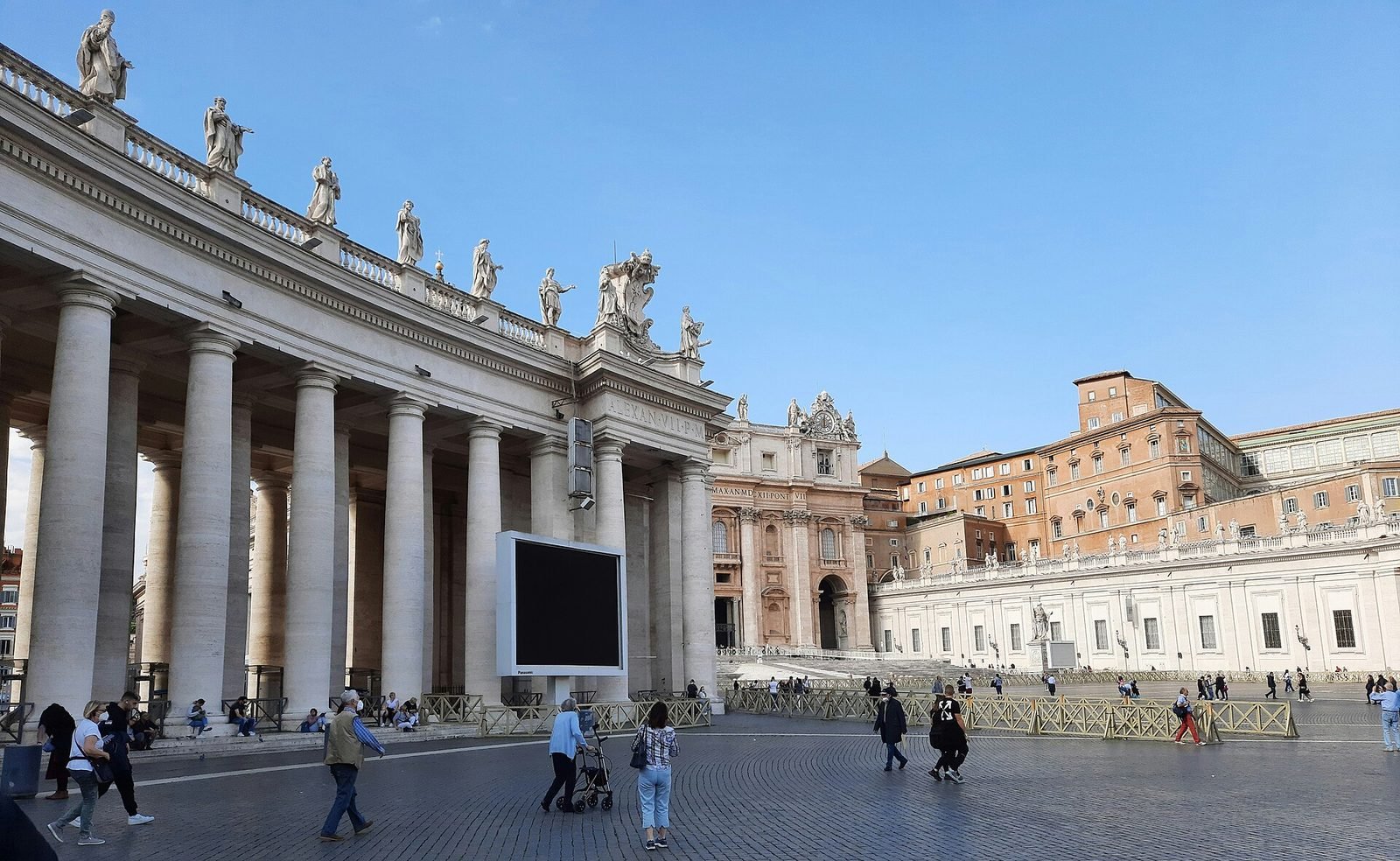
- Day 2: St. Peter’s Square and the basilica in the morning, the Janiculum in the afternoon, Trastevere and the Tiber Island in the evening.
- Day 3: Michelangelo’s Moses at San Pietro in Vincoli, the Circus Maximus, the Bocca della Verità, the Orange Garden on the Aventine and the Non-Catholic Cemetery at the Pyramid.
- What you now pay for: the Pantheon has a ticket of €7, free on the first Sunday of the month. For the area near the Trevi basin you need an entry ticket of €2 for non-residents, while the fountain seen from the square stays free.
- The free Sundays: on the first Sunday of the month the Colosseum, Forum and Palatine and the Pantheon are free. On the last Sunday of the month the Vatican Museums are free, from 09:00 to 14:00.
- Good to know: the water from Rome’s public drinking fountains, the nasoni, is drinkable and free, and the lawns of the Janiculum and the Circus Maximus are the places for a packed lunch.
The free Rome in 3 days program
| Day | Morning | Afternoon | Evening |
|---|---|---|---|
| 1. The squares and the Caravaggios | Santa Maria del Popolo, Piazza di Spagna | Trevi Fountain, San Luigi dei Francesi | Piazza Navona |
| 2. St. Peter’s and Trastevere | St. Peter’s Square, St. Peter’s Basilica | Janiculum | Trastevere, Tiber Island |
| 3. Ancient Rome from outside | San Pietro in Vincoli, Circus Maximus | Bocca della Verità, Orange Garden | Non-Catholic Cemetery, Testaccio |
Save this itinerary to My Trip
The button opens “My Trip” with the 15 stops already loaded day by day. There you add the dates, any tickets and the hotel, and remove the stops you’re not interested in. The program stays on your phone or computer, with no registration.
Day 1: from the Popolo to Piazza Navona, with three Caravaggios and no ticket
You start from
Piazza del Popolo, Flaminio stop on line A. Beside the gate is Santa Maria del Popolo. In the Cerasi chapel, to the left of the high altar, are Caravaggio’s Conversion of St. Paul and Crucifixion of St. Peter. Entry to the church is free. To light the canvases you sometimes need a coin in the light box, and it’s the only expense of the morning.

From the square you climb up to the Pincio for the terrace above the Popolo, 10 minutes of ramps, and continue on the level along Viale della Trinità dei Monti. That way you reach the church of Trinità dei Monti from above and go down the staircase to Piazza di Spagna.

From Piazza di Spagna to the Trevi Fountain it’s 10 minutes through the shopping streets. Here the rule has changed. According to the Roma Capitale announcement, since February 2, 2026 access to the inner perimeter, the area of the steps near the basin, requires an entry ticket of €2 for tourists and non-residents, from 09:00 to 22:00 (Mondays and Fridays from 11:30), with last entry at 21:00. Exempt are residents of Rome and the Metropolitan City, children under six, and people with disabilities with one companion.
The square around stays open to everyone, and after 22:00 the fountain becomes visible up close for free again. The advice, for a free Rome in 3 days itinerary, is to look at it by day from the square and come back late in the evening, when it’s lit and the crowd thins out. Continuing west you pass the Pantheon: today entry is paid, and we talk about it further on.
Two minutes from the Pantheon is San Luigi dei Francesi, the French national church. In the Contarelli chapel, the last on the left, are the three Caravaggio canvases dedicated to St. Matthew, including the Calling. Entry is free, the chapel is always crowded. Go in, wait your turn at the balustrade and watch the light coming from the right in the painting. It’s the high point of the day, and it costs nothing.
The last stop is Piazza Navona, five minutes away. It has the shape of the Stadium of Domitian it’s built on and three fountains, with Bernini’s Fountain of the Four Rivers in the center. Anyone with legs left gets to Campo de’ Fiori in five minutes for an aperitivo.
What to book ahead: nothing. If you’re tired, what to skip: the Pincio. From Santa Maria del Popolo you can go to Piazza di Spagna on the level along Via del Babuino, in a quarter of an hour.
Day 2: St. Peter’s, the Janiculum and Trastevere
The second day opens early in Piazza San Pietro, Ottaviano stop on line A and 10 minutes on foot. With the square still empty, the line at the basilica’s security check is short.
Entry to St. Peter’s Basilica is free. Inside, an hour is enough for Michelangelo’s Pietà, Bernini’s baldachin and the nave. You need appropriate clothing, shoulders and knees covered. The climb to the dome, though, is paid. If you want to do it, you’ll also find it among the dome and underground tours on GetYourGuide. On days of papal audiences and celebrations the square is fenced off and the access points change. The calendar is on the Holy See’s website.
If your trip includes the last Sunday of the month, here’s an opportunity. According to the Vatican Museums website
, every last Sunday of the month the museums open from 09:00 to 14:00, with last entry at 12:30, with free admission, except when it falls on Easter, June 29, or December 25, 26 or 31. In 2026 the next one is October 25. On other days the ticket is bought on the official website, or with priority entry on GetYourGuide.
From St. Peter’s to the Janiculum it’s about half an hour’s walk uphill, or you can take a bus. It’s the widest viewpoint over the historic center, with the domes one behind the other, and it has no hours or tickets. With a picnic blanket and lunch brought from home, the lawn is the nicest dining room of the day. For water there are the nasoni, the cast-iron drinking fountains scattered all over the center. Cover the hole at the bottom with your finger and the water comes out of the little hole at the top.
From the Janiculum you go down to Trastevere by way of the Fontana dell’Acqua Paola. Take the neighborhood without a list. Go into Santa Maria in Trastevere, with the golden mosaics of the apse, then get lost in the side streets. For addresses there’s the Estate Romana restaurant map. To book with the discounts of participating venues there’s TheFork.
You close on the Tiber Island, 10 minutes on foot, the only island in the Tiber in Rome, reached by Ponte Cestio and left by Ponte Fabricio, which is the oldest Roman bridge still in use in the city. Beyond the bridge begins the Jewish Ghetto, to cross in the evening for the Portico of Octavia.
If you happen to be there on a Sunday morning, before going up to the Janiculum you can stop by Porta Portese, Trastevere’s flea market. What to book ahead: nothing, except the dome or the Vatican Museums if you want them. If you’re tired, what to skip: the Janiculum. From St. Peter’s you get to Trastevere on the level, along the Tiber, in 25 minutes.
Day 3: ancient Rome with no ticket, from Moses to the Pyramid
The third day is the longest to walk, and the most varied. You start at San Pietro in Vincoli, Cavour stop on line B. Inside is Michelangelo’s Moses, at the center of the tomb of Julius II, and under the altar the chains that according to tradition bound St. Peter. The church opens early and closes at lunchtime, so go there first.
From there you go down to the Colosseum in 10 minutes. The Amphitheater is looked at from outside, and that’s already a lot. Walking around it you see the Arch of Constantine and, from Via di San Gregorio, the massive walls of the Palatine. If your third day falls on the first Sunday of the month, the Colosseum, Forum and Palatine are free. According to the Colosseum Archaeological Park website entry is free on the first Sunday of the month and also on April 25, June 2 and November 4.
At the end of Via di San Gregorio opens the Circus Maximus, the valley between the Palatine and the Aventine where the chariot races were run. Today it’s a big open lawn, with no ticket, with the ruins of the imperial palaces above. You cross it the whole length, a quarter of an hour on foot, and at the far end you reach the square of the Mouth of Truth, under the portico of Santa Maria in Cosmedin. According to the Roma Capitale tourism website, entry is free, with a voluntary offering.
From the Bocca della Verità you climb the Aventine by Clivo di Rocca Savella, a short ramp. At the top are the Basilica of Santa Sabina, from the 5th century, with the carved wooden door that preserves one of the earliest depictions of the crucifixion, and next to it the Orange Garden, with the terrace over the Tiber and St. Peter’s in the distance. A few steps further, in Piazza dei Cavalieri di Malta, is the famous keyhole: the dome of St. Peter’s framed by the gate.
You go down toward Testaccio and the Pyramid of Cestius, 20 minutes on foot. Next to the Pyramid is the
Non-Catholic Cemetery, where Keats, Shelley and Gramsci lie. According to the Cemetery’s website, entry is free with a suggested voluntary contribution of €5. It opens Monday to Saturday from 09:00 to 17:00, with last entry at 16:30, and Sundays and holidays from 09:00 to 13:00. If your third day is a Sunday, swap things around and go there in the morning.
The evening you stay in Testaccio, the district of the old slaughterhouse and the most traditional Roman cooking, at lower prices than the center. What to book ahead: nothing, unless you want to enter the archaeological area. If you’re tired, what to skip: the Non-Catholic Cemetery, which asks for time and silence. From the Bocca della Verità you head back toward the center by bus.
What do you now have to pay for in Rome?
The opposing view is this: the advice of many blogs, “go into the Pantheon, it’s free,” is old. According to the Direzione Musei nazionali della città di Roma, the full ticket costs €7 and the reduced ticket €2 for European Union citizens between 18 and 25. Under-18s, residents of Rome and everyone on the first Sunday of the month get in free. For anyone following a free Rome in 3 days itinerary, the first Sunday of the month is the day to put at the center of the trip.
If you don’t land on that Sunday you have two options. The first is to look at the Pantheon from outside: the portico with its granite columns and Piazza della Rotonda stay free, and already tell a lot. The second is to pay, and it’s one of the expenses that in our opinion are worth it: 20 minutes under the largest unreinforced concrete dome of antiquity. The ticket is bought on the official Italian museums portal, or with priority entry to the Pantheon on GetYourGuide or among the Pantheon offers on Tiqets.
The Trevi Fountain is the second case, and here our judgment is the opposite: the €2 entry ticket for the inner perimeter isn’t needed. The fountain is big, it’s perfectly visible from the square, and after 22:00 the perimeter is free again.
What not to put in a free Rome in 3 days itinerary
The most common mistake is stuffing the free Sunday at the Colosseum into an already full program. On the first Sunday of the month the archaeological area is free, and that’s exactly why it’s the most crowded day: you lose half a day in line and see everything in a rush. Otherwise the Colosseum from outside, with the Circus Maximus and the Palatine seen from below, still tells a lot.
The same goes for the Vatican Museums on the last Sunday. Free yes, but with hours cut to the morning only and a line that often wraps around the walls. Anyone with only three days who happens to be there can do it. Anyone who can choose, in our opinion, spends the ticket better on a normal day. Finally, the Appian Way Park: the road can be walked for free, but it’s far from the other stops and needs a day to itself. It doesn’t fit in a free Rome in 3 days program. It works fine as a fourth day.
Where to stay for this itinerary?
For a trip that bets on free, the hotel is the main expense, so it’s worth choosing well. The most practical area for this program is Prati, near the Vatican, quiet in the evening and connected by line A to the stops of the first day. Termini and the Esquiline are the cheapest choice, a short walk from San Pietro in Vincoli and the metro, though in exchange the area is less pleasant in the evening. Testaccio and San Saba, near the Aventine, are a good compromise for anyone looking for lower prices than the center.
Trastevere is great for dinner, less for sleeping: the metro doesn’t go there and the evening noise lasts late. The historic center, between the Pantheon and Navona, has the highest prices. To compare properties in the different areas, with the free cancellation filter, there are Hotels.com and Booking.com.
How do you get around Rome without spending?
On foot, almost always. Within each of the three areas the stops are between five and 20 minutes from each other. The metro is only for getting to the first stop of the day and for getting back: Flaminio for the first day, Ottaviano for the second, Cavour for the third. In three days a few single tickets are enough. Day passes are only worth it if you take a lot of transit.
To get to the city, high-speed trains stop at Termini and Tiburtina. Schedules and offers can be compared on Trainline and on the Italo website: the earlier you buy, the more choice you have among the low fares.
What to book before leaving?
For the basic itinerary, nothing beyond the hotel and the trip. All 15 stops have free entry and need no reservation. The exceptions are the ones you choose yourself: the Pantheon on normal days, the dome of St. Peter’s, the Vatican Museums. If you want to add the Colosseum on a paid day, the official ticket goes on sale 30 days ahead, as the Park’s website indicates. Alternatively there’s entry to the Colosseum and Forum with audio guide on GetYourGuide.
Anyone who wants some paid experiences alongside the free program will find them among the Rome attractions on Tiqets and among the GetYourGuide experiences. For a different evening in Trastevere there’s the food tour of Trastevere and Campo de’ Fiori. For the center at night, the walk of ghosts and mysteries of Rome. For anyone with little energy there’s the golf cart tour with artisanal gelato.
What changes if it rains?
The most exposed day is the third, almost all outdoors between the Circus Maximus and the Aventine. With rain forecast, swap it with the first, which goes from one church to another: Santa Maria del Popolo, San Luigi dei Francesi, and in between Sant’Ignazio or Sant’Agostino, both a few steps away and with free entry. The Basilica of Santa Maria Maggiore, 10 minutes from San Pietro in Vincoli, is a big free shelter, with the 5th-century mosaics in the nave.
St. Peter’s Basilica, on rainy days, is the best place in the city: big, free, covered. If it rains on the first Sunday of the month, it’s also the right day for the Pantheon: the water that comes in through the oculus and falls on the perforated floor is a show few people plan for. Other indoor ideas are collected among the museums of Rome, and what’s happening in the city on your days, often free, is in all events.
And with one day more or less?
With two days you keep the first and the second, and from the third you save the Orange Garden and the keyhole, to add to the evening of the second day by crossing the Tiber from Trastevere. With a fourth free day there are three choices: the Appian Way Park on foot or by bike, among tombs and aqueducts. Villa Borghese with its avenues. Or two neighborhoods off the beaten path, the Coppedè district and Garbatella.
Anyone looking for a big park for a picnic goes to
Villa Doria Pamphilj, above the Janiculum. For the Appian Way, anyone who doesn’t want to walk much can take the bike tour of the Appian Way, catacombs and aqueducts or the golf cart between the Appian Way and the catacombs. The catacombs are paid, like San Callisto. Destinations just outside the city are in near Rome.
What to bring for three days on foot on a budget
A free Rome in 3 days itinerary only works as long as you don’t buy water, maps and lunches at tourist prices. What you need fits in a small backpack. For each item we point to more than one search, because individual models often sell out. Prices change, so check them when you buy. Order before leaving: for delivery what counts is the estimated date at the time of the order, and it’s best to have things shipped home, not to the hotel.
For drinking and eating without spending
- Insulated bottle: fill it at the nasoni and it keeps the water cool until evening.
- Collapsible silicone bottle: the lightweight alternative, takes up no space when empty.
- Travel lunch containers: for the sandwich you buy at the bakery in the morning.
- Waterproof picnic blanket: for the lawn of the Janiculum or the Circus Maximus.
For walking and taking cover
- Comfortable walking shoes: three days of sampietrini, wear them in before leaving.
- Hiking socks: they prevent blisters better than any bandage.
- Windproof folding umbrella: to keep in your backpack from October to April.
- Shoulder-covering scarf: for entering the basilicas even when it’s hot.
To keep what you have safe
- Anti-theft backpack: useful on the metro and in the lines at St. Peter’s and Trevi.
- Anti-theft travel waist pack: for documents and phone, under your jacket.
- RFID-protected wallet: small, for cards and tickets.
Getting your bearings
- Folding map of Rome: it works without a battery and shows real distances.
- 10,000 mAh power bank: maps and photos drain your phone before evening.
- Budget guides to Rome: to read the night before, not in front of the monuments.
- Books of walks in Rome: to extend the program with other free routes.
Frequently asked questions
Can you really visit Rome for free in 3 days?
Yes, as far as admissions go: all 15 stops of this program are free. What remains are the costs of hotel, transport and meals, which you cut down with the water from the nasoni and a packed lunch. What doesn’t get in without paying, on normal days, are the big sites: the Colosseum, the Vatican Museums, the Pantheon. For those it’s best to choose the free Sundays or budget for a single ticket.
What are the free Sundays in Rome?
The first Sunday of the month for state sites, the last for the Vatican Museums. On the first Sunday the Colosseum, Roman Forum, Palatine and Pantheon, among others, are free. On the last Sunday of the month the Vatican Museums open free from 09:00 to 14:00, with last entry at 12:30, except when it falls on Easter, June 29 or December 25, 26 and 31. In autumn 2026 they are October 4, October 25 and November 1.
Is the Trevi Fountain paid?
Only the area near the basin, and only for non-residents. Since February 2, 2026 the inner perimeter requires an entry ticket of €2 for tourists and non-residents, from 09:00 to 22:00, with last entry at 21:00. On Mondays and Fridays it starts at 11:30. The fountain can be seen free from the square at any time, and after 22:00 the perimeter is free for everyone.
Is the Pantheon still free?
No, on normal days you pay. The full ticket is €7, the reduced one €2 for European Union citizens between 18 and 25. Under-18s, residents of Rome and all visitors on the first Sunday of the month get in free. The portico and Piazza della Rotonda stay free, and for anyone with little money they’re already enough to understand the building.
Are the churches of Rome free?
Almost all of them, yes, including the major basilicas like St. Peter’s and Santa Maria Maggiore. What you usually pay for are the attached parts: domes, crypts, cloisters, underground excavations or treasury museums. Churches often close at lunchtime and during Mass the chapels aren’t open to visitors. You need appropriate clothing, with shoulders and knees covered, even in summer.
Who wrote this and from what sources
The text comes from the editorial team of Tour Leader Pro, the Rome-based company that designs itineraries, tours and cultural events across Rome and Lazio. Fares, free admissions and hours come from the websites of Roma Capitale, the Direzione Musei nazionali della città di Roma, the Colosseum Archaeological Park, the Vatican Museums and the Non-Catholic Cemetery, as of the date shown at the top. Visit times and walking distances are estimates. Let us know what you find has changed.
A nearly zero-cost trip, for yourself or for a group of friends, takes more organization than one with all the tickets bought: fitting together the free Sundays, the church hours, the packed lunches. A useful resource for anyone organizing group trips is Tour Leader Pro. If Rome is only the first stop of a longer trip through Lazio, Tuscany and Campania, a useful resource for putting together a multi-day itinerary is Italy Planner.