Published on · updated on
Some links on this page are affiliate links: if you buy through them, Estate Romana receives a small commission, at no extra cost to you. As an Amazon Associate, Estate Romana earns from qualifying purchases.
A walking tour of San Lorenzo takes a morning, on foot, starting from Porta Tiburtina and ending in front of the Basilica of San Lorenzo fuori le Mura and the Verano cemetery. In between are the streets named after the Italic peoples, the house where Maria Montessori opened the first Casa dei Bambini, the former pasta factory that became a factory of artists and the park that remembers the bombing of July 19, 1943. It’s all within a few blocks, with Termini a quarter of an hour’s walk away.
The neighborhood was born between the late 1870s and the 1890s, squeezed between the Aurelian Walls, Via Tiburtina, the rail yard and the wall of the Verano. It was a working-class district, built in a hurry for those who worked on the railways and in the building sites of the new capital. This origin can still be read in the facades, the courtyards and the street names, and it’s the thread that holds the whole route together.
Data checked on October 3, 2026 on Estate Romana’s San Lorenzo page, on the City of Rome news item dedicated to the Montessori itinerary, on the basilica page of Turismo Roma and on the website of the Fondazione Pastificio Cerere. Hours and openings change with the seasons: where they aren’t given, the operator’s website is what counts.
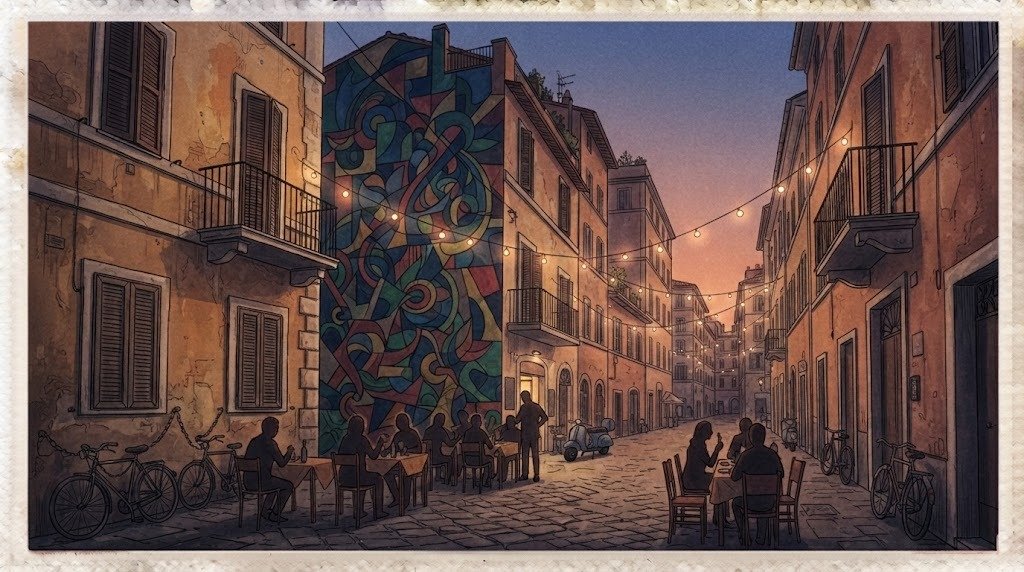
San Lorenzo walking tour at a glance
- What: a San Lorenzo walking tour is a half-day walk through the working-class neighborhood born in the late 19th century outside Porta Tiburtina, with social history, memory of the war, contemporary art and the early Christian basilica.
- When: the best time is the morning of a weekday, from October to May, when the neighborhood is alive but calm and the basilica and the Verano are open.
- Where: the main stops are Porta Tiburtina, Via dei Volsci, Largo degli Osci, Via dei Marsi 58, the former Pastificio Cerere at Via degli Ausoni 7, the July 19, 1943 park, Piazza dell’Immacolata, the basilica and the Verano.
- Getting there: from Termini it’s about 10 to 15 minutes on foot. On metro line B the useful stops are Policlinico, Castro Pretorio and Tiburtina, plus trams 3 and 19.
- Today: since February 14, 2026 five bilingual plaques with QR codes mark Maria Montessori’s places in the neighborhood, starting with the first Casa dei Bambini opened on January 6, 1907 at Via dei Marsi 58.
- Good to know: the Verano is open from 7:30 to 18:00 from October to March, and closes at 19:00 from April to September. The basilica is a working church, so during Mass you visit in silence.
Why do a walking tour of San Lorenzo?
Because it’s one of the few neighborhoods in Rome where the 20th century can be read with the naked eye, without panels and without tickets. In three hours you go from the working-class 19th century to modern pedagogy, from the bombs of 1943 to the art of the 1980s, and you end in a basilica that holds the tomb of a 3rd-century martyr. The historic center tells the Rome of popes and emperors: San Lorenzo tells the Rome of the people who lived in it.
The advice is to treat it as a complement to the big visits of the center, not as a fallback. Anyone who puts it in a free morning between the Vatican and the Colosseum goes home with a much more complete idea of Rome. To get your bearings among the city’s other destinations, the page of Rome’s tourist attractions collects the main pages.
What history does the neighborhood tell?
The name comes from the basilica dedicated to Lawrence, a deacon martyred in Rome in 258 and buried along Via Tiburtina. Over his tomb the emperor Constantine had a first shrine set up in the 4th century. In the 6th century Pope Pelagius II built a church that incorporated it. In the 13th century Honorius III built a second one, reversing the orientation and turning the older church into the presbytery: it’s the appearance you still see today.
The first thing that jumps out during the walking tour is the street names: Volsci, Equi, Marsi, Ausoni, Sabelli, Sanniti, Osci, Ernici. These are the Italic peoples that Rome fought and absorbed in the first centuries of its history. A neighborhood of immigrants from the countryside of Lazio and Abruzzo, baptized with the names of the ancient peoples of central Italy: hard to imagine a more fitting coincidence.
Maria Montessori in Via dei Marsi
In 1906 Edoardo Talamo, director of the Istituto Romano dei Beni Stabili, asked Maria Montessori to look after the children of the neighborhood’s public housing, who stayed alone during the day while their parents worked. On January 6, 1907, the day of the Epiphany, the first Casa dei Bambini opened at Via dei Marsi 58. From that room an educational method started that today is applied in schools around the world.
Since February 14, 2026 Municipio II and the Opera Nazionale Montessori have marked the route with five plaques, each with the image of the educator, a text in Italian and English and a QR code for further reading. For a San Lorenzo walking tour with kids it’s the stop that works best: you can tell it in two minutes and the little ones immediately understand what it’s about.
July 19, 1943
On the morning of July 19, 1943, between 11:00 and noon, Allied bombers struck the San Lorenzo rail yard and the surrounding neighborhoods. It was the first bombing of Rome. On the number of victims the sources disagree: estimates run from about 1,500 to over 3,000 dead, also because there were many unregistered displaced people in the city. The same day Pope Pius XII went among the rubble, near the basilica, which was also seriously damaged.
What is the best route for the San Lorenzo walking tour?
The route we propose is an open loop and is walked from west to east, so as to end in front of the basilica and the Verano, the two places that need the most time. At a slow pace, with stops, it takes between two and a half and three hours. Anyone in a hurry can cut the Pastificio Cerere part, but in our view it’s exactly what sets a San Lorenzo walking tour apart from a simple stroll.
1. Porta Tiburtina
You start at Porta Tiburtina, also called Porta San Lorenzo, one of the gates of the Aurelian Walls. Before entering the neighborhood it’s worth walking around it: the gate leans on an older arch, that of the aqueducts that brought water into the city. It’s the physical border between ancient Rome and the new neighborhood, and the easiest point to meet.
2. Via dei Volsci and Via degli Equi
Past the walls the walking tour enters the grid of streets dedicated to the Italic peoples. Via dei Volsci and Via degli Equi are the most representative: low buildings, shops on the ground floor, murals that change from year to year. Here it’s worth looking up and peeking at the courtyards through open doorways, always discreetly, because they are private homes.
3. Largo degli Osci
Largo degli Osci hosts the covered neighborhood market, the right place to understand the area in the morning: fruit and vegetable stalls, elderly residents, students lining up for a sandwich. If the walking tour falls on a Saturday it’s the liveliest stop of the route. In the afternoon and on Sunday the market is closed or nearly so.
4. Via dei Marsi 58
A few steps away is Maria Montessori’s first Casa dei Bambini, now marked by the plaque of the route inaugurated in 2026. It’s not a museum and you can’t visit inside: you read the plaque, use the QR code and move on.
5. The former Pastificio Cerere
At Via degli Ausoni 7 is the former Pastificio Cerere, founded in 1905, which produced pasta and flour for the capital until 1960. In the 1970s and 1980s its empty spaces were occupied by the studios of artists such as Bruno Ceccobelli, Gianni Dessì, Giuseppe Gallo, Nunzio, Piero Pizzi Cannella and Marco Tirelli, remembered as the Gruppo di San Lorenzo. The exhibition curated by Achille Bonito Oliva in the summer of 1984 made the building famous. Since 2004 it has been home to the Fondazione Pastificio Cerere: exhibitions and openings are published on the Foundation’s website.
6. Park of the Fallen of July 19, 1943
The park, the last outdoor stop of the walking tour before the basilica, at the end of the neighborhood toward the rail yard, is the stop for remembrance. It has benches and shade, and it’s the natural place for a water break and for telling the story of the bombing to the people walking with you.
7. Piazza dell’Immacolata
Piazza dell’Immacolata, halfway through the walking tour, is the civic heart of the neighborhood, with the church of the same name and the bars where nightlife concentrates in the evening. In the morning it’s quiet, and it’s the best spot for a coffee before the last two stops.
8. Basilica of San Lorenzo fuori le Mura
The basilica, at Piazzale del Verano 3, is one of the great pilgrimage churches of Rome. Inside, look for the difference in level between the two churches joined in the 13th century, the mosaics of the triumphal arch and the cloister. Alcide De Gasperi is also buried here, with a monument by Giacomo Manzù. Masses are at 8:00 and 18:30 on weekdays, at 9:30, 11:00 and 18:30 on Sunday: at those times the visit is suspended.
9. The Verano cemetery
The Verano, the last stop of the walking tour, at Piazzale del Verano 1, covers about 83 hectares and is divided into Catholic, Jewish, Protestant and military sections. It’s an open-air museum of funerary sculpture of the 19th and 20th centuries. You can’t cross it in 10 minutes: if you have an hour left, pick one section and walk it slowly.
For a fuller page on the neighborhood, with addresses and transport, there is our page on
San Lorenzo, what to see.
What is the most common mistake about San Lorenzo?
Thinking that San Lorenzo is mainly a nightlife neighborhood. It’s the reputation it has carried for years, tied to the bars around Piazza dell’Immacolata and the presence of students, and in our opinion it’s the reason many visitors skip it or only see it after dinner. In the evening the neighborhood is crowded, noisy and hard to read: you can’t see the plaques, the basilica is closed, and so is the Verano.
The San Lorenzo walking tour is at its best in the morning, when the shops raise their shutters, the market is working and the light enters the courtyards. If you want the evening too, the advice is to go back afterward, already knowing what you have in front of you.
How to get organized: when to go, on your own or with a tour?
The San Lorenzo walking tour is perfectly doable on your own, with this route and a charged smartphone. If you prefer a live explanation you can book a walking visit with licensed tour guides among those offered by GetYourGuide or Viator: always check language, meeting point and length before paying.
Advance notice is not a problem: the article comes out right around your dates, so everything you need can be bought right away. For online purchases, the delivery date estimated at the time of order is what counts. If you’re already in Rome, many sellers also deliver to the hotel, but it’s best to let the reception know. For tickets to museums and attractions for the rest of your stay, a combined pass like Turbopass or the tickets for Rome’s attractions on Tiqets avoid the lines.
If you’re traveling as a group, among friends, as an extended family, with company colleagues, for a bachelor party or as wedding guests, you have different needs: times to fit together, lunches for many people, transfers. In these cases it’s best to turn to Tour Leader Pro, among the best tour operators and boutique agencies in Rome, which designs custom tours with professional tour leaders and, for the explanations inside the basilica, the Verano and archaeological sites, selected licensed tour guides.
Walking tour for families, couples and groups
With kids the route should be shortened and built around two or three strong stories: the Casa dei Bambini, the market, the park. The Verano with the little ones is a choice to weigh as a family. The basilica, with its mosaics, usually sparks curiosity. The neighborhood is flat and works well even with a stroller, but the sidewalks are narrow and often occupied by cars and tables.
For a couple the San Lorenzo walking tour works as a slow morning, with breakfast at a café, an exhibition at the Pastificio Cerere if one is open and lunch in a trattoria. For a group of friends the advice is to split the tasks: who reads the plaques, who holds the map, who books lunch. A table for 8 or 10 people in San Lorenzo can be found, but it needs to be booked: the Estate Romana restaurant map helps you choose and TheFork lets you book online.
If it rains during the walking tour
A San Lorenzo walking tour in the rain loses little, as long as you change the order. You start from the basilica and its cloister, stop at the covered market in Largo degli Osci, check if the Pastificio Cerere has an exhibition open and put off the park and the Verano until it clears.
The kit for the San Lorenzo walking tour
For a walking tour you don’t need special gear, but three hours on foot on uneven sidewalks do add up. We divided the kit by category and put several alternatives in each, because individual items often sell out. Prices change: check them at the time of purchase.
What to wear
- Urban walking shoes: cushioned sole and grip for cobblestones and narrow sidewalks.
- Comfortable city shoes: the more understated alternative, suitable for the basilica and the restaurant too.
- Hat: the park and the Verano have sunny stretches even in October.
- Foldable hat: folds into a pocket when you enter a church.
- Foldable waterproof jacket: takes up little space and saves the morning if the weather changes.
What to bring
- Water bottle: in Rome the nasoni fountains are everywhere and the water is good.
- Insulated bottle: keeps water cool in summer and an herbal tea hot in winter.
- Anti-theft fanny pack: documents and phone in front of you, useful on trams and the metro.
- Anti-theft city backpack: hidden zippers, room for a jacket, water and a book.
- Pocket umbrella: the plan B for uncertain autumn days.
Tech
- Power bank: the map, photos and the plaques’ QR codes use battery.
- 10,000 mAh power bank: enough for a whole day and still pocketable.
- Short charging cable: the long one tangles in the fanny pack.
To read
- Books on San Lorenzo: history of the neighborhood, of the bombing and of its community.
- Guidebooks to Rome in book form: to fit the neighborhood into the rest of your stay.
- Biographies of Maria Montessori: to arrive at Via dei Marsi knowing who she was.
Experiences and bookings
- Tours and visits in Rome on GetYourGuide: to round out your stay with other neighborhoods on foot.
- Experiences in Rome on Viator: an alternative with detailed reviews.
- Tickets for museums and monuments on Tiqets: dated entries, to keep on your phone.
- Turbopass Roma: a pass with transport and attractions for those staying several days.
- Booking lunch with TheFork: especially useful for large tables.
Frequently asked questions
How long does a San Lorenzo walking tour take?
A San Lorenzo walking tour takes between two and a half and three hours at a slow pace, stops included. If you want to visit the Basilica of San Lorenzo fuori le Mura at leisure and stroll through a section of the Verano, add an hour. With lunch, the overall commitment is a good half day.
Where is it best to start?
The most convenient starting point for the walking tour is Porta Tiburtina, reachable on foot from Termini in 10 to 15 minutes. From there you enter the neighborhood and move east, to end in front of the basilica and the Verano cemetery, which are the stops that take the most time and have opening hours to respect.
Can you do the San Lorenzo walking tour on your own?
Yes, the route is easy to follow with a map on your phone and the plaques of the Montessori itinerary, which have QR codes. If you prefer a live account you can book a walking visit with licensed tour guides on the booking platforms, checking language, meeting point and length.
What is the best time of day?
The morning of weekdays is the best time for a walking tour. The market in Largo degli Osci is working, the shops are open, the light enters the courtyards and the basilica and the Verano can be visited. In the evening the neighborhood changes face and becomes one of the centers of student nightlife, not well suited to a visit.
Is San Lorenzo suitable for kids?
Yes, if the walking tour is shortened. The neighborhood is flat and the story of Maria Montessori’s first Casa dei Bambini, opened at Via dei Marsi 58 in 1907, is perfect to tell the little ones. The park offers a break in the shade. The narrow sidewalks need care with a stroller.
Who wrote this and on what sources
The text comes from the editorial team of Tour Leader Pro, the Roman firm that designs itineraries, visits and cultural events across Rome and Lazio. The information comes from Estate Romana’s San Lorenzo page, from the City of Rome news item on the itinerary of Maria Montessori’s places, from the basilica page on Turismo Roma and from the website of the Fondazione Pastificio Cerere, consulted on the date given at the top. Tell us what you find has changed.
Organizing a San Lorenzo walking tour for yourself is simple. Doing it for a group of friends means fitting together times, a booked lunch, someone to tell the story and a plan B for rain. That’s why a useful resource for anyone organizing group trips is Tour Leader Pro. If San Lorenzo is just one stop on a broader trip through Rome, the Castelli and Tuscia, a useful resource for putting together a multi-day itinerary is Italy Planner.