Tomb of Nero
In short. The Tomb of Nero is viewed from the street, free and at any hour: it is the sepulcher of Publio Vibio Mariano, a marble sarcophagus of the 3rd century AD set on a tall base, which the Turismo Roma portal of Roma Capitale places at Via…
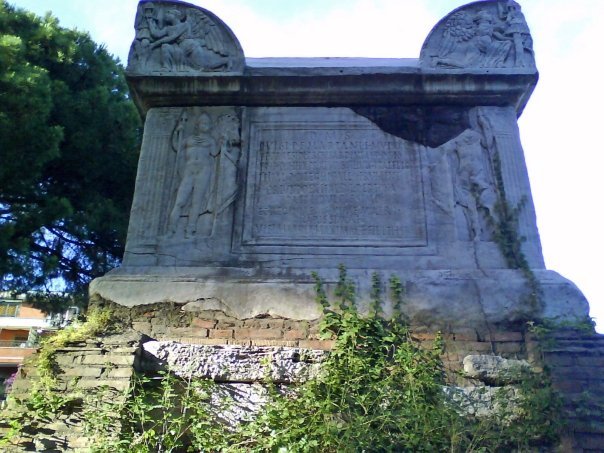
The Tomb of Nero is viewed from the street, free and at any hour: it is the sepulcher of Publio Vibio Mariano, a marble sarcophagus of the 3rd century AD set on a tall base, which the Turismo Roma portal of Roma Capitale places at Via Cassia 739-749, north of the city. There is no ticket office, there is no interior to visit, nothing to book. Nero has nothing to do with it. The wrong name, however, is so old that it has passed to an entire neighborhood.
RomaNatura, the regional body that manages the protected areas of the Municipality of Rome, places it at the sixth mile of the ancient Via Cassia, at kilometer 9.8 of the modern road, and describes it as a base 2.30 meters high topped by a monumental marble sarcophagus, with pillars at the corners and a double-pitched lid. The inscription names a procurator of Sardinia and his wife Regina Massima. Since the Middle Ages, however, everyone has called it Nero's tomb, and the name has never gone away.
Data checked on September 29, 2026 on the monument's page on Turismo Roma, on the RomaNatura site dedicated to the Insugherata Nature Reserve, on the Ministry of Culture portal and on the other sources cited in the text. None of these publishes hours or fares, because the sarcophagus is outdoors, along a public road. For information the city's channel is the contact center 060608, open every day from 9 to 19, or the mailbox info@060608.it.
In Brief: Address, Hours, Ticket
- Address: Via Cassia 739-749 according to Turismo Roma, at kilometer 9.8 of the Cassia at Via Tomba di Nerone according to RomaNatura, northern Rome.
- What it is: 3rd-century marble sarcophagus on a base, sepulcher of Publio Vibio Mariano and Regina Massima.
- How to enter: you don't, the monument is viewed from the outside, from the Cassia sidewalk.
- Price: free, no ticket and no booking.
- Hours: no hours published, Turismo Roma lists it as free access.
- How to get there: Atac lines running along Via Cassia, stops and routes updated on the Atac channels or at 060608.
- Accessibility: no specific information published, Turismo Roma refers to the Accessible Rome section of the portal.
Where It Is and What You Really See
The sarcophagus stands along the Cassia, on the stretch that crosses the residential neighborhoods of northern Rome, among apartment buildings, shops and almost constant traffic. RomaNatura places it at kilometer 9.8, at Via Tomba di Nerone, and specifies that it is visible at one of the entrances to the Insugherata Nature Reserve. The local press, in 2010, located it at the intersection with Via Vibio Mariano, the street that bears the name of the real deceased.
The sixth mile cited by RomaNatura is the Roman measure of distance from the ancient city. The Cassia was the road that went up from Rome toward Etruria, and along its route, as along all the consular roads, prominent families built the tombs of their dead. The modern route doesn't coincide everywhere with the ancient one, and this too matters, as we'll see further on, for understanding which side to look at the sarcophagus from.
The first thing you notice is the height. The base, which RomaNatura measures at 2.30 meters, lifts the sarcophagus above the head of those passing, and this makes it visible even from a car. On top is the marble chest, closed by a double-pitched lid that recalls the roof of a small house, with pillars on the corners. It is not a building with a room inside. It is a single funerary object set on a pedestal, at the edge of the road.
The decorations should be looked for calmly, and the sources don't describe them in the same way. Turismo Roma speaks of an inscription on the front that identifies the two spouses and of Dioscuri carved on the sides. The English encyclopedia entry describes two armed youths at the sides of the inscription, kneeling figures in the upper corners, eagles seizing a serpent on the flanks and a griffin below. The marble is nearly 18 centuries old, and the sunlight changes a lot what you can read.
Reporting on the 2010 restoration, the local press called it an Asian-type sarcophagus, rare in Italy. It's a detail that counts more than the legendary name. It is not just any ruin that survived by chance among the apartment blocks. It is a piece of quality, commissioned by a family of the imperial administration, which had the luck to stay where it had been placed, along the road.
Around it there is no archaeological area. Don't expect lawns, marked paths or an attached museum. The monument is set in the urban space like a fountain or a statue in a square, and those who live in the area pass in front of it every day without turning. Precisely for this reason it deserves respect: no climbing on the base, no graffiti, no trash left at the foot of the sarcophagus. The 2010 restoration, the press recalled, had been necessary also to erase the graffiti.
A Curiosity About the Tomb of Nero
The monument that bears the name of an emperor is, in reality, a daughter's tribute to her parents. The English encyclopedia entry reports that the one who erected it, as heir, was Vibia Maria Massima, daughter of Publio Vibio Mariano and Regina Massima, named in the inscription as clarissima femina, that is, belonging to the senatorial rank. RomaNatura describes the inscribed tablet as dedicated to the procurator of Sardinia and his wife. A family story, in short, turned by word of mouth into a story of imperial crimes.
There is also a geographic detail. According to the same encyclopedia entry, Vibio Mariano came from Iulia Dertona, present-day Tortona, in southern Piedmont. An official born in northern Italy, with a career among legions and provinces, ended up buried at the gates of Rome, along the road coming down from Etruria. And for centuries his name remained hidden behind that of an emperor who had nothing to do with him.
The third curiosity is toponymic. A short distance from each other, in the same area, are Via Tomba di Nerone and Via Vibio Mariano. The first preserves the medieval tradition, the second gives back the name written on the stone. The neighborhood, in practice, carries on its street signs both the error and its explanation. Few places in Rome show so clearly how a legend and a document end up coexisting without erasing each other.
Something Nobody Tells You About the Tomb of Nero
What you see from the modern Cassia is not the main front of the sepulcher. In recounting the 2010 restoration, the local press reported that the ancient Via Cassia did not run where the road runs today, and that the side facing the traffic is therefore the back of the sarcophagus. The inscription, made to be read by those traveling the Roman road, faced another direction. Whoever stops on the sidewalk and photographs only that side misses the most important piece.
The detail changes the way you look at it. A Roman tomb along a consular road was designed for those passing by: the name of the deceased, the offices, the dedication had to be visible to travelers, because memory relied on being read by passersby. Today the modern road has reversed the relationship, and the monument shows its back to the flow of cars. Walking around it, as far as the fence allows, restores the original sense of its position.
The second little-known thing concerns nature. RomaNatura lists the tomb among the places of history and culture of the Insugherata Nature Reserve and notes it as visible at one of the entrances to the protected area. The monument, therefore, acts as a threshold between the built city and the Roman countryside that survives in the valleys between the Cassia and the Trionfale. Whoever comes for the sarcophagus finds themselves a few steps from a landscape of woods and ditches that few Romans know.
The third thing concerns the base. The Ministry of Culture portal, presenting the archive photos of the Special Superintendency of Rome, specifies that the images date from 1914, a year before the restoration of the base. What you see today under the sarcophagus, therefore, also bears the marks of an intervention from the early 20th century. Comparing the historic photos with the current state is a good exercise to understand how much an outdoor monument changes over time, even when it seems motionless.
Why Is It Called the Tomb of Nero if Nero Isn't There?
It helps to separate three levels. What the documents say is simple: the inscription on the sarcophagus names Publio Vibio Mariano and Regina Massima, and Turismo Roma and RomaNatura date the monument to the 3rd century AD. Nero died in 68, about two centuries earlier. No ancient source links this sepulcher to the emperor. The inscription has always stayed in its place, readable by anyone who came close. The wrong name survived all the same, and this is the most curious point of the whole affair.
Then there is tradition. Turismo Roma writes that the sepulcher has been mistakenly called the Tomb of Nero since the Middle Ages, and RomaNatura confirms that the name extended to the modern neighborhood. The Italian encyclopedia entry links the birth of the belief to the 12th century: after the destruction of the family tomb of the Domitii, under the present-day Santa Maria del Popolo, the rumor spread that the emperor's remains had been brought here, on the Cassia.
The third level is legend. According to the account reported by the encyclopedia entries, Pope Paschal II, at the beginning of the 12th century, had the tomb of the Domitii at the foot of the Pincio torn down because a tree that had grown over it housed demons tied to Nero. The sources don't even agree on the plant: one speaks of a poplar, another of a walnut with crows. In place of the tomb a chapel rose, the core of the basilica. From there, according to tradition, the emperor's name migrated north.
The same tradition ties the name of the basilica and the square to the episode as well. The Italian encyclopedia entry recalls that the tree cut down by the pope's order was said to be a poplar, in Latin populus, and from here comes one of the explanations for the name Santa Maria del Popolo. It is an explanation that has circulated for centuries along with others, and should be taken as part of the story, not as an established fact. What remains is the link, entirely medieval, between the Pincio and the Cassia.
The bad reputation had concrete consequences. RomaNatura writes that the emperor's reputation fed beliefs about the supposed evil influences of the sepulcher, and that these superstitions lasted until the 19th century. For centuries, then, the sarcophagus of a provincial official was looked at with suspicion by those passing on the Cassia. It is an unfair fate for Vibio Mariano, and a good example of how a name can weigh more than an inscription carved in clear letters.
Our opinion is that the misunderstanding should be told without complacency. Many popular texts insist on the allure of mystery, but there is little mystery: the deceased is known, the date is known, the legend is medieval and its origin is known. What remains interesting is the mechanism. A city that had erased Nero's real tomb found a false one, and kept it for centuries. Other similar tales are found in The Ghosts of Rome.
Who Were Publio Vibio Mariano and Regina Massima?
The sources agree on the essential point: Publio Vibio Mariano was a high official of the empire with a post in Sardinia. Turismo Roma and RomaNatura list him as procurator of Sardinia. The Italian encyclopedia entry defines him as proconsul and governor of Sardinia and prefect of the legion II Italica. The English one reconstructs a career as military tribune, then prefect of the same legion, then procurator and governor of the island. The sources don't agree on the exact titles, but the profile is that of a man of the imperial administration.
The local press, in 2010, spoke instead of a Gallic legion. It is one of the many oscillations found around monuments little studied by the general public, and in these cases it's best to trust the reading of the inscription reported by the encyclopedia entries and the institutional pages. On precise dating the English entry is cautious: it places Vibio Mariano, hypothetically, in the era of Septimius Severus, between the late 2nd and early 3rd century, in line with RomaNatura's dating to the 3rd century.
Much less is known about Regina Massima. Her name appears in the inscription next to her husband's, and Turismo Roma lists her as buried with him in the same monument. The English entry adds that Vibio Mariano's father was also named Publio and had held posts of proconsular rank. A family of officials, then, with a daughter of senatorial rank, who closed the circle by having a sepulcher built, visible on the main road to the north.
The sarcophagus says a lot even without reading the letters. A tall base, a marble worked with military figures, a position along a consular road: these are the choices of someone who wanted to be remembered by everyone entering and leaving Rome. It is the same principle as the tombs of the Appia Antica, applied here with less space and fewer means, but with the same idea of memory entrusted to the road.
My Advice for Visiting the Tomb of Nero
The advice is to arrive on foot and give the sarcophagus the time of a full walk around the base, as far as the fence allows. From a car the monument looks like a white block at the edge of the road. Up close you can read the figures, the pillars, the shape of the lid, and you understand which side faced the ancient road. Allow about 20 minutes, no more, and then use the monument as a starting point.
A simple way to look at it is to proceed from the bottom up. First the base, more than two meters high, which served to detach the tomb from the level of the road. Then the chest, with the figures carved on the sides and the pillars at the corners. Finally the double-pitched lid, which gives the sarcophagus the look of a small house. Light binoculars or your phone's zoom help distinguish the details that the fence keeps at a distance.
It pays to choose the hour with care. The Cassia is busy almost always, and at peak hours the noise and the hurry make it hard to stop. Sunday morning is usually the quietest time. Cross only at crosswalks and traffic lights, because the road has the fast flow of an urban consular road and drivers don't expect pedestrians standing still looking at a monument.
The third piece of advice concerns context. Seen on its own, in our judgment, the sepulcher doesn't justify a trip from the center just for it. It is overrated as an isolated destination and underrated as a stop. It becomes instead a good half day if you put it in a route along the Cassia that starts at Milvian Bridge, or if you pair it with a walk in the Insugherata Reserve, which RomaNatura lists as accessible from this area too.
Those who come with children find in the sarcophagus an easy story to tell: a famous emperor, a wrong name, a flying balloon that ended up against the tomb. Keep the little ones away from the roadway, though, because Cassia traffic is heavy at almost all hours. More ideas for a family-friendly day in the city are collected in Rome with Kids, among our pages dedicated to places that are easy to visit.
Do You Pay, and Do You Need to Book?
You don't pay and you don't book. Turismo Roma lists the monument as free and with free access, with no hours. The sarcophagus is outdoors, protected by a fence that the local press described as installed with the 2010 restoration, and is viewed from the outside. There are no official tickets, nor regular visits inside the fence published by the authorities. Be wary of anyone offering a paid entrance to the sepulcher: the monument is public and visible to everyone from the street.
The Turismo Roma portal doesn't list an operator or a visiting calendar. For general information the official channel is the Roma Capitale contact center, 060608, open every day from 9 to 19, or the address info@060608.it. For initiatives in the nearby reserve, such as excursions or environmental education days, it's best to consult the site of RomaNatura on the Insugherata Reserve, which publishes its own activities.
The official reference page remains the Turismo Roma listing on the Tomb of Nero, with the address and links to accessibility services. Themed visits with archaeologists or local associations may be announced from time to time, with dates and arrangements that change and that don't always appear on institutional channels. Without a scheduled event you stay on the sidewalk, which for this monument is in any case the right viewpoint.
Another Well-Known Fact, Yet Rarely Cited
That the neighborhood is named after the sarcophagus is known by all Romans, even those who have never seen it. Less cited is the fact that the name has entered the city's official documents. The Italian encyclopedia entry reports that Tomba di Nerone is the name of zone LIII of the Agro Romano and of urban zone 20C of Municipio XV. A medieval error, that is, has become an administrative unit with which the city counts residents and services.
The same entry places the area's building development between the 1960s and the 1980s. Until then the sarcophagus stood in a country landscape, along a road connecting with Etruria and with the towns of Lake Bracciano. The archive photos from the early 1900s, published by the Special Superintendency of Rome on the Ministry of Culture portal, show the monument in 1914, decades before the apartment buildings surrounded it.
The result is a rare case. In most Roman neighborhoods the name comes from a saint, a family, a villa, an event. Here it comes from a wrong sepulcher, and the name has endured even when nobody believed the legend anymore. Our opinion is that the error deserves respect: it tells how the Romans of the Middle Ages looked at ruins, and how much the memory of Nero mattered to them.
There is one last, more practical aspect. Many people who search for the Tomb of Nero on a map find the neighborhood and not the monument, and end up at some random point in the area. It's best to look for the sarcophagus with the Cassia address given by Turismo Roma, or with Via Tomba di Nerone as a reference, as RomaNatura suggests. Otherwise you risk wandering a long time among the area's residential streets without finding the base, and confusing the monument with the name of a stop or an intersection.
The Right Photo to Take at the Tomb of Nero
The photo that tells the story of the monument is the one that puts it in relation to the city. A wide shot, with the base, the sarcophagus, a stretch of Cassia and the apartment buildings in the background, explains the history of the place better than any close-up: a Roman sepulcher that stayed where it was while the world around it changed. Shoot from the sidewalk, without stepping into the roadway, and wait for a moment when cars aren't covering the base.
The second photo is a detail of the side with the inscription. The carved letters are the real document of the monument, the ones that disprove the legend. With the raking light of morning or late afternoon they read better, because the shadows fill the grooves. A slight telephoto helps, since the fence keeps you at a distance. Avoid flash and the middle hours of summer days, when the white marble becomes a blotch without relief.
A third useful image is the one of the figures carved on the flanks, which Turismo Roma identifies as the Dioscuri and which the English entry describes in a more detailed way. Photographing them up close then lets you compare them at leisure at home. A good idea is to put side by side, in the same album, the sign of Via Tomba di Nerone and that of Via Vibio Mariano: two images that tell the misunderstanding better than any caption.
A few common-sense rules apply to photos too. Don't block the sidewalk with a tripod, don't climb over the fence to get close to the marble and don't climb on low walls or posts to find a higher spot. The monument is in a residential area, with doorways and shops a short distance away, and those who live there deserve the same attention given to the sarcophagus. A good shot can always be found staying on the public sidewalk.
How Do You Get There From Central Rome?
The sarcophagus is on Via Cassia, at kilometer 9.8 according to RomaNatura. From the center the simplest route is the one that goes through Piazza del Popolo, follows the Flaminia to Milvian Bridge and then takes the Cassia, which branches off right after the bridge. By car the travel time depends almost only on traffic, and at peak hours it can stretch considerably. Parking along the Cassia is not set up for visitors.
By public transport the area is served by the Atac lines running along Via Cassia. Lines, stops and schedules change with network reorganizations, and the most reliable data is from the Atac route planner or the 060608 contact center. It's best to enter as the destination Via Cassia address given by Turismo Roma, not the name of the neighborhood, which covers a much larger area than the monument.
By bicycle the route from the center is long and runs largely on very busy roads, to be considered with caution. You can instead arrive by car or bus and continue on foot toward the Insugherata Reserve, which RomaNatura lists as accessible from this area too. For those arriving from the north, from Lake Bracciano or the Tuscia, the sarcophagus is instead one of the first signs of ancient Rome along the road to the city.
A note on timing. Whoever leaves the center just to see the sarcophagus spends more time traveling than in front of the monument. It makes more sense to pair it with a stop along the same axis: the bridge over the Tiber, the Foro Italico and the Stadio Olimpico, the MAXXI and the Auditorium Parco della Musica, all on the road between the center and the Cassia.
Some Important Events That Happened Here in History
The first event is the construction of the sepulcher, in the 3rd century AD, at the sixth mile of the Cassia. RomaNatura and Turismo Roma agree on the dating. In that period the consular roads outside Rome were lined with tombs of every size, and that of Vibio Mariano, with its tall base, must have stood out among the others. The sepulcher has come down to us with the sarcophagus in its place on the base, and this is what makes it readable still today.
The second decisive moment is the 12th century. According to the encyclopedia entries, after the destruction of the tomb of the Domitii ordered by Paschal II under the Pincio, the rumor arose that Nero's remains had been moved to the Cassia. From that moment the sarcophagus had a new name. Turismo Roma confirms that the name dates to the Middle Ages. In the following centuries, according to the English entry, the monument became a Grand Tour destination and was drawn and engraved by artists starting in the 16th century.
In December 1804 the strangest episode occurred. The Italian encyclopedia entry tells that a balloon launched in Paris, in front of Notre-Dame, for the celebrations of Napoleon's coronation, ended its flight against the sepulcher on the Cassia. The impact with the supposed tomb of Nero was read as a bad omen. According to the same entry, the balloon is today kept at the Aeronautics Museum of Vigna di Valle, on Lake Bracciano.
The 20th century brought care and transformations. The Ministry of Culture portal published in May 2020 the archive photos of the Special Superintendency of Rome that show the monument in 1914, a year before the restoration of the base. Then, between the 1960s and 1980s, the countryside around it filled up with houses. In November 2010, according to the local press, a new restoration removed the graffiti, sealed the parts exposed to water, installed lighting and a fence and enhanced the inscription.
The last documented episode concerns the memory of the monument more than the monument itself. Between May 18 and 22, 2020 the Special Superintendency of Rome dedicated to the Tomb of Nero an installment of the series in which the Photographic Archive tells the city, published on the Ministry of Culture portal. The images come from the holdings of the former Superintendency for Environmental and Architectural Heritage of Lazio and of the former Superintendency for Architectural and Landscape Heritage of Rome, established in 1991.
Who Has Passed by the Tomb of Nero
The first person to remember is the one who wanted the sepulcher. Vibia Maria Massima, daughter of Vibio Mariano and Regina Massima according to the English encyclopedia entry, had the monument built as heir and chose for her parents a prominent position on the road. Very little is known about her, apart from the senatorial rank given in the inscription. Yet she is the author of the gesture that has kept the family's name alive for nearly 18 centuries.
After her, for centuries, passed everyone who entered Rome from the north along the Cassia: merchants, soldiers, pilgrims, travelers. According to the English entry, the sepulcher was drawn and engraved starting in the 16th century and then became a Grand Tour destination, almost always under the emperor's name. For those coming down toward Rome from the north, Nero's fame made it impossible to ignore, even when the inscription said otherwise.
In 1804 there arrived, literally from the sky, the balloon of Napoleon's coronation, which had set off from Paris. It was not a visit by the emperor, but a symbolic object that ended up by chance against a symbolic tomb. In 1914 someone photographed the monument with care, and those images, now in the holdings of the Photographic Archive of the Special Superintendency of Rome, were shown to the public in 2020 on the Ministry of Culture portal.
Today those who pass in front of the sarcophagus are mainly residents of Municipio XV, drivers headed toward Giustiniana and La Storta, hikers entering the Insugherata Reserve. The monument doesn't have an audience of tourists. This, in our judgment, is also its merit: you look at a Roman sepulcher without lines, without tickets, without the noise of the big sites, in the middle of the ordinary life of a neighborhood that owes it its name.
Among the most recent passages are those of the restorers. In November 2010, according to the local press, an intervention gave the monument back its legibility after about two years of neglect, graffiti and poor visibility. Technicians and architects worked on the surfaces, on the waterproofing and on the inscription, and the sarcophagus was fenced and lit. Since then the care of the monument also depends on those who live around it and on those who pass by, who can report damage at 060608.
How Does It Fit Among the Tombs of the Consular Roads?
The Tomb of Nero belongs to the same family of monuments found along all the roads leaving Rome. The best-known case is the Appia, with the Mausoleum of Cecilia Metella, the Capo di Bove area and the Tomb of the Scipios at the start of the road. The difference is one of scale: on the Appia you walk for kilometers among the tombs, on the Cassia the sarcophagus of Vibio Mariano has remained almost alone, surrounded by the city.
For the period, the most useful comparison is with the sepulchers of the 3rd century. The Hypogeum of the Aurelii and the Catacombs of Priscilla, on the Salaria, show how the dead were buried in Rome in the same period, in underground spaces. The Cassia sarcophagus represents instead the other choice, that of the exposed monument, made to be seen from the road and not to be hidden underground.
Whoever wants to understand the form of the object better will find many sarcophagi of the imperial era in the city's museums. Palazzo Massimo and the Baths of Diocletian of the Museo Nazionale Romano, together with the Capitoline Museums, hold carved chests and funerary inscriptions that help read the language of the images. Seeing them in a museum and then seeing the sarcophagus of Vibio Mariano in its original place is a good exercise.
For the following period, the natural step is the great late-antique mausoleums. The Mausoleum of Santa Costanza on the Nomentana and the Mausoleum of Sant'Elena on the Casilina show how, in the 4th century, monumental burial along the consular roads passed to Christian imperial families. For burial in a more modest form, the Columbarium of Pomponius Hylas tells instead of the world of freedmen and servants of the great households.
And Nero, where was he really buried? The encyclopedia entries point to the family tomb of the Domitii, at the foot of the Pincio, where the ashes were supposedly kept in a porphyry urn. That tomb no longer exists. In its place, after Paschal II's demolition, rose the chapel from which Santa Maria del Popolo was born. The real tomb, then, has vanished in the city, while the false one has remained in the countryside. Of Nero the builder, what remains is the Domus Aurea.
What Does the Insugherata Reserve Have to Do With It?
RomaNatura, the regional body for the management of the system of protected natural areas in the Municipality of Rome, lists the Tomb of Nero among the places of history and culture of the Insugherata Nature Reserve. The sarcophagus is not inside the woods, but along the Cassia, and the body notes it as visible at one of the entrances to the protected area. It is a sign that the boundary between archaeology and landscape, in this part of Rome, is not sharp.
The reserve occupies valleys and ditches between the built-up neighborhoods of northern Rome, and preserves a piece of Roman countryside that the rest of the city has lost. For trails, entrances and updated activities the reference is the RomaNatura site, which also publishes environmental education initiatives. Suitable shoes and water are the minimum for a walk in a natural area, especially after days of rain.
The link between sarcophagus and reserve also makes historical sense. The sepulcher was built in the countryside, along a road that crossed agricultural land, and the reserve preserves just that kind of landscape. Looking at the monument and then going down into the valleys of the Insugherata helps imagine the original context better than any reconstruction. Those who like walking in the city will find other green areas of northern Rome in Villa Ada and Villa Glori.
When Is It Closed and What Not to Expect?
The sarcophagus never closes, in the sense that it is outdoors and can be seen at any hour from the road. Turismo Roma lists it as free access and publishes no hours. What you don't do is enter the fenced area or get close to the marble: the fence, according to the local press of 2010, serves to protect the monument after a period of graffiti and neglect. There is no interior to visit, because the sepulcher is a closed sarcophagus set on a base.
Don't expect multimedia panels, a ticket office, a bookshop or a restroom. The monument is set in a stretch of urban road, with the neighborhood's services around and nothing else. Whoever arrives with the idea of an equipped archaeological area is disappointed, and whoever looks for an imperial mausoleum with the dimensions of that of Augustus has the wrong destination altogether. It is a single object, of great quality, which you look at in a few minutes.
Turismo Roma describes the sarcophagus as set in a public green area on the side of the modern Cassia. For this space no opening hours are published, and the state of the greenery around it depends on the ordinary maintenance of the city and the Municipio. Whoever finds trash, tall grass or damage to the fence can report it to the 060608 contact center. The monument itself, in any case, remains visible from the road even when the green area is not in the best condition.
In the evening visibility depends on the lighting, which the local press described as installed in 2010 but whose current state is unknown. For those arriving after dark the advice is not to count on it. In summer it's best to avoid the middle hours, when the white marble reflects the light and the reliefs are hard to read. On rainy days the stop is brief out of necessity. Before going out of your way, it's best to check with 060608 for any roadwork on the Cassia.
What to Pair It With During the Day
The most natural combination is with Ponte Milvio. The bridge marks the point where the Cassia begins, branching off from the Flaminia, and from there the sarcophagus is the first important ancient stop along the road. A morning can start at the bridge, continue with a stop at the Foro Italico and end in front of the sepulcher of Vibio Mariano. If you prefer green space, you can pair it with the Insugherata reserve or Villa Ada.
Anyone interested in the legend of Nero has an almost obligatory route: from the Cassia to Piazza del Popolo, where tradition places the real tomb and its destruction. The Porta del Popolo, the Flaminian Obelisk and the twin churches frame the basilica of Santa Maria del Popolo. Then you climb up to the Pincio and to Villa Borghese. The city's less orthodox stories are collected in Esoteric Rome.
Heading north, the Cassia leads out of the city and toward Lake Bracciano. On the lake shore, according to the encyclopedia entries, the 1804 balloon that ended up against the tomb is preserved, at the Aeronautics Museum of Vigna di Valle. Those who go around the lake can stop at the Castello Odescalchi in Bracciano, at Trevignano Romano and at the Pantane di Trevignano. The museum's hours and tickets should be checked on the Aeronautica's website.
Continuing toward the Tuscia, the road leads to the great Renaissance gardens. The Palazzo Farnese in Caprarola and Villa Lante in Bagnaia are full-day destinations, and require a car. Closer to Rome, on the side of the Flaminia, the Villa of Livia at Prima Porta completes an archaeological itinerary of northern Rome, and the National Etruscan Museum of Villa Giulia tells of the peoples who lived in the lands crossed by the Cassia.
If you're on a small budget, you can build a whole day without spending: the sarcophagus is free, so are Ponte Milvio and Piazza del Popolo, and many churches along the route have free access during opening hours. More ideas are collected in Free Rome and in Free Museums in Rome, which list the places and days when entry is free, to be always checked on the operators' websites before heading out.
Frequently Asked Questions
Is Nero buried in the Tomb of Nero?
No. The inscription on the sarcophagus names Publio Vibio Mariano, procurator of Sardinia, and his wife Regina Massima, and Turismo Roma and RomaNatura date the monument to the 3rd century AD, about two centuries after Nero's death. The emperor's name was attached to the sepulcher in the Middle Ages. According to the encyclopedia entries, Nero was buried in the family tomb of the Domitii, at the foot of the Pincio, destroyed at the beginning of the 12th century.
Where exactly is the Tomb of Nero?
Turismo Roma places it at Via Cassia 739-749, in northern Rome. RomaNatura gives kilometer 9.8 of the Cassia, at Via Tomba di Nerone, visible at one of the entrances to the Insugherata Nature Reserve. The local press described it at the intersection with Via Vibio Mariano. To find it, it's best to use the Cassia address and not the name of the neighborhood, which covers a much larger area than the monument.
Do you pay to see the Tomb of Nero?
No. Turismo Roma lists the monument as free and with free access, with no hours. The sarcophagus is outdoors, along the road, protected by a fence, and is viewed from the outside. There are no tickets or regular visits published by the authorities. For general information the official channel is the Roma Capitale contact center, 060608, open every day from 9 to 19, or the address info@060608.it.
Why is the neighborhood called Tomba di Nerone?
Because it took its name from the sarcophagus, which since the Middle Ages was believed to be the emperor's tomb. RomaNatura writes that the name extended to the modern neighborhood. According to the Italian encyclopedia entry, Tomba di Nerone is today the name of zone LIII of the Agro Romano and of urban zone 20C of Municipio XV, developed above all between the 1960s and 1980s, when the surrounding countryside filled with houses.
Can you see the inscription?
Yes, but not from the most obvious side. According to the local press that told of the 2010 restoration, the ancient Cassia ran at a different point from the modern one, and the side facing today's traffic is the back of the sarcophagus. To read the inscription you have to walk around the base, as far as the fence allows. The raking light of morning or late afternoon helps make out the carved letters.
How much time does the visit take?
For the sarcophagus alone, 20 minutes is enough, the time to walk around it and observe the carved figures and the inscription. In our judgment it is not worth a trip just for it from the center, but it becomes a good half day if you pair it with Ponte Milvio, the Foro Italico or a walk in the Insugherata Reserve. With a detour toward Lake Bracciano the day gets longer and changes character completely.
What does Napoleon's balloon have to do with it?
According to the Italian encyclopedia entry, in December 1804 a balloon launched in Paris, in front of Notre-Dame, for the celebrations of Napoleon's coronation, ended its flight against the sepulcher on the Cassia, after a long journey. The accident was interpreted as a bad omen, precisely because of the monument's reputation. The same entry reports that the balloon is kept at the Aeronautics Museum of Vigna di Valle, on Lake Bracciano.
Who takes care of the Tomb of Nero?
The Turismo Roma portal doesn't list a managing body for the monument. RomaNatura, which manages the Insugherata Nature Reserve, lists it among the places of history and culture of the protected area. The 1914 archive photos are held by the Special Superintendency of Rome, and the last restoration told by the local press dates to 2010. For reports on the state of the monument the city's official channel remains the contact center 060608.
Is the Tomb of Nero wheelchair accessible?
The monument is viewed from the Cassia sidewalk, but no body publishes specific information on the accessibility of the stretch of road, on the state of the sidewalks or on the crossings. Turismo Roma refers to the Accessible Rome section of its portal. Traffic on this stretch is heavy. Before heading out, it's best to ask the 060608 contact center for updated information on accessible routes and stops.
Who Wrote It and From What Sources
The text comes from the editorial team of Tour Leader Pro, the Rome-based organization that designs itineraries, visits and cultural events across Rome and Lazio. Fares, hours and access arrangements given here come from the official sources cited in the text, as of the date indicated at the beginning: for the Tomb of Nero the sources are the Turismo Roma page, the RomaNatura site and the portal of the Ministry of Culture. Let us know what you find changed.
Organizing a stop at the Tomb of Nero for many people seems simple, because there are no tickets or time slots. The real difficulty is the road: Cassia traffic, the sidewalks of a neighborhood street, the lack of an assembly point in front of the monument. It's best to get off the vehicle at a safe spot and reach the sarcophagus on foot, a few at a time. For those planning cultural outings in northern Rome, a useful resource for those who organize group trips is Tour Leader Pro.
The Tomb of Nero is also the first ancient stop on a road that leads from the capital toward Lake Bracciano, the Tuscia and Viterbo. Following the Cassia out of the city leads toward castles, villages and Renaissance gardens that deserve a multi-day trip, among Caprarola, Bagnaia and the towns of the lake. Putting together city and province takes a bit of planning, and a useful resource for putting together a multi-day itinerary is Italy Planner.