Caffè Rosati
In short. Caffè Rosati is at Piazza del Popolo 4/5a, on the corner with Via di Ripetta, and it is open: a bar, pastry shop and restaurant with outdoor tables on the square, privately run since the Rosati family sold the business.
Caffè Rosati is at Piazza del Popolo 4/5a, on the corner with Via di Ripetta, and it is open: a bar, pastry shop and restaurant with outdoor tables on the square, privately run since the Rosati family sold the business. There is no entrance fee and nothing to reserve at the bar counter. For a table at the restaurant the venue gives the phone number 06 3225859 and a booking page on its own site. The bar's price list doesn't appear to be published online with a date.
The reason to come here is the history of the place, not the little cup. The venue opens in 1922, occupies one of the two twin buildings that Giuseppe Valadier designed to close the square to the south, and between the postwar years and the mid-1960s it becomes the open-air living room of writers, screenwriters and painters. Across the Corso, in the mirror-image building, is the Canova, the other historic café on the square, with which the Rosati has always shared its clientele.
Address, phone numbers and opening status match the check of September 29, 2026 against the sources cited later in the text, starting with the tourism portal of Roma Capitale and the trade press with its date. The hours of the bar and the restaurant change with the season, and the operator gives them on its own site and by phone. If you're coming for a specific evening, especially on holidays or in August, a call before crossing the city saves you the surprise of a lowered shutter.
Where It Is and What You See
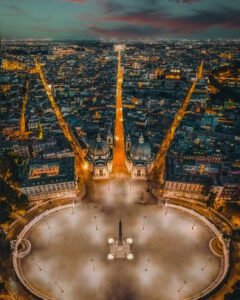
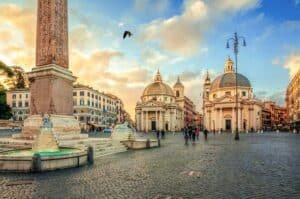
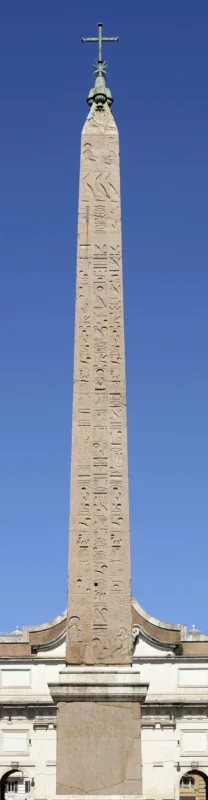
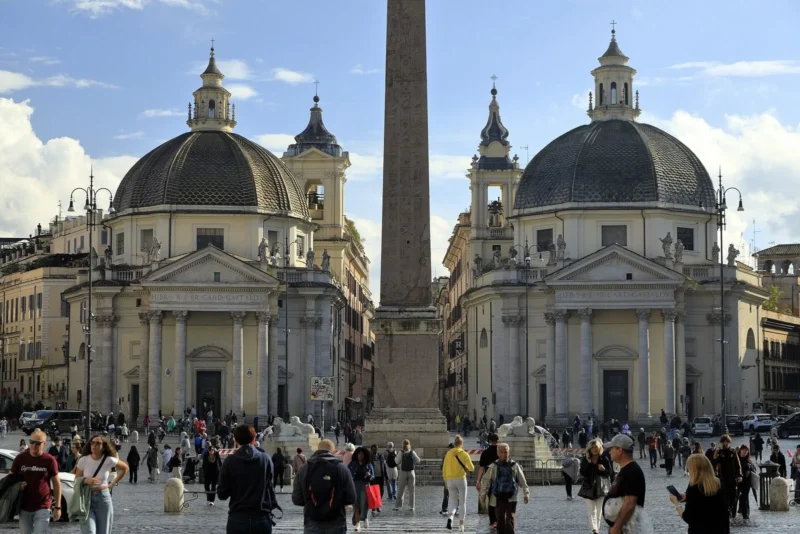
Anyone entering Piazza del Popolo through the Porta del Popolo has the Flaminian Obelisk in front and, at the far end, the twin churches that open the Tridente. The Rosati is on the right as you face the churches, in the building at the corner between the square and Via di Ripetta. The Canova is in the symmetrical position, on the left, at the start of Via del Babuino.
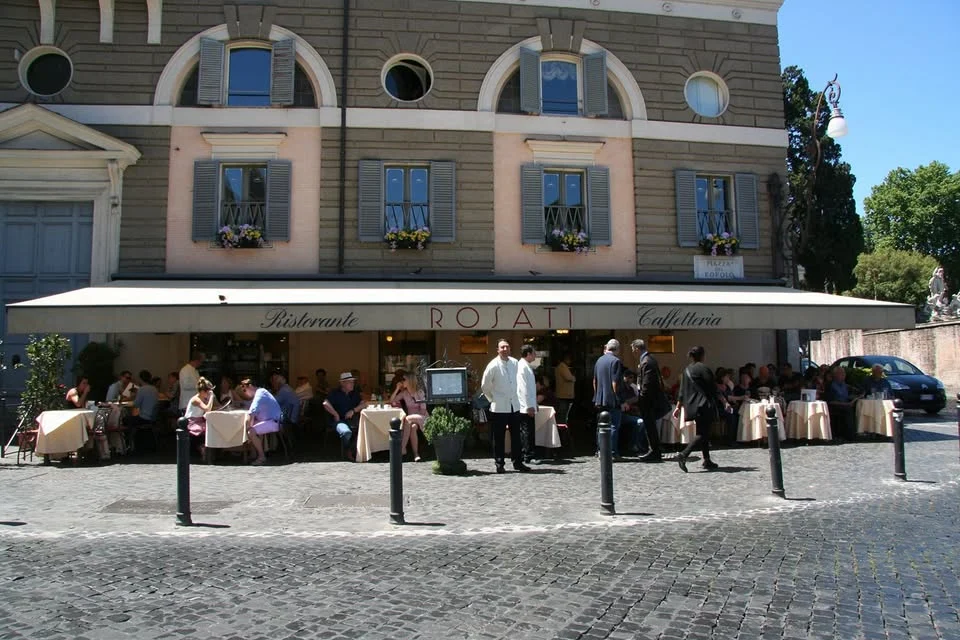
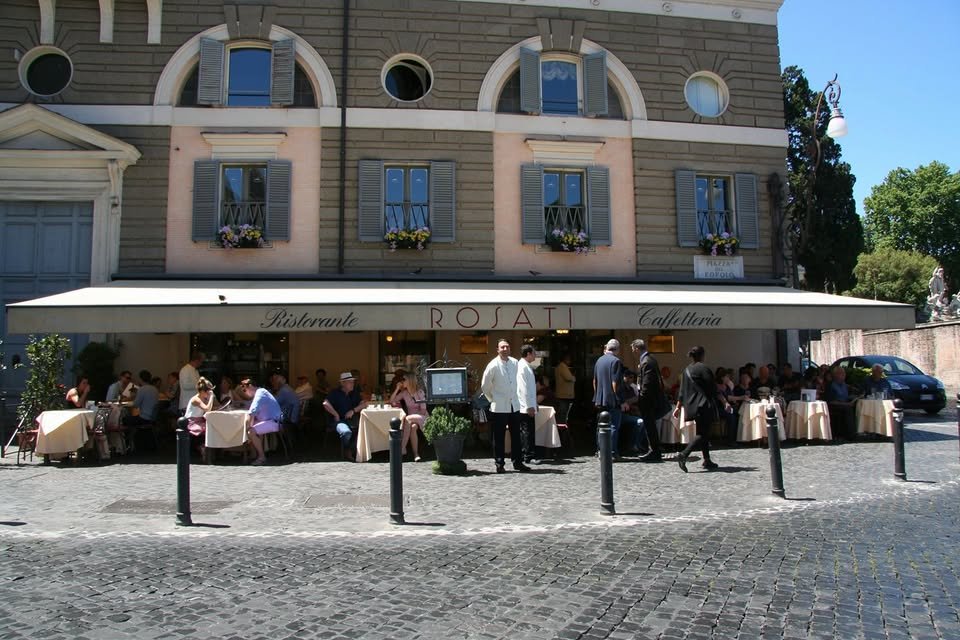
From the square the venue reads as a row of small tables under awnings, lined up along the facade and on the paving. It is the part everyone photographs and that gives the place its character: the street-level terrace, facing the obelisk and the Pincio. Inside are the bar counter, the pastry display and the restaurant rooms, spread over several spaces. The Comune's tourism portal describes the venue's architecture as Liberty style.
What not to expect. The Rosati is not a museum and has no panels, commemorative plaques readable from outside or a route telling its story. The memory of the place is kept in books and photo archives, not on the walls. Anyone who arrives hoping to find photos of Pasolini or Moravia hanging above the counter will be disappointed. You come to sit in a corner of the square where for 20 years a part of 20th-century Roman culture was made.
The position matters more than any furnishing. From here, seated, you take in the obelisk, the two churches, the ramps of the Pincio and the gate in a single glance. Few café terraces in Rome have a whole square in front of them, closed off, without traffic and designed as a single project. It is exactly the reason writers and painters chose these tables: to watch the city go by without having to move, and to be seen by those passing.
What It Is Like Today: Opening, Management, Hours and Prices
The venue is in business. The Roma Capitale tourism portal, in the version of July 31, 2025, lists it at Piazza del Popolo 4/5a with the phone numbers 06 3225859 and 06 3227378 and the email info@ristoranterosati.net. The venue's site, barrosati.it, presents the bar, pastry shop, restaurant, aperitifs and outdoor seating, with a booking page that gives the same main number. The service is that of a full bar-restaurant, from breakfast to dinner.
On the management it's best to be precise. The name has stayed that of the family that opened it, but ownership has changed several times. The free encyclopedia reports the sale in 1991 to Giuseppe Ciarrapico and later transfers to other owners, and the 2020 press also recalls his ownership for a period. The company that runs the venue today isn't named on the public tourism pages consulted. The name Rosati is a historic brand, not a family behind the counter.
Hours: the operator gives them on the site and by phone, and they change between summer and winter. The 2020 news report recalls that the official closing was historically at one in the morning, and the memoirs about the 1960s speak of tables left outside until late. Today don't count on late-night hours of that kind without having asked. For breakfast or an aperitif in the afternoon, on the other hand, the venue works steadily as a square-side café.
Prices: the figure isn't published in a dated form that can be reported here. By law the price list must be displayed in the venue, and it's best to read it before sitting down, because in all square-side cafés table service costs more than the counter and the difference, on a square like this one, is noticeable. Ask the price if an item doesn't have one. It isn't distrust, it's the habit of anyone who lives in Rome and has a coffee in the center.
On accessibility the public information is scarce. The outdoor tables rest on the level paving of the square and are reached without steps, while for the interior rooms, the restrooms and the connections between the restaurant's spaces the operator doesn't give an accessibility statement on the pages consulted. Anyone in a wheelchair or with a stroller does well to ask by phone when booking, specifying if they want to be inside or outside.
A Curiosity About Caffè Rosati
The Rosati was born from a dairy shop. According to the account published by Gambero Rosso on December 1, 2022, on the occasion of the centenary, the Rosati brothers took over in 1922 a small dairy shop facing the square and turned it into a café. Dairy shops, in the Rome of the early 1900s, were modest places where milk, eggs and little else were sold. Going from milk to coffee meant changing audience, and betting on the square as a place for strolling.
The bet made sense. Piazza del Popolo, until a few decades earlier, was the northern entrance to the city for anyone arriving by Via Flaminia, with the customs house, the passing of carriages and traffic that in the evening turned into a stroll toward the Pincio. A café in that corner intercepted those coming down from the gardens, those leaving the Corso and those arriving from the gate. The dairy shop served the neighborhood, the café served the whole city.
There is a second detail about the origins, and here the sources don't agree. The free encyclopedia writes that the Rosati family already ran a venue in Via Veneto from 1911, while the centenary account starts directly from the dairy shop in Piazza del Popolo. The two versions don't exclude each other, but none of the sources consulted documents the link between the two businesses with a verifiable deed or date. The shared name, by itself, isn't enough to reconstruct the genealogy.
What can be said with certainty is that 1922 is the date the venue claims, which appears in its brand and in the name of the official social page, and that in 2022 the centenary was celebrated publicly. Everything that comes before, that is, where the brothers came from and what trade they practiced, stays outside the accessible sources. For a venue that has seen half of Italian culture pass through, its origins are surprisingly little told.
Valadier's Building and the Venue
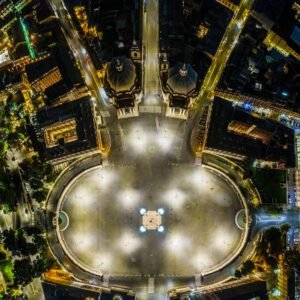
The square you see today is a project of the 1800s. Giuseppe Valadier, a Roman architect, redesigned it in the first decades of the century, giving it the exedra shape that closes it on both sides, with the ramps toward the Pincio to the east and the front toward the Tiber to the west. The Rosati occupies one of the two symmetrical buildings that close the square on the side of the churches, the one toward the district historically called dell'Oca, between Via di Ripetta and the river.
Symmetry is the point. Valadier had inherited an irregular square, with two 1600s twin churches that in plan are not twins, and the obelisk in the middle. His job was to put things in order: two hemicycles, two fountains, two identical buildings at the sides of the churches. The Rosati and the Canova live in the two mirror-image pieces of this stage set, and their rivalry arises first of all from an architectural fact: they are the same building seen in a mirror.
Of the interior of the venue the Comune's tourism portal speaks of Liberty style, and the definition holds for the layout of the historic bar. Over the years the restaurant has been enlarged and refurnished, and today the oldest part coexists with rooms of more recent character. There is no public protection record on the Rosati's furnishings that distinguishes the original piece from the reconstruction. Anyone who tells you every lamp dates from 1922 is telling a story, not documenting.
On the opposite side, the Canova is recognized as a historic shop by a registration decree of April 24, 2003, according to the Roma Capitale tourism portal. For the Rosati the same page doesn't report a decree, and the 2020 news report calls it a historic venue without citing the act. The municipal register of historic shops exists and is public, but the Rosati's registration doesn't appear on the pages consulted. A curious bureaucratic difference for two twin venues.
Something Nobody Tells You About Caffè Rosati
The Rosati closed. Not forever, but it closed. On October 27, 2020, in the middle of the second wave of the pandemic, the local press reported that the historic café had lowered its shutter for lack of customers. The head waiter, in service for 34 years, said he had cut the tables from 50 to 22 and had given up home deliveries so as not to distort the venue. It was a year from the centenary.
That closure says more than many anecdotes about writers. A square-side café lives on passing trade, and the passing trade at Piazza del Popolo, for decades, has been made up mostly of visitors. When the visitors vanished, the venue had no neighborhood of regulars to count on. It is the condition of almost all the historic cafés in the center, and the Rosati made it visible in a brutal way, in front of an empty square.
The reopening is documented. In April 2022 a new executive chef arrived in the kitchen, a pastry chef and leavened-dough specialist of Sicilian origin, and in December of the same year the centenary was celebrated with a panettone made specially in the venue's colors, gold and red. Gambero Rosso's account ties the relaunch precisely to the work on the pastry side. Today the venue is operating at full capacity, with bar, restaurant and outdoor seating.
Why it matters to know this. Because the story of the Rosati, told as an unbroken thread from 1922 to today, is a simplification. There were changes of ownership, a season of decline in the 1970s that the memoirs talk about, a closure in 2020 and a relaunch. Anyone who sits down here is not entering a time capsule. They are entering a commercial business that managed to keep its name and its position, and that is already quite a lot.
Rosati and Canova, the Two Cafés of the Square
Current status, first of all. At the check at the end of September 2026 both venues are in business. The Roma Capitale tourism portal, in the version of July 31, 2025, lists the Rosati at Piazza del Popolo 4/5a and the Canova at Piazza del Popolo 16/17, phone 06 3612231, as a bar and restaurant with outdoor tables and live music. The Canova's site publishes a bar price list dated 2025. Neither appears to be closed or under renovation.
On management the public information differs. For the Rosati the long series of ownership changes after the founding family is documented, from the sale in 1991 onward, the closure of October 2020 and the relaunch of 2022. For the Canova the sources consulted don't indicate recent changes of management or the name of the company that runs it: the information isn't published on the tourism pages. To know for certain you have to ask the venue directly.
The rivalry has a basis in memoirs. The journalist Giovanni Russo, in the book published by Rubbettino in 2006 on the Rome of the Dolce vita and its cafés, takes up the recollections of the screenwriter Ugo Pirro and describes the Rosati of the 1950s as the heir to what the great literary cafés of the center had been until the mid-1940s. The Canova, across the way, appears as the favorite place in winter, with cozy corners and more sheltered interiors.
This detail dismantles a very widespread legend. In the stories you hear in the square the division between the two cafés is political, with the left on one side and the right on the other. In the memoirs consulted the difference is instead seasonal and a matter of habit: in summer you stayed outside at the Rosati, in winter you sought the shelter of the Canova. A rigid political division isn't documented by dated sources, and people, then as now, crossed the square.
The Canova also has its photographic memory. In the archive of the Bridgeman agency there is a catalogued photograph by Mario Dondero showing Federico Fellini seated at the Canova with his secretary. It is one of the few visual documents that place a famous director precisely at one of the two tables, and ironically it concerns the venue less talked about. The literary fame went to the Rosati, the best-known photo to the one across the way.
The practical advice is to look at them together. Stand at the foot of the obelisk, turned toward the churches, and look at the two twin buildings at their sides. Same height, same openings, same role in the square, two different signs. It is the most correct reading of the whole matter: not two factions, but two halves of the same urban project by Valadier, occupied by two merchants who shared the same clientele for a century.
My Advice for Visiting Caffè Rosati
Come early in the morning, before 9:00, and have your coffee at the counter. The square at that hour is almost empty, the light comes in low from the ramps of the Pincio and stretches the obelisk's shadows across the paving, and inside you find the Romans who work in the area having breakfast standing up. It is the moment when the venue looks most like a neighborhood bar and least like a terrace for visitors.
If you want a table outside, pick it at sunset and count it as a ticket. You're paying for a front-row seat on one of the best-designed squares in Europe, and the coffee is the pretext. Read the price list on display before sitting down, order calmly and stay. The point of a table at the Rosati is to stay, exactly as the writers of the 1950s did who spent whole afternoons here.
Bring something to read by those who came here. A novel by Moravia, a collection by Flaiano, the Roman poems of Pasolini. It isn't a tourist gimmick: it is the only way to give content to a place that doesn't display its own history. Reading Flaiano at a table where Flaiano appears, seated, in the memories of his friends changes the quality of the stop more than any pastry.
For the restaurant, book, especially on weekends and on summer evenings. The phone number given by the venue is 06 3225859, and the site has a booking page. For the bar you need nothing. With a large group call ahead and ask explicitly if the outdoor tables are available, because in summer the terrace fills up early and the interior rooms are something else.
One last warning about event days. Piazza del Popolo is the place for big concerts, rallies and Comune events, and on those days the square is fenced off, the tables may be reduced and access becomes slow. Before arranging a meeting here, check on the Roma Capitale site if an event is scheduled. The Rosati stays open, but the square is no longer the same.
In winter, try the experiment that the memoirs suggest. Have a coffee at the Rosati counter, then cross the square and go into the Canova, and notice how the spaces change. This was the reason the same writers moved from one side to the other according to the season: outside at the Rosati in the sun, inside at the Canova in the cold. 20 minutes and two little cups are enough to understand the social geography of the square better than any book.
Another Well-Known Fact, Yet Rarely Cited
The Rosati is the café of the Scuola di Piazza del Popolo. The Comune's tourism portal also recalls it: in the 1960s the venue's tables were the meeting point of the painters of the group that took its name from the square, and among them the portal cites Franco Angeli, Tano Festa and Mario Schifano. Gambero Rosso adds Giosetta Fioroni. It is a piece of Italian art history that took place here, not just a round of drinks.
Everybody knows it, few connect it to what you see today. The works of that generation aren't hanging at the Rosati, but are kept in the city's museums. The Galleria Nazionale d’Arte Moderna, below Villa Borghese, is the place to see the Italian 1900s, and the MAXXI works on the following years. The natural route is to sit here and then go up to see the paintings.
The second rarely cited fact concerns the geography of the trade. The painters of the square lived and worked in the surroundings, between Via Margutta, Via del Babuino and the streets of the Tridente, where artists' studios were a tradition from the 1800s. The café was their waiting room, the place to meet gallery owners and critics. Without that network of studios a few minutes' walk away, the Rosati would have been a bar like any other.
Third fact: the decline. Russo's memoirs place the Rosati's peak between the 1950s and the mid-1960s, and speak of a change in clientele in the 1970s. It isn't conventional nostalgia. It is the moment when the center of Rome begins to empty of residents and fill up with offices and shops, and the literary cafés lose their reason for being. The Rosati comes out of it as a terrace, no longer as a circle.
La Dolce Vita and a Misunderstanding to Clear Up
Here I say the thing many people don't want to hear. The Rosati in Piazza del Popolo is sold everywhere as the café of the Dolce Vita, and the label is wrong. The Dolce Vita, the one of the lurking photographers and American stars, is Via Veneto, a kilometer and a half from here. The title of Russo's book itself says so, putting Flaiano and Fellini on Via Veneto, and so does the film.
The real season of the Rosati is another one, and in our opinion more interesting. It is the season of the postwar literati, of those who wrote novels and screenplays, of the intellectuals who discussed cinema and politics at the outdoor tables, and then of the painters of the square in the 1960s. Fewer flashes, more written pages. Confusing this story with that of the paparazzi means impoverishing it, not making it more attractive.
The misunderstanding has an explanation. The same people moved between the two areas, and some names, Fellini and Flaiano first of all, appear in both geographies. In addition, the free encyclopedia recalls that the Rosati family also had a venue on Via Veneto, and the identical name did the rest. But if you're looking for the place where the Dolce Vita was photographed, you have to go up toward Porta Pinciana, not come down here.
Why I insist. Because it often happens that people who arrive here look for the fountain from the film or Mastroianni's table, and the honest answer is that they aren't here. What is here is subtler: the place where Moravia and Morante spent their afternoons, where Pasolini came to sit, where Schifano waited for gallery owners. Anyone who comes with the Dolce Vita in mind leaves disappointed. Anyone who comes with books leaves happy.
The Right Photo to Take at Caffè Rosati
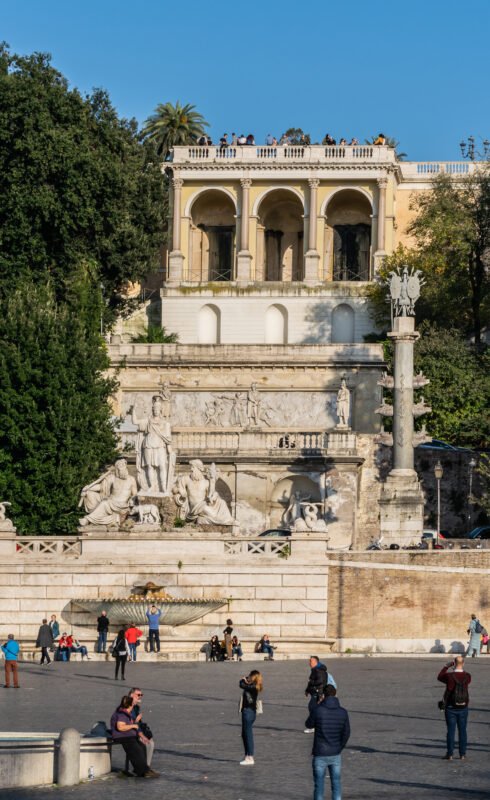
The right photo isn't taken at the Rosati, it's taken from the Pincio. Go up to the terrace above Valadier's ramps, stand at the balustrade and look for the corner between the square and Via di Ripetta. From up there you see the Rosati's small tables as a pale band along the facade, the obelisk in the center, the twin churches and the start of the Corso. It is the only shot that puts the café inside the design of the square.
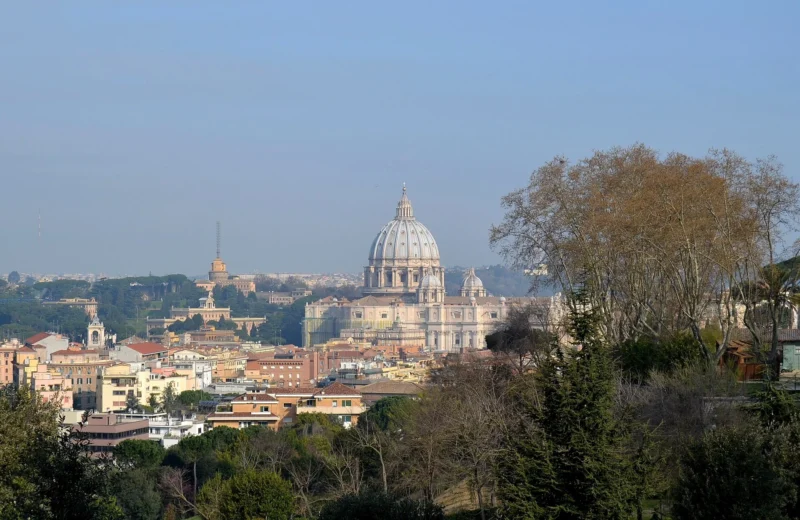
The best light is that of the late afternoon. In the middle hours the square is flat and dazzling, while from the Pincio the backlight of the sunset behind the dome of St. Peter's, visible on clear days, gives the depth that the middle hours lack. The view from the Pincio is one of the busiest viewpoints in Rome, so arrive before sunset to find a spot at the balustrade.
The second photo is taken from the center of the square. Stand near the lions of the fountain at the foot of the obelisk and shoot the Rosati's facade horizontally with the dome of Santa Maria dei Miracoli beside it. It is the image that tells the relationship between the café and the churches, and Valadier's symmetry. If you can, take the same shot toward the Canova and put the two photos side by side.
Avoid the photo of the little cup on the table with the blurred square behind it. It's the one everybody takes, it says little and it risks putting the people at the next tables in the foreground, who didn't ask to end up in your photo. If you photograph the tables, do it from a distance and without recognizable faces. Inside the venue always ask the staff before shooting, especially in the restaurant rooms during service.
Some Important Events That Happened Here in History
The first event is ancient and concerns the square, not the café. In 1589 Sixtus V had the Egyptian obelisk raised in the center, brought to Rome by Augustus, which previously stood in the Circus Maximus. Since then the square has had a visual focus and a meaning: it is the point where the three streets of the Tridente converge. The Rosati has faced that obelisk for a hundred years, and the obelisk had been there for more than three centuries before.
The second is Valadier's project, which in the first decades of the 1800s gives the square its current form with the exedras, the fountains and the twin buildings. The third is 1922, when the Rosati brothers turn the dairy shop into a café. They are three dates that can be read in the space: the obelisk, the architecture around it, the café that settles inside that architecture when the square is already a place for strolling.
In the centuries between the obelisk and Valadier the square was also the starting point of the race of riderless horses of the Roman Carnival, the barberi, which ran along the whole Corso to Piazza Venezia, and until the 1800s the place of some public executions. The Rosati therefore faces a space that has always been the city's theater, first of festivals and punishments, then of strolls, rallies and concerts.
The postwar period is the golden moment. Between the late 1940s and the mid-1960s the Rosati becomes the meeting point of writers, journalists, screenwriters and film producers, according to the recollections collected by Russo. Here, according to the same memoirs, screenplays were sketched, magazines were planned, nicknames were born. The waiters let young artists sit without making them order. Then, in the 1960s, the painters of the square arrive.
The 1970s mark the change in clientele and the venue's gradual shift toward a passing trade. In 1991, according to the free encyclopedia, the Rosati is sold to Giuseppe Ciarrapico, and other changes of ownership follow. The name stays, the family doesn't. In the same period the square is progressively freed of cars and returned to pedestrians, and the Rosati's terrace again faces a quiet space.
The square meanwhile changes function. In the second half of the 1900s it becomes the place of the big political and union demonstrations, of the closing rallies of electoral campaigns, of free concerts and of the New Year's parties organized by the Comune. The Rosati thus finds itself seated in the front row before half a century of Italian public history, and its tables have seen marches and stages pass without changing place. A function that no list of famous customers tells.
On October 27, 2020 the venue closes because of the pandemic crisis, with the tables reduced and the customers gone. In April 2022 the new kitchen and pastry team arrives, and in December 2022 the centenary is celebrated publicly. The Canova, on the other side, obtains in 2003 the decree recognizing it as a historic shop. These are the dates of recent history, less romantic than those of the writers but just as decisive for understanding why the Rosati still exists.
Who Has Passed Through Caffè Rosati
Alberto Moravia and Elsa Morante, first of all. In the recollections of Ugo Pirro taken up by Russo they are listed as very regular patrons, and their presence is the most cited in all the accounts. Two of the greatest Italian storytellers of the 1900s, a couple until the early 1960s, they lived in the area and made the Rosati their public living room. Anyone who wants to understand the place should start from them, not from the directors.
Pier Paolo Pasolini, who according to the same memoirs met Morante here in the 1950s. Ennio Flaiano, screenwriter, writer and fierce observer of Roman life, who in Russo's account is a fixture. Renato Guttuso, the most visible painter of the postwar cultural left. Mario Pannunzio, editor of Il Mondo, with the journalists of his circle, among them Sandro De Feo and Ercole Patti.
Then the painters of the square in the 1960s: Franco Angeli, Tano Festa, Mario Schifano, cited by the Comune's tourism portal, and Giosetta Fioroni recalled by Gambero Rosso. The same centenary account names Federico Fellini, the critic and politician Antonello Trombadori and Bernardo Bertolucci among the patrons. For these names the sources are more generic: they say that they passed through, not when or with whom.
A note on method. A name that appears in a list of patrons is not a document. A document is the recollection of a witness who says he saw someone sitting at that table in a certain season, like those collected by Russo. A document is a photograph cataloged in an archive with a caption. Everything else is tradition, and the tradition of a famous café naturally tends to lengthen the list.
It also works the other way around. Many real patrons never ended up in the lists because they weren't famous: the waiters whom the memoirs remember as generous with young artists without money, the residents of the neighborhood, the clerks of the offices on the Corso, the lesser-known gallery owners. The Rosati of the 1950s was a neighborhood venue frequented also by celebrated people, not a club of celebrities. Anyone who tells it only through the important names loses half the story.
Famous Customers: Documents, Tradition, Legend
What the documents say. The published memoirs, in particular Giovanni Russo's 2006 book that reports Ugo Pirro's recollections, place at the Rosati in the 1950s Pasolini, Morante, Moravia, Flaiano, Guttuso, Pannunzio, De Feo and Ercole Patti, and then young painters like Angeli and Festa. For the Canova there is the photograph by Mario Dondero with Fellini seated at the table. These are presences with a witness or an image behind them.
What tradition says. Encyclopedias and the press add names without dated episodes: Giorgio De Chirico, who lived in Piazza di Spagna, Carlo Levi, Roberto Rossellini, Bernardo Bertolucci, besides Fellini and Trombadori. They are plausible presences, because everyone lived or worked in the area or passed through Rome in those years, but in the sources consulted there is no account of a specific afternoon.
What is legend. A 2020 news report says that Fellini lived in the apartment above the venue. The director, as far as is known, lived on Via Margutta, in the Tridente, and the claim of the apartment above the Rosati finds no confirmation in the standard biographies. Legend too is the rigid political division between the two cafés of the square, which the memoirs consulted don't confirm and which they describe rather as a seasonal preference.
Then there are the famous lines. In stories about the Rosati, quips circulate attributed to Flaiano, to Moravia, to Pasolini, often without a source and often adapted from one book to another. None appears here in quotation marks, because none is placed at this table by a verifiable text. If someone tells you one, ask where he read it. Often the answer is another article that repeated it without a source.
How to Get There
By metro you get off at Flaminio, on line A, and enter the square passing under the Porta del Popolo. From the gate to the Rosati it's a few minutes on foot crossing the square diagonally to the right. It is the simplest and most beautiful route, because it makes you enter the square from its historic entrance, the one from which Grand Tour travelers arrived on Via Flaminia.
On foot from the center the route is that of the Tridente. From Piazza di Spagna you go up Via del Babuino and arrive on the other side of the square, in front of the Canova. From the Pantheon or from Piazza Colonna you take Via del Corso and come out between the two twin churches. From Via di Ripetta you arrive directly at the Rosati's corner, passing near the Ara Pacis.
By car it makes no sense. The Tridente is a limited traffic zone, the square is pedestrian, and the parking spots in the area are few and expensive. Anyone coming from outside Rome does better to leave the car in a park-and-ride lot and take the metro. Taxis can get close to the entrances of the square, but on event days the surrounding streets are closed and the approach becomes slow.
From the Pincio you walk down along Valadier's ramps, and it is the most scenic entrance: you arrive from above, see the whole square and descend toward the obelisk. It is a good finish for anyone who has spent the morning at Villa Borghese and the Galleria Borghese, which is about 20 minutes' walk away through the park. The ramps are wide but downhill, with a few unpaved stretches.
What to Combine in the Tridente
The first stop is on the same square. The Basilica of Santa Maria del Popolo, next to the gate, holds the two Caravaggios of the Cerasi Chapel and Raphael's Chigi Chapel, and is the strongest artistic reason to come to the square. The twin churches, in front of the Rosati, can be visited during service hours. The Museo Leonardo da Vinci, on the square, is the suggestion for families.
Going down the Corso you find the church of Gesù e Maria al Corso, then the Basilica of Santi Ambrogio e Carlo and, turning toward the river, the Mausoleum of Augustus with the church of San Rocco all’Augusteo. A little farther the Basilica of San Lorenzo in Lucina opens onto a quiet square, and Palazzo Ruspoli hosts temporary exhibitions.
On the literary side the Tridente is an open-air library. The Casa di Goethe, on the Corso, tells the story of the German poet's journey in Italy. The Keats-Shelley House, at the foot of the staircase, is dedicated to the English Romantics. They are two stops that give depth to the history of Rome's literary cafés: before the novelists of the 1900s, it was foreign travelers who filled the tables of the center.
Anyone following the thread of historic cafés will find on the site a general guide to the historic cafés and shops of Rome, with the overall picture of the venues recognized by the Comune. The discussion here stops at the square, because the Rosati makes sense read together with the Canova and Valadier's design more than inside a ranking of bars. For the same reason it's worth going up to the Pincio right afterward and looking at the square from above.
From the Pincio you continue on foot along the avenue that leads toward the staircase. You find Villa Medici, seat of the French Academy, with its gardens open to guided visits, then the Trinità dei Monti at the top of the staircase of Piazza di Spagna, and at the bottom the Barcaccia Fountain. It is a half-hour walk that closes the circle of the Tridente from above.
For cinema, the thread that ties the Rosati to Fellini and his screenwriters, the Casa del Cinema inside Villa Borghese organizes film series and meetings, and Cinecittà, outside the center, is the place where those films were shot. For the real Dolce Vita, the one of the photographers, there remains Via Veneto, reachable on foot through Villa Borghese.
Eating in the Area
The Tridente is the part of Rome where you eat worst for the same price, and I say it with the respect due to those who work honestly here. The reason is simple: residents are few, visitors very many, and a venue that lives on passing trade has no need to build loyalty with anyone. Romans don't come to dinner here by choice, they end up here for work or for an appointment. This doesn't mean that serious places don't exist, it means they have to be looked for.
The first signal to watch for is the photo menu displayed outside, with laminated images of the dishes and translations in five languages. A venue that has to show you the photo of the carbonara is addressing people who don't know what it is. The second signal is the person at the door who stops you to invite you in: a place that has to get customers on the street has no regular customers, and regular customers are the only guarantee.
The third signal is the woman rolling out the pasta sheet in the window or on the sidewalk. It's theater, meant to stop passersby. Fresh pasta made well is prepared in the kitchen in the morning, not in front of the dust of the street. The fourth signal is a kitchen open without interruption from morning to late at night: a real kitchen team takes a break, because it has to rest and prepare the next service.
The fifth concerns places set in front of monuments. They tend to have items without a price, like the fish of the day or the chef's dish, and sometimes a different price list between the outside tables and the inside room. Always ask the price before ordering. It also applies to chains with identical signs repeated on five squares in the center: convenient and predictable, but Romans don't go, simply because they know where to go elsewhere.
The criterion is to look at who is sitting. If at two in the afternoon on a Tuesday you see office workers, neighborhood shopkeepers and a few Roman families, you're in the right place. If you see only tables of visitors and the waiter switches to English at first glance, that is information, not a judgment. Moving a few streets away from the main squares, toward the river or toward the inner alleys, changes a lot.
A specific warning for anyone sitting at the tables of monumental squares, this one included. The price of a drink outdoors includes the position, and it's legitimate that it does. What isn't legitimate is finding out at the end. Read the price list on display, ask if table service has a surcharge and decide beforehand. It applies to any venue in the center, historic or recent, and spares you the only argument that truly ruins a Roman evening.
So you don't have to go by trial and error, we keep up to date a public list of addresses we really go to, in Rome and around, with no sponsorships and with venues that change when they change. You find it here: our list of the places where we eat. For the Tridente the usual rule applies: book, call first, and be wary of any venue that doesn't need reservations on a Saturday night.
Frequently Asked Questions
Is Caffè Rosati still open?
Yes. The venue is in business at Piazza del Popolo 4/5a, with bar, pastry shop, restaurant and outdoor tables. It closed temporarily in October 2020 during the pandemic and resumed work with a new kitchen and pastry team from 2022, the centenary year. The Roma Capitale tourism portal lists it with the phone numbers 06 3225859 and 06 3227378. For precise hours it's best to call first.
How much does a coffee cost at the Rosati?
The price list doesn't appear to be published in a dated form that can be consulted online, so I don't give figures. The price list is displayed in the venue as required by law and should be read before ordering. As in all square-side bars in the center, table service costs more than a drink at the counter, and on the terrace facing Piazza del Popolo the difference is significant. Ask the price of items that don't have one.
When did Caffè Rosati open?
The venue claims 1922 as its opening year. According to the account published by Gambero Rosso in December 2022, the Rosati brothers took over a dairy shop on the square that year and turned it into a café. The free encyclopedia reports that the family already had a venue on Via Veneto from 1911, but the link between the two businesses isn't documented with a deed in the sources consulted.
What is the difference between the Rosati and the Canova?
They are the two historic cafés of Piazza del Popolo, in the two twin buildings designed by Valadier at the sides of the churches. The Rosati is at the corner with Via di Ripetta, the Canova at Piazza del Popolo 16/17, toward Via del Babuino. In the memoirs of the 1950s the Rosati was the outdoor summer gathering place, the Canova the winter one, more intimate. Both appear to be open.
Was the Rosati the café of the Dolce Vita?
Not in the sense in which it is usually meant. The Dolce Vita of photographers and stars was Via Veneto. The Rosati in Piazza del Popolo had its golden season with the postwar writers and intellectuals, such as Moravia, Morante, Pasolini and Flaiano, and in the 1960s with the painters of the Scuola di Piazza del Popolo. Some figures frequented both areas, hence the confusion.
Who used to frequent the Rosati?
The published memoirs, in particular Giovanni Russo's 2006 book, recall at the Rosati Alberto Moravia, Elsa Morante, Pier Paolo Pasolini, Ennio Flaiano, Renato Guttuso and Mario Pannunzio. The Comune's portal cites the painters Franco Angeli, Tano Festa and Mario Schifano. Other names, such as Fellini, De Chirico or Rossellini, appear in press lists without precise, dated episodes.
Do you need to book at the Rosati?
For the bar and for a coffee at the counter, no. For the restaurant and for the outdoor tables on summer evenings and on weekends it is recommended, at 06 3225859 or with the booking page on the venue's site. With a large group it's best to call a few days ahead and ask explicitly about the availability of the terrace, which fills up first.
How do you get to Caffè Rosati by public transport?
The most convenient stop is Flaminio, on metro line A. Once out of the station you cross the Porta del Popolo and reach the venue in a few minutes on foot, on the right corner of the square as you face the twin churches. From Piazza di Spagna you walk along Via del Babuino, from the center along Via del Corso or Via di Ripetta. The square is pedestrian and the Tridente is a limited traffic zone.
Who Wrote This Page
The page comes from the editorial team of Tour Leader Pro, the Rome-based business that designs itineraries, visits and cultural events across Rome and Lazio. The address, phone numbers and opening status reported here come from the sources cited in the text, as of the date given at the opening. Since it is a private commercial business, hours and services may change without notice: check again before going and let us know what you find changed.
Putting together a walk in the Tridente means fitting together churches that open only during service hours, museums with mandatory booking, squares that are closed for big events and cafés that change hours with the season, for yourself or for a group of 40 people. Anyone facing this kind of puzzle finds on Tour Leader Pro working materials designed for those who guide and for those who organize on their own.
For the wider picture, that is regional trains and seasonal schedules, airports, rentals, moves from one province to another and destinations in Lazio outside the center of Rome, from the Castelli to the volcanic lakes of the north to the Tyrrhenian coast and the villages of the interior, a useful resource for putting together a multi-day itinerary is Italy Planner.
Contact Information
Nearby
 Piazza del Popolo100 m
- Flaminian Obelisk100 m
- Via del Corso100 m
- The Twin Churches of Piazza del Popolo100 m
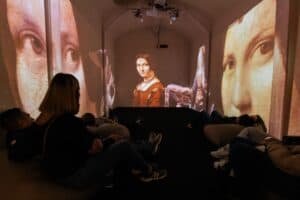
- Leonardo da Vinci Museum – Piazza del Popolo100 m
- Casa di Goethe100 m
Upcoming events nearby
- Fortunatamente at La Nuova Pesa, from October 1 to November 24, 2026100 m
- Passeggiate Romane at Porta del Popolo, gateway to Rome’s UNESCO Site, with LIS, November 7, 2026100 m
- Et in Arcadia ego at Casa di Goethe, December 2, 2026 to April 4, 2027100 m
- Suanjaya Kencut. Where Do We Belong? at the Mucciaccia Gallery, September 25 to November 9, 2026200 m