Published on
Some links on this page are affiliate links: if you buy through them, Estate Romana receives a small commission at no extra cost to you. As an Amazon Associate, Estate Romana earns from qualifying purchases.
Ancient Rome in 3 days is best seen by following the city as it grew: first the political heart, then the Campus Martius of the emperors, finally the road that left toward the south. The first day is for the Colosseum, the Palatine, the Roman Forum and the Imperial Forums. The second is for the Capitoline Hill and the plain between the Tiber and the Pantheon. The third is for the Circus Maximus, the Baths of Caracalla and the Appian Way, with the catacombs. That’s 14 stops, all reachable on foot or with a single public transit ride within the same day.
The program below is designed for people who come to Rome mainly for the archaeology and want to understand how the pieces fit together, instead of collecting tickets. For each day you’ll find the order of the stops, the time it takes, what to book and what to skip if your legs give out. Then the practical answers: where to sleep, how to get around, what to do if it rains.
Data checked on October 3, 2026 on the websites of the Colosseum Archaeological Park, the Soprintendenza Speciale di Roma (Baths of Caracalla), the Appian Way Archaeological Park, the Catacombs of San Callisto and the Musei in Comune di Roma. Hours and rules change with the seasons: the operator’s website is always what counts.

Ancient Rome in 3 days in brief
- What: an archaeological itinerary of ancient Rome in 3 days with 14 stops, divided into three areas close to each other so you don’t cross the city twice.
- Day 1: Colosseum, Palatine and Roman Forum in the morning, Trajan’s Markets with the Imperial Forums Museum and Trajan’s Forum in the afternoon.
- Day 2: Capitoline Museums in the morning, then the Largo Argentina Sacred Area, the Pantheon, the underground ruins of the Stadium of Domitian under Piazza Navona and the Ara Pacis.
- Day 3: Circus Maximus and Baths of Caracalla in the morning, Catacombs of San Callisto and the Appian Way Archaeological Park in the afternoon.
- To book ahead: the timed ticket for the Colosseum, Roman Forum and Palatine, on sale 30 days before the visit according to the Colosseum Archaeological Park.
- Closing days: the Baths of Caracalla and the state-run sites of the Appian Way are closed on Mondays, the Catacombs of San Callisto on Wednesdays: the third day shouldn’t fall on those days.
- Good to know: Ostia Antica, Hadrian’s Villa in Tivoli and the Domus Aurea, open only from Friday to Sunday, are left out and are the first to add with a fourth day.
The program for ancient Rome in 3 days
| Day | Morning | Afternoon | Evening |
|---|---|---|---|
| 1. The center of power | Colosseum, Palatine, Roman Forum | Trajan’s Markets, Imperial Forums Museum, Trajan’s Forum | Via dei Fori Imperiali lit up, dinner in Monti |
| 2. Capitoline Hill and Campus Martius | Capitoline Museums | Largo Argentina, Pantheon, Stadium of Domitian | Ara Pacis, historic center |
| 3. The road south | Circus Maximus, Baths of Caracalla | Catacombs of San Callisto, Appian Way | Back to the center, Testaccio or Aventine |
Save this itinerary in My Trip
The button opens “My Trip” with the 14 stops already loaded and divided into the three days. There you add the dates, the tickets you’ve bought and the hotel, and remove the stops you’re not interested in. The program stays saved on the phone or computer you’re using, with no registration.
Day 1: Colosseum, Palatine, Roman Forum and Imperial Forums
You start from the center of it all. A single timed ticket covers the Colosseum, the Palatine and the Roman Forum
. The amphitheater was inaugurated by Titus in AD 80, on the ground where the artificial lake of Nero’s residence used to be: from here you immediately understand that ancient Rome is made of layers, each built on top of the previous one. Book the first morning slot, when the arena is less crowded and the sun on the Palatine is still bearable.

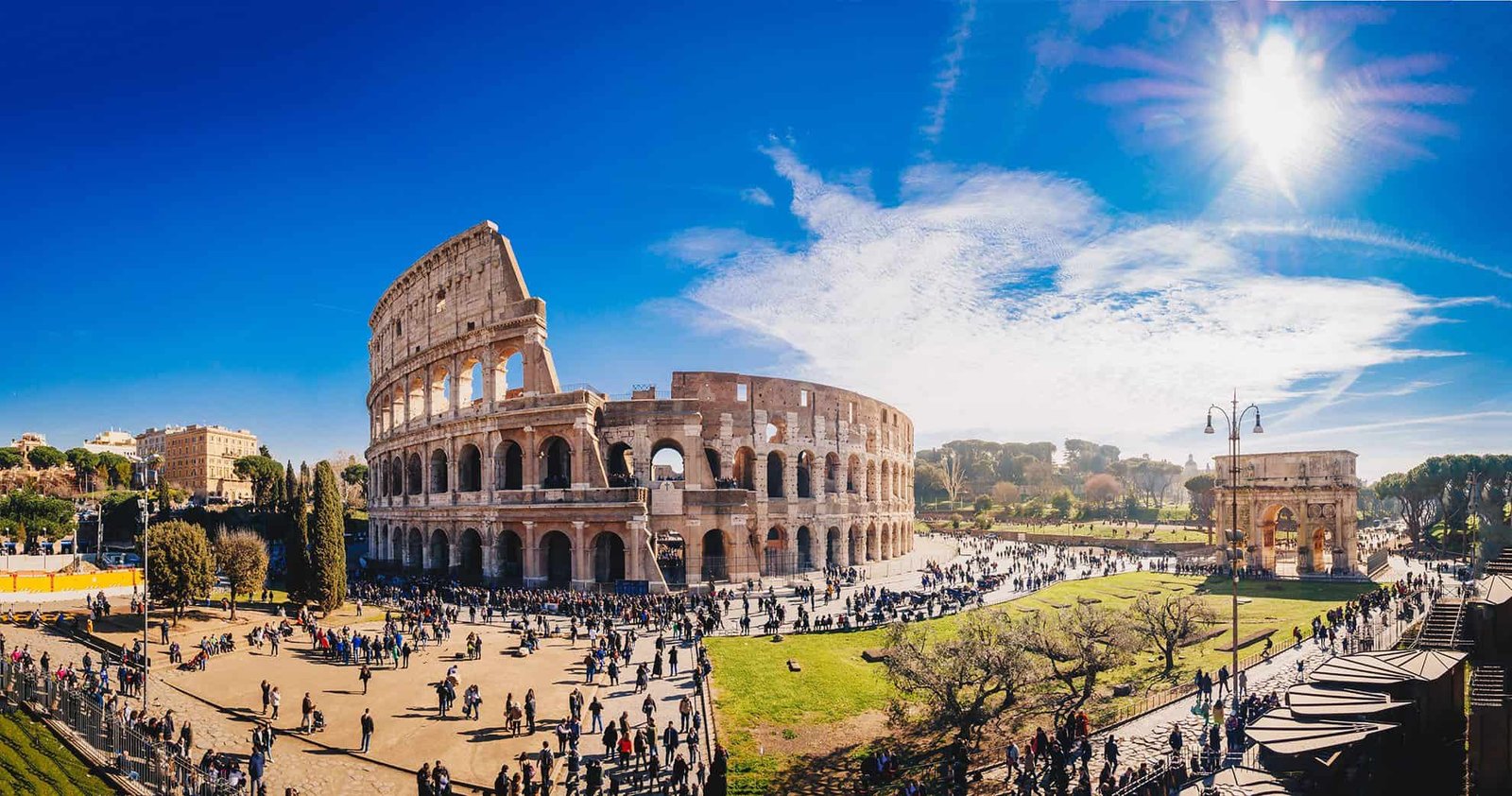
After the Colosseum you pass by the Arch of Constantine and climb the Palatine, the hill where according to tradition the city was born and where the emperors built their palaces. From the southern edge you look down on the valley of the Circus Maximus. Then you go down into the Forum, which you cross in the direction of the Capitoline Hill: here are the Curia, the triumphal arches and the eight columns of the Temple of Saturn, which guarded the state treasury. Plan on three or four hours in all: that’s an estimate, and if you read every panel it takes longer.
What to book ahead: the ticket. According to the website of the Colosseum Archaeological Park, sales open 30 days before the chosen date and from October 25, 2026 to February 28, 2027 the area closes at 16:30, with last entry at 15:30. If the official dates are sold out, there are entry to the Colosseum and Forum with an audio guide on GetYourGuide, the guided visit of the Colosseum, Forum and Palatine and the Colosseum offers on Tiqets.
For lunch you leave the Forum and head toward the Monti district, a few minutes on foot past Via dei Fori Imperiali. The afternoon is for the Forums of the emperors, built when the Roman Forum was no longer enough. Trajan’s Markets house the Imperial Forums Museum: you walk inside a 2nd-century building, on several floors, and from the terraces you look down on Trajan’s Forum with Trajan’s Column. According to the Musei in Comune di Roma the museum is open every day from 9:30 to 19:30, with last entry an hour before. A couple of hours is enough.
If you’re tired, what to skip: the inside of the Markets. Trajan’s Forum and the Column can be seen well from the street too, for free, and Via dei Fori Imperiali at sunset, with the monuments lit up, is the simplest way to end the day. For dinner look in Monti, or book with TheFork.
Day 2: the Capitoline Hill and the Campus Martius
The second day starts from the most sacred hill of Rome. The Capitoline Museums, open every day from 9:30 to 19:30 according to the Musei in Comune, hold what the Forum has lost: the original equestrian statue of Marcus Aurelius, the fragments of the colossal statue of Constantine, the She-Wolf. From the underground gallery that connects the two palaces you reach the overlook on the Forum, the most complete view of what you crossed the day before. It takes two or three hours.
Going down from the Capitoline Hill toward the north, in 10 minutes on foot you reach the Largo Argentina Sacred Area, four temples from the Republican age below street level. Here, right by the Theater of Pompey, stood the Curia where Julius Caesar was killed on the Ides of March in 44 BC. You can see the area well from the railing. For access to the inner path the hours are on the website of the Capitoline Superintendency. Half an hour is enough.
Another five minutes and there’s the Pantheon
, the only large building of ancient Rome still standing with its roof. The inscription on the front names Marcus Agrippa, but the building you see is the reconstruction ordered by Hadrian. The concrete dome, with the open oculus, is still the largest of its kind. Entry is paid and by time slot: it’s best to get the ticket ahead, from the official website or with entry to the Pantheon on GetYourGuide or on Tiqets.
Lunch fits well in this area. In the afternoon you go to Piazza Navona, which has the exact shape of the stadium Domitian had built for athletic games: the houses sit on the bleachers. Under the north side, the underground ruins of the Stadium of Domitian show the original arches, a few meters below the square. It’s a short visit, an hour at most, and it explains in one go how Rome grew on top of itself.
The last stop is the Ara Pacis, a quarter of an hour on foot toward the Tiber: the altar dedicated to Augustus’s peace, consecrated in 9 BC, today protected by the glass pavilion on the riverbank. According to the Musei in Comune it’s open every day from 9:30 to 19:30. Next to it is the Mausoleum of Augustus. If you’re tired, what to skip: the Stadium of Domitian, because the square above already tells its story. If you prefer a single pass for entries and transport, you can consider the Rome City Pass from Turbopass, checking which sites of this day it includes.
Day 3: Circus Maximus, Baths of Caracalla and the Appian Way
On the last day you leave the center following the direction of the legions and the pilgrims. You start early from the Circus Maximus, Circo Massimo stop on Metro B: today it’s a big lawn, but the outline of the chariot-racing track can still be read. 20 minutes is enough. From here to the Baths of Caracalla it’s about 10 minutes on foot along Viale delle Terme di Caracalla.
The baths, inaugurated in AD 216, are the best-preserved ancient bath complex in Rome: the walls of the caldaria still rise dozens of meters and the floor mosaics are partly visible. According to the website of the Soprintendenza Speciale di Roma, the Baths are closed on Mondays and on the winter schedule open from 9:00 to 16:30. Tickets are bought on Musei Italiani portal or on site. An hour and a half is a reasonable estimate.
After the baths you move to the Appian Way with the bus that runs along the road: lines and times are on the Atac website. The Appian Way Archaeological Park protects the stretch of the regina viarum opened by Appius Claudius Caecus in 312 BC. The first appointment is the Catacombs of San Callisto: according to the catacombs’ website they are closed on Wednesdays and open from 9:00 to 12:00 and from 14:00 to 17:00, with guided visits of about 40 minutes every half hour. They are also closed from January 13 to February 10, 2027.
If you want the organized visit, there’s the tour of the Catacombs of San Callisto on GetYourGuide. Once out, you walk on the Appian Way toward the south up to the Mausoleum of Cecilia Metella, among Roman paving stones, tombs and pines. According to the Park, its sites are closed on Mondays and in October they open from 9:00 to 18:30, from November to February until 16:30. Farther on is the Villa of the Quintilii, the largest villa of the suburbs: with a short afternoon, it’s best to keep it for another time.
If you’re tired, what to skip: the long walk on the Appian Way. As an alternative you do it by bike, with
the bike tour of the Appian Way, catacombs and aqueducts, or sitting down, with the two-and-a-half-hour golf cart ride through the catacombs and the Appian Way or with the golf cart city tour with the catacombs, a comfortable solution for people traveling with older people or small children.
What not to put in ancient Rome in 3 days?
The contrarian position worth taking has to do with the photo at the top. The Domus Aurea is the stop many would like to squeeze into the first day, because it’s a short walk from the Colosseum. According to the page of the Colosseum Archaeological Park, though, it’s open only on Friday, Saturday and Sunday, with timed entries and several closing days. Adding it to a day that already has the Colosseum, Palatine and Forum means coming out exhausted. If your calendar matches the weekend, it’s better to swap it for Trajan’s Markets, maybe with the visit with virtual reality.
The second mistake is the line at the Mouth of Truth, five minutes from the Circus Maximus. The big marble mask was in all likelihood a manhole cover or a fountain cover. The story of the bite for liars is a medieval legend. You can see it from the gate in a minute: half an hour of queuing for the photo with your hand inside, on the only day dedicated to the Appian Way, is time taken away from the baths.
The third mistake concerns trips out of town. Ostia Antica and Hadrian’s Villa are among the most beautiful archaeological sites in Italy, and for that very reason they each ask for a whole day. In three days they would take a third of the program away from the city.
Where to sleep for this itinerary?
For ancient Rome in 3 days the ideal area is the Monti district, between the Colosseum and Termini station: on the first day you go on foot, on the second you go down toward the Capitoline Hill in a quarter of an hour, on the third Metro B takes you to the Circus Maximus in two stops. Good alternatives are the area of the Celian Hill and San Giovanni, quiet in the evening and handy for the Appian Way, and Testaccio, close to the Circus Maximus and full of trattorias.
The historic center around the Pantheon is convenient only for the second day and costs more. Termini is practical for those arriving by train, less pleasant in the evening. To compare properties by area, with the free cancellation filter, there’s Hotels.com.
How do you get around?
On foot, for the first two days. The stops of the first are all within a kilometer and a half. Those of the second are in a walk of about two kilometers from the Capitoline Hill to the Ara Pacis. On the third day you need Metro B to the Circus Maximus and then the bus to the Appian Way: lines, times and tickets are on the Atac website, because the runs change with the seasons and on holidays.
You don’t need a car, and in the center it’s a problem because of the limited traffic zones. To get to Rome, high-speed trains stop at Termini and Tiburtina: you can compare times and fares on Trainline. If you want an overall idea of the city before you start, sitting down, you’ll find the offers of Viator in Rome.
What should you book before leaving?
First of all the Colosseum, as soon as sales open for your date. Then the Pantheon, especially on weekends. The catacombs don’t require a reservation for individuals, but on busy days the wait can get longer. Capitoline Museums, Trajan’s Markets, Ara Pacis and Baths of Caracalla usually have tickets available on site.
The most important check is the calendar. The third day can’t fall on a Monday, because of the Baths and the Appian Way, or on a Wednesday, because of San Callisto. If you prefer to buy everything in one place, you’ll find the experiences in Rome on GetYourGuide and the tickets for the attractions of Rome on Tiqets. Before buying, read the language, duration and what’s included on the product page.
What changes if it rains?
A lot, because ancient Rome in 3 days means being outdoors at least two days out of three. The second day is the most sheltered: the Capitoline Museums, Pantheon and Ara Pacis are indoors. With rain forecast, move it and do the Forum in the best weather: in the rain the paving stones are slippery and there’s no shelter. The Appian Way in the rain turns to mud.
There’s no shortage of indoor alternatives. At Termini there are the Baths of Diocletian and Palazzo Massimo alle Terme, with the frescoes from the villa of Livia. On Via Ostiense the Centrale Montemartini puts ancient statues among the machines of a power plant. According to the Musei in Comune it’s closed on Mondays. More ideas on the page of the museums of Rome.
What about one day more or less?
With two days you keep the first and the second, giving up the Appian Way. With a fourth day there are two choices: a trip to Ostia Antica, with entry with an audio guide, or Tivoli, with the excursion to Hadrian’s Villa and Villa d’Este.
If you stay in the city you add the Domus Aurea, if it’s the weekend, and the Basilica of San Clemente, a few minutes from the Colosseum: three stacked levels, from the medieval church down to a temple of Mithras. The other destinations out of town are in the near Rome section.
What to bring for ancient Rome in 3 days
The archaeological sites are almost all outdoors, on uneven ground and with little shade. For each item we list more than one search, because individual models sell out. Prices change constantly and should be checked when you buy. For deliveries, the estimated date at the time of the order is what counts: if you leave in a few days, check it before buying.
To read before and during
- An archaeological guide to Rome: with site plans, to find your way in the Forum.
- A history of ancient Rome: to read in the evening, to put what you’ve seen in order.
- An atlas of ancient Rome: the reconstructions help you imagine the buildings whole.
- A travel notebook: to jot down inscriptions, names and impressions.
For walking in the sun
- Comfortable walking shoes: thick sole for the paving stones of the Forum and the Appian Way.
- Folding sun hat: on the Palatine and at Caracalla shade is rare.
- Face sunscreen: useful in October too.
- Insulated water bottle: public drinking fountains can be found inside some archaeological areas too.
- Windproof folding umbrella: to keep in your backpack from October to April.
To see and to not miss anything
- Compact binoculars: for the reliefs of Trajan’s Column and the capitals up high.
- 10,000 mAh power bank: tickets, audio guides and maps drain the phone.
- Anti-theft backpack: for the metro and the lines at the busiest places.
- Anti-theft travel fanny pack: the light alternative for documents and phone.
Frequently asked questions
Are three days enough to see ancient Rome?
They’re enough for the essential places of ancient Rome: the Forum, the Palatine, the Colosseum, the Imperial Forums, the Pantheon, the Baths of Caracalla and the first stretch of the Appian Way. They’re not enough for Ostia Antica, Hadrian’s Villa and the big archaeological museums at Termini, which need more time. The program is meant to understand the ancient city as a whole, not to see every stone.
Which day of the week is best to start?
It’s best to plan so that the third day doesn’t fall on a Monday or a Wednesday. On Mondays the Baths of Caracalla and the state-run sites of the Appian Way are closed. On Wednesdays the Catacombs of San Callisto are. Starting on a Thursday, Friday or Saturday, for example, works. If the calendar doesn’t allow it, you swap the third day with the second.
What changes in winter?
Mostly the closing times. From October 25, 2026 to February 28, 2027 the Colosseum area closes at 16:30, and Caracalla and the Appian Way sites follow the winter schedule too. Start the days early, leaving the indoor museums, like the Capitoline ones, for late afternoon.
Is the itinerary good for children?
Yes, with a few cuts. The Colosseum and the catacombs please almost all children, the Forum a bit less. It’s best to take one stop out per day, for example Trajan’s Markets and the Stadium of Domitian, and do the Appian Way by bike or golf cart. A long break in the middle of the day saves the afternoon.
Do you need a guided visit or is an audio guide enough?
It depends on how much you’ve read beforehand. In the Roman Forum, where mostly bases and columns remain, an explanation on the spot helps a lot. At Caracalla and the Ara Pacis the panels are enough. At the catacombs the guided visit is the normal way in. A good paper guide, read the night before, makes any choice more useful.
Can you see anything of ancient Rome for free?
Yes, quite a lot. The Circus Maximus, the Largo Argentina Sacred Area seen from the street, Trajan’s Column, Piazza Navona and the path on the Appian Way are accessible without a ticket. According to the Appian Way Park, its sites are free on the first Sunday of the month. The rest of the program, from the Colosseum to the Pantheon, is paid.
How does “Save this itinerary” work?
The button under the table opens Estate Romana’s “My Trip” with the 14 stops already divided into the three days. You can enter the dates, remove or add places, mark the tickets you’ve bought and share the program with whoever is traveling with you. You don’t need an account: the trip stays saved on the device you’re using.
Who wrote this and from what sources
The text comes from the editorial team of Tour Leader Pro
, the Rome-based company that designs itineraries, visits and cultural events across Rome and Lazio. Hours, closures and sales rules come from the websites of the Colosseum Archaeological Park, the Soprintendenza Speciale di Roma, the Appian Way Archaeological Park, the Catacombs of San Callisto and the Musei in Comune, as of the date given at the top. Visit times and distances are estimates. Tell us what you find has changed.
Organizing three days of archaeology, for yourself or for a group of friends, means fitting together timed tickets, different closing days for each site and the pace of whoever walks slowest: a useful resource for anyone who organizes group trips is Tour Leader Pro. If Rome is only the start of a longer trip across Lazio, Campania and the ancient sites of the South, a useful resource for putting together a multi-day itinerary is Italy Planner.