Published on
Some links on this page are affiliate links: if you buy through them, Estate Romana receives a small commission, at no extra cost to you. As an Amazon Associate, Estate Romana earns from qualifying purchases.
Rome for free in 2 days can really be done, as long as you accept one rule: you see the piazzas, the churches, the viewpoints and the rioni, not the big museums. The first day crosses the center from Piazza del Popolo to Piazza Navona, passing by the Pincio, the Spanish Steps and the Trevi Fountain. The second starts at St. Peter’s, climbs to the Janiculum and goes down to Trastevere, Tiber Island and the Ghetto. 10 stops, five a day, all on foot and with no ticket.
There’s one part of the title you have to take seriously, though: some things that were free for decades now cost money. The Pantheon has had a ticket since 2023, and the Trevi Fountain has a paid entry for the area near the basin since February 2026. We point it out stop by stop, along with how to see them without spending.
Data checked on October 3, 2026 against the City of Rome press release on the Trevi Fountain, the website of the Directorate of National Museums of the City of Rome for the Pantheon, and the websites of the Colosseum Archaeological Park, the Vatican Museums and the Non-Catholic Cemetery. For churches, opening hours change with religious services: go by what each basilica publishes.
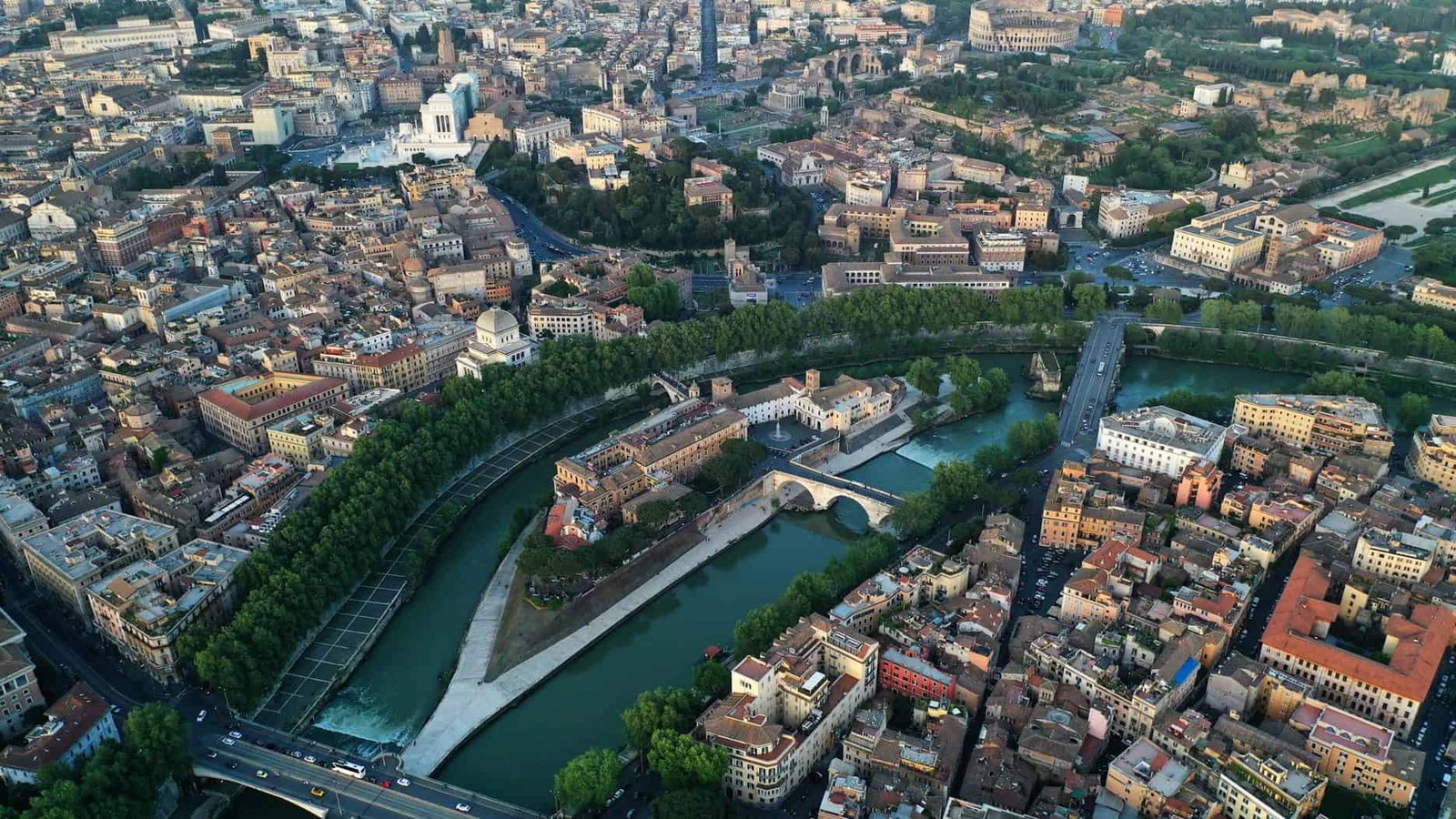
Rome for free in 2 days at a glance
- What: an itinerary for Rome for free in 2 days with 10 free-entry stops, five a day, grouped in two walkable areas.
- Day 1: Santa Maria del Popolo and the Pincio in the morning, Piazza di Spagna and Trinità dei Monti around midday, Trevi Fountain and Piazza Navona in the afternoon.
- Day 2: St. Peter’s Basilica at opening time, the Janiculum mid-morning, Trastevere at lunch, then Tiber Island and the Jewish Ghetto until evening.
- What you now pay for: the full Pantheon ticket is 7 euros from July 1, 2026, the ticket for the Trevi basin area is 2 euros from February 2, 2026. From the piazza the fountain is still visible for free.
- Free Sundays: on the first Sunday of the month, state museums and sites are free, including the Pantheon and the Colosseum. On the last Sunday of the month the Vatican Museums are free from 9:00 to 14:00.
- Getting around: on foot within each day. The metro is only for getting to the first stop, Flaminio on the first day and Ottaviano on the second.
- Good to know: water is free too, from the public drinking fountains called nasoni. A water bottle is the only purchase this itinerary really asks for.
The plan for Rome for free in 2 days
| Day | Morning | Afternoon | Evening |
|---|---|---|---|
| 1. The center of the piazzas | Santa Maria del Popolo, Pincio | Piazza di Spagna and Trinità dei Monti, Trevi Fountain | Piazza Navona |
| 2. From the Vatican to the Ghetto | St. Peter’s Basilica, Janiculum | Trastevere, Tiber Island | Jewish Ghetto |
Save this itinerary in My Trip
The button opens “My Trip” with the 10 stops already loaded and split across the two days. There you can add dates, your hotel and any tickets, remove what doesn’t interest you and add the variations you’ll find further down. The plan stays saved on your phone or computer, with no registration.
Day 1: from Piazza del Popolo to Piazza Navona
You start from the north, at the Flaminio stop on line A, and head south, so the walk is almost all flat or downhill. The first stop is Santa Maria del Popolo, the church next to the gate where for centuries people entered Rome from the north. Entry is free and inside there are two Caravaggio paintings, in the Cerasi chapel to the left of the main altar. Half an hour is enough. It’s best to arrive early: it’s a church with services, and visits are suspended during them.

Once you’re out in the piazza, you go up to the Pincio by the ramps to the left of the church: 10 minutes uphill, the only real climb of the day. The terrace looks down on Piazza del Popolo and, beyond the rooftops, the dome of St. Peter’s, which will be tomorrow’s first stop. From here you walk into Villa Borghese, the most central public park in Rome: if you have time, loop around the little lake, if not, keep going along the avenue to Trinità dei Monti. Allow an hour for terrace and park, as an estimate.

The avenue leads straight to the top of the steps. The church of Trinità dei Monti can be visited during the hours of the community that looks after it, and from the churchyard you get the best view over Piazza di Spagna. Take your time going down the steps: it’s one of the most crowded spots in the center, and the rules of conduct on the steps are enforced. At the bottom is the Barcaccia, the boat-shaped fountain, and the water that comes out is drinkable.
From Piazza di Spagna to the Trevi Fountain it’s 10 minutes through the inner streets. Here something has changed compared to the past. According to the City of Rome press release of January 28, 2026, since February 2 the entrance ticket to the area in front of the basin is 2 euros for tourists and non-residents, on Monday and Friday from 11:30 to 22:00, on other days from 9:00 to 22:00, with last entry at 21:00. Exempt are residents of Rome and the Metropolitan City, children under 6, and people with disabilities with one companion.
What this means for a Rome for free in 2 days itinerary: you can see the fountain for free from the piazza, always, and after 22:00 up close too, with no ticket. Our advice is to look at it from Via della Stamperia side during the day, without queuing, and come back in the evening after dinner, when the gate opens to everyone and the artificial light makes it more beautiful. If you still want to go down to the steps, you’ll find the ticket on the official site fontanaditrevi.roma.it.
Lunch, packed or standing up, works well between Trevi and the Pantheon. The Pantheon is the best-known case of a place that’s no longer free: according to the Directorate of National Museums of the City of Rome, since July 1, 2026 the full ticket costs 7 euros, the reduced ticket for European citizens between 18 and 25 costs 2 euros. It’s free for under-18s, for residents of the Municipality of Rome and for everyone on the first Sunday of the month. The portico and the piazza, with the fountain and the obelisk, remain free.
If you want to go in and pay, there are also Pantheon tickets on GetYourGuide and those on Tiqets, which cost more than the official ticket because they include an app or services. Two minutes from the Pantheon is the free stop many people skip: the church of San Luigi dei Francesi, with the three Caravaggio paintings on the cycle of St. Matthew in the Contarelli chapel. Free entry, church hours.
The last stop is Piazza Navona, five minutes away. It has the shape of the Stadium of Domitian it’s built on and three fountains: the Fountain of the Four Rivers, in the center, is by Bernini. Late afternoon is the right time, with the street artists and the low light. For an aperitivo and dinner, prices drop a lot as soon as you move away from the piazza toward Campo de’ Fiori and the side streets.
If you’re tired, what to skip: Villa Borghese. From the Pincio you go straight down to Trinità dei Monti in a quarter of an hour. If instead you want to see the center sitting down, for once, you can consider
the short tour of the center by golf cart: it’s not free, but it saves your legs for the next day.
Day 2: St. Peter’s, the Janiculum, Trastevere and the Ghetto
The second day starts early, at the Ottaviano stop on line A, 10 minutes on foot from Piazza San Pietro. St. Peter’s Basilica is the biggest free place in Rome: you go in without a ticket, after the security checks under the colonnade. The line grows with the hours, which is why it’s best to be there at opening. Shoulders and knees covered, otherwise they’ll stop you at the entrance. Inside, an hour is enough for Michelangelo’s Pietà, Bernini’s baldachin and the nave.
The climb to the dome is paid. If you want to do it, you’ll find it among the dome and underground tours on GetYourGuide too. The Vatican Museums, on the other hand, are outside this itinerary except in one case: according to the Vatican Museums website, on the last Sunday of every month entry is free from 9:00 to 14:00, with last entry at 12:30, except when it coincides with certain holidays. You go in without a reservation, so with a long line: it’s a choice to make knowingly, because it eats up half a day.
From St. Peter’s you walk up to the Janiculum in half an hour, along Via del Gianicolo and the tree-lined promenade. It’s the widest viewpoint over the historic center, and at noon from the terrace of Piazza Garibaldi you hear the cannon shot that marks the hour. Further on, the Acqua Paola fountain, called the Fontanone, is the place to stop for photos. All free, all outdoors. If you saw the Pincio yesterday, here you’ll see how different Rome looks from the west.
From the Fontanone you go down to Trastevere by the steps of Via Garibaldi: a quarter of an hour. It’s lunchtime, and the rione is the place where you eat best spending little, as long as you stay away from Piazza di Santa Maria. The basilica of Santa Maria in Trastevere, with the apse mosaics, has free entry. If you arrive on a Sunday morning you’ll find the Porta Portese market a little further south: you stroll for free, you buy if you want.
If you’d like lunch to become an experience, and you’re willing to spend, you can look at the food tour of Trastevere and Campo de’ Fiori. For everyone else there’s the Estate Romana restaurant map and the discount offers you can book on TheFork.
In the afternoon you cross Ponte Cestio and reach Tiber Island, the only island on the Tiber in Rome. From the bridge you can see the ruin of the Ponte Rotto, the ancient Pons Aemilius. Go down to the embankment, if the river level allows it: it’s one of the few spots where you walk right at water level in the heart of the city. Three quarters of an hour is enough, longer in summer, because on the island plenty of people stop to sit in the cool.
You exit on the other side by Ponte Fabricio, the oldest Roman bridge still in use, and you’re in the Jewish Ghetto. The Portico d’Ottavia, the street of the same name and the Synagogue square are free and outdoors. The Jewish Museum and the visit to the Synagogue are paid and follow the calendar of Jewish holidays: hours on the museum’s website. The neighborhood is best seen at dinnertime, when the bakeries and trattorias of the main street are open.
If you’re tired, what to skip: the Janiculum. From St. Peter’s to Trastevere you can also get there on the flat, along the Tiber, in 25 minutes. If instead you have energy for one more sunset, from the Ghetto in a quarter of an hour you reach the Mouth of Truth and from there you climb up the Aventine, to the
Orange Garden: free, next to the basilica of Santa Sabina, it looks at St. Peter’s from the south and closes the circle of the two days.
What in Rome is no longer free?
The most common mistake, in a Rome for free in 2 days itinerary, is trusting lists from a few years ago. The most widespread legend is that the Pantheon is “always free”: it was until 2023, now it’s only for those under 18, for residents of the Municipality and for everyone on the first Sunday of the month. The second is that you can touch the Trevi Fountain whenever you want: since February 2026 the basin area has hours, gates and a ticket, and you toss the coin from the balustrade.
Then there are free places where a contribution is requested. The Non-Catholic Cemetery in Testaccio, where Keats and Shelley are buried, has free entry but, as the cemetery’s website says, it invites visitors to a voluntary contribution of 5 euros, which pays for the upkeep of the tombs. Our advice is to leave it: it’s how these places stay open.
What not to put in Rome for free in 2 days
The contrary position worth taking: the Colosseum on the first Sunday of the month is not a bargain. According to the website of the Colosseum Archaeological Park, entry is free on the first Sunday of the month, on April 25, June 2 and November 4, under the terms given on the dedicated page. They’re also the most crowded days of the year. Whoever has only two days and spends them in line for the free Colosseum gives up half of free Rome to save one ticket: better to pay for it another day or look at it from outside.
The same goes for the Appian Way Regional Park. The road and the countryside are free and beautiful, but on their own they ask for a whole day, far from the center: in two days it takes away half the program. Save it for a third day, maybe on Sunday, when the first stretch is quieter. Also out is Villa Doria Pamphilj, the biggest park in the city: perfect for someone who lives in Rome, too much for someone with 48 hours.
Which days to choose for Rome for free in 2 days?
If you can choose your dates, the weekend with the first Sunday of the month is the one that pays off most. The Ministry of Culture opens state museums and sites for free with the initiative Domenica al museo. In the coming months it falls on October 4, November 1 and December 6, 2026. In Rome, that day the civic museums are free too, such as the Capitoline Museums, the Ara Pacis and Trajan’s Markets, with free entry subject to capacity.
The last Sunday of the month is instead the Vatican Museums one, in 2026 October 25 and November 29, except for the holidays excluded from the museums’ calendar. The two don’t add up: a first Sunday and a last Sunday are never in the same weekend. The advice, for a Rome for free in 2 days itinerary, is to pick the first Sunday and go into the Pantheon and one of the civic museums, leaving the Vatican for another occasion.
Where to sleep for this itinerary?
To spend little, the most practical area is the one around Termini and the Esquilino: lots of budget places, the two metro lines and the station for those arriving by train. The neighborhood is less pleasant than the center in the evening, but for two nights it works. Prati, near Ottaviano, costs a bit more and is quiet: the second day starts right outside your door. Trastevere is lovely for dinner, less so for sleeping, because it’s the area worst served by the metro.
To compare prices in the different areas, with the free cancellation filter, there are Hotels.com and Booking.com.
How do you get around?
On foot, almost always. The first day is three or four kilometers, the second a bit more with the climb to the Janiculum: these are estimates, not measurements. The metro is for the first stop and for heading back: line A to Flaminio and Ottaviano, the two starting stops. Tickets and fares are on the transport company’s website.
To get to Rome, the train is often the cheapest choice if you book in time: timetables and fares can be compared on Trainline and on the website of
Italo. A car in the center isn’t needed: restricted traffic zones and paid parking quickly eat up the savings.
What should you book before leaving?
Almost nothing, and that’s the beauty of this itinerary. The 10 stops have no ticket or bookable time slot. Only the hotel, with a cancellable rate, and the train need to be locked in early. If you want to add a paid entry, the Pantheon is the one that’s worth the most for the time it asks: 20 minutes. For the rest, if you change your mind on the spot, you’ll find tickets for Rome attractions on Tiqets and experiences in Rome on GetYourGuide.
What changes if it rains?
A lot, because almost everything is outdoors. With rain forecast, flip the proportions: more churches and fewer viewpoints. On the first day keep Santa Maria del Popolo, San Luigi dei Francesi and, paying, the Pantheon, where the water falling from the oculus is a show few people plan for. The Pincio and Villa Borghese get skipped. On the second day St. Peter’s Basilica becomes a longer visit, and the Janiculum gives way to Santa Maria in Trastevere.
The free indoor alternatives are the big basilicas: Santa Maria Maggiore and San Pietro in Vincoli, with Michelangelo’s Moses, both near Termini. Other ideas under cover are on the Rome museums page, and what’s happening in the city on your days is in all the events.
And with one day more or less?
With one day only, keep the first and add St. Peter’s early in the morning, taking the metro from Ottaviano to Flaminio: you lose the Tiber part, which is the most relaxing. With a third day the free choices are two. To the south, Testaccio and Garbatella: the Non-Catholic Cemetery, the market and the working-class housing blocks, described in the pages on Testaccio and Garbatella. Or the Appian Way, by bike or on foot. If you like curious architecture, add the Coppedè neighborhood, and if you’re looking for a lawn for a packed lunch there’s the Circus Maximus, open to everyone.
What to bring for Rome for free in 2 days
Two days on foot, outdoors and without spending call for few things, but the right ones: they’re the only purchases that really make the rest cheap. For each item we give more than one search, because individual models sell out. Prices change constantly, so check them when you buy. If you order before leaving, what counts is the estimated delivery date at the time of the order: choose delivery to your home, not to the hotel.
For drinking and eating while spending zero
- Insulated water bottle: you fill it for free at the nasoni of Rome, the public drinking fountains scattered all over the center.
- 1-liter steel water bottle: the larger alternative for hot days.
- Travel lunch containers: a packed lunch bought at the market is the first saving of the day.
- Waterproof picnic blanket: for lunch at Villa Borghese or on the grass of the Circus Maximus.
For walking and shelter
- Comfortable walking shoes: thick soles, already worn at least a week before leaving.
- Windproof folding umbrella: keep it in your backpack from October to April.
To keep what you have safe
- Anti-theft backpack: on the metro and at Trevi it makes a difference.
- Anti-theft travel fanny pack: the light alternative for documents and phone.
To find your way
- 10,000 mAh power bank: maps and photos drain your phone before evening.
- Foldable map of Rome: it works without a battery and gives you a better sense of distances than a screen.
- A low-cost paper guide to Rome: to read the night before. Check the edition year, for the reasons explained above.
Frequently asked questions
Can you really visit Rome for free in 2 days?
Yes, if you stick to piazzas, churches, parks and viewpoints, which in Rome are plentiful and first-rate. The 10 stops of this program have no ticket. What’s left to pay for is lodging with the tourist tax, transport to get there and meals, which you can cut a lot with a packed lunch and water from the drinking fountains.
Is the Pantheon still free?
No, with some exceptions. Since July 1, 2026 the full ticket costs 7 euros, according to the Directorate of National Museums of the City of Rome. Free entry for under-18s, residents of the Municipality of Rome and everyone on the first Sunday of the month. The portico and the piazza in front remain free, and even from there you get a sense of the size of the building.
How much does the Trevi Fountain cost?
From the piazza, nothing: you can always see it for free. Since February 2, 2026 the entrance ticket to the area in front of the basin is 2 euros for tourists and non-residents, from 9:00 to 22:00, from 11:30 on Monday and Friday. After 22:00 that area is free too. Residents of the Metropolitan City, children under 6 and people with disabilities with a companion are exempt.
When do you get into Rome’s museums for free?
On the first Sunday of the month in state museums and sites, like the Pantheon and the Colosseum, and in the civic museums of Roma Capitale. On the last Sunday of the month in the Vatican Museums, from 9:00 to 14:00 with last entry at 12:30, except on some holidays. In both cases the lines are long: it’s best to arrive at opening and choose just one museum.
Is entry to St. Peter’s Basilica free?
Yes, the basilica has no ticket. You pass through the security checks under the colonnade, with a line that grows during the morning. The climb to the dome and the Vatican Museums are paid, and they’re a different visit with a different entrance. Shoulders and knees must be covered, otherwise you’re stopped at the entrance.
How does “Save this itinerary” work?
The button under the table opens Estate Romana’s “My Trip” and loads the 10 stops into it, already split across the two days. From there you can enter dates, add variations like the Orange Garden or Santa Maria Maggiore, remove what you don’t need and share the plan. You don’t need an account: it stays saved on the device you use.
Who wrote this and from what sources
The text comes from the editorial team of Tour Leader Pro, the Rome-based company that designs itineraries, visits and cultural events in Rome and Lazio. Tickets, hours and free admissions come from the City of Rome press release on the Trevi Fountain and from the websites of the Directorate of National Museums of the City of Rome, the Colosseum Archaeological Park, the Vatican Museums and the Non-Catholic Cemetery, as of the date shown at the top. Times and distances are estimates. Let us know if you find anything changed.
Organizing two days at almost zero cost, for yourself or for a group of friends, means fitting together free Sundays, church closures and the pace of whoever walks slowest: a useful resource for anyone organizing group trips is Tour Leader Pro. If Rome is only the start of a longer trip through Lazio, Umbria and Tuscany, a useful resource for putting together a multi-day itinerary is Italy Planner.