MuSEd – Mauro Laeng Museum of School and Education
In short. Before setting out, a warning that changes the plans: the MuSEd cannot be visited.
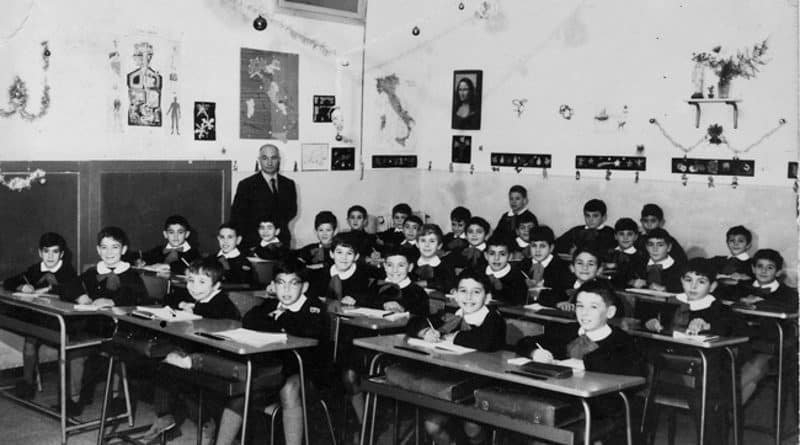
Before setting out, a warning that changes the plans: the MuSEd cannot be visited. The headquarters at Piazza della Repubblica 10 is closed for renovation work on the building and Roma Tre University has suspended both the consultation service and public access, until further notice. Anyone who shows up at the door finds a construction site, not a museum. The collections, however, have not vanished: they have been temporarily transferred to the department's premises at Via del Castro Pretorio 20, and part of the heritage travels around the city with the museum's itinerant project.
The practical file, in brief. Historic and legal address: Piazza della Repubblica 10, 00185 Rome, switchboard 06 57332032. Temporary location of the collections: Via del Castro Pretorio 20, 00185 Rome, switchboard 06 57339000 (for the same site the university also gives the address Via Milazzo 11/b). Teaching hub of the Department of Education Sciences, where in these months the off-site exhibition is set up: Via Principe Amedeo 182/b, switchboard 06 57339200. Single contact for any request for consultation, research or visit: mused@uniroma3.it. For activities with schools and for events: eventi.mused@uniroma3.it. Phone numbers given for the museum: 06 57339115 and 06 57339117. There is no ticket office and there is no ticket: the museum is a university facility and access, when allowed, is by appointment and free of charge. There are no continuous opening hours either: the MuSEd opens on request, not on a fixed calendar.
How you get there, when you get there again. Piazza della Repubblica has its station on metro line A, which bears the name of the square and of the Opera Theater. From Termini it's a good five minutes on foot, going up Via delle Terme di Diocleziano. Via del Castro Pretorio 20 is served by the Castro Pretorio station of line B, a couple of minutes' walk away, and by Termini station itself, which is the interchange between the two lines. Via Principe Amedeo 182/b is the stretch between Termini and Piazza Vittorio: from the central station it's seven or eight minutes on foot. Three addresses, a single urban quadrant, all inside the Castro Pretorio and Esquilino districts: whatever the destination of the day, the logistical base is Termini.
The rest of this guide serves to explain why a closed museum is still worth spending time on, and how to get in anyway: by writing, by booking, or by going to look for its display cases where the museum has taken them. To orient yourself among the other possible visits in the city there is the page of Rome's tourist attractions.
What the MuSEd really is
The MuSEd is the oldest Italian museum dedicated to the history of pedagogy, school and education, and belongs to the Department of Education Sciences of Roma Tre University. Put like that it sounds like a definition for a display board. Translated into concrete terms: it is the place where the desks, inkwells, blackboards, notebooks, report cards, primers, teachers' registers and teaching aids that Italy used to become literate have ended up, from the Bourbon and Savoy 1800s to the first personal computers that entered the classroom in the 1980s. It is a museum of collective memory disguised as a university museum.
The difference from a civic museum is substantial and must be understood right away, because it determines the way of visiting. A civic museum has a ticket booth, hours, an attendant and a marked route. The MuSEd has a director who is a full professor, a small staff, a scientific council and a public that the university defines, in order, as academic community, scholars and citizens. This means the museum exists to be studied before it is looked at, and that the door opens for whoever gives a reason for the request. It isn't snobbery: it is the legal nature of the thing.
The MuSEd is one of the three or four places in the city that manage to move an adult without using a single masterpiece. No Caravaggio, no Greek marble, no frescoed room. Just a rural school desk of the 1910s with the hole for the inkwell, and the precise feeling that that wood hosted someone who then fought in World War I. Anyone looking for aesthetic wonder should go to Palazzo Massimo alle Terme, which is 300 meters away. Anyone trying to understand how Italy was made, come here.
The museum recognizes itself in the international definition of a museum drawn up by ICOM, a permanent non-profit institution in the service of society, and at the same time presents itself as an instrument of the so-called university Third Mission, that is, that set of activities with which the university leaves its own corridors and speaks to the territory. It is a double nature that explains many things: the exhibitions in neighborhood libraries, the workshops for teachers, the cataloging work shared with the civil service.
Where the MuSEd is and how to get in today
The historic address of the MuSEd in Piazza della Repubblica
The headquarters is at number 10 Piazza della Repubblica, inside the building that Romans called for decades the Magistero, that is, the old Faculty of Magistero later merged into Education Sciences. The entrance is under the curved porticoes that shape the square, to the right of anyone looking at the Basilica of Santa Maria degli Angeli e dei Martiri with their back to Via Nazionale. Today that door is closed: the university has announced that because of renovation work the site is not open and it is not possible to access the museum for visits until further notice.
This is not a symbolic closure or a postponement of a few weeks. The construction site concerns the building, not the installation, and university building works have timelines nobody announces in advance. Anyone planning a trip to Rome in the coming months with the idea of getting into this museum should reckon with the concrete probability of still finding it inaccessible, and should write first to the museum's address to find out how things stand.
The temporary home of the MuSEd on Via del Castro Pretorio
The collection has been moved to the main premises of the Department of Education Sciences, at Via del Castro Pretorio 20, the building that houses teaching offices, administrative offices, faculty studies, conference rooms and the department library. It is a service location, not a museum installation: it means the materials are there, kept and partly consultable when the service resumes, but not that there is a visitor route to walk through.
It is worth knowing this because it saves a wasted trip. Showing up at Via del Castro Pretorio without an appointment, hoping to see the desks and the teaching aids, only gets you to a university doorman's desk. The way in goes through an email, not an intercom.
How to book a consultation at the MuSEd
The ordinary procedure, when the service is active, is simple and must be followed to the letter. You write to mused@uniroma3.it asking for an appointment and specifying what you want to see. For the archive the university also asks for a letter of introduction that clarifies the nature of the research. It is the practice of any serious historical archive and shouldn't intimidate: a degree thesis, a documented journalistic piece or a school research project are fully acceptable reasons. Consultation takes place on site, in the archive's dedicated room.
The library does not lend. Volumes are read there, by appointment, and anyone counting on taking home a primer from 1890 can spare themselves the request. It is the rule of every antiquarian collection and has an obvious reason: many of these books exist in very few copies, and the only way to still have them in 20 years is not to let them leave.
How to get to the MuSEd by public transport
For Piazza della Repubblica: metro line A, Repubblica stop, exit directly onto the square. Anyone arriving at Roma Termini by train can do it all on foot, five or six minutes along Via delle Terme di Diocleziano, skirting the side of the ancient baths. For Via del Castro Pretorio: metro line B, Castro Pretorio stop, or again Termini, which is about 10 minutes' walk away. For the teaching hub on Via Principe Amedeo: leave Termini on Via Giolitti side and continue toward Piazza Vittorio Emanuele II.
One piece of advice: in this quadrant the car is a sentence. Parking around Piazza della Repubblica is paid, scarce and patrolled, and the traffic on Via Nazionale at peak hours is what it is. The regional train, the metro or your own legs solve the problem in a quarter of the time.
The history of the MuSEd, from 1874 to today
Few Roman institutions have such a checkered biography. The museum is born, dies, rises again, dies again and rises once more, four times in 150 years, and every resurrection carries the name of a different educator. Telling it in full serves to understand why today the MuSEd keeps materials nobody else has.
1874: Ruggero Bonghi and the Museum of Instruction and Education
The original core goes back to 1874 and is due to Ruggero Bonghi, then minister of Public Instruction of the Kingdom of Italy. United Italy had an arithmetic problem before a cultural one: a population largely illiterate and a teaching corps to be built from nothing. Museo di Istruzione e di Educazione was conceived as a tool for training teachers, and for this reason it was equipped from the start with a library of international standing and a collection of the most advanced furnishings and teaching tools the European market offered.
The first home was the Ennio Quirino Visconti classical high school, in Piazza del Collegio Romano, at number 4, in the block that had been the great college of the Jesuits. Alongside the museum were placed a circulating library, which lent books to teachers, and a periodical titled Il Giornale del Museo. Among the directors of the early years were the geographer Giuseppe Dalla Vedova and the philosopher Antonio Labriola (Cassino 1843, Rome 1904), from 1873 professor of moral philosophy and pedagogy at the Roman university and, soon after, the greatest Italian scholar of Marxism, author of Del materialismo storico in 1896 and of Discorrendo di socialismo e di filosofia in 1897. That the man of Italian historical materialism directed a museum of desks and teaching aids is one of those short circuits that the history of education reserves for those who frequent it: for Labriola pedagogy was not a minor discipline, it was the place where a society decides what it wants to become.
1891: the first closure
About 20 years after the founding came the organizational crisis and the closure, in 1891. It is the recurring fate of Italian cultural institutions founded out of political impulse and never given a stable administrative structure: once the minister's enthusiasm ended, the budget ended. The collections were partly dispersed, and this dispersion explains why in the following decades the directors' work consisted above all in recovering what had been dismembered.
1907: Luigi Credaro and Museo Pedagogico
In 1907 the educator Luigi Credaro, dean of the Faculty of Letters and Philosophy of the University of Rome, reorganized the collection under the name Museo Pedagogico and paired it with the advanced course for graduates of the normal schools, that is, aspiring teachers. Credaro later became minister of Public Instruction and tied his name to the law of June 4, 1911, the Daneo-Credaro, which left to the municipalities the schools of the provincial capitals and put all the others under the school superintendencies: the State was taking elementary education in hand where municipal budgets could not hold. That same law allowed, under certain conditions, a single teacher to teach two sections of the same class at different hours, which is the exact portrait of the Italian rural school of the time. The museum, in those years, was the training tool of that reform.
In this form the museum remained active until the Gentile reform of 1923, which reorganized the entire Italian school system and, among many other consequences, took the oxygen away from the institution.
1936: Giuseppe Lombardo Radice and the most fertile season
Between 1936 and 1938 the museum resumed activity on the initiative of Giuseppe Lombardo Radice (1879-1938), a Sicilian educator, paired with the Institute of Pedagogy of the Faculty of Magistero. They are only two years, but they are the two years that produced the most precious collection now kept at the MuSEd. Lombardo Radice had worked with Giovanni Gentile on the drafting of the elementary curricula of 1923 and wanted to check what that reform had actually produced in Italian classrooms. So he had the real notebooks of real children delivered to his own home in Rome, from every corner of the country.
The result is a collection of 159 sets of primary school notebooks and some teachers' diaries, covering the span 1910-1937. There is no other documentary corpus in Italy that lets you read the school of the Fascist era from the side of the desks instead of that of ministerial circulars.
The postwar period and Luigi Volpicelli
In the following decades the institution changed name several times and passed under the direction of other intellectuals, among them Luigi Volpicelli, full professor of pedagogy and a leading figure in the educational debate of the second postwar period. Each of these passages left a sediment: archive documents, objects, periodicals, books. Today's MuSEd is the layered sum of those sediments.
1986: Mauro Laeng puts the pieces back together
The current configuration was born in 1986 thanks to Mauro Laeng, born in Rome in 1926 and died in Teramo in 2004, full professor of pedagogy at the University of Rome from 1975 to 1996 and president of the Centro nazionale italiano di tecnologie educative, the CNITE. Laeng recovered the variously dispersed material, reorganized it, expanded it and had it gathered by the department, giving life to what was then called the Museo storico della didattica. It was the work of a cultured junk dealer: searching in storerooms, cellars, the basements of faculties, recognizing the value of a heap of dusty wall charts and saving it.
Who Laeng was is told by his titles better than any eulogy: he founded and from 1966 directed the journal Didattica delle scienze, signed in 1960 the Problemi di struttura della pedagogia and in 1973 the Lineamenti di pedagogia, and directed the Enciclopedia pedagogica in six volumes, published between 1989 and 1993. A theorist, then, who nevertheless believed that theory must rest on real objects. The museum is the material consequence of that conviction.
Since 2005 the museum has carried his name. Laeng had died the year before, and the dedication was the university's way of acknowledging that without him, today, there would be nothing to preserve.
2018: the reopening under the direction of Lorenzo Cantatore
In 2018 the museum became accessible to the public again at Piazza della Repubblica site, under the direction of Professor Lorenzo Cantatore, with an installation that finally made visible the desks and the teacher's desk of a rural school of the 1910s, the blackboard, the pen nibs and the inkwells, together with a section dedicated to the teaching archive, with teachers' registers and the notebooks of schoolchildren of the last century. That season of opening has been interrupted by the work underway on the building.
Who directs the MuSEd today
The direction is entrusted to Lorenzo Cantatore, the deputy direction to Francesca Borruso. The scientific council brings together nine members: the director of the Department of Education Sciences Paola Perucchini, Francesca Borruso, Lorenzo Cantatore, Giovanna Capitelli, Chiara Lepri, Fridanna Maricchiolo, Chiara Meta, Ornella Martini and Elena Zizioli. The operating staff is small and specialized: Francesca Gagliardo for bibliographic and archival consultancy and for guided visits, Giovanni Piero Maragoni for library services, Stefania Petrera for educational services and relations with schools and the third sector, Piera Storari for library and communications. There are also operators of the universal civil service. When you write to the museum, keep in mind that on the other side there is this staff, not a call center: the courtesy and precision of the request make the difference to response times.
The heritage of the MuSEd: library, archive, objects
The museum's heritage is organized in three great documentary types that the department keeps distinct: objects, library and archive. They are three different ways of preserving the same thing, that is, the daily life of the Italian school, and three different ways of consulting it. It is worth looking at them one by one, because the richness of this museum can only be understood by going into detail.
The library of the MuSEd
About 20,000 volumes, all pertaining to the subjects represented in the collections: pedagogy, didactics, education, children's literature. The number, for a specialist university library, is remarkable. The composition is even more so.
There is children's literature, with the Italian and foreign classics of the 1800s and the entire Scala d'Oro series of UTET, the one with the gilded spines and the illustrations that anyone who frequented their grandparents' house recognizes at a glance. There are the volumes of newspapers and magazines for young people of the early 1900s, which are the best source for understanding how children were spoken to before television. There are school textbooks of Latin, Italian, history, geography and science, from the 1700s to the early 1900s, with particular attention to the manuals of the Fascist period: reading them today, with the rhetorical apparatus intact inside an arithmetic book for third grade, is an experience no historical essay can give back. There are finally the essays on pedagogy and didactics, the magazines for teachers and the personal libraries of significant figures in the educational field, which came in as a block together with their respective archives.
The book heritage is partly inventoried and cataloged. The bibliographic data already processed can be queried through RomaTreDiscovery, the university's unified catalog. For collections still being cataloged, the museum publishes specific lists online. Anyone looking for a precise title should do the search before writing: arriving with the shelf mark in hand shortens everyone's time. The library, it bears repeating, does not lend.
The archive of the MuSEd
The archive keeps documentation on the history of school and educational institutions and the papers of 20th-century intellectuals active in pedagogy and children's literature. The types are the classic ones of a historical archive and at the same time the very particular ones of a school archive: correspondence and letter collections, loose documents, competition announcements, reports, diaries, school registers, diplomas and certificates of different eras.
The competition announcements deserve a word apart, because they seem the driest paper in the world and instead tell everything: who could enter teaching, with what qualifications, at what salary, with what constraints of residence and conduct. The social history of the Italian teaching profession is inside those sheets.
A growing part of the archival collections is described and consultable on the digital platform archiUi, reachable from the museum's website. Consultation on site requires booking by email and the letter of introduction that states the nature of the research.
The teaching objects of the MuSEd
It is the section that strikes even those who want to know nothing about school. The list of types kept, read in a row, is an inventory of Italian childhood.
Materials for writing and reading: primers, report cards, syllabaries, notebooks, calligraphy models of Italian, French and English origin, shorthand manuals, aids for the elementary teaching of writing, reading and arithmetic. Teaching aids proper: didactic inlays, literacy materials, tools for technical and musical instruction. Visual material: prints, lithographs, drawings, posters and records. Applied arts: ceramics and paintings by Duilio Cambellotti, and school furniture designed by Alessandro Marcucci.
Then the part that raises eyebrows among insiders: developmental materials and school furniture from the first Casa dei Bambini of Maria Montessori. Not replicas, not generic Montessori material produced in series: the objects of the first Casa dei Bambini. If the Montessori method is today the most exported Italian pedagogical product in the world, these are its foundational finds.
Still more: historic scientific instruments from Istituto Santa Maria in Aquiro, that is, the physics cabinet of a Roman college of ancient foundation. Collections of puppets and teaching materials by Maria Luisa Bigiaretti and Gino Felci, because puppet theater was for decades a serious teaching tool and not a pastime. The school newspapers collected by Teresa Vergalli. Dolls, marionettes, small theaters, dioramas, construction sets. And finally, to close the circle, the first computers used in Italian schools and some teaching machines of British make, the teaching machines of the behaviorist era, which today have the effect of industrial archaeology.
A blunt judgment: the section of objects is worth the trip by itself, and above all for those who have children. Putting a 12-year-old in front of a two-seat desk with an inkwell and a teaching machine of the 1960s is the quickest way I know to make him understand that school is a historical construction and not a law of nature.
How to search the MuSEd materials from home
Two tools, both free. RomaTreDiscovery for the bibliographic data and for part of the school objects already cataloged. The archiUi platform, dedicated to the museum's archives, for the documentary collections described little by little. The pages of the individual collections on the department's website also publish the lists of materials being cataloged. Anyone working on a precise theme, from the history of childhood to the history of the illustrated book, can therefore set up the search remotely and show up on site already knowing what to ask for.
The collections of the MuSEd, one by one
Over time the museum has acquired dozens of personal and institutional collections. The list published by the university includes, among others, the collections Giuseppe Lombardo Radice, Ente Scuole per i Contadini, Maria Montessori, Istituto Santa Maria in Aquiro, Alfredo Bajocco and Marcellina Cappelli, Gino Felci, Cleofe Forti, CNITE, Armando Armando, Mario Alighiero Manacorda, Elena Sebastiani, Premio Luigi Malerba, Annunziata Armanni, Marcello Argilli, Albino Bernardini, Silvano Chiarantini, Ermanno Detti, Giuseppina Talarico, Maria Luisa Bigiaretti, Giovanni Gozzer and Pierluigi Cascioli, Luisa Marquardt, Teresa Vergalli, Carla Poesio, Felice Socciarelli and Irene Bernasconi, Giorgio Rossi, Gianna Marrone. I tell here about the main ones, those that by themselves justify the museum's existence.
The Giuseppe Lombardo Radice collection
This is the treasure. 100 59 sets of primary school notebooks and some teachers' diaries, from between 1910 and 1937, coming from some of the most disparate Italian realities. Lombardo Radice put them together between 1936 and 1938, while directing Museo Pedagogico, and initially gathered them in his Roman home. The aim was precise: to evaluate the real impact of the school reform of 1923, to which he had contributed by working with minister Giovanni Gentile on the drafting of the new elementary curricula.
It is worth pausing on this point, because it is rare. An educator who wrote the curricula decides, 13 years later, to go and see what those curricula produced in the hands of children, and does it by collecting the real notebooks, with the drawings, the mistakes, the teacher's red corrections, the essays on the fatherland and the arithmetic problems. It is not a self-celebratory operation: it is a field check, conducted by someone who risked discovering he had been wrong.
The collection also includes the scholar's private correspondence, with his wife, his children and many figures of the culture of the time, his personal library, donated in 2004, and a photographic collection of 423 pieces, donated in 2020 by his grandchildren. Lombardo Radice died in 1938 and the collection closed with him: those notebooks are the last thing he did, and you can tell.
The Ente Scuole per i Contadini collection
It is the most beautiful story kept at the MuSEd, and almost nobody knows it. At the beginning of the 1900s a group of women of the Roman section of the Unione Femminile Nazionale, led by Anna Fraentzel Celli (1878-1958), wife of Professor Angelo Celli (1857-1914), decided to teach literacy to the rural populations of the Agro romano. The initiative was the educational complement of the battle Celli was waging against the endemic malaria of the area: quinine on one side, the alphabet on the other, because a farm laborer who can read can also read the instructions of prophylaxis.
The educator Alessandro Marcucci soon came to direct the schools. The first classrooms were carved out wherever possible: huts, stables, disused railway cars, churches. Holiday, evening and daytime schools, which from the Agro romano then spread toward the Agro pontino, accompanied by kindergartens. In 1912 Marcucci designed at Colle di Fuori, near Rocca Priora, the Ente's first masonry school building, and Duilio Cambellotti decorated it with wooden triptychs of rural subject painted in tempera and with the majolica of the facade. Around the enterprise gravitated the poet Giovanni Cena, the writer Sibilla Aleramo and the man of letters Carlo Segrè.
The collection was donated to the museum in 1991 by Dr. Sebastiano Piana and documents the Ente's activity from 1908 to 1995: registers of minutes and of the schools, ledger of the kindergartens, deeds and correspondence, protocol registers, cash books, a photographic collection and artistic works by Cambellotti. Anyone who loves Roman Liberty style and knows Cambellotti only for the glass and the posters should know that the artist devoted years to painting panels for the barefoot children of the Agro. It is the least worldly and noblest chapter of his biography.
The Maria Montessori collection
Documents and materials tied to Maria Montessori, centered on the furnishings and developmental materials from the first Casa dei Bambini. On this collection the museum is sparing with public details, and the reason is obvious: these are objects of international value, in great demand for loan to exhibitions and very delicate to move. Anyone working on Montessori should write to the museum stating the reason for the research.
Istituto Santa Maria in Aquiro collection
From the ancient Roman institute comes the historic scientific instrumentation of its physics cabinet. They are brass, wood, lenses, electrostatic machines and demonstration apparatus that served to show students the principle before the formula. Today they are worth double: as the history of science and as the history of science teaching, which is not the same thing.
The Mario Alighiero Manacorda collection
Mario Alighiero Manacorda (1914-2013) was one of the greatest Italian historians of education, from antiquity to the contemporary age. The collection keeps documents and letter collections, pamphlets and printed matter, research materials on the history of education in Italy and in European and non-European countries, with particular attention to the socialist countries of the second half of the 1900s, and the papers of his political activity in the Italian Communist Party, focused on school policy and the secularity of school in postwar Italy. His heirs donated the archive in 2015. The private archive and personal library arrived in 2019. The first part is already consultable on archiUi.
The Albino Bernardini collection
Albino Bernardini (1917-2015) was an elementary school teacher, and Gianni Rodari called him a militant teacher. His name is tied to the Roman borgata of Pietralata, where he taught children whom school had already discarded and brought them to read and write. He collaborated with L'Unità, Paese Sera and L'Unione Sarda. His son Francesco donated to the museum, in 2018, the entire archive and library: correspondence, manuscripts of articles, novels and stories, the pupils' work, the classics of contemporary pedagogy, photographs, drawings, home movies, and even the typewriter and the recorder he worked with. The recorder, in particular, says more than 100 pages of method: Bernardini recorded the voices of his kids so that they could listen to themselves.
The Teresa Vergalli collection
Teresa Vergalli, born in 1927, was a partisan courier in Emilia-Romagna between 1944 and 1945, then a leader of the Unione Donne Italiane and an editor of Noi Donne. In the 1970s and 1980s she taught at the Don Paolo Albera elementary school, in Cinecittà, applying the practices of the Movimento di Cooperazione Educativa and founding with her pupils the school newspaper Senza Paura. The collection, donated in 2019, keeps the original copies of those newspapers and her publications. The title chosen by the children, 60 years ago, remains the most beautiful thing in the museum.
The Cleofe Forti collection
Cleofe Forti (1888-1972) taught in Lazio and Calabria until 1925, then directed Italian elementary schools abroad until 1947. The collection, donated in 2009 by Professor Rossana Forti, keeps the documents relating to the history of her teaching career. It is the kind of archive that at first sight seems minor and instead lets you reconstruct a piece of the history of the Italian presence in the world through its schools.
The children's literature collections at the MuSEd
A constellation of names that anyone who deals with children's books recognizes at once: Marcello Argilli, Ermanno Detti, Carla Poesio, the Premio Luigi Malerba collection, Gianna Marrone, Maria Luisa Bigiaretti with her puppets, Luisa Marquardt for school librarianship. Together they make the MuSEd one of the best-equipped places in Italy for studying 20th-century children's literature, on a par with the specialist collections of the great public libraries. Anyone who frequents the National Central Library of Rome, which is a stone's throw away, should know that a few hundred meters away there is this second deposit, much less trodden.
The MuSEd goes into the city: the museum that leaves home
With the site closed, the museum made the choice that many Italian institutions in similar difficulty should have made: instead of waiting for the end of the construction site, it took its heritage outside its own walls. The project is called Il MuSEd va in città and has as its subtitle a declaration of intent, the museum that meets communities. The declared model is that of itinerant museums: thematic exhibitions set up in social, school, health and cultural facilities of the Metropolitan City of Rome, accompanied by workshops, meetings and initiatives open to different audiences.
The first stop at the Moby Dick library
The first stop took place at the Moby Dick, a library and cultural hub at Via Edgardo Ferrati 3, between December 11, 2025 and February 2, 2026, with two initiatives with titles that say it all, L'Albero di Natale del MuSEd and Ricette per leggere ad alta voce. Taking the materials of a university museum into a neighborhood library, and not into a grand room in the center, is a political choice before it is a museographic one. I share it without reservation.
The second stop: L'acchiapparicordi
The second stop is the one underway now and is the reason this guide doesn't end with a closed sign. The exhibition is titled L'acchiapparicordi and is set up in Classroom 1 of the Teaching Hub of the Department of Education Sciences, at Via Principe Amedeo 182/b, from June 23 to October 31, 2026. The presentation ceremony was held on June 23, 2026 from 17:30 to 19:00 in the same classroom.
Since it is a university space, the access hours follow those of the Teaching Hub and it's best to arrange the visit by writing to the museum, especially for groups. Anyone in Rome between September and the end of October 2026 has here the only reasonable chance to see something of the collections without waiting for the reopening of the historic site. Go in the late afternoon, when the classrooms empty out: you see better and you talk with whoever is minding the exhibition.
The MuSEd and schools: workshops and routes for teachers
One of the museum's most solid activities concerns teachers, not tourists. The program dedicated to the schools of Rome and the metropolitan city offers visit routes built for teachers, principals and university students of education courses. In the academic year 2022-2023, to give an idea of the approach, the calendar counted 10 thematic seminars on questions such as gender stereotypes in school publishing, classroom furnishing as a pedagogical tool, historical teaching practices read through archive materials, environmental education and the sense of ecological belonging, literary and multimedia approaches to classic texts.
The structure of each meeting is articulated in four phases: historical introduction to the museum, exploration of the collections, thematic deepening and a hands-on workshop to design interdisciplinary curricular paths. Each session lasts four hours, with morning slots from 9:00 to 13:00 and afternoon slots from 14:30 to 18:30, for a maximum of 20 participants per visit. Reservations go through the address eventi.mused@uniroma3.it.
A professional observation: the limit of 20 people is not a whim. In the rooms of this museum, when they are usable again, a whole class of 25 kids doesn't fit comfortably and above all can't hear. Anyone organizing a school outing should think of two shifts, not one.
Piazza della Repubblica, the urban context of the MuSEd
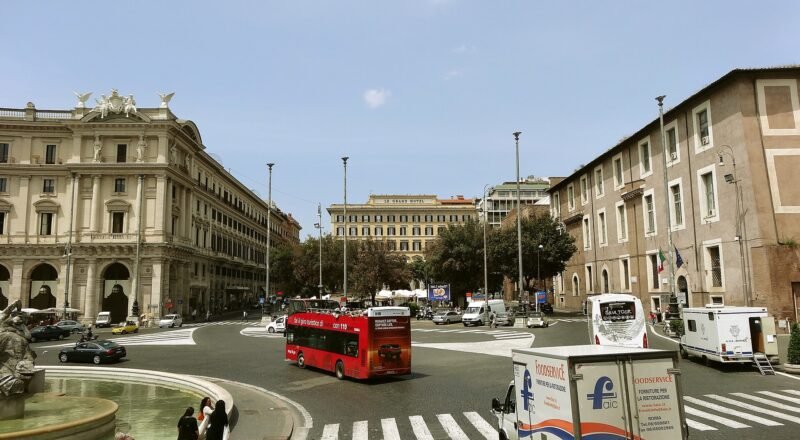
The museum didn't end up in this square by chance, but the square alone would deserve a guide. Until 1960 it was called Piazza dell'Esedra, and the old name explains the shape better than the new one: the hemicycle we see follows the monumental exedra of the Baths of Diocletian, the great curved structure, approximately 140 meters in diameter, which served as a space for watching gymnastic exercises. The baths were built between 298 and 306 AD and occupied an area of about 361 by 376 meters.
The two arcaded buildings that close the curve are the work of Gaetano Koch and were built between 1896 and 1902, deliberately following the ancient semicircle: monumental porticoes with round arches and coffered ceilings, three floors, Ionic pilasters and sculptural crownings in marble. A rare case, in Umbertine Rome, of new architecture that agrees to be the cast of a ruin and comes out well.
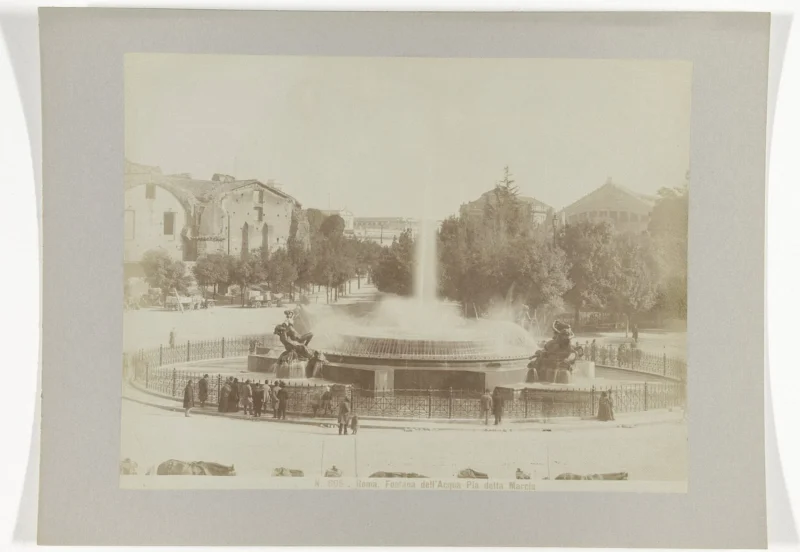
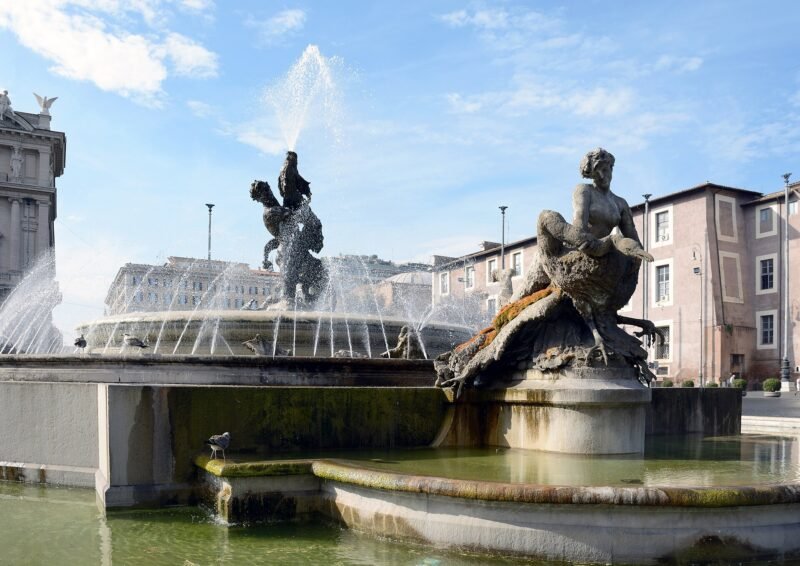
At the center is the Fontana delle Naiadi by Mario Rutelli, whose story is more eventful than it looks. The four bronze groups of nymphs were placed in 1901 and caused a scandal for their nudity. In 1911 the central group of Glaucus was added. The definitive version, with the five-meter-tall male figure gripping a dolphin, was inaugurated in 1914. 13 years for a fountain, with moral controversies attached: very Roman.
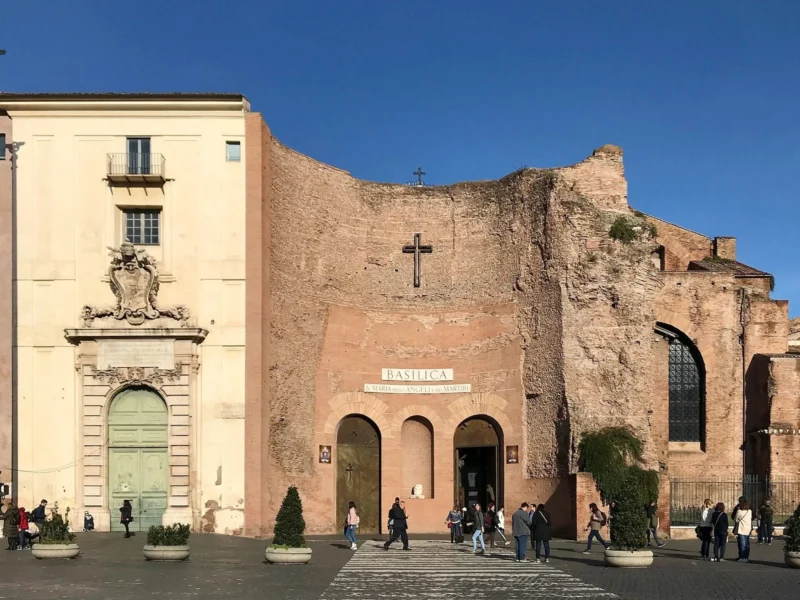
On the opposite side opens the Basilica of Santa Maria degli Angeli e dei Martiri, carved by Michelangelo out of the frigidarium of the baths between 1563 and 1566, where eight monolithic columns of pink Egyptian granite about 14 meters tall survive, along with the original proportions of the ancient space, with the three barrel vaults. Anyone visiting the neighborhood while thinking about schools should do this mental exercise: here, within a radius of 200 meters, there are an imperial bath complex, a Michelangelo church, an Umbertine square and a museum of the elementary school. Rome is this stratification, not a postcard.
What to see around the MuSEd within a 10-minute walk
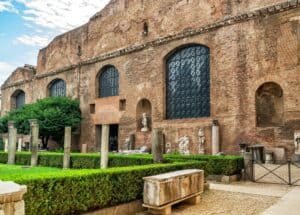
The closure of the museum doesn't condemn the day, because the quadrant is one of the densest in the city. The Baths of Diocletian are literally around the corner and keep the great 16th-century cloister and the sections of Museo Nazionale Romano. The Octagonal Hall, a little way off, is what remains of another room of the same bath complex and is one of the least visited and most beautiful spaces of the complex.
At 300 meters, in Largo di Villa Peretti, is Palazzo Massimo alle Terme with the wall paintings of the Roman age and the sculptures of Museo Nazionale Romano. If I had to choose a single archaeological museum for a visitor with half a day, I would choose that one. Toward Castro Pretorio you reach the Biblioteca Nazionale Centrale, one of the two central national libraries of Italy, with the one in Florence. Going up Via Nazionale, five minutes, you meet the Palazzo delle Esposizioni. On the other side, on the Esquilino, you climb to Santa Maria Maggiore, with the early Christian mosaics of the nave.
Anyone who instead wants to stay on theme, that is, university and scientific museums, has in the city an extraordinary and neglected network: the Physics Museum, the Museo di Chimica Primo Levi, the Museo di Antropologia G. Sergi, Museo Erbario, the Museo di Storia della Medicina and the mathematics collection of the Sapienza. Almost all work with the same logic as the school museum: appointment, academic staff, free admission. For families with small children, the avowedly playful alternative is Explora, at the Flaminio.
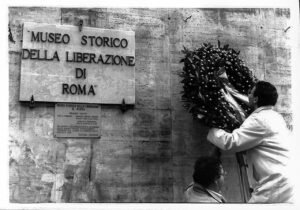
Two more thematic suggestions, for those who have developed a taste for Italian history told through papers: the Central Museum of the Risorgimento at the Vittoriano and the Museo Storico della Liberazione on Via Tasso, which is a quarter of an hour away and leaves a mark. Those who love the history of writing and the book then find the Museo delle Scritture Aldo Manuzio and the great historic libraries, from the Casanatense to the Angelica.
A curiosity about MuSEd - Mauro Laeng Museum of School and Education
The curiosity doesn't concern an object, it concerns a man. The first director of note of this institution, in the 1870s, was Antonio Labriola: the same Labriola who would become the greatest Italian scholar of Marxism, the author of Del materialismo storico in 1896 and of Discorrendo di socialismo e di filosofia in 1897, the correspondent of Friedrich Engels. Born in Cassino in 1843 and died in Rome in 1904, from 1873 he taught moral philosophy and pedagogy at the Roman university.
Now, try to hold the two images together. On one side the philosopher discussing class struggle with German social democracy. On the other the official who sorts catalogs of desks, chooses which wall maps to buy, decides if a primer deserves to enter the circulating library that sent books to provincial teachers. They are not two separate lives: they are the same. Labriola had understood before almost everyone that the elementary classroom is the place where a society reproduces itself, and that whoever controls the primer controls the future. A museum of teaching aids, in that perspective, is not a warehouse of trinkets: it is a political laboratory.
Then there is the funniest detail. Alongside Labriola, among the directors of the early seasons, appears Giuseppe Dalla Vedova, a geographer, one of the founders of Italian scientific geography. A Marxist philosopher and a positivist geographer passing the keys of the same school museum within a few years: the history of Italian education begins with this odd couple, and no plaque in Piazza della Repubblica tells it.
Something nobody tells you about MuSEd - Mauro Laeng Museum of School and Education
That you don't visit it the way you visit a museum. It is the most important thing and you find it written nowhere in the lists of Roman attractions, which keep listing this address next to the Capitoline Museums as if showing up were enough.
The MuSEd is a university facility. Even when the historic site is reopened, it won't have a ticket booth, it won't have continuous opening hours, it won't have an attendant in every room. It works by appointment: you write to mused@uniroma3.it, explain what you want to see and why, and agree on a day. For the archive you also need a letter of introduction stating the nature of the research. The library does not lend volumes: they are consulted on site. Admission is free and involves no ticket, openings follow an annual calendar and others are arranged by reservation. Translated: the door opens, but you have to knock in writing.
The second thing nobody says is that this is not an inconvenience, it is a stroke of luck. Whoever gets the appointment doesn't find a crowd, but a member of the staff who opens the display cases and tells the story. Francesca Gagliardo handles bibliographic and archival consultancy and accompanies the visits. Stefania Petrera follows the educational services. These are visits of a good hour, often more, led by someone who knows every piece. No Roman civic museum offers anything similar, at any price. The MuSEd does it free of charge, to whoever takes the trouble to write a decent email.
The advice I give you for visiting MuSEd - Mauro Laeng Museum of School and Education
First: before anything else, write. An email to mused@uniroma3.it with three lines saying who you are, what interests you and on which days you are in Rome is worth more than any online search. They'll answer telling you if and how you can get in, and in this construction phase it is the only way not to make a useless trip.
Second: prepare the visit. This is a museum that rewards those who arrive informed. Spend an hour on RomaTreDiscovery and on the archiUi platform, identify two or three pieces that really interest you, a collection, a series, a type of object, and ask for them by name. The difference between the generic visitor and the visitor who asks to see the notebooks of the Lombardo Radice collection from 1928 is the difference between a tour and an experience.
Third, and it counts double if you have children: bring them, but give them a task. Let them look for their name among the notebooks, compare their great-grandfather's report card with their own, try to read the English handwriting of the 19th-century models. A museum of school objects in front of a bored child becomes a furniture store. In front of a child with a question in mind it becomes a time machine.
Fourth, a contrarian piece of advice: while the site is closed, go and see the museum where it has moved, that is, in its off-site exhibitions. The exhibition L'acchiapparicordi, at Via Principe Amedeo 182/b until October 31, 2026, doesn't replace the rooms of Piazza della Repubblica, but it has a merit the rooms don't have: it is designed to be walked through by anyone passing by, without an appointment and without a letter of introduction.
Another well-known fact, and yet rarely cited
That the museum keeps materials and furnishings from the first Casa dei Bambini of Maria Montessori. And in Italy only a few hundred people know it.
The Montessori method is, in all likelihood, the most widespread Italian cultural product in the world after cuisine: schools on every continent, an immense bibliography, a huge market of materials in maple and beech sold to families on half the planet. All of this was born in Rome, in a working-class neighborhood, inside an experiment in social housing. The foundational objects of that experiment, the interlocking pieces, the solids, the child-sized furniture that overturned the very idea of the classroom, are not in a national museum with a line at the entrance. They are in a university museum closed for works, 200 meters from Termini station, and to see them you have to write an email.
I find this disproportion says a lot about Italy, and not only in a bad way. It says that heritage is where it was produced and where someone saved it, not where marketing would place it. It also says that those who deal seriously with education, in this country, have always worked in temporary premises and with scarce means, and have nonetheless produced things the world has copied. The museum, in the end, is the monument to this stubbornness.
The practical corollary, for anyone planning research: if you work on Montessori, the MuSEd goes on the list of places to contact next to the best-known Montessori institutions. Many don't, and they miss the material source.
The right photo to take at MuSEd - Mauro Laeng Museum of School and Education
Inside the museum, when it becomes possible, the right photo is just one and it's not the one everyone tries. Everyone photographs the whole desk, from three-quarters, with the teacher's desk in the background: you get a nostalgic postcard that says nothing. The photo that works is the detail of the desk's sloped top, up close, with the inkwell hole in the foreground and the carvings made with the pen nib by the children who passed through it. Side light, no flash, focus on the wood. In that frame you see time.
The second photo to take home is a double page of notebook from the Lombardo Radice collection, if the staff authorizes the shot: the child's handwriting, the stamp, the correction in red pencil. Careful, though: photographing archive materials is always subject to authorization, and the request must be made beforehand, in writing, together with the reservation. No serious archive admits that you arrive with the phone on and decide on the spot.
Outside, on the other hand, you can take the photograph anyway, even now that the door is closed. The site is under the curved porticoes of Gaetano Koch, and the colonnade of Piazza della Repubblica at sunset, with the light sliding low under the round arches and the coffers in shadow, is one of the least photographed and most photogenic views in the center. Stand in the middle of the square, in front of the Fontana delle Naiadi, and frame the hemicycle with the basilica of Santa Maria degli Angeli on the right: in one shot you get the ancient, the Renaissance, the Umbertine and, behind one of those windows, the museum of the Italian school. Golden hour, not noon.
Some important events that happened here in history
The chronology of this institution is a sequence of openings and closings worth marking, because every date corresponds to a turning point of the Italian school.
1874: Ruggero Bonghi, minister of Public Instruction, establishes Museo di Istruzione e di Educazione at the Ennio Quirino Visconti classical high school, in Piazza del Collegio Romano. It is born with a library of international standing and a collection of avant-garde furnishings and teaching tools, to train the teachers of a largely illiterate country.
1870s and 1880s: the direction passes between Giuseppe Dalla Vedova and Antonio Labriola. The circulating library and the periodical Il Giornale del Museo come out.
1891: closure. Organizational crisis, dispersal of the materials.
1907: Luigi Credaro reorganizes everything as Museo Pedagogico and pairs it with the advanced course for graduates of the normal schools. Four years later, as minister, he will sign the Daneo-Credaro law of June 4, 1911.
1923: the Gentile reform effectively ends the museum's second life.
1936-1938: Giuseppe Lombardo Radice reactivates it at the Institute of Pedagogy of the Faculty of Magistero and collects, in just two years, the 159 sets of school notebooks that are today the showpiece of the collections.
1986: Mauro Laeng recovers the dispersed material, reorders it and founds the museum in its current form at the Roma Tre department.
1991: the archive of the Ente Scuole per i Contadini arrives as a gift from Dr. Sebastiano Piana, with the papers and works of Duilio Cambellotti.
2005: the institution is named after Mauro Laeng, who died the year before.
2018: reopening to the public under the direction of Lorenzo Cantatore, with the installation of the rural classroom and the teaching archive.
2015, 2018, 2019, 2020: the great 20th-century donations follow one another, the Manacorda, Bernardini and Vergalli collections and the Lombardo Radice photographs.
2025-2026: Piazza della Repubblica site goes into renovation, the collections move to Via del Castro Pretorio, the museum leaves home with the project Il MuSEd va in città.
Who has passed through MuSEd - Mauro Laeng Museum of School and Education
The list of names tied to this institution is, in fact, the index of a manual of Italian education history. Ruggero Bonghi founds it as minister. Giuseppe Dalla Vedova, a geographer, and Antonio Labriola, a philosopher, direct it in the 1800s. Luigi Credaro refounds it in 1907 and becomes minister. Giuseppe Lombardo Radice reactivates it in 1936 and leaves it the most precious collection. Luigi Volpicelli leads it in the postwar period. Mauro Laeng saves it in 1986 and gives it the name it carries today. Lorenzo Cantatore reopens it in 2018 and directs it now.
But the figures don't end with the directors, because in a museum of this kind people also pass through their papers. Maria Montessori is here with the furnishings and materials of the first Casa dei Bambini. Duilio Cambellotti is here with the ceramics and paintings made for the schools of the Agro romano, and with him Alessandro Marcucci, who directed those schools and designed their furnishings. Anna Fraentzel Celli, who started the enterprise with the women of the Unione Femminile Nazionale, and her husband Angelo Celli, the physician of the battle against malaria. Around them Giovanni Cena, Sibilla Aleramo, Carlo Segrè.
Then the long 20th century: Mario Alighiero Manacorda, historian of education and Communist leader, with his political archive on the secularity of school. Albino Bernardini, the teacher of Pietralata whom Gianni Rodari called a militant teacher. Teresa Vergalli, partisan courier and later teacher in Cinecittà, with the newspaper Senza Paura written by her children. Cleofe Forti, who directed the Italian schools abroad until 1947. And the children's literature team: Marcello Argilli, Ermanno Detti, Carla Poesio, the Premio Luigi Malerba, Maria Luisa Bigiaretti with the puppets, Gino Felci.
No crowned head has passed through here, and that is perfectly fine. The teachers passed through, a category Italy has used a lot and thanked little.
Quick questions about MuSEd - Mauro Laeng Museum of School and Education
Is the MuSEd open right now?
No. The site at Piazza della Repubblica 10 is closed for renovation work on the building, the consultation service is suspended and it is not possible to access it for visits until further notice from the university.
Where have the MuSEd collections gone during the closure?
They have been temporarily transferred to the premises of the Department of Education Sciences at Via del Castro Pretorio 20, which however is not an exhibition space open to the public.
How much does it cost to enter the MuSEd?
Nothing. There is no ticket office and admission is free: it is a university museum, not a civic or state museum, and access is by appointment.
How do you book a visit to the MuSEd?
By writing to mused@uniroma3.it and stating what you wish to consult or see. For activities with schools and for events the address is eventi.mused@uniroma3.it.
What is the exact address of the MuSEd?
Piazza della Repubblica 10, 00185 Rome. The collections are temporarily at Via del Castro Pretorio 20, also in 00185, and the teaching hub that hosts the off-site exhibitions is at Via Principe Amedeo 182/b.
What is the MuSEd phone number?
For the museum the numbers given are 06 57339115 and 06 57339117. The switchboard of Piazza della Repubblica site is 06 57332032, that of Via del Castro Pretorio 06 57339000, that of the teaching hub on Via Principe Amedeo 06 57339200.
Who runs the MuSEd?
The Department of Education Sciences of Roma Tre University. It is therefore a public university museum, not a private foundation and not a municipal museum.
Who is the director of the MuSEd?
Lorenzo Cantatore. The deputy direction is entrusted to Francesca Borruso and the museum has a scientific council of nine members.
Why is the museum named Mauro Laeng?
Because in 1986 the educator Mauro Laeng recovered and reorganized the dispersed materials of the earlier collections, effectively refounding the institution. The museum has carried his name since 2005.
How old is the MuSEd?
The original core goes back to 1874: it is the oldest Italian museum institution dedicated to the history of pedagogy, school and education.
What do you see at the MuSEd?
School furniture and objects, primers, syllabaries, notebooks, report cards, calligraphy models, teaching aids, charts and prints, Montessori materials from the first Casa dei Bambini, scientific instruments, puppets and educational toys, and even the first computers to enter the Italian school.
How long does the visit to the MuSEd take?
The structured routes for teachers and students last four hours and include historical introduction, exploration of the collections, thematic deepening and a workshop. An ordinary visit takes at least an hour, better two.
Is the MuSEd suitable for children?
Yes, but with an adult who tells the story. Objects speak to children more than you'd think, as long as someone explains what an inkwell is. For an offer built entirely on play, the alternative in the city is Explora, the children's museum of Rome.
Can you take photographs at the MuSEd?
For archive and book materials, photographing is subject to authorization, which must be requested together with the reservation. Better to arrange everything in writing before showing up.
Can you borrow the books of the MuSEd library?
No. The library does not lend: volumes are consulted on site, by appointment.
Do you need a letter of introduction to consult the MuSEd archive?
Yes. For access to the archival collections the university asks for a letter stating the nature of the research, in addition to the reservation by email.
How many volumes does the MuSEd library hold?
About 20,000, devoted to pedagogy, didactics, education and children's literature, with periodicals for young people of the early 1900s and school texts from the 1700s to the 1900s.
Can you consult the MuSEd heritage online?
In part, yes. The bibliographic data and a portion of the school objects can be searched on RomaTreDiscovery. The archival collections described little by little are published on the archiUi platform dedicated to the museum's archives.
What is the Lombardo Radice collection?
A collection of 159 groups of elementary school notebooks and a few teachers' diaries, from 1910 to 1937, put together by the educator between 1936 and 1938 to test the effects of the 1923 school reform. It also includes private correspondence, his personal library and 423 photographs.
Does the MuSEd have materials from Maria Montessori?
Yes: developmental materials and school furnishings from the first Casa dei Bambini, along with documents. It is one of the museum's most important cores.
How do you get to the MuSEd by metro?
For Piazza della Repubblica, take line A to the Repubblica stop. For Via del Castro Pretorio, take line B to the Castro Pretorio stop. From Roma Termini, which is where the two lines cross, you can walk to both locations in a few minutes.
Is the MuSEd accessible to people with mobility disabilities?
The building is currently being renovated and accessibility will have to be checked when it reopens. Anyone with specific needs should mention them in the booking email, so that a workable solution can be agreed.
Is there a coat check or luggage storage at the MuSEd?
No. It is a university facility, not a museum equipped for tourism. If you arrive from the station with suitcases, leave them at the Termini luggage storage.
Does the MuSEd take part in the free museum Sundays?
No, because the initiative covers state and city museums. Admission here is free anyway, but by appointment.
What is the difference between the MuSEd and Rome's other university museums?
The access model is the same, by appointment and without a ticket, but the theme is unique: no other Italian collection documents the history of school and education from 1874 to today with this continuity.
Does the MuSEd hold exhibitions outside its own building?
Yes. The project Il MuSEd va in città takes the collections to libraries, schools and social and health facilities in the Metropolitan City of Rome. After the stop at the Moby Dick library between December 2025 and February 2026, the exhibition L'acchiapparicordi is on display at Via Principe Amedeo 182/b from June 23 to October 31, 2026.
Does the MuSEd offer activities for teachers?
Yes, with four-hour seminar programs for teachers, school principals and university students, in time slots of 9:00-13:00 or 14:30-18:30, for groups of up to 20 people, by reservation at eventi.mused@uniroma3.it.
What is there to see near the MuSEd?
The Baths of Diocletian and the Octagonal Hall, Palazzo Massimo alle Terme, the Basilica of Santa Maria degli Angeli e dei Martiri on the same square, the National Central Library toward Castro Pretorio, Palazzo delle Esposizioni going up Via Nazionale, and Santa Maria Maggiore on the Esquiline.
Is the MuSEd worth visiting even if you have no connection to schools?
Yes, on one condition: that you are interested in understanding how contemporary Italy was formed. Anyone looking for art masterpieces will find little. Anyone looking for the daily life of six generations will find a great deal.
My verdict on the MuSEd
It pays to distrust museums that sell themselves easily. This one doesn't sell itself at all: it is closed, it is a university facility, it has no signs, no bookshop, and to get in you have to write an email and wait. Even so, when the doors on Piazza della Repubblica open again, it will remain one of the three or four places I recommend without hesitation to anyone who has already seen the Colosseum and wants to understand something more about the city and the country.
In the meantime, my advice is practical and concrete: send the email to mused@uniroma3.it, ask when it reopens and, if in doubt, go see the exhibition on Via Principe Amedeo before October 31, 2026. Bring a middle schooler. Let them take in with their own eyes a desk with an inkwell and a notebook from 1928. Then ask them what they think someone will make of their tablet in a display case 90 years from now.
Article written by the editorial team of TourLeaderPro, contact them for Private/Corporate/V.I.P. Tours and Experiences.
Planning a trip to Rome? The English guides to visiting the city are on ItalyPlanner.com.
Contact Information
Nearby
 Basilica of Santa Maria degli Angeli e dei Martiri100 m
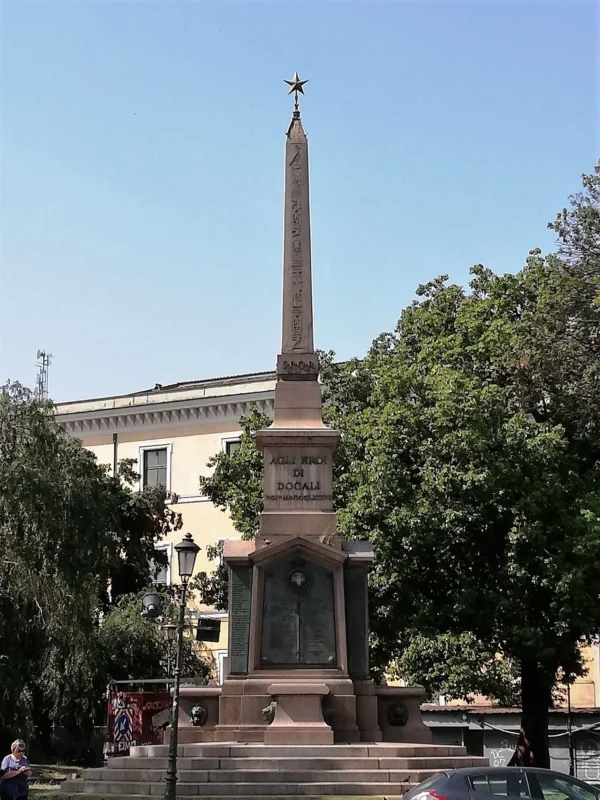
- Dogali Obelisk100 m
- Piazza della Repubblica100 m
- Fontana delle Naiadi100 m
- Octagonal Hall of the Baths of Diocletian – National Roman Museum200 m
- Michelangelo’s Cloister200 m
Upcoming events nearby
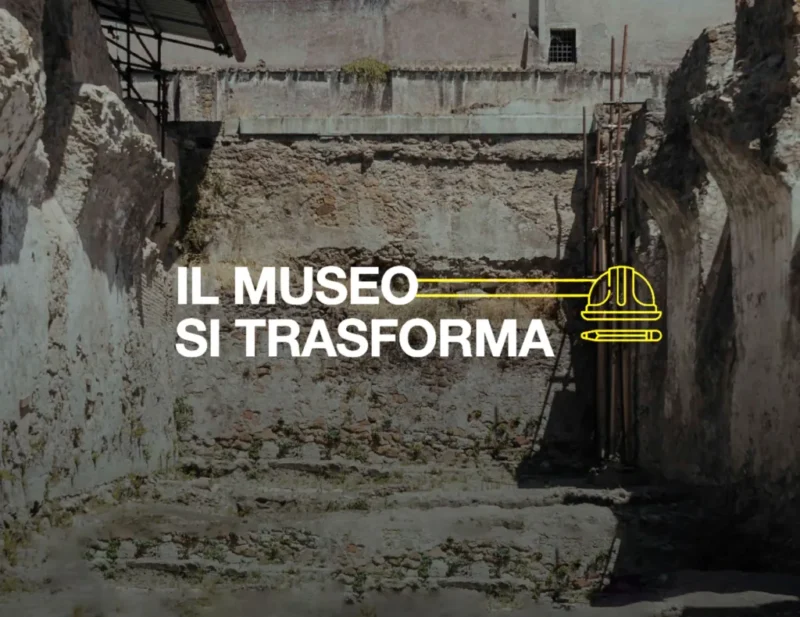
- The Museum Transforms (URBS Construction Sites) at Museo Nazionale Romano, February 18 to December 16, 2026100 m
- MedFilm Festival 2026 in Rome, November 5 to 15, 2026100 m
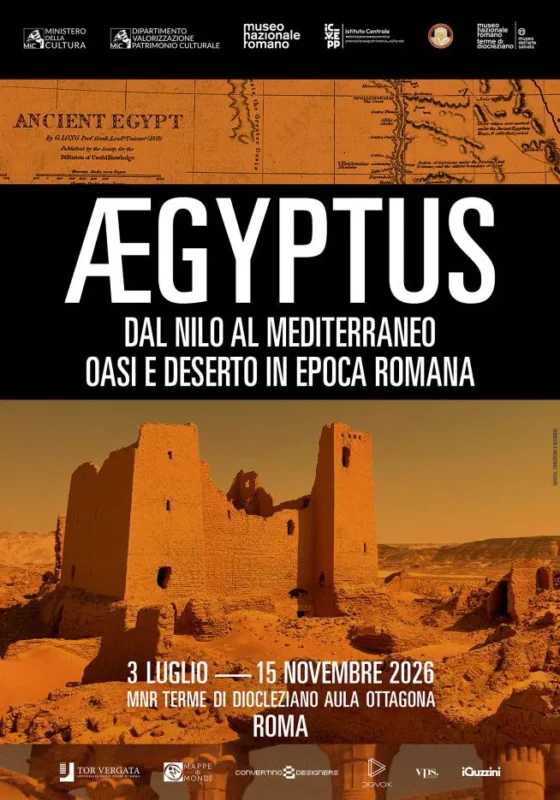
- AEGYPTUS. Dal Nilo al Mediterraneo at the Baths of Diocletian, through November 15, 2026200 m
- Hank Willis Thomas and Man Ray. Tomorrow I shall contradict myself at Galleria Continua, September 25 to December 31, 2026200 m