AEGYPTUS. Dal Nilo al Mediterraneo at the Baths of Diocletian, through November 15, 2026
In short. AEGYPTUS. Dal Nilo al Mediterraneo. Oasi e deserto in epoca romana is open from July 4 to November 15, 2026 in the Museo dell'Arte Salvata, inside the Octagonal Hall of the Baths of Diocletian, Via Giuseppe Romita 8, Rome.
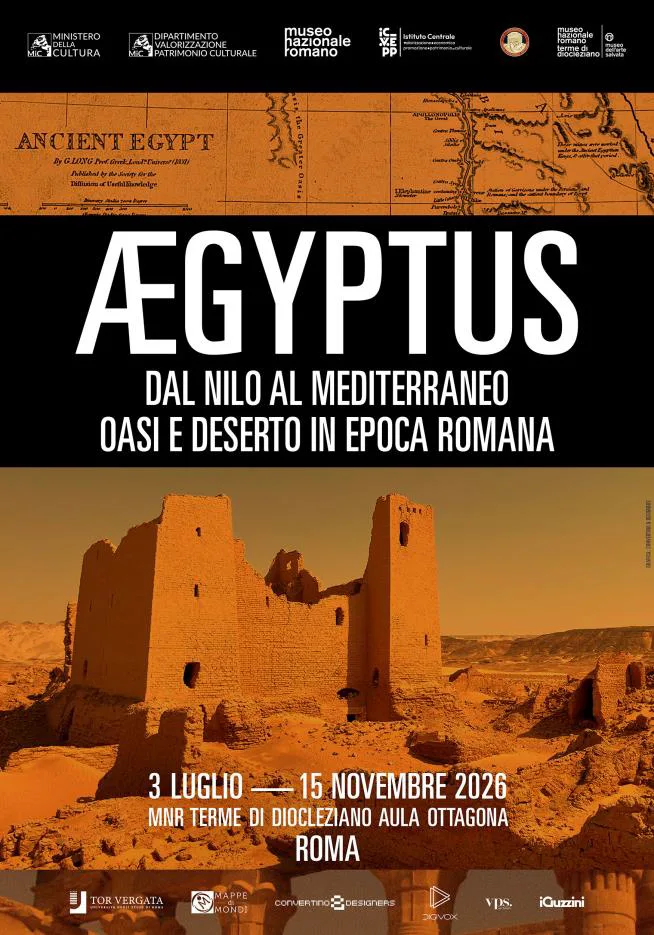
AEGYPTUS. Dal Nilo al Mediterraneo. Oasi e deserto in epoca romana is open from July 4 to November 15, 2026 in the Museo dell'Arte Salvata, inside the Octagonal Hall of the Baths of Diocletian, Via Giuseppe Romita 8, Rome. The Museo Nazionale Romano is open Tuesday to Sunday from 9:00 to 19:00, with last entry at 18:00, and is closed on Monday. The museum sells a ticket for the Octagonal Hall alone at €5 and a single ticket for all venues at €15 full price, €2 reduced, valid for one week. On the first Sunday of the month admission is free, as it is on November 1 and 4. Tickets are bought at the ticket office or on the official portal of the state museums indicated on the Museo Nazionale Romano website. For the Baths of Diocletian the museum lists Metro lines A and B, Termini stop.
A Roman octagon from the 4th century, designed for the largest baths of antiquity, hosting a video art and artificial intelligence installation on the Egyptian desert: put like that it sounds like a provocation, and in part it is. But AEGYPTUS tells a true and little-known story, that of the Roman garrisons, villages and temples in the oases of Egypt's western desert, and tells it with the archaeologists who are digging in those places today. It's worth the detour, a few steps from Termini station: it's a short, intense exhibition, and above all different from everything you see in the museum's other rooms.
AEGYPTUS at the Octagonal Hall: the essentials
The exhibition is open until Sunday, November 15, 2026 in the Octagonal Hall, home of the Museo dell'Arte Salvata, one of the venues of the Museo Nazionale Romano.
Dates
The exhibition opened on July 4, 2026 and closes on November 15. At the end of September, seven full weeks remain, with all the weekends of October and the first half of November.
Hours
The Museo Nazionale Romano is open Tuesday to Sunday from 9:00 to 19:00, with last entry at 18:00. It is closed on Monday. In the first week of the exhibition the museum had planned special evening openings of the Octagonal Hall, now over.
Tickets
The museum offers a ticket for the Octagonal Hall alone at €5 and a single ticket for all the venues of the Museo Nazionale Romano, €15 full price and €2 reduced, valid for one admission to each venue within a week of first entry. There is also a €10 fare for holders of affiliated passes and an annual pass, the MNR Card, at €30 full price and €20 reduced. For access to the exhibition, what is indicated at the ticket office at the time of purchase applies.
Free days
On the first Sunday of the month admission is free at all state cultural sites: during the exhibition period, Sunday, October 4 and Sunday, November 1. The museum also lists November 1 and 4 as free days.
What you see in AEGYPTUS
The exhibition tells of the Roman presence in the oases of Egypt's western desert between the 1st century BC and the 5th century AD, a chapter of ancient history still little known to the general public.
The artifacts
The route opens with archaeological artifacts from two sources. One part comes from the collections of the Museo Nazionale Romano, which handled their identification and selection. Another comes from the recovery and investigation work of the Carabinieri Command for the Protection of Cultural Heritage, the same one that is the protagonist of the Museo dell'Arte Salvata housed in the Octagonal Hall.
The immersive installation
After the artifacts, the exhibition becomes an immersive, crossmedia installation: video art, digital reconstructions, images of the excavations, animations and artificial intelligence accompany the public in discovering the landscape of the oases and the Roman desert. The museum calls it more an event than a traditional exhibition, and the description is honest.
The oases as crossroads
At the center of the story are the oases, places of encounter and exchange between cultures, trade, religions and different peoples, in a territory that for centuries was a bridge between Africa, the Mediterranean and the Near East. The desert, in this reading, is not a periphery of the Empire but a vital space of connection.
The ongoing research
The exhibition grows out of the work of the archaeologists engaged in the Greco-Roman excavations in Egypt, carried out with the support of the Egyptian Ministry of Antiquities. The account of contemporary archaeological research is part of the project: the images of the excavations are not illustrations but working documents.
Who conceived and curated AEGYPTUS
The project, promoted by the Ministry of Culture, was conceived by Elisabetta Bruscolini and curated by Alfonsina Russo, Elisabetta Bruscolini, Angelo Piero Cappello, Federica Rinaldi and Alessio De Cristofaro, as part of the cultural cooperation activities with Africa and the Mediterranean.
The Ministry's guidelines
The museum places the initiative within the strategic lines of the Minister of Culture Alessandro Giuli, which aim to join scientific research, technological innovation and heritage enhancement, with particular attention to cooperation in the Mediterranean and in Africa.
The authors of the installation
The video art work and the graphic design are by Studio Convertino. The film made with artificial intelligence is by Riccardo Boccuzzi. The exhibition design is by Studio VPS architetti. The organization is by Mappe di Mondi. The lighting design was made with the technical sponsorship of iGuzzini Illuminazione.
The universities involved
Scholars and archaeologists take part from the Università di Roma Tor Vergata, the Università degli Studi di Milano, the Politecnico di Milano, the Università del Salento, the Università Federico II of Naples, the Università di Padova and the University of Leicester. The scientific catalog is edited by the Department of Literary, Philosophical and Art History Studies of Tor Vergata.
The Public Program
In the first week of opening the exhibition was accompanied by a program of evening meetings with Italian and international archaeologists and scholars, in the space in front of the exhibition venue. The series has ended, but the museum's page keeps its program and the press kit.
A curiosity about AEGYPTUS. Dal Nilo al Mediterraneo at the Baths of Diocletian, through November 15, 2026
The curiosity is the place. AEGYPTUS is not housed in just any room of the Museo Nazionale Romano but in the Museo dell'Arte Salvata, the space that since 2022 the Octagonal Hall has devoted to recovered works, largely by the Carabinieri Command for the Protection of Cultural Heritage. Part of the exhibition's artifacts comes precisely from those recovery and investigation activities.
It's a detail that changes the way you look at the display cases. The objects that open the route are not only testimonies of Roman Egypt: some have a second story behind them, that of their theft and their return. The Museo dell'Arte Salvata was created exactly to tell this second life of works, and AEGYPTUS interweaves it with the first.
My advice is to ask in the gallery, or look in the captions, for the provenance of each artifact, distinguishing those from the museum's historical collections from those that were recovered. It's a way to understand how the protection of heritage works today, as well as to learn about the Roman oases.
The Octagonal Hall and the Museo dell'Arte Salvata
The Octagonal Hall is part of the Baths of Diocletian, one of the venues of the Museo Nazionale Romano, and since 2022 has housed the Museo dell'Arte Salvata.
A bath chamber
The octagon is one of the surviving rooms of the great bath complex built by Diocletian. Entering it means finding yourself inside an ancient volume: a container that no contemporary architect could invent.
The Museo dell'Arte Salvata
The Museo dell'Arte Salvata is devoted to works recovered by the Carabinieri Command for the Protection of Cultural Heritage and presents, on rotation, the results of their activity. Hosting here an exhibition on Roman Egypt with recovered artifacts is consistent with the vocation of the space.
The Octagonal Hall ticket
The Museo Nazionale Romano sells a ticket for the Octagonal Hall alone at €5, in addition to the single ticket for all venues. Anyone short on time who wants to see only AEGYPTUS thus has an economical and quick solution.
One thing nobody tells you about AEGYPTUS. Dal Nilo al Mediterraneo at the Baths of Diocletian, through November 15, 2026
What nobody says is that the Octagonal Hall has a different address from the Baths of Diocletian. The Museo Nazionale Romano lists for the Baths Via Enrico De Nicola 78, while the exhibition is at Via Giuseppe Romita 8, where the octagon is. They are two entrances to the same great ancient complex, but anyone who follows the navigator to the wrong address ends up walking around the block. Check the address before you leave.
The second thing concerns closures. The museum reports that from September 29 Halls X, XI and XI bis of the Baths of Diocletian are temporarily closed for the dismantling of an exhibition, and that the Natatio, Hall VIII and the Museo di Protostoria are closed until further notice. Anyone thinking of combining AEGYPTUS with a complete visit to the Baths will find a reduced route: better to know beforehand.
The third thing is good news: the exhibition is short. It's an installation, not a survey of hundreds of artifacts, and it can be seen well in three quarters of an hour. It therefore lends itself to a visit at a moment in transit, for example before a train from Termini.
The Baths of Diocletian: the venue
The Baths of Diocletian were begun in 298 by the emperor Maximian and opened in 306. The enclosure measured about 380 by 365 meters, about 14 hectares, and could hold up to 3,000 people.
The transformations
The baths' exedra became today's Piazza della Repubblica, laid out by Gaetano Koch at the end of the 1800s. Between 1561 and 1564 Michelangelo transformed part of the rooms into the basilica of Santa Maria degli Angeli, later reworked by Vanvitelli in 1749. In 1575 Gregory XIII carved out granaries there. In 1763 the oil warehouses were built, with 10 wells.
A name for the station
Termini station takes its name precisely from the baths. It's one of the clearest cases of an ancient monument giving its name to a modern place.
The museum
The Museo Nazionale Romano was born with the law of March 7, 1889 and its first venue was the cloister of the Carthusian monastery at the Baths. In 2016 it obtained special autonomy, and today it has several venues: the Baths of Diocletian, Palazzo Massimo, Palazzo Altemps and the Crypta Balbi, the latter currently closed. The Museo dell'Arte Salvata has been in the Octagonal Hall since 2022. The conversion of the Baths into exhibition space dates to 2000.
My advice for visiting AEGYPTUS. Dal Nilo al Mediterraneo at the Baths of Diocletian, through November 15, 2026
My advice is to combine AEGYPTUS with Palazzo Massimo, not with the Baths. The single €15 ticket is valid for a week and includes all the venues, and Palazzo Massimo, at Largo di Villa Peretti 2, is also served by the Termini stop. With the temporary closures announced at the Baths, the combination of the Octagonal Hall plus Palazzo Massimo is the richest today. If you only have an hour, take the €5 Octagonal Hall ticket and devote the time to the exhibition.
The second piece of advice is to enter the installation without hurrying. Video art and animations tell in sequences: whoever comes in halfway and leaves after five minutes risks missing the sense of the story. Stay long enough to see one sequence in full.
Third piece of advice: avoid the first Sunday of the month, Sunday, October 4 and Sunday, November 1, unless you want to take advantage of the free admission while accepting a bigger crowd. A weekday afternoon, after 15:00, is the quietest moment for an exhibition of this kind.
Roman Egypt and the oases of the western desert
The period covered runs from the 1st century BC to the 5th century AD: five centuries of Roman presence in the oases of Egypt's western desert.
A strategic territory
The exhibition presents the oases as a strategic territory that for centuries was a bridge between Africa, the Mediterranean and the Near East. Caravans, cults, languages and different communities crossed paths here.
Settlements like mirages
The museum uses an effective image: Roman settlements appearing like a mirage in the desert. It is the idea that guides the immersive part of the exhibition, built to give the visitor back the sense of distance and surprise of someone arriving at an oasis after days in the desert.
Why we know so little
The museum stresses that this is a chapter of ancient history that is still little known. The ongoing excavations, with Italian and foreign universities, are changing what we know: the exhibition is also a way of bringing the results of a research that is still open to the public.
A thesis, not just a story
The exhibition takes a precise position: the desert not as a margin of the Empire but as a space of connection, exchange and cultural contamination. It's a historiographical thesis, and the good thing about the installation is that it lets the visitor check it, putting next to the artifacts the images of the excavations from which that thesis comes. You can share it, with one reservation: digital images seduce, and it's best to go back to the display cases before leaving.
Another well-known fact, yet rarely cited
It's well known that Termini station takes its name from the Baths of Diocletian. Less often cited is how large these baths were, and how many transformations they have gone through. The enclosure measured about 380 by 365 meters, 14 hectares, and could hold up to 3,000 people. In the 1500s Michelangelo transformed part of the rooms into the basilica of Santa Maria degli Angeli, and in the 1700s Vanvitelli reworked it. Pope Gregory XIII, in 1575, carved out granaries in the rooms of the baths. In 1763 the oil warehouses were built, with 10 wells for oil. The exedra became Piazza della Repubblica, with the buildings of Gaetano Koch at the end of the 1800s.
The result is that anyone who arrives in Rome by train and walks past Piazza della Repubblica is walking inside the perimeter of the baths without knowing it. The Octagonal Hall is one of the pieces of this giant still standing, and the exhibition on Roman Egypt, a few steps from the tracks, ideally connects two ends of the Empire: the heart of the capital and its farthest oases.
The right photo to take at AEGYPTUS. Dal Nilo al Mediterraneo at the Baths of Diocletian, through November 15, 2026
The right photo is the one that holds together the ancient and the digital: the Roman octagon with the projections of the desert on its surfaces. Stand at the back of the hall and frame horizontally, including a portion of the ancient masonry at the edges and the projected images in the center. It's an image that tells the exhibition better than any description. Before shooting, ask the staff if photographs are allowed, and don't use flash: it would ruin the effect of the projections and disturb other visitors.
The second photo is a detail: an artifact in a display case under the installation's lighting, designed with the technical sponsorship of iGuzzini. Display cases in dark rooms are better photographed by bringing the lens close to the glass, to eliminate reflections.
The third is on the way out: Piazza della Repubblica, the ancient exedra of the baths, with the fountain in the center. It's the same curve that Diocletian had laid out, redrawn by Umbertine Rome. A good way to end the day with the right view.
How to get to the Octagonal Hall
The Octagonal Hall is at Via Giuseppe Romita 8, in the complex of the Baths of Diocletian, near Piazza della Repubblica and Termini station.
By metro
The Museo Nazionale Romano lists for the Baths of Diocletian Metro lines A and B, Termini stop. Termini is the main hub of the network: from any line you get there without difficulty.
By train
If you arrive in Rome by train you find the Octagonal Hall a few minutes from Termini station: it's one of the most convenient exhibitions to reach for those passing through.
By bus
The Termini area is served by many bus lines. To choose the most convenient one from your starting point, use the ATAC route planner with Via Giuseppe Romita as the destination.
By car
Around Termini traffic is heavy and parking is difficult. Better public transit.
Around the Octagonal Hall: Termini and Piazza della Repubblica
The exhibition is in one of the areas of Rome densest in monuments, often crossed in a rush to get to the station.
Palazzo Massimo
A few steps away, Palazzo Massimo, at Largo di Villa Peretti 2, is another venue of the Museo Nazionale Romano. With the single ticket you visit it within a week.
Santa Maria degli Angeli
The basilica carved by Michelangelo out of the rooms of the baths looks onto Piazza della Repubblica. Going in after the exhibition lets you grasp the scale of the bath complex.
Palazzo Altemps
For those with the single ticket, Palazzo Altemps, in Piazza Sant'Apollinare, completes the round of the museum's venues with the ancient sculptures of the Ludovisi collection.
AEGYPTUS and the other venues of the single ticket
The single ticket of the Museo Nazionale Romano, €15 full price, allows one admission to each venue within a week of first entry. Here is what it includes, besides the Octagonal Hall.
Palazzo Altemps
The palace, in Piazza Sant'Apollinare, is tied in its origins to the Riario family and to the name of Melozzo da Forlì. In 1568 it passed to Cardinal Marco Sittico Altemps, and in 1690 the Accademia dell'Arcadia was founded there. Bought by the State in 1982, it became a museum in 1997. Here you find the Ludovisi Throne and the Dying Gaul.
Palazzo Massimo
At Largo di Villa Peretti 2, a short distance from the Baths, served by the Termini stop of Metro lines A and B. For those coming for AEGYPTUS it's the most convenient venue to add.
Crypta Balbi
The venue on Via delle Botteghe Oscure, built on the remains of the portico of the Theater of Balbus of 13 BC and opened as a museum in 2001, is currently closed to the public. Anyone buying the single ticket should not count on it.
Some important events that happened here in history
298: the emperor Maximian begins construction of the baths dedicated to Diocletian.
306: the baths are inaugurated. The enclosure covers about 14 hectares.
1561-1564: Michelangelo transforms part of the rooms into the basilica of Santa Maria degli Angeli.
1575: Gregory XIII carves out granaries in the rooms of the baths.
1749: Luigi Vanvitelli works on Santa Maria degli Angeli.
1763: the oil warehouses are built, with 10 wells.
March 7, 1889: a law establishes the Museo Nazionale Romano, with its first venue in the cloister of the Carthusian monastery at the Baths.
Late 1800s: the exedra becomes Piazza della Repubblica, with the buildings of Gaetano Koch.
2000: the Baths are converted into exhibition space.
2016: the Museo Nazionale Romano obtains special autonomy.
2022: the Museo dell'Arte Salvata opens in the Octagonal Hall.
July 4, 2026: AEGYPTUS opens, with a program of evening meetings in the first week.
AEGYPTUS with children
An immersive installation with video art, animations and digital reconstructions is one of the exhibition formats best suited to kids.
Why it works
The desert, the oases, the Roman forts and the archaeological digs are subjects children follow willingly, and the language of moving images lowers the attention threshold required. The exhibition is short: three quarters of an hour is enough.
A question to start
Before going in, ask the kids what the Romans were doing in the desert. It's the question the exhibition starts from, and finding the answer in the gallery will keep them engaged.
The ticket
With the Octagonal Hall-only ticket at €5, the visit with children stays inexpensive. The conditions for free admission for minors are indicated by the museum.
Accessibility at the Octagonal Hall
The Museo Nazionale Romano has a section of its website devoted to accessibility and public services, which is worth consulting before the visit.
The space
The Octagonal Hall is an ancient space that hosts a multimedia installation. Anyone with visual, hearing or orientation difficulties can ask staff at the entrance for assistance.
Information
For information the Museo Nazionale Romano gives the number 06 684851. Report your needs before the visit.
Who has passed through AEGYPTUS. Dal Nilo al Mediterraneo at the Baths of Diocletian, through November 15, 2026
The Baths of Diocletian were built for crowds: up to 3,000 people could fit there at the same time. The first names tied to the place are those of the emperors: Maximian, who began the works in 298, and Diocletian, to whom the baths were dedicated.
In the 1500s came Michelangelo, who between 1561 and 1564 transformed part of the rooms into the basilica of Santa Maria degli Angeli. In the 1700s Luigi Vanvitelli worked here. Popes such as Gregory XIII used the rooms for Rome's granaries. At the end of the 1800s Gaetano Koch designed Piazza della Repubblica on the curve of the exedra, and in the cloister of the Carthusian monastery, in 1889, the Museo Nazionale Romano found its first venue.
In our century the Carabinieri of the Command for the Protection of Cultural Heritage have passed through the Octagonal Hall, with the recovered works that gave life to the Museo dell'Arte Salvata. With AEGYPTUS came the archaeologists of Tor Vergata, Milan, Lecce, Naples, Padua and Leicester, and artists such as Studio Convertino and Riccardo Boccuzzi, who brought the Egyptian desert inside a Roman octagon. Alongside them Alfonsina Russo, Federica Rinaldi, Alessio De Cristofaro, Angelo Piero Cappello and Elisabetta Bruscolini, who signed the project.
How to organize the visit to AEGYPTUS
AEGYPTUS is a compact exhibition, easy to fit into a day in Rome.
Short visit
If you have little time: the €5 Octagonal Hall ticket, three quarters of an hour in the exhibition, then a stop in Piazza della Repubblica and in Santa Maria degli Angeli.
Half day
If you have a morning: the single €15 ticket, AEGYPTUS and Palazzo Massimo. It's the richest combination, a few steps from each other.
A day with the single ticket
The single ticket is valid for a week: you can split the visit over several days, adding Palazzo Altemps later.
Where to eat near the Octagonal Hall
The Termini area offers many options, of very different quality.
Around the station
Bars, hot food counters and fast restaurants are everywhere, designed for travelers. Useful for a quick meal, rarely memorable.
Monti
Going down toward the Monti district the offering gets more interesting, with trattorias, osterias and places frequented by Romans. Worth the quarter-hour walk.
Esquiline Hill
Toward Piazza Vittorio and the Esquiline Hill you find cuisines from all over the world, at low prices. After an exhibition on the oases as crossroads of cultures it makes a certain sense.
Frequently asked questions about AEGYPTUS at the Octagonal Hall
Until when is the AEGYPTUS exhibition open in Rome?
AEGYPTUS. Dal Nilo al Mediterraneo is open in the Octagonal Hall of the Baths of Diocletian, home of the Museo dell'Arte Salvata, from July 4 to November 15, 2026. The museum is open Tuesday to Sunday from 9:00 to 19:00, with last entry at 18:00, and is closed on Monday.
How much does the AEGYPTUS ticket cost?
The Museo Nazionale Romano sells a ticket for the Octagonal Hall alone, where AEGYPTUS is, at €5, and a single ticket for all venues at €15 full price and €2 reduced, valid for a week. The conditions for the exhibition are confirmed at the ticket office.
Where is the Octagonal Hall of the Baths of Diocletian?
The Octagonal Hall of the Baths of Diocletian is at Via Giuseppe Romita 8, near Piazza della Repubblica and Termini station. The main entrance of the Baths is instead at Via Enrico De Nicola 78: they are two different entrances to the same complex.
What does the AEGYPTUS exhibition tell?
AEGYPTUS tells of the Roman presence in the oases of Egypt's western desert between the 1st century BC and the 5th century AD, with artifacts from the Museo Nazionale Romano and the Carabinieri for the Protection of Cultural Heritage and an installation of video art, digital reconstructions and artificial intelligence.
Who curated AEGYPTUS?
AEGYPTUS was conceived by Elisabetta Bruscolini and curated by Alfonsina Russo, Elisabetta Bruscolini, Angelo Piero Cappello, Federica Rinaldi and Alessio De Cristofaro. The video art is by Studio Convertino, the film with artificial intelligence by Riccardo Boccuzzi, the exhibition design by Studio VPS architetti.
Is the AEGYPTUS exhibition free on the first Sunday of the month?
On the first Sunday of the month admission to state cultural sites, including the Museo Nazionale Romano that hosts AEGYPTUS, is free: during the exhibition period, Sunday, October 4 and Sunday, November 1. The museum also lists November 4 as free.
How do you get to AEGYPTUS by metro?
For the Baths of Diocletian, where the Octagonal Hall that hosts AEGYPTUS is, the Museo Nazionale Romano lists Metro lines A and B, Termini stop. From the station you reach Via Giuseppe Romita on foot in a few minutes.
The final advice
Get the single ticket, see AEGYPTUS and then go into Palazzo Massimo: in one morning you go from the oases of the Egyptian desert to the masterpieces of imperial Rome, without leaving Termini. It's an exhibition that lasts less than an hour and stays in your head longer than many monumental shows.
Article written by the editorial team of Tour Leader Pro, contact them for Private/Corporate/V.I.P. Tours and Experiences.
Planning a trip to Rome? The English-language guides for visiting the city are on ItalyPlanner.com.