San Salvatore Maggiore Abbey
In short. San Salvatore Maggiore Abbey stands on the Letenano mountain plateau, in the territory of Pratoianni, a hamlet of Concerviano (RI), and has belonged to the Comune di Concerviano since 1986.
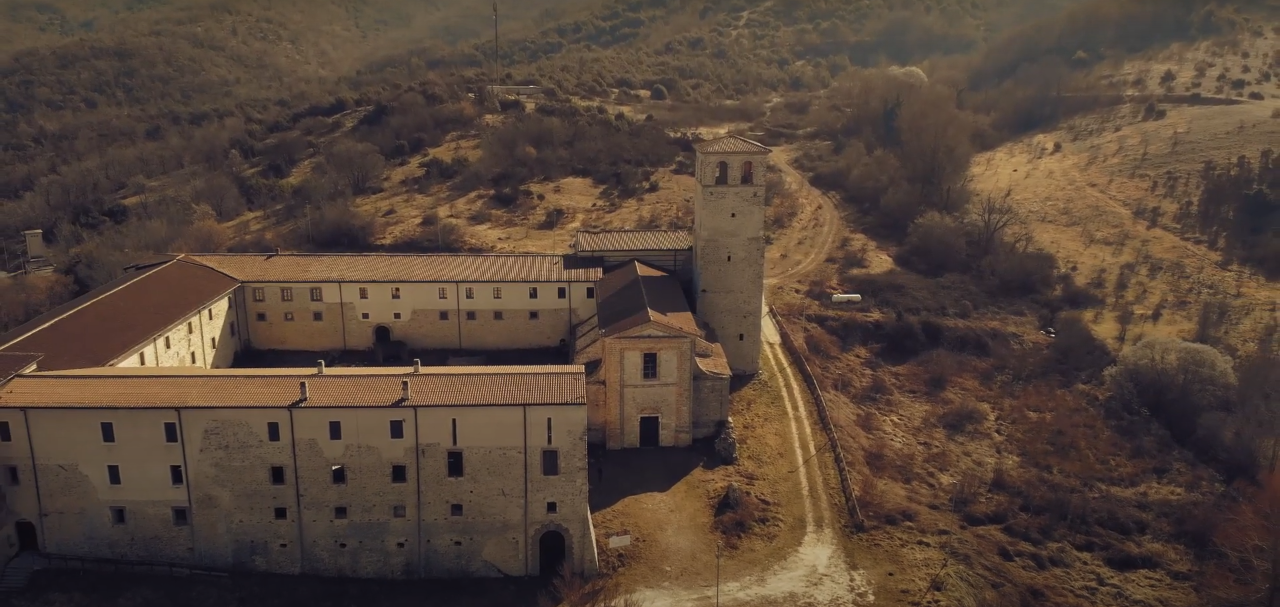
San Salvatore Maggiore Abbey stands on the Letenano mountain plateau, in the territory of Pratoianni, a hamlet of Concerviano (RI), and has belonged to the Comune di Concerviano since 1986. It has no published opening hours: according to the Rete delle Dimore Storiche del Lazio, it can be visited by phone reservation, at 0765 714020 or by writing to info@abbaziasansalvatoremaggiore.it. The price of the visit is not published. From the outside the complex can be viewed freely, and you go in only after fixing an appointment.
It is a Benedictine monastery founded in 735, according to the documentary tradition tied to Farfa Abbey, and suppressed by Pope Urban VIII with an act of September 12, 1629. After centuries as a seminary, the 1915 Marsica earthquake damaged it and the complex was abandoned. Sold by the dioceses in 1979 to a private owner, it passed to the Comune, which since the 1990s has turned it into a restoration site. Today it is not a church with regular Masses: it is a public monument that opens on request and for events.
Data checked on September 29, 2026 on the page of the Rete delle Dimore Storiche del Lazio, on the historical entry of BeWeB of the Italian Episcopal Conference, on the entry of the Roma Lazio Film Commission, on the FAI page and on the Cotral website cited below. The operator does not publish an opening calendar, a fare or a seasonal schedule. For any practical detail the channel to use is the contact given for reservations, preferably a few days ahead.
At a glance: address, hours, ticket
- Address: località Abbazia di San Salvatore Maggiore, Letenano mountain plateau, hamlet of Pratoianni, Concerviano (RI), near the village of Vaccareccia.
- Ownership: held by the Comune di Concerviano since 1986, according to the Rete delle Dimore Storiche del Lazio.
- How to get in: visit by phone reservation, tel. 0765 714020, email info@abbaziasansalvatoremaggiore.it.
- Price: not published by the operator, ask when you book.
- Hours: no fixed hours published, the exterior can be seen freely.
- How to get there: by car on a paved road, according to the Roma Lazio Film Commission, or by checking the Cotral runs to Concerviano.
- Accessibility: the operator does not publish information on barrier-free routes, it's best to ask beforehand.
Where it is and what you really see
The abbey occupies a high plateau between the Salto and Turano valleys, on the watershed of the two rivers, in the upper Sabina of Rieti. The nearest village is Vaccareccia, a hamlet of Concerviano. Around it are woods, pastures and a few scattered villages, and the city of Rieti lies to the northwest. It is an isolated place, and the isolation is part of its history: the monks sought distance from the world and, at the same time, control of a vast territory.
What do you see when you arrive? According to the Rete delle Dimore Storiche del Lazio and the entry of the Roma Lazio Film Commission, the complex consists of a single-nave church with side chapels, an imposing bell tower and three conventual buildings arranged around a rectangular courtyard of about 50 meters per side. The bell tower is the most recognizable element from afar. The courtyard, once you are inside, gives the measure of how large the community was in its best centuries.
The three wings are not the same age or the same function. According to the Rete delle Dimore Storiche del Lazio, the east wing housed the common functions of monastic life, the north wing served for defense and residence, and the west wing was meant for administration and representation. Anyone who looks closely can read on the walls the transformation from medieval monastery to fortified residence of the commendatory cardinals, and then to seminary, with openings, rebuilding and additions from different periods.
The detail to look for is the church portal. According to the free encyclopedia Wikipedia it was made in 1506, in the time of the commendatory Sisto Gara della Rovere, with panels depicting the castles of the abbatial lordship. Another notable piece is the tombstone of Sextus Tadius, part of a Roman sarcophagus reused as the basin of a drinking trough inside the complex, visible proof of the Roman villa on which the monastery rose.
The plateau was the center of a small lordship. According to Wikipedia, the papal bull of 1191 recognized the abbey's holding of the territory between the Salto and the Turano, called the Plage, from the Paganico ditch to the Borgo of Rieti. In 1310 the castles disputed by the abbey included, among others, Vallecupola, Rocca Vittiana, Poggio Vittiano, Longone, Vaccareccia, Roccaranieri, Cenciara, Concerviano and Pratoianni. Many of these names still correspond to towns and hamlets of the area today, and are found on the road maps of the valley.
The complex you see today is therefore the administrative heart of that small monastic state. From here the abbots collected tributes, appointed officials, administered justice in the castles and negotiated with popes, emperors and the Comune of Rieti. When you arrive by road, the disproportion between the bulk of the monastery and the small villages around it tells well who commanded the valley. It is the most useful key for understanding why such a large building stands in such a secluded place.
A curiosity about San Salvatore Maggiore Abbey
The bishop of Rieti is still today also the abbot of San Salvatore Maggiore. The historical entry of BeWeB, the portal of church heritage of the Italian Episcopal Conference, recalls that in 1925 the apostolic constitution of Pius XI In altis Sabinae montibus united to the diocese of Rieti the parishes of Pratoianni, Vaccareccia, Longone, Vallecupola, Rocca Vittiana, Poggio Vittiano and Varco. Since then the abbatial title passes to the bishops of Rieti, and the diocese carries the memory of the monastery in its name.
Second curiosity: the monks of the Salvatore were called berrettanti, after the headdress they wore, according to Wikipedia. The same text relates that the community kept the Frankish rite for a long time instead of the Roman one, to the point that Pope Leo IV, in the mid 9th century, threatened the entire monastery with excommunication. A mountain abbey in the territory of Rieti resisting Rome over the liturgy is a sign of how tied it was to the Carolingian world and its protectors beyond the Alps.
Third curiosity, an economic one. After the suppression of 1629 the abbey's revenues went to Cardinal Francesco Barberini, nephew of Urban VIII. According to Wikipedia, the wool of the flocks of the San Salvatore territory served the weaving workshop that the cardinal had opened in 1627 at Palazzo Barberini, active until 1683. Part of the tapestries that came out of that workshop is today in the Vatican Museums. The thread that links a Sabine pasture to a papal collection is literally made of wool.
The last one concerns collective memory. The FAI page dedicated to the complex indicates that the abbey was reported to the I Luoghi del Cuore census in the 2016, 2018, 2020 and 2022 editions. The same page describes the monument as acquired by the Comune di Concerviano and under restoration. Four voting campaigns in six years say that in the valley someone has mobilized steadily so that it would not fall back into oblivion.
Something nobody tells you about San Salvatore Maggiore Abbey
The opposing view, in our judgment, concerns the comparison with Farfa. Many present San Salvatore Maggiore as the little sister of Farfa Abbey, and those who arrive expect a living monastery, with monks, fixed hours and an open church. It is not so. Farfa is still a monastic community, San Salvatore is a restored monument owned by the Comune, with no stable religious life. Anyone leaving Rome expecting the same experience risks finding the gate closed.
A second thing rarely said: the complex has not always been a romantic ruin. After the suppression it had a second life lasting more than two centuries. According to Wikipedia, in 1746 Cardinal Marcello Federico Lante moved there the seminary established at Toffia in 1629, and from 1880 to 1915 the building was the summer seat of the seminaries of Poggio Mirteto and Rieti. Many of the rooms you walk through today were classrooms, dormitories and refectories of seminarians, not cells of medieval monks.
Third thing: the sources do not agree on the change of ownership. Wikipedia writes that in 1979 the dioceses of Rieti and Poggio Mirteto sold the complex to a private owner, who in 1986 sold it on to the Comune di Concerviano. The BeWeB entry instead indicates, after the sale of 1979, a transfer to the Comunità montana del Salto Cicolano in 1985. The Rete delle Dimore Storiche del Lazio attributes the purchase to the Comune in 1986, under mayor Damiano Buzzi. The current owner, for all of them, is the Comune.
Fourth thing, a practical one. The entry of the Roma Lazio Film Commission notes that electricity is not available on site, while water is present. The detail concerns productions that want to film here, but it also tells the visitor a lot: no bar inside, no services permanently organized, no lighting designed for evening visits. It's best to arrive with water, shoes suited to uneven ground and a clear idea of the time agreed with whoever opens it.
What was the relationship between San Salvatore Maggiore and Farfa?
A family relationship, according to the sources. Wikipedia attributes the founding of 735 to Lucerius of Moriana, companion of Thomas of Moriana, the monk who in 721 had refounded Farfa. The BeWeB entry specifies that the date comes from the Chronicon Farfense, the chronicle of the Sabine abbey, which speaks of a coenobium Sancti Salvatoris near Longone, in the territory of Rieti. The two communities were therefore born from the same monastic environment, in the years of the Lombard kingdom of Liutprand.
In the following centuries their destinies run in parallel. After the fall of the Lombard kingdom, according to Wikipedia, San Salvatore, Farfa and the monastery of Sant'Andrea on Monte Soratte were considered royal monasteries of the Carolingian kingdom. The properties of the two abbeys were often adjoining, jagged and intertwined between the Salto, the Turano, the plain of Rieti and the Sabina. The letters kept in the archives of Farfa document a relationship of friendship between the abbots, especially between the end of the 9th and the beginning of the 10th century.
The closeness becomes administrative union with the commenda. According to Wikipedia, in 1399 Boniface IX entrusted the two monasteries to a single administrator, his nephew Francesco Carbone Tomacelli. In 1494 Pope Alexander VI permanently united the commenda of San Salvatore to that of Farfa, and from then on the two abbeys had the same commendatories until the 1600s: Orsini, della Rovere, Farnese, Barberini. With the suppression of 1629 San Salvatore was finally incorporated into Farfa.
For the visitor, the comparison is instructive. Farfa has kept monastic life and a village at the foot of the monastery, described among our entries on Castelnuovo di Farfa and in the one on Fara in Sabina. San Salvatore has lost all of this and presents itself stripped bare, isolated on its plateau. Seeing both helps to understand what the network of the great imperial abbeys between the Sabina and the Rieti area meant in the Middle Ages.
My advice for visiting San Salvatore Maggiore Abbey
Book before you leave, always. The complex has no open ticket office, and without an appointment you stay in front of the portal. Call the number given by the Rete delle Dimore Storiche del Lazio a few days ahead, ask for the exact time, the meeting point, the duration and the cost, and have them confirm that the inside of the church will be accessible. During periods of works some parts may stay closed, and the operator does not publish updated notices.
Arrive with the history already in your head. On site the panels are few and the complex, without context, can look like just a big stone building. Three reference points are enough: the founding of 735 tied to Farfa, the Saracen destruction of 891 and the reconsecration of 974, the suppression of 1629 followed by the seminary. With these dates you can read the bell tower, the portal of 1506 and the transformation of the wings into a fortified residence and then a school.
Choose the season. The plateau is high and open, with cold winters and possible snowfall. Spring and early autumn are the most comfortable periods for combining the visit with a walk in the surroundings or with the lakes. In summer the long days allow you to add Lake Salto or Lake Turano, which lie in the two valleys on either side of Mount Letenano.
If you come with other people, friends or an association, you must say so when you book. In 2015 the local press reported special conditions for those arriving in groups of more than 10. The current operator does not publish rules for groups, so the number must be agreed. Keep in mind that parking is not indicated by the official sources and that access on a paved road, for the Roma Lazio Film Commission, is possible even for large vehicles.
Can you walk in freely, and how much does it cost?
No, you cannot walk in freely. The Rete delle Dimore Storiche del Lazio indicates that the visit happens by phone reservation, with the number 0765 714020, the email info@abbaziasansalvatoremaggiore.it and the abbey's website as references. The operator does not publish fares or an opening calendar. The cost, the length and the language of the visit must be asked when you book. No paid product dedicated to this abbey appears on the online booking platforms.
Where do you really book? Only through the contacts given on the page of the Rete delle Dimore Storiche del Lazio, which refers to the abbey's website and the operator's contacts. Be wary of hours found on review portals or old promotional pages, which are not updated by the owner. For questions about the abbatial title or the religious history of the place the institutional reference is the Diocese of Rieti.
A historical datum helps to get oriented. On August 10, 2015 the online paper Rietinvetrina announced the reopening to visitors with guided visits on Saturday at 16:00 and Sunday at 11:00, from March to December, lasting about 90 minutes, at a price of five euros per person, with reservation required. Those conditions date back more than 10 years and do not appear confirmed by the current operator. They should be read as a rough indication, not as valid hours.
Then there are the openings tied to events. Over the years the complex has hosted conferences, visits organized by the Comune with cultural institutions of the area and, according to the photos published by the Rete delle Dimore Storiche del Lazio, theater performances and tastings. On September 6, 2015, for example, the Comune, the State Archive of Rieti and two historical associations of the Sabina organized an afternoon with a visit to the restorations and a conference, according to Frontiera Rieti. To know if there are events on the calendar, it's best to ask the operator.
Another well-known fact, yet rarely cited
That the abbey was destroyed by the Saracens everyone repeats. Less cited is the time it took to put it back on its feet. According to Wikipedia the raiders set the complex on fire in 891 and stayed encamped in the territory for a long time. The church was reconsecrated only in 974, about 50 years after that of Farfa, with the intervention of Emperor Otto II and his wife Theophanu. From then on the monks celebrated two anniversaries of consecration, January 17 and July 4.
The second fact known to historians and little told concerns written culture. According to Wikipedia the abbey had an active scriptorium from at least the 11th century, and the codices produced here circulated in the churches of Rome and in other monasteries. The monastery's archive, however, has been dispersed, and much of what is known comes from the archives of Farfa. In 1308, according to the same source, rebel vassals assaulted the monastery and burned books, vestments, privileges and papers.
Third fact: in 1304 Cardinal Francesco Orsini di Napoleone left his library by will to San Salvatore Maggiore, except the law books destined for the Basilica of Santa Maria Maggiore, according to Wikipedia. A few years later the assault of 1308 sent a good part of that heritage up in smoke. A cardinal's library in a mountain monastery says what the prestige of the place was in the early 1300s, before the long decline.
Finally, the presence of missionaries and reformers. According to Wikipedia, in 1628 some Piarists came to San Salvatore at the request of Cardinal Barberini to Joseph Calasanz, and left again in 1635. At Easter 1645 the missionaries of Saint Vincent de Paul came, and one of them, Father Humbert Dunots, died at the abbey after contracting the plague while blessing the sick of Concerviano. In 1742 the abbey's lands received the mission of Leonard of Port Maurice.
The right photo to take at San Salvatore Maggiore Abbey
The photo that tells the place is the one of the whole complex on the plateau, with the bell tower rising above the wings of the monastery and the mountains around. You need a viewpoint at a distance, from the access road or the surrounding meadows, staying on public areas. The raking light of morning or late afternoon brings out the stone of the walls. At midday in summer the complex turns flat and loses depth.
The second image to look for is the portal of 1506, with the panels of the castles. It should be photographed up close, one panel at a time, and then as a whole, to show the sequence. It is a document in stone of the abbatial lordship, a sort of carved map of the monastery's possessions in the early 1500s. During the visit ask which castles are recognizable, because some names still correspond to towns and hamlets of the valley.
Third choice: the inner courtyard, if the visit allows it, with the three wings that enclose it. A wide-angle lens helps convey the size, about 50 meters per side according to the Rete delle Dimore Storiche del Lazio. Look also for the tombstone of Sextus Tadius on the trough, which joins the Roman sarcophagus and the monastic reuse in a single frame. Inside closed spaces always ask permission before shooting.
On the seasons: autumn gives the best colors to the surrounding woods, winter with snow offers rare images but makes the road demanding. In spring the green of the pastures contrasts with the gray stone. For professional video or photo productions the entry of the Roma Lazio Film Commission gives the contacts of the regional foundation and recalls the absence of electricity on site, a detail not to be underestimated with battery-powered equipment.
How do you get there from Rome and from Rieti?
The operator does not publish detailed directions. The entry of the Roma Lazio Film Commission indicates that the site can be reached by car, even with large vehicles, on a paved road. The reference to set on the navigator is località Abbazia di San Salvatore Maggiore, in the municipality of Concerviano, near the hamlet of Vaccareccia. Before leaving, it's best to ask the operator, when you book, for the recommended route and the place to leave the car.
By public transport the situation is more complicated. The suburban service of Lazio is run by Cotral, which provides a timetable search by locality and the toll-free number 800 174 471. It's best to look for the runs from Rieti to Concerviano and its hamlets, checking that they exist on the days and at the times of the visit. The official sources do not indicate a stop at the abbey, and the last stretch might require a lift or a walk.
From Rome the trip goes through Rieti or through the Turano valley, depending on the road chosen. In our judgment, for those without a car, San Salvatore Maggiore is not a destination suited to a day trip by public transport alone. Anyone traveling without a car does better to choose Farfa, closer to the Salaria and better served, and to keep San Salvatore for an organized trip with a vehicle.
Those who like to walk can consider arriving on foot from one of the nearby villages, but only with up-to-date maps and information from the Comune on the trails that can be walked. The territory is mountainous, with elevation changes and isolated stretches, and the operator does not publish a map of the routes. In winter snow and ice can make even the secondary paved roads difficult. Check the weather and any ordinances before setting out.
Some important events that happened here in history
In 735 the monastery is born, according to the Chronicon Farfense cited by BeWeB. In the 9th century come the imperial privileges and the gifts of the popes: Wikipedia recalls the cloths embroidered with gold offered by Paschal I and, in 872, the immunities granted by Louis II. In 891 the Saracens set the complex on fire. In 974 the church is reconsecrated with the support of Otto II. These are the years in which the abbey controls lands from the Sabina to Abruzzo and the Marche.
On May 27, 1191 Pope Celestine III, with a bull, places San Salvatore under the protection of the Holy See and confirms its properties, according to Wikipedia. For the first time the possession of the territory between the Salto and the Turano that will become the abbatial lordship is sanctioned. In 1268, after the battle of Tagliacozzo, Prince Henry of Castile, captured during his flight, stays two weeks at the abbey before being handed over to Charles of Anjou on September 7, according to the same source.
In the first months of 1308 the rebel vassals besiege and sack the monastery. In 1399 the commenda regime begins, which from 1494 unites San Salvatore to Farfa. In 1506 the commendatory Sisto Gara della Rovere has the portal with the castles made. On September 12, 1629 Urban VIII suppresses the abbey: BeWeB speaks of a brief, Wikipedia of a bull titled Singulari diligentia, and recalls that 34 monks were reduced to secular clergy.
In 1746 the seminary moves into the monastery. In 1841 the territorial abbey is suppressed and the seminary leaves the building. From 1880 to 1915 the complex is the summer seat of the seminaries of Poggio Mirteto and Rieti, until the Marsica earthquake of 1915 damages it. In 1925 the parishes pass to the diocese of Rieti. In 1979 the sale to a private owner, in 1986 the purchase by the Comune, and from the 1990s the restorations.
Who has passed through San Salvatore Maggiore Abbey
The first names are those of the founders and the abbots. Lucerius of Moriana, to whom Wikipedia attributes the founding. Abbot Usualdus, who according to the same source corresponded with Alcuin of York, the master of Charlemagne's palatine school. Abbot Landuinus, friend of Abbot Hugh of Farfa at the turn between the 9th and 10th century. Battista Orsini, who died around 1447 and is remembered as the last abbot elected by the monks.
Then the prisoners and the soldiers. Henry of Castile, defeated at Tagliacozzo in 1268, was held here for two weeks before his long imprisonment. According to Wikipedia, in 1495, 200 soldiers of the King of France Charles VIII passed through the abbey after an attempted sack at Cittaducale. During the Roman Republic of 1798 and 1799 a column of French soldiers crossed the territory from Rieti toward the Cicolano, where the insurrections were continuing.
The commendatories bring to San Salvatore the names of the great Roman families. Giovanni Battista Orsini, who died in 1503 in Castel Sant'Angelo after the conspiracy against Cesare Borgia, according to Wikipedia. Ranuccio and then Alessandro Farnese, of the family of Palazzo Farnese in Caprarola, who according to Wikipedia promoted in 1577 the restoration of the church of Farfa. Francesco Barberini, who asked for and obtained the suppression. Later Domenico Passionei and the Lante Montefeltro della Rovere.
Finally the religious of the Counter-Reformation and of the following centuries. The Piarists sent by Joseph Calasanz in 1628. The missionaries of Saint Vincent de Paul in 1645, with Father Humbert Dunots who died of plague. Leonard of Port Maurice, who in 1742 preached in the abbey's lands and erected Via Crucis in some parishes. And for over a century and a half generations of seminarians of the Sabina and the Rieti area, until the earthquake of 1915.
What is documented and what is tradition?
What the documents say. The bull of Celestine III of May 27, 1191 on the abbey's properties, the act of suppression of September 12, 1629, the constitution In altis Sabinae montibus of 1925 are official acts cited by Wikipedia and by BeWeB. The tombstone of Sextus Tadius is recorded in the Corpus Inscriptionum Latinarum, according to Wikipedia. The portal of 1506 and the visible structures are material documents that anyone can observe during the visit.
What tradition says. The date of 735 and the name of the founder Lucerius come from the chronicle of Farfa, a monastic source written centuries after the events and interested in exalting the origins of its own religious family. Also the story of Christmas 800, when according to Wikipedia the abbot of the Salvatore paid homage to Charlemagne at Farfa and obtained the title of imperial abbey, belongs to this tradition. It is plausible, but it does not have the force of a preserved original act.
What remains legend or reconstruction. The story of the liberation of the territory from the Saracens in the battle of Trebula Mutuesca in 914, reported by Wikipedia, mixes local memory and historical reconstruction. The same goes for the nickname of berrettanti given to the monks and for the harsh words against the Barberini that circulate in the stories of the abbey, partisan judgments more than documents. Popular tales of hidden treasures or underground tunnels, common to many monasteries, are not confirmed here by any official source.
The advice for visitors is to keep the three levels separate. The founding dates and the great imperial names lend fascination to the history, but the solid proofs are the bulls, the archive papers of Farfa and the stones of the building. The Roman villa underneath, confirmed by the reused materials, is perhaps the surest datum of all. Those who want to go deeper find in the historical entry of BeWeB a reliable ecclesiastical summary.
What state is the abbey in after the restorations?
The Comune di Concerviano, owner since 1986, began the restorations in the 1990s, according to Wikipedia, which speaks of the complex as a case study. The works confirmed the Roman origin of the construction, with structural and decorative clues. In 2015 the local press spoke of a reopening to visitors after about two decades of construction work. The FAI page still describes the monument as under restoration, without giving completion dates.
What does this mean for the visitor? Part of the complex is recovered and can be visited with the operator, while other parts may be under work or not accessible. The operator does not publish an updated list of the open spaces, of the works in progress or of the funding obtained. The solution is always the same: ask by phone, when you book, which rooms you will see and if the church is accessible on the chosen day.
The complex also has a cultural function. According to the Rete delle Dimore Storiche del Lazio it hosts guided visits and activities such as theater performances and tastings, documented by the photos on the page. The Roma Lazio Film Commission offers it as a location for film and television productions, with the contacts of the regional foundation. No regular religious celebrations appear, and the operator does not publish a calendar of Masses or feasts in the abbey church.
The earthquake remains the great underlying theme. The complex was damaged by the Marsica quake of 1915 and stayed abandoned for decades, after a failed restoration attempt in the 1930s and an attempt to entrust it to the Salesians between the 1950s and 1960s, according to Wikipedia. The Rieti area is seismic, as the towns of Amatrice and Leonessa remind us. Every visit to a historic building in the area should also be read in light of this fragility.
Where does San Salvatore Maggiore fit among the abbeys of Lazio?
In Lazio the great Benedictine abbeys tell very different stories. Montecassino Abbey is the mother house of the order, rebuilt after the war. The Sacro Speco of Subiaco and the Monastery of Santa Scolastica keep the memory of Saint Benedict. Farfa is the imperial abbey of the Sabina, still inhabited. San Salvatore Maggiore is the most isolated and least known of the group, and for exactly this reason it shows unfiltered the arc of a medieval monastery.
Then there is the Cistercian strand, which comes later. Casamari Abbey and Fossanova Abbey show the Gothic of the white monks, with bright churches and regular cloisters. The comparison helps in understanding San Salvatore: here the architecture was reworked until it became a fortified residence and seminary, while in the Cistercian abbeys the medieval layout can still be read in a more unified way.
Between the Sabina and the Tiber valley there are other medieval monasteries worth knowing. San Giovanni in Argentella Abbey, near Palombara, and, across the Tiber, Santa Maria di Falleri Abbey. In the plain of Rieti, instead, the strongest religious presence is the Franciscan one, with the Greccio Sanctuary and the Fonte Colombo Sanctuary.
The link with Rome is closer than it seems. The abbots of San Salvatore dug in the suburban cemeteries of Rome in search of relics, and according to Wikipedia they obtained the body of the martyr Hippolytus. In 1373 Pope Gregory XI charged the abbot of San Lorenzo fuori le mura with visiting and reforming the monastery. In 1306, according to the same source, a family of the area tried to impose as abbot the abbot of Subiaco.
When is it closed and what should you not expect?
In practice it is closed whenever you don't have an appointment. The operator does not publish fixed opening days, and the interior can be seen only by reservation. In the winter months the climate of the plateau, with cold and possible snow, can make access and the visit difficult. During periods of works some parts of the complex may stay off limits. Before setting out, have them confirm on the same day that the appointment is valid.
What should you not expect? A monastic community: the monks left in the 1600s. A Sunday Mass: no calendar of celebrations appears. A bar, a shop, a ticket office: the entry of the Roma Lazio Film Commission also notes the absence of electricity on site. Explanatory panels in every room: the history has to be studied beforehand. Nor extensive medieval frescoes as in other monasteries of Lazio, because centuries of transformations have changed the look of the interiors.
Don't expect a town around it either. The abbey stands isolated, with the village of Vaccareccia as the nearest inhabited center, and services are found in the towns of the valley or at Rieti. For those who need restrooms, water or shelter in case of rain, it's best to organize beforehand. With small children or people with mobility difficulties, ask the operator what the ground of the courtyard is like and if there are steps to enter the church.
Finally, don't count on up-to-date online information. Review portals report addresses and descriptions not verified by the owner, and some abbey websites don't always respond. The only datum that counts is what the operator gives you by phone. In our judgment this uncertainty is the price to pay for a little-visited place, and those who accept it find a monument without crowds, told by the people who look after it.
Eating in the area
Inside the complex there is no refreshment point, and the operator does not publish rules on picnics or eating in the courtyard. In the area of the upper Sabina of Rieti, the places to eat are in the towns of the Salto and Turano valleys, in Rieti and in the villages on the lakes. Tourist pressure is low for much of the year, and the typical traps of central Rome are rare here. They become more frequent in the summer places of passage.
The signs to recognize are always the same. The barker in front of the restaurant, the menu with photographs of the dishes, items without prices, a different menu outside and inside, a kitchen open nonstop without a break, fresh pasta made in the window to catch attention. People who live in the valley avoid these places because they count on passing trade and not on regular customers. In the lake villages, on summer weekends, it's wise to watch for exactly these details.
The practical rule is to look for where local people eat, with a short menu tied to the season and to mountain products, and prices written in plain view. In small towns the kitchen hours are rigid, and after a certain time it can be hard to find a table. Calling ahead is often the best choice. For carefully selected addresses there is the list of addresses on Google Maps, useful for organizing the day.
Those who prefer a packed lunch must bring everything from home or buy it before going up to the plateau, because there are no shops around the abbey. Respect the pastures and private properties nearby, don't leave trash and don't light fires. The shores of Lake Turano, with the villages of Castel di Tora and Paganico Sabino, are a good alternative for an outdoor break.
What to combine in a day
The most logical pairing is the Turano valley. Castel di Tora, with its lake, and a little above it Antuni, the abandoned village on the promontory, are described among our entries. On the same road you find Collalto Sabino with its castle and the Monte Navegna and Monte Cervia Nature Reserve, for those who want to add a walk in the woods. It is a day of mountains, villages and water.
To the east opens the Salto valley and the artificial lake that took its name. Lake Salto and the towns of the Cicolano complete the picture of the territories once controlled by the abbey. Those who prefer the city can go down to Rieti, visit the historic center, and then move on to the Lungo and Ripasottile Lakes Reserve or go up to Terminillo.
Those who follow the religious thread find the Franciscan sanctuaries in the plain of Rieti. Besides Greccio and Fonte Colombo there are the Poggio Bustone Sanctuary and the Santa Maria della Foresta Sanctuary. They are open places with more regular hours, suited to filling the day if the visit to the abbey is short. The contrast between Benedictine monasticism and Franciscan spirituality is evident in the landscape too.
For a two-day Sabine itinerary you can join San Salvatore Maggiore and Farfa, passing through Toffia, seat of the first seminary established with the abbey's revenues, and through Poggio Mirteto. In the lower Sabina you also find Roccantica and Orvinio. In Rome, on the way back, the thread of history continues at Palazzo Barberini, where the weaving workshop fed by the wool of the Salvatore's lands was born.
Frequently asked questions
Is San Salvatore Maggiore Abbey open to the public?
Not with fixed hours. According to the Rete delle Dimore Storiche del Lazio the visit happens by phone reservation, at 0765 714020, or by writing to info@abbaziasansalvatoremaggiore.it. The operator does not publish an opening calendar or fares. The exterior of the complex can be seen from the access road and the public areas around it, while to enter the church and the courtyard you need an appointment agreed a few days ahead.
How much does a visit to the abbey cost?
The current price is not published by the operator and must be asked when you book. In 2015 the online paper Rietinvetrina reported guided visits at five euros per person, on Saturday afternoon and Sunday morning from March to December, with reservation required. Those conditions do not appear confirmed today by the operator and may have changed. There is no dedicated online ticket on booking platforms.
Who owns the abbey?
The Comune di Concerviano, according to the Rete delle Dimore Storiche del Lazio, which places the purchase in 1986. The sources do not agree on the intermediate steps: Wikipedia speaks of a sale in 1979 from the dioceses of Rieti and Poggio Mirteto to a private owner, then sold on to the Comune, while the BeWeB entry indicates a transfer to the Comunità montana del Salto Cicolano in 1985. The title of abbot of San Salvatore belongs to the bishop of Rieti.
Is Mass celebrated in the abbey?
No calendar of regular celebrations appears. The complex is a monument owned by the Comune, restored and open by reservation and for events. The monastic community was suppressed in 1629 and the building was then a seminary until 1915. For information on any extraordinary celebrations it's best to contact the Diocese of Rieti, whose bishop still holds the abbatial title of San Salvatore Maggiore.
What links San Salvatore Maggiore to Farfa Abbey?
A lot. According to the tradition documented by the chronicle of Farfa, the founder Lucerius was a companion of Thomas of Moriana, who had refounded Farfa. The two abbeys had adjoining properties and friendly relations between the abbots, received imperial privileges in the Carolingian age and from 1494 shared the same commendatories. With the suppression of 1629 San Salvatore was incorporated into Farfa, which is still inhabited by monks.
How do you get to the abbey without a car?
With difficulty. Suburban transport is run by Cotral, whose website offers a timetable search by locality and the toll-free number 800 174 471. It's best to look for the runs from Rieti toward Concerviano and its hamlets, checking days and times. The official sources do not indicate a stop at the abbey, and the last stretch might require a lift. In our judgment, without a car it is better to choose Farfa.
What do you see during the visit?
According to the Rete delle Dimore Storiche del Lazio, the single-nave church with side chapels, the bell tower and the three conventual wings around a courtyard of about 50 meters per side. Look for the portal of 1506 with the panels of the abbey's castles and the Roman tombstone of Sextus Tadius, reused as the basin of a trough. Which rooms are open on the chosen day must be asked of the operator.
When is the best time to go?
Spring and early autumn are the most comfortable seasons, with mild temperatures and roads free of snow. The Mount Letenano plateau is high and in winter can be cold and snowy. In summer you can combine the visit with a stop at the lakes of Salto and Turano. In every season the rule stays the same: book first and have the appointment confirmed.
Who wrote this and from what sources
The text comes from the editorial team of Tour Leader Pro, the Rome-based outfit that designs itineraries, visits and cultural events between Rome and Lazio. The visiting arrangements and contacts given here come from the official sources cited in the text, as of the date stated at the top: for San Salvatore Maggiore, the page of the Rete delle Dimore Storiche del Lazio and the operator's indications at the time of booking are authoritative. Tell us what you find changed.
Organizing a visit to San Salvatore Maggiore for several people means working on the fit of the pieces: fixing the appointment with the operator, calculating the travel time on mountain roads, providing water and services that are missing on site, combining Farfa or the lakes to fill the day. For anyone planning outings of this kind, a useful resource for organizing group trips is Tour Leader Pro, with tools designed to coordinate visits and itineraries.
San Salvatore Maggiore opens the door to a little-trodden Sabina, made of abbeys, castles of the monastic lordship, artificial lakes and Franciscan sanctuaries in the plain of Rieti. Putting together the Turano valley, the Cicolano, Farfa and perhaps the lower Sabina takes a few days and a bit of planning, and a useful resource for building a multi-day itinerary is Italy Planner.