Abbazia di Santa Maria di Falleri
In short. The Abbey of Santa Maria di Falleri is not private and is not open every day: the church belongs to the Municipality of Fabrica di Roma, which opens it to visitors on Saturdays, Sundays and holidays from 10 to 13, according to the…
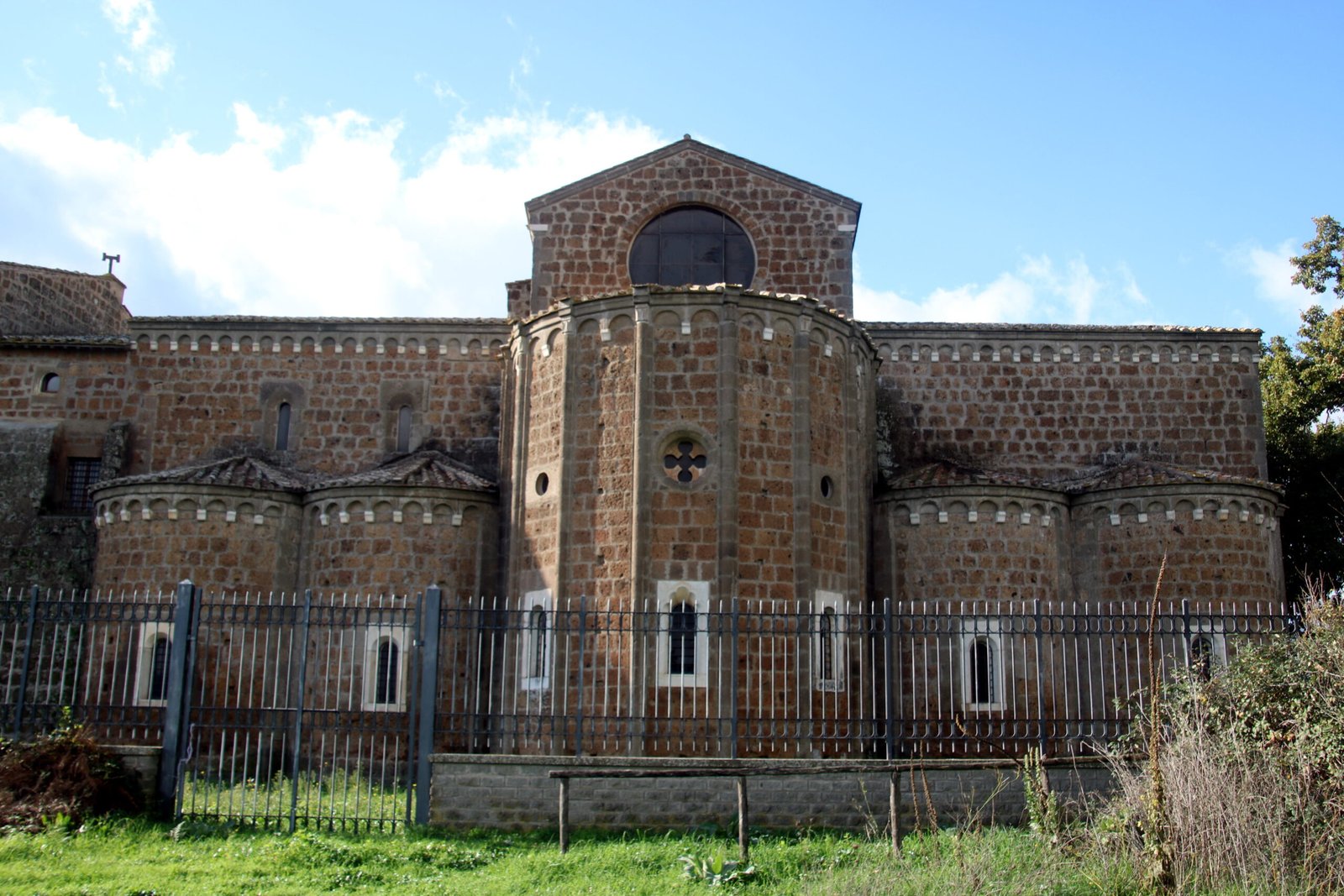
The Abbey of Santa Maria di Falleri is not private and is not open every day: the church belongs to the Municipality of Fabrica di Roma, which opens it to visitors on Saturdays, Sundays and holidays from 10 to 13, according to the municipal notice published on March 4, 2026 for the season that began on April 25. It's inside the walls of Falerii Novi, in the locality of Parco Falisco, between Fabrica di Roma and Civita Castellana. The Municipality doesn't publish a street number or an admission price.
Today what remains is the abbey church, not a monastery to visit. It's a Cistercian building from the end of the 12th century, in tuff, with three naves, a marble portal signed by the marble workers Lorenzo and Jacopo and five apses opening onto the transept, a solution that the sources describe as an isolated case among Italian Cistercian churches. Around it stretch the walls and gates of the Roman city, covered in our page on Falerii Novi.
Data checked on September 29, 2026 on the website of the Municipality of Fabrica di Roma, on the reopening notice and on the page of the Culture Office, as well as on the Cotral website for transport. The 2026 notice doesn't give the end date of the seasonal openings, doesn't say if booking is required and doesn't list fares. For any doubt the reference is the Municipality's Culture Office, at via A. Cencelli 20 in Fabrica di Roma, at the numbers 0761 569001, 0761 569936 and 0761 567530.
At a glance: address, hours, ticket
- Address: località Parco Falisco, inside the walls of Falerii Novi, 01034 Fabrica di Roma (VT), about four kilometers from the town toward Civita Castellana. The Municipality doesn't publish a street number.
- Ownership and management: Municipality of Fabrica di Roma, Culture Office, via A. Cencelli 20, telephone 0761 569001.
- How you get in: during the opening hours set by the Municipality, with municipal staff on site. Outside those hours the church is closed.
- Price: the municipal notice doesn't give a ticket. The information needs to be confirmed with the Culture Office.
- 2026 hours: Saturday, Sunday and holidays from 10 to 13, from April 25. The closing date of the season is not published.
- How to get there: by car on the road between Fabrica di Roma and Civita Castellana, or on foot along Via Amerina. No dedicated public transport line appears from the operator.
- Accessibility: the Municipality doesn't publish information on step-free access and facilities.
Where it is and what you actually see
Falerii Novi is in the territory of Fabrica di Roma, more or less halfway between the town and Civita Castellana, as the Municipality writes. It's an abandoned Roman city, enclosed by tuff walls still largely standing, with towers and gates. The church of Santa Maria di Falleri stands inside this enclosure, in a landscape of open countryside, far from inhabited centers. Whoever arrives sees the walls first, then the tuff facade of the church in the middle of the fields.
The facade is simple. In the center the marble portal with three recessed orders and small columns at the corners, above it three circular openings that give light to the interior, according to the description by Moveaboutitaly and the site I luoghi del silenzio. The rest is local tuff, a poor, dark stone, worked in blocks. Marble appears only in the portal and in some reused columns. It's the typical sobriety of the Cistercians, who in their churches gave up decoration, bell towers and colors.
Inside, the space is divided into three naves, with the central one twice as wide as the side ones. The supports are not all the same: cross-shaped pillars, square pillars and Roman columns with capitals different from one another, taken from the ruins of the city. One of the capitals, according to I luoghi del silenzio, bears sculpted figures of Roman soldiers. The transept is covered by a barrel vault. The current floor is in peperino, probably different from the original one in beaten earth.
The piece that makes the church different from the others is at the back. Five apses open onto the transept, one large in the center and four smaller ones, two per side, according to Tuscia Turismo and Lazio Nascosto. Online sources consider it a unique case in Italy among the churches of the order, with a model of French origin. The building also holds Roman finds, among them a marble altar dedicated to Cornelia Salonina, wife of the emperor Gallienus, who lived in the 3rd century AD.
A curiosity about the Abbey of Santa Maria di Falleri
The columns of the church are pieces of the dead city that surrounds it. The monks, who arrived when Falerii Novi had already been abandoned for centuries, used the materials they had at hand: column shafts, capitals, squared blocks. That's why no capital is the same as another. Reuse was a common practice in the Middle Ages, but here it's particularly readable, because the quarry the pieces came from is still there, a few meters away, inside the same walls.
The second detail concerns the altar of Cornelia Salonina. The inscription, according to I luoghi del silenzio, records the favors granted by the imperial house to Falerii Novi and the appointment of a certain Tyrius Septimius Azizus as curator of the city's public works. It's an administrative document of the Roman age that ended up in a medieval church. Whoever enters thus finds, in the same space, the urban politics of the 3rd century and the monastic life of the 12th.
Third curiosity, again epigraphic. Toward the end of the 19th century Count Giuseppe Cencelli found a cippus dedicated to the Lares protectors of roads and crossroads, according to the same source. The Latin formula speaks of a vow fulfilled to the Lares of the crossroads and of the roads. It's a rare find, because it recalls the cult of the deities who protected travelers, in a city born precisely along a Roman road, Via Amerina, which still passes under its walls.
The last curiosity concerns the name. In the sources you find Santa Maria di Falleri, Santa Maria in Falleri and Santa Maria a Faleri. The Municipality uses both the first form, in the page dedicated to Falerii Novi, and the second, in the opening notices. Falleri is the medieval form of the name of the Roman city, Falerii. When looking for directions or news it's worth trying all three spellings, because websites and maps are not consistent with each other.
One thing nobody tells you about the Abbey of Santa Maria di Falleri
Calling it an abbey creates the wrong expectations. Anyone arriving expecting a complex like Fossanova or Casamari, with a cloister, chapter house and refectory to walk through, ends up disappointed. Open sources describe the church, the finds and the walls, not a monastery that can be visited. In our judgment this is the thing people get wrong most often: the trip is worth it for the church inside the Roman city, not for a complete abbey. With this idea in mind, the visit is much more satisfying.
Second thing rarely said: the hours change from one year to the next. In 2024 the Municipality announced openings from May to the end of October, with Saturday afternoon from 16:30 to 19:30 and Sunday morning from 10 to 13. In 2026 the notice instead gives Saturday, Sunday and holidays from 10 to 13. Anyone who trusts an old guide online or a schedule seen on a portal may find the gate closed. The only reliable reference is the municipal notice of the current year.
Third thing: on weekdays the church can't be visited. The 2026 notice speaks only of Saturdays, Sundays and holidays. Anyone planning a trip around the Tuscia from Monday to Friday can see the walls, the gates and Via Amerina, but of the church they will see only the outside. For groups, schools or special needs the Municipality doesn't publish a procedure for opening on request: the only way to find out is to call the Culture Office a few weeks ahead.
Fourth thing, a practical one. The five apses, the most cited detail, can't be seen well from the facade. To understand them you have to go in and look toward the transept, or walk around the church, outside, where you can read the profile of the minor apses next to the central one. Many stop in front of the portal, take a photo and leave. The advice is to spend at least 10 minutes on the walk around the outside, unhurried, before or after the opening.
How does a Cistercian abbey come to exist inside an abandoned Roman city?
Falerii Novi was founded in 241 BC, after Rome had defeated the Falisci and destroyed their capital, Falerii Veteres, present-day Civita Castellana. The Municipality recalls that the city was rebuilt on the plain, in a less defensible position, and took the name Falerii Novi. It had a circuit of walls of almost triangular shape, with about 80 towers. In the Middle Ages the population went back to living on the cliff of Civita Castellana, and the city on the plain emptied out.
Between the end of the 10th and the beginning of the 11th century a monastic community settled among the ruins, according to I luoghi del silenzio. The site dedicated to Cistercian abbeys describes it as Benedictine. In 1143 a colony of Cistercian monks arrived from the abbey of Saint-Sulpice, which the Municipality places in Savoy. From that moment Santa Maria di Falleri entered the network of the order of Cîteaux, in the line of the abbey of Pontigny, according to the same Cistercian site.
In 1179 a bull of Pope Alexander III confirmed the monks' possessions and rights, as Moveaboutitaly and I luoghi del silenzio report. The construction of the church seen today is placed in the last decades of the 12th century. Two plaques record the consecration of two altars in the transept chapels in 1183 and 1186. The portal was signed by the marble workers Lorenzo and Jacopo toward the end of the 1180s of the same century.
The choice of the place had a logic. The Roman walls offered a ready-made enclosure, the ruins a reserve of worked stone, Via Amerina a connection to Rome and to Umbria. The Cistercians looked for secluded places, suited to farm work, and the plain around Falerii Novi was one. The result is a rare case in Lazio: a medieval monastery planted inside the intact perimeter of an ancient city, without a new town growing up around it.
On the dates the sources don't fully agree. The site dedicated to Cistercian abbeys and I luoghi del silenzio give 1143 as the year of the monks' arrival from Saint-Sulpice, and the latter describes it as attested by the only written document on the abbey. Lazio Nascosto presents 1143 as a presumed date and gives 1179, the year of the papal bull, as the first certain mention of the Cistercians. Anyone who reads different dates on panels and websites finds here the origin of the difference.
My advice for visiting the Abbey of Santa Maria di Falleri
Get to Falerii Novi before 10, on a Saturday or Sunday when it's open. Use the first hour for the walls and the Porta di Giove, then go into the church as soon as it opens, when there are fewer people. In three hours of opening there is plenty of time, but anyone arriving at a quarter to noon risks finding the staff getting ready to close. The 10-13 window is narrow, so it's best to build the day around it.
Before leaving, call the Municipality's Culture Office to confirm that it's open that weekend. The 2026 notice doesn't give the end date of the season, and in autumn the question is legitimate. The main number is 0761 569001. The abbey's Facebook page, pointed out by the Municipality itself, is a useful channel for last-minute notices, such as closures for bad weather or special openings for feasts and events.
Inside the church, do three things. Look at the capitals one by one, searching for the one with the Roman soldiers. Look for the altar of Cornelia Salonina and read the inscription. Then stand in the middle of the nave and look toward the transept, to understand the layout of the five apses. Ask the municipal staff present which parts are accessible, because the Municipality doesn't publish a plan of the route or a list of the finds on display.
For the outside you need country shoes. The ground around the church and along the walls is unpaved, with tall grass in spring and mud after rain. In summer bring water and a hat, because there is little shade. Stay on the existing paths and roads, without crossing cultivated fields and without climbing on the walls or the towers. They are ancient, fragile structures, and falling stones are not rare at sites of this kind.
How much does it cost and do you need to book?
The reopening notice published by the Municipality of Fabrica di Roma on March 4, 2026 doesn't give an admission price or a booking requirement. The portal Lazio Nascosto presents admission as free, but it isn't an official source, and the information needs to be confirmed with the Culture Office. There's no online ticket office, and the operator doesn't sell paid visits: you enter during the set hours, with municipal staff present in the church.
| Day | 2026 hours according to the Municipality |
|---|---|
| Saturday | 10:00-13:00 |
| Sunday | 10:00-13:00 |
| Holidays | 10:00-13:00 |
| Monday to Friday | closed |
There is only one official channel: the reopening notice of the Municipality of Fabrica di Roma, with the contacts of the Culture Office at via A. Cencelli 20. For group visits, classes or associations the phone call is indispensable, even just to announce your arrival: the staff on site are municipal and the Municipality doesn't publish a maximum number of entries. Lazio Nascosto also gives an email address for the office, which needs to be confirmed by phone.
Anyone looking for a visit with an explanation will find online local associations and Tuscia event portals that offer visits to Santa Maria di Falleri on specific dates. These are third-party initiatives, with prices and conditions set by whoever organizes them, and they don't replace the municipal openings. Before paying, it's best to check that the organizer is legitimate and that the date matches an opening of the church, asking the Culture Office for confirmation.
Another well-known fact, yet rarely cited
That the church is Cistercian, everyone writes. Less cited is that its monastic history was short. In 1355 the abbey, already in crisis, was entrusted for reform to the monastery of San Lorenzo al Verano, according to online sources. In 1392 its lands passed to the Hospital of Santo Spirito in Sassia, which administered them until about 1536. In less than three centuries the Cistercians of Falleri had already left the scene.
The second fact known to scholars and rarely told concerns ownership. In 1649 the abbey passed to the Apostolic Chamber and the church was closed to worship. In 1786 Pope Pius VI granted it in emphyteusis to the Municipality of Fabrica di Roma, according to Moveaboutitaly and I luoghi del silenzio. The Municipality's role derives from this 18th-century grant: the church doesn't belong to a parish or a religious order, and has no Mass schedule.
Third fact: the monument remained almost intact precisely because it was abandoned. Closed in 1649, the church did not undergo the Baroque transformations that changed the face of many medieval churches in Lazio. Nobody added stucco, gilded altars or new facades. The site dedicated to Cistercian abbeys describes it as more or less intact. It's the paradox of many country buildings: abandonment damaged them, but it also left them as they were.
The last fact concerns the current management. According to Il Messaggero of April 2018 and the portal Tuscia Turismo, the Municipality manages the monument directly, with an agreement with the former Archaeological Superintendency for Southern Etruria, and with municipal staff for openings and maintenance. In the spring of 2018, a few days after the reopening, the newspaper counted about 10 groups of visitors who had come from Italy, Japan, Belgium and France.
The right photo to take at the Abbey of Santa Maria di Falleri
The photo that tells the story of the place is the one that puts the church and the walls together. Step back from the facade far enough to frame the marble portal and, in the background or to the side, a stretch of the Roman tuff enclosure. It's the image that explains the particularity of Falleri better than any text: a medieval church inside an ancient city left empty. It works in landscape, with a lot of sky and the lawn in the foreground.
The second image is the portal up close. The three marble recesses and the corner columns hold up well in side light, early in the morning or in the late afternoon. At midday in summer the flat light erases the relief. Look for the signature of the marble workers Lorenzo and Jacopo that the sources mention on the portal, and photograph it carefully. Open sources don't give its full text, and the image counts as a document.
Inside, the right photo is the one along the axis of the central nave, from the entrance toward the transept, with the reused columns at the sides and the apses at the back. The light comes in through the openings of the facade and changes a lot with the hour. Always ask the staff if photography is allowed and if a tripod is permitted, because the Municipality doesn't publish rules on this. Avoid flash near the finds and the inscriptions.
For the outside, walking around the church gives you the framing of the apses, with their tuff curves. In autumn and winter the low sun brings out their relief. A cloudy day renders the colors of the stone better. Anyone using a drone must respect the national rules on flying and ask the Municipality for permission, since it's a public monument in an archaeological area: the operator doesn't publish general authorizations.
How to get there from Rome?
By car it's the simplest solution. Falerii Novi is on the road connecting Fabrica di Roma to Civita Castellana, about four kilometers from Fabrica according to Tuscia Turismo. From Rome you head north, toward the Flaminia and the Civita Castellana area. The Municipality doesn't indicate a dedicated parking lot, and the sources don't describe an organized parking area. Park without blocking access to fields and gates, and check the route with an up-to-date navigator.
By train the situation has to be checked before leaving. The Roma-Civita Castellana-Viterbo railway is run by Cotral and departs from piazzale Flaminio in Rome. At the end of September 2026 the line page on the Cotral website reports the section between Montebello and Morlupo suspended and served by replacement buses. Beyond the station, moreover, there remains the stretch to Falerii Novi, which the official sources don't indicate as served by public transport.
On foot the church can be reached along Via Amerina. The Fondazione Biodistretto della Via Amerina e delle Forre publishes the Corchiano, Falerii Novi, Nepi stage, 16.3 kilometers long, with about four hours and 20 minutes of walking and difficulty listed as easy. The route touches the Cavo degli Zucchi, the Porta di Giove and the abbey. GPX tracks and maps can be downloaded from the foundation's website. You need a car or a ride for the return.
Anyone coming from Viterbo or the Monti Cimini area instead heads down toward Fabrica di Roma and follows the signs for Civita Castellana. Here too the reference on maps is the locality Parco Falisco or the name Falerii Novi. To get out of the city on a Saturday morning it's best to leave early and check for works on the consular roads, and for the urban stretch there's our page on how to get around Rome.
Some important events that happened here in history
In 241 BC Rome founded Falerii Novi on the plain, after the defeat of the Falisci and the destruction of their capital on the cliff. The city had walls about two kilometers long, monumental gates and a system of towers. In the 19th century the forum, the theater and the amphitheater were excavated, according to the Municipality. In the Middle Ages the city emptied out and the population went back to the heights of Civita Castellana, leaving ruins and countryside on the plain.
Between the 10th and 11th century a monastic community settled among the ruins. In 1143 the Cistercians arrived from Saint-Sulpice. In 1179 Pope Alexander III confirmed their possessions. In 1183 and 1186 two altars of the transept were consecrated, as the plaques record. Toward the end of the 1180s the marble workers Lorenzo and Jacopo signed the portal. These are the decades in which the church took the form it still has today.
Then the decline. In 1355 the abbey was entrusted to San Lorenzo al Verano to be reformed. In 1392 the lands passed to the Hospital of Santo Spirito in Sassia. In the 16th century the complex was held in commendam, and in 1571, according to the bishop of Gaeta cited by I luoghi del silenzio, it was already in ruins. In 1649 ownership passed to the Apostolic Chamber and the church was closed. In 1786 Pius VI granted it in emphyteusis to the Municipality of Fabrica.
The 20th century brought the church back to visitors. Since 1990 the Superintendency for environmental and architectural heritage of Lazio has carried out restorations, according to I luoghi del silenzio. In 2018 the Municipality reopened the church with its own staff, under an agreement with the Archaeological Superintendency. In March 2024 the Municipality announced the discovery, in the area of Falerii Novi, of a marble head belonging to a small male sculpture. Since April 25, 2026 the weekend openings have resumed.
Who has passed through the Abbey of Santa Maria di Falleri
The first names tied to the place are Roman. Cornelia Salonina, wife of the emperor Gallienus, who reigned in the 3rd century AD, is remembered by the altar dedicated to her and kept in the church. The same inscription names Tyrius Septimius Azizus, curator of the public works of Falerii Novi, according to I luoghi del silenzio. They are people of whom almost nothing is known, but the stone has kept them tied to this place for 18 centuries.
Then the monks. The Cistercians who arrived in 1143 from the abbey of Saint-Sulpice are a community without names in the open sources, but their choice of life explains the form of the church. Pope Alexander III, with the bull of 1179, confirmed their possessions. The marble workers Lorenzo and Jacopo signed the portal, and the sources link them to the family of marble workers known as the Cosmati.
After the monks came the Roman institutions. The Hospital of Santo Spirito in Sassia administered the lands from 1392 for almost a century and a half, under the pontificate of Boniface IX according to Moveaboutitaly. The Apostolic Chamber became its owner in 1649. Pope Pius VI, in 1786, entrusted it in emphyteusis to the Municipality of Fabrica di Roma. Toward the end of the 19th century Count Giuseppe Cencelli found the cippus dedicated to the Lares of the roads.
The latest arrivals are walkers and foreign visitors. Via Amerina, recovered as a trail by the Fondazione Biodistretto, brings to Falerii Novi those who walk between Corchiano and Nepi. Il Messaggero, in 2018, told of visitors who had come from Japan, Belgium and France, often archaeology enthusiasts. And every weekend of opening the Municipality's staff keeps open a church that had remained closed for more than three centuries.
What is around the church, inside the walls of Falerii Novi?
The church is only one part of the site. The Municipality writes that the circuit of the walls measures 2,108 meters, while the site In Agro Falisco speaks of 2,018 meters: the sources don't agree on the exact figure. There were about 80 towers, and about 50 are still preserved. Of the original gates, two remain visible, the Porta di Giove and the Porta di Bove. All this is covered in our page dedicated to Falerii Novi, which is worth reading before the visit.
The Porta di Giove is the best known. Tuscia Turismo describes it as surmounted by a head of Jupiter carved in the keystone of the arch. It's one of the points touched by the stage of Via Amerina described by the Fondazione Biodistretto, so a mandatory passage for those arriving on foot. The Porta di Bove, cited by In Agro Falisco, completes the tour. Open sources give no hours or tickets for the walls and the gates, which are seen outdoors.
The forum, the theater and the amphitheater were excavated in the 19th century, but today they can't be read as at Ostia Antica. Whoever goes inside the walls sees mostly countryside. It's the difference between an equipped archaeological park and an abandoned city left to the earth. In our judgment this is precisely why the site strikes you more: the medieval church is the building that dominates the enclosure, and the rest of the city is guessed at from the contours of the ground.
Outside the walls runs Via Amerina, the Roman road that went up from Rome toward Umbria through Nepi and Falerii Novi. The city on the plain founded in 241 BC was born along this axis, and the road still passes next to the walls and the Porta di Giove. The monks of the 12th century chose a place that was still connected, not an isolated hermitage. Without the road, the presence of an abbey here would be hard to explain.
Today the Fondazione Biodistretto della Via Amerina e delle Forre has turned the route into a stage-by-stage trail, with maps and downloadable tracks. The stage that passes through Falerii Novi touches the Cavo degli Zucchi, a cut in the tuff with tombs dug into the rock, the Tre Ponti stretch with its restored paving and the Cavaterra waterfall near Nepi. Il Messaggero, in 2018, described Via Amerina and the Cavo degli Zucchi as freely visitable.
The contrary view worth keeping in mind concerns the trail itself. Many present it as a walk suited to everyone, and the foundation rates it as easy. But it's more than 16 kilometers on unpaved ground, with stretches exposed to the sun and uneven footing in the cuts. Whoever only wants to see the church and the Porta di Giove doesn't need to do the whole stage: a car and a short walk inside the walls are enough.
The site isn't a closed museum, and research continues. In March 2024 the Municipality of Fabrica di Roma announced the discovery, in the area of Falerii Novi, of a marble head belonging to a small male sculpture. The Municipality also recalls that scientific responsibility for the archaeological area lies with the Superintendency. Anyone who comes across remains or fragments surfacing in the fields leaves them where they are and, if they seem important, notifies the Municipality or the Superintendency.
What is true about the dove of light at the solstice?
What the sources say: the site In Agro Falisco, run by the Fondazione Biodistretto della Via Amerina e delle Forre, reports a phenomenon called the dove of light, tied to the dawn of the summer solstice. The church has the classic orientation of Cistercian churches, from west to east, according to Moveaboutitaly, with the apses facing the sunrise. This is enough to explain why the morning light enters the apses in a particular way on certain days of the year.
What local tradition says: at dawn on the solstice a beam of light would draw inside a figure reminiscent of a dove. It's a story that circulates among those who frequent the site, and that links the shape of the church to a symbolic meaning. The Municipality doesn't publish a description of the phenomenon, nor special openings at dawn on the solstice. Anyone wanting to witness it should ask the Culture Office if a dedicated opening exists.
What remains legend: the idea that the monks designed the church to obtain precisely that figure is not confirmed by an official source. Many medieval churches oriented to the east produce plays of light on the days of the solstices and equinoxes. Reading an intentional design into every reflection is a common temptation. The phenomenon, if you see it, is worth what it is: the morning light entering a church built to receive it.
Where does Falleri stand among the Cistercian abbeys of Lazio?
Before comparing it with the other abbeys, it helps to know how to recognize the hand of the order. The first clue is the plan. Moveaboutitaly describes it as T-shaped, with the apse area practically attached to the transept. The orientation is the classic one of the order, with the entrance to the west and the apses to the east. The site dedicated to Cistercian abbeys places Falleri in the line of Pontigny, one of the great French mother houses, and this explains a building model that in Lazio is found only in part.
The second clue is the renunciation of decoration. The Cistercians followed a rule that called for bare churches, with no figurative paintings, no imposing bell towers, no precious floors. At Falleri the tuff dominates, and marble appears only where a sign of dignity was needed, that is, in the portal. The reused Roman columns are a practical exception more than an aesthetic choice: they were already there, inside the walls, and saved the work of quarrying.
The third clue is the light. The three circular openings of the facade and the windows of the apses give a measured light, which changes with the hours and the seasons. In Cistercian churches natural light replaced decoration, and this holds here too. Whoever visits the church in the morning, during the municipal opening hours, sees the light entering from the east-facing apses, while the nave stays darker toward the entrance.
In Lazio the Cistercians left much larger complexes. The Abbey of Fossanova and the Abbey of Casamari preserve a cloister, chapter house and monastic rooms. The Abbey of Valvisciolo is still inhabited by a community. In Rome there is the Abbey of Tre Fontane. Falleri is different: small, isolated, with no visible monastery, but with that five-apse plan that the others don't have.
Anyone who loves the monastic Middle Ages can build a comparison with other abbeys of Lazio that had different histories. The Abbey of Farfa in Sabina is Benedictine and still alive. The Abbey of San Giovanni in Argentella and the Abbey of San Salvatore Maggiore tell of other paths of foundation, crisis and abandonment. Falleri belongs to the family of monasteries left without monks, then entrusted to public bodies.
The ties with Rome run through two institutions that played a role in its history. The Basilica of San Lorenzo fuori le mura, at the Verano, received the abbey for reform in 1355. The Hospital of Santo Spirito in Sassia, next to the Church of Santo Spirito in Sassia, administered its lands from 1392. By visiting these places in Rome you find a part of the story of Falleri.
When is it closed and what shouldn't you expect?
The church is closed Monday to Friday and, on weekends, outside the 10-13 window, according to the Municipality's notice for 2026. The notice doesn't say when the season ends. In 2024 the Municipality announced regular openings until the end of October, but every year is its own story. In winter the ordinary openings may be suspended, so between November and April it's best to ask the Culture Office before getting in the car.
What shouldn't you expect? A complete monastery: open sources don't describe a cloister or monastic rooms that can be visited. A Mass: the church has been closed to worship since 1649 and belongs to the Municipality. A visitor center with restrooms, a bar and panels: the Municipality doesn't publish a list of services. An equipped parking lot: it doesn't appear from the operator. A bus that drops you at the door: the official sources don't indicate direct lines to Falerii Novi.
Don't expect an archaeological park with an enclosure, ticket office and signposted route either. The walls, the gates and the fields inside the enclosure are seen outdoors, but the remains of the forum and the theater are not in view as at a recently excavated site. The walking distances between the church, the Porta di Giove and Via Amerina are short but on unpaved ground. After rain the ground becomes muddy and slippery.
Extraordinary closures can't be predicted. Bad weather, works, events or staff absences can change the schedule of a single weekend. The Municipality publishes notices in the news section of its website and points to the abbey's Facebook page. For those coming from far away, the Friday phone call to the Culture Office is the simplest way to avoid a wasted trip and a closed gate.
Anyone traveling with children or with people who have difficulty walking must consider the terrain. From the point where you leave the car to the church the ground is countryside, and the Municipality doesn't publish information on ramps, step-free routes or accessible restrooms. A phone call to the Culture Office tells you where to get close by car and what to expect at the entrance. For the youngest, the walls and gates are often the most fun part, but they should be looked at from the ground.
Eating in the area
Inside Falerii Novi there is no refreshment point, and the Municipality doesn't publish rules on picnics in the area. The common-sense rules of any open-air archaeological site apply: no fires, no glass, take your trash away, no meals sitting on the walls or the ruins. Outside the enclosure are the towns of Fabrica di Roma and Civita Castellana, with places aimed mostly at the people who live and work there, and low tourist pressure.
Traps exist here too, especially in the busiest towns of the Tuscia on fine-weather weekends. The signs are always the same: the barker on the sidewalk, the menu with photographs of the dishes, items with no price, a different menu outside and inside, a kitchen open continuously with no break. Locals avoid these places because the quality depends on passing trade and not on regular customers.
The practical rule is to choose where you see local people at lunch, with a short menu and clear prices. The visit ends at 13, and in the nearby towns many kitchens close early on Sunday: it's best to book before arriving at Falerii Novi. To find addresses selected with care there is the list of addresses on Google Maps, also useful for organizing the day in the Agro Falisco.
What to pair it with in a day
The natural pairing is the city the church is part of. The tour of the walls of Falerii Novi, with the Porta di Giove, takes a good hour. Then the town of Fabrica di Roma, a few kilometers away. In the afternoon you can go up to Civita Castellana, on the cliff of the ancient Faliscan capital, to close the circle of the story that led to the founding of the city on the plain.
To the south opens the Treja valley. The Treja Valley Park links Calcata and Faleria, with the Monte Gelato waterfalls a little further on. Anyone following Via Amerina toward Nepi finds Nepi and the Picchio waterfall. Among the other destinations in the area are Castel Sant'Elia and the Corchiano gorges, the starting point of the walking stage.
To the north you climb to the Monti Cimini. Caprarola with Palazzo Farnese and Lake Vico can be reached by car on the same day. Further east are Vignanello and Vasanello. Anyone who prefers to stay on the theme of abandoned ancient cities can plan Ferento or ancient Sutri.
For a longer excursion, Monte Soratte is to the southeast, toward the Tiber valley, reachable by car on the same day. In Rome, to complete your knowledge of the peoples of ancient Italy, the National Etruscan Museum of Villa Giulia is the obligatory stop. On the site you'll also find the page on Via Francigena in Lazio, another historic trail of the Tuscia, and the one on Viterbo.
Frequently asked questions
Is the Abbey of Santa Maria di Falleri privately owned?
No. The church belongs to the Municipality of Fabrica di Roma, to which Pope Pius VI granted it in emphyteusis in 1786, according to historical sources online. The Municipality manages it directly, with an agreement with the former Archaeological Superintendency for Southern Etruria, and opens it with its own staff on the set days. It isn't a parish and has no Mass schedule. For information the Culture Office answers, at the number 0761 569001.
When is the Abbey of Santa Maria di Falleri open?
According to the Municipality's notice published on March 4, 2026, from April 25, 2026 the church is open on Saturdays, Sundays and holidays from 10 to 13. On weekdays it is closed. The notice doesn't give the season's end date, and in past years the hours have changed. Before leaving, especially in autumn and winter, it's best to ask the Culture Office of the Municipality of Fabrica di Roma for confirmation.
How much does it cost to enter?
The Municipality's official notice doesn't give a ticket. The portal Lazio Nascosto presents admission as free, but it isn't an official source, so the information needs to be confirmed with the Culture Office before the visit. There's no online ticket office. Visits with an explanation offered by associations or event portals are third-party initiatives, with prices set by whoever organizes them.
What is the relationship between the church and Falerii Novi?
The church stands inside the walls of Falerii Novi, the Roman city founded in 241 BC and later abandoned. The monks built it in the 12th century using the materials of the ruins, including Roman columns and capitals. The walls, the gates and Via Amerina can be seen outdoors around the church. For the Roman city, its walls and its gates there's our page dedicated to Falerii Novi.
Why are the five apses so important?
Because the sources describe them as an isolated case among Italian Cistercian churches. A large central apse and four minor apses open onto the transept, two per side, according to Tuscia Turismo and Lazio Nascosto. It's an arrangement of French origin, tied to the provenance of the monks who arrived in 1143 from Saint-Sulpice. To understand it you have to go in and look toward the transept, or walk around the church.
Can you get there by public transport from Rome?
The official sources don't indicate a direct public transport connection to Falerii Novi. The Roma-Civita Castellana-Viterbo railway of Cotral serves the area, but in September 2026 the Cotral website reports the section between Montebello and Morlupo served by replacement buses. From the station there is still a stretch to cover. The car is the most practical solution, or the trail of Via Amerina.
Can you visit the walls and the Porta di Giove when the church is closed?
The walls and the gates are seen outdoors, and Moveaboutitaly describes the site as accessible all year round. Il Messaggero, in 2018, described Via Amerina and the Cavo degli Zucchi as freely visitable. The Municipality doesn't publish specific rules for the outdoor area. Stay on the paths and roads, without entering cultivated fields and without climbing on the walls or the towers, which are fragile.
What is the dove of light?
It's a phenomenon reported by the site In Agro Falisco at dawn on the summer solstice. According to local tradition the light of the rising sun would draw inside the church a figure similar to a dove. The church is oriented from west to east, with the apses toward the sunrise. The Municipality doesn't publish openings at dawn for the solstice: whoever wants to attend must ask the Culture Office.
How much time does the visit take?
For the church alone, between 30 and 45 minutes is enough, including the walk around the outside to see the apses. With the walls, the Porta di Giove and a stretch of Via Amerina you need at least two hours, to be concentrated around the 10-13 opening window set by the Municipality for 2026. Anyone walking the entire Via Amerina stage between Corchiano and Nepi should plan a whole day, with the return organized.
Who wrote this and from what sources
The text comes from the editorial team of Tour Leader Pro, the Rome-based outfit that designs itineraries, visits and cultural events across Rome and Lazio. Fares, hours and access arrangements reported here come from the official sources cited in the text, as of the date given at the top: for Santa Maria di Falleri, the notices of the Municipality of Fabrica di Roma and its Culture Office are authoritative. Tell us what you find changed.
Organizing a visit to Falerii Novi for a group means working on the fit: a three-hour opening window on the weekend, a parking spot to find in the countryside, lunch in the nearby towns to book in advance, Via Amerina trail to coordinate with a vehicle for the return. For those planning outings of this kind, a useful resource for those who organize group trips is Tour Leader Pro.
Santa Maria di Falleri is a door onto a less beaten Tuscia, made of Faliscan cities, gorges, Roman roads and medieval abbeys far from the big flows. Putting together the Agro Falisco, the Monti Cimini, Lake Vico and Viterbo takes a few days and a bit of planning, and a useful resource for putting together a multi-day itinerary is Italy Planner.