Abbey of San Giovanni in Argentella
In short. The Abbey of San Giovanni in Argentella is at Via di San Giovanni in Argentella 94, in Palombara Sabina, and since 2020 it has been run directly by the Diocese of Sabina and Poggio Mirteto, which looks after its openings, visits and maintenance.
The Abbey of San Giovanni in Argentella is at Via di San Giovanni in Argentella 94, in Palombara Sabina, and since 2020 it has been run directly by the Diocese of Sabina and Poggio Mirteto, which looks after its openings, visits and maintenance. You can enter on Saturday afternoon and Sunday morning, with hours that change between winter and summer. The operator doesn't list an admission ticket, and on other days it can be visited only on request, by writing to the diocese.
The three-aisle Romanesque church stands in the countryside, about three kilometers from the center of Palombara and about 30 kilometers from Rome. It has been a national monument since 1900, built in the 12th century over an early medieval oratory and over the remains of a Roman building, according to the diocese's page. Inside you can see a stucco ciborium with disputed dating, a crypt beneath the raised presbytery and 14th-century frescoes, partly damaged by damp.
Data checked on September 29, 2026 on the page of the Diocese of Sabina and Poggio Mirteto dedicated to the abbey, on the April 2026 visit program published by the same diocese, on the historical notes of the Società Tiburtina di Storia e d'Arte and on the other sources cited further on. The operator doesn't publish a Sunday Mass schedule in the abbey. For confirmations and bookings the channels given are a number for WhatsApp messages only and the email address of the diocesan cultural heritage office.
At a glance: address, hours, ticket
- Address: Via di San Giovanni in Argentella 94, 00018 Palombara Sabina (RM), in the countryside about three kilometers from the town.
- Operator: Diocese of Sabina and Poggio Mirteto, since 2020, through the cultural heritage office.
- Hours: Saturday from 15:00 to 17:00 from November to March and from 16:00 to 19:00 from April to October, Sunday from 10:00 to 13:00.
- Closures: Easter, Christmas, New Year's Day and Ferragosto, according to the diocese.
- Price: the operator lists no fee, the diocesan guided visits of April 2026 were free.
- Contacts: 320 8269095 WhatsApp messages only, beniculturali@diocesisabina.it, bookings outside opening hours on request.
- Accessibility: the operator publishes no information, the presbytery and the Chapel of San Michele are raised on steps.
Where it is and what you really see
The abbey is not in the town. It lies in a valley about three kilometers from the built-up center of Palombara Sabina, along provincial road 23a, Via Palombarese, according to the Wikipedia encyclopedia entry. Around it are fields, olive groves and a few houses. The complex can be seen from afar thanks to the brick bell tower, which rises on the left side of the church and remains the landmark for those arriving by car.
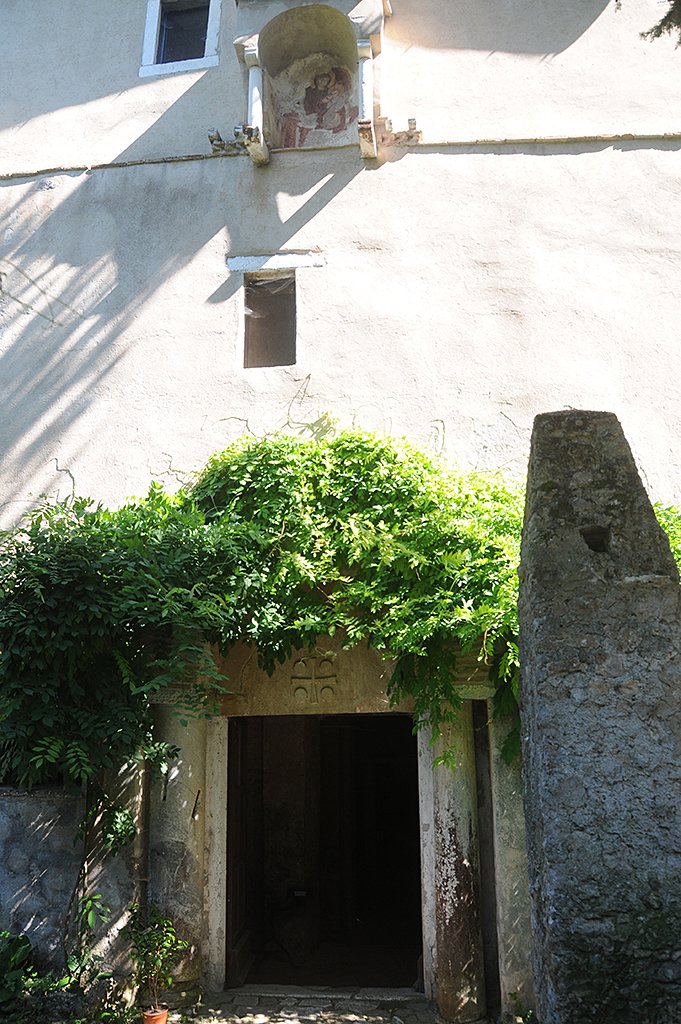
From the outside you can recognize three elements. The facade with the avancorpo, a structure added in front of the church and already described in a protocol of 1594. The portal with the porch and the sculpted lunette with an equal-armed cross and four discs. The bell tower with single, double and triple windows. The side walls alternate irregular stones of yellow tuff and regular bands of white limestone, a detail that is easy to notice in low-angled sun.
Inside, the church has three aisles each ending in an apse. The central nave is much wider than the side ones, with eight arched windows per side and an open-truss roof. Columns and pillars support round arches. The presbytery is raised above the crypt and closed off by a balustrade. In the middle of the presbytery stands the ciborium, the piece that on its own justifies the trip from Rome, in our judgment.
Anyone coming in with an eye used to Rome's basilicas will notice the irregularities right away. Wikipedia points out that the columns don't face each other exactly, that the steps toward the presbytery have different sizes and that the ramp climbs a bit diagonally. They are not errors to be corrected by eye. They are the sign of a building that grew in phases, with reused Roman salvaged material and with local workers who worked on what was already there instead of starting from scratch.
One detail to look for right away is the capitals of the aisles. Wikipedia describes them as decorated with laurel leaves and other plants, and dates them to the first quarter of the 3rd century AD. They are therefore reused Roman pieces, older than the church by almost a thousand years. The ciborium too, according to the same entry, is built largely with salvaged material. The medieval building is in large part an assemblage of ancient pieces.
A curiosity about the Abbey of San Giovanni in Argentella
The name comes from water. The diocese writes that "Argentella" seems to derive from the silvery reflections of the water that runs in the valley, and the Società Tiburtina di Storia e d'Arte speaks of the laminations produced by the water that gushes out beneath the abbey. Next to the church are preserved Roman structures and the intake channel of a spring: according to the same Society it was these very structures that convinced the Benedictine monks to choose the site.
A second curiosity: the abbey today depends on the diocese of Sabina and Poggio Mirteto, based in the province of Rieti, even though Palombara is in the province of Rome. But the first document that perhaps concerns it points toward Tivoli. The Società Tiburtina cites an 8th-century deed in which a fundum Argenti appears as attached to the diocese of Tivoli. The sources don't agree that it is the same place, and that is why the date remains a hypothesis.
Third curiosity, the lunette above the portal. Wikipedia tells how the equal-armed cross with four discs was read for a long time as proof of a Greek origin of the monastery. Today another reading prevails, which considers it a symbol of the Benedictine order already used in this form in the 6th century. Other interpretations reported online link it to water or alchemy. None has documentary proof, and the lunette remains open to hypotheses.
Fourth curiosity, the place before the church. The diocese writes that the Roman building discovered beneath the abbey could have been a rustic villa or a temple dedicated to the worship of waters, and it doesn't choose between the two hypotheses. In both cases the continuity is evident: for 2,000 years the same spot in the valley has been chosen for the presence of water, first by Roman owners or priests, then by the monks who dedicated the oratory to the saint of baptism.
One thing nobody tells you about the Abbey of San Giovanni in Argentella
Many tourist pages are stuck on a management that no longer exists. The national portal Italia.it still speaks of a citizens' committee, the FAI Luoghi del Cuore entry gives the Fraternity of Santi Nicola e Sergio as operator, and Via di Francesco in Lazio website reports hours and a landline number different from the official ones. Since 2020 the operator has been the diocese. Anyone who plans the day on the old information risks finding the gate closed.
The opposing view is this: in our judgment the miraculous spring is overrated as a reason to visit. Many texts insist on the healing water and on the baths of June 24, but the diocese itself writes that the spring today is hard to locate. Anyone who arrives hoping to see a spring gushing out will be disappointed. The real reason to come all the way here is the stucco ciborium, together with the irregular nave and the remains of the 14th-century frescoes.
A third thing rarely mentioned: the frescoes you see are a part of those that were there. Wikipedia writes that many were stolen and that others are damaged by damp, and FAI speaks of paintings hard to read in the lower part because of rising damp. The capitals of the two ancient columns on the presbytery balustrade were also stolen. It's best to look at the church knowing that it is a wounded monument, saved late, and not an intact complex.
Last thing, the most practical. The abbey does not depend on the Municipality of Palombara Sabina, as Wikipedia recalls, but on the curia. Anyone who calls the municipal offices or the town's information point to find out if the church is open risks getting generic answers. The right channel is the diocese's. The Municipality remains in any case a contact for roads and for public events in the town, and the mayor was present at the inauguration of the new lighting in 2024.
Who runs the abbey today and when can you enter?
The management belongs to the Diocese of Sabina and Poggio Mirteto. The diocesan page explains that at the beginning of 2020, through the efforts of Bishop Ernesto Mandara, the church was entrusted directly to the diocese, which since then has looked after its openings, visits and maintenance. Before that, from 1969 to 2020 according to the diocese, the Fraternity of Santi Nicola e Sergio took care of it. Wikipedia and FAI instead give 1963 as the start year of that presence, and the sources don't agree.
The hours published by the diocese are simple. On Saturday you enter from 15:00 to 17:00 from November to March and from 16:00 to 19:00 from April to October. On Sunday from 10:00 to 13:00, all year. The abbey stays closed at Easter, Christmas, New Year's Day and Ferragosto. Outside these hours you can ask for a visit by appointment, by writing to the diocese's cultural heritage office or sending a message to the number given.
The published number, 320 8269095, accepts only WhatsApp messages, and the diocese states this explicitly. Phoning is useless. The email address for information is beniculturali@diocesisabina.it, the one for booking the diocesan guided visits is prenotazionibeniculturali@diocesisabina.it. For general matters the curia of Poggio Mirteto, at Piazza Mario Dottori 14, answers at 0765 24019, according to the April 2026 visit program.
On religious life the public data are few. According to the local outlet Tiburno Tv, in December 2024 the rector of the abbey was Don Luigi De Angelis, parish priest of San Biagio and Sant'Egidio in Palombara. The OrariMesse portal classifies it as a subsidiary church, with no Mass times. The diocese doesn't publish a calendar of fixed celebrations. Anyone who wants to attend a Mass in the abbey must ask first, through the parish of Palombara or the diocesan channels.
| Period | Saturday | Sunday |
|---|---|---|
| November to March | 15:00-17:00 | 10:00-13:00 |
| April to October | 16:00-19:00 | 10:00-13:00 |
| Easter, Christmas, New Year's Day, Ferragosto | closed | closed |
My advice for visiting the Abbey of San Giovanni in Argentella
Write first. Even within the published hours, a WhatsApp message to the diocese's number the day before costs little and removes the doubt of an extraordinary closure, a private celebration or a change of shift. The abbey's official site, argentella.it, is given by the diocese as a reference, but it's best to treat the diocesan page as the main source for hours and closures.
Choose Sunday morning if you can. The three hours from 10:00 to 13:00 are the longest window, valid all year, and leave the afternoon free to go up to the town or move toward Tivoli or the Rieti Sabina. Saturday in winter, with only two hours and the light fading early, is the least convenient choice. In summer, on the other hand, Saturday until 19:00 leaves more light to look calmly at the exterior too.
Inside, start from the back. Look first at the nave as a whole, with the irregularities of the columns, then move closer to the presbytery and the ciborium, and only at the end look for the little chapel of San Michele, at the end of a small aisle, and the frescoes of the Chapel of San Guglielmo in the right aisle. Reading the history before leaving helps a lot, because on site the operator doesn't describe any explanatory panels.
One last tip: take a look at the exterior at the back too. The central apse, according to Wikipedia, has three slender windows closed by an archivolt and decorated with pilaster strips joined by pairs of hanging arches, while the side apses are smaller and plainer. It's the part of the building that best tells the story of the rural Romanesque of the Sabina, and it escapes those who go in and out of the portal without walking around the church.
Do you pay anything and do you need to book?
During the Saturday and Sunday opening hours the diocese indicates neither a ticket nor an obligation to book. Booking is needed, however, for visits outside hours and for the guided visits the diocese organizes on specific dates. For April 2026 the cultural heritage office had scheduled three appointments, on April 11, 19 and 26, with departures every hour, qualified staff and free admission, with mandatory booking by email.
The official channel is only one: the abbey's page on the website of the Diocese of Sabina and Poggio Mirteto, with the cultural heritage contacts. There is no paid tour dedicated to the abbey worth pointing out on online booking platforms, and there's no sense in paying an intermediary for a place that the diocese opens for free on weekends. A voluntary offering for maintenance is always an appreciated gesture, even though the operator doesn't ask for it.
For visits with a school class, an association or a parish the way is to write in advance to prenotazionibeniculturali@diocesisabina.it, giving the day, the number of people and any accessibility needs. The diocese doesn't publish a capacity limit or a procedure for events, concerts or filming. For these requests the reference remains the cultural heritage office, and secondarily the curia of Poggio Mirteto at 0765 24019.
Another well-known fact, yet rarely cited
That the abbey is a national monument everyone recalls. Few know how it came to be. The Società Tiburtina attributes the rediscovery to the Bolognese painter Enea Monti, who worked until his death to recover the building, and dates the recognition to June 10, 1900, with Royal Decree number 293. Wikipedia instead links the declaration to the efforts of Reverend Luttazi. The two versions can coexist: an artist and a priest worked for the same cause.
The second fact concerns a date often overlooked, 1170. According to the Società Tiburtina, by that year the Romanesque reconstruction was complete, and to 1170 dates the Cosmatesque iconostasis by the marble worker Centurius, that is, the marble enclosure that separated the presbytery from the space of the faithful. It is one of the few works in the church with an author's name and a date. The diocese places the bell tower and the works of art instead between the 12th and 13th centuries, in more general terms.
Third fact: the bell tower is younger than the church. Wikipedia writes that it arose at least a century later, probably in several phases, with salvaged material. In the bell chamber there was a bell donated in 1330 by the Guglielmites of Perugia, damaged and removed around 1820. Parts of the structure toward the bell tower were rebuilt in 1880. Anyone photographing it thinking of a single medieval block is in fact looking at a tower reworked in several phases.
Finally, television. According to Wikipedia, in 2019 the abbey hosted the filming of the Rai series Pezzi unici. It's a minor detail, but it explains why a church in the open countryside, little visited for years, has come to be recognized again by a wider public. The continued participation in the FAI Luoghi del Cuore census, from 2010 to 2022 according to the Fund's page, points in the same direction.
One last fact concerns the saint's name. Saint William, depicted in the frescoes of the chapel, is not to be confused with other better-known saints of the same name. The Società Tiburtina specifies that the chapel's cycle follows the life of the saint written in the 13th century by the monk Thebaldo. Anyone who wants to understand the painted scenes must therefore start from that 13th-century account, tied to the order that inhabited the abbey from 1284 to 1445.
The right photo to take at the Abbey of San Giovanni in Argentella
The photo that tells the story of the place is the one of the facade with the bell tower on the left, taken from a certain distance so as to include the meadow and the countryside around. It works best in low-angled light, which makes the white limestone bands stand out in the yellow tuff walls, so away from noon. Saturday from April to October, with opening until 19:00, is the right window for this image.
The second photo is the ciborium, shot from the central nave with the exposed trusses overhead. If the operator allows it, get closer for the details of the carved interlacing on the columns and of the stucco capitals. Always ask the staff present if photography is allowed and if flash is permitted: the frescoes are fragile and the diocese doesn't publish a regulation on shooting inside.
Third choice, the lunette of the portal with the cross and the four discs, the most debated symbol of the church. It should be shot head-on, with side light that gives relief to the sculpture. Avoid full noon. During celebrations no photos of worshippers and no moving around in the church, and if you find people praying leave them out of the frame, even during tourist opening hours.
A note on the new lighting. Since December 2024 the church has an interior and exterior system funded with National Recovery and Resilience Plan money, according to Tiburno Tv. The operator doesn't publish ordinary evening openings, so the illuminated church is seen mostly during celebrations and events. If the diocese announces an appointment after sunset, it's the chance for a photo of the facade different from the daytime ones that circulate online.
On the calendar, spring and autumn give the best results. In spring the green of the surrounding fields frames the pale stone of the facade, in autumn the low sun comes in from the side and lengthens the shadows of the porch. In winter the Saturday window closes at 17:00, with little useful light. Inside, the natural light coming down from the eight windows per side of the central nave is enough for photos without flash in the middle hours of Sunday.
How do you get there from Rome?
By car it's the simplest solution. According to Wikipedia the abbey is about 36 kilometers from Rome, reachable from provincial road 23a, Via Palombarese, and about three kilometers from the center of Palombara Sabina. Via di Francesco in Lazio website gives the provincial road in the direction of Santa Lucia di Fonte Nuova. The operator doesn't publish directions for parking: it's best to ask via WhatsApp when booking or in the confirmation message.
By public transport the route is more complicated. Palombara Sabina is connected to Rome by Cotral buses, but the abbey's operator doesn't give a stop near the church. For the route of the day it's best to use the Cotral timetable search, or the toll-free number 800 174 471 given on the company's website, and then assess the last stretch to the abbey, which is in the countryside outside the town.
On foot from the center of Palombara it's about three kilometers. The operator doesn't publish a pedestrian route, and walking along a country provincial road is not a stroll to improvise, especially in the dark hours of winter. Anyone arriving in town by bus would do well to arrange a ride or a local taxi. By bicycle the valley is pleasant, but the elevation changes toward the town must be taken into account.
Depending on the route chosen by the navigation system, from Rome you pass near Mentana and Monterotondo, or via Guidonia Montecelio. The navigation system chooses based on traffic. The advice is to set as your destination the exact address given by the diocese, Via di San Giovanni in Argentella 94, and not just Palombara Sabina, so you don't end up in the center and have to turn back.
Some important events that happened here in history
Between the 2nd and 1st century BC, according to the diocese, a Roman building stood on the spot, built near a spring, perhaps a rustic villa, perhaps a temple tied to the worship of waters. During the restorations of the 1970s, Wikipedia reports, mighty walls were found beneath the late Baroque floor of the central nave. On top of those structures arose a first oratory dedicated to Saint John the Baptist, dated by the diocese between the 6th and 8th century and no longer visible today.
In the 10th century the Benedictine abbey is documented. The Società Tiburtina cites the privilege of Pope Benedict VI of 973 and the bull of Marinus II of 994-995, Wikipedia recalls documents of 998, 999 and 1010. In 1111, with the intervention of Pope Paschal II, Count Ottaviano, lord of Palombara, returned to the monks vast lands that had been usurped. Between the 11th and 12th century the present Romanesque church arose, completed by 1170, the year of Centurius's iconostasis.
In 1283, according to the Società Tiburtina, the last Benedictine abbot, Jacopo, was transferred at the will of Pope Martin IV to the Roman church of San Saba. Shortly afterward Cardinal Jacopo Savelli, the future Pope Honorius IV, entrusted the monastery to the Guglielmites. The year is 1284 for the Società Tiburtina and for Wikipedia, 1286 for the diocese. The new monks transformed the avancorpo and created the Chapel of San Guglielmo in the right aisle.
In 1445 the Guglielmites left the abbey. There followed a period of care by the Franciscans of the nearby convent of San Francesco, the commendams to the Savelli abbots until 1659 according to Wikipedia, and a long abandonment. In 1815 Cardinal Lorenzo Litta ordered maintenance work. In 1900 came the declaration of national monument. In the 20th century the Fraternity of Santi Nicola e Sergio, since 2020 the diocese. On December 1, 2024 the new lighting system was inaugurated.
The last date is recent. On December 1, 2024, according to Tiburno Tv, Cardinal Giovanni Battista Re presided over a solemn Eucharistic celebration for the switching on of the new interior and exterior lighting system, funded with National Recovery and Resilience Plan money. In the spring of 2026 the diocese offered a cycle of free guided visits by booking, confirming a management that aims to open the monument to a wider public.
Who passed through the Abbey of San Giovanni in Argentella
The first names are those of the Benedictine monks, who according to the Società Tiburtina chose the site for the Roman structures and for the spring. Their holdings covered an area that roughly coincides with the present municipal territory of Palombara. Then the popes of the documents, Benedict VI and Marinus II in the 10th century, and Paschal II, who in 1111 obtained from Count Ottaviano the return of the lands to the monks.
The second group of names belongs to the 13th century. The marble worker Centurius, author of the iconostasis of 1170. Abbot Jacopo, the last Benedictine, transferred to San Saba in 1283. Cardinal Jacopo Savelli, later Pope Honorius IV, who entrusted the monastery to the Guglielmites. The monk Thebaldo, who in the 13th century wrote the life of Saint William followed by the painters of the chapel's frescoes, according to the Società Tiburtina. And the Guglielmites of Perugia, who in 1330 donated a bell.
After 1445 there passed through here the Franciscans of the nearby convent of San Francesco, the commendatory abbots of the Savelli family, Cardinal Lorenzo Litta in 1815. At the end of the 19th century the Bolognese painter Enea Monti, who devoted the rest of his life to the church, and Reverend Luttazi, cited by Wikipedia for the declaration of national monument. Then, for half a century, the members of the Fraternity of Santi Nicola e Sergio, who kept the church open.
The last names are recent. Bishop Ernesto Mandara, who in 2020 brought the management to the diocese. On December 1, 2024, for the switching on of the new lighting funded with National Recovery and Resilience Plan money, according to Tiburno Tv, those present were Cardinal Giovanni Battista Re, Bishop Mandara, the mayor of Palombara Alessandro Palombi and regional councilor Eleonora Berni. The project bears the signature of the architect Antonio Petrini.
What is the relationship between the abbey and the town of Palombara?
For centuries the abbey was the true center of the territory. According to the Società Tiburtina, in the Middle Ages the monastery's holdings covered an area that roughly coincides with the present Municipality of Palombara Sabina. The monks organized fields, woods and rights over a wide zone, and this soon brought them into conflict with the lay lords of the castle, who looked at the same lands with other interests.
The clearest document is from 1111. The Società Tiburtina cites the deed by which Count Ottaviano, lord of Palombara, returned to the monks vast lands that had been usurped, and speaks of clashes with the Crescenzi Ottaviani family. The diocese adds that the restitution took place with the intervention of Pope Paschal II and that it marked the monastery's moment of greatest splendor, the one in which the Romanesque church seen today arose.
After the departure of the Guglielmites, in 1445, the relationship reversed. The town grew, the abbey stayed isolated in the countryside. The Società Tiburtina recalls a period of care by the Franciscans of the nearby convent of San Francesco, then abandonment. Wikipedia reports the commendams entrusted to the abbots of the Savelli family until 1659. For the people of Palombara the church remained tied above all to the feast of Saint John the Baptist and to the water of the valley.
Today the link runs through the parish and the associations. According to Tiburno Tv the rector of the abbey in 2024 was the parish priest of San Biagio and Sant'Egidio, and the cultural association La Palombella had donated the amplification system for the Mass inaugurating the lighting. Anyone who visits the abbey and then goes up to the town therefore finds the same community again, with the same parish and the same religious festivals.
What is true about the miraculous spring?
What the documents and official sources say: next to the church are preserved Roman structures and the intake channel of a spring, according to the Società Tiburtina. The diocese writes that the Roman building was built near a spring that is today hard to locate, and that the name probably derives from the silvery reflections of the water of the valley. So far there are archaeological data and an explanation of the place name, with nothing miraculous.
What local tradition says: according to Wikipedia the water of the spring was believed to be therapeutic and miraculous, and the inhabitants had the custom of bathing on June 24, the feast of Saint John the Baptist, the church's patron. The link between the saint of baptism and a water considered beneficial fits with the dedication, and explains well why the custom became fixed on precisely that day of the year.
What remains legend: the healing powers of the water have no confirmation, and no official source speaks of them as a fact. On the same level are the esoteric readings of the portal's lunette, as an alchemical or water symbol, reported by some sites. The diocese presents the church for its history and its works of art, and the advice is to look at it the same way, leaving the spring to the storytelling.
What to look at inside: ciborium, crypt, frescoes?
The ciborium is the canopy over the altar, held up by four columns. Wikipedia describes it as built largely with salvaged material, with columns carved with plant interlacing in Lombard style and arabesque stucco capitals of the 11th and 12th century. The Società Tiburtina speaks of wicker-like interlace motifs and Corinthian stucco capitals, and recalls that its dating has always been debated. It remains the rarest piece in the church.
The crypt is beneath the raised presbytery, following a model that goes back to the early Christian basilicas. It is semi-underground and keeps its original relationship with water. The presbytery balustrade held up two shafts of ancient columns whose capitals have been stolen. The diocese also recalls fragments of opus sectile flooring, plutei and small pillars of the Carolingian age, a sign of a decorative phase prior to the Romanesque church.
The frescoes are largely 14th-century, from the time of the Guglielmites. FAI cites a procession, a cortege of knights and the figure of Saint William. Wikipedia describes the saint with a red robe over a white robe and a stucco halo, and also attributes to the Guglielmites the Adoration of the Cross in the vestibule. The online magazine Liturgical Arts Journal also points out a Madonna of the milk. In the lower part damp has erased a lot.
Climbing a few steps at the end of a small aisle you enter the little chapel of San Michele, a small square room that gives access to the bell tower. In the small apse there is a frescoed figure of the archangel, by an unknown author and rather damaged, which stayed hidden until 1969 according to Wikipedia. Saint Michael and Saint John the Baptist, the same entry observes, were the saints dearest to the Lombards, and the double presence reinforces the hypothesis of a consecration of that era.
How does the Argentella fit among the abbeys of the Sabina?
The Sabina is a land of monasteries. The most famous is the Abbey of Farfa, in the territory of Fara in Sabina, a great imperial abbey with a village around it. Farther north, in the Rieti Sabina, stands the Abbey of San Salvatore Maggiore. The Argentella is smaller and more isolated than both, and for this very reason it reads better: a single church, few phases, no museum complex around it.
The history of the Argentella touches Rome too. The last Benedictine abbot was transferred in 1283 to the Basilica of San Saba on the Aventine, according to the Società Tiburtina. To compare the brick tower of Palombara with the Romanesque bell towers of the city you can look at the one at Santa Maria in Cosmedin. For the work of medieval marble workers and for multilayered churches, the best comparisons in Rome are the Basilica of San Clemente and the Santi Quattro Coronati.
Those who collect the abbeys of Lazio will also find among our entries the great Cistercian complexes, such as the Abbey of Casamari, the Abbey of Fossanova and the Abbey of Santa Maria di Falleri, as well as the Abbey of Tre Fontane within Rome. They are architectures that differ in era and religious order. The Argentella remains a case of rural Romanesque, far from the main routes, tied to an agricultural territory more than to a center of power.
On the Benedictine side, the natural comparison is with Subiaco. The Monastery of Santa Scolastica and the Sacro Speco tell the origins of Benedictine monasticism in the Aniene valley. Anyone with time for two days can put together Palombara and Subiaco, passing through the Aniene valley and Vicovaro, and so follow the story of the monks in two neighboring territories.
One last pairing concerns Tivoli. The 8th-century deed cited by the Società Tiburtina, with the fundum Argenti attached to the diocese of Tivoli, recalls that for a long time this part of the Roman Sabina gravitated toward Tivoli. Anyone who visits the Argentella and then goes down toward the city of villas therefore retraces an ancient link between the Palombara valley and the Aniene valley, today divided between two different dioceses.
When is it closed and what not to expect?
The abbey is closed Monday to Friday, except for visits by appointment, and on the four days indicated by the diocese: Easter, Christmas, New Year's Day and Ferragosto. In winter on Saturday you can enter only from 15:00 to 17:00. The diocese doesn't publish a notice of extraordinary closures on the abbey's page, so a message to the WhatsApp number the day before remains the simplest precaution, especially on long weekends and bad-weather days.
What not to expect? A museum with ticket office, bookshop and multimedia room: the operator lists none. A visible spring gushing from the crypt: the spring is today hard to locate, according to the diocese. An intact cycle of frescoes: many have been stolen and damp has ruined the lower part. A cloister and monastic cells: the Società Tiburtina recalls their construction in the 12th century, but today the visit concerns the church.
Don't expect services on site either. The operator lists no restrooms, café or refreshment points, and the abbey is in the countryside. Bring water in summer and a heavy layer in winter, because Romanesque stone churches stay cold even on mild days. Those with mobility difficulties should consider the steps of the presbytery and of the little chapel of San Michele, and ask the diocese before leaving which spaces can be reached without stairs.
One last warning concerns online sources. Hours and phone numbers have circulated for years on portals and blogs, often copied from texts predating the diocesan management. One of them still lists Sunday afternoon among the openings and a landline number with area code 0774. The diocese publishes only Sunday morning and a mobile number for messages. When in doubt the diocesan page counts, and the confirmation message remains the most prudent choice.
Eating in the area
Next to the abbey the operator lists no refreshment points, and the church is not a place for a picnic. To eat you go up to Palombara Sabina or move toward Monterotondo and Mentana. The area isn't beaten by mass tourism, and the traps of central Rome are rare, but some signs apply everywhere: the menu with photographs of the dishes, items with no price, a different menu outside and inside, the kitchen open nonstop with no break.
In the towns of the Sabina Sunday lunch is a local ritual, and the places frequented by local families fill up early. The advice is to book, or to eat before or after the peak. Be wary of places along busy roads that count on the one-time customer, with high prices and generic cooking. The Romans of the area avoid them for this reason, not out of snobbery.
The practical rule remains the same: short menu, seasonal dishes, clearly written prices and tables occupied by locals. In the countryside it's worth asking what is coming in from the vegetable gardens and olive presses of the area that season. To find addresses selected with care there's the list of addresses on Google Maps, useful for organizing the day between Palombara, Tivoli and the Sabina.
What to combine in a day
The most natural pairing is the town. After the Sunday morning visit you go up to Palombara Sabina for the historic center and lunch. Palombara lies at the foot of the Monti Lucretili, a regional nature park with trails for all levels. Walkers can devote the afternoon to a stretch of trail, first checking the park authority's notices on seasonal closures.
Beyond the Lucretili you reach San Polo dei Cavalieri, the Percile Lakes and, in the Licenza valley, the Villa of Horace, the country residence of the Latin poet. To the south there's Tivoli, with Villa d'Este, Hadrian's Villa and the Villa Gregoriana Park. All require their own hours and tickets, to be checked on the operators' websites.
Toward the north and the Tiber opens the Sabina of villages: Poggio Mirteto, seat of the diocese, Poggio Catino, Torri in Sabina, Casperia and Castelnuovo di Farfa. For nature along the river there's the Nazzano Tevere Farfa Nature Reserve, and on the other bank Monte Soratte.
Those who prefer to stay close to Rome can stop at the Nomentum Nature Reserve on the way back, or, in summer, at the Terme di Cretone, in the territory of Palombara. For the area's town festivals, food fairs and religious occasions, the reference on the site is the calendar of food fairs and festivals of Lazio, to be cross-checked with the abbey's hours before leaving.
Frequently asked questions
Is the Abbey of San Giovanni in Argentella open to the public?
Yes, on weekends. According to the Diocese of Sabina and Poggio Mirteto, which has run it since 2020, you can enter on Saturday from 15:00 to 17:00 from November to March and from 16:00 to 19:00 from April to October, and on Sunday from 10:00 to 13:00. It is closed at Easter, Christmas, New Year's Day and Ferragosto. On other days it can be visited only by appointment, by writing to the diocese's cultural heritage office.
How much does it cost to enter the abbey?
The diocese lists no admission ticket for the Saturday and Sunday openings. The guided visits that the diocesan cultural heritage office organized in April 2026, with departures every hour and qualified staff, were free with mandatory booking. There is no paid tour dedicated to the abbey worth pointing out. An offering for the church's maintenance is a voluntary gesture, which the operator doesn't ask for.
How do you contact the operator for a visit outside opening hours?
The diocese gives the number 320 8269095, which accepts only WhatsApp messages, and the email address beniculturali@diocesisabina.it. For scheduled guided visits the address is prenotazionibeniculturali@diocesisabina.it. For general matters the curia of Poggio Mirteto answers at 0765 24019. Different landline numbers reported by old tourist sites are not confirmed by a recent official source.
Are Masses celebrated in the Abbey of San Giovanni in Argentella?
The diocese doesn't publish a schedule of fixed Masses in the abbey, and the OrariMesse portal lists it as a subsidiary church without times. The church is nonetheless a place of worship: on December 1, 2024, according to Tiburno Tv, a solemn Mass presided over by Cardinal Giovanni Battista Re was celebrated there. To find out if a celebration is planned, it's best to ask the parish of Palombara or the diocese's channels.
Can you see the miraculous spring?
Not the way you imagine. The diocese writes that the spring near which the Roman building stood is today hard to locate. The Società Tiburtina recalls next to the church Roman structures and the water intake channel. The healing and miraculous properties attributed to the water, with the baths of June 24, belong to the local tradition reported by Wikipedia, not to verified data.
How do you get to the abbey without a car?
Palombara Sabina is served by Cotral buses, to be checked with the timetable search on the company's website or at the toll-free number 800 174 471. The operator lists no stop near the abbey, which is in the countryside about three kilometers from the center. The operator gives no pedestrian route for the last stretch, so it's best to arrange a ride or a taxi from the town.
When was the abbey founded?
The sources don't agree on the exact date. The diocese places a first oratory between the 6th and 8th century, over a Roman building of the 2nd or 1st century BC, and the present church in the 12th century. The Società Tiburtina cites documents of 973 and 994-995 and an 8th-century deed perhaps referring to the place. Wikipedia recalls documents of 998, 999 and 1010.
Who were the Guglielmites who lived in the abbey?
They were the monks of the order of Saint William, to whom Cardinal Jacopo Savelli, the future Pope Honorius IV, entrusted the monastery in 1284 according to the Società Tiburtina and Wikipedia, in 1286 according to the diocese. They stayed until 1445. They transformed the avancorpo, created the Chapel of San Guglielmo in the right aisle and, according to the sources, the frescoes with the life of the saint.
Who wrote this and on what sources
The text comes from the editorial team of Tour Leader Pro, the Roman company that designs itineraries, visits and cultural events across Rome and Lazio. Hours, contacts and access procedures reported here come from the official sources mentioned in the text, as of the date given at the opening: for the Argentella the authoritative sources are the page of the Diocese of Sabina and Poggio Mirteto and its notices on visits, and for the history the Società Tiburtina di Storia e d'Arte. Let us know what you find changed.
Organizing a visit to the Argentella for a group means working on the opening windows more than on tickets: writing to the diocese for a visit outside hours, calculating transfer times from Rome, choosing where to have lunch in the Sabina and taking into account the steps of the presbytery. For those who plan outings of this kind, a useful resource for those who organize group trips is Tour Leader Pro, with tools designed to coordinate visits and itineraries.
The Argentella is also a gateway to a little-traveled part of Lazio, made of Romanesque abbeys, hilltop villages, olive groves and mountain parks less than an hour from Rome. Putting together the Sabina, the Aniene valley, Tivoli and perhaps Subiaco takes a few days and a bit of planning, and a useful resource for building a multi-day itinerary is Italy Planner.