Palombara Sabina (RM)
In short. You can wander around Palombara Sabina freely, but the two monuments that justify the trip open on tight schedules.
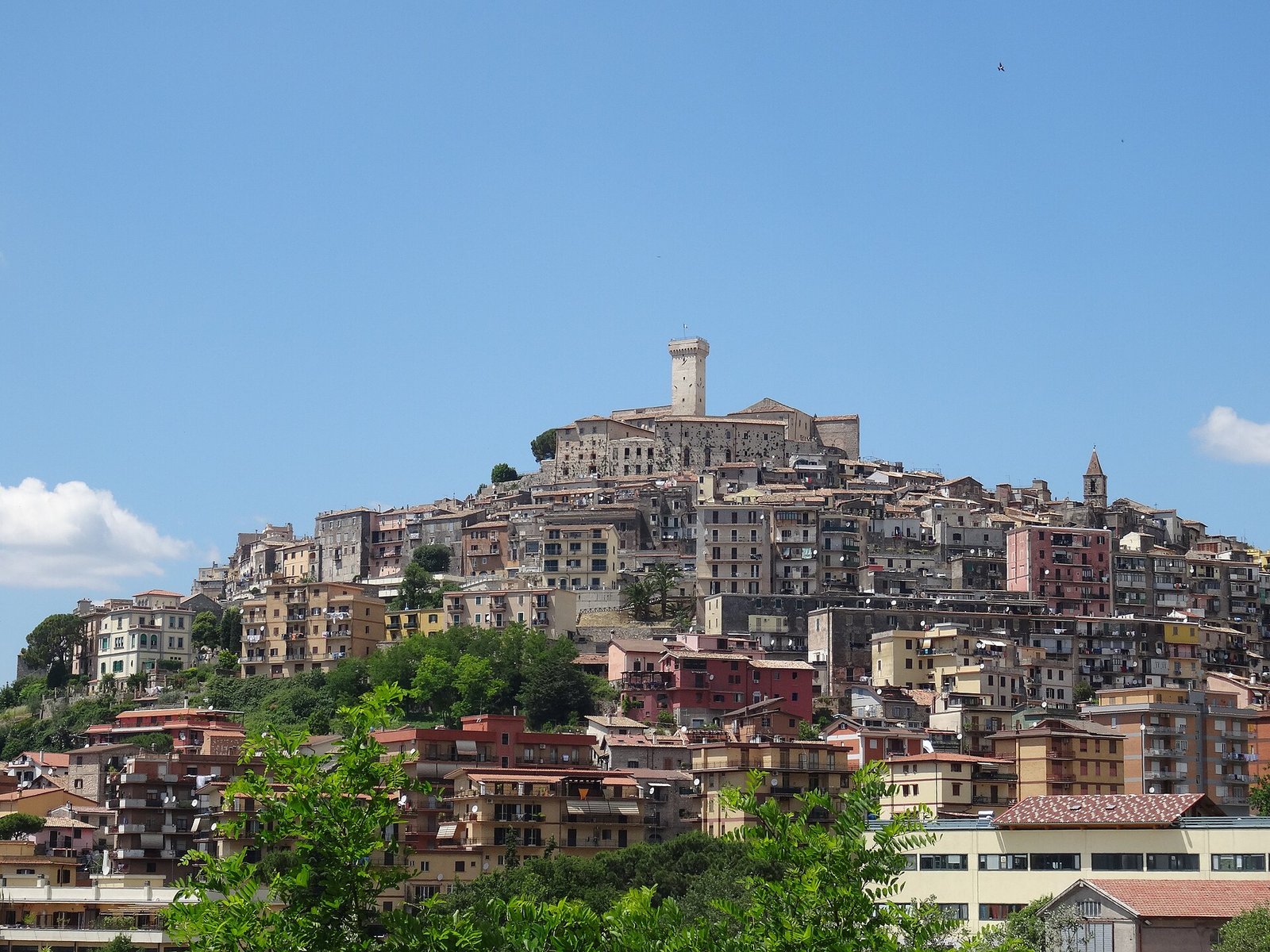
You can wander around Palombara Sabina freely, but the two monuments that justify the trip open on tight schedules. Castello Savelli Torlonia, owned by the Comune since 1971, closed the 2026 season of weekend openings in August, at €8 full price, and after the European Heritage Days of September 26 and 27 it has no published calendar. The abbey of San Giovanni in Argentella, at Via di San Giovanni in Argentella 94, run by the Diocese of Sabina-Poggio Mirteto, opens on Saturday afternoon and Sunday morning.
The town sits at an elevation of 372 meters, on the western slope of Monte Gennaro, the peak that towers over it to the east and belongs to the Monti Lucretili Regional Natural Park. It has about 13,000 inhabitants, two hamlets, Cretone and Stazzano, and a historic center where narrow streets climb in a spiral up to the castle. At Cretone there is a private thermal spa that works only in summer, with a season that the operator lists as closed on September 13.
Data checked on September 29, 2026 on the Diocese of Sabina-Poggio Mirteto's page about the abbey, on the Ministry of Culture portal, on the website of the Terme Sabine di Cretone and in the local press that reported on the management of the castle in 2026. The Museo naturalistico territoriale housed in the castle is listed as closed for refitting. For the autumn openings of the castle, the point of reference is the Department of Culture and Tourism of the Comune di Palombara Sabina, which organizes the special openings.
At a glance: address, hours, ticket
- Where: Palombara Sabina (RM), 372 meters, at the foot of Monte Gennaro. The castle occupies the top of the historic center, the abbey is at Via di San Giovanni in Argentella 94, outside the built-up area.
- Operators: the castle belongs to the Comune, which for spring and summer 2026 entrusted its openings to two historical reenactment experts. The abbey has been run by the Diocese of Sabina-Poggio Mirteto since 2020.
- How to get in: the castle only during the openings announced by the Comune. The abbey on Saturday and Sunday at the times indicated, or by reservation at 320 8269095 (WhatsApp only) or at beniculturali@diocesisabina.it.
- Price: castle €8 full price and €5 reduced in the 2026 season, free on the European Heritage Days. For the abbey the diocese does not list a ticket.
- Abbey hours: Saturday from 16:00 to 19:00 from April to October, from 15:00 to 17:00 from November to March, Sunday from 10:00 to 13:00. Closed on Easter, Christmas, New Year's Day and Ferragosto.
- How to get there: Cotral bus from Rome, or train to Passo Corese (FL1) or to Marcellina-Palombara (FL2) and then a Cotral bus.
- Museum: the Museo naturalistico territoriale in the castle is listed as closed for refitting according to the Ministry of Culture portal.
Where it is and what you actually see
Palombara is in the countryside northeast of Rome, at the point where the plain starts to rise toward the Lucretili. Monte Gennaro closes off the horizon behind the town, and from almost every point of the historic center you can see its dark bulk. The village occupies a hill, and on top of the hill is the castle, which you recognize from afar by the watchtower and the walls that surround it.
The historic center is built around the castle like the coils of a shell. The very narrow streets wind uphill around the fortress, and whoever enters from below ends up walking the same flank of the hill several times, at different elevations, before reaching the top. It is not a scenic effect designed for visitors. It is the shape of a medieval town that grew up against its fortress, with the houses pressed one against the other along the contour lines of the hill.
The watchtower, according to the Wikipedia entry on the town, has eight floors and is connected to the so-called Muro del Soccorso, a walkway about 100 meters long with 37 arrow slits. It is easy to see from the outside even on the days when the castle is closed. In the historic center you then find the church of Santa Maria Annunziata, also called del Gonfalone, the church of San Biagio, which is the town's parish, and the ruins of the convent of San Nicola.
The abbey of San Giovanni in Argentella, on the other hand, is outside the built-up area, in the countryside, about two kilometers from the town according to the parish of San Biagio. It is a Romanesque church with three naves, a bell tower and medieval liturgical furnishings that alone are worth the trip. Visiting Palombara without seeing it means missing the most important part of the trip, and it is best to plan the day starting from its hours.
On any weekday, then, the visitor finds a lived-in village, with its climbs, its glimpses of Monte Gennaro and a closed castle to look at from the outside. On Saturday afternoon and Sunday morning the abbey is added. The castle really opens only in the seasons and on the special days that the Comune announces, and outside those dates its interior stays inaccessible.
Lower down, toward the plain, is the hamlet of Cretone with the thermal spa, and farther north the hamlet of Stazzano. Heading east instead, you enter the territory of the Monti Lucretili Park, with the trails that lead to Monte Gennaro. Palombara thus works as a hinge between three different landscapes: the countryside of the Roman Sabina, the fortified village and the protected mountain of the park.
The town's calendar follows the religious and agricultural feasts. According to the Wikipedia entry, on February 3 the town celebrates San Biagio, patron of the parish, with the procession and the blessing of the throats. On Good Friday there is a procession, on August 5 the feast of the Madonna della Neve, and in June, since 1933, the Cherry Festival. These are the days when the historic center fills up, with advantages and disadvantages for those who visit.
A curiosity about Palombara Sabina (RM)
The town's name comes from pigeons. According to the Wikipedia entry, in the 8th century the place was called Palumba or Palumbus, with reference to the dovecotes of the area. The palomba, in old Italian and in many dialects of central Italy, is precisely the dove or the wood pigeon. An agricultural, everyday name, tied to the raising of birds and not to a noble family or a saint.
The second part of the name is much more recent. Palombara became Palombara Sabina only after 1870, when, with the capture of Rome and the end of the Papal State, the comune became part of the Kingdom of Italy. The addition served to distinguish it from the other towns with similar names scattered across the peninsula and to place it in the historical region it belongs to, the Sabina.
Then there is the question of the ancient cities. The same entry reports that the territory probably corresponds to Cameria or to Regillum, two centers cited by Latin literary sources. That "probably" should be taken seriously: these are proposed identifications, not excavations that have turned up a name carved in stone. It is one of the many hypotheses that surround the Sabine villages, where the remote past is often reconstructed from clues.
For those who visit the town, the curiosity has a practical side. The name is a reminder that, before the castle and the Savelli, there was an agricultural settlement here, and that the wealth of the place came from the surrounding countryside. Looking at the fields and olive groves below the town, beyond the walls, helps you understand why a powerful family wanted to fortify this particular hill, guarding productive lands and the roads to the Sabina.
Something nobody tells you about Palombara Sabina (RM)
Castello Savelli is often presented as the largest castle in Lazio. The Wikipedia entry on the building speaks of 132 rooms over 10,000 square meters. What is rarely added is that, in the ordinary openings of 2026, the visit lasts about 45 minutes and focuses on the piano nobile of the palace of Troilo Savelli, where there are frescoes datable between the 15th and 16th centuries, according to Tiburno TV.
The second fact that does not appear in the brochures concerns management. According to the same source, in July 2025 the Comune had started looking for public-private partnership proposals to entrust the castle as a whole, but the procedure did not conclude. The 2026 openings, from March 21 through August, were therefore a solution for the spring and summer season only, pending a stable management.
The third concerns the museum. The Ministry of Culture portal states that inside the castle is the Museo naturalistico territoriale, and lists it as closed every day because it is being refitted. Whoever arrives hoping to see natural history collections on Monte Gennaro and the Lucretili will be disappointed. The contact given by the portal is the number 0774 63641, with the email address c.cultura@virgilio.it.
Taken together, these three pieces of information change the way you plan the outing. The castle should not be treated as a museum with a fixed ticket office, but as a civic monument that opens seasonally, with formulas that change from year to year. Before leaving, it is always worth looking for the announcement from the Comune or the local press, and building the day around the abbey, which instead has stable weekly hours.
What can you see inside Castello Savelli?
According to the Wikipedia entry on the castle, the original core was built by the Ottaviani, a branch of the Crescenzi, on a square plan, over an area of about one hectare. The first mention dates to 1064, in the Sublacense register, that is, in the documents of the abbey of Subiaco. In the 13th and 14th centuries the building underwent many alterations, and in the second half of the 15th century the Muro del Soccorso was drastically modified.
The form you see today owes a lot to the 16th century. It was Troilo Savelli, according to the same source, who rebuilt and reinforced the castle and had the rooms of the palace frescoed. The masonry watchtower, with its crown of machicolations, that is, the projecting openings from which attackers at the base of the wall were struck, remains the most recognizable element of the complex even for those looking at it from the road.
The decorations of the piano nobile are attributed to Baldassarre Peruzzi, the Sienese architect and painter active in Rome in the early 16th century. According to the encyclopedia entry, the study features portraits of Roman heroes, including Attilius Regulus, each with a phrase of praise. The ceiling is decorated with grotesques with drawings of putti, and in a small studiolo the liberal arts are depicted: astronomy, music, rhetoric, arithmetic, geometry and dialectic.
The decorative program says a lot about who commissioned it. A feudal lord who has the heroes of republican Rome and the arts of learning painted wants to present himself as the heir to that tradition, cultured as well as powerful. For today's visitor it is the highlight of the visit, and the reason it is worth keeping an eye on the castle's special openings, even if they last only a few hours.
The Wikipedia entry on the town also recalls that the castle was restored in 2008. Today it houses the municipal library and the Museo naturalistico territoriale, currently closed for refitting. Those who know other castles in Lazio that are open all year, such as Castello Odescalchi in Bracciano or Santa Severa Castle, should lower their expectations about the continuity of the openings, not about the quality of the building.
The formula chosen in 2026 deserves a couple of words. The visits were not audio guide tours, but walks of about three quarters of an hour in which the history of the castle was told with the tools of historical reenactment: costumes, reconstructed objects, craft work, including that of the blacksmith. Those traveling with children find in this kind of visit a direct way to make the Middle Ages concrete, while those who are mainly looking for the frescoes should know that the time in front of the painted walls is limited.
The Muro del Soccorso deserves a look even when the castle is closed. The name tells its function: it was the fortified walkway through which the garrison could receive aid or withdraw without crossing the town, protected by the arrow slits. In the second half of the 15th century, according to the entry on the castle, it was drastically modified, a sign that siege techniques were changing with the spread of firearms.
Why is the abbey of San Giovanni in Argentella worth the trip?
The page of the Diocese of Sabina-Poggio Mirteto about the abbey reconstructs its history in layers. Under the church there are Roman remains datable between the 2nd and 1st centuries BC. On top of them a primitive oratory was established between the 6th and 8th centuries, in the Lombard age. During the 12th century, on the oratory, the current Romanesque church was built, with three naves and apsidal endings.
The most precious piece is the pergola of Centurius, dated 1170, which the parish of San Biagio describes as a pre-Cosmatesque iconostasis. It is a marble enclosure that separated the altar area from the space of the faithful. The diocese also points out fragments of opus sectile flooring, that is, made of small marble slabs cut and composed into geometric designs, decorated plutei and small pillars, and the bell tower, dated between the 12th and 13th centuries.
The parish adds a ciborium, the stone canopy above the altar, which it attributes to craftsmen of the Lombard school. For a point of comparison in Rome, those who have seen the medieval furnishings of the San Clemente Basilica or of Santa Maria in Cosmedin find here the same idea of a divided and decorated liturgical space, in a country church and without the crowds of the center.
Recent history explains why the abbey can be visited regularly today. According to the diocese, in 1286 the complex was entrusted to the Guglielmites, an eremitic order, and in 1969 the Fraternity of Saints Nicholas and Sergius settled there. Since 2020 the management has passed to the Diocese of Sabina-Poggio Mirteto, which set the weekend hours and a contact for reservations.
The parish finally recalls that the abbey has been a national monument since 1900, and that between the 9th and 11th centuries it was one of the most powerful abbeys in Lazio, squeezed between the Diocese of Tivoli and the expansion of the nearby Abbey of Farfa. On this date the sources do not agree: the English Wikipedia entry places the declaration of national monument in 1895.
Once inside, it is best to read the church in a precise order. First the space as a whole, with the three naves and the apses, which give the measure of a Romanesque country church. Then the pergola of Centurius, looking closely at its reliefs. Then the flooring fragments and the plutei, and finally, on the way out, the bell tower. Those with little time should concentrate on the pergola: it is the piece that the diocese and the parish put first in their descriptions.
My advice for visiting Palombara Sabina (RM)
Start with the abbey, not the castle. It is the only one of the two monuments with fixed weekly hours, and therefore the only one on which you can build a day without surprises. Sunday morning, from 10:00 to 13:00, is the most convenient window for those coming from Rome: you go into the abbey, then head up into town for lunch and spend the afternoon on the historic center and the castle walls.
On Saturday, until the end of October, the abbey opens from 16:00 to 19:00. From November to March the hours shorten, from 15:00 to 17:00, and with the short days it is best to arrive right at opening. In the season when the castle opens on weekends, Saturday lets you combine the two visits: castle in the morning or early afternoon, abbey before sunset.
Write first to the diocese's WhatsApp number, 320 8269095, or to the address beniculturali@diocesisabina.it. This is to get confirmation that the opening is regular on the day you choose, and for those traveling in an organized group it is the way to get a visit by reservation outside the fixed hours. The diocese does not publish a ticket price, and if an offering is expected it is best to ask in the same message.
For the castle the rule is to look for the announcement. The openings of the 2026 season were communicated by the Comune and picked up by the local press, as were the European Heritage Days at the end of September. Without an announcement, the castle should be counted as a monument to see from the outside, and the day should be planned as a full one anyway: the village, the abbey and a walk toward Monte Gennaro are enough to fill it.
How much does it cost and how do you book?
In the 2026 season of openings, from March 21 through August, the castle charged a ticket of €8 full price and €5 reduced, with discounts for residents and for children under 10, according to Tiburno TV. The visits lasted about 45 minutes, with hours from 10:00 to 13:00 and from 14:00 to 17:00. On the European Heritage Days of September 26 and 27 admission was free, without reservation.
For the castle tickets there is no online sales channel indicated by the operator, and the fares for autumn 2026 are not published. The channel to consult is the website of the Comune di Palombara Sabina, with the communications of the Department of Culture and Tourism. For the abbey the reference is the page of the Diocese of Sabina-Poggio Mirteto, with the WhatsApp number and the email address for reservations. Neither operator lists online sellers.
| Place | When you can get in | Price |
|---|---|---|
| Abbey of San Giovanni in Argentella | Saturday 16:00 to 19:00 (April to October), 15:00 to 17:00 (November to March), Sunday 10:00 to 13:00 | Not listed by the diocese |
| Castello Savelli, 2026 season | Saturday and Sunday 10:00 to 13:00 and 14:00 to 17:00, from March 21 to August | €8 full price, €5 reduced |
| Castello Savelli, European Heritage Days | September 26 16:00 to 20:00 and 21:00 to 23:00, September 27 10:00 to 18:00 | Free |
Booking for the abbey is not required during opening hours, but it becomes the only way to get in on other days. For the castle, during the special openings in September, no reservation was required. Anyone planning a visit for autumn or winter 2026 should therefore start from the abbey and check close to the date if the Comune has announced new openings of the castle.
Another well-known fact, yet rarely mentioned
Anyone who works on medieval history knows it, but it rarely appears in the town's tourist presentations: according to the Wikipedia entry on the castle, in 1310 the building was the seat of a tribunal for the trial of the Templars. These were the years of the trial against the knightly order, begun in France and then extended to other territories of Christendom, including the Papal States.
This fact calls for caution: the entry does not go into detail, and to look into it you need the specialist studies on the trial of the Templars in the Papal States. It remains significant that a country castle, today almost always closed, appears in an episode of European scope, in years when the Savelli family had been lords of the place for decades and had close ties with the curia.
The same source recalls an older episode, from 1180, when the antipope Innocent III was arrested in the castle, not to be confused with Pope Innocent III, Lothar of the counts of Segni, elected in 1198. The antipope of 1180 was one of the figures opposed to Pope Alexander III in the long season of schisms of the 12th century, and his capture marked the end of his brief adventure.
These two episodes say one thing only: for centuries Palombara was a place where Roman politics was decided with weapons and tribunals as well. The castle was not a vacation residence, but a fortress in the hands of families who counted for a great deal in the papal curia.
The right photo to take in Palombara Sabina (RM)
The image that sums up the town is the profile of the village with the castle on top and Monte Gennaro behind it. You get it by moving away, from the lower countryside, and with a lens that tightens the scene slightly. The town is on the western slope of the mountain, and in the afternoon the light hits the houses head-on: it is the moment when the stone of the walls stands out best from the dark background of the mountain.
Inside the historic center, the right photo is the one that shows the spiral. Look for a spot where you can see, one above the other, two or three rows of houses along the same curve of the hill, with the castle tower poking up at the top. It is a photograph of structure more than of a monument, and it tells the story of the town better than a close-up of the portal.
At the abbey of San Giovanni in Argentella the photo to take home is the Romanesque bell tower seen from the meadow in front of the church, with the countryside around it. Inside, before photographing the pergola of Centurius or the flooring fragments, it is best to ask permission of whoever opens the church: the diocese does not publish rules on photography, and during services the camera should not be used.
Those who climb toward Monte Gennaro then get the opposite photo: the town seen from above, small, with the countryside of the Roman Sabina opening toward the west. It is the framing that makes you understand why Palombara was born there, on a hill guarding the plain and backed up against the mountain. You need a clear day, and winter mornings after the tramontana wind are often the best.
How do you get there from central Rome?
Palombara is about 40 kilometers from Rome, to the northeast. By public transport the connection is the Cotral bus lines: the runs to Palombara traditionally leave from the Ponte Mammolo terminus, on Metro line B. Terminus, stops and times should be checked on the Cotral website before leaving, because they change between weekdays, Saturdays and holidays and between the school period and summer.
The alternative is the regional train. According to the Wikipedia entry on the town, Palombara is connected by Cotral runs to the Passo Corese station, on line FL1, and to the Marcellina-Palombara station, on line FL2, which goes from Roma Tiburtina toward Tivoli. In both cases the train takes you close, not into the town, and the last stretch has to be done by bus: it is best to check the connections beforehand, especially on holidays.
By car you leave Rome toward the northeast and follow the signs for Palombara Sabina. The historic center has narrow streets, designed for walkers and carts, and it is best to leave the car in the lower part of town and climb on foot. On the pages consulted, the Comune does not publish specific parking information for visitors to the castle.
The abbey of San Giovanni in Argentella is about two kilometers from the town, in the countryside. The sources consulted do not indicate a direct public connection. Without a car you can do the stretch on foot, but along country roads where you should walk carefully, wear something visible and move during the day. By car, Via di San Giovanni in Argentella 94 is the address to enter in the navigation system.
The weak point of public transport is the return. On holidays the runs thin out, and whoever arrives on Sunday for the opening of the abbey needs to know beforehand what time the last useful bus leaves for Rome or for the connecting station. It is best to note down two return runs, not one, and to allow time to come down from the historic center to the stop. For those traveling without a car, Saturday generally offers more options than Sunday.
Some important events that happened here in history
In the 8th century the place appears as Palumba or Palumbus, and for a long period the territory depended on the abbey of Farfa, according to the Wikipedia entry on the town. In the 12th century, according to the diocese, the Romanesque church was built over the old oratory of San Giovanni in Argentella, and in 1170 the pergola that bears the name of Centurius was made, the oldest dated element among those the diocese lists.
1064 is the year of the first mention of the castle in the Sublacense register. In 1180 an antipope was arrested there. The passage to the Savelli has two different dates in the sources: the entry on the castle speaks of the purchase by Luca Savelli in 1250, the one on the town gives 1279 as the year in which Palombara became a fief of the family. The sources do not agree, and the two dates may refer to different transfers.
In 1286, according to the diocese, the abbey was entrusted to the Guglielmites. The English Wikipedia entry places the beginning of their presence in 1284 and has it last until 1445, by order of Iacopo Savelli, bishop and lord of Palombara. In 1310 the castle hosted the tribunal for the trial of the Templars. In the 16th century Troilo Savelli rebuilt the castle and had its rooms frescoed.
In 1600, according to the entry on the town, the Savelli sold the fief to the Borghese. Centuries of changes of ownership followed, until the middle of the 20th century, and the Torlonia name that remains tied to the castle recalls one of the later owning families. In 1870 the comune entered the Kingdom of Italy and took the name Palombara Sabina. In 1900, according to the parish, the abbey was declared a national monument.
The 20th century brings three local dates. Since 1933 the Cherry Festival has been held, in June. In 1969 the Fraternity of Saints Nicholas and Sergius settled at the Argentella, and in 1971 the Comune bought the castle. In 2008 the castle was restored. In 2020 the abbey passed to the management of the Diocese of Sabina-Poggio Mirteto, and in 2026 the castle reopened on weekends with a seasonal management.
Who passed through Palombara Sabina (RM)
The first names are those of the lords. The Ottaviani, a branch of the Crescenzi, built the core of the castle. Luca Savelli, whom the encyclopedia entry lists as a nephew of Pope Honorius III, bought it in the mid-13th century. Troilo Savelli, in the 16th century, made it the fortified residence that you see today. The Borghese became its owners in 1600, and the Torlonia name remained tied to the castle until its transfer to the Comune.
Iacopo Savelli, bishop and lord of the place according to the English entry on the abbey, entrusted San Giovanni in Argentella to the hermits of Saint William. At the end of the 12th century the castle saw the capture of the antipope Innocent III, and in 1310 the judges and defendants of the trial of the Templars. These are presences documented by a single encyclopedic source, and their detail should be looked into in specialist studies.
Then there are the artists. Centurius is the name tied to the pergola of the Argentella of 1170, a 12th-century marble worker whom the sources remember for this work and who gives his name to the most important furnishing of the abbey. Baldassarre Peruzzi, to whom the frescoes of the castle's piano nobile are attributed, is a leading figure of the Roman Renaissance, known for the Villa Farnesina in Trastevere.
In the 20th century the abbey welcomed the Fraternity of Saints Nicholas and Sergius, which stayed there until the transfer to the diocese in 2020. And in 2026 the castle was opened by Emiliano Bultrini, a PhD in medieval history from the University of Tor Vergata, and by Jacopo Matricciani, an artisan and reenactor, with living history visits, that is, history told through the reconstruction of objects, clothing and trades.
Documents, tradition and legend: what do we really know?
What the documents say: the castle is cited in 1064 in the register of the abbey of Subiaco, the pergola of the Argentella bears the date 1170, the Comune bought the castle in 1971 and the diocese has run the abbey since 2020. These are the most solid dates of the account. The presence of the Guglielmites in the abbey between the 13th and 15th centuries is also documented, albeit with a small difference over the starting year.
What scholarly tradition says: that the territory of Palombara corresponds to ancient Cameria or to Regillum is a proposed identification, which the same encyclopedia entry presents with a "probably." The attribution of the castle's frescoes to Baldassarre Peruzzi should also be read as an attribution, not as a signature. The same goes for the abbey's ciborium assigned to craftsmen of the Lombard school.
What is story more than fact: the English entry on the abbey reports that the founding of the church is attributed to the Lombards around 529, a date that does not match that of the diocese, which places the primitive oratory between the 6th and 8th centuries. The name Argentella would come from a nearby spring, perhaps the one of the Valle Lunga, but the same source uses the conditional.
Keeping the three levels distinct helps avoid repeating as certainties the phrases that circulate on tourist sites. At Palombara the true history is already rich enough not to need additions: a castle that hosted a tribunal on the Templars and a country church with a furnishing dated to the 12th century and tied to the name of its author are enough to justify the trip.
Monte Gennaro, Lucretili and Cretone: what is around the village?
Monte Gennaro towers over Palombara to the east and is one of the best-known peaks of the Monti Lucretili Park. Trails leave from the town and climb toward the summit, and hiking reports also describe access from Prato Favale, above Marcellina, and from San Polo dei Cavalieri. These are real mountain hikes, with significant elevation gain, to be tackled with suitable shoes, water and a reliable track.
Before leaving it is best to consult the Park Authority about open trails and any seasonal ordinances, for example on fire risk in summer. The western slope of Gennaro, the one that faces Palombara, is exposed to the afternoon sun, and on hot days the climb becomes tiring. In autumn and spring the weather is the most favorable, and in winter the summit may be snowy.
Going down toward the plain you reach Cretone, where the Terme Sabine di Cretone, on Via dell'Acqua Sulfurea, run three large pools, one of them for children. The operator describes the water as calcium-sulfur, with a temperature of about 23 degrees, and the pools as fed by continuous exchange. In the season indicated on the website, the spa opens from May 28 to September 13, every day from 9:00 to 18:30.
At the end of September the spa is therefore closed until the next season. The fares are published in the price list on the Terme Sabine di Cretone website, and the telephone number given by the operator is 0774 615100. Those looking for thermal water that is open outside the season in the same area will find the Acque Albule at the Bagni di Tivoli, with hours and prices to be checked with their operator.
When is it closed and what shouldn't you expect?
From Monday to Friday, in practice, Palombara offers the village and the views. The abbey is closed, except for visits arranged with the diocese, and the castle has no announced weekday openings. The abbey is also closed on Easter, Christmas, New Year's Day and Ferragosto, that is, on some of the days when many Romans choose a day trip out of town. The natural history museum in the castle is closed for refitting.
From October 2026 on, the castle has no published calendar. It may be that the Comune announces new openings for the holidays, as happened in the past, but until there is an announcement it is best to consider it closed. The Cretone spa, closed since September 13, reopens with the next summer season, on dates that the operator will communicate on its own website.
The contrary view, in our judgment, concerns precisely the slogan of the largest castle in Lazio. As an argument for choosing an outing, it is overrated. The size of a building closed almost all year cannot be visited, and even during the openings you see only a part of the palace. The real reason to come to Palombara is the Argentella, which opens every weekend and holds a medieval furnishing dated to 1170.
Don't expect a town organized for mass tourism either. Palombara is a comune of about 13,000 inhabitants that lives off its own daily life, with its shops, its schools and the commuter traffic to Rome. That is what makes it interesting: you walk through a lived-in historic center, not an emptied village, and you have to respect its rhythms, the quiet of the lunch hours and the parking of the residents' cars.
One last warning concerns festival days. During the Cherry Festival or the processions the historic center changes face: more people, streets closed to traffic, parking impossible to find. For those who love town festivals it is the best moment, for those who want to see the abbey and the walls at leisure it is the worst. Choose based on what you are looking for, and check the town calendar before setting the date.
Eating in the area
Palombara does not have the traps of central Rome, and the risk of running into a barker or a photo menu in six languages is low. A few precautions are still worthwhile. On festival days and during the Cherry Festival, in June, temporary stands and refreshment points appear, and it is best to check that prices are displayed. Items without a price, especially fish or mushrooms sold by weight, should be clarified before ordering.
The criterion that works in the towns of the Roman Sabina is the residents'. A place full of locals at lunch on a weekday offers more guarantees than one chosen for the view. Be wary of places that are open continuously without a kitchen break, and of menus that differ between the one displayed outside and the one handed to you at the table. For those who want to start with a few specific recommendations, there is the list of addresses on Google Maps.
What to combine in a day
The most natural pairing is with Tivoli, which is to the southeast along the edge of the Lucretili. Those who arrive at the Argentella on Sunday morning can continue in the afternoon toward Villa d'Este, the Villa Gregoriana Park or Hadrian's Villa, checking the admission hours first. It is a long but coherent day, between the Sabine Middle Ages and the imperial and Renaissance villas.
Those who prefer to stay in the park can climb to San Polo dei Cavalieri, with its castle, or push on toward the Licenza valley, where you find Percile, the small lakes of Percile and the Villa of Horace. On the opposite side of the Lucretili, toward the Aniene valley, there is Vicovaro.
To the north the road leads into the Sabina proper. The Abbey of Farfa, on which Palombara depended for centuries, is the most interesting comparison with the Argentella: two Benedictine abbeys of the same region, one that stayed powerful, the other reduced to a country church. In the same area are Fara in Sabina, Torri in Sabina and, farther east, Orvinio.
For a day outdoors along the Tiber there are the Nazzano Tevere Farfa Nature Reserve and the Farfa Gorges. Those who instead want to continue with castles will find, closer to Rome, the Castello di Lunghezza, and toward the Prenestini Mountains fortified villages such as Castel San Pietro Romano, Palestrina and Zagarolo.
Farther away, for those with a weekend, the Aniene valley leads to Anticoli Corrado and to Subiaco, with the Sacro Speco. The link with Palombara is concrete: the first mention of the castle is found precisely in the register of the Subiaco abbey. From there you enter the Monti Simbruini Park, the mountain that ideally continues the Lucretili toward Abruzzo.
Frequently asked questions
Is Castello Savelli in Palombara Sabina open?
Not on fixed hours. In 2026 the castle opened on Saturday and Sunday from March 21 through August, from 10:00 to 13:00 and from 14:00 to 17:00, with a ticket of €8 full price and €5 reduced. It then opened free of charge for the European Heritage Days on September 26 and 27. For the autumn there is no published calendar, and it is best to follow the Comune's communications.
When can you visit the abbey of San Giovanni in Argentella?
According to the Diocese of Sabina-Poggio Mirteto, the abbey opens on Saturday from 16:00 to 19:00 from April to October and from 15:00 to 17:00 from November to March, on Sunday from 10:00 to 13:00. It is closed on Easter, Christmas, New Year's Day and Ferragosto. Outside these hours you can ask for a visit by reservation at 320 8269095, WhatsApp only, or at beniculturali@diocesisabina.it.
Do you pay to enter the abbey?
The diocese's page does not list a ticket or a fare for visits by reservation. If an offering is expected, or if the arranged visit has a cost, you find out by asking directly at the WhatsApp number or the diocese's email address. It is best to do so in the message in which you ask for confirmation of the opening, so you arrive at the church door without misunderstandings or surprises.
Can you visit the castle's museum?
No. The Museo naturalistico territoriale, which the Ministry of Culture portal places inside Castello Savelli, is listed as closed every day because it is being refitted. The contact given by the portal is 0774 63641, with the address c.cultura@virgilio.it. Those who visit the castle during the seasonal openings see the piano nobile of the palace of Troilo Savelli with its frescoes, not the museum's collections.
How do you get to Palombara Sabina without a car?
By Cotral bus from Rome, which traditionally leaves from the Ponte Mammolo terminus on Metro line B, or by regional train to Passo Corese, on the FL1, or to Marcellina-Palombara, on the FL2, and then by connecting Cotral runs. Times and termini should be checked on the Cotral website. For the abbey, about two kilometers from the town, there is no direct public connection.
Are the Cretone thermal baths open in autumn?
No. According to the operator, the season of the Terme Sabine di Cretone runs from May 28 to September 13, every day from 9:00 to 18:30. The spa is on Via dell'Acqua Sulfurea, in the hamlet of Cretone, and has three pools, one of them for children. Fares and dates for the next season should be checked on the spa's website or at 0774 615100.
Can you climb Monte Gennaro starting from Palombara?
Yes, trails leave from the town and climb toward the summit, inside the Monti Lucretili Park. These are mountain routes with significant elevation gain, which require hiking shoes, water, a reliable track and an honest assessment of your own fitness. Before leaving it is best to check with the Park Authority about the condition of the trails and any seasonal bans related to fire risk.
Can you see Palombara Sabina in half a day?
The village and the abbey can be seen in one morning, if you arrive on Sunday for the opening at 10:00. If the castle is open you need at least two more hours, between the climb to the historic center and the visit. Those who add a hike toward Monte Gennaro, or a stop in Tivoli in the afternoon, should count on the whole day and leave Rome early, especially by public transport.
What is the best time to go to Palombara?
It depends on what you want to see. To find the castle open as well, you need to aim for weekends in the spring and summer season or for the special openings announced by the Comune. For the spa you need summer. For the abbey and the village, all the weekends of the year are fine, except the holidays when the abbey closes. Spring and autumn are the best seasons for climbing toward Monte Gennaro.
Who wrote this and from what sources
The text comes from the editorial team of Tour Leader Pro, the Rome-based outfit that designs itineraries, visits and cultural events across Rome and Lazio. The fares, hours and booking arrangements reported here come from the official sources cited in the text, as of the date given at the start: the page of the Diocese of Sabina-Poggio Mirteto for the abbey, the Ministry of Culture portal for the museum, the website of the Terme Sabine and the local press for the castle. Tell us what you find changed.
Organizing a day in Palombara, for yourself or for a group, means fitting together hours that do not coincide: the fixed openings of the abbey, the seasonal ones of the castle, the Cotral runs and, in summer, the spa. For a group, the visit to the Argentella must be arranged with the diocese, and the castle openings must be asked of the Comune. A useful resource for those who organize group trips is Tour Leader Pro.
Palombara fits well into a broader trip through Lazio, among the Sabina of the abbeys, the Lucretili, Tivoli and the Aniene valley. These are areas close to each other but poorly connected by public transport, and those traveling without a car need to plan their stops and overnight stays carefully. To line up several days among villages, parks and archaeological sites, a useful resource for putting together a multi-day itinerary is Italy Planner.