Castello di Lunghezza
In short. There's a point on Via Collatina where Rome suddenly stops looking like Rome.
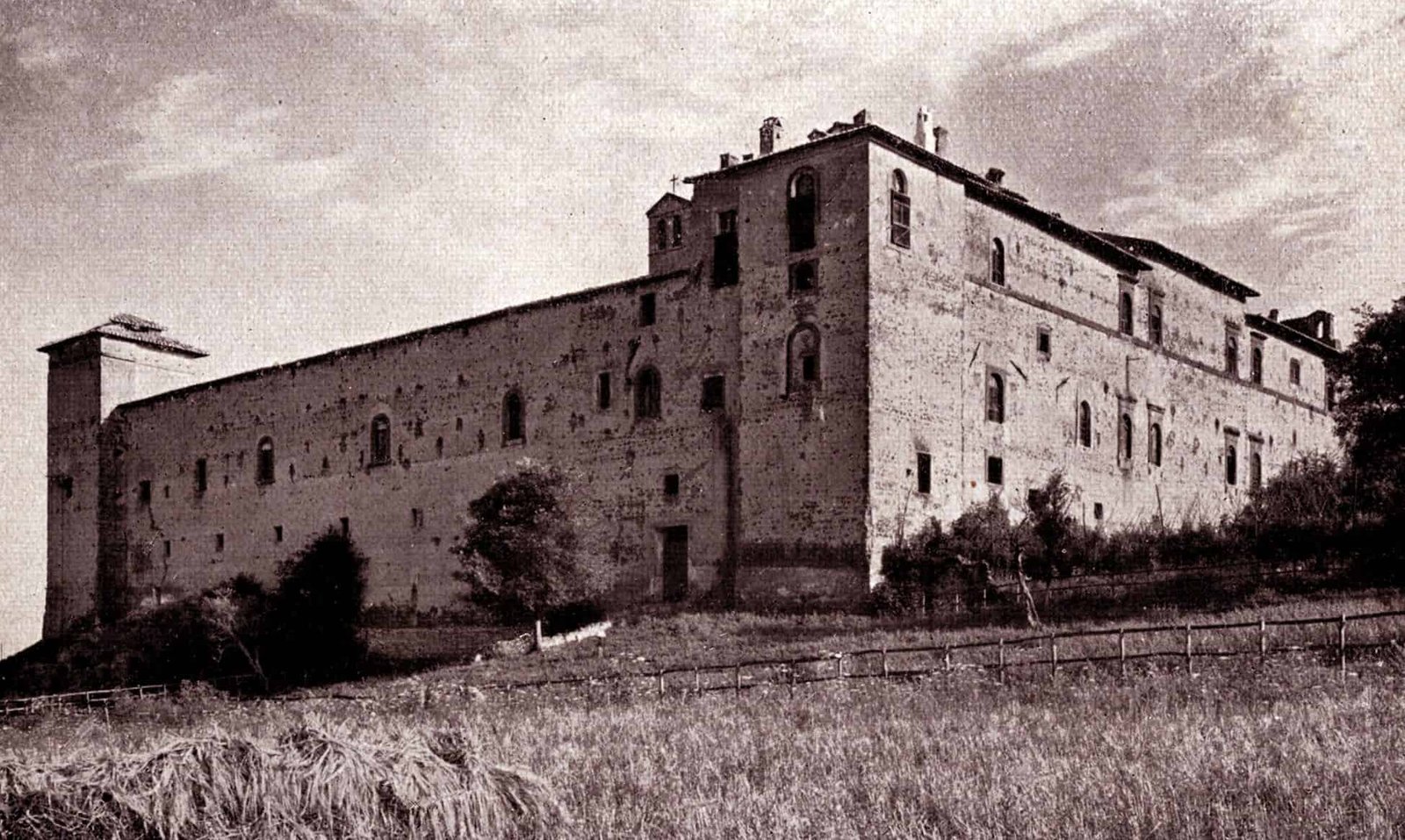
There's a point on Via Collatina where Rome suddenly stops looking like Rome. You've left behind the Grande Raccordo Anulare, the warehouses, the roundabouts with scraggly flower beds, the shopping center signs. The road narrows, starts to descend, and all at once the landscape opens onto a green valley that nobody expects 10 minutes from the ring road. Below, the Aniene draws a wide, lazy bend. Above, on a tuff spur that the river has been carving for millennia, stands a mass of biscuit-colored masonry with a square tower and a line of battlements. That's the Castello di Lunghezza, and the first thing I want to tell you is that it stands exactly where it had to stand: at the point where river, rock and road meet, that is, the point where, for 3,000 years, anyone who wanted to control this piece of countryside has built something.
The second thing I want to tell you, and I say it right away because it's what makes the difference between a successful visit and a wasted trip, is that the Castello di Lunghezza is not a monument with free entry. It's not an archaeological area you enter with a ticket and wander on your own, it's not a house museum open every day, it's not a site you can visit by happening on it by chance on a Tuesday morning. It's a private property, alive and working, that opens to the public for events, parties and organized activities, and that today hosts inside it a theme park for children. You get in on set days and with a ticket bought for that specific day. If you arrive without having checked the calendar, the most you take home is a photograph from outside, and the photograph from outside, I'll tell you up front, isn't even bad, but it isn't the reason it's worth coming all the way here.
The third thing, and here I get into why I'm writing you 3,000 words and more about a castle on the outskirts, is that this tuff cliff has beneath its feet one of the heaviest stories in the entire Roman tradition. Not a local story, not a parish-pump anecdote: the story of Lucretia and Tarquinius Collatinus, that is the tale the Romans themselves placed at the origin of the fall of the monarchy and the birth of the Republic in 509 BC. Collatia, the Latin city of that story, stood here. And "here" means, in all likelihood, right under and around the foundations of this castle. Now I'll explain it all in order, distinguishing with the utmost honesty I can muster what is myth from what is history, because confusing the two is the fastest way to make a tourist guide ridiculous.
Where Exactly the Castello di Lunghezza Is
The Castello di Lunghezza rises in the eastern quadrant of Rome's municipal territory, in the sector Romans generically call "la Collatina," between Ponte di Nona, Salone, Castelverde and La Rustica. Administratively we're inside Roma Capitale, in Municipio VI delle Torri. Geographically we're already in a transition zone, where the city ends in fits and starts and the countryside resumes in patches, with its wheat fields, its rows of reeds along the river and its farmhouses that pop up out of nowhere on top of the hills.
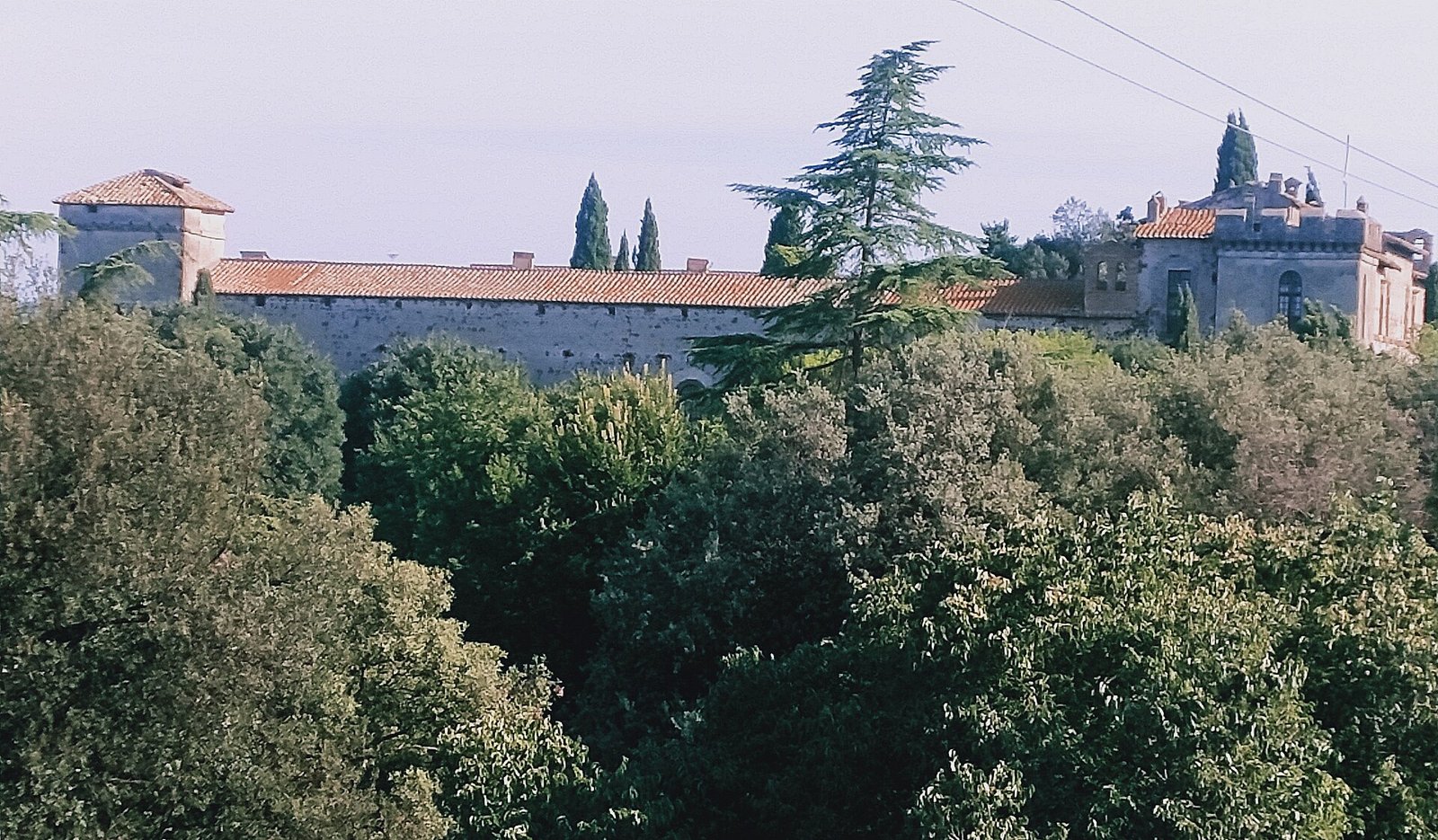
The road reference the castle itself uses to orient those arriving by car is exit number 14 of the Grande Raccordo Anulare, the one for Via Collatina. From there you continue east, away from the center, for a few kilometers: the road crosses the industrial area, passes the interchange for Settecamini and Salone, and then starts to descend toward the river. The Aniene is the sign you've arrived. The castle is on the right bank, on a rise that dominates the bend, and you see it appear among the trees with a theatrical effect you don't expect from a suburban neighborhood.
The Meaning of That Position
Castle positions are never accidental, and this one is a military geography manual in miniature. A tuff spur isolated on three sides, a river serving as a natural moat on one flank, a ford or in any case an obligatory passage just below, and a clear view for kilometers toward the plain to the west and toward the mountains to the east. Whoever is up there sees anyone coming a good half hour ahead and controls the traffic between Rome and the Aniene valley. It's the same reasoning that led to founding a Latin settlement here in the Iron Age, that led the Romans to keep a station here along the road, and that led the monks and then the barons to fortify the cliff. The centuries change, the patrons change, the logic of the terrain doesn't.
A Landscape Detail Nobody Notices
If you stop at the roadside, before going up, and look east on a clear day, you see the outline of the Tiburtine Mountains and, far off, the white patch of Tivoli clinging to the mountain. That's the direction the water comes from: the Aniene rises in the Simbruini Mountains, plunges at Tivoli in a waterfall that for two millennia was one of the most painted attractions in Europe, and then stretches out across this rolling plain to empty into the Tiber at Ponte Salario. The Castello di Lunghezza sits exactly halfway along that plain stretch, and it's no accident: it's the point where the river slows down and becomes crossable.
The Castello di Lunghezza and the Bend of the Aniene
I want to insist on the river, because it's the key to everything else. The Aniene is Rome's second watercourse and, for a large part of ancient history, the more useful one. The Tiber is the road to the sea. The Aniene is the road to the mountains, that is to timber, stone, Tivoli travertine, pozzolana and above all good water. Four of the great aqueducts that slaked the thirst of imperial Rome took their water in the Aniene valley or its immediate surroundings: the Anio Vetus, opened in the third century BC, the Aqua Marcia, the Aqua Claudia and the Anio Novus, the last two completed under Claudius in the middle of the first century AD. Every drop of that water passed a short distance from this cliff.
There's more, and it concerns Via Collatina itself. The sources of the Aqua Virgo, the aqueduct that Marcus Vipsanius Agrippa had built in 19 BC to feed his baths in the Campus Martius, and which still today feeds the Trevi Fountain, are in the Salone area, that is a few kilometers from Lunghezza, along this same road. When you drink at the Barcaccia in Piazza di Spagna or look at Bernini's Triton, you're looking at water that set out from this quadrant of countryside. It's the kind of connection that suddenly makes interesting a landscape that at first glance seems merely neglected.
A River That Shaped the Tuff
The tuff bank on which the Castello di Lunghezza rests is volcanic material, arrived here from the eruptions of the Alban Hills district in remote geological eras. The Aniene has worked on it for millennia, cutting the valley and leaving the hardest spurs standing. The result is a landscape of terraces and cliffs, perfect for anyone who wants to build in a dominant position and needs locally quarried stone. Tuff is cut with a saw, carried by mule and holds up very well if you keep it dry: it's the material half the walls of the Roman countryside are made of, and the castle is no exception.
Mills, Fords and Quarries
Along the Aniene, throughout the Middle Ages and up to the 1800s, water mills, fulling mills and workshops operated. The river was a productive resource before it was an obstacle. Whoever controlled a stretch of bank controlled the grinding of grain for a slice of countryside, and grinding grain, in an agricultural economy, is pure power. This is not a folkloric detail: it is one of the economic reasons why an estate like Lunghezza was worth contending for by families that had far more beautiful palaces elsewhere.
Collatia: The Latin City Beneath the Castello di Lunghezza
Now let's go underground, literally and historiographically. Before the castle, before the monastery, before the Roman road, there was a city on this cliff. It was called Collatia, it was one of the Latin communities that dotted archaic Latium, and ancient tradition places it about 10 miles from Rome along the road that takes its name from it: Via Collatina.
The identification of the site of Collatia with the Lunghezza height is the one accepted by historical topography for more than a century now, and it rests on a convergent set of clues: the distance from Rome given by the sources, the course of Via Collatina, the naturally defended position, and the remains of ancient structures that have surfaced on the cliff and in its surroundings. It isn't an absolute certainty as an inscription with the city's name carved on it would be, and anyone who tells you otherwise is selling you a certainty the documentation doesn't offer. But it is, in the present state of knowledge, by far the soundest hypothesis, and no serious alternative comes close.
What a Latin City Was
It's worth clarifying what we're talking about, because the word "city" evokes the wrong images. Collatia wasn't a metropolis: it was a fortified settlement of a few thousand people at most, with an acropolis on the highest, defended part, a fabric of scattered houses, cultivated land around, a sanctuary, and an autonomous political community that recognized itself in the league of the Latin cities. In archaic Latium there were dozens of this kind: Gabii, Fidenae, Crustumerium, Ficulea, Antemnae, Politorium, Corniculum. Rome, at the beginning, was one of them. Then it absorbed them all, and most of those names survive today only because Livy wrote them down.
The Decline of Collatia
Collatia disappears early from active history. Absorbed into the Roman orbit already in the regal age according to tradition, in the Republican and imperial ages it is little more than a minor rural center. The ancient authors who mention it do so with a certain detachment, almost as an example of a fallen place: it was one of those localities the Romans remembered mostly for its past history. Meanwhile the territory filled with villas and farms, with tombs along the road, with production facilities. The city dissolved into the agrarian landscape, and the cliff stayed there, available for the next person who felt like fortifying it.
Lucretia and Tarquinius Collatinus: The Big Story of the Castello di Lunghezza
Here we are at the reason this place deserves, on paper, a chapter in the textbooks. If Collatia stood here, then here stood the house of Lucius Tarquinius Collatinus and his wife Lucretia, and here, according to the tale Rome handed down for centuries, happened the event that would bring down the monarchy.
The frame is that of the last king, Tarquin the Proud. The Roman army besieges Ardea, city of the Rutuli, to the south. The siege is long and boring, like all sieges, and in the evening the young aristocrats who command the units drink and get bored. Among them are the king's sons and Collatinus, their relative, lord of Collatia. The talk slides to their wives, each claims his own is the best, and at a certain point, it's Collatinus who proposes it, they decide to settle the matter with a field test: they mount their horses, ride back in haste to Rome and then here to Collatia, and go to see what their respective wives are doing in the dead of night, without warning.
In Rome they find the princesses at a banquet, merrymaking. In Collatia they find Lucretia seated in the atrium, among her maidservants, spinning wool by lamplight. The wager is won without dispute. But in the company is Sextus Tarquinius, the king's son, and in that scene, the irreproachable woman, the orderly house, the husband bragging, something happens that the ancient account describes as a desire born of the very virtue of the victim. A few days later Sextus returns to Collatia alone. He is welcomed as a guest, because he's a relative and because hospitality is sacred. At night he enters Lucretia's room with sword in hand and rapes her, after blackmailing her with a threat built expressly to strike her one weak point: if she resists, he says, he will kill her and kill a slave, laying the corpse beside her, and tell everyone he caught her in adultery.
The Next Day
In the morning Lucretia sends for her father in Rome and her husband at Ardea, asking each to bring a trusted friend. Her father arrives with Publius Valerius. Her husband arrives with Lucius Junius Brutus. Lucretia tells everything in front of them, demands an oath that the guilty man be punished, and then, and this is the gesture argued over for two millennia, pulls out a knife she had hidden under her dress and kills herself. Her reasoning, in the ancient account, is of chilling lucidity: her body has been violated but her mind is innocent, and yet she doesn't want any dishonored woman to be able to cite Lucretia one day as a precedent for continuing to live.
That's when Brutus, the man everyone until then considers half an idiot, the nickname means precisely "the dull one," and tradition says he had built it up on himself as a protective mask at the court of a king who eliminated brilliant relatives, pulls the knife from the wound, raises it and swears on the blood that he will drive the Tarquins out of Rome. The body is carried to the square of Collatia and shown to the people, then taken to Rome. The revolt blazes. Tarquin the Proud finds the gates closed, the monarchy ends, and the next year Rome has two consuls in place of the king: Lucius Junius Brutus and Lucius Tarquinius Collatinus. We are, in the traditional chronology, in 509 BC.
How the Ancient Sources Tell the Story
The account just given isn't "history": it's a synthesis of a few literary sources, all much later than the events, which are worth telling apart one by one. Doing so doesn't take away from the story's appeal. If anything, it adds to it, because it shows you how a community builds its own political founding myth.
Livy
The canonical version, the one everyone knows without knowing it, is in the first book of Livy's Ab urbe condita, written across the end of the Republic and the beginning of Augustus's principate, that is a good five centuries after the events narrated. Livy is an extraordinary narrator: he builds the scene of the night-time contest among the wives like a little stage drama, with characters who move, speak and give themselves away. He is also a historian aware of his own limits, who in the preface warns the reader that the events of the earliest times are embellished by poetic tales rather than founded on reliable documents. That warning applies precisely to the chapter we're reading.
Dionysius of Halicarnassus
A contemporary of Livy, a Greek, author of the Roman Antiquities, Dionysius tells the same story at much greater length and with partly different details, adding speeches, political motivations and procedural passages. His is a more "explained" version, meant for a Greek audience that had to understand how Roman institutions worked. Comparing the two texts is the simplest proof that in the first century BC different variants of the same legend were circulating.
Ovid
In the second book of the Fasti, the poem on the Roman calendar, Ovid tells of Lucretia in verse, hooking her to the Regifugium, the "flight of the king," celebrated on February 24. It's the most moving and most literary version of the three, with the scene of the wool spun by lamplight, the fear, the modesty of the woman who blushes as she tells it. It's also the one that most influenced European painting and poetry in the following centuries.
Myth and History: What We Can Really Say
Here I have to play the spoilsport, but I do it gladly, because the real history is more interesting than the hagiographic one. The question "did it really happen, here?" admits only one honest answer: we don't know, and almost certainly not in the form in which it was told to us.
The reasons are technical and solid. The written sources on which the account is based are five centuries later than the events. Rome had no historiography before the end of the third century BC. The archaic archives, if they existed, were in large part destroyed during the Gallic sack in the early years of the fourth century. What the ancient historians had available was a mix of oral tradition, family memories of the great houses, often interested in ennobling their own ancestors, concise priestly annals and analogical reconstructions. Livy knew this perfectly well.
The Suspicion of the Narrative Structure
Then there is a subtler and decisive argument. The story of Lucretia has a structure that repeats, almost identically, one other time in Livy's narrative: in 449 BC the story of Verginia, the girl her father kills to save her from the designs of the decemvir Appius Claudius, brings about the fall of the decemvirate and the return of the ordinary institutions. Two women, two acts of violence, two bodies shown to the people, two constitutional revolutions. When a culture tells the same story twice at the same structural point, the end of a tyrannical regime, the most economical conclusion is that it is using a narrative scheme, not reporting two independent chronicles.
What Remains Historical
Quite a lot remains, actually. What remains is the fact that in Rome, between the end of the sixth and the beginning of the fifth century BC, royal power ended and was replaced by annual, collegial magistracies: on this archaeology and tradition agree, even if the exact dates and modalities remain debated. What remains is the historical existence of Collatia as a Latin community. What remains is the culturally enormous fact that the Romans chose precisely this story, a domestic violence, a woman's body, an oath on blood, to explain to themselves the birth of their own political freedom. And what remains, for those of us standing on this cliff, is the circumstance that the place the story indicates as the scene of the event is precisely this one.
How to Say It Out Loud Without Getting It Wrong
The correct formula, up here, is this: "This is the place where the Romans located the house of Lucretia." Not "this is the house of Lucretia," which would be false. Not "there's nothing true here," which would be silly. The memory of a place is a historical fact even when the event remembered is not, and in the case of Collatia that memory is documented, ancient and continuous. That is already a great deal.
509 BC and the Birth of the Roman Republic
If the story of Lucretia is the trigger, the Republic is the shot, and it's worth understanding what really changes, because "they drove out the king and the Republic was born" is a sentence you learn at school and forget right away without ever having understood it.
The fundamental change is that supreme power, the imperium, stops being lifelong and individual and becomes annual and collegial. In place of a king who reigns as long as he lives, two magistrates who stay in office 12 months and who can block each other. It's an institutional invention brilliant in its brutality: whoever holds power knows that in a year he will be a private citizen again and that his colleague can stop him tomorrow morning. Around this core everything else is built: the senate as an organ of continuity, the popular assemblies, the progressive definition of the other magistracies, and the absolute taboo against anyone aspiring to kingship, which will remain active in Roman politics until the time of Caesar, that is for four and a half centuries.
The First Consuls and the Fate of Collatinus
Tradition gives as the first consuls Lucius Junius Brutus and Lucius Tarquinius Collatinus, that is the avenger and the husband. But Collatinus's career lasts a very short time, and the reason is of a political harshness that says everything about the climate of those months: his name is Tarquinius. He bears the name of the family just expelled, and the people, or whoever steers their moods, won't tolerate a Tarquin, however deserving, sitting at the top of the newly freed city. Collatinus is induced to resign and go into voluntary exile. In his place comes Publius Valerius, the one who had arrived with Lucretia's father, who will go down in history with the nickname Publicola, "friend of the people."
There's something bitter and deeply Roman in this epilogue. The man who suffered the greatest wrong is sacrificed to reasons of state within a few months of the victory. The Republic is born already capable of ingratitude toward its own founders, and over four and a half centuries it will show it many more times.
The Regifugium and the Memory of the Calendar
The Roman calendar kept, on February 24, a festival called the Regifugium, the flight of the king. The ancients explained it precisely as a commemoration of the expulsion of the Tarquins. Modern scholars suspect it was originally an archaic rite of a quite different meaning, reinterpreted in historical terms after the end of the monarchy. This too is instructive: a community that needs a founding myth looks for it everywhere, even inside its own oldest rites, and rewrites them to make them fit.
Lucretia After Lucretia: Two Millennia of Rereadings
Few figures of antiquity have had a posthumous fortune comparable to that of the woman of Collatia. And since the Castello di Lunghezza is the place that tradition indicates as her home, it's worth knowing where you'll find her again once you're back in the city.
The Moral Debate
The first great short circuit is produced by Saint Augustine, who in the first book of the City of God takes on the Lucretia case with an uncomfortable question: if she was innocent, why did she kill herself? And if she killed herself, didn't she in turn commit a crime, killing an innocent woman? Augustine's reasoning serves a precise polemical end, to defend the Christian women raped during the sack of Rome in 410 who had chosen to go on living, but it opens a discussion that will run through the whole Middle Ages and the Renaissance. Machiavelli, centuries later, returns to the case from an entirely political angle, in the Discourses, to reason about how private offenses against women have ruined more than one state.
Painting
From the 1400s on Lucretia becomes a recurring subject of European painting, with two moments chosen by artists: the night-time violence and the suicide. Botticelli dedicates to her a narrative panel that stages the whole story like a civic frieze. Titian paints a most violent version, all physical tension. Lucas Cranach produces an almost serial run of them, with the figure standing and the dagger pointed. Artemisia Gentileschi takes it on several times, and in her case the subject carries a biographical weight that needs no explaining. Rembrandt dedicates two canvases to her in the last period of his life, among the most heart-wrenching he painted, in which the scene is reduced to a woman alone, the knife, and a gaze that is no longer directed at anyone.
Theater, Poetry, Music
Shakespeare, as a young man, dedicates a narrative poem to her, The Rape of Lucrece, published in 1594: nearly 2,000 lines in which the story becomes a psychological analysis of criminal desire. In the 20th century Benjamin Britten drew from it a chamber opera, The Rape of Lucretia, first performed at Glyndebourne in 1946, with a chorus that comments on the action as in a Greek tragedy. Between the Elizabethan poem and the postwar opera lies everything Europe has thought about power, the body and guilt.
Why I'm Telling You All This
Because when you climb up this cliff and look at the river, what makes the place extraordinary isn't the masonry in front of you, which is beautiful, but isn't Villa d'Este, but the depth of the well that opens beneath your feet. You are in the place that generated, by literary routes, a considerable part of the Western political and artistic imagination. It's the kind of awareness that changes the quality of an outing.
Via Collatina: A Minor Road with an Enormous Name
The road that brings you here deserves a chapter of its own. Via Collatina is one of Rome's minor consular roads, and "minor" is to be understood literally: it never had the traffic of Via Appia, the fame of Via Flaminia or the military importance of Via Salaria. It began as a local connecting road toward Collatia, precisely, and continued toward the Tiburtine area, parallel to the far more famous Via Tiburtina that runs to its north and Via Prenestina that runs to its south.
Its interest lies precisely in this modesty. The great consular roads were rebuilt, widened, monumentalized and finally buried under modern highways. The minor roads preserve better the ancient route and the relationship with the landscape. Traveling Via Collatina you cross a countryside that, in stretches, is still readable as it was in the 1800s, when the Grand Tour painters came here to paint aqueducts, herds and ruins.
The Bundle of Roads of the Eastern Quadrant
To orient yourself mentally, keep in mind that from Porta Maggiore and the San Lorenzo area a bundle of almost parallel roads leaves toward the east: Tiburtina, Collatina, Prenestina, Casilina. They are the four routes that structured the whole eastern sector of Rome, and still today they determine the urban layout of the neighborhoods, the bus lines, the borders of the municipi. The Castello di Lunghezza is on the second. A few hundred meters away, as the crow flies, runs the fourth, with its Roman bridge.
Ponte di Nona, the Silent Neighbor
A very short distance from the castle, on Via Prenestina, is one of the best-preserved Roman bridges in the entire suburbium: Ponte di Nona, so called because it stood at the ninth mile from Rome. It's a structure of blocks with arches still standing, and for centuries ordinary traffic passed over it. In its vicinity archaeologists have investigated an extra-urban sanctuary that yielded a votive deposit with hundreds of terracottas, including very many anatomical ex-votos: hands, feet, eyes, ears, internal organs. They were healing offerings, left by farmers and travelers who asked the deity of the place to fix their knee or their eyesight. It is perhaps the most moving portrait of everyday life in this countryside, and it's not far from here.
From Late Antiquity to the Monastery: The Medieval Origins of the Castello di Lunghezza
Between the end of the empire and the full Middle Ages there is, as always in the Roman countryside, a documentary hole that no one manages to fill completely. What can be reconstructed in general is the mechanism: the villas and farms of the imperial age are depopulated or transformed, the population gathers in a few defensible points, and high places that were already fortified become valuable again. The phenomenon has a technical name, incastellamento, and it's what gives the Roman countryside the face it still has today: a succession of towers, fortified farmhouses and hilltop villages.
In the case of Lunghezza, the tradition preserved on site traces the earliest news of the complex to the eighth century, when the existing structure supposedly turned into a fortified monastery inhabited by Benedictine monks. It's a typical story: in the early Middle Ages monasteries are, besides religious centers, organized farm enterprises and territorial strongholds, and their presence explains why at so many sites in the Roman countryside the fortification precedes by centuries the arrival of the barons.
Why the Benedictines
The Benedictine rule, with its balance between prayer and work, produced all over Europe a network of settlements that were in effect the engine of post-ancient agricultural reconstruction. They drained, broke up land, rebuilt canals, kept archives. In Latium their presence is capillary, and not far from here, going up the Aniene valley, you reach Subiaco, where Benedict of Nursia lived his hermit experience and where stand the monasteries that are at the origin of the whole movement. The valley you see from this terrace leads up there.
How a Monastery Becomes a Castle
The passage from fortified monastery to baronial castle, when it happens, almost never involves a rebuilding from scratch. Towers are added, walls are raised, a moat is dug, an enclosure is built. The oldest masonry stays inside, absorbed, and re-emerges only when someone strips off a plaster or opens a test trench. That's why in the castles of the Roman countryside the stratigraphic reading of the walls is more instructive than any archive document: the wall is itself a document, written in overlapping layers.
The Conti di Poli, the Colonna, the Orsini: The Contested Fief
With the 1200s we enter the most eventful phase of the history of the Castello di Lunghezza, that of the great Roman baronial houses contending for the countryside around the city. It must be said right away, to understand everything else: in medieval Rome power doesn't lie only in the Vatican and on the Capitoline. It lies in the families that control the towers, castles, fords and roads within 40 kilometers of the city. Whoever has the castles has the grain, the tolls, the armed men and the ability to starve Rome by closing the access roads.
Local tradition places the fief of Lunghezza, from 1242, under the protection of the powerful Conti di Poli family, a branch of the Conti house that had given the Church Innocent III, one of the most powerful popes of the entire Middle Ages. The Conti were allies of the papacy, and their fortune had grown in the shadow of the curia. But alliances, in that world, lasted as long as they were convenient. Toward the end of the century the Conti move closer to the Colonna, the house that more than any other would wage war on the popes, and the game changes color.
Colonna Against Orsini: The Feud That Made Rome
You can't understand anything about the medieval Roman countryside without keeping in mind the rivalry between Colonna and Orsini. Two enormous families, each with dozens of castles, cardinals in the curia, private armies, neighborhoods of Rome under control. The Colonna dominated the south-eastern sector, toward Palestrina and the Prenestini mountains. The Orsini the northern sector and the Monte Giordano area in the city. For two centuries they fought each other inside and outside the walls, and every pope who ascended the throne found himself having to choose, or pretend not to choose, between the two camps.
Lunghezza, because of its position, stood exactly on the friction line. It's no surprise that in the passage between the 1200s and the 1300s the castle changes hands, and that what moves it is a war fought at the highest level.
Boniface VIII, the Slap of Anagni and the Consequences for Lunghezza
The pope who enters this story is named Benedetto Caetani and went down in history as Boniface VIII: one of the harshest, most ambitious and most hated pontiffs of the Middle Ages, the man who proclaims the first Jubilee in 1300 and who theorizes the superiority of spiritual power over temporal in the most absolute terms ever formulated. He is also the man Dante puts in hell for simony, through the mouth of another pope, with a prophetic anticipation that is one of the fiercest moments of the Divine Comedy.
Boniface VIII fights the Colonna with unprecedented violence, going so far as to proclaim a crusade against them and raze their stronghold of Palestrina. In that conflict the pope leans on the Orsini, and local tradition tells that it is precisely this episode that leads the Orsini to drive the Conti out of Lunghezza and take the fief.
Anagni, 1303
The epilogue of the story is one of the most famous episodes of European medieval history. In September 1303 an armed group led by Sciarra Colonna and by the French king's counselor Guillaume de Nogaret bursts into the papal palace at Anagni and captures Boniface VIII. The episode went down in history as "the slap of Anagni," although the physical slap is probably a later addition by tradition. The pope is freed after a few days by the townspeople, but dies a few weeks later in Rome. It is the resounding defeat of the theocratic claim, and it opens the way to the transfer of the papacy to Avignon.
That a castle on the Collatina was one of the many pieces moved in that continental game is, for me, one of the reasons it's worth telling about minor places. Great history doesn't take place only in great places: it passes through here, leaves a mark in the property records, and goes away.
A Necessary Clarification
The reconstruction just laid out is the one handed down on site and taken up by popular literature. The feudal chronologies of the Roman countryside are difficult matter: the papers are scattered among chapter, notarial and family archives, the names of estates change, and not infrequently local tradition compacts into a single episode processes that lasted decades. Take the dates as indicative, not as gravestones. The general picture, a castle contested among Conti, Colonna and Orsini against the background of the conflict between papacy and baronage, is however solid and consistent with everything we know about this territory.
From the Orsini to the Medici: How a Castle Ends Up as a Dowry
The way the Castello di Lunghezza leaves the exclusively Roman baronial orbit and lands in the hands of one of Europe's most famous families is, in its way, a lesson in social history. There are no sieges or betrayals: there's a marriage.
The fief stays with the Orsini until it becomes part of the dowry of Alfonsina Orsini, who marries Piero de' Medici, son of Lorenzo the Magnificent. It's the kind of alliance the great families made in the 1400s: the Medici, Florentine bankers rising politically, sought Roman aristocratic legitimacy. The Orsini, old Roman aristocracy, sought capital and backing among the emerging powers. Land moves together with people, and an estate on the Collatina thus crosses the Apennines, by notarial route, from the papal nobility to the Florentine dynasty.
Alfonsina Orsini, a Woman of Power
It's worth spending a couple of words on her, because she's no extra. Alfonsina Orsini was a figure of considerable political weight: left a widow by Piero de' Medici, the one the Florentines called "the Fatuous" for having lost the city in 1494, she managed the family's interests with determination and in Florence, in the years of the Medici restoration, exercised concrete influence over the city's government. Women, in the history of the great houses, move estates and alliances far more than school textbooks let on. This castle is the material proof, since it passes through at least twice via the female line.
The Big Picture: Rome as a Land Market
In the 1500s the Roman countryside gradually becomes an enormous system of large estates, the grain and pastoral latifundium that historians call the Roman agro, owned by noble families, ecclesiastical bodies and hospitals, and managed through countryside merchants who leased them. It's an economic system that would last until the land reclamations of the 1900s and that explains why so many castles of the agro aren't permanent residences but business centers: people went there for the hunting and to oversee the harvests, not to live all year.
Clarice de' Medici and Filippo Strozzi: The Castello di Lunghezza Becomes a Residence
In the 1500s the fief passes into the dowry of Clarice de' Medici, daughter of Piero and Alfonsina, who marries Filippo Strozzi the Younger. With this marriage the castle enters the Strozzi estate, and will remain there, according to local tradition, for a very long time, until the decline of the house in the 1800s.
Filippo Strozzi the Younger is one of the most dramatic figures of the Florentine Renaissance: a banker of enormous wealth, related to the Medici and at the same time their opponent, he ended his days a prisoner in the Fortezza da Basso in Florence after leading the attempt of the republican exiles against Cosimo I, and his death in 1538 remains wrapped in a fog that the sources of the time never cleared. Clarice, for her part, is remembered by the chroniclers as a woman of very strong character, capable of publicly rebuking her blood relatives when she judged them unworthy of the name they bore.
From Fortress to Residence
It's in this phase, according to the tradition preserved on site, that the Castello di Lunghezza undergoes its deepest transformations: the medieval fortress is adapted as a noble residence, with the demands of comfort, light and display that the 1500s impose. It's exactly what happens in dozens of castles of Lazio in those same decades: bigger windows are opened in the curtain walls, loggias are built, inner courts are organized, gardens are laid out. War, for the Roman aristocracy of the 1500s, is no longer fought from the battlements: it's fought in the curia.
The Network of Kinship That Passes Through Here
If you follow the names, this suburban castle turns out to be related to half of Europe. Clarice de' Medici is the aunt of Catherine de' Medici, who would become queen of France and be one of the absolute protagonists of Europe in the 1500s, from the wars of religion to the St. Bartholomew's Day massacre. And the Medici branch that passes through here is that of Lorenzo the Magnificent, that is the one of Florentine patronage par excellence. The castle's tradition has it that among the guests who passed through these halls was also Michelangelo Buonarroti, tied to the Strozzi by documented relations of friendship and commissions. I'll come back to this later, in the chapter on who has passed through here, because it deserves a serious discussion and not a list of names thrown in.
The Grazioli and the Modern Ownership Story
Among the families that recur in the ownership story of the Lunghezza estate also appears the name of the Grazioli, a house that in 19th-century Rome was among the most active in acquiring large land holdings and that left its name to one of the best-known palaces in central Rome, a stone's throw from Piazza Venezia.
I must be honest on one point: the precise reconstruction of the chain of ownership of this estate between the 1700s and the 1900s is archive material, and the popular sources available contradict each other or are silent on dates and modalities. I prefer to tell you that the Grazioli name belongs to the story of this land rather than invent a deed of sale complete with year and notary. The general phenomenon, though, is perfectly clear and worth telling, because it explains the landscape around you.
The 1800s and the Reshuffling of Land
Between the end of the 1700s and Italian unification, landed property in the Roman agro undergoes an enormous reshuffling. The old baronial families, often in debt, sell. New families, enriched through finance, contracts or trade, buy. After 1870, with Rome the capital, the building fever and land speculation are added, which will transform in a few decades the face of the city and, more slowly, that of the countryside. The great estates are broken up, reclaimed, partly subdivided into lots. It's the process that, a century later, will produce the neighborhoods that today surround the Castello di Lunghezza.
The Architecture of the Castello di Lunghezza: What You Read in the Masonry
Let's look at the building now for what it is, because it's an exercise you can do from outside too and that makes the silhouette in front of you much more interesting.
The Castello di Lunghezza isn't a castle "of one era": it's an organism grown by accumulation, like practically all buildings of this type. The oldest core is the one that sits highest and most central, where the rock is narrowest and the defense most natural. Around it, over the centuries, were added building blocks, curtain walls, service rooms, stables, courts. The result is an articulated complex that includes, besides the great noble building, courtyard gardens and a park of a few hectares.
How to Read a Wall
A game that works: look at the wall and look for the seams. A building grown in phases always shows the points where one phase leans on the previous one. There are three signs and you recognize them without being a technician. First: the change of material, tuff against brick, large blocks against small blocks. Second: the change of texture, that is the way the courses are laid, regular and horizontal in one phase, disordered in the other. Third, the most eloquent: the blocked openings, that is windows or doors closed with different masonry, which tell you that room changed function.
The Battlements and 19th-Century Taste
A recommendation to make in front of any Italian castle: distrust the battlements. In Italy an impressive amount of the crenellation we see on castles today is the work of restorations and rebuilding between the 1800s and the early 1900s, when neo-medieval taste required that a castle look like the idea of a castle people had at that moment. It isn't forgery in the swindling sense of the word: it's the way a culture tells itself its own past. But when you look at the profile of a manor and find it too perfect, too regular, too much like an illustration, the suspicion is healthy.
The Tower of the Castello di Lunghezza
The tower is the element that identifies the complex from afar and the oldest element in building principle, if not necessarily in the visible masonry. In the Roman countryside the tower is the fundamental structure: there are dozens, many isolated in the middle of fields, and the names of Rome's outlying neighborhoods tell it: Tor Sapienza, Tor Tre Teste, Torre Angela, Torre Maura, Torrenova, Torre Gaia, Tor Bella Monaca. Each of those names corresponds to a real tower, often still existing, often absorbed into a 10-story apartment building.
What a Tower Was Really For
It served three purposes at once. First, to see: from the top you control the territory and communicate by sight with neighboring towers, with fires at night and smoke by day. Second, to resist: a well-built tower, with a raised entrance and retractable stair, could hold out for days against a band of raiders, which was the normal threat, far more frequent than a full-scale siege. Third, to store: the ground floor or the cellars were storage for grain, which in the Roman agro was the real treasure, and which had to be defended from armed bands exactly as you defend a safe.
The Geometry of Defense
In the towers of the Roman countryside the plan is almost always square or rectangular, and this isn't out of building laziness: a square plan is simpler to make with block masonry and allows wooden floors resting on straight beams. The circular plan, which is technically superior because it deflects blows better and has no vulnerable corners, appears later and especially where there is a concrete risk of artillery. If you have a square tower, you almost always have a structure designed before the arrival of the bombards.
Courts, Gardens and Park Around the Castello di Lunghezza
The complex isn't just the building: around it are the courtyard gardens and an extensive park, which the castle itself quantifies at about three hectares, with an equipped area that as a whole covers a surface of tens of thousands of square meters. It's a proportion to keep in mind, because it completely changes the experience of the visit: here you don't enter a building, you enter a green enclosure that contains a building.
The Garden as a Political Instrument
In the Rome of the 1500s and 1600s the garden of a noble residence isn't an ornament: it's a declaration. It serves to show that the owner possesses water, a scarce and very expensive good, that he possesses space, that he possesses the time and money to maintain something unproductive. The great gardens of Lazio, from Villa d'Este at Tivoli to Bomarzo, are ideological machines before they are aesthetic ones. The courtyard gardens of a castle in the agro are obviously on another scale, more modest and more practical, but the principle is the same: inside the walls, order and greenery, outside, the countryside at work.
The Greenery Today
The current park is organized around the activities that take place in the complex: paths, areas for shows, spaces for picnics and for dining, equipped zones. It's a contemporary use, not a philological one, and it would be absurd to demand otherwise. One thing to know: if you come in spring, the vegetation of the Aniene valley has a beauty that surprises those who expect the suburbs. There's the acid green of young fields, there are poppies, and there's that low, oblique light that made the Roman countryside famous among three generations of northern painters.
The Castello di Lunghezza and the Fortified Farmhouses of the Roman Countryside
To really understand this place you have to see it as part of a system, not as a single piece. Within 20 kilometers of Rome's eastern gate there are dozens of fortified structures of medieval and modern date: isolated towers, farmhouses with an absorbed tower, true castles, walled villages. Together they made up a network of control and production that organized this territory for eight centuries.
What a Casale Is
The casale of the Roman countryside is a precise and fascinating building type: a rural complex that brings together the farm manager's dwelling, the quarters of the wage laborers, the stables, haylofts, grain storerooms, often a chapel, and almost always an older tower around which the rest has aggregated. It isn't a Tuscan farm with its harmonious proportions: it's a converted defensive structure, disordered, grown in layers, with thick walls and few windows at the bottom. You'll see several along the roads of this quadrant, often half-abandoned in the middle of fields, and now you'll know what you're looking at.
Why They Were Still Needed in the 1700s
Here's a fact that always surprises. The Roman countryside stayed unsafe much longer than we imagine. Banditry, raids, endemic malaria in the low damp zones, depopulation: until well into the 1800s the agro was a territory where people didn't live permanently except at high, protected points. The systematic land reclamations and the defeat of malaria are achievements of the 1900s. That's why a castle on the Collatina isn't a colorful relic of the Middle Ages: it was a working infrastructure until the day before yesterday.
Axel Munthe and the Castello di Lunghezza
There's a 19th- and 20th-century chapter that makes this castle suddenly cosmopolitan, and its protagonist is a Swede almost everyone knows without knowing they know him.
Axel Munthe, born in 1857, was a physician and writer, and his worldwide fame is tied to one book, The Story of San Michele, published in 1929, which told in memoir form his life, his patients, his animals and above all the house he had built himself at Anacapri, on the remains of a chapel and ancient structures, overlooking the Gulf of Naples. It was one of the greatest publishing successes of 20th-century Europe, translated everywhere, read by millions of people. Villa San Michele still exists and can be visited.
The tradition preserved at Lunghezza tells that Munthe, still young, had dealings with this castle and that, together with the sister of the last Strozzi heir, he turned the most medieval wing of the complex into a convalescent clinic. Munthe the physician practiced for a long time in Italy, in particular in Rome, where he had a very large international clientele and where he was active during the cholera epidemic that struck Naples in 1884. The idea of a nursing home in a castle in the countryside, in good air and far from urban miasmas, is perfectly consistent with the medicine of his time, which treated with air, rest and landscape far more than with drugs.
Hilda Pennington Mellor
The story continues with Munthe's marriage to Hilda Pennington Mellor, a noblewoman of English family, who according to the local account received the Castello di Lunghezza itself as a gift from her father. Again, as in the 1400s and 1500s: property moves through a marriage and through a woman. That it happens three times on the same estate, centuries apart, is a small lesson in how aristocratic fortunes really worked, where dowries have shifted more land than battles.
A Castle in the Culture of the Late Grand Tour
The presence of an Anglo-Swedish family in a castle of the Roman agro between the 1800s and 1900s isn't an anomaly: it's the long tail of the Grand Tour. For two centuries northern Europe had been coming to Italy to study, to paint, to take cures and to fall in love with ruins. In the 1800s many stayed and bought. The Roman countryside, with its light and its ruins, was for foreigners a literary landscape before it was a geographical place. That a Swedish physician, author of a worldwide bestseller, ends up tied to a castle on the Collatina is, all things considered, the most predictable chapter of this story.
The 1900s of the Castello di Lunghezza: War and Decay
The castle's 20th century is the least glorious and most instructive part. Shortly before the Second World War the owner had to abandon it, and during the conflict the complex was used as a command post by the German army. It isn't a rare fate: in the countryside around Rome, solid, isolated structures with good visibility and close to important roads were systematically requisitioned, and many paid for that choice with bombing, looting and destruction.
In the postwar period begins the long phase that local documents describe without mincing words as slow, constant decay. It's the fate of much of Italy's minor heritage in the second half of the 20th century: buildings too big to live in, too costly to maintain, too peripheral to attract investment, too little spectacular to enter tourist circuits. The roof leaks, the damp rises, the plaster falls, vegetation gets in. 20 years of neglect is enough to compromise what has withstood 800 years.
Why the Eastern Periphery Suffered More Than Others
There's a structural reason. Between the 1950s and the 1980s the expansion of Rome toward the east was extremely fast and largely disorderly, with neighborhoods born from subdivision and then legalized, infrastructure arriving years after the houses, services chronically late. In a context like that the widespread historic heritage, towers, casali, rural churches, was long perceived as an obstacle or a nuisance, not as a resource. Only in recent decades has the perspective changed, and not everywhere.
An Episode the Castle Remembers
In the complex's memory there is also a party organized in the 1990s in honor of Charles of England, today King Charles III. It's the kind of episode that seems a society detail and instead tells a phase well: a semi-dormant castle that, every so often, wakes up for an event, shows what it could be and then goes back to sleep. The real turning point will come later, and will come from a direction nobody expected.
The Second Life of the Castello di Lunghezza: Events and Theme Park
The recovery of the Castello di Lunghezza is tied to a private initiative that chose an unusual path for Italian historic heritage: instead of turning it into a museum, opening it to traditional guided visits or waiting for public funding, it turned it into a theme park for families and children, flanked by an intense activity of private events, weddings, parties, ceremonies, corporate events, and by a program of school visits.
The project is the one that bears the name "Il Fantastico Mondo del Fantastico," alongside which, in the winter season, comes the Christmas setup of the "Fantastico Castello di Babbo Natale." In practice, this means that on opening days the castle and its park are animated by live shows, costumed characters, themed routes, play areas and activities for children, with a calendar that changes from season to season and with theme days.
The Uncomfortable Question
I know perfectly well that at this point some readers turn up their noses. A site that tradition ties to Lucretia and the birth of the Roman Republic, turned into a park with princesses and superheroes: isn't that an outrage? The honest answer is no, and it's an answer that needs arguing rather than dispatching with a quip.
First: the castle was in decay, and nobody was intervening. The real alternatives weren't "theme park or national museum," they were "theme park or progressive collapse." Italy's minor heritage is full of structures that waited in vain for the museum and meanwhile lost their roofs. Second: a use that generates revenue is what allows routine maintenance, which is the real enemy of decay, far more than extraordinary restoration. Third: tens of thousands of Roman children have gone inside a castle from the 1200s, have walked on its masonry, have seen a tower up close. Not all of them will become archaeologists, but some will, and none of them will ever think that castles are boring stuff.
The Limit You Need to Be Aware Of
All this said, the legitimate criticism exists and I put it on the table: whoever comes here looking for a historical and archaeological reading of the site of Collatia will not find, in the form of visit available today, an interpretive apparatus comparable to that of an equipped archaeological area. The history is there, the place is there, but the register of the experience is that of family entertainment. Knowing it beforehand means arriving with the right expectations, and the right expectations are half the satisfaction of a trip.
How a Visit to the Castello di Lunghezza Works Today
This is the most practical section of the whole entry, and I ask you to read it carefully because it's the one that spares you a wasted day.
The Castello di Lunghezza is not a free-access monument. I repeat the concept with different wording, because it's the number one source of misunderstandings: there is no ticket office open every day, there is no permanent visiting route accessible to anyone who shows up at the gate, there are no fixed opening hours as in a civic museum. The complex is private and opens to the public on the days set by the theme park's calendar and on the occasion of specific events.
The Correct Procedure
The sequence that works is always the same, and it's disarmingly banal, but I see it skipped constantly. First: check the opening calendar on the official site, because there are closure periods, days reserved for schools and theme days. Second: verify which setup is active in that period, because the summer, autumn and Christmas programs are very different experiences. Third: buy the ticket for the chosen date, online if possible, both because it's the practice recommended by the organization and because peak days fill up. Fourth: arrive early, because the parking lot is large but the line at the entrance on crowded days is not.
The Other Doors In
There are two other ways of getting into this castle, and both are legitimate and often overlooked. The first is school trips: the complex has a structured program for schools, which is the channel through which, if you're a teacher, you can organize a day with a more educational slant. The second is private events: the castle is a venue for weddings, baptisms, communions, graduation parties, birthdays and corporate events, with courtyards, gardens and historic rooms. If you're looking for a place for a party in Rome and want something that isn't the usual restaurant with the big hall, this is one of the most distinctive options in the eastern quadrant.
For Those Who Don't Get In
If you happen to be around here on a closed day, don't despair: the Aniene valley around the castle can be walked, the outline of the complex is perfectly visible from the road and from the fields, and within a few kilometers you have Ponte di Nona on the Prenestina and a countryside that, at certain hours, is still the one of the 19th-century landscape painters. It's an honest consolation, not a consolation prize.
The Quadrant: Lunghezza, Castelverde, Salone
Around the castle is a piece of Rome that Romans from the center know little and tourists not at all, and which is instead one of the most interesting urban laboratories of the contemporary city.
Lunghezza today is a residential area developed mostly in the second half of the 20th century along the Collatina and around the railway station. A little further east is Castelverde, another rapidly grown settlement, and to the north is the Salone area, where productive and commercial functions have been layered on the agricultural vocation. Then there's Ponte di Nona, which gives its name to an entire residential sector, and further south the Prenestina with its neighborhoods. It's the fabric of that part of Rome that has absorbed, in three generations, hundreds of thousands of inhabitants.
The Paradox of the Roman Periphery
The paradox is this: no European capital has, in its peripheries, such a density of history. In the zone we're describing you find a pre-Roman site, a consular road, an ancient bridge, a sanctuary with votive deposits, an imperial aqueduct at its sources, about 10 medieval towers and a castle with 800 years of documents. All this is inside the municipality of Rome, reachable by public transport, and for the vast majority of the city's visitors simply doesn't exist.
How to Change Perspective
The advice I give to those who live in Rome is to treat the eastern periphery as you would treat an unknown province: with a map, without hurry, looking up the names of places and asking where they come from. You'll discover that Tor Tre Teste really has a tower, that Ponte di Nona really is at the ninth mile, that the Collatina really goes to Collatia. Roman toponymy is an open-air archive, and reading it is free.
How to Get to the Castello di Lunghezza
Let's talk logistics, which in the Roman periphery is everything.
By Car
It's the simplest means. The reference is the Grande Raccordo Anulare and the exit for Via Collatina, number 14, after which you continue east for a few kilometers. The complex has a very large parking area, on the order of tens of thousands of square meters, which on peak days is considerable good fortune. Anyone arriving from the A24 Rome-L'Aquila motorway can exit and merge onto the Raccordo, or reach the area from the Tiburtina.
By Train
This is the information almost nobody knows and that seems to me the most useful. Lunghezza has a railway station on the regional line that connects Rome to Tivoli via Guidonia, the line Romans call by the abbreviation FL2 and that departs from Roma Tiburtina. It's an urban and suburban line with frequent runs on weekdays, and the trip from Tiburtina station takes a handful of minutes. From Lunghezza station to the castle there is then a stretch to cover, which on foot is not trivial but not impossible either for those who like to walk. If you're without a car, this is the way.
By Surface Transit
The quadrant is served by urban bus lines that go up the Collatina and connect the neighborhoods of the area with the subway terminals. I won't give you line numbers because Rome's surface network is reorganized fairly often and a wrong number is worse than no number: check the public transport trip planner the same day, entering the Lunghezza area as the destination.
The Traffic Advice
The Collatina, at weekday rush hours, is congested like all Roman radial roads. If you go on an opening day of the park, which is typically a weekend, the problem is greatly reduced. If you go on a weekday for a site inspection or for an event, consider that entering and leaving that quadrant between 8:00 and 9:30 in the morning, and between 17:00 and 19:00, costs time.
The Castello di Lunghezza, Tivoli and the Aniene Valley
A smart way to use this castle is to treat it as the western gate of an itinerary that goes up the river. The Aniene valley is one of the richest tourist routes in Lazio and it starts exactly here.
Tivoli
Around 20 kilometers away, still to the east, is Tivoli, ancient Tibur, which concentrates in a few square kilometers three sites of world importance. Hadrian's Villa, the residence the emperor Hadrian had built for himself in the first half of the second century, is the most extraordinary collection of experimental architecture of antiquity: a cultured, traveling emperor who rebuilds at home the places he loved. Villa d'Este, from the 1500s, is the absolute masterpiece of the Renaissance water garden, with hundreds of fountains fed only by gravity. Villa Gregoriana, from the 1800s, is a romantic park built around the great waterfall of the Aniene. To these is added the sanctuary of Hercules Victor, one of the most imposing sacred complexes of Republican Italy.
Ponte Lucano and the Plautii
On Via Tiburtina, just before Tivoli, is a monument that deserves a stop and that nearly everyone drives past without seeing: the mausoleum of the Plautii, a circular tomb of the Augustan age next to Ponte Lucano, on the Aniene. It's the same river you see from Lunghezza, a few dozen kilometers farther upstream.
Subiaco and the Simbruini Mountains
Anyone with a whole day and a desire to drive can go up as far as Subiaco, where Nero had a villa built with artificial lakes by damming the Aniene and where, five centuries later, Benedict of Nursia withdrew into a cave, giving rise to Western monasticism. The monastery of San Benedetto, clinging to the rock face above the valley, is one of the most impressive places in Lazio. From Lunghezza to Subiaco you go up, in essence, the whole history of Rome's water.
Why It's Called Lunghezza
On the name there are hypotheses and no certainty, and it's worth being precise about this too. The place name Lunghezza appears in medieval documentation referring to the estate and the castle, and the explanations proposed range between a derivation from a personal name of the Roman or early medieval age, a very common mechanism in the toponymy of the agro, where dozens of estates still carry the name of the owner of 2,000 years ago, and a derivation from the elongated shape of the rise or the estate.
The general phenomenon is fascinating anyway. The Roman countryside is strewn with names that are linguistic fossils: some preserve the name of a Roman family, others that of a saint patron of a vanished church, others still a characteristic of the terrain. When you pass a sign that says Salone, Corcolle, Sant'Alessandro, Castel Arcione, you are reading overlapping layers of history that no one has ever erased, simply because changing the name of a place takes effort and nobody has ever bothered.
Collatia, Collatinus, Collatina
The most elegant case in this area is precisely the Collatia-Collatinus-Collatina chain. The city gives its name to the road that brings us here and the surname to the family that governed it: Tarquinius Collatinus is called that because he is lord of Collatia, exactly as today we'd say "the count of" something. That name, which in 509 BC cost a man the consulship and exile, is still written on the road signs of Rome's eastern periphery. I don't know many better examples of toponymic continuity in Europe.
The Castello di Lunghezza Season by Season
The complex changes character radically depending on the time of year, and choosing the right season is the most important decision you have to make.
Spring
It's the best moment by far for the landscape. The countryside around is green and flowering, the light is long, the heat not yet aggressive, and the park can be enjoyed outdoors without effort. It's also the period of peak activity for school trips, so weekdays may be taken up by groups: if you're after quiet, check the calendar.
Summer
In summer the Roman countryside is merciless. The sun of the plain between 11:00 and 16:00, without shade, is a serious matter and must not be underestimated, especially with children. If you come in summer, aim for the evening openings when they are scheduled, which are also the most evocative: a castle lit up at night, with the cool rising from the river, is a whole different show. Bring water and hats, always.
Fall
The Roman fall is generous: mild temperatures until well into November, golden light, colors. It's also the season in which the park typically offers the themed setups tied to the end of October, which are among the best loved by the children's audience. The risk is rain, which here, when it comes, comes for real.
Winter and Christmas
The Christmas period is the one in which the complex takes on its most recognizable identity for Romans, with the Santa Claus castle setup. For a very broad range of families in the capital it is by now an established December appointment. The usual rule applies, multiplied by 10: book ahead, arrive early, dress warmly. On an exposed cliff, with the river below, December's damp gets into your bones.
Visiting the Castello di Lunghezza with Children
Since today this is, in fact, the main way of visiting, I devote a chapter to how to make it work well, from the point of view of an adult who would also like to take something home for himself.
The Two-Level Strategy
The trick I recommend to parents is what I call the two-level one: let the children live the experience for what it is, shows, characters, games, and carve out, within the same day, 10 minutes of adult gaze. 10 minutes are enough. You stop at a point, look at the masonry and look for the seams we talked about. You lean out toward the valley and spot the river. You look at the tower and wonder where the stairs came in. Then you go back to your role as accompanying adult, and the day has been for both of you.
Telling Lucretia to Children
A frequent question: can you tell a child the story of Lucretia? The story contains a sexual assault and a suicide, so the immediate answer is no, not in the raw form of the sources. But the civic core of the story, yes, and it works very well even with the little ones: there was a king who behaved badly and believed he could do anything because he was the king. He did a terrible wrong to a family. The city rebelled and decided that nobody would ever again rule alone for life, and that in place of the king there would be two people, for one year only, watched by everyone. It's the first civics lesson in Western history and it can be told in 30 seconds. Under a castle, it works.
Practical Aspects
The complex has dining areas and equipped picnic spaces, which makes it possible to organize the day on your own. Closed, comfortable shoes are mandatory: you walk on natural ground, on gravel and on stone, not on shopping mall floors. A change of clothes for the little ones never hurt anybody. And if someone in the party has mobility difficulties, consider that a castle on a cliff entails level changes and uneven surfaces by definition: it's best to find out beforehand what is actually accessible.
The Castello di Lunghezza as an Events Venue
There's one last key to reading worth focusing on, because it's the one that economically supports all the rest: the castle works as a venue for private and corporate events.
The cards it plays are obvious: historic rooms, courtyards, gardens, an extensive park, a very large parking lot and a paradoxically convenient position, a few minutes from the Raccordo and therefore reachable from the whole city. For weddings, ceremonies, graduation parties, birthdays and corporate conventions this combination, historic atmosphere plus working logistics, is rare in Lazio, where you often have to choose between a captivating but unreachable villa and a convenient and anonymous hotel.
What to Ask If You're Evaluating the Place
As someone who has done quite a few site visits, I give you the three questions that really matter and that nobody ever asks. First: what happens if it rains? In a venue that lives on open spaces, the indoor plan B is the decisive variable, and it must be seen with your own eyes, not listened to in words. Second: how many simultaneous events are scheduled on the same day? In a large complex the answer may be more than one, and it changes the experience a lot. Third: how do access and times for setup and teardown work? It's the item that blows more budgets than any other.
A Curiosity About the Castello di Lunghezza
The curiosity I like best concerns a linguistic detail that almost nobody notices and that, once noticed, you can no longer ignore. The name of Lucius Tarquinius Collatinus, Lucretia's husband, isn't a family name in the sense we mean it: it's a geographic adjective. Collatinus means, literally, "the one from Collatia." Tradition tells that the family branch took that nickname because a relative of the Tarquins, Egerius, was left in command of the city after it had been subdued by Rome, and from him descended a line that carried forever in its name the place over which it exercised power.
Now follow the chain to today. A Latin city is called Collatia. Its lord is called Collatinus. The road that leads to that city is called Collatina. The road still exists, with the same name, and you drive over it in your car to get here. Meanwhile the city has been gone for 2,000 years, the lord is a figure we don't know ever existed, and his adjective survives printed on Google maps and on the green signs of the Grande Raccordo Anulare. 3,000 years of toponymic continuity, and nobody notices while looking for the right exit.
Then there is a second curiosity, of the opposite sign, which concerns the wool scene. In the ancient account the decisive proof of Lucretia's virtue is that, in the dead of night, while the other noblewomen banquet, she spins wool with her maidservants. That detail is not a narrative flourish: spinning wool was, in Roman culture, the codified sign of the ideal matron, so much so that in funerary inscriptions the highest praise for a woman was "she kept the house, she spun the wool." It's a formula found on real gravestones, of real people, for centuries. The nocturnal scene at Collatia, in short, was for a Roman reader immediately decipherable as a moral icon, exactly as for us would be the image of someone getting up at dawn to go to work.
Something Nobody Tells You About the Castello di Lunghezza
What nobody tells you is that the most important part of this site can't be seen, and in all likelihood will never be seen satisfactorily. Under the complex, in the tuff bank, there are cavities, rooms and structures that belong to phases much older than those visible on the surface. The castle itself says so, speaking in its own presentation of remains partly visible in the subsoil. Geology suggests it: tuff is easy to dig and throughout this area life was lived as much above as below ground level, among quarries, tunnels, cisterns, service rooms and water-catchment structures.
The point almost nobody spells out, though, is another, and it's one of method. A site like this, occupied without interruption from the Bronze Age to today, with a Latin city, a Roman phase, a monastery, a castle, a Renaissance residence, a clinic, a military command and a theme park layered on top of each other, is a nightmare for the archaeologist and a dream for the historian. Each phase destroyed or reused the previous one. Medieval foundations rest on readapted ancient structures. The 1500s cellars cut through older stratigraphy. The 1900s works moved earth without control. Reconstructing the sequence would require long, costly and invasive excavations in a building that in the meantime has to keep standing and keep operating.
That's why, when someone tells you confidently "this is the house of Lucretia" or, at the opposite extreme, "there's nothing ancient here," they're telling you a convenience. The truth is more uncomfortable and more interesting: there is almost certainly a very great deal here, but in the current state nobody can tell you exactly what, and most of that very great deal stays buried beneath what came after. The subsoil of Lunghezza is one of the many unsettled accounts of Roman suburban archaeology, which has resources for a minimal fraction of what would need investigating.
The Advice I Give You for Visiting the Castello di Lunghezza
The main advice is just one and I repeat it for the third time because it's the one that makes the difference: check the calendar and buy the ticket before leaving. It's not a monument that opens every day. The number of people who show up at the gate on a Tuesday in February convinced they'll find a ticket office is, believe me, much higher than you imagine, and the disappointment is entirely avoidable with three minutes of checking on the official site.
The second piece of advice is to consciously choose the type of day. The available experiences are not interchangeable: an ordinary park day, a theme day, an evening event and the Christmas setup are four different things in audience, atmosphere, attendance and duration. If you have small children, aim for an ordinary opening and arrive at opening time: the first hour is the one with the least line and with the kids still rested, and by mid-afternoon, when the general tiredness level rises, you'll already be halfway through your third round. If instead you come without children, out of historical curiosity, consider an evening event, when the complex is lit and the temperature is civilized.
The third piece of advice is methodological and concerns you. Before leaving, read Livy's account of Lucretia. It's a few pages, you can find it everywhere, and it completely changes the day. Walking on a cliff with in your head the scene of the wool spun by lamplight, of the horses launched into the night from Ardea, of the knife pulled from the wound and raised above the head, is a different experience from walking on any cliff. The landscape doesn't change: you change, and when traveling that's almost always the only thing that really counts.
Fourth and last: take five minutes, before or after, to go down toward the Aniene and look at the castle from below. That's where you understand why someone decided to build in exactly that spot, and where the relationship between the cliff, the river and the masonry becomes evident. From above you see a castle. From below you see a strategic choice 3,000 years old.
Another Well-Known Fact, Yet Seldom Cited
The well-known fact is that the Roman Republic is born in 509 BC from the expulsion of the Tarquins. Everybody knows it, it's in every middle school textbook, it's one of those dates you learn by heart along with 476 and 1492. What is rarely cited, and which is instead the most interesting point of the whole matter, is that the Romans themselves placed the trigger of that passage not in Rome, but in a small town in the countryside: here.
Think about it for a moment, because it's a narrative choice anything but obvious. A community building the founding myth of its own political freedom would have every reason to set it in its own symbolic center: the Capitoline, the Forum, the Regia. Instead the key scene, the house, the wool, the night, the knife, takes place about 10 miles from the walls, in a subdued Latin city, in the house of a man who bears the name of the ruling family. Rome enters the story only afterward, when the body is brought into the city and the revolt blazes. The founding gesture happens on the periphery and is imported.
The implications are two, and both are substantial. The first concerns the relationship between Rome and Latium: in archaic Roman historical consciousness Latium isn't a backdrop, it's the field in which Rome builds itself, and the Latin cities aren't extras but protagonists. Rome was born as one among many, and for a long time told itself as such. The second implication is subtler: placing the origin of the Republic outside the walls means saying that political freedom is born not from an institution but from an indignation, and that indignation can arise anywhere. It's a modern thought in an ancient text, and it's probably one of the reasons this story has kept working for 25 centuries.
Then there's a third little-cited thing, and it concerns dates. 509 BC is a date of the traditional Roman chronology, reconstructed backward by the annalists on the basis of the lists of consuls. Modern historians have been debating for a century and a half how reliable it is, and positions range from those who accept it broadly to those who lower the end of the monarchy by a few decades. Nobody, however, doubts that the transition occurred around that time. It's a good reminder that precise dates of antiquity are often useful conventions more than measurements.
The Right Photo to Take at the Castello di Lunghezza
The wrong photo, the one everybody takes, is the frontal close-up of the main gate, possibly backlit, possibly with half the family in front squinting. It doesn't work, and the reason is technical before aesthetic: a castle on a cliff is a building that explains itself through its relationship with the terrain, and if you photograph it up close and head-on you eliminate exactly the information that makes it interesting.
The right photo is the one that holds three elements at once: the built mass, the rock it rests on and the valley below. To get it you have to move away and go down, looking for a point along the road or at the edge of the fields from which the complex is seen at three-quarters, with the slope in the foreground and the green of the Aniene valley serving as a base. That way the tower stands out against the sky, the masonry gains volume thanks to the side shadows, and whoever looks at the photograph understands in an instant why someone built there.
The Light
The light you need is the low one: early morning or the last hour before sunset. At noon the vertical sun flattens the masonry and burns out the sky, and the tuff, which has a beautiful warm color, becomes a whitish mass with no character. With raking light, instead, every course of blocks casts its own shadow, the joints read, and the color shifts to a gold that is exactly what the Grand Tour painters came to this countryside to look for. If you're there in the late afternoon, wait: the half hour before sunset is worth the wait.
The Other Two Photos to Take Home
The second photo I recommend is a masonry detail: one square meter of wall in which you can see two different textures meeting, or a blocked window. It's a photograph nobody takes and that, looked at again at home, tells more history than 20 wide shots. The third is vertical and concerns the river: position yourself where you can frame the water of the Aniene below and the silhouette of the castle above, even if small. It's the image that sums everything up in a single frame.
A Note on People
If you're there on a park opening day, remember that around you are families with children. Photograph the castle, the landscape, your own people, and leave other people's kids alone: it's good manners and it's also the law. And if you want a photo of the complex without a crowd, the only way is to take it from outside, before or after opening hours.
Some Important Events That Happened Here in History
Here, in chronological order, are the events this cliff has seen or that tradition attributes to it, distinguishing each time the level of certainty, because mixing the levels would be wrong.
The Pre-Roman Age and the Submission of Collatia
The first event is the settlement itself: the formation, in the protohistoric age, of a stable village on this height, within that process of birth of the Latin communities that archaeology amply documents in Latium between the Final Bronze Age and the Iron Age. The second, on the traditional level, is the submission of Collatia to Rome in the regal age, which Livy tells in a memorable page: the solemn formula by which the representatives of Collatia hand over themselves, the people, the city, the fields, the waters, the boundaries, the temples, the sacred furnishings and every divine and human thing into the hands of the Roman people, and the Roman who answers by accepting. It is one of the oldest and most precise descriptions of that legal rite the Romans called deditio, unconditional surrender, and is worth a read all on its own.
Lucretia's Night
The third event is the one that gives this place its universal relevance: the story of Lucretia, the violence of Sextus Tarquinius, Brutus's oath, the transport of the body into the city square and then to Rome, the revolt and the fall of the monarchy. Level: legendary, with a possible historical core impossible to isolate. Importance: enormous, because it's the tale that gave the Roman Republic its own origin narrative and Europe one of its fundamental political images.
The Middle Ages of the Barons
The fourth block of events is medieval and has greater documentary consistency: the transformation of the site into a fortified monastery attributed to the eighth century, the passage under the protection of the Conti di Poli from 1242, the break of the alliance with the papacy at the end of the 1200s, the conflict that sets the Colonna and the Conti on one side against Boniface VIII and the Orsini on the other, and the outcome of that conflict, with the Orsini settling at Lunghezza. In the background, in 1303, the Anagni assault, which changes the history of Europe and which reverberates even in this corner of countryside.
The Renaissance and the Dowries
The fifth event is not a battle but a contract, and it counts as much as a battle: the passage of the fief into the dowry of Alfonsina Orsini, bride of Piero de' Medici, and then into that of Clarice de' Medici, bride of Filippo Strozzi. With those two marriages the castle enters the orbit of two of Italy's most famous families and undergoes the architectural transformation from fortress to noble residence.
The 1900s
The sixth block is 20th-century: the transformation of part of the complex into a convalescent clinic in the context of the story tied to Axel Munthe, the arrival of the Anglo-Swedish family, the forced abandonment on the eve of the Second World War, the use of the castle as a command post of the German army during the conflict, and the long postwar decay. The seventh and last is recent and ongoing: the recovery of the structure through its transformation into a theme park and events venue, and the consequent reopening to the public after decades of substantial inaccessibility.
Who Has Passed Through the Castello di Lunghezza
To finish, the list of people, which is the most direct way to measure the stature of a place. I do it by dividing into three categories, because it would be wrong to treat in the same way a legendary figure, a documented owner and a guest at a party in the 1990s.
The Figures of Tradition
On the first rung are the figures tradition ties to this place and whose historicity is entirely open to debate: Lucretia, Lucius Tarquinius Collatinus, Sextus Tarquinius, Lucius Junius Brutus, Spurius Lucretius Tricipitinus, Publius Valerius Publicola, and of course Tarquin the Proud. They are, as a block, the protagonists of the most dramatic moment of archaic Roman memory. Historical, semi-historical or entirely constructed by tradition, the fact remains that the Romans placed them here, and that generations of readers, from Ovid to Shakespeare to Britten, have imagined this cliff while reading those pages.
The Owners and the Families
On the second rung are the names that belong to the complex's ownership story, and they are names of the first magnitude in Italian history: the Conti di Poli, the Colonna, the Orsini, the Medici through Alfonsina Orsini and Clarice de' Medici, the Strozzi through Filippo Strozzi the Younger, and later in time the Grazioli. Through Clarice, the castle enters the network of kinship that leads to Catherine de' Medici, future queen of France and one of the most powerful women of Europe in the 1500s. There is no need to imagine all of them seated at dinner in these rooms, many owners of estates in the agro almost never set foot in them, but the chain of possession is real and says a lot about the rank of the place.
The Guests, Between Tradition and Chronicle
On the third rung are the guests. The tradition preserved by the castle counts Michelangelo Buonarroti among its visitors, which, given the documented relationship between the artist and the Strozzi family, isn't an absurd hypothesis but remains, as things stand, a tradition and not a verified fact: I flag it as such, because confusing a nice story with a document is the original sin of popular writing. More solid, because it belongs to recent chronicle and not to centuries-old memory, is the news of the party organized in the castle in the 1990s in honor of Charles of England, now King Charles III.
And then there's Axel Munthe, who of all is perhaps the most fitting name to close with. A Swedish physician who treated half the European aristocracy, who wrote one of the most-read memoirs of the 20th century, who built himself a house perched over the Gulf of Naples and who, according to the memory of this place, imagined in a castle of the Roman countryside a clinic where convalescents could breathe good air. Between Livy's Lucretia and the children who run in the park today, the thread that holds them together is always the same: a tuff cliff above a bend of the Aniene, which for 3,000 years has kept being useful for something.
If you've felt like going, the rule is always the same: check the calendar on the official site of the Castello di Lunghezza, choose the day, get the ticket in advance, and bring three pages of Livy with you. The place does the rest.
Quick Questions About the Castello di Lunghezza
Where Is the Castello di Lunghezza
It's in the eastern quadrant of Rome, on Via Collatina, inside Municipio VI delle Torri, between Ponte di Nona, Salone, Castelverde and La Rustica. The castle rises on a tuff spur above a bend of the Aniene, on the river's right bank. You see it appear among the trees when the road starts to descend toward the water, a few kilometers past the Grande Raccordo Anulare.
How to Get to the Castello di Lunghezza
By car it's the simplest solution: take exit number 14 of the Grande Raccordo Anulare, the one for Via Collatina, and continue east for a few kilometers. Parking is very large. Without a car there's the FL2 regional train from Roma Tiburtina to Lunghezza station, then a non-trivial stretch remains on foot. For buses check the public transport planner the same day.
Can the Castello di Lunghezza Be Visited Freely
No, it's a private property and not a free-access monument. There's no ticket office open every day, no permanent route and no fixed hours as in a museum. It opens on the days set by the calendar of the theme park for families and children and on the occasion of events. If you arrive on a closed day you take home only the view from outside, from the road and the fields.
Do You Need to Book or Buy a Ticket in Advance
Yes, you'd better. First you check the opening calendar on the official site, because there are closure periods, days reserved for schools and theme days. Then you verify which setup is active and buy the ticket for that date, online if possible: it's the practice recommended by the organization and peak days fill up. Arrive early, because on crowded days the line at the entrance is long.
When Is the Best Time to Go to the Castello di Lunghezza
Spring is the best moment for the landscape, with green countryside and the heat not yet aggressive. In summer aim for the evening openings when they are scheduled, and bring water and hats. In fall the park usually offers the themed setups at the end of October. In December there's the Santa Claus castle setup: book ahead, arrive early and dress warmly, because on the cliff you feel the damp.
Is the Castello di Lunghezza Suitable for Children
Yes, today it's the main way of visiting: on opening days you find live shows, costumed characters, themed routes and play areas. There are dining areas and picnic spaces. Put closed, comfortable shoes on the kids, because you walk on natural ground, gravel and stone. If someone has mobility difficulties, find out beforehand what is accessible: a cliff entails level changes and uneven surfaces.
Article written by the editorial team of TourLeaderPro, contact them for Private/Corporate/V.I.P. Tours and Experiences.
Planning a trip to Rome? The English-language guides for visiting the city are on ItalyPlanner.com.