Horace’s Villa
In short. Horace's Villa is located in the valley of the Licenza stream, in the municipality of Licenza (RM), and is a state archaeological area entrusted to the Soprintendenza for Archaeology, Fine Arts and Landscape for the metropolitan area of…
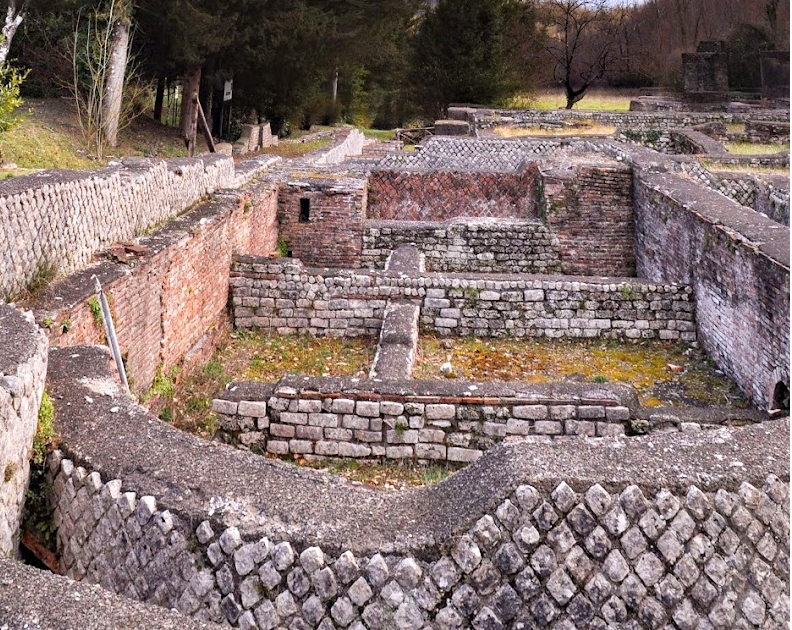
Horace's Villa is located in the valley of the Licenza stream, in the municipality of Licenza (RM), and is a state archaeological area entrusted to the Soprintendenza for Archaeology, Fine Arts and Landscape for the metropolitan area of Rome and the province of Rieti. Entry is free but you can enter only by mandatory reservation, to be arranged with the Aniene Turismo tourist information center. There is no ticket office open every day: without an appointment you'll find the gate closed.
What you actually visit: the foundations and walls of a Roman country residence 107 meters long and 43 wide, divided into three sectors, with the living quarters to the north, a large quadriporticus with a garden and a pool to the south and a bath complex to the west. Literary tradition links it to the poet Quintus Horatius Flaccus, who received the estate as a gift from Maecenas between 33 and 32 BC.
The practical information matches the check of September 29, 2026 on the Soprintendenza page dedicated to the villa, on the Ministry of Culture portal and on the other sources cited later. Where two public pages give different contact details, here we follow the operator's. Before getting in the car, though, a phone call is worthwhile: the site opens on request, and the call is part of the visit.
At a glance: address, hours, ticket
- Address: the Soprintendenza gives Via Licinese with no street number, 00026 Licenza (RM), while the Ministry of Culture portal gives Via Licentina, the access road to the area.
- Operator: Soprintendenza for Archaeology, Fine Arts and Landscape for the metropolitan area of Rome and the province of Rieti, with reception handled by Aniene Turismo.
- How to enter: only by mandatory reservation, by writing to info@anieneturismo.it or calling +39 348 432 7797.
- Price: free entry.
- Hours: the operator doesn't publish a fixed calendar, visit slots are arranged when you book.
- How to get there: by car on the A24, exit Vicovaro Mandela, then the Tiburtina and the Licinese. By Cotral intercity buses, schedules to be checked on the company's website.
- Accessibility: the Soprintendenza reports a driveable road up to the entrance with ample parking and a shorter pedestrian path through the woods, with no other information for people with mobility difficulties.
Where it is and what you actually see
The villa occupies a plateau on the side of the Licenza valley, the ancient Digentia, between the towns of Licenza and Roccagiovine, below the ridges of the Monti Lucretili Park. It's real countryside, with olive groves, woods and few houses. Coming from Tivoli, you leave the Aniene valley behind and climb into a narrow side valley. The villa can't be seen from the main road: you reach it by a signposted detour.
Inside the enclosure the layout is easy to read. To the north are the living quarters, about 20 rooms on a single floor arranged around an atrium with a square impluvium. To the south opens the large porticoed garden, more than 80 meters long, with a pool of about 13 by 25 meters in the middle. To the west stretches the bath complex, the best preserved part and also the latest. Everything is at foundation level or a little above.
The walls are in limestone opus reticulatum, the technique of small pyramid-shaped blocks set in a net pattern that you find in half of ancient Rome. The floors were mostly in cocciopesto, some in black and white mosaic with geometric motifs. Those mosaics are now largely covered to protect them, and anyone expecting a decorated carpet to photograph will be disappointed. You walk among perimeters, thresholds, column bases and pools.
The garden is the space that gives the measure of the place. A central ramp, in line with the atrium, descended from the house to the quadriporticus. The sources describe flower beds and hedges originally pruned in the Roman topiary art, while today the ground is overgrown with trees grown over the decades. It takes a bit of imagination to put porticoes and borders back in place, but the proportions can still be read well while walking along the edge of the pool.
On the sides of the pool remain the bases that held decorative elements added in the Flavian and Hadrianic periods, probably statues or fountains. Along the north wall of the complex, in the same phase, a square brick fountain with semicircular niches was built. These are details that escape anyone walking quickly, and they are exactly the ones that show how the villa was embellished by the owners who came after the poet, not by him.
The landscape around matters as much as the ruins. The plateau looks over the valley from a sheltered position, with the stream's water below and the woods on the slopes. It isn't a spectacular viewpoint, it's a place chosen for living well all year round. Anyone who visits the villa with this key understands why the Roman elite sought out these side valleys, far from the main road but reachable in a day from the capital.
A curiosity about Horace's Villa
The part you remember best after the visit is not the poet's house but the latrine of the baths. It's a room with perforated seats lined up one next to the other, with no dividers, in the Roman manner. It is among the best preserved structures of the bath complex, which in the Flavian and Hadrianic period grew to more than 50 brick rooms. A villa tied to the poetry of retreat ends up showing you, first of all, a communal bathroom.
At the southern end of the baths there is then a rectangular building with an elliptical room and four semicircular exedras. Those who have studied the site interpret it as a possible laconicum, that is a room for dry heat bathing, a sauna. It is an interpretation, not a certainty written on an inscription. In the same room, centuries later, burials were carved out: the same space had very different functions a few centuries apart.
Another curiosity concerns the name of the locality. When excavations began, in the 18th century, the plateau was known as Vigne di San Pietro. The place name has nothing to do with Horace: according to the published reconstruction, it dates to the early medieval phase, when a small monastic community lived among the ruins. For centuries, then, those who worked this land associated it with a saint, and no memory of the poet remained on the spot.
One thing nobody tells you about Horace's Villa
Almost nothing of what you see can be dated with certainty to Horace's years. The research team that excavated here between 1997 and 2003 dated the first phase to a simple rustic structure, contemporary with the poet or slightly earlier, and recognized a major later reconstruction, perhaps of the Neronian period. The baths date from the end of the first century and were enlarged between 130 and 150 AD.
The practical consequence is that the villa you walk through is in large part that of the owners who came after. The poet remains the reason the site is famous, but the walls tell more about the life of a large imperial country residence than about a man of letters in retreat. Anyone who knows this beforehand enjoys the visit more, because they stop looking for Horace's desk and start reading the rooms for what they are.
Our opinion, against the grain of many accounts, is that the label "Horace's house" does more harm than good. It creates the expectation of an intimate, literary dwelling, and leads people to underestimate what the site really offers: a sequence of transformations almost a thousand years long, from farmhouse to villa, from baths to tombs, from monastery to vineyard. It is that sequence, not the poet's name, that justifies the road to Licenza.
Is it really Horace's villa?
The honest answer is that the identification is probable but not proven by an inscription. No text found on the spot carries the poet's name. The archaeologists of the most recent excavation project stated that they found no traces of Horace's presence and very little of the villa of his time, refusing to force the data. The recognition rests on the consistency between the place and the descriptions of the Sabine estate in the poet's verses.
Already in the Renaissance the location of the estate was debated among scholars. Around 1650 the German scholar Lucas Holstenius was the first to indicate the Licenza valley as the seat of Horace's property. In 1760 the Baron de Saint-Odile began a first limited excavation in the locality then called Vigne di San Pietro, and the finds of mosaics and wall remains shifted the consensus toward Licenza.
Systematic work arrives in the 20th century. From 1911 to 1915 the archaeologist Angiolo Pasqui conducted extensive excavations and restorations, and the materials from those campaigns are the basis of the museum in town. In 1930 and 1931 the American Academy in Rome stepped in, then between 1970 and 1990 the Soprintendenza with conservation work. From 1997 the international project directed by Bernard Frischer began, and its results were published in two volumes in 2006.
There are also indirect clues about the later owners. On brick stamps and lead pipes appear names of people tied to the villa in different eras: Manius Naevius for the earliest phase, then Claudia Epicharis, Tiberius Claudius Burrus and, between the Hadrianic and Antonine periods, Publius Hostilius Firminus. None of these names is Horace's. It is the kind of material evidence that is missing precisely for the most famous owner.
The fact remains that no alternative location has ever gathered comparable consensus. The site lies in the right valley, has the dimensions of a gentleman's agricultural residence, has a first phase compatible with the poet's chronology and a later history consistent with a property passing from hand to hand. The correct formula, for the writer and for the visitor, is therefore "the site identified as Horace's villa," not "the house where Horace lived."
My advice for visiting Horace's Villa
My advice is to book a few days ahead and to ask in the same call if the Horatian Civic Museum in town is also open on the day you choose. The villa alone is only half understood: the paintings, stuccoes, sculptures and objects found in the excavations are in the Licenza museum, not on site. The two visits together take a morning, and they fit only if the hours coincide.
The second piece of advice concerns the access route. The Soprintendenza reports two ways to reach the entrance: a driveable road with ample parking and a shorter pedestrian path through a small wood. The path is the more pleasant choice if you have suitable shoes, because it brings you into the valley landscape before you even see the ruins. With wet ground, with strollers or with people who have trouble walking, the driveable road to the parking lot is better.
Once inside, the clearest reading order is that of the ancient design. You start from the atrium area, where the living rooms were, go down toward the garden following the axis of the ramp, walk around the pool and finish with the baths on the western side. That way the sequence of house, garden and baths makes sense without a plan in hand, and the later phases are recognized by difference.
On the season, the rule is to avoid the hottest months and the days after heavy rain. Spring and fall are the times when the site works best: soft light, clean lawns, a temperature suited to an outdoor visit. In winter the valley is cool and damp, and the visit remains possible if the operator confirms it, but the ground can be muddy. Always ask, when booking, about the conditions of the route.
Third point: bring water and something to cover up from the sun. The site is outdoors, with little shade apart from the garden trees, and the operator doesn't report any refreshment services. In summer the midday hours are the worst. An unofficial guide estimates about two hours for the complete visit of the villa and surroundings, a credible time if you add the museum and the nymphaeum in town.
How much does it cost and how do you book?
Entry is free. According to the Soprintendenza page, the visit must be booked through Aniene Turismo, the tourist information center that handles reception: the email address is info@anieneturismo.it, the phone +39 348 432 7797. The operator doesn't publish fixed time slots or a maximum number of participants. These are details to ask when booking, together with the exact meeting point.
There is no ticket to buy, so there is no online sales channel to look for either. The official channel is only one, the Soprintendenza page, which refers to the contact details of Aniene Turismo. On the main tour platforms there is no product dedicated to this villa. Be wary of anyone offering paid entry without a guided visit: the site doesn't provide for them.
The Ministry of Culture portal lists, in the place's page, contact details different from those of the Soprintendenza, including phone numbers with morning answering hours. It appears to be a less updated page. If the Aniene Turismo number doesn't answer, the safest route is to write to the Soprintendenza, at the address sabap-met-rm@cultura.gov.it published on its site, and ask whom to contact. Better one more email than a wasted trip.
Besides visits by reservation there are extraordinary openings. For the European Heritage Days of September 26 and 27, 2026, the Soprintendenza had announced an opening of the villa from 9 to 13, with guided visits on site and without reservation, together with the Municipality of Licenza and Aniene Turismo. Occasions like this return in the ministerial calendar: it's worth checking the Soprintendenza events page.
For schools, associations and organized groups the procedure is the same, but it's best to move earlier and state right away the number of participants, the age of the kids and the vehicle you are arriving in. The operator doesn't publish capacity limits or special conditions for groups, so these are things to agree on in writing. Also ask if it's possible to combine the visit to the villa with that of the civic museum in town.
Another well-known fact, yet rarely cited
That Maecenas gave Horace an estate in the Sabina is known by almost everyone. Less often cited is its size: the official sources speak of a property of about 40 hectares, with woods, pastures, orchards, vineyards and olive groves. It wasn't a garden with a little house. It was a real farm, with its workers, of which the villa was the residential center. The gift had economic value, as well as sentimental.
From here a second fact, also rarely repeated. The poet's villa, according to those who excavated it, already had a first bath installation: a small balneum in opus reticulatum, with a heated apsidal room and a pool. Under the floors of that room you can still see the suspensurae, the small pillars that held up the floor while letting hot air circulate. The taste for bath comforts, at Licenza, began early.
Third fact, perhaps the most overlooked: the villa has been excavated and restored in several rounds for over two centuries, and what you see is also the result of those interventions. The extensive restorations by Angiolo Pasqui, at the start of the 20th century, and the conservation work by the Soprintendenza between the 1970s and 1980s consolidated and in part rebuilt the tops of the walls. Reading a ruin also means reading who looked after it.
Fourth and last: the estate wasn't cut off from the world as the word retreat suggests. The villa lay in a valley connected to Via Tiburtina Valeria, the great road toward Abruzzo, and therefore a few hours from Rome. The Sabine retreat was a calculated distance, far enough from the city to escape obligations and close enough to return. It's the model of many villas in the Tiburtine area.
The right photo to take at Horace's Villa
The shot that tells the story of the site is the one along the axis of the garden, from the side opposite the house, with the central pool in the foreground, the ramp and the atrium area in the background and the valley slopes behind. It brings together the geometry of the Roman design and the landscape that made it famous. You need a clear day and a slightly raised position, as far as the routes allowed during the visit permit.
The second photo not to skip is a detail: the small pillars of the suspensurae in the baths, or the row of latrine seats. They are less obvious images than the panorama and explain better how the villa worked. Always follow the instructions of whoever leads the visit: don't climb on the walls, don't enter the fenced areas and don't move the mosaic covers to photograph them.
A third image is taken in town, not at the villa: the small waterfall of the Orsini Nymphaeum, with the semicircular exedra behind it. It's the photo that appears in almost every account of Licenza, because it ties Horace's name to the water of the Bandusia Spring. Take it knowing that it's a modern-era architecture. For photos inside the civic museum, ask the staff first if they are allowed and with what limits.
How do you get there from central Rome?
By car the route given by the guides is the A24 motorway toward L'Aquila to the Vicovaro Mandela exit, then Via Tiburtina Valeria toward Licenza, then Via Licinese, the provincial road that climbs the valley, to the left turn onto Via Licentina. From Rome the time depends heavily on traffic on the Tiburtina and the ring road. At the entrance the Soprintendenza reports ample parking, a rare thing for an archaeological area.
By public transport the villa can be reached with the Cotral intercity buses that serve the valley, but the runs are few, especially on weekends, and the stop is not in front of the entrance. One online guide puts it bluntly: getting there this way is very complicated. Up-to-date schedules are checked on the Cotral website before leaving, not on the same day.
For a group or a family the practical solution remains the car or a rented vehicle. Keep in mind that the last part of the road is narrow and rural, not well suited to large coaches. Anyone on foot from the bus stop has to allow for stretches along provincial roads with no sidewalk, to be walked with care. Ask Aniene Turismo, when booking, which stop is the most convenient.
If you're already visiting Tivoli, Licenza is a natural detour to the northeast along Via Tiburtina Valeria, the same direction as the upper Aniene valley. The advice is not to arrive at the last minute for the appointment set with Aniene Turismo: on the last stretch there are few signs and the phone signal can be weak. Save the arrival point and the contact number on your phone beforehand.
Some important events that happened here in history
Between 33 and 32 BC Maecenas gives the estate to Horace. It is the starting date of everything, and the only one tied with certainty to the poet. According to a hypothesis by the scholar Bernard Frischer, reported by the Soprintendenza, at Horace's death the property passed to Augustus, and later Nero and Vespasian would have used it as a stopover residence. It is a hypothesis: no document on site confirms it.
In the Flavian period, in the first century AD, the small bath becomes a real bath complex, enlarged again between 130 and 150. It is in this phase that a square brick fountain with semicircular niches is also added along the north wall. The villa, at that point, is a prestigious imperial residence in a secluded valley, reachable from Rome in a day's travel.
In the fourth century, according to the reconstruction published by the specialist press, Constantine includes the villa in the possessio called Duas Casas and donates it to the Roman basilica of Santi Marcellino e Pietro, the complex on Via Labicana tied to the Mausoleum of Sant'Elena. A memory of that property would remain in the name of the church of Santa Maria delle Case, near Roccagiovine. From the same era the decline of the villa begins.
Between the fourth and fifth centuries the rooms are divided with opus listatum partitions and poor burials appear. Between the sixth and ninth centuries a small monastic community arises on the ruins, burying its dead in the elliptical room of the baths and dividing the pool. The place name Vigne di San Pietro, by which the locality was known when excavations began, would date to this religious phase.
Then the centuries of silence and vineyard, up to the 17th century of the scholarly identification and the 18th century of the first excavations. In 1911 the campaigns of Angiolo Pasqui begin, resumed in 1915, which yield much of the materials now in the museum. The 20th century adds the American research of 1930 and 1931, the state restorations of the 1970s and 1980s, and the great international project that started in 1997.
The last chapter, for now, is that of the openings to the public organized by the Ministry. The villa takes part in national initiatives such as the European Heritage Days, which in September 2026 had as their theme the protection of heritage, and the Soprintendenza promotes free guided visits on extraordinary dates. It's a site that stays outside the big flows, and its recent history is made of small repeated openings more than of big events.
Who has passed through Horace's Villa
Horace, first of all, even though the site preserves no direct traces of him. Then Maecenas, as the donor of the estate, even though no source documents a visit by him. If Frischer's hypothesis is correct, the property passed to Augustus and was used by Nero and Vespasian during their travels. From the brick stamps also emerge the names of less famous owners, from Manius Naevius to Publius Hostilius Firminus.
In the Christian era the monks of the early medieval cenobium pass through here, of whom burials and partitions remain. Much later come the scholars. Lucas Holstenius, in the mid-17th century, points out the place. Baron de Saint-Odile digs in 1760. In 1775 the Scottish painter Allan Ramsay continues the research, a sign of how much Horace's name attracted the educated travelers of the Grand Tour even far from the beaten roads.
The 20th century brings professional archaeologists: Angiolo Pasqui with the campaigns of 1911 and 1915, then the scholars of the American Academy in Rome in the 1930s. Giuseppe Lugli, a Roman archaeologist, worked on the valley and proposed an identification of the Bandusia Spring in the surroundings. From 1997 the project led by Bernard Frischer, with Jane Crawford and Monica De Simone, brought researchers from American universities back into the field for several years.
The debate among scholars has also contributed to the fame of the place. In the 18th century the Frenchman Capmartin de Chaupy worked on Horatian geography and placed the Bandusia Spring in the territory of Venosa, fueling a discussion that still goes on. In the 19th and 20th centuries Italian and foreign scholars and writers returned to the subject of the Sabine estate. The place, that is, has been visited more often with the pen than with shoes.
The Bandusia Spring: documents, tradition, legend
What the documents say. Horace dedicates to the spring of Bandusia the 13th ode of the third book of the Odes. The text doesn't say where it is. A bull of Pope Paschal II from 1103, cited by the Enciclopedia Treccani, concerns the territory of Venosa, the poet's native city in Basilicata, and is the document on which the location of the spring in the Venosa area is based. The 18th century added the research of Capmartin de Chaupy.
What tradition says. Already the ancient commentators of Horace, such as pseudo-Acron, placed the spring near the Sabine villa. In the 20th century Giuseppe Lugli proposed to recognize it in a spring of the Licenza valley called Fonte Bello or Fonte degli Oratini. The hypothesis most widely shared today, according to Treccani itself, is that there were two Bandusian springs: one in his native land and one in the Sabina, named by the poet in memory of the first.
What is legend or, better, sentimental identification. In town the Bandusia Spring is often associated with the small waterfall of the Orsini Nymphaeum, a large semicircular exedra built in the modern era by digging out part of the hill. The nymphaeum is a fine Renaissance architecture, but the association with Horace's verses is a choice of local memory, not an archaeological fact. Visit it for what it is, and enjoy it without looking for the poet in the water.
Why does the distinction matter? Because on no other detail of the villa is the confusion among the three levels so frequent. Tourist panels, travel sites and oral accounts often present one of the three hypotheses as certain, depending on who writes and where. In Basilicata the spring is at Venosa, in the Sabina it is at Licenza. The correct position is to declare the doubt and explain where each thesis comes from.
The Horatian Civic Museum and the Orsini Nymphaeum
The Horatian Civic Museum is housed in the Orsini Borghese Baronial Palace, in Piazza del Palazzo in Licenza. It holds the materials from the villa: capitals and marble slabs, sculptures and statue fragments, ceramics, oil lamps, coins, blown glass, everyday objects such as spatulas, needles and loom weights, and samples of the frescoes and floors. Educational panels explain the villa and the area.
Among the pieces reported by the sources are a torso of Eros, a torso of Aphrodite and a head of a youth datable to the end of the first century, together with coins that document the use of the site until a late period. The published hours don't agree among the different pages available online, and none of them gives an update date. To find out if the museum is open on the day of your visit, call 0774 46031, given on the same portal.
The Orsini Nymphaeum is near the town and is the natural stop after the museum. The descriptions speak of a semicircular exedra about 23 meters in diameter, with an architectural backdrop between small columns and a scrolled pediment, from which a small waterfall descends into a semicircular basin. Here too the access arrangements must be asked about in advance, because the sources give no public hours.
The museum is the necessary complement to the villa, and in our judgment it should be seen before the archaeological area, not after. Anyone who already has in mind the paintings, stuccoes and marble fragments found in the excavations looks at the foundations with different eyes, and can imagine decorated rooms where today there are only low walls. If the opening hours allow, organize the morning in this order: town, museum, nymphaeum, villa.
Where Licenza stands among the Roman villas of Lazio
Horace's Villa is part of a constellation of country residences built by the Roman elite along the valleys east of the capital. The most famous is Hadrian's Villa in Tivoli, an imperial city on a reduced scale. Higher up, in the upper Aniene valley, is the Villa of Trajan at Arcinazzo Romano, and toward Palestrina the Villa of Hadrian. Licenza is the smallest and the least monumental.
Precisely for this reason it is the most useful for understanding the starting model. In front of Hadrian's Villa you see the end point of an idea of residence, at Licenza you see a version closer to the gentleman's farm, later enlarged. Anyone who knows the suburban villas of Rome, such as the Villa of the Quintilii, the Villa of Livia or the Villa of Maxentius, finds a useful comparison here.
There is also a thread that leads straight to the center of Rome. Maecenas, Horace's patron, was one of the men closest to Augustus, and the Augustan age can be read in Rome in the Mausoleum of Augustus, the Ara Pacis and on the Palatine, where the princeps' house stood. Visiting Licenza after those places helps you see the reverse of the capital: the countryside where its intellectuals sought silence.
For the baths, the comparison to make is with Rome's great public complexes. The Baths of Caracalla and the Baths of Diocletian show the same sequence of hot and cold rooms, with suspensurae and pools, on an enormously larger scale. At Licenza the same technique serves a single family and its guests. The difference in scale tells well the distance between public luxury and private comfort.
For the decorations, though, it's best to look to the museums of Rome. The garden paintings of the Villa of Livia are displayed at Palazzo Massimo alle Terme, and they give an idea of how the rooms of an Augustan-age country residence could have looked. At Licenza the surviving paintings are fragments kept in the civic museum. The comparison helps you imagine walls that today are reduced to a few centimeters of plaster.
The villa, finally, enters another Roman route, that of the places tied to foreign research in Italy. The American Academy in Rome dug here in the 1930s, and since 1997 the site has been back at the center of an international project with American universities. For anyone who knows the foreign academies on the Janiculum and in the center, Licenza is one of the places where that tradition of study has left concrete traces on the ground.
When is it closed, and what should you not expect?
The villa is closed whenever there is no reservation or announced extraordinary opening. The operator publishes no fixed opening days. An unofficial guide lists the villa and nymphaeum as closed on Monday, but the claim isn't confirmed by an official source. In case of heavy rain or maintenance work the visit can be canceled: always ask for confirmation the day before.
Don't expect frescoed walls, statues on site or exposed mosaics. The frescoes and sculptures are at the museum, the mosaics are largely covered for protection. Don't expect services either: the operator doesn't list a café, bookshop or restrooms open to the public, so plan ahead. The site is a countryside archaeological area with visitor routes, and the visit by reservation is the right moment to ask questions of whoever opens the gate for you.
Finally, don't expect to find the poet's house as it is pictured in the imagination. Many images and many texts online overlay the literary memory onto the ruins, and present as Horatian what dates from one or two centuries later. Those who arrive prepared to read the phases, instead, find a clear, well kept and uncrowded site, which you tour without hurry and without lines.
If you arrive without a reservation and find it closed, don't look for gaps in the fence and don't climb over: the area is protected and the remains are fragile. From the access road you can sense the position of the plateau, but the ruins can't be read from the outside. Better to use the day for the town, the museum if open and the nymphaeum, and arrange the villa visit later by contacting Aniene Turismo.
Where to eat nearby
In the Licenza valley the towns are small and the places few, with hours that change between season and off-season. There are none of the typical traps of Rome's monumental zones, but a few common-sense rules remain. If the only place open has a photo menu in several languages, items with no price or a barker, you're in the wrong place here too. Calling ahead, in the villages, is always a good idea.
Anyone thinking of bringing a packed lunch must ask the operator if the villa area allows stopping to eat: the information isn't published and it is in any case an archaeological area, where the rules are stricter than in a park. The green areas of the nearby towns and the trails of the regional park are better places for an outdoor stop, always taking your trash back with you.
The most frequent traps are found going down to Tivoli, in front of the famous villas: tables with a view and prices adjusted to the customer, kitchens always open with no break, different menus inside and outside. Romans avoid them for a simple reason: you pay for the position, not the cooking. For addresses, in Rome and beyond, consult the list of addresses on Google Maps.
What to pair with it in a day
The most natural combination is with the towns of the valley. Percile is a little farther up the same valley, and just above it are the Percile Lakes, two small karst ponds reachable on foot. Orvinio, already in the province of Rieti, and San Polo dei Cavalieri, on the other slope of the Lucretili, complete the picture of the mountain villages.
If you prefer to stay on the theme of ancient villas, the day can head down to Tivoli. A morning at Licenza and an afternoon at Villa d'Este is a workable pairing, with the difference that Villa d'Este has a ticket and fixed hours. Putting Hadrian's Villa in the same day as well, instead, is a frequent mistake: they are two long visits, and one of the three ends up sacrificed.
To the east the road leads into the upper Aniene valley. Anticoli Corrado, the town of models and painters, is along the way. Farther on Subiaco offers the Sacro Speco and the Monti Simbruini Park. These are slow mountain roads, and putting everything in the same day after Licenza means seeing little and driving a lot: you have to pick one direction only.
Anyone who has already seen Hadrian's Villa and Villa d'Este can make Licenza the first step of a tour of the less visited imperial villas. The Villa of Trajan at Arcinazzo Romano, on the highlands beyond Subiaco, completes the comparison with a residence built for an emperor. They are two different days, with mountain roads in between, but together they tell how Rome used the inland valleys.
Anyone arriving from the north, finally, can come up from Orvinio and the Sabina of Rieti. It's a slow ridge route, suited to those who have time and are in no hurry to return to the city. The Farfa Gorges and the Nazzano Tevere Farfa reserve are other nature destinations in the same wider area, to keep for a separate day.
For those who love the landscape more than the archaeological site, the valley is a starting point for the trails of the Monti Lucretili. On the way back to Rome, the Acque Albule of Bagni di Tivoli are a possible stop. Those who continue north find the Sabina with the Abbey of Farfa, Fara in Sabina and Torri in Sabina, but that's already another itinerary.
Anyone staying in Rome who wants to prepare the visit can start from the Aniene within the city. The Valle dell'Aniene Nature Reserve, within the municipal territory, follows the same river that farther upstream comes down from Subiaco and Tivoli. For an overview of the capital's state archaeological areas, our page on the state museums of Rome is also useful, with the sites managed by the Ministry.
And if you're looking for other free places to round out the weekend, the page Free Rome collects monuments and areas you can visit without a ticket. To stay with the ancient Roman countryside, the Appia Antica Park with Capo di Bove offers a similar experience: remains of private residences amid greenery, few people and slow rhythms.
Frequently asked questions
How much does it cost to enter Horace's Villa?
Entry is free. The Soprintendenza for Archaeology, Fine Arts and Landscape for the metropolitan area of Rome and the province of Rieti lists the visit as free and by mandatory reservation through Aniene Turismo. There is no ticket to buy online or on site. Be wary of paid offers that promise entry without an organized visit: the operator doesn't provide for this arrangement.
Do you need a reservation?
Yes, always, except for the extraordinary openings announced by the Soprintendenza, such as the one for the European Heritage Days. You book by writing to info@anieneturismo.it or calling +39 348 432 7797. In the same request it's worth asking where to set the meeting, how long the visit lasts and if the Horatian Civic Museum in town is also open on the day you choose.
Are we sure it was Horace's villa?
The identification is accepted by the institutions but is not proven by an inscription with the poet's name. The archaeologists of the latest major excavation project found no direct traces of his presence and very little of the villa of his time. The recognition rests on the correspondence between the place, the valley of the Digentia and the descriptions of the Sabine estate in Horace's texts.
Where are the finds from the excavations?
The materials from the early 20th-century campaigns are in the Horatian Civic Museum of Licenza, in the Orsini Borghese Baronial Palace in Piazza del Palazzo. There are paintings, stuccoes, sculptures, ceramics, coins and everyday objects. The hours published online are not consistent across the different pages, so before going call the number 0774 46031 given by the Ministry portal.
Is the Bandusia Spring at Licenza?
The sources don't agree. Horace dedicates an ode to it without saying where it is. One ancient tradition places it near the Sabine villa, another, supported by a papal document of 1103, puts it in the territory of Venosa, the poet's native city. The most widely shared hypothesis is that there were two. In town it is often associated with the Orsini Nymphaeum, but that is a choice of local memory.
Can you get there by public transport?
Yes, with the Cotral intercity buses that serve the valley, but the runs are few, especially on weekends, and the stop is not at the site entrance. Check the updated schedules on the Cotral website the day before and allow for a stretch on foot along roads without sidewalks. For a group or a family the car remains the most practical solution.
How much time does the visit take?
The operator doesn't give a duration. An unofficial guide estimates about two hours for the villa and surroundings together. With the museum in town and a stop at the Orsini Nymphaeum the morning is full. If you want to pair another place, choose something nearby such as Percile and its ponds, or Villa d'Este in Tivoli for the afternoon.
Who manages Horace's Villa?
The villa is a state archaeological area under the responsibility of the Soprintendenza for Archaeology, Fine Arts and Landscape for the metropolitan area of Rome and the province of Rieti, which reports to the Ministry of Culture. Reservations and reception are entrusted to Aniene Turismo, the valley's tourist information center. Extraordinary openings are organized by the Soprintendenza together with the Municipality of Licenza.
Is the visit suitable for children?
Yes, as long as you prepare them: there are no statues or exposed mosaics, but the garden with the pool, the baths with the heating pillars and the latrine with seats in a row make a big impression on the little ones. The site is outdoors, in the countryside, with little shade. You need comfortable shoes, water and a hat. For more ideas on the subject there is our page on Rome with Kids.
Who wrote this and from which sources
The text comes from the editorial team of Tour Leader Pro, the Roman organization that designs itineraries, visits and cultural events between Rome and Lazio. Fees, hours and booking arrangements reported here come from the official sources cited in the text as of the date indicated at the opening: the Soprintendenza page on the villa, the Ministry of Culture portal and the announcement of the European Heritage Days. Let us know what you find changed.
Organizing the visit to Horace's Villa for a group means working with a site that opens on request, a museum with hours to be confirmed and narrow country roads for coaches. It's best to settle the reservation with Aniene Turismo first and then build the rest of the day. A useful resource for those who organize group trips in Lazio is Tour Leader Pro.
Licenza is a stop that pays off more within a multi-day itinerary among Tivoli, the Aniene valley, the Monti Lucretili and the Sabina, rather than as an isolated outing from Rome. Those with time can sleep in the valley and devote one day to the villas and one to the villages and trails. A useful resource for building a multi-day itinerary is Italy Planner.