Pyrgi and the Sanctuary of Leucothea
In short. Pyrgi is the archaeological area that extends next to the castle of Santa Severa, on the coast of Santa Marinella, and corresponds to the port of the Etruscan city of Caere and its great maritime sanctuary.
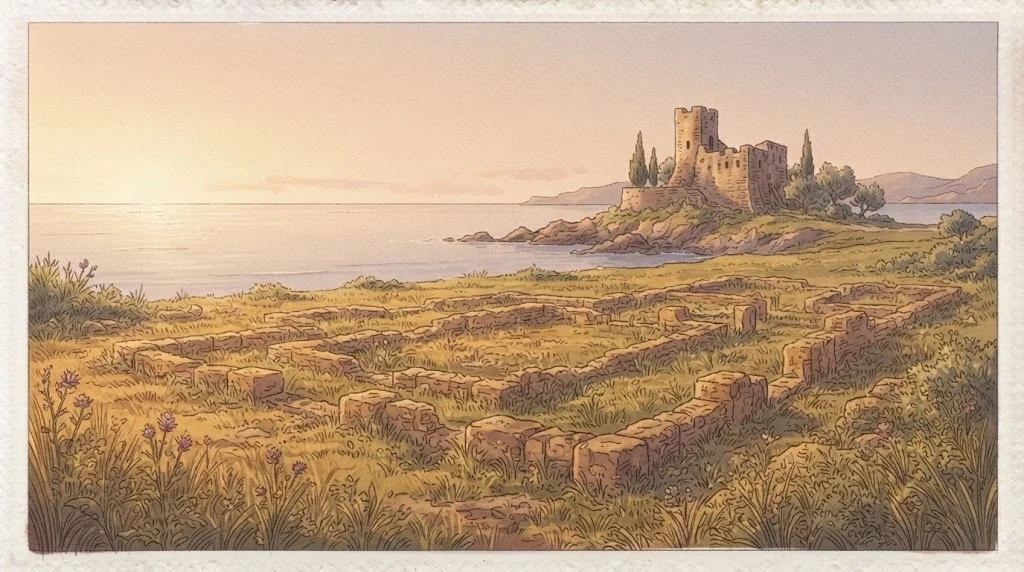
Pyrgi is the archaeological area that extends next to the castle of Santa Severa, on the coast of Santa Marinella, and corresponds to the port of the Etruscan city of Caere and its great maritime sanctuary. From this place come three gold sheets inscribed in Etruscan and Phoenician, found in 1964, among the most important documents the ancient Mediterranean has left us. The originals are in Rome, at Villa Giulia.
Anyone coming here for the day needs to know one thing right away: the sacred area has no ordinary opening like the castle. You enter on the special openings and on the guided visits, mostly free, that the Soprintendenza organizes with the archaeologists of the Sapienza. The rest of the year you look at it from outside, from the perimeter, with the sea a few meters away. Data taken on September 28, 2026.
Where it is and what Pyrgi was
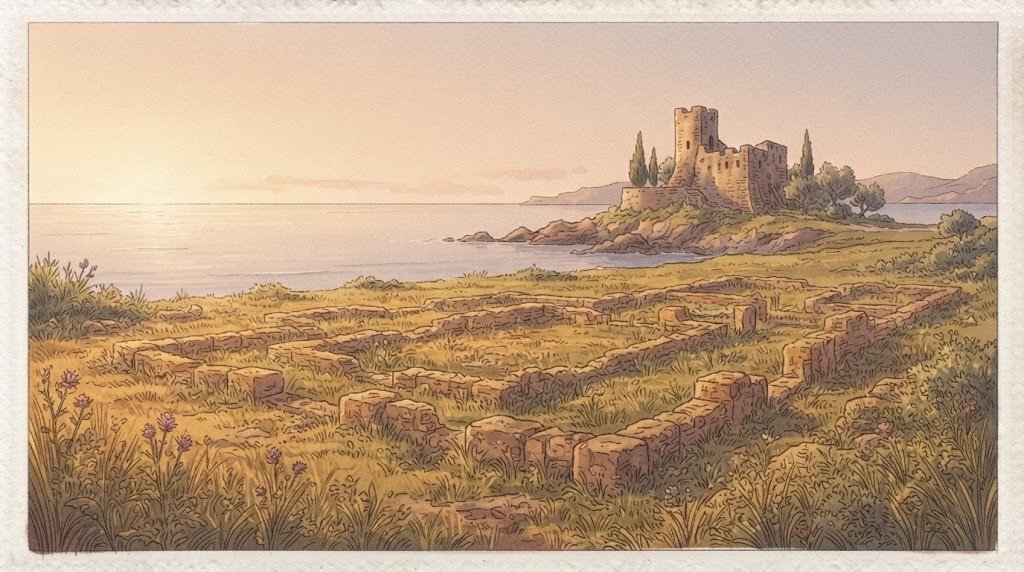
The address is SS1 Via Aurelia km 52.600, 00058 Santa Marinella, province of Rome. Santa Severa is a hamlet of Santa Marinella, about 50 kilometers north of the capital, on the same route that leads to Civitavecchia and then into the Maremma. The archaeological area occupies the strip of land between Via Aurelia and the beach, immediately south of the fortified village.
Caere, present-day Cerveteri, lies about a dozen kilometers inland. Pyrgi was its outlet to the sea, connected to the city by a monumental road that the archaeologists of the Sapienza compare to the relationship between Athens and Piraeus. Not just any landing place, then, but an official terminal: whoever landed here dealt with the power of one of the richest cities of southern Etruria.
The Greek name Pyrgoi means towers. The ancients referred it to the fortifications of the place, and the place name then passed to the Roman castrum and finally, by extension, to the area. Greek and Latin sources speak of this place mostly for the sanctuary and its riches, not for the port itself, which says how much the religious side of the landing place mattered.
Two sanctuaries, not one
The excavations have identified two distinct, contemporary sacred areas. The first is the monumental sanctuary, the one with the two large temples, public and political in character, built by the government of Caere. The second, farther south, is the so-called southern sanctuary: many small altars, modest structures, offerings of Attic pottery of remarkable quality, cults tied to Demeter and to female fertility deities.
The difference between the two areas matters more than it seems. The monumental sanctuary speaks the language of diplomacy between states, with royal dedications and bilingual inscriptions. The southern sanctuary speaks the language of sailors, foreign merchants and women who asked for a happy birth. Two different audiences, two different economies of the sacred, in the same kilometer of coast.
The measurements help to grasp the scale. The Sapienza's documentation speaks of more than 14,000 square meters for the sacred areas, while the Soprintendenza's entries describe an archaeological complex of about 10 hectares, excavations, settlement and fortifications included. The two figures don't contradict each other: they measure different things, the sacred enclosure in one case and the site as a whole in the other.
A curiosity about Pyrgi and the Sanctuary of Leucothea
The goddess of Pyrgi changes name depending on who is writing. Strabo, a Greek geographer of the Augustan age, speaks of a sanctuary of Leucothea. Other ancient sources, including the tradition passing through Pseudo-Aristotle and Aelian, call her Eileithyia. The gold sheets, which are the local and direct document, say Uni in Etruscan and Astarte in Phoenician. Four names for the same sacred space.
The multiplication of divine names is not confusion on the part of the ancients. A port sanctuary worked exactly like this: each community that landed recognized its own deity in the local one, and called her by its own name. The Greeks saw Leucothea, the white goddess of the sea who saves the shipwrecked. The Phoenicians and Carthaginians saw Astarte. The Etruscans stayed with Uni, the great patron goddess of the city.
The mechanism has a technical name, interpretatio, and Pyrgi is one of the best-documented cases there is. It also works the other way around: when Dionysius of Syracuse decided to plunder the sanctuary, he knew perfectly well he was striking a place recognized by half the Mediterranean. The sacrilege, for him, was part of the political message.
The right question is: what was the goddess really called? The answer is that there is no true name. There is a sacred place that spoke four languages because four different fleets docked there. It is a lesson about the ancient Mediterranean worth more than 10 information panels.
The gold sheets of Pyrgi
On July 8, 1964, during the Sapienza excavations, three thin, rolled gold sheets came out of the ground between the two temples, with the nails that were used to fix them to a wooden door or doorpost. Two carry a text in Etruscan, the third a text in Phoenician. The commonly accepted date is the end of the 6th century BC, around 510 or 500.
The content is a dedication. Thefarie Velianas, who ruled Caere, dedicates to the goddess a sacred place, identified with temple B. In the Etruscan text the goddess is Uni, in the Phoenician one she is Astarte. There is also a reference to a cycle of years and to a ritual anniversary, and Thefarie's name carries a title that scholars have debated for decades without arriving at a single translation.
One point must be stated precisely, because you read the opposite around. The Phoenician text is not the word-for-word translation of the Etruscan one. It is a parallel text, a summary, with contents that partly coincide and partly don't. Calling it the Rosetta Stone of Etruscan is convenient and wrong: the sheets confirmed readings already hypothesized, they did not decipher a language.
Why they matter so much
The historical import of the document is political before linguistic. An Etruscan lord dedicates a temple to a goddess called by the name the Phoenicians use, at a time when Carthage and the Etruscan cities are allied against Greek pressure in the Tyrrhenian. The sheets are the material proof of that axis, written in gold and hung on a door.
The second reason is length. Long Etruscan texts can be counted on the fingers of two hands, and almost all are short funerary epigraphs or property inscriptions. Having an articulated, dated text, with a ruler's name and a ritual formula, in an archaeological context known to the centimeter, is a very rare condition in Etruscan studies.
The original sheets can be seen at the National Etruscan Museum of Villa Giulia, at Piazzale di Villa Giulia 9 in Rome, displayed in the room dedicated to Pyrgi. The museum is open Tuesday to Sunday from 8:30 to 19:30, closed Monday, full ticket €13.00 and reduced €2.00, free admission the first Sunday of the month. Phone 06 3226571.
In the Antiquarium of Pyrgi, at Santa Severa, you see a copy. Put plainly: the copy helps you understand the context, the emotion comes from the originals. Anyone with only one day who wants the sheets has to go to Villa Giulia, not to Santa Severa. Anyone who wants the place where they were found has to do the opposite.
Something nobody tells you about Pyrgi and the Sanctuary of Leucothea
Nearly all the pages promoting Santa Severa put Pyrgi on the list of things to see as if it were a site with free entry, a sign and a ticket office. It isn't. The sacred area has no ordinary public opening hours, and anyone arriving on any Tuesday in February finds a fence, some signs and a lawn.
The real way in is the special openings and the guided visits. The Soprintendenza per l'Etruria meridionale announces them on its website, often for the European Heritage Days in September, and during the summer excavation season it runs the open excavation format, with archaeologists from the Sapienza accompanying groups. Free admission, booking not required but recommended, phone 0766 570194.
The meeting point for these visits, when they are announced, is the entrance of the castle of Santa Severa, 10 minutes before the time indicated. The typical hours of the open excavation format in the past have been Tuesday and Thursday at 11:00 and 15:00 and Saturday at 10:00, in the months of the season. The dates change every year and need checking before you leave.
There is also a middle way few people know. During the excavation seasons the dig has been filmed by webcams that can be viewed online, which lets you see the work in progress without being on site. As a substitute for the visit it is worth little, as a tool for finding out if digging is going on in that period it is worth quite a lot.
What you actually see today
The standing structures at Pyrgi are few and low. The two temples can be read as foundations and platforms, not as elevations: the wood and terracotta that made them colorful and showy buildings disappeared millennia ago, and the surviving decorations are in the museum. Anyone expecting standing columns will be disappointed, and it's better to know this beforehand.
Some things can still be read well by eye, though. The plan of the two side-by-side temples, the open area between them where the sheets were found, the remains of the block walls that defended the Roman castrum, the fragments of the residential quarter excavated in the last 15 years. With a guide explaining, the whole becomes understandable in 40 minutes.
On the architectural form of the two buildings the reference works disagree. The entry in the Enciclopedia Italiana and that in the Enciclopedia dell'Arte Antica, both Treccani, describe in opposite ways which of the two temples has the Tuscan three-cella plan and which the Greek-type plan. On this point the entry stops: the chronology is solid, the description of the plan in popular sources is not.
The chronologies that hold
Temple B is the older of the two, built around 510 BC in the period of Thefarie Velianas. Temple A is more recent, datable around 470 or 460, and belongs to a different political phase, following the season of personal rulers. Between the two buildings runs half a century and a change of regime in Caere.
From temple A comes the terracotta high relief with the myth of the Seven Against Thebes, first half of the 5th century, now at Villa Giulia. The scene includes Tydeus gnawing the skull of Melanippus and Capaneus struck by Zeus's thunderbolt. The 1996 restoration put together more than 2,000 fragments, and only after that work did the iconography become fully legible.
The excavations are not finished and are not a thing of the past. In September 2026 the Sapienza season returned a fragment of an antefix with the face of the goddess Uni, belonging to temple B. News of this kind comes out almost every summer, which makes the place more interesting than many sites where no one has dug for 40 years.
My advice for visiting Pyrgi and the Sanctuary of Leucothea
Build the day the opposite way from how everyone builds it. First Villa Giulia in Rome, at a relaxed pace, sheets and the Seven high relief. Then, another day, the train to Santa Severa. Arriving on site having already seen the gold and the terracotta in the display case completely changes how you perceive that fenced lawn: it stops being empty.
Call first. The number 0766 570194 answers for the castle and for the initiatives on the archaeological area, and it tells you if there are guided visits that week and if the Antiquarium has reopened. 10 minutes on the phone saves a three-hour round trip made to find everything closed.
Never choose Monday. The castle is closed on Mondays all year, and without the castle the trip loses half its content, because the Sala Pyrgi, included in the museum ticket, is the only sure exhibition space on the subject while the Antiquarium stays closed for works. In summer, then, the castle opens only in the afternoon: from 17:00 to midnight from June 26 to August 30.
How to fit hours and seasons together
The castle's hours change four times a year. From November 1 to March 31 it is open Tuesday to Friday from 9:00 to 16:00 and Saturday, Sunday and holidays from 10:00 to 17:00. From April 1 to June 25 and from September 1 to October 31 Tuesday to Friday from 9:00 to 18:00 and on weekends from 10:00 to 19:00. From June 26 to August 30 evenings only, from 17:00 to midnight.
The best season for this trip runs from mid-September to the end of October. The sea is still enjoyable, the afternoon light on the water is low and right, the excavation season is often under way or just closed, and the European Heritage Days fall in September with free openings. July and August I would leave to the beachgoers.
Plan for three hours on site if the castle is open, an hour and a half if you limit yourself to the outside and the archaeological perimeter. Add beach time if the season allows: the beach below the castle is wide, with dark sand, and lets you swim with the walls behind you.
Hours, tickets and costs
The archaeological area has no ticket of its own, because it has no ordinary opening. The guided visits announced by the Soprintendenza have so far had free admission. Anyone promising a ticket for Pyrgi as a standalone site is selling something the public bodies have not put on sale. Checked on September 28, 2026.
The Museo del Castello costs €4.00 full and €3.00 reduced. The ticket includes Piazza della Rocca, the early Christian church, the Sala del Nostromo and the Sala Pyrgi. The Torre Saracena costs €2.00 separately, or €4.00 combined with the museum. There is a family package in which one adult pays the full price and minors under 18 enter free.
Reductions apply to minors between six and 18, over 65s, groups of 12 or more, teachers, public employees and guests of the hostel inside. Free entry goes to children under six, accompanying teachers, residents of Santa Marinella, people with disabilities, tour guides, students of archaeology and art history, and journalists. The outdoor areas, courtyards and esplanade, remain free to enter.
The Antiquarium of Pyrgi, which is in the area in front of the castle, displays materials from the excavations, fragments of architectural terracottas and the copy of the sheets. The hours stated on the castle's official website are Saturday and Sunday from 10:00 to 17:00 with last entry at 16:30, but as of the date of this check it is listed as closed for renovation. Before counting on that visit, call.
Parking in front of the entrance is paid: €4.00 for the whole day between 8:00 and 20:00, €2.00 for the evening band between 20:00 and 8:00, or €0.50 an hour with the first 30 minutes free. Anyone who buys the museum ticket gets three hours of free parking. In high season it fills up early.
How to get there by train from Rome
The line is the Tyrrhenian railway between Rome and Civitavecchia, the same one that serves Ladispoli and Santa Marinella. The stop to use is Santa Severa Nord: the castle's official information gives about 15 minutes on foot from there to the entrance. Santa Severa is about 50 kilometers from Rome and the regional train trip is around an hour.
Watch out for two details that wreck trips. Not all regional trains stop at the minor stations, so choose the run by looking at the timetable and not at whatever generic app you have. And the station is called Santa Severa Nord, distinct from the Santa Severa stop: anyone who enters the wrong name gets off in the wrong place and walks an extra kilometer.
The walk from the station to the castle is on an asphalt road, flat, without shade for long stretches. In July and August those 15 minutes at two in the afternoon are felt in full. Hat, water, closed shoes if you then enter the excavation area, where the ground is uneven and the tall weeds hide the changes in level.
The road alternatives
The Cotral from Rome leaves from Cornelia station and arrives at Santa Marinella, from where you continue by local transport. From Civitavecchia there is the Cotral line from Porta Tarquinia to Santa Severa station, then about 10 minutes on foot to the west along Via della Stazione. By car you leave the Aurelia at kilometer 52.600, with paid parking in front of the entrance.
A practical tip for those coming from Rome without a car: this trip combines well with a second stop on the same line, for example the Torre Flavia marsh or the castle of Palo in Ladispoli. The regional ticket costs little and the line runs parallel to the coast for its whole length.
Another well-known fact, yet rarely mentioned
In 384 BC Dionysius the Elder, tyrant of Syracuse, arrived here with 60 triremes and plundered the sanctuary. The official reason was the fight against the pirates of the Tyrrhenian. The result was the transfer to Syracuse of loot that ancient sources quantify at more than 1,000 talents taken from the temple, plus 500 collected in the rest of Etruria.
That money financed the war against Carthage. Diodorus Siculus and Strabo tell the episode, and it is one of the few cases in which an ancient figure on the wealth of a Tyrrhenian sanctuary reaches us in detail. A thousand talents was an enormous sum, comparable to the annual budget of a military power of the time.
The fact is well known among specialists and almost absent from tourist pages. Yet it explains better than anything else what Pyrgi was: a place where offerings in precious metal accumulated for generations, under the protection of a goddess recognized by Greeks, Phoenicians and Etruscans. A port sanctuary was also a bank.
The chronology after the plunder is a slow decline. Around 264 BC Rome established a maritime colony there, with the quadrangular castrum whose walls can still be read on the ground. The decline came with the founding of Centumcellae, present-day Civitavecchia, which absorbed the port functions. Pyrgi went on supplying fish to Rome and little else.
The contrarian view
I'll say something the area's tourist offices won't like: Pyrgi, as an archaeological visit in itself, does not today live up to what its fame promises. The medieval stronghold next door is more rewarding for the average visitor, the Antiquarium is closed, the sacred area is accessible on and off, and the objects that make it famous are in Rome.
Anyone who wants to see the gold sheets has to go to Villa Giulia, full stop. Anyone who wants to understand the archaic Mediterranean has to come to Santa Severa, because the physical place, the sea 50 meters away, the dark sand and the profile of the coast explain things a display case doesn't. They are two different trips.
The truly unpopular view is this: as long as the Antiquarium stays closed and the area has no regular opening, recommending Pyrgi as a day's archaeological destination to someone coming from outside the region means wasting their time. Recommending it as a stop within a day on the Etruscan coast, with castle and beach, is instead honest and works very well.
If the ministry and the Region found a way to open the area with a stable schedule, even just on weekends, the verdict would change in an afternoon. The material is there, the research is alive, the archaeologists who guide the special openings are excellent. What's missing is continuity, which is a management problem and not a heritage one.
The right photo to take at Pyrgi and the Sanctuary of Leucothea
The photo that works is not the one of the lawn with the remains, which becomes unreadable in a photograph. It is the one taken from the beach, south of the castle, keeping the profile of the walls on the left and the line of the coast stretching toward the Maremma. The frame holds together sea, village and archaeological area, which is exactly the sense of the place.
The right time is late afternoon. The coast here faces west and southwest, so the sun sets over the sea and in September and October the low light falls on the walls and the dark sand with a quality that doesn't exist at noon. In summer the castle opens until midnight, which also allows for twilight.
Inside the excavation area, when you enter with the guided visit, the useful photograph is from above and vertical, on the temple platforms. It serves to make the plan legible, which gets lost at eye level. If you have a phone with a wide-angle lens, use it from a raised point, asking the guide first where you can stand.
Avoid one thing: the close-up photo of the copy of the sheets with the glass in front. The reflection ruins everything and the result doesn't do justice to the object. If you want the photograph of the sheets, take it at Villa Giulia, where the display case lighting is designed and the piece is the original. Here it's better to concentrate on the landscape, which is the real resource.
Some important events that happened here in history
Around 510 BC Thefarie Velianas, lord of Caere, has temple B built and dedicated, and has the three gold sheets fixed to its doors. It is the founding act of the monumental sanctuary and the moment when the relationship between Caere and the Punic world is put in writing in two languages, in a metal that doesn't corrode.
Around 470 BC temple A is built, with the great pediment high relief of the Seven Against Thebes. The chosen subject, violent and dark, tells of the ruin of those who defy the gods, and many scholars read it as a political message against the season of personal governments of which Thefarie had been the local example.
In 384 BC the Syracusan plunder takes place. The sanctuary loses much of its accumulated treasures, and from that moment it never returns to its earlier levels, though it remains frequented. It is a date that marks a sharp break in the economic history of the southern Etruscan coast, and Greek sources speak of it as a sensational event.
Around 264 BC Rome establishes a maritime colony at Pyrgi. The Roman castrum occupies part of the area, and its block walls remain the most conspicuous standing element. The sanctuary keeps functioning in reduced forms, and the port gradually loses weight while Ostia and then Centumcellae grow.
In 1957 the Sapienza begins the systematic excavations, which continue without interruption to this day and have trained generations of Italian and foreign archaeologists. In 1964 the sheets come out. In 1996 the restoration of the temple A high relief puts together more than 2,000 fragments. In 2017 the natural monument protecting the area is born, more than 67 hectares entrusted to the Lazio Region.
Who has passed through Pyrgi and the Sanctuary of Leucothea
Thefarie Velianas remains the most important proper name, because it is written in the document itself. About the man we know what the sheets say and little else: he ruled Caere at the end of the 6th century, with a title that scholars translate in different ways, and had close ties with the Phoenician-Punic world. A local lord with a foreign policy.
Dionysius the Elder of Syracuse passed through here in 384 BC with his fleet, and he passed through as a plunderer. He is the leading historical figure most surely tied to the site, and his name appears in all the manuals in connection with Pyrgi. He left us no monuments, he took the treasure away.
Strabo, Diodorus Siculus, Aelian and the pseudo-Aristotelian tradition passed through Pyrgi with their pens. Their lines are the reason why, even before the excavations, it was known that somewhere on the Lazio coast there had been a very rich sanctuary. The archaeologists of the 20th century started from those passages to look for the right place.
Giovanni Colonna, an Etruscologist at the Sapienza, directed research on Pyrgi for decades and signed its reference studies, from the mythical-historical origins to the pediment high reliefs. Together with Massimo Pallottino, who started the enterprise in 1957, he is the name that recurs in every serious bibliography on the site. Today's excavations continue that school.
Then came sailors, Punic merchants, women asking for protection in childbirth, Roman colonists, fishermen, Saracen soldiers who in the Middle Ages pushed the population inside the village walls. The stratigraphy of Santa Severa contains all these passages, which is why the castle of Santa Severa and the ancient area should be read together.
The castle, the museum and the Sala Pyrgi
The castle stands exactly on top of the northern sector of ancient Pyrgi, and this explains why the two subjects are inseparable. Inside the complex are the Museo del Castello, the Museo del Mare e della Navigazione Antica, the Museo del Territorio and the Antiquarium. The village has been open all year since 2017 and also hosts a hostel.
The Sala Pyrgi, included in the museum ticket, is today the most reliable way to see something related to the sanctuary without depending on the special openings. It doesn't replace the Antiquarium, but with a ticket of four euros and a visit that also includes the early Christian church and Piazza della Rocca, the ratio between cost and content stays good.
The Museo del Mare e della Navigazione Antica deserves a stop even from those who came only for the Etruscans. It reconstructs how the Tyrrhenian routes and cargoes worked, which is exactly the economic frame in which Pyrgi makes sense. Without the ships and the trade, the sanctuary remains a building plan on a lawn.
The natural setting around the area
In 2017 the Lazio Region established the natural monument that protects the Pyrgi area, just over 67 hectares between Via Aurelia and the sea. The restriction protects both the archaeological deposit and the coastal strip, and has the merit of having stopped construction in a zone that would otherwise have ended up under second homes.
Immediately to the north begins the Macchiatonda nature reserve, with trails through the small woodland and bird-watching huts. It is one of the few coastal wetlands left on this stretch of coast, and in spring and autumn the passage of migratory birds is substantial. Anyone with an extra morning happily combines it with the archaeological visit.
On the same coast there is also the stretch of shore called Sabbie Nere, which owes its name to the volcanic minerals in the sand. The dark color of these beaches is not dirt but geological origin, something that every summer someone mistakes for pollution and reports to the local papers.
What to see nearby in a day
The natural stop for anyone who gets passionate about the Etruscans after Pyrgi is the Banditaccia necropolis, in Cerveteri, a World Heritage site and about a dozen kilometers inland. The tumulus tombs tell of the same society that financed the sanctuary of Pyrgi, seen however from the side of death and family rather than that of trade.
Farther north, still on the Tyrrhenian railway, are Tarquinia with its painted tombs and Tuscania with its Romanesque churches. Anyone who wants to stay on the coast finds the Tarquinia salt pans and the thermal baths of Sant'Agostino, where hot water flows freely a few meters from the sea.
Inland, the day readily stretches to Allumiere and its beech wood, a beech forest at low altitude that is a botanical oddity of Lazio. Those who prefer lakes have Lake Bracciano with the Odescalchi castle and the town of Bracciano, all reachable in under an hour by car.
Staying on the archaeological theme, within a radius of a few dozen kilometers there are the park of the ancient city of Sutri with the amphitheater cut into the tuff, the village of Sutri, the Veio park and Monterano, the abandoned village with its 18th-century ruins. For the stretch of coast closest to Rome there remain Fregene, Maccarese and the Castel di Guido oasis.
Anyone with energy left who loves fresh water can close the day at the small waterfalls of the Norcino ditch, in the territory of Cerveteri, or at Lake Martignano, which remains the quietest of the Sabatini lakes. They are short stops, of an hour, that help you shake off the heat before heading back.
Eating in the area
Santa Severa in summer is a beach-tourism machine, and this changes how you eat. The risk here is not the restaurant disguised as a Roman trattoria of the historic center, it is the beachfront kiosk that in summer serves 300 covers a day to people who are hungry and in a hurry. The average quality falls as the number of covers rises.
The first signal to read is the menu with photographs of the dishes. A place that has to show you the picture of a plate of spaghetti assumes you don't know what you are ordering, which means its typical customer is passing through and won't be back. Where customers come back, the menu is just written, often on a blackboard.
The second signal is the person at the entrance who invites you to sit. A place that has to go and fetch customers from the sidewalk has a filling problem, and it offloads that problem onto the raw ingredients. It also applies to the seaside variant, the sign with the fixed-price menu displayed on the street in front of the entrance.
The third signal is the show in front of the window: the lady rolling fresh pasta in full view, the grill lit on the sidewalk. It is scenery, a lure designed for passersby, and says nothing about the quality of the cooking. In the places where you eat well, the work happens in the kitchen, at seven in the morning, without an audience.
Fourth signal, the kitchen always open. A place that serves meals non-stop from 10:00 in the morning to 1:00 at night doesn't have a kitchen shift, it has a reheating counter. In a seaside town this almost always translates into reheated fried food and fish that didn't arrive that morning from the fishing boat.
Fifth signal, unwritten prices. Fish by weight without the price per kilo displayed, items with no price, the terrace price list different from the one in the indoor room: these are the classic techniques by which, in front of a famous place, the bill is adjusted to the customer's face. Asking the price before ordering isn't rude, it's normal.
The chains with repeated signage that you see in the center of Rome and in the tourist towns of the coast work as attractions in themselves, with their recognizable brand and the identical product everywhere. They aren't a scam and there is nothing wrong with going. It's simply that Romans, when they go down to the sea, don't set foot in them: they know they are paying for the brand.
There is only one criterion, and it works here too. Look at who is sitting at the tables and in what language they order. If at two in the afternoon on a Thursday in October the place is full of local people speaking Italian with the local accent, that place will serve you well.
A seasonal rule specific to this stretch of coast: out of season many kitchens close completely or open only on weekends. Anyone coming in November or February should plan on heading back toward Rome for dinner, or check beforehand. Alternatively, the local markets and the town's bakeries solve a quick lunch better than any tourist menu.
Our list of addresses in Rome and the surrounding area, updated as we go, is on Google Maps. For a wider picture of where to shop and eat in the city, the page on the markets of Rome collects the neighborhood and historic ones.
Pyrgi and the museums of Rome
For anyone who wants to build an Etruscan route in the city, Villa Giulia remains the main stop, but not the only one. The Museo delle Antichità Etrusche e Italiche of the Sapienza, in the university city, displays study materials and casts, and has the merit of telling the archaeologist's trade as well as the objects.
Anyone widening the field to Roman antiquity finds the classic sequence of the Museo Nazionale Romano: Palazzo Massimo alle Terme for the paintings and portraits, the Terme di Diocleziano for the inscriptions, the Crypta Balbi for the urban stratigraphy. Three sites visited with the same integrated ticket.
Then there are the Capitoline Museums, with their antiquities section that includes archaic-period materials from Lazio, and the Centrale Montemartini, where ancient sculptures live alongside the machines of the old power plant. For outdoor monuments there are the Roman Forum, the Colosseum and the Appian Way Park.
Anyone who wants to see how a working Roman port looked has the village of Ostia Antica next to the excavations. The comparison between Ostia and Pyrgi is instructive: the first preserved in elevation and legible to anyone, the second reduced to foundations. Same sea, two opposite archaeological fates, and a lesson in how much luck counts in preservation.
Accessibility and practical tips
The ground of the archaeological area is uneven, with grass, stones and unprotected changes in level. On the guided visits groups move on foot over unpaved paths, so wheelchairs and lightweight strollers have a hard time. The castle and the village, on the other hand, have more manageable surfaces, and people with disabilities enter the museum free of charge.
For children the formula that works is sea plus castle, with the archaeological area as a short side dish. A child under 10 in front of a temple foundation gets bored in three minutes, while the Torre Saracena and the sea museum hold their attention. The family ticket, with minors free, makes it cheap.
In summer you need shade and here shade is scarce. The band between 12:00 and 16:00 in the hot months is to be avoided on the excavation area, and not by chance the guided visits of the summer season are scheduled at 10:00 or 11:00 in the morning. Water, a hat and closed shoes remain the minimum kit, even for a short visit.
Last practical thing, the weather. Guided visits to the area are canceled in case of bad weather, and in winter the coast here takes strong wind from the libeccio. Anyone planning the trip in January or February should allow for the possibility that the outing falls through, and keep the indoor alternative inside the castle ready.
Frequently asked questions
Can you visit the Pyrgi archaeological area freely?
No. The Pyrgi archaeological area has no ordinary opening to the public. Access is through special openings and guided visits organized by the Soprintendenza per l'Etruria meridionale, often with archaeologists from the Sapienza, on the European Heritage Days or during the excavation seasons. The number to call for information is 0766 570194.
How much does it cost to visit Pyrgi?
The guided visits to the archaeological area announced by the Soprintendenza have so far been free. The Museo del Castello di Santa Severa, which includes the Sala Pyrgi, costs €4.00 full and €3.00 reduced, with the Torre Saracena at €2.00 or at €4.00 combined. The outdoor areas of the village are free to enter.
Where are the gold sheets of Pyrgi?
The originals of the three sheets are at the National Etruscan Museum of Villa Giulia, at Piazzale di Villa Giulia 9 in Rome, displayed in the room dedicated to Pyrgi. A copy is displayed in the Antiquarium of Santa Severa. Villa Giulia is open Tuesday to Sunday from 8:30 to 19:30 and closed Monday, full ticket €13.00.
What do the gold sheets say?
The two Etruscan sheets and the Phoenician one record the dedication of a sacred place, identified with temple B, by Thefarie Velianas, who ruled Caere at the end of the 6th century BC. The deity is Uni in the Etruscan text and Astarte in the Phoenician one. The Phoenician text is not a literal translation but a parallel version.
Is the Pyrgi Antiquarium open?
As of the date of the check, September 28, 2026, the Pyrgi Antiquarium is listed as closed for renovation. The stated hours when it is in operation are Saturday and Sunday from 10:00 to 17:00, with last entry at 16:30. It's best to phone the castle before leaving, because reopenings are not always announced in advance on the general channels.
How do you get to Pyrgi by train from Rome?
You take a regional train on the Tyrrhenian line toward Civitavecchia and get off at Santa Severa Nord, from where the castle's official information gives about 15 minutes on foot. Not all regional trains stop at the minor stations, so choose the run by the timetable. The distance from Rome is about 50 kilometers.
Are Pyrgi and the castle of Santa Severa the same thing?
No, but they are in the same place. The medieval castle stands on top of the northern sector of ancient Pyrgi, and the Etruscan sacred area with the two temples extends alongside, to the south. The castle has regular hours and a ticket office, the archaeological area doesn't. Anyone who visits only the castle doesn't see the sanctuary, and vice versa.
How much time does the visit take?
For the archaeological area with a guide, 40 minutes is enough. Adding the castle, the museum and the Sala Pyrgi, you reach two and a half or three hours. With the beach and lunch the day fills up easily. Anyone arriving by train from Rome should allow about an hour of travel in each direction.
Is it better to go to Pyrgi or to Villa Giulia?
It depends on what you're looking for. To see the gold sheets, the Seven Against Thebes high relief and the terracottas of the temples, the answer is Villa Giulia, no doubt. To understand the place, the position on the sea and the relationship with the port of Caere, the answer is Santa Severa. Done in the right order, museum first and site after, they reinforce each other.
Who wrote this page
The page is edited by the editorial team of Tour Leader Pro, the Rome-based company that designs and coordinates visits, itineraries and cultural events across Rome and Lazio. The hours, fares and access conditions given here come from the official sources cited in the text and are valid as of the date stated: before setting out it's best to check them again, because in this field they change often.
Anyone who has to build an itinerary outside Rome, making seasonal openings, archaeological sites that can only be visited by calendar, regional trains that don't stop everywhere and walking distances that look short on paper all add up, for themselves or for a group, finds work tools and operational sheets on Tour Leader Pro, designed both for those who guide and for those who organize on their own.
For the overall picture of rail connections, rentals, airports and destinations in Lazio outside central Rome, from the lakes of the Sabatini area to the Etruscan coast and on to the Maremma, with real travel times and the train and bus combinations that actually work on weekdays and weekends, a useful resource for planning the day is Italy Planner.