Published on
Some links on this page are affiliate links: if you buy through them, Estate Romana receives a small commission at no extra cost to you. As an Amazon Associate, Estate Romana earns from qualifying purchases.
A pilgrimage to Rome in 3 days holds up if each day has a precise center and a single area of the city. The first day is Peter’s: the Wednesday audience in the square, the basilica, the Vatican Museums. The second is that of the Lateran and the Esquiline, from the Scala Santa to Santa Maria Maggiore, all on foot. The third goes underground, into the catacombs of the Appian Way, and comes back up to the tomb of Paul. That’s 14 stops, four or five a day, and they leave room for prayer, which in a pilgrimage is not a detail.
Below you’ll find the plan in a table and then each day in the order in which it makes sense to do it, with what needs booking ahead and what you can skip when your legs give out. The pilgrimage is designed for people traveling alone, as a couple or as a family, but it also works for a parish or a group of friends: the differences are indicated where needed.
Data checked on October 3, 2026 on the website of the Holy See (tickets for audiences and celebrations), on the website of the Vatican Museums, on those of the Catacombs of San Callisto and of Domitilla and on the website of the Sanctuary of the Scala Santa. For the other churches, opening hours and Mass times change with the seasons and the celebrations: the operator’s website counts.

Pilgrimage to Rome in 3 days at a glance
- What: a pilgrimage to Rome in 3 days with 14 stops, divided into three areas: the Vatican, the Lateran with the Esquiline, the Appian Way with St. Paul Outside the Walls.
- Day 1: general audience on Wednesday in Piazza San Pietro, St. Peter’s Basilica, the Vatican Museums with the Sistine Chapel, in the evening Santissima Trinità dei Pellegrini.
- Day 2: Scala Santa, St. John Lateran, San Clemente, San Pietro in Vincoli and Santa Maria Maggiore, all reachable on foot.
- Day 3: Appian Way Park, Catacombs of San Callisto, Basilica of St. Paul Outside the Walls and, at sunset, Santa Sabina on the Aventine.
- Audience: it is normally held on Wednesday and the ticket is always free. You request it on the portal of the Prefecture of the Papal Household.
- Closings to remember: the Catacombs of San Callisto close on Wednesday, those of Domitilla on Tuesday, the Vatican Museums on Sunday except the last one of the month.
- Good to know: the 2025 Jubilee closed on January 6, 2026 and the Holy Door of St. Peter’s can no longer be crossed until the next Holy Year.
The pilgrimage plan, day by day
| Day | Morning | Afternoon | Evening |
|---|---|---|---|
| 1. Peter’s tomb (Wednesday) | Audience in Piazza San Pietro | St. Peter’s Basilica, Vatican Museums and Sistine Chapel | Santissima Trinità dei Pellegrini |
| 2. Lateran and Esquiline | Scala Santa, St. John Lateran | San Clemente, San Pietro in Vincoli | Santa Maria Maggiore |
| 3. The catacombs and Paul | Appian Way, Catacombs of San Callisto | St. Paul Outside the Walls | Santa Sabina on the Aventine |
Save this itinerary in My Trip
The button opens “My Trip” with the 14 stops of the pilgrimage already loaded and divided into the three days. There you add the dates, the tickets you got and the hotel, and remove the stops you’re not interested in. The plan stays saved on your phone or computer, no registration needed.
Day 1: the audience, the basilica and the Vatican Museums
The first day of the pilgrimage should coincide with a Wednesday, because it’s the day on which the Pope normally holds the general audience, in Piazza San Pietro or in the Paul VI Audience Hall. According to
the Holy See’s page on reservations, the ticket for audiences and celebrations is always free and is requested on the portal of the Prefecture of the Papal Household. Whoever offers you a paid audience is selling an ancillary service, not the seat.
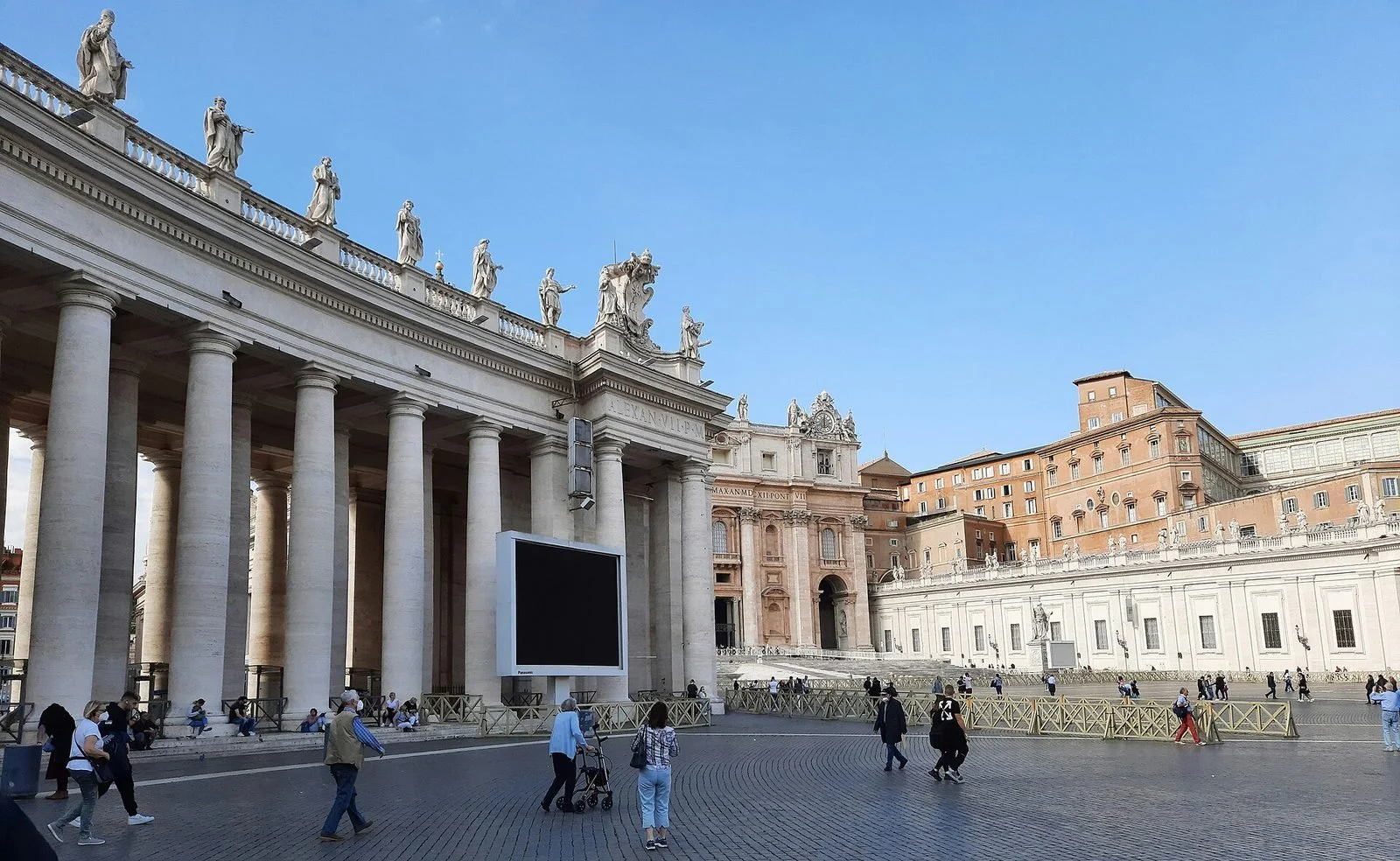
What to book ahead: the audience ticket, as soon as you know the dates. Pickup method and time are indicated in the confirmation. The security checks at the colonnade gates take time, so it’s best to arrive well in advance. In the square the wait is long and outdoors: a hat, water and a scarf for the shoulders make the difference. If the Wednesday doesn’t coincide with your pilgrimage, on Sunday at noon there is normally the Angelus from the window of the Apostolic Palace, with no ticket.
When the audience is over you enter St. Peter’s Basilica. The heart of the pilgrimage is under the papal altar: the confessio, which descends toward the apostle’s tomb. Inside, one hour is enough for the Pietà, the baldachin, the cathedra and a stop in the Blessed Sacrament chapel, reserved for those who pray. In the hours after the audience the line at the checks gets longer: allow for it. If you want to climb the dome or go down into the underground, there are the dome and underground visits on GetYourGuide.

After lunch, in the Borgo or Prati area, you go around the walls to the Vatican Museums: a quarter of an hour on foot. According to the Vatican Museums website they are open Monday to Saturday from 8:00 to 20:00, with last entry at 18:00, and closed on Sunday except the last one of the month. The route ends in the Sistine Chapel, where popes are elected: it’s the point where art and faith truly touch. You need three hours, a cautious estimate.
Timed tickets are bought on the official website. Alternatively there are the priority entries to the Vatican Museums on GetYourGuide and those on Tiqets.
On the evening of the first day of the pilgrimage you cross the Tiber at Ponte Sisto, half an hour’s walk, to the Santissima Trinità dei Pellegrini. The name says it all: it’s the church tied to the confraternity of Saint Philip Neri that in the 16th century welcomed the pilgrims of the Holy Years. Ending the first day here has a precise meaning. If you’re tired, what to skip: the Vatican Museums. The real pilgrimage is accomplished between the square and Peter’s tomb, and the museum can wait for another trip.
Day 2: from the Scala Santa to Santa Maria Maggiore
The second day of the pilgrimage is done all on foot, on a walk of about three kilometers. It’s an estimate, without detours. You start early at the Holy Stairs, San Giovanni stop on metro line A. According to the Sanctuary’s website
, the staircase opens Monday to Saturday at 6:00 and on Sunday at 7:00, with a break between 13:30 and 15:00, and you climb it only on your knees and in silence. Tradition identifies it with the staircase of Pilate’s praetorium, brought to Rome by Saint Helena.
At the top is the Sancta Sanctorum, the ancient private chapel of the popes, which can be visited for a fee: the Sanctuary’s website lists a full ticket of €3.50 and shorter hours, with Sunday morning closed. Climbing the staircase on your knees takes half an hour, depending on the crowd. If you have knee problems, assess it honestly before you begin.
Having crossed the square you enter the Basilica of St. John Lateran, the cathedral of Rome and the first of the papal basilicas in dignity: it’s the church of the Pope as bishop of the city. One hour is enough for the nave, the Cosmati cloister, if open, and the baptistery next door. From here, going down Via di San Giovanni in Laterano, in a quarter of an hour you reach San Clemente.
The Basilica of San Clemente is the stop that explains Rome better than a book: under the 12th-century church there is a 4th-century basilica, and below that Roman buildings and a mithraeum. Going down the levels means walking through the history of the first Christian community. The descent into the excavations is paid and has its own hours. The upper church, with the apse mosaic, can be visited freely. One hour, a comfortable estimate.
After lunch, between Monti and the Colle Oppio, you climb to San Pietro in Vincoli, 10 minutes uphill. Here are kept the chains that tradition attributes to Peter’s imprisonment, under the main altar, and Michelangelo’s Moses for the tomb of Julius II. Half an hour is enough. It’s the right way to tie the second day to the first: the apostle’s tomb yesterday, his chains today.
The last stop is Santa Maria Maggiore, a quarter of an hour on foot. It’s the oldest Marian church in Rome, with the 5th-century mosaics in the nave and the chapel of the icon of the Salus Populi Romani. Since April 2025 Pope Francis has been buried there, and his tomb has in turn become a pilgrimage destination: expect a short but constant line. Arriving in the late afternoon you often find the vespers prayer.
If you’re tired, what to skip: San Clemente. From St. John you can go to Santa Maria Maggiore directly along Via Merulana, on the flat, and stop at San Pietro in Vincoli only if you have energy left. For dinner the Monti area is a short walk away. You book with TheFork, or you choose on the Estate Romana restaurant map.
Day 3: the catacombs of the Appian Way and Paul’s tomb
On the third day the pilgrimage leaves the walls. You go by bus or taxi to the Appian Way Park, beyond Porta San Sebastiano: lines and times on the transit company’s website. The stretch of ancient road among the tombs, with the Roman paving stones still in place, is walked in half an hour to the catacomb entrance.
For the pilgrimage the Catacombs of San Callisto are the official cemetery of the Church of Rome in the 3rd century, with the crypt of the popes and that of Saint Cecilia. According to the catacombs’ website they open from 9:00 to 12:00 and from 14:00 to 17:00 and close on Wednesday: for this reason the third day cannot fall on a Wednesday. Visit methods and available languages are indicated on the website. Allow a good hour, as an estimate.
What to book ahead: with a group, the catacomb visit, on the official website. Those traveling alone or as a couple also find the visit to the Catacombs of San Callisto on GetYourGuide or the catacomb offers on Tiqets. If the dates don’t match, the nearby alternative is the Catacombs of Domitilla, with the same hours and closed on Tuesday, as their website indicates.
For those who have trouble walking, the Appian Way can also be seen well while seated. The alternatives are
the golf cart ride of the catacombs and the Appian Way, the one that combines the center and the catacombs and, for the fitter, the bike along the Appian Way and the aqueducts. Read the length, language and accessibility on the product page.
After lunch you go to the Basilica of St. Paul Outside the Walls, by taxi or bus. Those with strong legs can follow Via delle Sette Chiese, the historic stretch of the pilgrims’ route. The basilica stands on the tomb of the apostle of the Gentiles, visible under the altar. One hour, an hour and a half. From here the Basilica San Paolo stop on metro line B takes you back toward the center.
In the evening you get off at the Circo Massimo stop and climb the Aventine, 10 minutes on foot, to the Basilica of Santa Sabina. It’s a 5th-century basilica, almost intact, with a carved wooden portal that preserves one of the oldest depictions of the Crucifixion. Next to it is the Orange Garden, with the view of the dome of St. Peter’s: ending the pilgrimage by looking from afar at the place where it began has something fitting about it. If you’re tired, skip the Aventine and head back after St. Paul’s.
What not to put in a pilgrimage to Rome in 3 days
The contrarian position to take right away: in three days the full Seven Churches Pilgrimage doesn’t fit, if you want to do it properly. It’s the tradition made popular by Saint Philip Neri, a walk of about 20 kilometers in one day that touches the four papal basilicas plus San Lorenzo, Santa Croce and San Sebastiano. Squeezing it in between the audience and the catacombs means turning it into a taxi dash. This plan still touches five of them, in three days: in our view it’s the best way to experience them.
The second mistake is looking for the Holy Door. The 2025 Jubilee closed on January 6, 2026, when Pope Leo XIV closed the one at St. Peter’s. The Holy Doors stay closed until the next Holy Year, and many programs printed earlier don’t say so. The third is putting two catacombs on the same day: the second visit, after the first, adds nothing and takes away the time for St. Paul’s. Finally, the Sacro Speco of Subiaco is a wonderful destination but outside Rome: it’s worth a whole day, not an afternoon.
How to organize the pilgrimage, alone or in a group?
In the pilgrimage the fixed point is the calendar. The pilgrimage to Rome in 3 days works best from Wednesday to Friday: audience on the first day, the Catacombs of San Callisto open on the third. If you arrive at another time of the week, the second day moves freely and the third goes to Domitilla when San Callisto is closed. Mass times in the basilicas change often: look them up on each one’s website the week before.
For a parish or a group of friends the difference lies in three things: the audience tickets must be requested for everyone together and well in advance, the catacombs must be booked by group, and whoever celebrates in the basilicas must follow the sacristy’s procedures. For transfers from the airport, a transfer booked on Suntransfers avoids splitting the group between trains and taxis.
Quote for your group
For parishes, groups of friends, large families, schools or diocesan pilgrimages a custom plan is best, with tour escorts, audience reservations and catacombs handled in advance and, for explanations at the sites, licensed tour guides selected by the best tour operators and boutique agencies in Rome. Write the dates, the number of people and what you want to see: the quote is free.
Where to stay for this itinerary?
For a pilgrimage to Rome in 3 days the most convenient area is the one between St. Peter’s and Prati: the first day starts right outside your door and on the morning of the audience you don’t lose time on the metro. The second choice is the Esquiline, between Santa Maria Maggiore and St. John: the second day starts on foot and Termini is close for those arriving by train. Several religious houses offer hospitality to pilgrims, with their own rules on return times: ask for them before booking.
Avoid areas far from the metro, because in this plan you use it every day. To compare hotels and apartments in the two areas, with the free cancellation filter, there are Hotels.com and Booking.com.
How do you get around?
During the pilgrimage you move on foot within each area and by metro between one area and another. Line A serves the first day, with the Ottaviano stop, and the start of the second, with San Giovanni. Line B serves the third, with Basilica San Paolo and Circo Massimo. For the Appian Way you need buses or taxis: lines and times on the transit company’s website, which change on holidays. You don’t need a car and it creates problems, between restricted traffic zones and scarce parking.
To get here, high-speed trains stop at Termini and Tiburtina: times and fares can be compared on Trainline and on the website of Italo. The earlier you buy, the more choice is left on fares, especially for a group that has to travel together.
What to book before you leave?
For the pilgrimage you need four reservations, in this order. The free audience ticket, on the portal of the Prefecture of the Papal Household. The Vatican Museums, on the official website. The catacomb visit, essential for a group and recommended in busy periods. The hotel, with a cancellable rate. The basilicas, the Scala Santa and Santa Sabina don’t require booking for those who enter to pray or to visit in silence.
If you want an on-site explanation in the more complex places, St. Peter’s, the Vatican, the catacombs, you’ll find offers among the experiences in Rome on GetYourGuide and among the tickets for Rome attractions on Tiqets. Before buying, read the language, the length and who leads the visit on the product page.
What changes if it rains?
The pilgrimage to Rome in 3 days is among the plans that suffer least from rain: almost all the stops are indoors. The weak point is the audience in the square, which takes place even in bad weather: you need a light raincoat and a small umbrella, because big ones block the view of the people behind. On the third day, the Appian Way on foot gets slippery: go by taxi straight to the catacombs, which are underground and dry.
For days that call for more time indoors, ideas are collected in the sacred art section of Estate Romana. The events of your days are in all events.
What about one day more or less?
With a two-day pilgrimage you keep the first and the second, and of the catacombs only the wish remains. Or you add St. Paul’s to the second day, giving up San Clemente. With four days you add Trastevere, with the Basilica of Santa Cecilia, and the Catacombs of Priscilla on Via Salaria, with times on the operator’s website. With five days the trip to the Sacro Speco of Subiaco comes in, where Saint Benedict lived as a hermit. The other destinations outside the city are in the near Rome section.
What to bring for a three-day pilgrimage
A pilgrimage to Rome in 3 days means long waits on your feet, many kilometers on sampietrini and basilicas where shoulders and knees must be covered. What you need fits in a small backpack. For each item we list more than one search, because individual models sell out. Prices change constantly, so check them when you buy. For delivery, the estimated date at the time of the order is what counts, even if you have it shipped to the hotel.
To read
- Guides to Rome for the pilgrim: churches, prayers and the history of the holy places in a single volume.
- Books on the Seven Churches: to understand Saint Philip Neri’s tradition before walking a piece of it.
- Books on the catacombs of Rome: the evening before the third day, to arrive knowing what to look for.
- Pocket Gospel: light, for the moments of prayer at the apostles’ tombs.
To wear
- Comfortable walking shoes: already worn before you leave, with a sole that holds on wet ground too.
- Shoulder-covering scarf: bare shoulders are not allowed in the basilicas, and in your bag it weighs nothing.
- Foldable sun hat: for the wait at the audience and for the Appian Way, where there is little shade.
- Windproof folding umbrella: small, so it doesn’t block the view in the square.
For the day and for safety
- Insulated water bottle: Rome’s public fountains give good, free water.
- Anti-theft backpack: in the crush at the gates and on the metro it makes the difference.
- 10,000 mAh power bank: tickets, maps and photos drain the phone before evening.
- Travel notebook: to write down intentions, readings and memories of each day.
- Travel pillow: for the coach or the train, especially on the way back.
Experiences to add
- Capuchin Crypt and catacombs with transfers: useful for those who don’t want to think about getting to the Appian Way.
- Rome by night in a golf cart: to see the illuminated basilicas without more kilometers on foot.
- Experiences in Rome on Viator: a second catalog to compare for dates and languages.
Frequently asked questions
How much does it cost to attend the Pope’s audience?
Nothing: the ticket for the general audience is always free, as the Holy See states. You request it on the portal of the Prefecture of the Papal Household, giving the date and the number of people. Whoever offers it for a fee is selling an added service, like transport or explanation, not the seat. The audience is normally held on Wednesday, barring the Pope’s other commitments.
Can you still pass through the Holy Door?
No: the 2025 Jubilee closed on January 6, 2026 with the closing of the Holy Door of St. Peter’s, and the Holy Doors of the papal basilicas stay closed until the next Holy Year. The basilicas are visited normally, through the main entrance. A pilgrimage to Rome to the apostles’ tombs doesn’t depend on the Jubilee and can be made at any time of the year.
What is the best day to start the pilgrimage?
Wednesday, if you want the audience on the first day. That way the second falls on Thursday and the third on Friday, when the Catacombs of San Callisto are open. If you arrive on Sunday, at noon there is normally the Angelus in the square, but the Vatican Museums are closed, except the last Sunday of the month: move them to another day.
What is the dress code in the basilicas?
Shoulders and knees covered, for everyone. At the gates of St. Peter’s the check is strict and whoever doesn’t follow the rule can be stopped, even after a long line. A scarf in your bag and pants or skirts below the knee solve the problem. In the catacombs the temperature is cool all year: a light sweater is needed even in summer.
Is the pilgrimage good for older people?
Yes, with some adjustments. The second day gets shorter by skipping San Clemente, the third is done by taxi or golf cart to the catacombs. The Scala Santa, which is climbed only on your knees, can be left to those who can manage it. The audience waits are the most tiring part: for those who can’t handle hours on their feet, the Sunday Angelus is a shorter alternative.
Can you celebrate Mass with your own group during the pilgrimage?
Yes, but it has to be requested first, following the procedures of each basilica. For papal celebrations the concelebrating priests follow a dedicated channel, indicated on the Holy See’s website. For a group Mass at a side altar of St. Peter’s or another basilica, you write to the sacristy well in advance, giving the date, the number of people and the celebrant.
How does “Save this itinerary” work?
The button under the table opens Estate Romana’s “My Trip” with the 14 stops already divided into the three days. From there you enter the dates, mark the bookings made, add or remove places and send the plan to whoever is traveling with you. You don’t need an account: the trip stays saved on the device you’re using.
Who wrote this and from which sources
The text comes from the editorial team of Tour Leader Pro, the Rome-based outfit that designs itineraries, visits and cultural events across Rome and Lazio. Audiences, hours and closings come from the websites of the Holy See, the Vatican Museums, the Catacombs of San Callisto and of Domitilla and the Sanctuary of the Scala Santa, on the date indicated at the start. Visit times and distances are estimates. Tell us what you find changed.
Organizing a three-day pilgrimage, for yourself or for a group of friends, means fitting together an audience ticket, the weekly closings of the catacombs and the pace of whoever walks slowest: a useful resource for people organizing group trips is Tour Leader Pro. If Rome is only the first stage of a longer journey, toward Subiaco, Assisi or the sanctuaries of Lazio, a useful resource for putting together a multi-day itinerary is Italy Planner.