Il non finito at the Capitoline Museums, the Unfinished Paintings of the Pinacoteca
In short. Il non finito: fra poetica e tecnica esecutiva is the exhibition that the Capitoline Museums devote to the unfinished paintings kept in the Pinacoteca Capitolina.
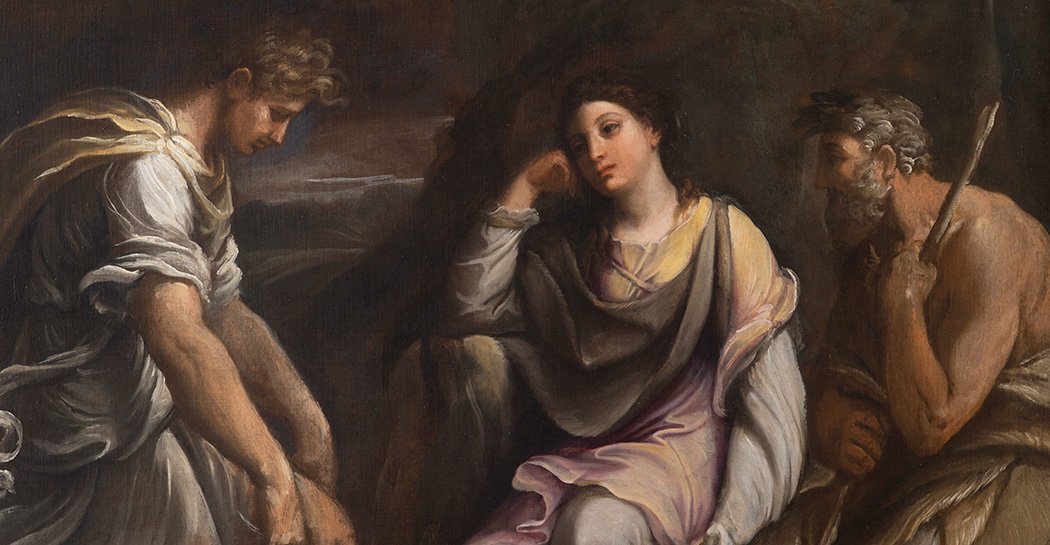
Il non finito: fra poetica e tecnica esecutiva is the exhibition that the Capitoline Museums devote to the unfinished paintings kept in the Pinacoteca Capitolina. It is held in the rooms of the Pinacoteca, inside the ordinary museum route in Piazza del Capitoline Hill, and is open from January 15, 2026 to January 4, 2027, after an extension of the deadline initially set in spring. Anyone reading these lines in September 2026 therefore arrives with the exhibition open, with almost four months of margin ahead. The ticket is the regular admission to the Capitoline Museums: no separate ticket is needed, and this changes quite a lot the way the visit is best organized.

There is a precise moment, in certain paintings, when painting stops being an image and goes back to being work. It happens when a painting was left unfinished: a hand barely sketched next to a polished face, a background that stays brown and empty, a figure dashed off in broad brushstrokes while the one beside it already has the smooth skin of finished portraits. In that moment you see the workshop. You see the order in which the painter proceeded, which parts he considered urgent and which he postponed, where he put thick color and where he let the preparation breathe. The Pinacoteca Capitolina keeps a small group of works of this kind, generally passed through absentmindedly by those running toward the famous pieces, and the exhibition builds around them a route that puts them back at the center.
The approach is not only art historical. The project was born from the meeting between an art historian and a specialist in scientific diagnostics, and the result shows: next to the canvases there are images obtained with non-invasive techniques, that is analyses that read the painting without touching it and without taking samples. Infrared reflectography for the underdrawing, X-ray for the deep layers and the second thoughts, ultraviolet fluorescence for varnishes and restorations, X-ray fluorescence spectroscopy for mapping the chemical elements present in the pigments. Lined up, these images tell the painting as a stratigraphy. And when the painting is unfinished, the stratigraphy becomes legible even to the naked eye, because the upper layers that normally cover everything else are missing.
What the exhibition is and where it is held
The official title is Il non finito: fra poetica e tecnica esecutiva. The venue is the Pinacoteca Capitolina, inside the Capitoline Museums, at Piazza del Campidoglio 1. The rooms of the Pinacoteca occupy the upper floor of the Palazzo dei Conservatori, the palace that closes the right side of the square for those climbing from the Cordonata. It is therefore not an exhibition set up in a separate space with its own entrance, as happens for the big temporary exhibitions hosted in the wing of Palazzo Caffarelli: here the intervention takes place inside the permanent collection, among the paintings that live in the Pinacoteca all year.
The dates are January 15, 2026 as opening and January 4, 2027 as closing. The second date is the result of an extension: the initial calendar foresaw a much shorter run, closing in the spring of 2026, and the extension to the start of 2027 came afterward. In the system of Roman civic museums extensions are not a bureaucratic automatism, and when they come they almost always signal two things together, a public response above expectations and a display that creates no conservation problems for the works involved. In the case of the non finito the second condition is particularly easy to meet, because almost all the paintings on display already belong to the Pinacoteca and do not require return to lenders by a contractual deadline.
The curatorship is entrusted to Costanza Barbieri, of the Academy of Fine Arts of Rome, and Claudio Seccaroni, of ENEA. It is a pairing that says a lot about the project: on one side art history with its attention to poetics and context, on the other physics applied to cultural heritage with its attention to materials and sequences of execution. The exhibition was born within the EAR project, short for Enacting Artistic Research, funded with money from the National Recovery and Resilience Plan under NextGenerationEU, and brings together academies and research institutes around the theme of the creative process. The catalog is published by Artemide Edizioni.
On the practical side, the point that matters most is that admission to the exhibition is included in the Capitoline Museums ticket. There is no separate ticket, no dedicated line, no booking for a specific time slot for the non finito route. Whoever enters the museum enters here too. This has a consequence that many visitors don't take into account: the exhibition has no concentrated flow of its own, and so the rooms of the Pinacoteca are crowded or empty exactly as they would be on any ordinary day, following the general rhythm of the museum. In practical terms, the time you enter the museum determines everything.
What non finito means in painting
The term deserves to be handled with care, because very different situations end up under the same label. It is worth separating them, because the exhibition route passes through all of them and without this distinction you risk reading every unfinished canvas as if it were the same story.
Non finito by interruption
This is the most obvious and most frequent case. The painter dies, falls ill, changes city, quarrels with the patron, or the patron stops paying and the work stops. The painting stays in the state it was in that day. There is no aesthetic intention behind it, only a biographical or contractual accident. These are the most precious works for anyone studying technique, because they photograph an ordinary moment of the process, without staging choices: what you see is exactly what the painter was doing.
Non finito by critical abandonment
Different is the case of the painting that the painter decides not to complete because it doesn't work. It happens more often than you would think. A composition turns out wrong, a figure doesn't hold up, a patron changes his mind halfway and the canvas is set aside with the idea of taking it up again and then it never is. Here reflectography becomes precious, because it shows the second thoughts: arms moved, heads turned, figures removed, outlines redrawn several times. The abandoned painting preserves the moment when the problem became unsolvable.
Non finito as a choice, that is poetics
The third case is the most debated. There is a tradition, going back at least to the 1500s and running through the whole later history of art, according to which a work deliberately left suspended has a force that the finished work loses. The most cited ancient model is the report, handed down by classical sources, that the works left unfinished by the great painters of antiquity were admired more than the completed ones, because in them one saw the lines of the artist's thought. In the Italian Renaissance this idea becomes a topic of discussion among insiders, and Michelangelo's sculpture is its most famous version: the Prisoners emerging halfway out of the block of marble have defined for centuries the very image of the non finito.
In painting the question is more elusive, because a canvas left half done is hard to tell apart from a canvas interrupted by chance. The difference between intention and accident, in many cases, cannot be demonstrated. It is one of the reasons an exhibition like this one needs diagnostics: the scientific images don't solve the problem of the artist's will, but they narrow the field of hypotheses, because they make it possible to understand if the painting was built with the typical sequence of a planned work or with that of a quick trial.
The bozzetto, which is something else again
A bozzetto is not an unfinished painting: it is a finished work belonging to a different category. It serves to fix an idea, to show it to the patron, to organize the composition before the large canvas. It has its own rules, reduced format, quick execution, color laid on in a synthetic way. Confusing it with the non finito is a common mistake, and since the Pinacoteca keeps both bozzetti and interrupted works, the exhibition has the chance to put them side by side and show the difference. A bozzetto has an internal completeness of its own even when it is sketchy. An interrupted painting instead has parts at different stages of work, and it is precisely this unevenness that is its distinguishing mark.
The work sequence that the non finito makes visible
Oil painting on canvas, in the Italian 1500s and 1600s, follows a fairly constant order. First the preparation of the support, that is the laying of a colored ground layer, often reddish brown or gray, which serves to even out absorption and to give a middle tone to build on. Then the drawing, traced with a thin brush or with dry material, which in the finished painting disappears under the color and which infrared reflectography finds again. Then the sketching of the masses, with colors laid on broadly to fix lights and shadows. Then the glazes and the finishing touches, that is the thin and transparent layers that give depth to flesh tones and fabrics. Finally the details: eyelashes, reflections, jewels, blades of grass.
In an unfinished painting this sequence reads like a geological section. There are zones stopped at the ground, zones stopped at the drawing, zones sketched and zones finished. And since painters didn't work uniformly across the surface but by priority, the non finito also reveals the order of priorities: almost always faces and hands first, because they are the parts the patron looks at, and draperies or backgrounds last, because they were often entrusted to the workshop.
What the analyses see
The techniques used in the project each have a precise field of application, and it's good to know it in order to read the panels in the exhibition without getting lost.
Infrared reflectography exploits the fact that some infrared wavelengths pass through the layers of color and are absorbed by carbon-based materials. Since the preparatory drawing was often traced with charcoal, lamp black or carbon-based inks, the image gives back the drawing under the paint. It serves to see second thoughts, transfer lines, the squaring grids used to enlarge a drawing onto canvas.
X-ray passes through the whole thickness of the work and gives back an image tied to the density of materials. Lead-based pigments, like lead white, turn out very opaque and therefore light on the plate. The result highlights the construction of the lights and the structure of the support, that is the weave of the canvas, the seams, the nails, any patches and old linings.
X-ray fluorescence spectroscopy, in its scanning version, produces distribution maps of the chemical elements present in the painting. It allows you to say where the copper is, where the lead, where the mercury, and from this data you work back with good approximation to the pigments used, because each historical pigment has a recognizable elemental signature. It is the technique that has changed the work of the last 20 years the most, because it makes it possible to read the palette without taking samples.
None of these techniques produces automatic truths. They produce images that must be interpreted, and the interpretation remains work of comparing physical data with historical knowledge. When the panels of a scientific exhibition present a conclusion, that conclusion is always the arrival point of a discussion, not an objective datum fallen from the sky. It is worth keeping in mind while looking at the reflectographs hung next to the paintings.
A curiosity about Il non finito at the Capitoline Museums, the Unfinished Paintings of the Pinacoteca
The curiosity concerns how the exhibition was extended. The route was born with a short duration, as a study display: opening in mid-January 2026 and closing in spring, the time to accompany the publication of the research results and then put the rooms back as they were. The calendar was then extended to January 4, 2027, that is almost a whole year. For an exhibition that has no ticket of its own and therefore brings no additional direct revenue, an extension of this size means only one thing: the public passes through, stops to read, and the museum registered the change in visitor behavior inside the Pinacoteca.
There is a second curious element, less visible. The works on display were already there. Most of the work did not consist of bringing paintings in from outside, but of reorganizing and re-installing what the museum owns, placing the diagnostic images beside the canvases. It is an exhibition model that costs little, involves no transport risks and enhances the home heritage. In the season of big exhibitions built on international loans, a project that looks inside its own storage is almost a countercurrent gesture. And it works precisely because the theme requires it: to talk about the creative process you need works that the museum can keep under instrumentation for months, impossible with a loan that expires.
What you see in the exhibition
The core of the exhibition is a small group of paintings from the Pinacoteca, accompanied by the images obtained with the analyses and by digital frames that show the underlying drawing and the elemental maps next to the original. The limited number of works is a choice, not a limit: a route about the process of execution requires long reading times on each piece, and a parade of 50 paintings would make the comparison between painting and scientific image impossible.
Guido Reni, the largest group
The most substantial part concerns Guido Reni, the Bolognese painter whom the Pinacoteca Capitolina keeps in significant quantity. Among the works involved are Silvio, Dorinda and Linco, the Blessed Soul in the double version of bozzetto and canvas, a Jesus and the Young Saint John, a Penitent Magdalene, a Lucretia and a Cleopatra.
Reni is an almost perfect case for a discussion of the non finito, for reasons that concern his way of working and his critical fortunes. Reni's late manner, that of the 1640s, proceeds by increasingly sparse applications on light grounds, with flesh tones of an almost absent lightness and draperies barely hinted at. Many contemporaries judged it hasty painting, perhaps tied to the painter's financial difficulties and the need to deliver quickly. Others, already then, recognized in it the outcome of a search on light and on the dematerialization of figures. The discussion is not closed even today: in front of a late, sparse Reni canvas, deciding if it is an interrupted work, a work delivered in a state the painter considered complete, or an intended result of lightness remains a critical judgment more than a finding. The analyses help to understand which layers are missing, but they don't say if anyone intended to lay them on.
On Lucretia, Cleopatra and Penitent Magdalene a further clarification is worth making. These are subjects that Reni and his workshop replicated in several versions, in great demand on the market of the time, and the specialist literature has discussed for decades which versions are entirely autograph, which the result of collaboration with assistants and which workshop replicas. The scholars' positions diverge, and not on a marginal detail: the very way of reading the painting changes. Anyone looking at these canvases in the exhibition would do well to consider the labels as the current state of a discussion, not as a final verdict.
Jacopo Palma il Vecchio, Christ and the Adulteress
The painting is traced back to the last years of the Venetian painter's activity, around the second half of the 1520s, and its unfinished condition is tied to the artist's death, which occurred in 1528. It is a classic case of biographical interruption: the canvas stays in the state in which the work stopped. For those who study Venetian painting it is a precious document, because the Venetian method built the image directly with color more than with preliminary drawing, and seeing a Venetian canvas stopped halfway makes it possible to verify how far that description, repeated in every textbook, really matches what happens on the surface.
Benvenuto Tisi called Garofalo, Circumcision
The Ferrarese painter, active between Ferrara and Rome in the first half of the 1500s, is the author of the other major unfinished work in the route. Garofalo has an interesting story for the theme: in the last years of his life he progressively lost his sight, and this brings into the discussion of the non finito a physical variable that usually stays implicit. A painter who loses his sight doesn't abandon a painting by poetic choice or because of a quarrel with the patron: he leaves it because the body stops responding. It is the most concrete reminder that the non finito, before being an aesthetic category, is almost always a matter of human lives that are interrupted.
Ludovico Carracci, Portrait of a Youth
The fourth name is that of Ludovico Carracci, the eldest of the three Carracci who in Bologna, at the end of the 1500s, reformed Italian painting by putting study from life back at the center. An unfinished portrait from the Carracci sphere is particularly useful in a route like this, because the Bolognese reform was founded precisely on drawing and on the practice of study, and a portrait left half done shows the passage from study from nature to the construction of the painting. Here too critics have discussed the attribution among the members of the family and their circle, as often happens for Carracci works neither signed nor documented.
The scientific images next to the paintings
The perhaps most surprising part of the route is not the paintings but their doubles. Each work is flanked by the diagnostic shots, presented on digital supports that let you compare the visible image with the infrared one, with the X-ray and with the chemical maps. The effect is that of a second painting hidden inside the first. In the reflectographs there often appear lines that in the final painting no longer exist: a hand placed in a different spot, a profile shifted by a few centimeters, a figure removed altogether. Anyone who has never seen a reflectograph in person, in front of a painting they know, feels a sense of disorientation that is worth the visit on its own.
A warning is in order, though, which anyone used to these images confirms. Reflectographs and X-rays are only partly legible, and they are full of noise: canvas weaves, old fillings, nails, cracks, lining marks. The human brain is very good at recognizing figures where there are none, and fanciful readings of X-rays have produced over the years a fair number of discoveries later withdrawn. The panels of a serious exhibition indicate what is seen with reasonable certainty and leave the rest on the level of hypothesis.
Something nobody tells you about Il non finito at the Capitoline Museums, the Unfinished Paintings of the Pinacoteca
What nobody says is that the non finito, in the history of museums, was for a long time a problem to hide more than a heritage to display. Throughout the 19th century and a good part of the 20th, unfinished paintings ended up in storage, or were hung in passage rooms, in corridors, above doors, in the spots where nobody stops. In some worse cases they were completed, that is a restorer laid on the missing color to make the work presentable. These are interventions that today are recognized with ultraviolet fluorescence and that pose a serious problem: a canvas finished by a stranger's hand two centuries later is no longer a document of the original process.
The second element rarely mentioned concerns the relationship between non finito and attribution. An unfinished painting is harder to attribute than a finished one, because the very surface signs that scholars use as a signature are missing: the way of rendering eyelashes, the reflections in the eyes, the edges of draperies. On a sketch what remains is the construction of the composition and the way of laying the first masses, more generic elements and more easily shared within a workshop. Hence the practical rule that holds for almost all European collections: groups of unfinished works have more eventful attribution histories than average, with changes of name over the decades. An exhibition that shows unfinished paintings therefore shows, implicitly, also the limits of knowledge about those paintings. And it is to its credit that it does so openly, instead of flattening everything onto reassuring labels.
The third element is the most practical and the least noble: diagnostics cost money. Reflectographs, X-rays and chemical mapping require instrumentation, specialized staff and machine time. A civic museum doesn't normally have an ordinary budget for campaigns of this kind on a large scale, and that is why similar projects are almost always born attached to funding dedicated to research. Here the funding comes from the National Recovery and Resilience Plan through a project that involves academies and scientific institutes. Put directly, without that channel these images would not exist, and the paintings would continue to be looked at only from the outside.
The Pinacoteca Capitolina
The Pinacoteca Capitolina is the painting collection of the Capitoline Museums and occupies the upper floor of the Palazzo dei Conservatori. Its birth goes back to the mid-1700s, when Pope Benedict XIV bought two large private Roman collections to assign them to the Campidoglio. It is one of the founding moments of the modern public museum, because the logic of the operation was not to enrich a papal residence but to build a collection accessible and tied to the civic institution.
The collection covers mostly Italian painting between the 1400s and the 1700s, with substantial groups from the Bolognese, Venetian, Roman and Emilian schools. Among the best-known pieces the public looks for are works by Caravaggio, Pietro da Cortona's large canvas of the Rape of the Sabine Women, the works of Guercino, Titian, Rubens, Tintoretto, as well as an important group of portraits. The rooms also keep the Sala di Santa Petronilla, named after the monumental altarpiece by Guercino that came from St. Peter's Basilica, and the section devoted to the porcelain collection.
Why the Pinacoteca is often skipped
There is an architectural reason and a reason of fatigue. The architectural reason is that the Pinacoteca is at the end of the classic route: whoever enters from the Palazzo dei Conservatori passes through the historic apartments, the Hall of the Horatii and Curiatii, the Capitoline Wolf, the Exedra of Marcus Aurelius, then goes down to the Tabularium and back up to Palazzo Nuovo, and only after, or before if they decide to reverse it, tackles the picture rooms. The reason of fatigue is that the Capitoline Museums require at least two and a half hours of attention, and ancient sculpture is tiring: after two hours the ability to look at a painting drops sharply.
My advice for visiting Il non finito at the Capitoline Museums, the Unfinished Paintings of the Pinacoteca
The advice is only one and goes against almost everyone's habit: enter at opening and go straight up to the Pinacoteca, before anything else. The Capitoline Museums open at 9:30. In the first 40 minutes the flow is concentrated on the ground floor and the courtyard, because everybody photographs the fragments of the Colossus of Constantine and then goes up toward the Wolf. Anyone who heads straight for the upper floor finds the picture rooms practically empty, and for a route that requires comparing back and forth the painting with its reflectograph this condition is worth more than any other precaution. A quarter of an hour in an empty room in front of a Reni canvas yields more than an hour in the middle of the crowd.
The second piece of advice concerns the method of observation. In front of each unfinished work it's best to proceed in three steps. First step: look only at the painting, without reading anything, and look by eye for the zones at different stages of work, that is ask yourself which part is finished and which isn't. Second step: read the panel and look at the diagnostic images. Third step: go back to the painting and check if what the images say can also be found with the naked eye, perhaps moving sideways to catch the light at a slant. The third step is the one almost nobody does and it is the one that really makes you understand something, because it teaches you to see the thickness of the color and the direction of the brushstrokes.
Third piece of advice, of a practical nature: raking light. In the rooms of the Pinacoteca some works receive natural light from the windows and others are lit artificially. Moving one meter from the frontal position, the layer of color reveals the relief of the brushstroke, the cracks and the zones where the preparation comes through. It is a banal gesture that transforms the visit, and it holds for every picture gallery in the world.
Fifth piece of advice, for those who live in Rome: the MIC card completely changes the relationship with this museum. With unlimited admission to the civic museums it becomes possible to climb to the Campidoglio for half an hour, look at three paintings and leave, which is the right way to frequent a picture gallery and the opposite of the single three-hour visit. For an exhibition like this one, which rewards returning, the difference is enormous.
The Capitoline Museums as a venue
The Capitoline Museums are considered the oldest public museum in the world. The conventional birth date is 1471, when Pope Sixtus IV donated to the Roman people a group of ancient bronzes by placing them on the Capitoline hill. From that core, enlarged over the following centuries, the present collection derives, spread over three buildings facing the square: the Palazzo dei Conservatori on the right going up, Palazzo Nuovo on the left and the Palazzo Senatorio in the center, which is the seat of the City of Rome and under which is the Tabularium, the ancient Roman state archive overlooking the Forum.
The square is the work of Michelangelo, who starting in the 1530s redesigned the whole layout of the hill: the paving with the star design, the facades of the side palaces with the giant order, the Capitoline Cordonata that climbs gently from Piazza Venezia. One detail that explains all the rest: the square turns its back on the Roman Forum and looks toward St. Peter's. It is a choice of political orientation, not of urban convenience, and it tells the story of the 16th-century Campidoglio as a point of balance between civic power and papal power.
What the museum contains besides the Pinacoteca
The minimum list includes the Capitoline Wolf, the Spinario, the Capitoline Brutus, the Dying Gaul, the Capitoline Venus, the gilded bronze equestrian statue of Marcus Aurelius displayed in the Exedra, the colossal fragments of the statue of Constantine in the courtyard, the rooms of the Conservatori apartments with the fresco cycles, the Castellani collection, the section of the temple of Jupiter Capitolinus under Palazzo Caffarelli and the panoramic terrace of the Caffarelli wing. It is a quantity of material that makes a single exhaustive visit difficult, and it is the reason Romans who know the museum go back to it in installments.
The other exhibitions on the calendar in the same period
In the period when the non finito route stays open, other exhibitions have overlapped at the Capitolini: Angels, devoted to angelic figures from the ancient to the contemporary, the big exhibition on Diego Rivera and 20th-century Mexican art, the reconstruction of the Colossus of Constantine in the garden of Villa Caffarelli and the long-term route on the colored marbles of the Santarelli collection. In the wing of Palazzo Caffarelli the exhibition on Vasari and Rome was also held until early September 2026. The combination makes the Capitolini, this season, the Roman museum with the busiest calendar, and it's best to check what is included in the ticket before buying it.
Tickets and access
The data that follow are those published by the museum. The fares of the Capitoline Museums change with a certain frequency, because they are recalculated according to the temporary exhibitions included in the route: they should be reread on the official site before leaving, especially at the turn between one exhibition and another.
Address, hours and closures
The address is Piazza del Campidoglio 1, 00186 Roma. The ordinary hours are every day from 9:30 to 19:30, with last entry one hour before closing. On December 24 and 31 the opening is shortened, from 9:30 to 14:00. The annual closing days are two, May 1 and December 25. The reference switchboard is 060608, active every day from 9:00 to 19:00.
Fares
The Capitoline fare system has two levels: the ordinary one, valid when no paid exhibitions are included in the route, and the increased one of periods with a temporary exhibition included. The ordinary fares for the museum alone are €15.00 full price and €9.50 reduced. The Capitolini Card, valid for seven days and including admission to the Capitoline Museums and to the Centrale Montemartini, costs €15.50 full price and €11.50 reduced: half a euro more than the base fare to get in addition a second museum and seven days of validity.
In the periods with the Angels exhibition included in the route, the ticket for non-residents was set at €16.50 full price and €11.00 reduced. The Diego Rivera exhibition has instead a separate ticket, at €15.00 full and €13.00 reduced, and there is a combined ticket that includes the museum and the exhibitions at €23.50 full and €19.50 reduced. Residents of Rome and the Metropolitan City enter free by showing an ID, and the same goes for holders of a valid MIC card and for the free-admission categories provided by municipal regulations.
The non finito route, as said, doesn't require an additional ticket: whoever enters the Capitoline Museums with any valid ticket finds it included. For those who live in the city this means admission at no cost, and I say it with a certain insistence because the share of Romans who don't use their free admission remains very high.
Advance booking and services
The advance booking fee is €1.00. Purchase can be made online, through the 060608 call center or directly at the ticket office. A rule that the site spells out without ambiguity: tickets bought in advance online, through the call center or at the ticket office are non-refundable and cannot be changed. It means that a date and time chosen in advance must be respected and that an unforeseen event gives no right to move the visit. Anyone not sure of their plans does better to buy on site, all the more since the Capitolini rarely sell out as happens at the Colosseum or the Vatican Museums.
How to get there
The Campidoglio is reached on foot from Piazza Venezia in three minutes, climbing the Capitoline Cordonata. The most useful metro stop is Colosseo on line B, from which you climb back up Via dei Fori Imperiali in 12 or 15 minutes of flat and very scenic walking. Alternatively you use the bus network that converges on Piazza Venezia, the best-served surface hub of the historic center. By car the story is simple: it's not worth it. The area falls within the limited traffic zone of the historic center and surface parking is practically nonexistent. Whoever arrives from outside the city parks at a metro terminus and finishes the trip by train.
Another well-known fact, yet rarely mentioned
The well-known fact is that the Capitoline Museums were born in 1471 from the donation of ancient bronzes made by Pope Sixtus IV to the Roman people, and that for this reason they are described as the oldest public museum in the world. The part almost nobody adds concerns the political meaning of that gesture: giving back to the people of Rome the symbols of their antiquity meant recognizing the Campidoglio's role as civic seat, in opposition to the Vatican as seat of papal power. The donated bronzes were not neutral objects. Among them was the Wolf, which is the very symbol of the city, and the colossal fragments of the statue of Constantine, that is the emperor who had tied Rome to Christianity.
There is, however, a second fact equally well known and equally little explored, which concerns painting itself and is pertinent to the theme. The Pinacoteca was born three centuries later, in the mid-1700s, by public purchase of private collections, and its constitution answers a precise concern of the time: preventing the great Roman collections from being broken up and sold abroad. It was already then a political problem. When today one wonders why a civic picture gallery keeps so many heterogeneous works, including unfinished canvases and workshop material, the answer is in that origin: it is not a collection built by selection, it is a collection built by rescue. And rescue collections take everything in, even what an ideal museum choice would have discarded. The non finito on display today at the Campidoglio came all the way here for exactly this reason.
Accessibility
The museum publishes a page dedicated to accessibility and the information that follows is the official one. Admission is free for people with disabilities and for a family member or other companion, free admission recognized across the whole network of Roman civic museums.
In terms of mobility the complex has elevators, stairlifts and ramps, which make it possible to overcome the main level differences of the route. In a museum carved out of three historic palaces connected to one another, there are many level differences, and the museum itself notes that the structure of the buildings in some places limits the complete removal of barriers: some rooms may be harder to access, and it's best to check the situation on the day in advance. The notices page of the site reports temporary limitations, for example elevators out of service for maintenance or closed rooms, and it is the first thing to read for anyone organizing a visit with specific needs.
For blind and partially sighted visitors, permanent tactile aids are available that allow direct exploration of some of the main works, accompanied by dedicated educational programs. In connection with the non finito route, the museum made a three-dimensional model of Guido Reni's Blessed Soul, designed for tactile exploration. It is a choice coherent with the theme, because translating a painting into relief means deciding which elements of the composition are structural and which accessory, that is doing in a practical way the same operation the painter does when he establishes the order of work.
For deaf visitors the museum has produced video guides in Italian Sign Language: a video route on the museum as a whole, a presentation of the history of the Campidoglio viewable on an interactive touchscreen station and an integrated video guide devoted specifically to the Pinacoteca, therefore useful for those who concentrate on the painting rooms.
A practical observation that comes from field experience and not from the site: the arrival at the museum, and not only the route inside, has to be planned. The Cordonata Capitolina is a ramp of low, long steps, passable but tiring with a hand-pushed wheelchair. Anyone with mobility problems should find out in advance about alternative access by calling 060608 before showing up, because the logistics of the hill are complex and a solution agreed in advance avoids a problematic arrival. It also holds for those accompanying elderly people: the climb to the Campidoglio is not trivial.
The right photo to take at Il non finito at the Capitoline Museums, the Unfinished Paintings of the Pinacoteca
In the rooms of the Pinacoteca photography is allowed without flash and without a tripod, as in almost the whole Capitoline route, but the frontal photograph of a painting is useless: there are better reproductions than any amateur shot. The photo worth taking is another one, and it is the one from the side. Stand to the side of the unfinished canvas, find the angle where the light comes in raking, and photograph the surface instead of the image. What comes out is the relief of the material: the thick brushstrokes of the sketched zones, the thin color of the finished zones, the canvas showing through where the preparation was left bare. It is a photograph that no catalog publishes and that tells the painting much better than the official reproduction.
Outside the rooms, the Campidoglio offers three classic shots and one less frequented. The three classics are the square seen from the top of the Cordonata with the paving design highlighted, the equestrian statue in the center with the Michelangelo facades behind it, and the colossal fragments of Constantine in the courtyard of the Palazzo dei Conservatori, where the hand with the index finger pointing up always works. The fourth, the one few people take, is the view from the Tabularium over the Roman Forum: the ancient arches make a natural frame and in late afternoon the light comes in from the right and lights up the columns of the Temple of Saturn. For the square, instead, the best time is first thing in the morning, when the low sun crosses the colonnade and the tourists haven't yet filled the space.
Some important events that happened here in history
In the archaic age and then throughout the Republican and imperial era, the southern summit of the hill housed the temple of Jupiter Optimus Maximus Capitolinus, the most important sanctuary of the Roman state. Its foundations in cappellaccio, the volcanic stone of the first centuries of Rome, can still be seen in the rooms under Palazzo Caffarelli, inside the museum route. The triumphal processions that climbed Via Sacra from the Forum arrived there.
On the other summit of the hill stood the temple of Juno Moneta, next to which was the mint: the word money derives from that place, and it is one of the most concrete etymologies Italian has. Today on the area stands the basilica of Santa Maria in Aracoeli, with its very steep staircase that climbs parallel to the Cordonata.
In the Middle Ages the Campidoglio becomes the seat of the city government. In 1143 the rebirth of the Roman Senate installs the communal institution here, and since then the hill has remained without interruption the center of civic administration: the Palazzo Senatorio, today the seat of the City of Rome, is the direct heir of that story. In 1341 Francesco Petrarca was crowned poet on the Campidoglio, a ceremony that consciously revived the ancient model and marks one of the founding moments of Humanism.
In 1471 Sixtus IV donates the bronzes to the Roman people: it is the birth certificate of the museum. In 1538 the equestrian statue of Marcus Aurelius is moved to the Campidoglio from the Lateran, and it is the occasion that leads Michelangelo to redesign the square. Michelangelo's building site proceeds slowly and is completed long after the artist's death, but the design remains his, including the star-shaped paving built only in the 20th century from his plans.
In the 20th century the hill was at the center of two heavy urban transformations: the construction of the monument to Vittorio Emanuele II, today the Altar of the Fatherland, which wiped out an entire sector of medieval buildings on the northern flank, and the opening of Via dei Fori Imperiali in the 1930s. Finally, on March 25, 1957, in the Hall of the Horatii and Curiatii of the Palazzo dei Conservatori the Treaties of Rome are signed, the act that gives rise to the European Economic Community. That room is part of the visit route: whoever enters the Capitolini passes through it, often without knowing.
Who has passed through Il non finito at the Capitoline Museums, the Unfinished Paintings of the Pinacoteca
For the public of a single exhibition there are no public lists of illustrious visitors, and inventing them would be as easy as it is pointless. It makes more sense to look at who has passed, in the proper sense, through the rooms of the Pinacoteca and the Campidoglio, because the list is long and surprising.
Through the Pinacoteca have passed the painters themselves. The Capitoline collections worked for two centuries as a training ground for artists in training: copying the great masters was a required part of apprenticeship, and the picture rooms were frequented by academy students with portable easels. The fact that today the exhibition comes from a collaboration with the Academy of Fine Arts of Rome closes a circle that has lasted a very long time.
Through the hill have passed the travelers of the Grand Tour, who climbed to the Campidoglio as a required stop: Goethe, who spent decisive months in Rome, Stendhal, who wrote memorable pages about the Campidoglio, the northern painters who drew the ruins of the Forum from the Tabularium. Before them, in the Renaissance, the hill was a destination for draftsmen of antiquities, the same ones who filled notebooks that today are in the libraries of half of Europe.
What's around the Campidoglio
The Campidoglio is surrounded by a density of things to see that has no equal, and it's good to know in advance what to choose so as not to turn the day into a march.
On the hill itself
The basilica of Santa Maria in Aracoeli is reached by the monumental staircase next to the Cordonata or, with much less effort, by a side passage that starts from the square: the second option saves more than 100 steps. Inside are reused columns all different from one another, a Cosmatesque floor and the Bufalini Chapel frescoed by Pinturicchio. It is a free place and almost always quiet.
A few minutes on foot
The Altar of the Fatherland occupies the northern flank of the hill and includes the Central Museum of the Risorgimento. The panoramic elevator takes you to the highest terrace in the center, from which you see the Campidoglio from the only point that reveals its whole geometry. The Trajan's Markets are reached in five minutes and house the Museum of the Imperial Forums. The Mamertine Prison is at the foot of the hill, toward the Forum. Continuing along Via dei Fori Imperiali you reach the Colosseum and the entrance of the Palatine Hill in a quarter of an hour of walking.
Toward the Tiber
Going down the opposite side you reach in 10 minutes the Mouth of Truth, that is the portico of Santa Maria in Cosmedin, and the area of the Forum Boarium with the two best-preserved Republican temples of the city. A little further on opens the Circus Maximus, and above it the Orange Garden on the Aventine. On the river, Tiber Island is reached skirting the Theater of Marcellus.
Other museums within useful range
The Crypta Balbi is 10 minutes away and tells the story of urban layering like no other Roman museum. The Centrale Montemartini, which is the detached branch of the Capitolini inside an old power plant, is included in the Capitolini Card and deserves a visit of its own. Farther north are the Ara Pacis, the Palazzo delle Esposizioni and the Scuderie del Quirinale. Anyone organizing a budget Roman weekend can consult the calendar of free museums, because the free-admission Sundays also involve the civic circuit.
Quick questions
Can you still visit the non finito exhibition?
Yes. The official calendar lists the opening from January 15, 2026 to January 4, 2027, after an extension of the deadline initially set for spring. In September 2026 the route is ongoing.
Where exactly is it held?
In the Pinacoteca Capitolina, on the upper floor of the Palazzo dei Conservatori, inside the ordinary route of the Capitoline Museums. It is not an exhibition with a separate entrance.
Do you need a separate ticket?
No. It is included in the admission ticket to the Capitoline Museums.
Who curated the exhibition?
Costanza Barbieri, of the Academy of Fine Arts of Rome, and Claudio Seccaroni, of ENEA.
What does non finito mean?
It indicates a work left unfinished. It can be so through accidental interruption, through the death or illness of the artist, through abandonment after a second thought, or through a declared poetic choice. The exhibition works precisely on the distinction between these possibilities.
Which works can you see?
The core includes paintings by Guido Reni, among them Silvio, Dorinda and Linco, the Blessed Soul in the bozzetto version and the canvas one, a Jesus and the Young Saint John, a Penitent Magdalene, a Lucretia and a Cleopatra. Also Christ and the Adulteress by Jacopo Palma il Vecchio, the Circumcision by Benvenuto Tisi called Garofalo, and a Portrait of a Youth by Ludovico Carracci.
Are the attributions certain?
Not all of them. On several Reni subjects replicated in more than one version, critics have long discussed the boundary between full autograph work, workshop collaboration and replica, and the scholars' positions diverge. An unfinished painting, moreover, is harder to attribute than a finished one, because the surface details that specialists use for recognition are missing.
What analyses were done on the paintings?
Non-invasive imaging diagnostic techniques: infrared reflectography for the underdrawing, X-ray for the deep layers and the structure of the support, ultraviolet fluorescence for varnishes and restorations, X-ray fluorescence spectroscopy for mapping the pigments.
Is there a catalog?
Yes, published by Artemide Edizioni.
How much does it cost to enter the Capitoline Museums?
The ordinary fare for the museum alone is €15.00 full price and €9.50 reduced. In periods with exhibitions included in the route the price goes up, and the site publishes the updated fares from time to time. It's always best to check before leaving.
Do Romans pay?
Residents of Rome and the Metropolitan City enter free by showing an ID, and the same goes for holders of a valid MIC card.
How much time do you need?
For the Pinacoteca alone with the non finito route, 40 minutes done well are enough. For the whole Capitoline Museums complex you need at least two and a half hours, and half a day is the right measure.
What is the best time to go?
Opening at 9:30, going straight up to the Pinacoteca before the flow reaches the picture floor. Alternatively the last two hours of the afternoon on weekdays.
Is the museum accessible?
The complex has elevators, stairlifts and ramps, and admission is free for people with disabilities and for one companion. The museum notes that the nature of the historic buildings limits in some places the complete removal of barriers: it's best to check the notices page and call 060608 before the visit.
Are there services for blind or deaf visitors?
Yes. Permanent tactile aids and dedicated programs for blind and partially sighted visitors, with a three-dimensional model of Reni's Blessed Soul tied to the non finito route. For deaf visitors, video guides in Italian Sign Language, including one devoted to the Pinacoteca.
How do you get to the Campidoglio?
On foot from Piazza Venezia in three minutes climbing the Cordonata Capitolina, or from the Colosseo stop on metro line B climbing back up Via dei Fori Imperiali in a quarter of an hour. By car it's not worth it: limited traffic zone and no useful parking.
What other exhibitions are at the Capitolini in the same period?
During 2026 the Capitoline calendar has included Angels, the Diego Rivera exhibition, the reconstruction of the Colossus of Constantine and the long-term route on the colored marbles of the Santarelli collection. The picture changes over time: the museum's exhibitions page gives the current situation.
The non finito, in the end, is the most honest theme a museum can put on show: it tells painting as work, with its timings, its second thoughts and its interruptions, and reminds us that behind every polished surface there is a sequence of gestures that someone carried out in a certain order. Whoever climbs to the Campidoglio with this key in their pocket looks differently even at the finished paintings in the next rooms, and that is not a small thing.
Frequently asked questions about Il non finito at the Capitoline Museums, the Unfinished Paintings of the Pinacoteca
Can you still visit the exhibition Il non finito at the Capitoline Museums?
Yes, the official calendar lists the opening from January 15, 2026 to January 4, 2027, after an extension of the deadline initially set for spring. In September 2026 the route is ongoing.
Where is the exhibition Il non finito held?
The exhibition, whose official title is Il non finito: fra poetica e tecnica esecutiva, is held in the Pinacoteca Capitolina, on the upper floor of the Palazzo dei Conservatori, inside the ordinary route of the Capitoline Museums at Piazza del Campidoglio 1.
Do you need a separate ticket to see the exhibition Il non finito?
No, the exhibition has no distinct ticket of its own: it is integrated into the ordinary route of the Pinacoteca Capitolina, so you visit it with the normal admission to the Capitoline Museums, whose fares should be checked on the official site because they change depending on the temporary exhibitions under way.
What do you see in the exhibition Il non finito?
The core of the exhibition is a small group of paintings from the Pinacoteca Capitolina, accompanied by the images obtained with diagnostic analyses and by digital frames that show the underlying drawing and the elemental maps next to the original.
Are the Capitoline Museums accessible to people with disabilities?
Yes, admission is free for people with disabilities and for a family member or companion, free admission recognized across the whole network of Roman civic museums. The complex has elevators, stairlifts and ramps to overcome the main level differences of the route.
Can you photograph the paintings on display?
Yes, in the rooms of the Pinacoteca photography is allowed without flash and without a tripod, as in almost the whole Capitoline route.
What is the advice for visiting the exhibition without too many crowds?
It's best to enter when the Capitoline Museums open, at 9:30, and go straight up to the Pinacoteca before anything else, because in the first 40 minutes the flow of visitors is concentrated on the ground floor and the courtyard.
To organize a guided visit with licensed tour leaders and guides in Rome, the reference is TourLeaderPro. To build the complete itinerary of your trip in Italy, with stops, timing and connections between cities, the starting point is ItalyPlanner.