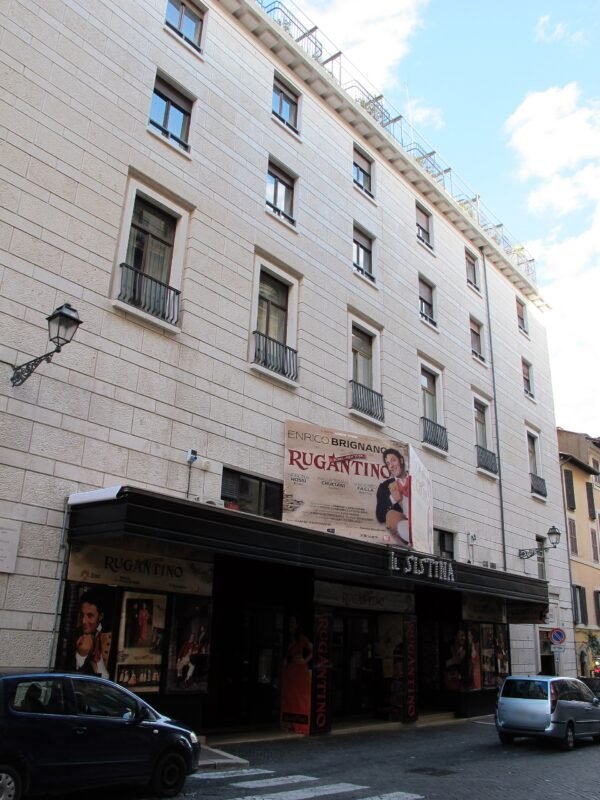
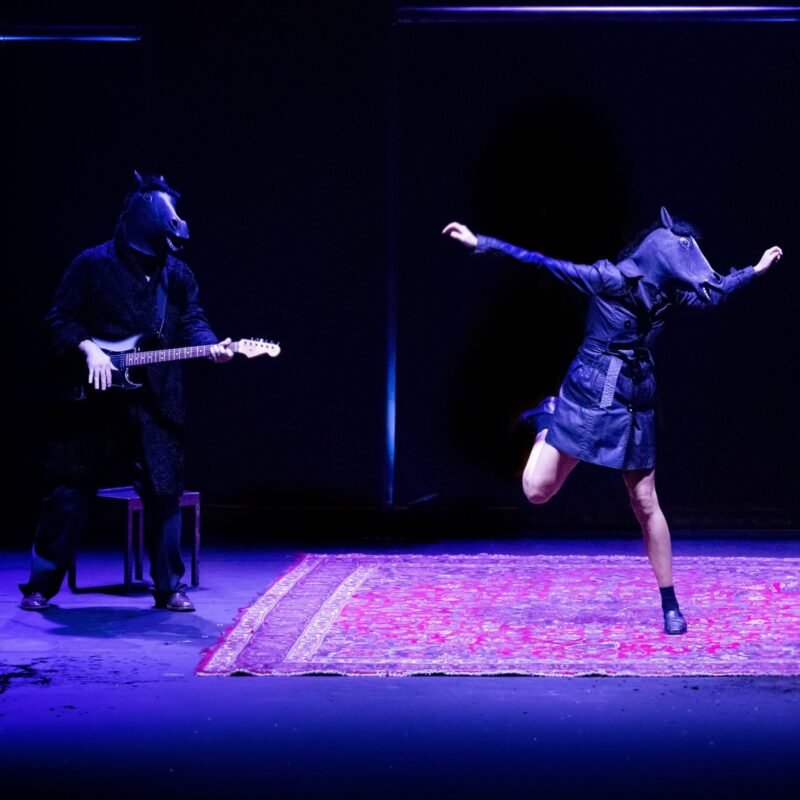
Madre per sempre with Marisa Laurito and Giorgia Würth at Teatro Quirino, November 24 to 29, 2026
In short. Madre per sempre, the play by Catalan playwright Marta Barceló (original title Tocar mare), comes to Teatro Quirino Vittorio Gassman at Via delle Vergini 7, in the Trevi neighborhood, with Marisa Laurito and Giorgia Würth, directed by Siddhartha Prestinari.
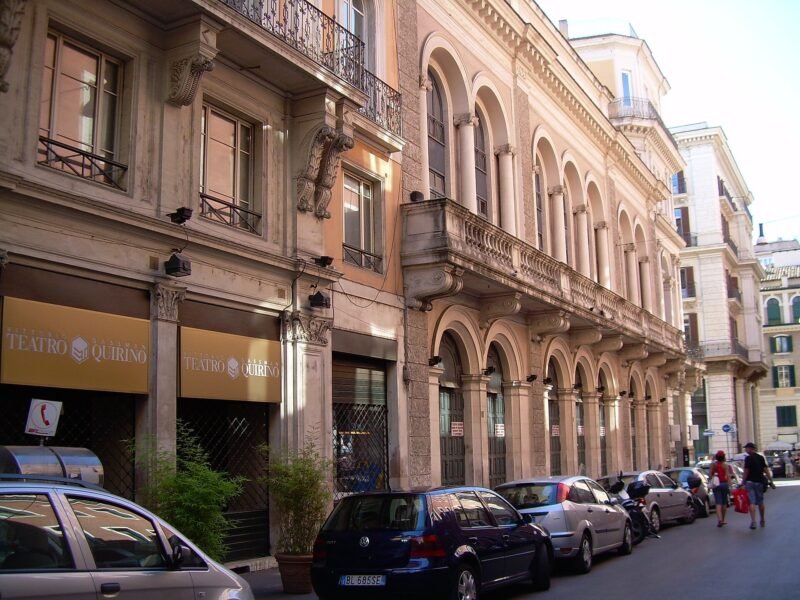
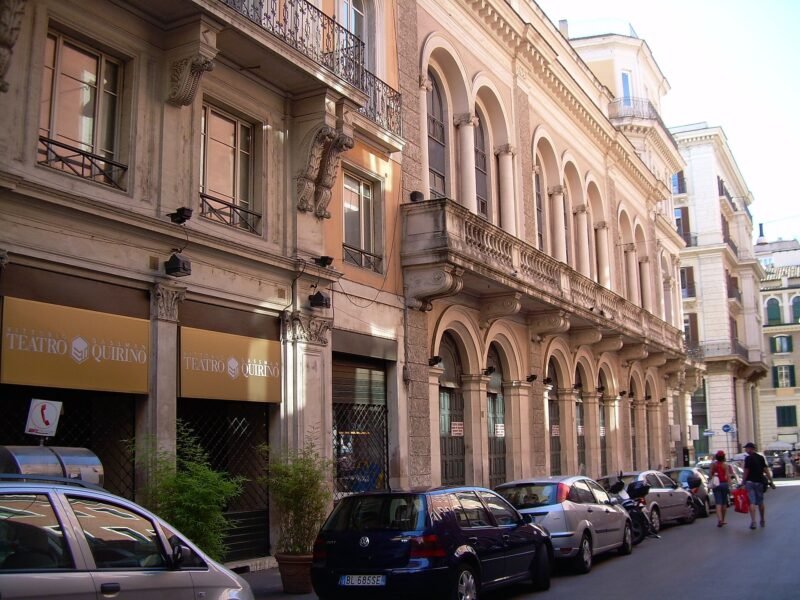
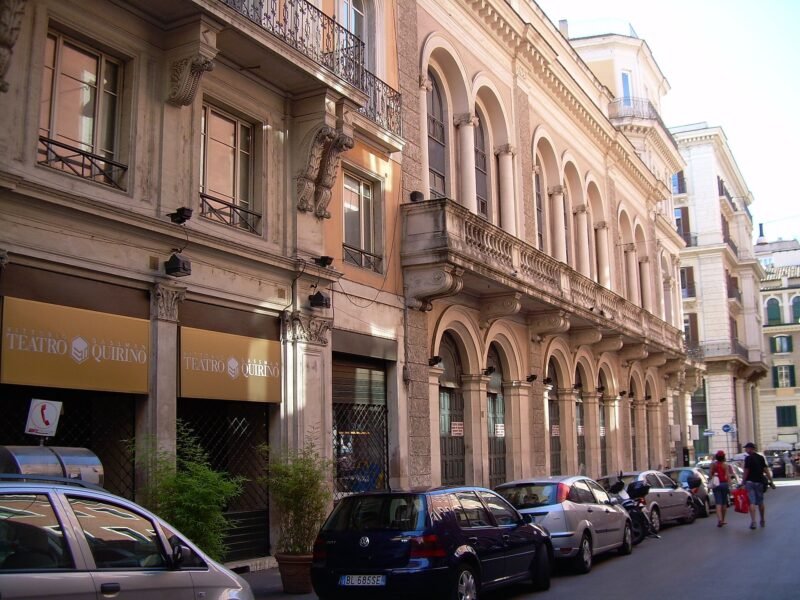
Madre per sempre, the play by Catalan playwright Marta Barceló (original title Tocar mare), comes to Teatro Quirino Vittorio Gassman at Via delle Vergini 7, in the Trevi neighborhood, with Marisa Laurito and Giorgia Würth, directed by Siddhartha Prestinari. The theater lists six performances: Tuesday 24 and Wednesday November 25, 2026 at 21:00, Thursday 26 at 17:00, Friday 27 at 21:00, Saturday 28 and Sunday November 29 at 17:00. The running time isn't given. The Quirino's single-ticket price list for the 2026/2027 season sets, for Tuesday to Thursday performances, 32 euros in the stalls, 26 in the first balcony, 21 in the second balcony and 15 in the gallery, and from Friday to Sunday 36, 30, 25 and 19 euros, booking fee included. Tickets can be bought from the theater's official website, which links to its own online ticketing circuit, or at the box office on the corner of Via delle Vergini and Via Minghetti. The phone box office (06 6794585, biglietteria@teatroquirino.com) answers Monday to Friday from 10:00 to 13:00 and from 14:00 to 18:00. The show is presented by ArtistiAssociati, a theater production center. To reach the theater by public transport, use the ATAC journey planner.
Language: opera sung in its original language; no English surtitles are announced, so check with the theater.

Madre per sempre: the story
At the center of the play are two very different women. One is close to retirement, the other works in audiovisual production. According to the Quirino's presentation, what they have in common is the desire to fill a void, and their meeting gives rise to a chosen family, able to cross biological and social boundaries. Barceló approaches the theme with irony, tenderness and great humanity, asking what it really means to become a mother and how love, more than blood, can create a bond meant to last.
The idea of the chosen family is central to understanding the show. It's not about adoption in a bureaucratic sense, but about an affinity built over time, between two people who have no obligation to each other and who, precisely because of this, can decide to become necessary to each other.
One without a mother, the other without children
In her director's notes Siddhartha Prestinari sums up the heart of the story like this: a woman without a mother and a woman without children meet and intertwine their lives, showing themselves and rediscovering themselves in their respective loneliness. It's a perfect, almost fairy-tale symmetry, which the play tests against the concreteness of everyday life.
The rules of the deal
The two protagonists give themselves instructions to set up a simple pact: getting to know each other without intruding on the other's world, without invading what the director calls each one's "too much." Too much pain, sometimes too much love, often too much left unsaid. It's a pact of caution, the kind of agreement you make when you're afraid of losing yourself.
When the rules break
As time goes by, between intimate stories and confessions, the meeting becomes something else. It crosses the rules, breaks down reserve, loses itself in tenderness and becomes family. The play therefore follows a precise arc: from controlled distance to intimacy, from formal agreement to bond.
The theme: what it means to be a mother
The Italian title, Madre per sempre (Mother Forever), puts the stress on duration, on the promise, while the Catalan original is Tocar mare. Beyond the translation, the question stays the same: is motherhood a biological fact or a relationship you choose and renew every day?
Motherhood as something built
The play, according to the presentation, explores in an original way the meaning of motherhood and how family bonds are built. The idea that family is built, rather than simply inherited, runs through much contemporary theater, and Barceló tackles it from a particular point of view: that of two adult women, with no small children involved.
Loneliness as a starting point
The two protagonists meet starting from a lack. One has lost or never had a mother, the other has had no children. The play doesn't treat these absences as dramas to be solved, but as spaces to fill with a new relationship.
Irony and tenderness
The Quirino stresses the play's register: irony, tenderness, humanity. It's not a gloomy drama, but a sentimental comedy that can make you laugh and move you, a balance the two performers, given their artistic history, know well.
Marta Barceló, the author
Marta Barceló is a Catalan playwright and artist. According to the Quirino's presentation she studied at the Institut del Teatre in Barcelona, the city's great drama school, and worked for about 20 years with the company Res de Res i en Blanc.
A theater that travels
Her works have been staged in Spain, Greece, Germany, Romania, Cyprus and Italy. It's the profile of an author who has found an audience in different countries and languages, a sign that the themes of her theater, bonds, loneliness, family, easily cross national borders.
A play for two voices
Madre per sempre is built for two actresses, and everything plays out in a relationship that changes over time. It's a form that asks a lot of the performers, because there are no secondary characters to share the weight of the story: every emotional turn has to come from the dialogue.
Marisa Laurito
Marisa Laurito was born in Naples on April 19, 1951. She trained at the most important school Neapolitan theater could offer: she joined Eduardo De Filippo's company and made her debut with him in 1969 in Le bugie con le gambe lunghe.
Quelli della notte and Sanremo
The general public discovered her in 1985 with Quelli della notte, Renzo Arbore's show on Rai 2 that became a cultural phenomenon. In 1989 she took part in the Sanremo Festival with Il babà è una cosa seria, finishing 12th.
Film
She made her film debut in 1976, and has worked among others in Odds and Evens with Bud Spencer and Terence Hill, in Il mistero di Bellavista and, more recently, in Sergio Rubini's I fratelli De Filippo, a film that in a way comes full circle with her beginnings with Eduardo.
Theater and artistic direction
On stage she won the Maschera d'argento as the lead in Café Chantant, and acted in Menopause the Musical between 2006 and 2009, in Aggiungi un posto a tavola between 2009 and 2011 and, since 2017, in Due donne in fuga with Iva Zanicchi. For the 2020-2022 period she was artistic director of Teatro Trianon Viviani in Naples. On television she is one of the leads of Mina Settembre.
The Quirino's presentation
The theater describes her as a warm, charismatic presence, able to combine comedy and pathos. It's exactly the quality a character like the woman close to retirement requires: the ability to make you smile without losing depth.
Giorgia Würth
Giorgia Würth was born in Genoa on June 5, 1979, to a Swiss father and a Ligurian mother. Raised between Varazze and Milan, she graduated in Communication Sciences and Technologies from IULM University.
From television to TV drama
She started as a presenter on Disney Channel between 1998 and 2001, then was a Rai 3 continuity announcer for a few years. In TV drama she acted in Un posto al sole, in the miniseries Moana, where she played Ilona Staller, and for several seasons in Le tre rose di Eva on Canale 5, as Tessa Taviani.
Film and writing
In film she worked with Fausto Brizzi in Ex, Maschi contro femmine, Femmine contro maschi and Com'è bello far l'amore. She is also a writer: her debut novel, Tutta da rifare, published by Fazi in 2010, won the Premio Afrodite and the Premio Falerno Primo Romanzo. In 2014 L'accarezzatrice came out with Mondadori. In 2017 she directed the documentary Salvatrice, devoted to Sandra Milo.
Theater
On stage she has acted among others in Antigone, Cecità, Un marziano a Roma, Xanax and, in the 2023-2024 season, in Non so se tu sai che lo so. The Quirino presents her as a sensitive performer, with a spare, realistic style, a natural counterpoint to Laurito's warmth.
The two actresses between screen and stage
To understand what each of the two performers brings to the stage, it's worth taking a closer look at their careers, which meet here in a play for two voices, where every acting choice is immediately reflected on the other actress.
Laurito beyond comedy
Alongside lighter roles, Marisa Laurito has worked in different registers. In film she acted in Terranova, in 1991, alongside Antonio Banderas. On television she appeared in Dio vede e provvede in 1997 and in Baciati dall'amore in 2011, before becoming co-lead of Mina Settembre from 2022. Her career, which started in Eduardo's company, has always held together the laughter and the melancholy typical of Neapolitan theater.
Würth between TV drama, presenting and books
Giorgia Würth has steadily alternated acting and presenting. Besides the roles already mentioned, she worked in Il bene e il male on Rai 1, in the sixth season of Un medico in famiglia, in Casa Flora for Swiss television and in Eppure cadiamo felici in 2023. She presented C'è posto per te on Sky and Voglio vivere così on Cielo. In 2019 she self-published the book IO, LUI e altri effetti collaterali.
A meeting of two traditions
On one side the great school of Neapolitan actors' theater, on the other a generation raised between television, TV drama and writing. Barceló's play, with its two women different in age and world, seems made on purpose to bring these two ways of being on stage into dialogue.
Chosen families: why this theme speaks to the present
The idea that family isn't only the one you're born into, but also the one you build, has entered everyday language. People speak of chosen families to describe bonds of deep friendship, mutual care, living together between people with no blood ties. Madre per sempre takes this theme into a particular territory, that of motherhood between adults, where there's no child to raise but a relationship to invent.
Adult loneliness
The two protagonists aren't young people looking for a place in the world. One is close to retirement, the other has an established career. Theirs is the loneliness of adulthood, less often told than that of adolescence and often quieter. The theater gives it a voice through dialogue and confession.
The courage to change the rules
The most interesting part of the story, according to the director's notes, is the moment the rules break. The initial agreement, getting to know each other without intruding, is a form of self-defense. Going beyond it means accepting the risk of suffering, of losing, of being too much. It's the substance of every real bond.
Body and contact
In a play about bonds, gestures count as much as words. The path the direction describes, from cautious agreement to tenderness, also runs through the physical distance between the two women: measured and controlled at first, then smaller and smaller. It's one of the aspects you only catch in the hall, watching how the two actresses occupy the stage and how, little by little, they share it.
A wide-ranging audience
A show like this speaks to very different audiences: those who have lost a mother, those who haven't had children, those who have built bonds outside their family of origin, but also those who simply wonder what holds people together. It's a theater of relationships, which asks the audience to recognize themselves more than to judge.
The Quirino and Galleria Sciarra, a single complex
If you go to the Quirino for this show, you have the chance to discover a corner of Rome many people walk through without noticing. Galleria Sciarra was built between 1885 and 1888 as the outermost courtyard of Palazzo Sciarra Colonna di Carbognano, to a design by Giulio De Angelis, the same architect who rebuilt the theater in 1882. It was commissioned by Prince Maffeo Barberini Colonna di Sciarra.
Iron, glass and encaustic
The gallery is covered by an iron and glass vault and has cast-iron columns at the entrances. The walls are decorated in encaustic with the cycle of the glorification of woman, attributed to Giuseppe Cellini. In the 1970s the structure was restored and rebuilt in reinforced concrete, preserving the painted decorations and the iron parts.
A passage open during office hours
Today the gallery is a private courtyard open to the public during office hours, with entrances from Piazza dell'Oratorio and Via Minghetti. It's part of a complex that runs from the Banco di Roma building to Teatro Quirino, and its doorway is counted among the so-called four wonders of Rome.
The show in the Quirino's season
Madre per sempre arrives right after Brecht's Mother Courage and Her Children, on stage from November 17 to 22 with Lunetta Savino. For two consecutive weeks the Quirino therefore puts two mother figures center stage, very far apart: the canteen woman who lives off the war and loses her children, and the woman who never had a child and finds a family in meeting another woman.
An unintended diptych
Seeing the two shows a few days apart allows an interesting comparison. Brecht tells of a motherhood bent by trade and survival, Barceló of a chosen, built motherhood. The Quirino's open cards let you combine different titles of the season.
Subscriptions
Madre per sempre is included in the fixed-seat subscription series of the 2026/2027 season. If you're not a subscriber you can choose between single tickets and cards for six or eight shows, in midweek and weekend versions. The season continues in 2027 with titles such as Elettra 1944.
Two actresses, two generations
The choice of performers is one of the most interesting elements of the show. Between Marisa Laurito and Giorgia Würth there are almost 30 years of difference, and two very distant paths: Eduardo's school and Arbore's television on one side, TV presenting, drama and writing on the other. Barceló's play lives precisely on this gap.
Comedy and realism
The Quirino describes the two actresses with complementary adjectives: warm and charismatic the first, spare and realistic the second. In a play for two voices, the balance between different registers is the key to success.
Siddhartha Prestinari's direction
Siddhartha Prestinari's director's notes insist on the passage from rules to tenderness. It's work that asks the performers to start from a certain rigidity, that of the initial agreement, and loosen it gradually, up to the moment the meeting becomes family.
Practical information
The Madre per sempre schedule is particularly rich in afternoon shows: three performances out of six are at 17:00, Thursday 26, Saturday 28 and Sunday 29. It's an opportunity if you prefer daytime theater or want to pair the show with dinner in the center.
Prices by day
The performances on Tuesday 24, Wednesday 25 and Thursday 26 fall in the midweek band of the price list, with the stalls at 32 euros. Those on Friday 27, Saturday 28 and Sunday 29 fall in the weekend band, with the stalls at 36 euros. For the gallery, prices are 15 and 19 euros respectively.
Discounts and cards
The theater applies the statutory discounts for under 26 and over 65, under the conditions given on the box office page, and offers open cards for six or eight shows. Tickets and cards, once issued, can't be exchanged or canceled. For schools, groups and associations the promotion office is available at 06 6783042.
A curious fact about Teatro Quirino
The Quirino is part of a complex that extends to Galleria Sciarra, the covered courtyard built between 1885 and 1888 for the same Prince Maffeo Barberini Colonna di Sciarra who had wanted the theater. Among the scenes painted on the gallery's walls there's one, the Conversazione galante, in which according to legend the man portrayed is Gabriele D'Annunzio.
The initials on the shields
On the shields at the gallery's entrances appear the initials CSS, which refer to Carolina Colonna Sciarra, the prince's mother. The same complex housed the daily La Tribuna and the magazine Cronaca Bizantina, edited by D'Annunzio himself. The theater, in short, was born inside a small district of culture and journalism in late 19th-century Rome.
Something nobody tells you about Teatro Quirino
In its early days the Quirino wasn't a drama theater. The official website says the first years were devoted to marionette shows and popular farces, attended by a large and cultured audience. The prince wanted to make up for the lack of entertainment venues in the center east of Via del Corso, and chose a light repertoire, able to draw audiences.
The first shows
The early repertoire included marionettes and popular farces, but also Pulcinella comedies and operettas for the middle-class audience. Either way, the early Quirino was an entertainment theater, far from the image of a temple of drama it has today.
My advice for visiting Teatro Quirino
My advice is to choose the 17:00 performance on Saturday 28 or Sunday 29, and to spend the hour before at Galleria Sciarra and the Trevi Fountain, both a few minutes from the theater. Coming out of the show in the early evening, you find the center lit up but still lively, and it's easy to continue with dinner in the neighborhood.
Arrive from the right side
The box office is on the corner of Via delle Vergini and Via Minghetti. If you're coming from Via del Corso, you can turn into Via Minghetti and walk past the gallery's entrances, reaching the theater by the shortest and at the same time most interesting route.
Another well-known fact, yet rarely mentioned
Everyone knows the theater bears the name of Vittorio Gassman. Less well known is that the naming is fairly recent: it dates to June 29, 2004, when the actor's name was added to the historic one. The Quirino's website calls him one of the most acclaimed Italian stage actors of the 20th century, and his face is among those welcoming audiences in the photographs at the entrance.
A school inside the theater
Another rarely mentioned aspect is training. The Quirino hosts the Officine Quirino, a school of theater and dramatic art. In a hall named after one of the great Italian actors, the idea of training new generations of performers has a special meaning.
The right photo to take at Teatro Quirino
For this show the right photo isn't taken in the theater but a few steps away: under the iron and glass vault of Galleria Sciarra, framing the female figures painted on the walls. The cycle celebrates the virtues of woman, and it's hard to imagine a more fitting visual introduction to a show about two women who choose to become family.
Without disturbing
The gallery is a private courtyard open during office hours: photograph it discreetly, without blocking the way.
The canopy at the entrance
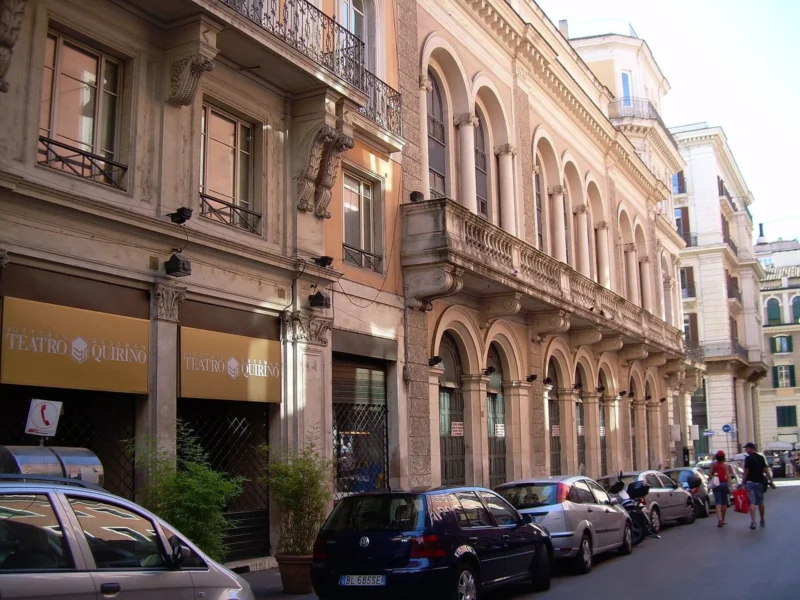
If you want a photo of the theater, frame the canopy on Via delle Vergini with the show poster. The canopy dates from the renovation inaugurated in 1955 and is one of the most recognizable features of the facade.
Some important events that happened here
1871: the founding
Prince Maffeo Sciarra had the theater built on his property near the Trevi Fountain. The name recalls the Quirinal and the god Quirinus.
1882: a more elegant theater
A first renovation, led by the architects De Angelis and Morra, turned the hall into a more elegant venue for the capital's middle class.
1898: the interiors by Belloli and Moraldi
According to the theater's website, Belloli and Moraldi worked on the interiors with more traditional decorative motifs, and with these works opera and ballet came onto the stage.
1914: Mascagni's season
After the Secession-style renovation by Marcello Piacentini, the theater reopened with an opera season conducted by Pietro Mascagni.
1955: the modern hall
On October 13, 1955 the renovated theater was inaugurated, with the cantilevered tiers and the entrance canopy.
2009-2015: the new managements
From July 2009 to June 2014 the theater was run by Geppy Gleijeses. From 2015 management passed to Quirino srl, with Guglielmo Ferro as artistic director and Rosario Coppolino handling administration.
Who has passed through Teatro Quirino
The Quirino's stage, the official website recalls, has seen Ferruccio Benini, Ettore Petrolini, Eduardo De Filippo, Vittorio Gassman, Carmelo Bene, Carlo Giuffrè, Giorgio Strehler, Paolo Stoppa, Paola Borboni and Luca Ronconi. It's a list that tells more than a century of Italian theater.
Eduardo and his students
Eduardo De Filippo's name has special value for this show. Marisa Laurito made her debut in his very company, in 1969. Returning to act in a theater that welcomed her teacher adds a thread of memory to the evening.
The great actresses
In the list of historic stars appears Paola Borboni, the only actress mentioned next to so many actors and directors. The two performers of Madre per sempre take up, in their own way, the legacy of a long tradition of leading actresses at the Quirino.
Before or after the show: the surroundings
The Quirino is a few minutes' walk from the Trevi Fountain and Galleria Sciarra, two stops that combine naturally with an afternoon performance.
Piazza Colonna
Toward Via del Corso opens Piazza Colonna, dominated by the Column of Marcus Aurelius, with its spiral reliefs.
The Quirinal
Heading up to the east you reach Piazza del Quirinale, with its view over the city, and Scuderie del Quirinale, which hosts major exhibitions.
Santi Apostoli
South of the theater, toward Piazza Venezia, you come to the Basilica of Santi XII Apostoli, which faces the square of the same name.
Frequently asked questions about Madre per sempre
When is Madre per sempre on at Teatro Quirino?
From Tuesday, November 24 to Sunday, November 29, 2026, with six performances. The times published by the theater are: Tuesday 24 and Wednesday 25 at 21:00, Thursday 26 at 17:00, Friday 27 at 21:00, Saturday 28 and Sunday 29 at 17:00. It's worth checking the performance when you buy.
Who are the performers?
Marisa Laurito and Giorgia Würth. The play is by Marta Barceló, a Catalan playwright, and the original title is Tocar mare. Direction is by Siddhartha Prestinari. The show is presented by ArtistiAssociati, a theater production center. The official page doesn't give the names of those responsible for sets, costumes, lighting and translation.
How much are tickets?
According to the 2026/2027 season price list, from Tuesday to Thursday the stalls cost 32 euros, the first balcony 26, the second 21 and the gallery 15. From Friday to Sunday prices are 36, 30, 25 and 19 euros. Prices include the booking fee. The statutory discounts apply to under 26 and over 65.
Where do you buy tickets?
From the official Teatro Quirino website, which links to the online ticketing circuit, or at the box office on the corner of Via delle Vergini and Via Minghetti. The phone box office answers at 06 6794585 Monday to Friday, from 10:00 to 13:00 and from 14:00 to 18:00, also for changing performances.
What is the show about?
About two very different women, one close to retirement and the other working in audiovisual production, one without a mother and the other without children. They meet, set themselves rules so as not to invade each other's lives and, over time, go beyond those rules until they become a chosen family.
How long is it?
The running time isn't given on the official show page: the information isn't published. Since it's a play for two performers, it's reasonable to expect an evening of drama of moderate length, but for a precise figure it's best to ask the theater's phone box office.
Is it a comedy or a drama?
Both. The Quirino's presentation speaks of irony, tenderness and great humanity, and describes Marisa Laurito as able to combine comedy and pathos. It's a sentimental comedy that tackles serious themes, loneliness, motherhood, family, in a tone that leaves room for a smile.
How do you get to Teatro Quirino?
The theater is at Via delle Vergini 7, between Via del Corso and the Trevi Fountain, in an area that is largely pedestrian or limited traffic. For public transport, the most reliable route is calculated with the ATAC journey planner.
Final advice on Madre per sempre
Madre per sempre brings to the Quirino a small, universal story: two lonely women who decide not to be lonely anymore. Marta Barceló's play, already staged in several European countries, finds in Marisa Laurito and Giorgia Würth two performers from different generations and schools, and this very distance promises to give depth to the relationship on stage. My advice is to choose one of the three afternoon shows and to arrive a little early to walk through Galleria Sciarra: the female figures painted under the vault are the ideal prologue to a show about women, bonds and the families we choose.
Article written by the editorial team of Tour Leader Pro, contact them for Private/Corporate/V.I.P. Tours and Experiences.
Planning a trip to Rome? The English-language guides to visiting the city are on ItalyPlanner.com.
Contact Information
Nearby
 Teatro Quirino Vittorio Gassman100 m
- Galleria Sciarra100 m
- Vicus Caprarius, the City of Water100 m
- Fontanella degli innamorati100 m
- Trevi Fountain100 m
- Church of San Marcello al Corso100 m
Upcoming events nearby
- L’inconveniente with Milena Vukotic at Teatro Quirino, January 19 to 31, 2027100 m
- L’uomo, la bestia e la virtù with Vanessa Gravina at Teatro Quirino, March 16 to 21, 2027100 m
- Le serve with Fioretta Mari at Teatro Quirino, March 9 to 14, 2027100 m
- Rosso Malpelo with Enrico Guarneri at Teatro Quirino, February 2 to 7, 2027100 m

You might also like
- C’era una volta… Scugnizzi at Teatro Sistina, November 18 to 29, 2026
- Dominio Pubblico, Across The Arts at Argot Studio and Centro Giovani Zalib, September 21 to November 26, 2026
- Breaking Brecht with Veronica Pivetti at Teatro Sala Umberto, November 26 to 29, 2026
- Mother Courage and Her Children at Teatro Quirino, November 17 to 22, 2026
- Crime and Punishment at Piccolo Eliseo, November 17 to 29, 2026
- A Midsummer Night’s Dream at Teatro Quirino, from November 3 to 8, 2026