Rosso Malpelo with Enrico Guarneri at Teatro Quirino, February 2 to 7, 2027
In short. Rosso Malpelo, from the short story by Giovanni Verga, with Enrico Guarneri and directed by Guglielmo Ferro, plays at Teatro Quirino Vittorio Gassman, at Via delle Vergini 7 (00187 Rome), from February 2 to 7, 2027, for six…
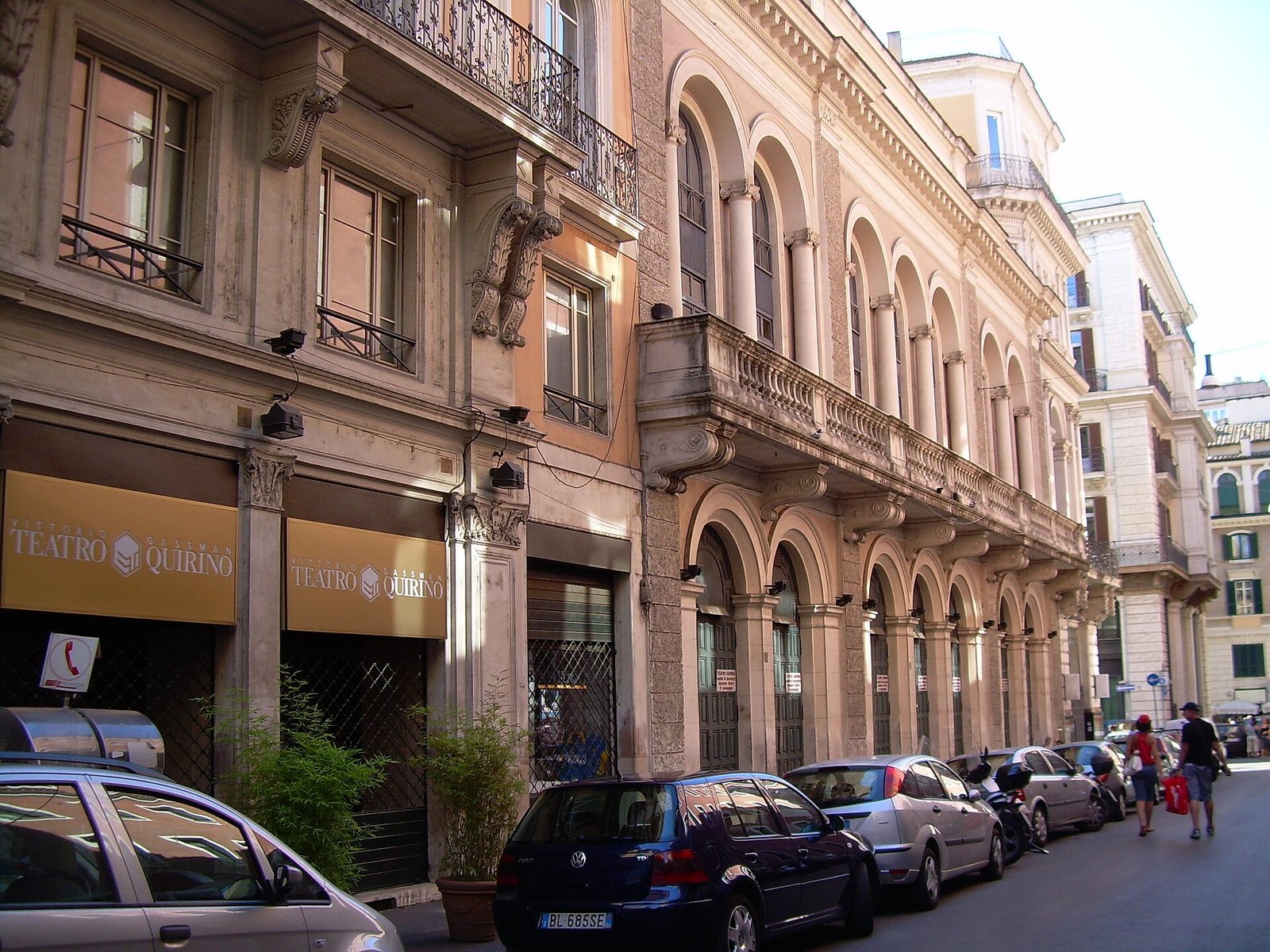
Rosso Malpelo, from the short story by Giovanni Verga, with Enrico Guarneri and directed by Guglielmo Ferro, plays at Teatro Quirino Vittorio Gassman, at Via delle Vergini 7 (00187 Rome), from February 2 to 7, 2027, for six performances: Tuesday the 2nd at 21:00, Wednesday the 3rd at 19:00, Thursday the 4th at 17:00, Friday the 5th and Saturday the 6th at 21:00, Sunday the 7th at 17:00. The show is presented by the cultural association Progetto Teatrando. The Quirino is in the Trevi district, between Via del Corso and the Trevi Fountain, and is reached on foot from the Barberini and Spagna stops of Metro Line A. Prices are published by the theater in the section on tickets and subscriptions. Tickets are bought on the official Teatro Quirino website, from the online purchase button on the show page, at the box office on Via delle Vergini or through the theater's phone box office.
Language: performed in Italian. No English version or English surtitles are announced.
Rosso Malpelo at the Quirino: dates, times and tickets
Rosso Malpelo plays at Teatro Quirino in Rome from February 2 to 7, 2027, with six performances in six days and times that change from day to day.
The calendar
Tuesday, February 2 at 21:00, Wednesday the 3rd at 19:00, Thursday the 4th at 17:00, Friday the 5th at 21:00, Saturday the 6th at 21:00, Sunday the 7th at 17:00. This is the calendar published by the theater on the show page. It is best to check the time of the chosen performance carefully, because at the Quirino matinees fall on weekdays too.
Tickets
The show page on the Quirino website has an online purchase button linked to the theater's box office. For reservations, date changes and phone purchases the theater lists a remote box office, active Monday to Friday from 10:00 to 13:00 and from 14:00 to 18:00, at 06 6794585.
The box office
The box office on Via delle Vergini follows the seasonal hours published on the website. In the autumn period it is open Monday to Friday from 11:00 to 18:00 and Saturday from 10:00 to 13:00. For the February hours it is best to check the box office page.
The billing
The cultural association Progetto Teatrando presents Enrico Guarneri in Rosso Malpelo by Giovanni Verga, directed by Guglielmo Ferro. The cast, according to the theater's page, is being finalized.
Rosso Malpelo: the show
The show is a theatrical adaptation of Giovanni Verga's short story, set in a scorching and suffocating sand quarry. Enrico Guarneri plays an adult Malpelo, narrator and tragic conscience of the story.
An adult Malpelo
The strongest dramaturgical choice is this: the protagonist of the short story, a boy, becomes on stage a man who remembers. The theater's presentation describes him as able to move between memory and present, between spoken word and silenced pain. It is a way to bring to the stage Verga's narrating voice, which in the short story does not coincide with the author's.
The cast and the chorus
Around Guarneri acts a group of actors who give body to the characters of the quarry and of the village: the father Misciu Bestia, a figure broken by work and destiny. Ranocchio, a fragile companion in suffering. The quarry workers, the foreman, the voices of the village and of superstition. The actors are often on stage as a chorus too, the face of a cruel society that condemns Malpelo for the color of his hair even before his actions.
Set, lights and costumes
The staging, according to the theater, is essential and strongly symbolic: lights and sounds create the oppressive atmosphere of the quarry, which becomes a place of toil, dust and silences. The costumes recall a harsh and timeless Sicily, with worn clothes, rough fabrics and earthy colors.
The ending
The show develops as a journey into dehumanization: Malpelo, branded and isolated, accepts the role imposed on him and turns the violence he suffers into armor. The ending, dark and inevitable, offers no redemption but leaves an open question about the meaning of justice, work and denied childhood.
Verga's short story: history and plot
Rosso Malpelo is a short story by Giovanni Verga that first appeared in the Fanfulla in 1878 and was collected in 1880 in Vita dei campi.
The versions
The story came out at the start of August 1878 in the Fanfulla della domenica. In 1880 it was reprinted in Vita dei campi, third after Fantasticheria and Jeli il pastore. In 1897 Verga published the definitive version, with deep changes, in the Treves edition of Vita dei campi, illustrated by the painter Arnaldo Ferraguti.
The plot
Sicily, 19th century. Malpelo is a boy who works in a red sand quarry, despised by everyone for his red hair, which popular belief associates with malice. He works with his father, mastro Misciu, called Bestia for the heavy jobs he accepts, the only one to show him affection. When a pillar collapses, the father stays buried under the sand, and the boy digs in vain with his bare hands.
Ranocchio
A little boy nicknamed Ranocchio for the way he walks arrives at the quarry. Malpelo protects and torments him at once, to teach him to live in a hard world. Ranocchio falls ill and dies. Left alone, Malpelo agrees to explore an abandoned tunnel and never comes out. The quarry workers, Verga tells us, still fear seeing him reappear.
The proverb
The language of the short story is full of popular expressions and proverbs, starting with the one that sums it up: "russu è malu pilu." The prejudice about hair color is the engine of the story.
Rosso Malpelo and verismo
Rosso Malpelo describes the poverty and exploitation of the poorest classes in late 19th-century Sicily, and is one of the tests in which Verga experiments with the narrative techniques he will use in I Malavoglia.
Impersonality
Despite the principle of impersonality typical of the verists, Verga lets his pity for Malpelo show, a defeated figure with no way to escape his destiny. Boys like him, the story suggests, react to the evil they suffer by inflicting more suffering and by suppressing compassion in order to survive.
Estrangement and regression
The critic Romano Luperini identified in the short story the device of estrangement, by which events appear from an unexpected viewpoint, and that of regression: the author does not tell the story in his own voice but in that of the people. Verga's point of view emerges from the structure of the story and does not coincide with that of the narrating voice.
Who is the villain?
The structure is antiphrastic: the story argues a thesis, Malpelo is wicked, but lets the opposite be glimpsed. It is the question the Quirino show puts at the center: who is truly cruel, the boy or the community that judges him?
The theme of child labor
The short story is today also read as one of the first Italian tales about child labor, a reality emerging from the inquiries of the newly unified Kingdom of Italy. The show speaks of it explicitly as a denied childhood.
Verga's language
The construction of the sentence in Rosso Malpelo imitates speech: paratactic syntax, use of the all-purpose che, anacolutha, metaphors and similes drawn from the popular world, many expressions of the traditional Catania dialect. For an actor it is a language to speak more than to act, and the choice of a Catania-born performer for the narrator role should be read in this key too.
Who Enrico Guarneri is: the biography
Enrico Guarneri is a Sicilian actor and comedian born in San Gregorio di Catania in 1953, known in Sicily above all for the character of Litterio and as the interpreter of important author texts in the theater.
Surveyor and actor
In an interview with the newspaper La Sicilia, Guarneri recounted that he began working as a surveyor in 1973, right after military service, and spent over 20 years as a technician by day and an actor in the evenings, at night and on weekends, with theater rehearsals after work. The decision to leave the job came after a family meeting, when the theater had already begun to bear fruit.
Litterio
The character of Litterio was born in 1997. On November 28, 1998 he arrived on television, in the program Insieme on Antenna Sicilia hosted by Salvo La Rosa, who had seen him awarded as an emerging character at the Polifemo d'Argento in Zafferana Etnea. Litterio, gullible and without malice, became the mask that made Guarneri popular across the island.
Beyond the mask
In the same interview the actor explains that Litterio served him as a springboard but that continuing to bring him on stage would expose him to the risk of ridicule. His career has widened to author theater, film and television. In the 2023-24 season of the Turi Ferro series at the Abc in Catania he was the lead in Goldoni's The Liar (Il bugiardo), in an adaptation directed by Giampaolo Romania.
Dialect and language
Guarneri defends the use of dialect and regional inflections on stage, with a precise argument: the truths of a text, he maintains, also pass through the color of the language of those who say it. It is a position that makes his encounter with Verga natural, whose language imitates speech and welcomes Catania expressions.
Guglielmo Ferro, the director
The direction of Rosso Malpelo is by Guglielmo Ferro, artistic director of Teatro Quirino since 2015.
A house director
Ferro has directed the Quirino since 2015, when management passed to Quirino srl, under the administration of Rosario Coppolino. Rosso Malpelo is therefore a staging signed by the person who decides the line of the theater that hosts it.
Verga and Sicilian theater
It is not the first time Ferro works on Verga: in 2017 he directed La Lupa, with Giulia Fiume in the cast.
The essential set
For Rosso Malpelo the presentation speaks of an essential staging in which the protagonist is the action: a choice consistent with the nature of the short story, which Verga builds by accumulation of facts, without comment.
A curiosity about Rosso Malpelo with Enrico Guarneri at Teatro Quirino, February 2 to 7, 2027
The curiosity is in the lead's trade. Before being a full-time actor, Enrico Guarneri worked for over 20 years as a surveyor: a job made of land, measurements, construction sites and excavations. Today he brings to the stage the story of a boy who works in a sand quarry, and of a father buried by the collapse of a pillar that nobody wanted to take down. Those who know the construction site know what a pillar giving way means. The actor comes to Verga with an experience that most of his colleagues don't have.
Then there is a detail about language. In the short story Verga uses many expressions of the Catania dialect, and the proverb "russu è malu pilu" is its symbol. Guarneri is from Catania, and in interviews he openly defends the value of dialect and regional inflections as a vehicle of truth. On the Quirino stage, in the center of Rome, Verga's language is spoken again by a voice that knows it from the inside.
Finally, a fact about the short story. Rosso Malpelo was not born in a book but in a newspaper: it came out in August 1878 in the Fanfulla della domenica, and only two years later entered the collection Vita dei campi. The story of the quarry boy met its first readers among the pages of a periodical, before becoming one of the most studied texts of Italian literature.
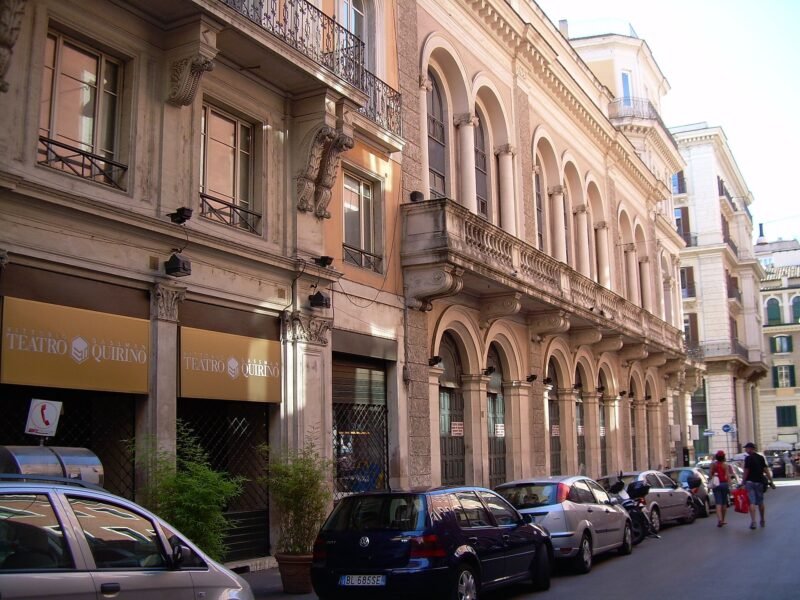
Teatro Quirino Vittorio Gassman, the show's hall
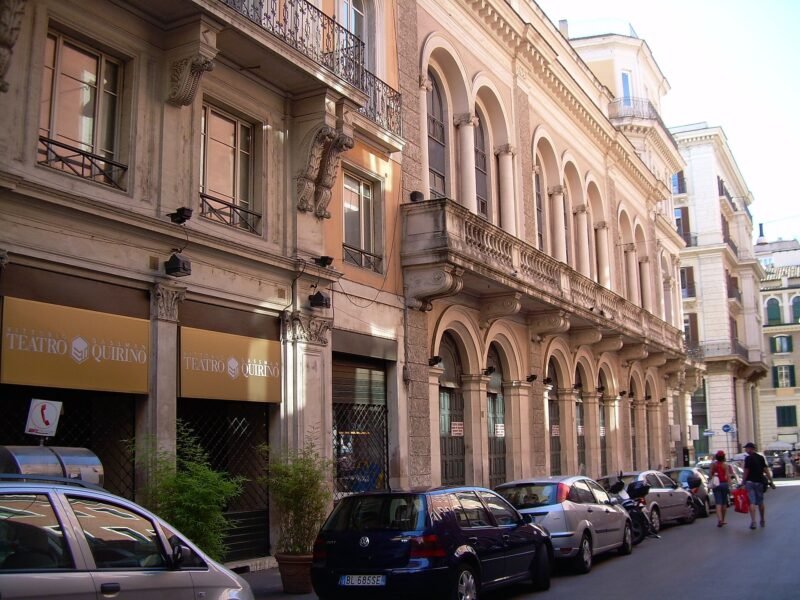
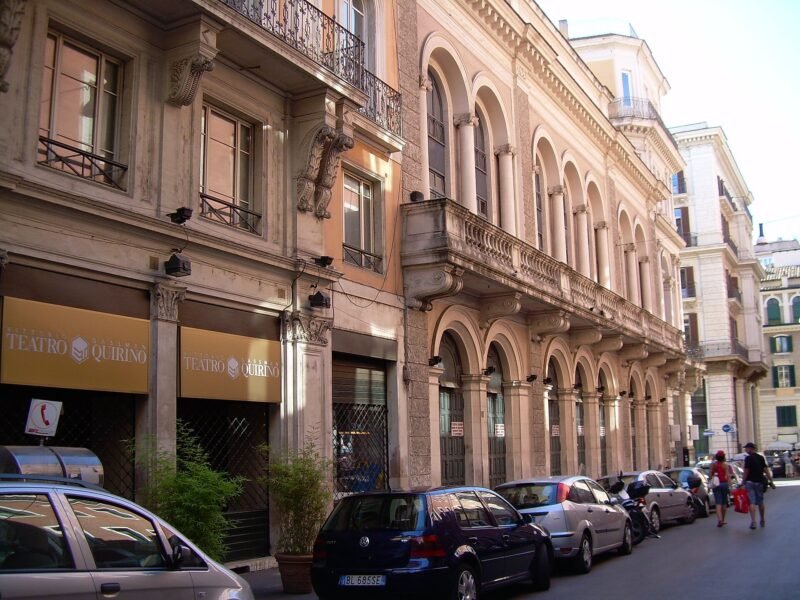
Teatro Quirino is a horseshoe-shaped hall with two balconies and a gallery, seating 852, in the Trevi district, since 2015 it has been run by Quirino srl with Guglielmo Ferro as artistic director.
A wooden theater
The first Quirino was commissioned in 1871 by Prince Maffeo Barberini Colonna di Sciarra, inside the Palazzo Sciarra property, with an entrance from Via del Corso. Designed by Giulio De Angelis with Francesco Marra, it was entirely made of wood and, according to tradition, was put up in a single day. The name recalls the Quirinal and the god Quirinus.
The reconstruction
In 1882 the opening of a street between Via del Corso and the Trevi Fountain forced it to be dismantled. De Angelis rebuilt it in masonry a few meters farther on, in a horseshoe shape, with two tiers of boxes and neoclassical cast-iron columns.
Piacentini
In 1914 Marcello Piacentini added a third tier of boxes and a retractable roof, in 1954 he returned to the theater with the cantilevered tiers and the canopy still seen over the entrance. The venue's profile is on the page about Teatro Quirino.
One thing nobody tells you about Rosso Malpelo with Enrico Guarneri at Teatro Quirino, February 2 to 7, 2027
One thing rarely said is that Rosso Malpelo is not a light show, even though the lead is one of the best-loved comic actors in Sicily. Those who go to the theater to find the Guarneri of Litterio will find something else: the presentation speaks of theater of denunciation and poetry, of a journey into dehumanization, of a dark ending with no redemption. It is a precise actor's choice, consistent with what Guarneri has said about the need to go beyond the comic mask.
The second thing concerns the school audience. Rosso Malpelo is one of the most-read short stories in Italian schools, and the weekday matinees, like the one on Thursday, February 4 at 17:00, are the time when you are most likely to find students and teachers in the hall. Those who prefer a quieter house choose the Tuesday or Friday evening. Those going with teenagers who study Verga find the matinee the most convenient time.
The third concerns the cast. The theater's page lists, beside Guarneri's name, a cast being finalized. To know who will play Misciu Bestia and Ranocchio, it is best to follow the Quirino's updates in the weeks before the debut.
How to get to Teatro Quirino
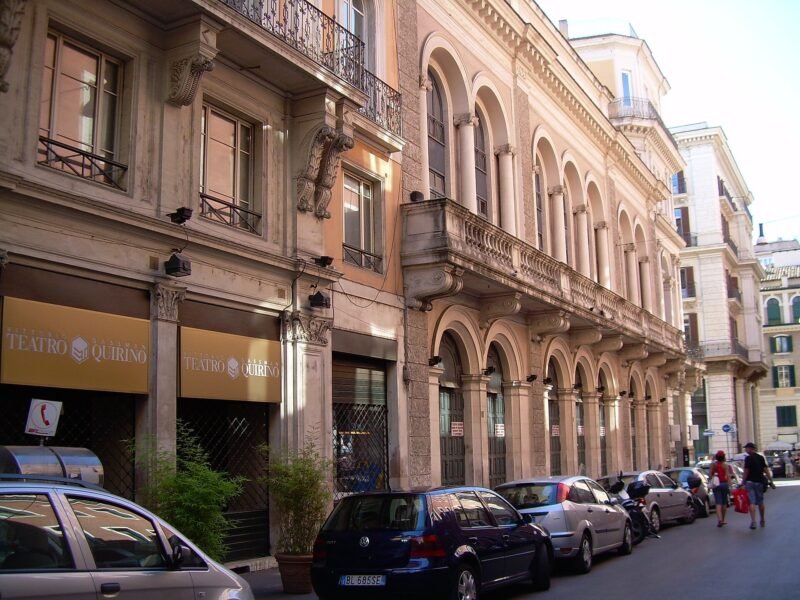
Teatro Quirino, at Via delle Vergini 7, is in the Trevi district between Via del Corso and the Trevi Fountain, in the historic center, it is reached on foot from the Barberini and Spagna stops of Metro A.
By Metro
From the Barberini stop you head down Via del Tritone toward Via del Corso and, at the Trevi Fountain, turn into the little streets of the district to Via delle Vergini. From Spagna the route is longer but crosses some of the most beautiful streets in the center.
By bus
Many lines run along Via del Tritone and Via del Corso or stop around Piazza Venezia. The fastest combination depends on the starting point: the ATAC route planner shows it in real time.
By car and taxi
The historic center is a limited traffic zone: leave the car outside the ZTL. For a matinee with elderly people, a taxi to the end of Via delle Vergini is the most convenient choice.
The advice I give you for visiting Rosso Malpelo with Enrico Guarneri at Teatro Quirino, February 2 to 7, 2027
The advice is to reread the short story before going. It is a few pages, available for free in digital libraries too, and reading it completely changes the experience of the show: it lets you recognize Misciu Bestia, Ranocchio, the donkey, the father's shoes found in the sand, and above all grasp the choice of the adaptation, which turns the boy into an adult who remembers.
The second piece of advice concerns the performance. With six dates and different times each day, it is best to choose according to who you bring: the Thursday or Sunday matinee for those going with teenagers or older people, the Saturday evening for those who want to combine theater with dinner in the center, the 19:00 performance on Wednesday for those leaving work who want to get home at a reasonable hour.
Finally, the seat. The Quirino is a horseshoe-shaped Italian-style theater. For a show built on lights, sounds and a chorus on stage, in our view the central orchestra and the front-facing first balcony give a better sense of the whole scene than the side seats.
Another well-known fact, yet rarely mentioned
It is well known that Rosso Malpelo is a short story by Verga. Much less cited is that the text read today is not the 1878 one. In 1897 Verga published a definitive version, with deep changes, in the new Treves edition of Vita dei campi, illustrated by the painter Arnaldo Ferraguti. Between the first appearance in the Fanfulla della domenica and the last version, almost 20 years pass: Verga returned several times to the story of the quarry boy, a sign of how important he considered it.
It is also well known that Verga is the father of verismo. Less often recalled is that Rosso Malpelo is the short story in which he experiments for the first time with some techniques he will use extensively in I Malavoglia. The critic Romano Luperini devoted a whole essay to it in 1976, and returned to it 30 years later, comparing it with Pirandello's Ciàula scopre la luna: another boy, another mine, another Sicily.
A third little-cited fact concerns the show's lead. Enrico Guarneri has recounted that he left the surveyor's job only when the theater had already begun to support him, and that in his first four years as a full-time actor he earned as much as in 20 years as a technician. A career begun late, and precisely for that built with a rare determination.
The right photo to take at Rosso Malpelo with Enrico Guarneri at Teatro Quirino, February 2 to 7, 2027
The right photo is taken outside, under the canopy that Marcello Piacentini added to the entrance in the 1950s and that is still the distinctive mark of the facade. With the sign lit and the Rosso Malpelo poster, it is the image that tells the evening: an Italian-style theater on a little street of the center, a few steps from the most famous fountain in the world.
During the show no photographs: the theater's rules require it, and respect for the actors too. In a staging built on lights and silences a flash breaks the atmosphere for everyone. Before the start, if staff allow, a shot of the horseshoe hall from the balcony, without flash, captures the architecture of the 19th-century theater renewed by Piacentini.
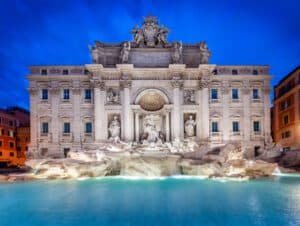
The second photo is taken at the Trevi Fountain, on the way out. After a matinee, toward evening, the fountain is lit. After an evening performance it is almost deserted, and you can photograph it from the side steps without the daytime crowd.
The Trevi district around the Quirino
Teatro Quirino is in the Trevi district, between Via del Corso and the Quirinal hill: in a few minutes on foot you reach the Trevi Fountain, the Quirinale, Piazza Colonna and the Galleria Alberto Sordi.
The Trevi Fountain
The fountain is a few dozen meters from the theater: the first Quirino, in 1871, reached right up to the basin. In front of the fountain is the church of Santi Vincenzo e Anastasio a Trevi.
The Quirinale
Climbing through the little streets of the district you reach the square of the Quirinal Palace, with the obelisk and one of the widest views over the rooftops of the center. Opposite are the Scuderie del Quirinale, home of major exhibitions.
Via del Corso and Piazza Colonna
Heading down toward Via del Corso you meet Palazzo Sciarra, on whose property the first theater was born, and a little farther north Piazza Colonna with the Column of Marcus Aurelius. Opposite opens the Galleria Alberto Sordi, useful on rainy evenings.
Some important events that took place here in history
The history of Teatro Quirino spans more than 150 years of Rome as a capital. In 1871 Prince Maffeo Barberini Colonna di Sciarra had a wooden theater built in the property of Palazzo Sciarra, to a design by Giulio De Angelis and Francesco Marra, the repertoire is popular, pulcinellate and operettas. Rome has just become the capital of the Kingdom.
In 1882 the theater was taken apart and rebuilt in masonry a few meters farther on. In 1898 the interiors were decorated with drapes, velvets and gilded stucco and the repertoire opened to opera and ballet: in June 1899 Antonino Palminteri conducted there Verdi's I Lombardi and Puccini's Manon Lescaut. It is the same period in which Verga was working on the definitive version of the stories of Vita dei campi, published in 1897.
In 1914 Marcello Piacentini added the third tier of boxes and the retractable roof. From 1946 the theater was run by the Ente Teatrale Italiano. In 1954 Piacentini returned with a radical intervention and the theater reopened on October 13, 1955. In 2009 management passed to Gitiesse Artisti Riuniti of Geppy Gleijeses, in 2015 to Quirino srl, with Guglielmo Ferro as artistic director. Today the theater also bears the name of Vittorio Gassman.
Who has played Rosso Malpelo with Enrico Guarneri at Teatro Quirino, February 2 to 7, 2027
Through Teatro Quirino have passed first of all the men who built and transformed it: Prince Maffeo Barberini Colonna di Sciarra, who wanted it in 1871. Giulio De Angelis, who designed it twice, in wood and in masonry. Marcello Piacentini, who renewed it in 1914 and redesigned it in 1954. On the podium, in June 1899, stood Antonino Palminteri, with Verdi and Puccini.
Among recent directors are Geppy Gleijeses and Guglielmo Ferro. In the 2026-27 season the Quirino hosts, among others, Sei personaggi in cerca d'autore, Il viaggio di Francesco and, in January, Milena Vukotic with L'inconveniente, directed by Luca Manfredi.
From February 2 to 7, 2027 Enrico Guarneri, Guglielmo Ferro and the company of the cultural association Progetto Teatrando pass through Via delle Vergini. And through the short story pass Malpelo and his father Misciu Bestia, Ranocchio, the quarry workers and the foreman, and with them Giovanni Verga, who almost 150 years ago entrusted to the pages of a newspaper the story of a red-haired boy.
Who to bring to see Rosso Malpelo
Rosso Malpelo is a show that suits different audiences: students, literature lovers, Sicilian spectators who know Guarneri, those who love classic prose theater.
With teenagers
For those studying Verga in middle or high school, seeing the short story on stage is an effective way to understand it. The themes, violence, mourning, child labor, are hard, so it is best that younger teenagers have read the text beforehand.
For literature lovers
Those who know Verga well will find interest in the choice of an adult Malpelo and in the stage rendering of estrangement, that is, of the point of view of the village that judges the boy.
For those who know Guarneri
The Sicilian audience that knows Guarneri as a comedian will see him in a tragic role: a chance to discover the other half of his repertoire.
Teatro Quirino accessibility
For the conditions of access to the hall for people with disabilities and the dedicated seats, the reference is the Teatro Quirino box office, at the contacts published on the official website, which has a page devoted to accessibility.
Before booking
The Quirino is a historic theater, reworked several times: it is best to ask which sectors can be reached without stairs before choosing a seat.
Getting there
The little streets of the Trevi district are paved with sampietrini and often crowded. For those who have trouble moving around, a taxi to the entrance is the safest choice.
Where to eat near Teatro Quirino
The Trevi district is full of places, but many are designed for the tourists who crowd the fountain: to eat well before or after the show it is best to move a few streets away.
Before the matinee
For a light lunch before 17:00, the streets between Via del Corso and the Pantheon offer trattorias and bakeries. Best to avoid places with the menu photographed in the window on the most crowded squares.
After the evening performance
After the 21:00 performance dinner becomes an after-theater supper: the Pantheon area, 10 minutes on foot, stays lively late even on weekdays.
Frequently asked questions about Rosso Malpelo at the Quirino
When does Rosso Malpelo play at Teatro Quirino?
Rosso Malpelo plays at Teatro Quirino from February 2 to 7, 2027: Tuesday the 2nd at 21:00, Wednesday the 3rd at 19:00, Thursday the 4th at 17:00, Friday the 5th and Saturday the 6th at 21:00, Sunday the 7th at 17:00.
Who is the lead of Rosso Malpelo?
The lead of Rosso Malpelo at the Quirino is Enrico Guarneri, an actor from Catania known for the character of Litterio, who plays an adult Malpelo, the narrator of the story. The rest of the cast, according to the theater, is being finalized.
Who directs it?
The direction of Rosso Malpelo with Enrico Guarneri is by Guglielmo Ferro, artistic director of Teatro Quirino since 2015. The show is presented by the cultural association Progetto Teatrando.
What is Rosso Malpelo about?
Rosso Malpelo, from Giovanni Verga's 1878 short story, tells of a boy who works in a Sicilian sand quarry, despised for his red hair, who loses his father in a collapse and is left alone in a cruel world.
Is the show suitable for students?
Rosso Malpelo at the Quirino is suitable for students who study Verga, especially at the matinees on Thursday, February 4 and Sunday, February 7 at 17:00. The themes are hard, so it is best to read the short story before going.
How do I get to Teatro Quirino?
Teatro Quirino, at Via delle Vergini 7, is in the Trevi district, a few steps from the Trevi Fountain. You get there on foot from the Barberini and Spagna stops of Metro Line A. Driving is not recommended because the center is a limited traffic zone.
Where do you buy tickets?
Tickets for Rosso Malpelo are bought on the official Teatro Quirino website, at the box office on Via delle Vergini 7 or through the phone box office at 06 6794585, active Monday to Friday.
The final advice on Rosso Malpelo at the Quirino
An actor who made Sicily laugh for 20 years with Litterio, a director who runs the theater that hosts him, a short story that Verga rewrote over 20 years, in a 19th-century theater two steps from the Trevi Fountain. The advice is to reread Verga's few pages, choose the performance time with care and prepare for a dark show with no consolations. In our view it is precisely this absence of redemption that makes Rosso Malpelo, still today, a story that strikes.
Article written by the editorial team of Tour Leader Pro, contact them for Private/Corporate/V.I.P. Tours and Experiences.
Planning a trip to Rome? The English guides to visiting the city are on ItalyPlanner.com.
Contact Information
Nearby
 Teatro Quirino Vittorio Gassman100 m
- Galleria Sciarra100 m
- Vicus Caprarius, the City of Water100 m
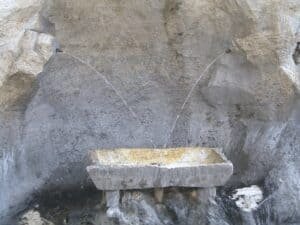
- Fontanella degli innamorati100 m
- Trevi Fountain100 m
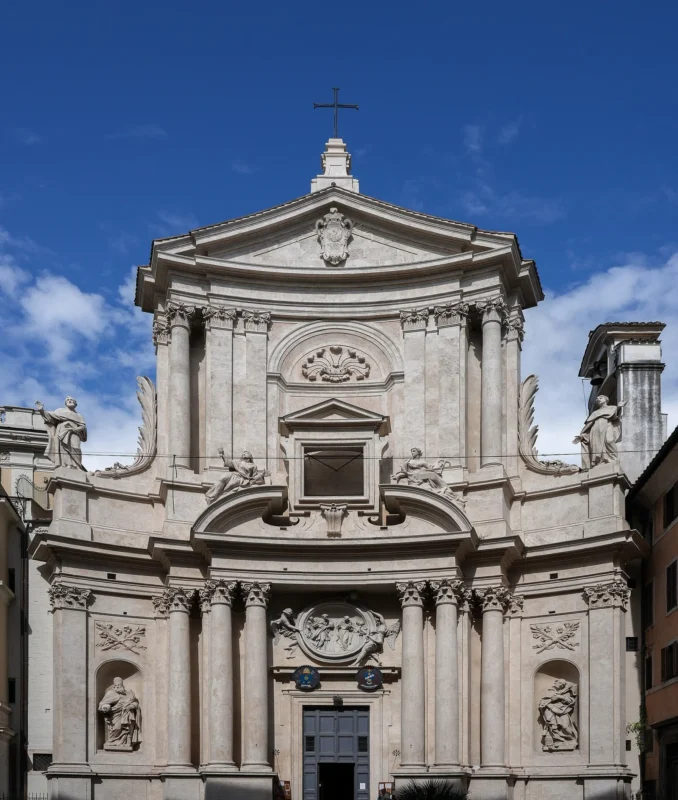
- Church of San Marcello al Corso100 m
Upcoming events nearby
- L’inconveniente with Milena Vukotic at Teatro Quirino, January 19 to 31, 2027100 m
- L’uomo, la bestia e la virtù with Vanessa Gravina at Teatro Quirino, March 16 to 21, 2027100 m
- Le serve with Fioretta Mari at Teatro Quirino, March 9 to 14, 2027100 m
- Il giuoco delle parti with Pippo Pattavina at Teatro Quirino, February 9 to 14, 2027100 m

You might also like
- Il commissario Montalbano with Vincenzo Pirrotta at Teatro Quirino, February 16 to 28, 2027
- Priscilla, La regina del deserto, the musical at Teatro Sistina, from February 10, 2027
- Figli maschi by Centouno at Teatro Sala Umberto, February 16 to 28, 2027
- Don Giovanni with Simone Toni and Enzo Paci at Teatro Sala Umberto, February 2 to 14, 2027
- Totalmente incompatibili, Nuzzo and Di Biase at Teatro Sistina, January 22-24, 2027
- Captivo by Gianfranco Gallo at Teatro Sala Umberto, January 13-24, 2027