Il giuoco delle parti with Pippo Pattavina at Teatro Quirino, February 9 to 14, 2027
In short. Luigi Pirandello's Il giuoco delle parti (The Rules of the Game), with Pippo Pattavina as Leone Gala and directed by Gianpaolo Romania, plays at Teatro Quirino Vittorio Gassman, at Via delle Vergini 7 (00187 Rome), from February 9 to…

Luigi Pirandello's Il giuoco delle parti (The Rules of the Game), with Pippo Pattavina as Leone Gala and directed by Gianpaolo Romania, plays at Teatro Quirino Vittorio Gassman, at Via delle Vergini 7 (00187 Rome), from February 9 to 14, 2027, for six performances: Tuesday the 9th at 21:00, Wednesday the 10th at 19:00, Thursday the 11th at 17:00, Friday the 12th and Saturday the 13th at 21:00, Sunday the 14th at 17:00. The show is presented by the Associazione Culturale Progetto Teatrando, with a cast of seven actors beside the lead. The Quirino is in the Trevi district, between Via del Corso and the Trevi Fountain, and is reached on foot from the Barberini and Spagna stops of Metro Line A. Prices are published by the theater in the tickets and subscriptions section. Tickets are bought on the official Teatro Quirino website, from the online purchase button on the show page, at the box office on Via delle Vergini or through the theater's phone box office.
Language: opera sung in its original language; no English surtitles are announced, so check with the theater.
Il giuoco delle parti at the Quirino: dates, times and tickets
Il giuoco delle parti plays at Teatro Quirino in Rome for a single week, from February 9 to 14, 2027, with six performances on six consecutive days and a different time each day.
The performance calendar
Tuesday, February 9 at 21:00, Wednesday the 10th at 19:00, Thursday the 11th at 17:00, Friday the 12th at 21:00, Saturday the 13th at 21:00 and Sunday the 14th at 17:00. This is the calendar the theater publishes on the show page: three evening shows at 21:00, one performance at 19:00 and two matinees.
A short week
Six evenings are few for a theater that usually keeps its titles for two weeks or more. Those who want to see Pattavina in Pirandello in Rome have a narrow window, and the weekend performances are the first to sell out.
Tickets
The show page on the Quirino website has an online purchase button linked to the theater box office. For reservations, date changes and phone purchases the theater lists a remote box office, open Monday to Friday from 10:00 to 13:00 and 14:00 to 18:00, at 06 6794585 or at biglietteria@teatroquirino.com. Prices for the different sections are published in the section devoted to tickets and subscriptions.
The cast
The lead is Pippo Pattavina, as Leone Gala. Beside him, according to the theater's page, is a cast of seven actors still being finalized. Direction is by Gianpaolo Romania, and the production is by the Associazione Culturale Progetto Teatrando.
Il giuoco delle parti: the plot of Pirandello's comedy
Il giuoco delle parti is a comedy in three acts written by Luigi Pirandello in 1918, drawn from his 1913 short story Quando si è capito il giuoco, and published in 1919 in the Florentine magazine Nuova Antologia and by Fratelli Treves.
A glass triangle
Leone Gala poses as a cynical philosopher. His wife Silia, capricious and impatient, hates her husband's relentless reasoning. Between the two, like a clay pot among iron ones, is Guido Venanzi, her lover, dominated by both. Leone has allowed Silia to have Venanzi as a lover, saving bourgeois appearances. Every day he visits his official wife for half an hour, punctually.
A man who has emptied himself
Leone has solved the problem of existence by making a void inside himself, without feelings or passions. To give his days some meaning anyway, he has built himself a philosopher's cloak and discusses doctrine with his servant Filippo, whom he calls Socrates. His other pastime is cooking, cultivated with maniacal care.
Silia's plan
Silia cannot bear being always watched and predicted by her husband, to the point of wishing him dead. Guido refuses to kill him. The chance comes by accident: a group of tipsy revelers mistakes Silia's house for that of a neighbor of doubtful reputation. Silia calls the neighbors to witness the offense and demands that her husband wash away the dishonor in a duel against young Marquis Miglioriti, a famous swordsman.
The reversal
Leone agrees to challenge the offender, as husband pro forma. But when it is time to fight, he invokes the logic of the game: Silia's real husband, in fact, is Venanzi, and it falls to him to take the field. Everyone must play their part. Leone wins, yet the revenge so well built brings him no satisfaction: for Pirandello the victory of reason is always illusory.
Il giuoco delle parti according to Teatro Quirino
In Teatro Quirino's presentation Il giuoco delle parti is a theatrical device of great finesse, in which psychology becomes scene and the characters move like pawns that are aware and at the same time prisoners of the roles they inhabit.
Leone as hidden director
The proposed reading puts at the center Leone Gala's detachment: a rational, almost surgical distance that is not absence but strategy. In his apparent disengagement Leone becomes the hidden director of events, and moves every pawn toward an inevitable and dramatic ending. The border between intelligence and inhumanity is the theme the show wants to lay bare.
An essential set
The set, according to the theater, bets on essentiality, to build a clear and sharp atmosphere. The costumes become a visual language, a mirror of the identities and appearances that sustain the game and at the same time crack it. Around Pattavina the cast builds a network of tense relationships, made of ambiguity and unspoken truths.
The show's questions
The presentation closes with two questions for the audience: how free are we really to escape the roles that define us, and what remains of us when we decide to stop playing. These are the questions Pirandello has posed for over a century, and the Quirino judges them of rare relevance.
Who Pippo Pattavina is: the biography
Pippo Pattavina, born Giuseppe Pattavina in Lentini on July 31, 1938, is a Sicilian actor who performs in Italian and Sicilian and is one of the historic faces of Catania theater.
The early career and L'isola dei pupi
Before drama theater came a long apprenticeship as a singer, actor and entertainer. Fame arrived with L'isola dei pupi, a show written by Turi Ferro and performed with the Teatro Stabile di Catania company. Pattavina's name has been tied ever since to the great season of Catania theater.
With Albertazzi and Proclemer
In the following years he worked with Giorgio Albertazzi in Richard III and with Anna Proclemer in Come prima, meglio di prima, another Pirandello title. In 2011 he was Harpagon in Molière's The Miser, directed by Angelo Tosto. In 2016 he was Angelo Baldovino in Pirandello's Il piacere dell'onestà, directed by Antonio Calenda.
The pair with Tuccio Musumeci
For Sicilian audiences Pattavina is also half of a comic pair. With Tuccio Musumeci he signed Pipino il Breve, from 1978, successfully restaged for decades, and Il comico e la spalla, written and directed by Vincenzo Cerami with music by Nicola Piovani.
Television and drama series
On television Pattavina was a cabaret performer and joke teller in the Antenna Sicilia program Questo piccolo grande amore, between the late 1970s and early 1980s, and in La fiera del venerdì in a pair with Mariella Lo Giudice. He hosted several editions of the Festival della nuova canzone siciliana. In national drama series he is the elderly principal Burgio in some episodes of Il commissario Montalbano and Judge Pietro Scaglione in Boris Giuliano, un poliziotto a Palermo, aired in May 2016.
Pirandello again
On February 24, 2023, at Teatro Grandinetti in Lamezia Terme, he played Vitangelo Moscarda in Uno, nessuno e centomila. Leone Gala is therefore the latest in a series of Pirandello characters that runs through his entire mature career.
A curiosity about Il giuoco delle parti with Pippo Pattavina at Teatro Quirino, February 9 to 14, 2027
The subtlest curiosity concerns another Pirandello text. In Sei personaggi in cerca d'autore (Six Characters in Search of an Author), when the curtain rises, a company of actors is rehearsing a comedy: it is Il giuoco delle parti itself. Pirandello cites himself, and uses this comedy as an example of bourgeois theater interrupted by the irruption of the six characters.
At the Quirino the coincidence is double, because in the 2026/2027 season the same theater hosted Sei personaggi in cerca d'autore. Those who saw that show find here the comedy the actors of the Sei personaggi were rehearsing, and can close the circle.
Second curiosity: the play comes from a short story with an almost identical title, Quando si è capito il giuoco, published in 1913, five years before the theatrical version was written. The story's title says it all: the plot revolves around the moment someone understands the rules and decides to use them. Leone Gala is exactly this, the man who understood the game before the others.
Teatro Quirino Vittorio Gassman
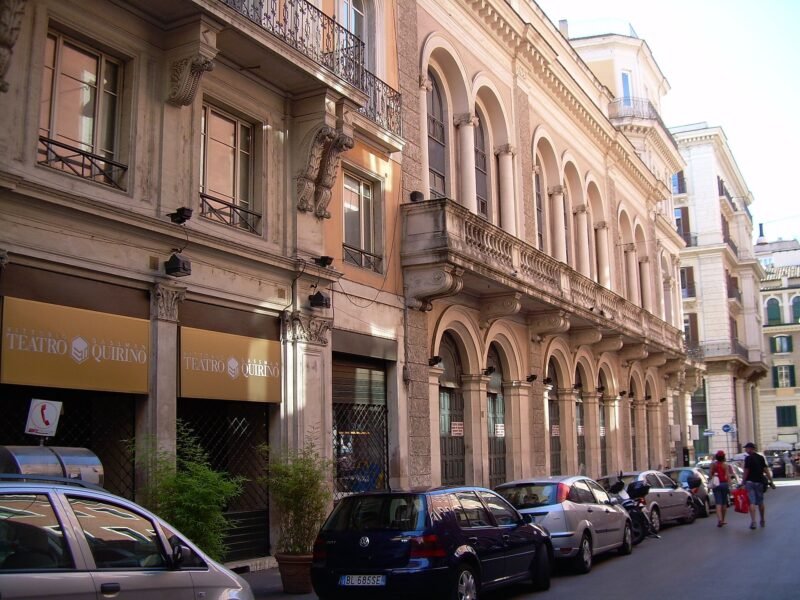
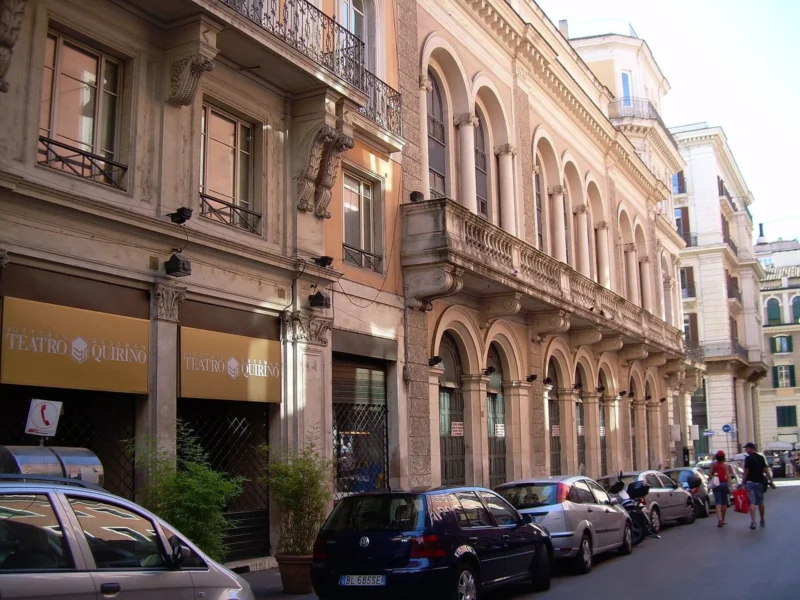
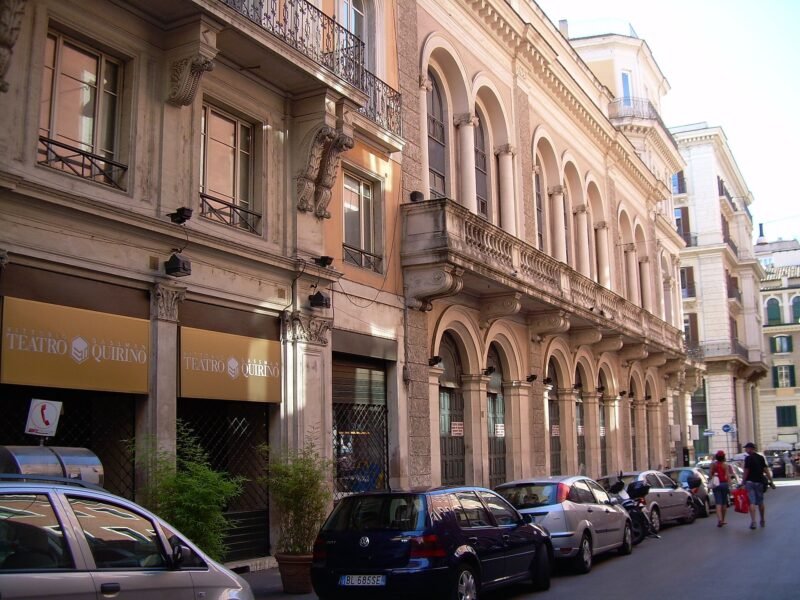
Teatro Quirino is a horseshoe-shaped hall with two balconies and a gallery, seating 852, in the Trevi district. Since 2015 it has been run by Quirino srl, with Guglielmo Ferro as artistic director.
Born in wood
The first Quirino was commissioned in 1871 by Prince Maffeo Barberini Colonna di Sciarra, inside the Palazzo Sciarra property, with an entrance on Via del Corso reaching almost to the Trevi Fountain. It was built entirely of wood, designed by Giulio De Angelis with Francesco Marra, and by tradition was raised in a single day. The name recalls the Quirinal and the god Quirinus. The repertoire was popular: Pulcinella farces and operettas.
Reconstruction in masonry
In 1882 the opening of a street between Via del Corso and the Trevi Fountain forced it to be taken down. De Angelis rebuilt it a few meters away, in masonry: horseshoe shape, two tiers of boxes, a metal structure with neoclassical cast iron columns. In 1898 came drapes, velvets and gilded stucco, and with them opera and ballet.
Piacentini's hands
In 1914 Marcello Piacentini lowered the orchestra to add a third tier of boxes and fitted the hall with a retractable roof. In 1954, 40 years later, he returned with a more radical intervention: cantilevered tiers, 990 seats, the offices of the Ente Teatrale Italiano and the canopy still seen at the entrance. The profile of the place is on our page on Teatro Quirino.
One thing nobody tells you about Il giuoco delle parti with Pippo Pattavina at Teatro Quirino, February 9 to 14, 2027
What is rarely said is that Il giuoco delle parti, at the Quirino, opens a small Sicilian cycle. A week after the last performance, from February 16, the same stage hosts the first stage adaptation of Il commissario Montalbano, with Vincenzo Pirrotta. And Pippo Pattavina, in the TV series based on Andrea Camilleri's novels, was the principal Burgio. Camilleri, for his part, grew up under Pirandello's sign: his paternal grandmother was a first cousin of the playwright, and as a director he staged mostly his plays. Those who follow the Quirino in February can go in two weeks from Pirandello to Camilleri, with an actor as the bridge.
The second thing concerns the times. At the Quirino the performances change time every day, and in this short week it counts even more: on Thursday you go to the theater at 17:00, on Wednesday at 19:00, on Friday and Saturday at 21:00. Those who buy in a hurry, taking the evening time for granted, risk finding the hall already closed. It is best to check the ticket twice.
Third thing: the cast beside Pattavina is, for now, listed by the theater as being finalized. For a show built on a triangle, the name of whoever plays Silia and Venanzi matters. Those who want to know before choosing a date would do well to recheck the theater's page in the weeks before.
How to get to Teatro Quirino
Teatro Quirino, at Via delle Vergini 7, is in the Trevi district between Via del Corso and the Trevi Fountain, in the historic center. It is reached on foot from the Barberini and Spagna stops of Metro Line A.
By Metro Line A
From Barberini you go down Via del Tritone toward Via del Corso and, near the Trevi Fountain, enter the district's little streets to Via delle Vergini. From Spagna you cross the Tridente to Via del Corso. The route is a little longer but passes through some of the most beautiful streets of the center.
By bus
Many surface lines run along Via del Tritone and Via del Corso or stop around Piazza Venezia. The fastest combination depends on the starting point: the Atac route planner shows it in real time, detours included.
By car and taxi
The historic center is a limited traffic zone, so the car must be left outside the ZTL. For the Thursday and Sunday matinees, with older people, a taxi to the mouth of Via delle Vergini is the most comfortable choice.
The advice I give you for visiting Il giuoco delle parti with Pippo Pattavina at Teatro Quirino, February 9 to 14, 2027
The advice is to reread the plot before going in, at least in outline. Il giuoco delle parti is a text of words, dense with reasoning, in which the final twist is entirely logical: Leone wins because he understood the mechanism before the others. Knowing in advance where the story goes spoils nothing. On the contrary, it lets you enjoy Leone's moves the way you enjoy the moves of a chess game whose result you know. Wikisource hosts the full text for those who want to go further.
The second piece of advice concerns the seat. The Quirino's horseshoe hall is compact enough to let you follow faces from the front rows of the orchestra and the first balcony. In a show the presentation describes as made of tensions, ambiguities and unspoken truths, in our view it is best to sit close, because Leone's coldness comes through looks more than lines.
Third piece of advice: if possible, book Il commissario Montalbano too on the same trip, from February 16. The two evenings, a week apart, show two Sicilian ways of looking at justice and social masks: Pirandello's reasoned and cruel one and Camilleri's ironic and human one.
Another well-known fact, yet rarely mentioned
It is well known that Il giuoco delle parti is one of Pirandello's most staged texts. Less remembered is that there is a significant television version: Rai made it in 1970, directed by Giorgio De Lullo and starring Romolo Valli, Rossella Falk and Carlo Giuffrè, and aired it on April 28 of that year. It was part of the productions devoted to drama and tried to hold together fidelity to the text and television language. It is the reference against which, even today, every new Leone Gala is measured.
A second well-known and little-cited fact concerns publication. Before reaching book form, Il giuoco delle parti appeared in 1919 in Nuova Antologia, the Florentine magazine, and in the same year in the Fratelli Treves editions: a double release that says how much Pirandello, in those years, was already an author contested between magazines and publishers.
Finally, a detail about Leone's servant. Filippo, the domestic with whom the master discusses philosophy, is nicknamed Socrates. It is an irony Pirandello builds to show how much Leone's philosophy is a game, performed before an audience of one.
The Trevi district around the Quirino
Teatro Quirino is in the Trevi district, between Via del Corso and the Quirinal. In a few minutes on foot you reach the Trevi Fountain, the Quirinal Palace, Piazza Colonna and the Galleria Alberto Sordi.
The fountain
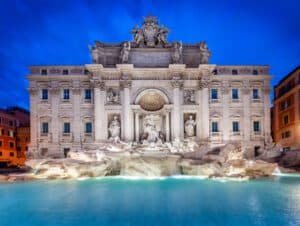
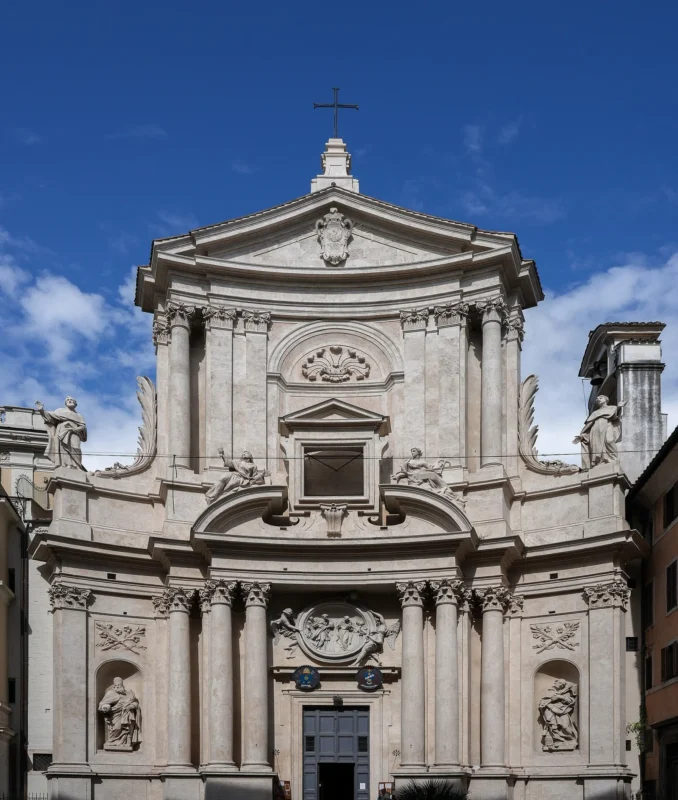
The Trevi Fountain is a few dozen meters from the entrance, so close that the first Quirino, in 1871, reached almost to the basin. In front of the fountain is the church of Santi Vincenzo e Anastasio a Trevi.
The Quirinal
Climbing the district's little streets you reach the square of the Quirinal Palace, with one of the widest views over the rooftops of the center. Opposite are the Scuderie del Quirinale, venue for major exhibitions. A visit before the Thursday or Sunday matinee is a good plan for a February day.
Via del Corso and Piazza Colonna
Going down toward Via del Corso you pass Palazzo Sciarra, on whose property the first theater was born. A little farther north opens Piazza Colonna, with the column of Marcus Aurelius, and across the street the Galleria Alberto Sordi, a useful shelter on rainy evenings.
The right photo to take at Il giuoco delle parti with Pippo Pattavina at Teatro Quirino, February 9 to 14, 2027
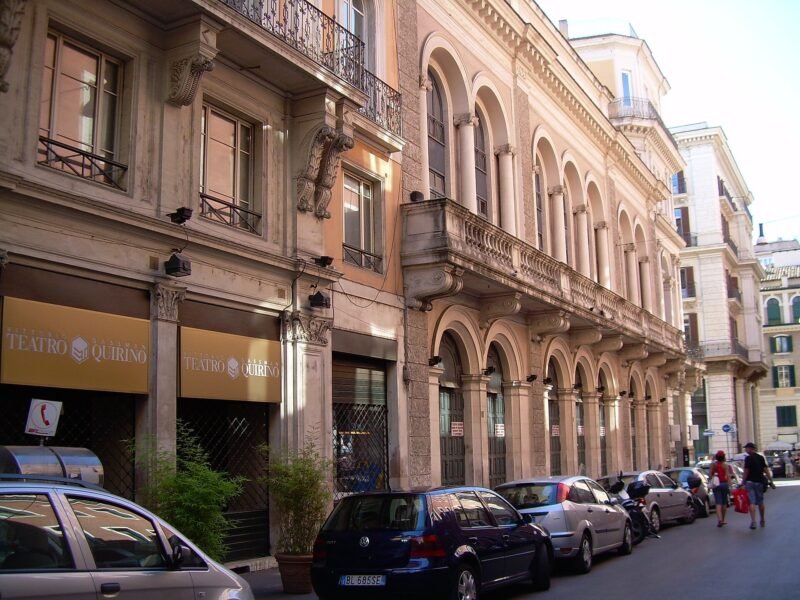
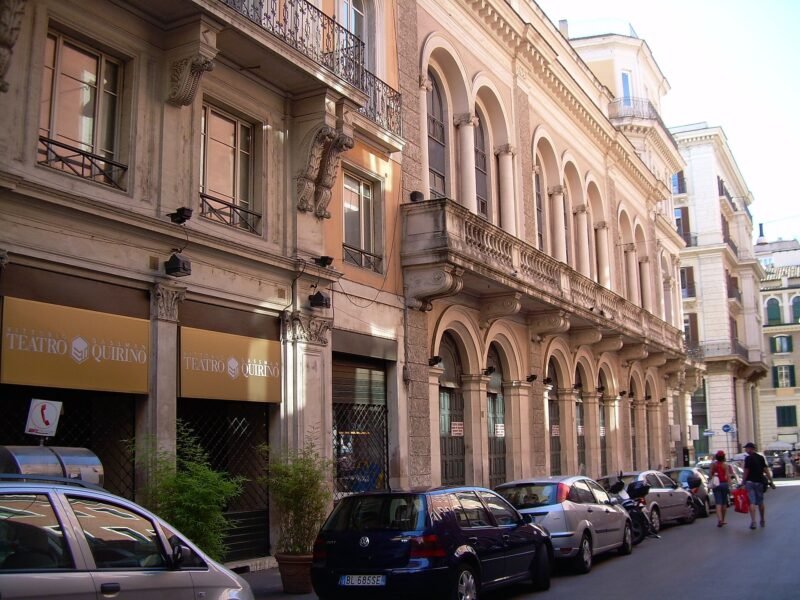
The right photo is taken outside, under the canopy that Marcello Piacentini added to the entrance in the 1950s and that remains the most recognizable sign of the facade. With the sign lit and the show poster bearing Pippo Pattavina's name, it is the image that tells the evening: a 19th-century theater on a small street in the center, a few steps from the most famous fountain in Rome.
In the hall, no photographs during the show. The theater rules ask it and the text asks it, built on pauses and silences in which a flash would ruin the tension for everyone. Before the start, if staff allow, a flash-free shot of the horseshoe hall from the balcony captures the 19th-century structure with the boxes renewed by Piacentini.
The second photo is taken at the Trevi Fountain, on the way out. After the Thursday or Sunday matinee, around 19:00, in February it is already dark and the fountain is lit. The artificial light on the facade of Palazzo Poli gives a different image from the daytime one, with fewer people on the side steps.
Some important events that took place here in history
The history of Teatro Quirino spans over 150 years of Rome as capital. In 1871, with Rome just made capital of the Kingdom, Prince Maffeo Barberini Colonna di Sciarra had a wooden theater built on the Palazzo Sciarra property, to a design by Giulio De Angelis and Francesco Marra. The repertoire was popular: Pulcinella farces, operettas, shows for a neighborhood audience.
In 1882 the theater was taken down to open a street between Via del Corso and the Trevi Fountain and rebuilt in masonry a few meters away. In 1898 the interiors were enriched with drapes, velvets and gilded stucco, and the program opened to opera and ballet. In June 1899 the conductor Antonino Palminteri led Verdi's I Lombardi alla prima crociata and Puccini's Manon Lescaut there.
In 1914 came Marcello Piacentini's first intervention, with the third tier of boxes and the retractable roof. From 1946 the theater was run by the Ente Teatrale Italiano, which also housed its offices there. In 1954 Piacentini returned for a deep remodeling, and the Quirino reopened on October 13, 1955. In 2009 management passed to Geppy Gleijeses's Gitiesse Artisti Riuniti, in 2015 to Quirino srl, with Guglielmo Ferro as artistic director. Today the Quirino is also a production center, and names its hall after Vittorio Gassman.
Who has played Il giuoco delle parti with Pippo Pattavina at Teatro Quirino, February 9 to 14, 2027
Through Teatro Quirino have passed first of all the men who built and transformed it: Prince Maffeo Barberini Colonna di Sciarra, who commissioned it, Giulio De Angelis, who designed it twice, in wood and in masonry, and Marcello Piacentini, who renewed it in 1914 and redesigned it in 1954. On the podium, in June 1899, stood Antonino Palminteri with Verdi and Puccini. And on the facade today is the name of Vittorio Gassman.
Among recent directors are Geppy Gleijeses and Guglielmo Ferro. For Pippo Pattavina the name of Ferro carries particular weight: Guglielmo is the son of Turi Ferro and Ida Carrara, and it was Turi Ferro who wrote L'isola dei pupi, the show with the Stabile di Catania company that gave Pattavina his fame. Today's Quirino, run by the son, thus welcomes one of the actors who grew up in the father's season.
Passing through the Quirino this season are also Il viaggio di Francesco and, right after Pirandello, Il commissario Montalbano with Vincenzo Pirrotta. From February 9 to 14 pass Pippo Pattavina, seven actors, director Gianpaolo Romania and, through the text, Leone Gala, Silia, Guido Venanzi and the servant Socrates: four characters prisoner of their parts in a theater that, more than many others, has changed shape without changing name.
Pirandello and the theater of masks
Il giuoco delle parti belongs to the heart of Luigi Pirandello's theatrical output, the one in which the social mask becomes the real subject of the drama.
Parts as masks
The title itself is a statement of poetics: everyone has a part to play, husband, wife, lover, and tragedy is born when someone takes their part too seriously or, like Leone, plays it with perfect lucidity. The Quirino's presentation insists on this point: the characters are pawns that are aware and at the same time prisoners.
The game of reason
Leone is a character who reasons all the way through. His final victory is a masterpiece of logic, and precisely for that reason it is empty. It is the same lesson Pirandello entrusts to other characters of his: reason can win the game, but does not give life back.
A thread to Uno, nessuno e centomila
Pattavina recently played Vitangelo Moscarda, the protagonist of Uno, nessuno e centomila, the man who discovers he is not to others what he believes himself to be. Leone Gala is his opposite and his brother: he knows perfectly well how others see him, and uses that knowledge as a weapon.
Who to take to see Il giuoco delle parti
Il giuoco delle parti is a show for an adult audience, suited to Pirandello fans and to those looking for a theater of words, made of psychological tension more than action.
With students
Pirandello is a school-syllabus author, and seeing one of his comedies on stage helps more than many pages of textbook. In our view the show suits the last years of high school, for students who have already met the author in class. The Thursday matinee is the most convenient time.
For lovers of Sicilian theater
For those who follow Catania theater, seeing Pattavina in Rome in a major Pirandello role is a rare opportunity, especially in a run of only six evenings.
As a couple
It is a comedy about a marriage, a lover and a husband who sees everything. In our view it is also an excellent conversation topic for a dinner for two after the show.
Teatro Quirino accessibility
For the conditions of access to the hall and seats dedicated to people with disabilities, the reference is the Teatro Quirino box office, at the contacts published on the official website, which also has a page devoted to accessibility.
Before booking
The Quirino is a historic theater, reworked several times: it is best to ask which sectors can be reached without stairs before choosing a seat.
Getting there
The streets of the Trevi district are paved with sampietrini (cobblestones) and often crowded. For those who have trouble getting around, a taxi to the entrance is the safest choice, especially for the matinees.
Where to eat near Teatro Quirino
The Trevi district is full of places, but many are designed for the tourists who crowd the fountain: to eat well before or after the show it is best to move a few streets away.
Before the matinee
For a lunch before 17:00 the streets between Via del Corso and the Pantheon offer trattorias and bakeries. It is best to avoid places with the menu photographed in the window on the busiest squares.
With the 19:00 performance
On Wednesday the 10th the show begins at 19:00. You come out in time for a real dinner, without staying out late.
After the evening show
After the 21:00 performances dinner becomes a post-theater meal. The Pantheon area, 10 minutes on foot, stays lively late even on weeknights.
February in Rome, between theater and Carnival
The week of February 9, 2027 falls in the middle of the Roman winter: short days, cool evenings, fewer crowds at tourist sites than in spring.
The weather
The matinees let you leave the theater with the last light or shortly after. For the evening shows a coat and comfortable shoes for the sampietrini are advisable.
A theater week
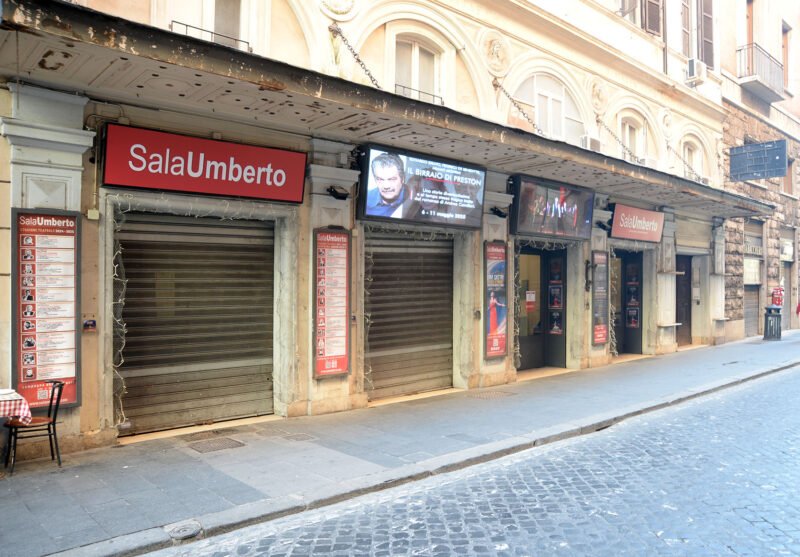
The center in February offers a unique concentration of halls: the Quirino, the Sala Umberto 10 minutes on foot away, the theaters on Via del Corso and around. Those who stay in town a few days can build a small theater program without taking transport.
Frequently asked questions about Il giuoco delle parti at the Quirino
When does Il giuoco delle parti play at Teatro Quirino?
Il giuoco delle parti with Pippo Pattavina plays at Teatro Quirino in Rome from February 9 to 14, 2027, with six performances: Tuesday the 9th, Friday the 12th and Saturday the 13th at 21:00, Wednesday the 10th at 19:00, Thursday the 11th and Sunday the 14th at 17:00.
Who acts in Il giuoco delle parti at the Quirino?
In Il giuoco delle parti at Teatro Quirino the lead is Pippo Pattavina, as Leone Gala. The theater lists a cast of seven actors still being finalized. Direction is by Gianpaolo Romania, and the production is by the Associazione Culturale Progetto Teatrando.
What is Il giuoco delle parti about?
Pirandello's Il giuoco delle parti tells of Leone Gala, a lucid and detached husband, his wife Silia and her lover Guido Venanzi. Silia tries to have her husband die in a duel, but Leone reverses the plan: it is the lover who must fight. Reason wins, and leaves emptiness.
How much do tickets cost?
Ticket prices for Il giuoco delle parti are published by Teatro Quirino in the tickets and subscriptions section of the official website. For reservations and phone purchases the remote box office answers at 06 6794585, Monday to Friday from 10:00 to 13:00 and 14:00 to 18:00.
When was Il giuoco delle parti written?
Il giuoco delle parti was written by Luigi Pirandello in 1918, from the 1913 short story Quando si è capito il giuoco, and published in 1919 in Nuova Antologia and by Fratelli Treves. It is cited in Sei personaggi in cerca d'autore.
How do I get to Teatro Quirino?
Teatro Quirino, at Via delle Vergini 7, is in the Trevi district, a few steps from the Trevi Fountain. You get there on foot from the Barberini and Spagna stops of Metro A, driving is discouraged because the historic center is a limited traffic zone.
Who is Pippo Pattavina?
Pippo Pattavina, born in Lentini in 1938, is a Sicilian actor known for Turi Ferro's L'isola dei pupi, for the pair with Tuccio Musumeci and for the principal Burgio in the TV Commissario Montalbano. He has played Pirandello several times.
The final advice on Il giuoco delle parti at the Quirino
A great Pirandello text, a Sicilian actor with a long career between Catania and the great stages, a 19th-century hall a stone's throw from the Trevi Fountain, and only six evenings to see them together. The advice is to choose the date early, checking the time carefully since at the Quirino it changes every day, to take a seat near the stage so as not to miss Leone Gala's coldness, and to keep an evening free the following week for Pirrotta's Montalbano: February at the Quirino, this year, speaks Sicilian.
Article written by the editorial team of Tour Leader Pro, contact them for Private/Corporate/V.I.P. Tours and Experiences.
Planning a trip to Rome? The English guides to visiting the city are on ItalyPlanner.com.
Contact Information
Nearby
 Teatro Quirino Vittorio Gassman100 m
- Galleria Sciarra100 m
- Vicus Caprarius, the City of Water100 m
- Fontanella degli innamorati100 m
- Trevi Fountain100 m
- Church of San Marcello al Corso100 m
Upcoming events nearby
- L’inconveniente with Milena Vukotic at Teatro Quirino, January 19 to 31, 2027100 m
- L’uomo, la bestia e la virtù with Vanessa Gravina at Teatro Quirino, March 16 to 21, 2027100 m
- Le serve with Fioretta Mari at Teatro Quirino, March 9 to 14, 2027100 m
- Rosso Malpelo with Enrico Guarneri at Teatro Quirino, February 2 to 7, 2027100 m

You might also like
- Il commissario Montalbano with Vincenzo Pirrotta at Teatro Quirino, February 16 to 28, 2027
- Priscilla, La regina del deserto, the musical at Teatro Sistina, from February 10, 2027
- Figli maschi by Centouno at Teatro Sala Umberto, February 16 to 28, 2027
- Don Giovanni with Simone Toni and Enzo Paci at Teatro Sala Umberto, February 2 to 14, 2027
- Totalmente incompatibili, Nuzzo and Di Biase at Teatro Sistina, January 22-24, 2027
- Captivo by Gianfranco Gallo at Teatro Sala Umberto, January 13-24, 2027