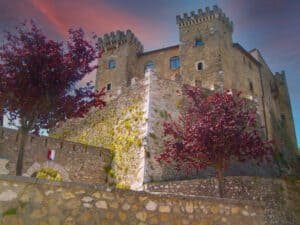
Lariano (RM)
In short. Lariano sits on the provincial road that climbs from Velletri toward the Lepini Mountains, about 30 kilometers from Rome, and the town hall is at Via Santa Eurosia 1, in the center of town.
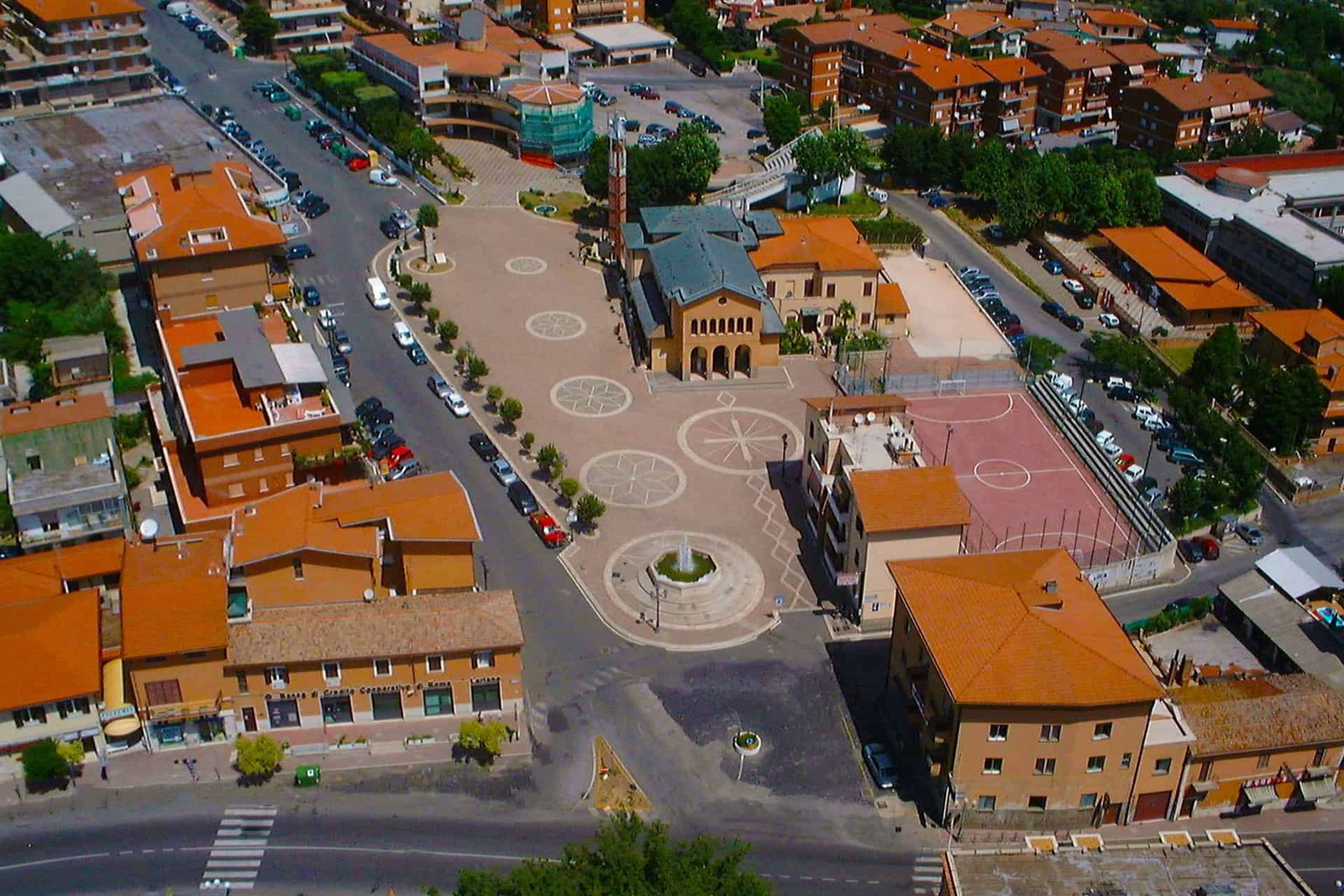
Lariano sits on the provincial road that climbs from Velletri toward the Lepini Mountains, about 30 kilometers from Rome, and the town hall is at Via Santa Eurosia 1, in the center of town. The municipality has a little over 13,000 residents, the postal code is 00076, the built-up area stretches around 350 meters above sea level and the highest point of the territory is Maschio d'Ariano, at 891 meters. There's no ticket to pay: it's a town, you just walk in, and parking is free almost everywhere except on festival days, when the municipality opens dedicated areas along Via Sausset-les-Pins and Via G. Mechelli. By car from Rome you take Via Appia as far as Velletri and then climb, or you exit at Valmontone from the A1 motorway and head down toward Artena. By train you get to Velletri on the FL4 line and continue by the Cotral bus that terminates at Lariano, Piazza Brass. The peak season is September, when the Sagra del Fungo Porcino fills the town, but the bread can be bought all year and the bakeries open early in the morning.
Anyone who comes to Lariano for the first time usually comes for two reasons: the bread and the mushrooms. They are two good reasons, and neither is a tourist invention. But the town deserves a few more hours than a food stop, because the woods around it hide the ruins of one of the most contested fortresses of medieval Lazio and a village carved into the tuff that almost nobody visits. The whole territory falls within the Castelli Romani Park, and this explains why the chestnut grove reaches up to the last houses.
Where Lariano (RM) is and how to get there from Rome
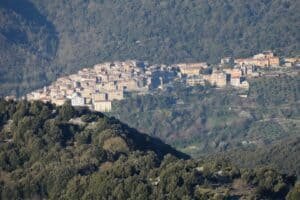
Geographically Lariano occupies the eastern slope of the volcanic complex of the Alban Hills, on the foothills of the Artemisio range, at the southern edge of the crater. It borders Velletri to the west, Artena to the east, Rocca di Papa and Rocca Priora to the north, and Cori to the south. It's a hinge position: from here you can see the Castelli basin and the start of the Pontine plain at the same time, and anyone driving south suddenly notices the landscape change.
By car to Lariano (RM)
The simplest road is Via Appia Nuova, State Road 7, as far as Velletri, then the climb toward the town following the signs for Lariano and Artena. From south Rome it's about 40 minutes without traffic and a good hour at rush hour, because the stretch between Albano and Velletri is one of the most congested in southern Lazio. The motorway alternative goes via the A1 with the Valmontone exit, then Artena and finally the provincial road that enters Lariano from the east: it's longer on paper, often faster on weekends. The third option, the most beautiful, is the road of the Castelli: Frascati, Rocca di Papa, Via dei Laghi, then down toward Velletri. It takes longer, you see Lake Albano and cross the woods: if you have a car and half a day, it's the right choice.
By public transport: train and bus to Lariano (RM)
Lariano no longer has an active station. The hub is Velletri, terminus of the FL4 regional line that departs from Roma Termini: the trip takes about an hour and the trains are frequent on Sundays too. From the square outside Velletri station departs the Cotral bus that goes up to Lariano and terminates at Piazza Brass, in the center of town. The route has a handful of stops and under normal conditions takes about 20 minutes. Schedules change between the school period and the summer, and on Sundays the runs thin out a lot: it's best to check the updated timetable on the carrier's website before leaving, especially for the evening return, because the last useful run to Velletri is earlier than you'd imagine.
How much time you need to see Lariano (RM)
Half a day is enough for the town: a walk around the center, the church, the bakery, a stroll to the viewpoint. A full day is needed if you climb Maschio d'Ariano, and in that case the math is different, because the full trail from the valley floor takes about four hours round trip. The advice: combine Lariano with Velletri in the same outing. The two towns have a shared and conflictual history, and understanding one without the other is like reading half a letter.
Lariano (RM) by the numbers
The municipality of Lariano belongs to the Metropolitan City of Rome Capital, the phone area code is 06, the population is over 13,000 and the density is high for a mountain municipality because the built-up area is all concentrated in the basin, while the rest of the territory is woodland. The climate is mild with rainy winters, annual rainfall is around 1,200 millimeters and in summer the mercury can touch 35 degrees Celsius on the valley floor, but at altitude you can breathe. The patron saint is Saint Eurosia. The oldest twinning, since 1980, is with Sausset-les-Pins in Provence, and it isn't a decorative detail: the street that bears the name of the French town is the one where you park in summer for the festival.

The homemade bread of Lariano (RM)
Lariano bread is the product that has carried the town's name across half of Lazio, and it's recognized among the traditional agri-food products of the Lazio Region. It's not a European designation: it's a regional recognition that certifies an established production tradition, and the difference matters, because anyone who tells you it's a Community trademark is telling you something that isn't true. The classic shape is a large loaf, dark outside and in, with a thick crust that crackles under the knife and a compact crumb of amber color.
How Lariano (RM) bread is made
The declared ingredients are four: whole-grain soft wheat flour, type 00 flour, natural yeast, water and salt. The sourdough starter is the key to the whole business. It is renewed day by day in the family bakeries, and the long rise explains both the slight acidity you notice on the palate and the keeping time of the bread, which unlike the Roman rosetta lasts several days without becoming inedible. The dough is worked with methods that the town's bakers declare unchanged for over two centuries, with a long resting phase and a hand shaping that leaves the loaf deliberately irregular.
Why the chestnut wood oven changes the result
Baking takes place in wood-fired ovens fed with bundles of chestnut, and this is the point where geography and cooking coincide. The chestnut grove covers a large part of the slopes of the Artemisio, the wood has been zero-kilometer for centuries, and chestnut has a combustion that produces a lively flame and then a long ember: in a few minutes the loaf gets its dark crust and then bakes slowly in the residual heat of the vault. Anyone who has tasted the same dough baked in an electric oven notices right away. The light smoky aroma is missing, and the crust comes out thinner.
How to eat Lariano (RM) bread and how long it lasts
This bread stands up to strong flavors. It goes with meats, with cured meats, with aged pecorino cheeses, with bean soup. Fresh, its natural destination is bruschetta: a thick slice, toasted over the embers, garlic rubbed on, and new oil. From the second day it gets better in soups, and on the fourth day it's grated for panzanella or used in meatballs. A clear opinion, after many breakfasts eaten here: buy the whole loaf and not the sliced half kilo. The big loaf dries out more slowly, and Lariano bread sliced in advance loses half its point in 24 hours.
Where to buy bread in Lariano (RM)
The town's bakeries are several and almost all family-run, spread between the center and the access roads. They open very early, and the local rule is simple: the best bread is the first batch of the morning. On holidays and during the festivals the loaves are gone before noon. Be wary of stalls that sell Lariano bread outside the town without indicating the bakery of origin: the name is used loosely, and not everything that carries that label really comes out of a wood-fired oven in Lariano.

The porcini mushroom and the festivals of Lariano (RM)
Lariano is, together with Velletri, the Lazio capital of the porcino. The reason is ecological before it is gastronomic: the coppiced chestnut grove of the Artemisio, on deep volcanic soil and with 1,200 millimeters of rain a year, is the ideal environment for Boletus, which fruits in two waves, a late-spring one and an autumn one, more abundant. The calendar of the festivals depends on this.
The Sagra del Fungo Porcino of Lariano (RM)
In 2026 the Sagra del Fungo Porcino was held from September 10 to 13, with the stands in Piazza dell'Anfiteatro, a short walk from Piazza Sant'Eurosia. The evenings opened at 21:00 with concerts: Thursday the tribute to Ultimo by Sogni Appesi, Friday the tribute to Claudio Baglioni by Tutti Qui Live, Saturday Zucchero e Derivati, Sunday the multi-artist show Tali e Quali. The food stands operated every evening of the four days, with lunch service as well on Saturday and Sunday. The official price list of the event showed the porcini sandwich at €6, the first course with a drink at €10, the full menu with pasta, sandwich and wine or water at €14, the porcini pizza at €10. A gluten-free option was offered. Free parking was active from September 10 to 15 along Via Sausset-les-Pins and Via G. Mechelli, and the town's shops stayed open until midnight on the 12th and 13th. On Saturday morning, at 8:00, a guided walk in the woods organized by the Pro Loco together with the local hiking groups left from Piazza Martiri della Libertà. For future editions, dates and prices should be checked against the official communications of the municipality and the Pro Loco, because they change from year to year.
The Sagra della Bruschetta with Lariano (RM) bread
The second festival by fame is the bruschetta one, which celebrates the meeting of the local bread and the oil of the Castelli. It's a May festival, tied to the long days and the end of the pruning. The format is the classic village-festival one: slices toasted over the embers in front of everyone, garlic, oil, salt, and the variants with tomato or with mushrooms in oil. It's worth going for a technical reason: it's the only setting where you see Lariano bread treated as a raw ingredient and not as an accompaniment, and the difference between a bruschetta made with that bread and any other one you understand in a single bite.
The other festivals of the year in Lariano (RM)
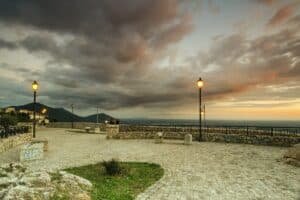
The Lariano calendar also includes the Sagra della Pizza e della Birra in summer, the Festa dei prodotti tipici locali e del Pane di Lariano in the warm season, and the Festa della Polenta in the dead of winter, when the cold of the basin justifies a dish that elsewhere would be out of place. A good part of the events takes place in the esplanade of the Anfiteatro Comunale, which is the real public living room of the town. The exact dates vary every year and are published by the municipality and the Pro Loco: before hitting the road it's worth checking them.
How to eat at the festivals of Lariano (RM) without mistakes
Practical advice from a professional: arrive early at the Lariano festivals. Not at 21:00, when the line at the stands is long and the tables are taken, but at 19:30, just as they open. You eat calmly, finish in time for the concert and get back to the car without crossing the crowd. Second point: the right dish is the simple one. The fettuccine with porcini are worth the trip, the porcini pizza is honest, while the more elaborate preparations at the stands tend to cover the mushroom instead of enhancing it. Third point, less pleasant but true: in the same weeks Velletri also holds its own event dedicated to the porcino, with a longer calendar. They are two distinct events, with two different organizations and two different atmospheres. The Lariano one is smaller, more village-like, and in our judgment more authentic.

A curiosity about Lariano (RM)
The name of Lariano comes from a mistake of popular grammar that lasted centuries. On the mountain above the town, in Roman times, there were one or more villas of the gens Arria, and the Latin toponym that derived from it was Arianum, that is, the estate of the Arrii. When in the Middle Ages the castle became the point of reference of the territory, the locals didn't say Arianum, they said l'Arianum, with the article. Then the article fused to the name, the apostrophe disappeared from pronunciation and from writing, and Lariano came out of it. It's a phenomenon linguists call agglutination of the article, the same one that turned Puglia into Lecce from Lupiae in other contexts and that in Italian produced words like lonza or lusignolo in the old language.
The real curiosity, though, is another: the phenomenon occurred twice, in two opposite directions, in the same territory. The mountain that dominates the town is called Maschio d'Ariano, and there the article did not fuse, because the preposition kept it detached. So today the town is called Lariano with the L, and the mountain that gave it its name is called Ariano without it. Two forms of the same word, 200 meters of elevation apart, frozen in two different stages of the same evolution. Anyone who leads a group here and manages to tell this story in front of the view of the Maschio always gets the same reaction: people look at the mountain in a different way.
I'll add a detail that almost nobody mentions. Local tradition, reported by more than one scholarly source, places in 328 BC the moment when the castle known as the castle of the Algido supposedly took the name Ariano. It's a date to be taken for what it is, that is, a tradition, not a documented fact: no surviving ancient source confirms it, and the first document that names Lariano dates to 1140. But the fact that the town's memory felt the need to give itself such an early date says a lot about how much Lariano cares about its Roman roots.
Maschio d'Ariano, the mountain that gave Lariano (RM) its name
Above the town rises the Artemisio range, the outer rim of the crater of the Vulcano Laziale, which draws a horseshoe around the basin. The highest point of that range is Maschio d'Ariano, 891 meters, and the summit is marked by a metal cross. A little below, Colle del Vescovo reaches 775 meters. From up there, on clear days, the eye takes in at once the Pontine plain, the outline of the Lepini Mountains and, to the north, the whole Castelli basin with the lakes.
The ancients' Mount Algido
For the Romans this relief was mons Algidus, the Algido, and the name already tells you the climate: algidus in Latin means icy. It was a sacred place. Horace (Quintus Horatius Flaccus), in the Carmen Saeculare composed for the ludi saeculares of 17 BC, invokes Diana and names the Algido among the mountains dear to her: the mountain above Lariano thus enters the official poetry of the age of Augustus. The later scholarly tradition placed a temple of the goddess up here, but of that sanctuary there are no remains identified with certainty, and on this point it's wise to be careful: what is documented is the sacred character of the mountain in the perception of the ancients, not a building.
The reason the Algido appears so often in the sources is strategic. Through the pass that the mountain dominates ran the route linking Rome with Campania, and whoever held the pass controlled the traffic. Livy, in his history of Rome, tells that here Romans and Aequi clashed repeatedly for about two centuries: the Algido is one of the recurring names of the archaic war of Lazio, along with Corioli and Praeneste, present-day Palestrina.
The ruins of the castle on Maschio d'Ariano
Of what was the most contested fortress of the Alban Hills little remains: patches of masonry, traces of cuts in the rock, a natural balcony overlooking the void. The demolition was deliberate and complete, and anyone who reaches the top expecting a fortress is disappointed. Those who instead know what they're looking for read the perimeter in the ground, recognize the artificial cuts in the tuff and understand why that spot was worth a war: from there you can see with the naked eye both routes of penetration toward Rome, and in the 15th century that meant power.
The rock village below the summit
The most extraordinary thing about the Maschio isn't at the top, it's just below. Descending the side that faces the Fonte Donzella you come across seven clusters of dwellings carved into the tuff. The first cluster includes five dwellings with articulated floor plans and corridors that penetrate the rock up to seven meters. Inside you can make out niches for oil lamps, flues, storerooms, living spaces. It isn't a cemetery and it isn't a temporary shelter: it's a stable settlement carved into the stone, and you visit it in silence, because there is no custodian, no ticket office and no one to explain it to you. On the slope there are also burials attributed to the Iron Age, a sign that people frequented the mountain long before both the Romans and the medieval castle lords.
The trail to Maschio d'Ariano
You climb from the Velletri side. The classic route starts from the cemetery area, follows Via del Cigliolo and Via Fontana Marcaccio to the Fontana Marcaccio, at an elevation of 630 meters, then takes the dirt road of Via Monte Artemisio, which coincides with the Park's trail 523. After about 20 minutes you reach the Rifugio Monte Artemisio. Continuing for about an hour you arrive at the Valletta del Lupo, where trail 523a bends left and climbs a narrow trench dug in the tuff that leads directly to the ruins. The full loop, rock village included, takes about four hours. There's also a short version, of about five kilometers and two and a half hours, starting from Casa del Parco Rifugio Forestale dell'Artemisio, classified between tourist and hiking: it's the one the Park uses for excursions guided by park rangers, with limited numbers and by reservation.
A warning no brochure will give you. The Artemisio woods in autumn are full of mushroom hunters, and the secondary trails are a maze of tracks identical to one another. If you don't know the area, stay on 523 and 523a, which are marked, and don't improvise shortcuts: phone coverage in some gullies is zero and darkness in the middle of the chestnut grove arrives sooner than the clock suggests.

Something nobody tells you about Lariano (RM)
Lariano is a very young municipality. It was born on August 28, 1967, with a decree of the President of the Republic, number 825, which sanctioned the separation from Velletri. Before that date Lariano did not exist as an entity: it was a hamlet, and its paperwork was done at the town hall in Velletri, seven kilometers away. Visitors take for granted that the town has always been there with its bell tower and its mayor, but in fact its administrative autonomy is more recent than color television in Italy.
The part that is almost never told is how much it cost. The committee for municipal autonomy was formed in 1957: exactly 10 years of administrative battle before the decree. And the decree did not close the matter. After 1967 some citizens of Velletri filed an appeal with the Council of State to obtain the annulment of the creation of the new municipality, and for a period the very existence of Lariano hung on a ruling. The last bureaucratic act of the separation, the cadastral update that definitively detached the Lariano parcels from the Velletri ones, came decades later. Every August 28 the town celebrates the anniversary of autonomy, and in 2026 it was the 59th.
Why does this change the way you look at the town? Because it explains the Lariano identity, which to a distracted visitor looks like parochialism and is instead precise historical memory. Lariano was an autonomous municipality in the Middle Ages, with a castle, a mayor and a population probably larger than that of Marino and Rocca di Papa. It lost everything in the 15th century, when the fortress was razed to the ground and the territory given to Velletri as a war prize. So 1967 is not, for the people of Lariano, the birth of a new municipality: it's the return of something that had been taken away by force five centuries earlier. Said in town, you'll hear this sentence pronounced with a certain intensity.
The history of Lariano (RM)
The historical story of Lariano is that of a contested strategic point, and it reads better if divided into four phases: the Roman estate, the medieval castle, the destruction, the farming town.
The Roman villas and the name of Lariano (RM)
The territory, by position and climate, early attracted the Roman aristocracy, who built country villas here. Finds from this area have ended up in the collections of the Vatican Museums and in the civic museum of Velletri. Among those properties, one or more belonged to the gens Arria, and from there Arianum, then Larianum. The mountain above them had already been famous for centuries as Algido.
Lariano (RM) in the Middle Ages: the rocca praetiosa
The first document that names Lariano is from 1140. Local tradition attributes to a Demetrius, son of Melosius, the rebuilding of the castle in the 10th century, to give safe refuge to the populations during the Saracen raids that in 846 had struck Rome: this too is a piece of scholarly tradition, to be distinguished from archival documentation. What is certain is the role of the fortress in the following two centuries. The castle controlled on one side the Appian route and on the other the Anagni route, and this double view made it the object of the ambitions of the most powerful families of Lazio: the Counts of Tusculum, the Annibaldi, the Savelli and above all the Colonna.
The Roman Church claimed direct dominion over the fortress in the conclave held at Viterbo in 1269, where the castle of Lariano was described as praetiosa, that is, precious: an adjective that in a papal act amounts to a declaration of strategic interest. The territories had already passed under the dependence of the Church in an earlier age, under Pope Alexander III. In 1200 Pope Innocent III judged the place so safe that he had the viscount of Campiglia, a prisoner of the Romans during the war against Viterbo, take refuge there. In 1235 Pope Gregory IX included the fortress among the Castellanies of the Church, and Pope Clement IV entrusted its custody to a Templar knight, Brother Raymond.
On the death of Clement IV, on November 29, 1268, with the papal throne vacant, Ricciardello Annibaldi seized the castle by surprise after raids in the territory. The militias of Velletri, urged on by the College of Cardinals gathered at Viterbo, tried several times to retake it in the name of the Church, and failed. The Colonna, however, succeeded. At the end of the 14th century the fortress belonged to Niccolò Colonna, who held it until the antipope Clement VII handed it over to Giordano Orsini. The Colonna recovered it and kept it until 1412, the year in which Teobaldo Annibaldi managed to reconquer it.
The destruction of the castle of Lariano (RM)
The breaking point comes in the 15th century. In 1417 Cardinal Oddone Colonna ascends the papal throne as Martin V, and in 1427 he assigns the castle in vicariate to his nephew, Cardinal Prospero Colonna. Martin V dies in 1431. His successor, Eugene IV, revokes en bloc the privileges granted by his predecessor to his own family. The Colonna rebel, and the revolt forces the pope to flee Rome by boat along the Tiber, taking refuge first in Florence and then in Bologna. Eugene IV responds with excommunication, which carries confiscation of property: among it, the castle of Lariano with its attached territories.
War breaks out. 8,000 papal infantrymen win back for the Church Albano Laziale, Castel Gandolfo, Civita, Zagarolo and even Palestrina, the Colonna's main fief. Lariano they do not. The pope then sends 4,000 infantrymen to besiege the fortress, and to these are added 800 soldiers from Velletri led by Paolo Annibaldi della Molara. The attack is massed. The defenders barricade themselves, armed, in the church of San Silvestro. The resistance lasts some time longer, until the people of Lariano, exhausted and with no hope of help from other houses, capitulate. On October 26, 1436 Nardo Di Stefano and Cola di Nardo, mayors, come out of the castle as a sign of surrender.
The fortress is set on fire and razed to the ground, and the territory is given by Eugene IV to Velletri in gratitude for the military help. But the matter doesn't end there. In 1447 Pope Nicholas V returns possession to Cardinal Prospero Colonna. In 1458 the place is in the hands of the brothers Prospero and Odoardo Colonna, and Odoardo sells it to his sister Vittoria, who in the same year cedes it to Pius II. It is Pius II who orders the final demolition of the fortress, which Prospero was having rebuilt, and in 1463 the same pope, declaring the demolition accomplished, recognizes possession to Vittoria Colonna and her relatives. In 1493 Alexander VI finally sanctions possession of the ruins to the city of Velletri. The Colonna heirs continued to claim the ground of the fortress, and the Holy See closed the dispute with a partition of the territory between Velletri and the family, fixing the boundary on the summit of the Maschio. Anyone who walks the ridge today crosses, without realizing it, a line drawn by a papal arbitration.
After the fortress: brigands and farmers at Lariano (RM)
After the destruction, the population split. It has been supposed that the men-at-arms accepted relocation to Velletri to continue the soldier's trade, while the farmers stayed where they were born. The present center was born from huts leaning against the slope below the Maschio, which became a true farming center between the end of the 1600s and the early 1700s. In the following centuries the ruins at altitude had a second life as a refuge for brigands: among them the famous Gasperone is remembered, one of the best-known names of brigandage in the Papal States. The wood that today we walk for pleasure was then the place nobody crossed at night.
The railway that passed through Lariano (RM)
A forgotten chapter is the railway one. The Velletri-Segni line was part of the 19th-century project of the Papal States to link Rome to Ceprano and then to Naples: the concession went to the company that operated the Pio Latina, and on January 27, 1862 the tracks reached Segni, with the extension to Ceprano by December of the same year. The route touched Lariano, which had its station. It was a single-track line, never electrified, with the roadbed prepared for a doubling that was never built. From 1892, with the opening of the variant between Ciampino and Segni, the Velletri-Segni was downgraded to a local line. Passenger service ended on February 20, 1957, replaced by buses. Freight traffic continued, on the Velletri-Lariano section, until 1966, and was largely tied to shipments of chestnut timber destined for telegraph poles. The Lariano station building is still standing, with the colors and lettering of the period: it's one of the most photogenic things in town and appears on no postcard.
1967 and the Lariano (RM) of today
The rest is recent history: the decree of August 28, 1967, the appeal to the Council of State, the building of the town hall, the population growth that has taken the municipality past 13,000 residents. The municipal library was founded in 2007 and is part of the consortium of the Castelli Romani library system. The Lariano dialect, very close to that of Velletri, is heard less and less among the young. The local soccer team, Atletico Lariano, carries in its name the year 1963, that is, four years before the municipality existed: a detail worth more than many pages on the identity of this place.
Frequently asked questions about Lariano (RM)
How far is Lariano from Rome and how do you get there?
Lariano is about 30 kilometers from Rome, covered by car in just under 40 minutes without traffic from the southern part of the capital, or in a good hour at rush hour. Without a car you get there by regional train on the FL4 line from Roma Termini to Velletri, then by bus.
How much does it cost to visit Lariano?
Visiting Lariano is cheap: there are no tickets to pay, the town is free, the woods are free and the ruins of Maschio d'Ariano are free. Parking is free, except in the areas managed on event days. At the 2026 Sagra del Fungo Porcino the official price list ran from €6 for the sandwich to €14 for the full menu.
Why is Lariano famous for its bread?
Lariano is famous for its homemade bread, recognized among the traditional agri-food products of the Lazio Region, a regional recognition and not a European trademark. The classic shape is a loaf with a thick crust, whose success carried the town's name across half of Lazio.
When is the Sagra del Fungo Porcino of Lariano held?
The Sagra del Fungo Porcino of Lariano follows the fruiting calendar of Boletus in the coppiced chestnut grove of the Artemisio, with two waves, a late-spring one and a more abundant autumn one, which determine the period of the events dedicated to the mushroom.
Is Lariano suitable for a visit with children?
Yes, the town works well with children for practical reasons: you park and walk on the flat in the center, the Anfiteatro esplanade is an open space where they can run, and on festival days the stands have portions and prices suited even to large families. The climb to Maschio d'Ariano, however, is demanding for children under 10 in the long version.
What is the best time to visit Lariano?
From mid-September to late November is the best season to visit Lariano, for the woods, the mushrooms, the light and the temperature. March, April and May work just as well for walks, with the advantage of the undergrowth in bloom and the drawback of mud on the trails.
What can you see from Maschio d'Ariano above Lariano?
From Maschio d'Ariano, the highest peak of the Artemisio range at 891 meters above Lariano, marked by a metal cross, on clear days the eye takes in at once the Pontine plain, the outline of the Lepini Mountains and, on tramontana days after a weather front, the line of the sea.
My advice for visiting Lariano (RM)
There's only one piece of advice, and it goes against the way almost everyone visits this town: don't come to Lariano on a Sunday afternoon in September. Come on a Tuesday morning in October. I'll explain why, with numbers in hand.
On festival days the town receives in a few hours a number of visitors greater than its residents. The provincial road that climbs from Velletri has one lane per direction, and the result is a queue that starts at the junction and reaches the center. The stands are crowded, the bakeries have run out of bread by noon, the woods are full of people and the trails are walked by those looking for mushrooms. You eat well and have fun, but you see nothing of Lariano: you see a festival, which could take place anywhere.
On a mid-October Tuesday morning the picture changes. The bread comes out of the oven at 7:00, the first batch is still there at 9:00, you park in front of the church, the bar on the square serves a breakfast that costs half what it does in Rome. At 10:00 you set out for the Maschio: the temperature at altitude is perfect, the chestnut grove has the right color, the air after the first rains is clear and from the rock balcony you see the Lepini all the way to the sea. You come back at 14:00, have lunch at a trattoria where you don't need to book, and in the afternoon you go down to Velletri for the civic museum. It's a full day, it costs little and it gives you back the real town.
Second piece of advice, minor but useful: bring a rigid container. If you buy bread and want to bring it home intact, the big loaf in a plastic bag sweats and the crust goes soft. A paper bag inside a canvas tote works better. And if you go up to altitude, wear shoes with a treaded sole: the wet tuff of trail 523a is as slippery as soap. For organized groups and accompanied visits in Lazio you can turn to licensed professionals such as those at TourLeaderPro, who work regularly on these itineraries.
The churches of Lariano (RM)
Lariano doesn't have a monumental ecclesiastical heritage, and anyone who arrives looking for medieval frescoes has the wrong address: the town, let's remember, was born as an aggregate of farm huts after the destruction of the fortress, and its churches tell of a rural devotion, not of aristocratic commissions. This doesn't make them any less interesting, though, because they are documents of a religiosity tied to the work of the fields.
The parish of Santa Maria Intemerata in Lariano (RM)
The parish church is at Piazza Sant'Eurosia 5, belongs to the suburbicarian diocese of Velletri-Segni and serves the whole population of the municipality. The dedication dates to May 5, 1950, so the current building is from the 20th century. The facade has a small portico recalling early Christian churches, a choice of taste consistent with Italian sacred architecture of those years. Inside, the central nave is punctuated by large stained-glass windows with the faces of the apostles, which in the middle hours of the day cast color onto the floor. The titular feast of Santa Maria Intemerata falls on the last Sunday of May. The times of the services change between the summer and winter periods, and should be checked on the parish website or the diocese's.
The Madonna del Buon Consiglio
The town's second church is dedicated to the Madonna del Buon Consiglio and was built in 1785 to meet the needs of the farming population, who lived scattered across the farms and struggled to reach the center. The date is significant: we're in the heart of the 18th century, the farming center has consolidated for less than a century, and a community that builds its second church is a community that is growing. Today it's a shrine linked to the parish, with a Sunday service of its own.
Sant'Eurosia, the patron saint of Lariano (RM)
The patron saint of Lariano is a Bohemian saint who died in Spain, and that alone should arouse curiosity. According to the hagiographic tradition, Eurosia was born around 864 with the name Dobroslava, daughter of a duke of Bohemia, and was raised at the court of Duke Boriboj and Duchess Ludmilla, receiving baptism in 877 among the first Christians of her country. Betrothed to an Aragonese prince, on the journey to Spain in 880 she fell prisoner to a Moorish chief. She refused to renounce her faith and to marry him, and was martyred at about 16 years old. The iconography shows her with severed hands.
How the cult of a Pyrenean martyr arrived in a town of the Castelli Romani is an open question: the most recurring hypotheses involve the Colonna, with their Spanish ties, or Iberian soldiers passing through in the 18th century. What is clear is why it took root. Eurosia is invoked against hail and storms, and a town of farmers and winegrowers clinging to the slope of a mountain, where a June hailstorm wipes out the year's harvest, could not have chosen a more fitting protector. The patronal feast is celebrated at the end of May, and the occasion once also recurred on the last Sunday of October. The diocesan calendar indicates June 25 as the saint's day. The celebrations were accompanied by donkey races, a greased pole, fireworks and visitors from neighboring towns: the feast of Sant'Eurosia was, for generations, the most important day of the Lariano year.
Another well-known fact, yet rarely mentioned
Everyone knows that the Castelli Romani are wine country and that Genzano and Lariano are bread country. Almost no one links the two things to the real cause, which is geological: the soil. The Alban Hills are an extinct volcano, and the volcano left three things that explain the entire economy of these towns.
The first is tuff. A soft rock, it's dug with simple tools: that's why on Maschio d'Ariano there are seven clusters of rock-cut dwellings, that's why the trail climbs inside a trench carved in the stone, that's why throughout the area there are underground cellars. Where tuff outcrops, people dig instead of building, and they've done so for millennia.
The second is fertility. Volcanic soils are rich in potassium and phosphorus, they retain water and drain the excess: the vine thrives there, and the same combination grows a vigorous chestnut grove. The chestnut, in turn, produces two things that matter in Lariano: the wood for bundles and the ideal mycelium for the porcino. All of local gastronomy descends from there.
The third is water. The volcanic complex works like a sponge: rainwater penetrates the porous materials, descends to the impermeable layers and re-emerges in springs along the slopes. The springs that the trails meet, from Fontana Marcaccio to Fonte Donzella, are not colorful episodes: they are the reason a settlement at altitude was possible and a castle could withstand a siege. In 1436 the fortress gave way from hunger and lack of relief, not from thirst.
The rarely cited fact, in essence, is this: the eruption that formed the Vulcano Laziale hundreds of thousands of years ago still determines today what you eat for lunch in Lariano. The bread baked with chestnut wood, the mushroom gathered under that chestnut, the wine of the Castelli: three products, one single cause.
The woods of Lariano (RM) and the Castelli Romani Park
The Castelli Romani Regional Park was established by regional law number 2 of January 13, 1984 and protects about 15,000 hectares spread across 16 municipalities: Albano Laziale, Ariccia, Castel Gandolfo, Ciampino, Frascati, Genzano di Roma, Grottaferrata, Lanuvio, Lariano, Marino, Monte Compatri, Monte Porzio Catone, Nemi, Rocca di Papa, Rocca Priora and Velletri, for a catchment of about 350,000 residents. Almost the entire municipal territory of Lariano falls within the perimeter of the protected area.
The chestnut grove above Lariano (RM)
The dominant formation is the chestnut grove, managed as coppice, that is, cut in rotation to obtain poles and bundles. It's a worked wood, not a virgin forest, and you can see it: the shoots grow in tufts from the old stumps, the logging tracks cut across the slopes. Alongside the chestnut appear beech on the cool exposures at altitude, mixed woods, Turkey oak woods and a Mediterranean undergrowth with viburnum, privet and strawberry tree. Anyone who climbs in November finds the ground covered with burrs: chestnut gathering, where permitted, is another of the town's historic economies.
The animals of the Artemisio
The park's fauna includes porcupine, badger and squirrel among the mammals, buzzard, sparrowhawk and peregrine falcon among the raptors, mallard and gray heron on the water, and among the reptiles the rare Hermann's tortoise. The most significant fact of recent years is the return of the wolf to the protected area. It isn't a danger to those who walk, it's an ecological indicator: an apex predator returns only where the food chain holds. The place name Valletta del Lupo, which the trail crosses, existed long before this return.
Picking mushrooms around Lariano (RM)
Picking epigeous mushrooms in Lazio is regulated: you need an authorization and must respect daily quantity limits, and additional rules apply inside the park. How to obtain the permit card and the permitted quantities should be checked with the municipality and the Park Authority before going out with a basket. A recommendation worth more than any regulation: the porcino has poisonous look-alikes, and no photo identification app is reliable. If you have no experience, buy mushrooms from authorized stalls and leave the woods alone.
The southern Via Francigena and Lariano (RM)
Nearby passes a variant of the southern Via Francigena, the branch that goes down from the Castelli toward Campania and Puglia on the tracks of the ancient route toward the South. It's an itinerary for experienced walkers, not a Sunday stroll: the stages are long, lodging must be arranged in advance and the signage in the wooded stretches is patchy. Whoever walks it crosses exactly the same pass that Roman armies and papal militias fought over for 20 centuries.

The right photo to take at Lariano (RM)
The photograph worth the trip isn't in town. It's from the rock balcony below the ruins of Maschio d'Ariano, at 891 meters, and it's shot looking south. In the foreground the cut edge of the tuff, then the chestnut grove plunging down, then the Pontine plain opening like a table, and at the back the wall of the Lepini Mountains. On tramontana days, after a weather front, you can make out the line of the sea and the outline of Circeo. It's a photograph that explains in a single image why a castle rose here: you see everything, and anyone seen from here can't arrive by surprise.
The right conditions: late October or November, a few hours after rain, with the sky washed clean. The best light is that of late afternoon, when the low-angle sun sculpts the ridges of the Lepini and the chestnut grove turns copper. Watch the return time, though: in that season it gets dark around 17:30, and coming down 523a in the dark is not advised. If you have to choose between perfect light and getting back in daylight, choose getting back.
The second photograph, for those who don't climb, is the old railway station building, with the original colors and lettering still legible. It's a flat-light subject, better on an overcast day, and it gives back a piece of 19th-century Italy that survived by distraction. The third, the easiest, is the row of just-baked loaves on a wooden table: photograph them in side backlight in front of the oven mouth, without flash, and you'll see the crust.
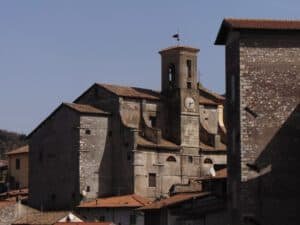
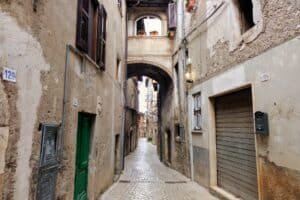
A warning about photography in town: Lariano is not a postcard village. The houses are largely from the second half of the 20th century, the facades have been recently plastered, you won't find medieval alleys because the Middle Ages here were demolished by papal decree. If you're looking for that kind of image, you'll find it at Artena, half an hour away. Better to know it before than after.
A few important events that happened here in history
The first event is from 458 BC, or 457 according to other chronologies, and concerns the mountain above the town. The consul Lucius Minucius Esquilinus Augurinus had let himself be surrounded on the Algido by the Aequi commanded by Gracchus Cloelius. Five horsemen managed to break through the blockade and carried the news to Rome. The Senate appointed Lucius Quinctius Cincinnatus dictator, who according to tradition was called while plowing his own field. Cincinnatus gathered an army, marched by night toward the mountain and in turn surrounded the besiegers with a palisade. The besieged, hearing the din of their own men, counterattacked, and the Aequi, caught between two fires, had to surrender at the end of a night battle that was extremely noisy. Cincinnatus celebrated the triumph and laid down the dictatorship 16 days after assuming it, on a mandate that provided for six months. It's the founding episode of an entire Roman political ethic, and the main source is Livy. It must be said honestly that the identification of the Algido with the Maschio of Lariano, though the current one, is not an archaeological certainty: the Mount Algido of the sources has not been located with definitive documentary proof, and it is still a matter of debate.
The second event is from November 29, 1268 and the following months. With the papacy vacant after the death of Clement IV, Ricciardello Annibaldi seized the fortress in a coup de main. A military campaign followed, conducted by the militias of Velletri on behalf of the College of Cardinals gathered at Viterbo, a campaign that failed. It is in that context that, in the Viterbo conclave of 1269, the castle of Lariano is described as praetiosa in an official act of the Church: a rare case of an adjective of value attributed to a fortress in a papal document.
The third event is from October 26, 1436, and it is the end of medieval Lariano. After a siege conducted by 4,000 papal infantrymen reinforced by 800 men from Velletri, with the last defenders barricaded in the church of San Silvestro, the mayors Nardo Di Stefano and Cola di Nardo came out of the castle as a sign of surrender. The fortress was burned and demolished. It was not a decisive battle for the history of Italy, but it was decisive for this territory: it erased a municipality and created the conditions for its rebirth five centuries later.
The fourth event is from May and June 1944 and again concerns the mountain. The Artemisio range lay on the Caesar Line, the last German barrier before Rome, which ran from the Tyrrhenian to the Adriatic and which the Germans garrisoned with two infantry divisions, the 4th Parachute Division and elements of the Hermann Goering armored division. In the context of the Allied operation that led to the breakthrough, the American general Fred Walker identified through aerial reconnaissance an unguarded gap along the Artemisio, and through that gap the American troops outflanked the German defenses concentrated on the main roads. The fighting took place between May 23 and June 2, 1944. The bombing of May 22 caused more than 300 civilian victims at Velletri, and the historic center of Velletri was devastated. The liberation of Rome came on June 4. The ridge that today we walk in trekking shoes was, for 10 days, the linchpin of the Italian campaign.
The fifth event has no battle date, but it is perhaps the one that changed the town's daily life the most: August 28, 1967, the decree of the President of the Republic number 825 that created the Municipality of Lariano by detaching it from Velletri, after 10 years of work by the committee for autonomy and before a dispute before the Council of State.
Who has passed through Lariano (RM)
Let's start with the most illustrious in the literary sense: Horace (Quintus Horatius Flaccus). There is no record that he set foot on the mountain, but he named it, and it is a naming of rank. In the Carmen Saeculare, the hymn commissioned by Augustus for the ludi saeculares of 17 BC and sung by a chorus of children on the Palatine, Horace invokes Diana and calls up the Algido among the places of the goddess. Thanks to those verses the mountain above Lariano entered the official poetic liturgy of the empire. Whoever looks at the peak from the town square is looking at a mountain that has a place in Latin literature.
The second is Livy, who wrote the chronicle of these places. In his history of Rome the two centuries of clashes between Romans and Aequi have the Algido as their recurring theater, and the account of the Cincinnatus episode is owed to him. Through Livy, anyone who studied Latin in high school has met this mountain without knowing where it was.
Then come the popes, and there are many. Alexander III, under whom the territories passed into dependence on the Church. Innocent III, who in 1200 chose the fortress as a safe prison for the viscount of Campiglia. Gregory IX, who in 1235 listed it among the Castellanies of the Church. Clement IV, who entrusted its custody to the Templar knight Brother Raymond. Martin V, that is, Oddone Colonna, who in 1427 assigned it in vicariate to his nephew. Eugene IV, who excommunicated it together with its masters and had it razed to the ground. Nicholas V, who in 1447 returned it to the Colonna. Pius II, who in 1458 ordered its final demolition and in 1463 certified its completion. Alexander VI, who in 1493 assigned the ruins to Velletri. Nine pontiffs who personally dealt with a fortress on a mountain of 891 meters: few places in Lazio can claim such insistent papal attention.
Among the laity, the great houses: the Counts of Tusculum, the Annibaldi with Ricciardello and with Teobaldo who reconquered the castle in 1412, the Savelli, the Orsini with Giordano, and above all the Colonna, from Niccolò at the end of the 14th century to Prospero, Odoardo and Vittoria in the 15th. The same Vittoria Colonna who appears in the acts of 1458 and 1463 is a name that recurs, and for clarity it must be said that she is not the poet friend of Michelangelo, who lived a century later and belonged to another branch of the family: the namesake often misleads.
Finally there is the least respectable and most popular figure: Gasperone, the brigand who in the 19th century made the castle ruins one of his hideouts. Antonio Gasbarrone, that was his name, is the best-known figure of papal brigandage, and his presence among these ruins belongs to the oral memory of the territory before it belongs to documents. And there are, in June 1944, the American soldiers of the Fifth Army who climbed through the Artemisio gap: none of them knew they were walking Cincinnatus's pass.
What's around Lariano (RM)
Velletri, the older sister
Velletri is seven kilometers away and is the key to understanding Lariano. An ancient city, capital of the Volsci, suburbicarian diocesan seat, it has a civic archaeological museum where materials from the territory have ended up. It was Velletri that received the ruins of the fortress as a gift in 1436, and it was from Velletri that Lariano separated in 1967. Visiting one after the other on the same day is the smartest way to spend your time around here.
The lakes and the towns of the crater
At 20 minutes by road to the north you enter the volcanic part of the Castelli: Nemi with its lake and its wild strawberries, Genzano di Roma with the infiorata and its bread, the historic rival of Lariano's, Ariccia with the bridge and the porchetta, Albano Laziale with the remains of the Castra Albana, Castel Gandolfo overlooking Lake Albano, Marino with the grape festival. Higher up, Rocca di Papa and Rocca Priora, the two highest towns of the group.
Toward the Lepini and the Sacco Valley
To the east and south the landscape changes: Artena with its vertical historic center closed to cars, Segni with the polygonal walls and the Porta Saracena, Cori with the Temple of Hercules. They are three places that the standard Castelli itineraries ignore and that are each worth half a day. Anyone organizing a trip to Rome who wants to add a day outside the city can also read the English-language guides on the capital and its surroundings on ItalyPlanner.
Lariano (RM) with children
The town works well with children for practical reasons: you park, you walk on the flat in the center, the Anfiteatro esplanade is an open space where they can run, and on festival days the stands have portions and prices suited even to large families. The climb to Maschio d'Ariano is another matter: in the long version from the valley floor it's demanding for children under 10, while the short variant from the Rifugio Forestale, about 5 kilometers round trip, is within reach of a child used to walking. Bring water, because at altitude the springs aren't always active, and a change of clothes, because the damp undergrowth gets things dirty. The rock village is very popular with kids, who find it a place to explore: for exactly that reason keeping them in sight is necessary, because the cavities are deep and not protected by anything.
When to go to Lariano (RM) and when to avoid it
From mid-September to late November is the best season, for the woods, the mushrooms, the light and the temperature. March, April and May work just as well for walks, with the advantage of the undergrowth in bloom and the drawback of mud on the trails. July and August on the valley floor are hot, with peaks that approach 35 degrees Celsius and beyond, and it's best to do the climb early in the morning. December and January are for those who love the empty town: you come for the bread, for the polenta, for a warm trattoria, not for the views, because cloud cover on the Artemisio in those months is frequent.
To avoid, if you're looking for the town and not the festival: the four days of the Sagra del Fungo Porcino and the October weekends with good weather, when the road toward the woods is a procession of cars of mushroom hunters. Also avoid the day after a major storm, because 523a in the stretch dug into the tuff becomes one continuous slide.
How much you spend in Lariano (RM)
Lariano is one of the least expensive places in the Rome belt. There are no tickets to pay: the town is free, the woods are free, the ruins are free. Parking is free, except in the areas managed on event days, which anyway during the 2026 festival were indicated as free. At the Sagra del Fungo Porcino the official 2026 price list ran from the €6 sandwich to the €14 full menu. In the town's trattorias a full lunch stays at small-town prices, and bread is bought by weight at the bakery. The real expense, if you want to bring something home, is dried porcini and bread: on festival days the stalls are many and prices vary quite a lot, so make a full round before buying at the first stall.
Quick questions about Lariano (RM)
How far is Lariano (RM) from Rome?
About 30 kilometers from the capital. By car it's just under 40 minutes without traffic from the southern part of Rome, a good hour at rush hour. By public transport allow an hour by train to Velletri plus about 20 minutes by bus.
How do you get to Lariano (RM) without a car?
Regional train on the FL4 line from Roma Termini to Velletri, then the Cotral bus from the station square to Piazza Brass, in the center of Lariano. Schedules vary between the school period and summer and on Sundays the runs are reduced: check the carrier's timetable, especially for the return.
Do you pay a ticket to visit Lariano (RM)?
No. Lariano is a town, not a paid site. Access to the woods and the climb to the ruins of Maschio d'Ariano are free too.
How much time do you need to visit Lariano (RM)?
Half a day for the town, a full day if you add the climb to Maschio d'Ariano. The full trail from the valley floor takes about four hours round trip, the short variant from the Rifugio Forestale about two and a half hours.
What is Lariano (RM) bread?
A loaf of whole-grain flour and type 00 flour, natural yeast, water and salt, baked in a wood-fired oven with chestnut bundles. It's recognized among the traditional agri-food products of the Lazio Region.
Is Lariano (RM) bread DOP or IGP?
No. The recognition is the regional one of traditional agri-food product of Lazio, not a European designation. Anyone who presents it as DOP is using an improper label.
How long does Lariano (RM) bread last?
Thanks to the long natural leavening and the large size it keeps for several days. It should be kept in a paper bag and not in plastic, and from the second day it does better in soups and bruschetta than on its own.
Where do you buy bread in Lariano (RM)?
At the town's bakeries, almost all family-run and spread between the center and the access roads. They open very early: the first batch of the morning is the best, and on festival days the bread runs out by noon.
When is the Sagra del Fungo Porcino of Lariano (RM) held?
In September. In 2026 it was held from September 10 to 13 in Piazza dell'Anfiteatro. The dates change every year and are communicated by the municipality and the Pro Loco.
How much does it cost to eat at the Lariano (RM) festival?
The official 2026 price list showed €6 for the porcini sandwich, €10 for the first course with a drink, €14 for the full menu with pasta, sandwich and wine or water, €10 for the porcini pizza. A gluten-free option was also offered.
Is lunch also served at the Lariano (RM) festival?
In the 2026 edition the stands were open every evening of the four days, while lunch service was offered only on Saturday and Sunday.
Where do you park in Lariano (RM) during the festival?
In the 2026 edition the municipality made free parking areas available from September 10 to 15 along Via Sausset-les-Pins and Via G. Mechelli. Outside festival days you park without difficulty in the center.
What is the difference between the Lariano (RM) festival and the Velletri porcino festival?
They are two distinct events, with different organizations, in the same period. The Velletri one is longer and has a broader music lineup, the Lariano one is more intimate and more tied to the town. Anyone looking for community atmosphere goes to Lariano, anyone looking for big concerts goes to Velletri.
What is Maschio d'Ariano?
It's the highest peak of the Artemisio range, 891 meters, which dominates Lariano. It corresponds to the Mount Algido of the ancient sources and hosts the ruins of the medieval castle destroyed in the 15th century.
Can you climb to the ruins of the Lariano (RM) castle?
Yes, on foot. The classic route starts from the Velletri side and climbs along the Park's trail 523, with the final detour onto 523a that climbs a trench dug in the tuff. There are no tickets, custodians or services at altitude.
What remains of the castle of Lariano (RM)?
Little: patches of masonry, cuts in the rock, a panoramic overlook. The demolition ordered by the papacy in the 15th century was complete and repeated, and in 1463 Pius II certified that the demolition had taken place.
Can the rock village of Lariano (RM) be visited?
You reach it on foot by descending from the summit toward the Fonte Donzella. It consists of seven clusters of dwellings carved into the tuff, with niches for oil lamps, flues and corridors up to seven meters deep. It isn't an equipped site: there are no protected paths or lighting, and the cavities must be approached with caution.
Is Lariano (RM) suitable for children?
Yes for the town and for the short variant of the trail. The long climb to Maschio d'Ariano is demanding under 10. In the rock village children must be kept in sight, because the cavities are deep and not marked off.
Can you pick mushrooms in the woods of Lariano (RM)?
Picking in Lazio is subject to authorization and quantity limits, and inside the park additional rules apply. Get information from the municipality and the Park Authority before going out. Without mycological experience, it's better to buy mushrooms from authorized stalls.
Who is the patron saint of Lariano (RM)?
Sant'Eurosia, a martyr of Bohemian origin killed in Spain according to the hagiographic tradition, invoked against hail and storms. The town's feast is celebrated at the end of May. The diocesan calendar indicates June 25 as the saint's day.
When was the municipality of Lariano (RM) born?
On August 28, 1967, with the decree of the President of the Republic number 825 that sanctioned its separation from Velletri, after 10 years of work by the committee for autonomy. Every year the town celebrates that date.
Does Lariano (RM) have a railway station?
Not any more in operation. The Velletri-Segni line, which reached Segni on January 27, 1862, touched Lariano with its own station. Passenger service ended in February 1957 and freight traffic on the Velletri-Lariano section continued until 1966. The building is still standing with the colors and lettering of the period.
Is Lariano (RM) part of the Castelli Romani Park?
Yes. The Castelli Romani Regional Park, established by regional law number 2 of January 13, 1984, protects about 15,000 hectares across 16 municipalities, and almost all of Lariano's territory falls within the protected perimeter.
What can you see from the summit above Lariano (RM)?
The Pontine plain, the chain of the Lepini Mountains, the Castelli Romani basin to the north and, on clear days, the line of the sea with the Circeo promontory.
What can you combine with a visit to Lariano (RM)?
Velletri on the same day, for the shared history and the civic museum. Alternatively Artena, Segni and Cori toward the Lepini, or the towns of the crater with the lakes. For a day out of Rome organized with a professional you can contact TourLeaderPro.
Are there guided visits in the woods of Lariano (RM)?
The Park Authority organizes excursions led by park rangers along the itinerary that leads to Maschio d'Ariano, with limited numbers and by reservation. During the festival the Pro Loco and the local hiking groups offer morning walks in the woods.
What is the best time to visit Lariano (RM)?
From mid-September to late November for the woods and the light, spring for walks. July and August are hot on the valley floor, winter is for those who want the empty town, the bread and the polenta.
Where exactly is Lariano (RM)?
In the Metropolitan City of Rome Capital, on the foothills of the Artemisio range, at the southern edge of the Alban Hills, between Velletri to the west, Artena to the east, Rocca di Papa and Rocca Priora to the north and Cori to the south. The postal code is 00076.
Are there English-language guides to Rome and its surroundings?
Yes: the English-language itineraries on the capital, useful also for those who want to add a day out of town, are collected on ItalyPlanner.
I've been coming to Lariano for many years and every time I leave with the same impression: it's a town that doesn't put on a show. It doesn't have a postcard historic center because its historic center was demolished by order of a pope, it doesn't have a museum because its finds are elsewhere, it doesn't have a shopping street. It has a mountain with stones on top that were fought over by nine pontiffs, a wood that produces two of the best things in Lazio, and a bread that after three days is still bread. If you're after something scenic, go elsewhere. If you want to understand how people lived and fought on this edge of the crater, climb to the Maschio on an October morning, stay 10 minutes in silence on the rock balcony, and then come down and buy the loaf. Nothing else is needed.
Article written by the editorial team of TourLeaderPro, contact them for Private/Corporate/V.I.P. Tours and Experiences.
Planning a trip to Rome? The English-language guides for visiting the city are on ItalyPlanner.com.