The palaces open to visitors in Rome that belong to the country’s institutions are working offices, not museums. That is why entry works differently at each one: the Chamber of Deputies opens with free registration, the Quirinal Palace by reservation, the Senate under its own rules, while Palazzaccio is mostly something you admire from the Tiber embankment. This guide lines up the four main palaces and the places near them, using the details from the estateromana.com listings. For a broader picture, see our page on Rome attractions you can’t miss.
The Four Palaces at a Glance
- Montecitorio: free visit, usually on the first Sunday of the month, with mandatory registration.
- Palazzo Madama: home of the Senate, with no ticket office and no continuous opening hours; it can’t be visited freely.
- Quirinal Palace: visit by reservation, with a booking fee of €2.50 per person.
- Palazzaccio: the Palace of Justice on the Tiber embankment in Prati, best viewed slowly from the outside.
Hours and rules change. Before you go, always check the listing for the place and the institution’s official website.
Palaces Open to Visitors in Rome: Chamber and Senate
Montecitorio – Chamber of Deputies
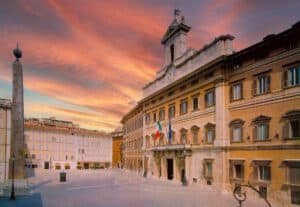
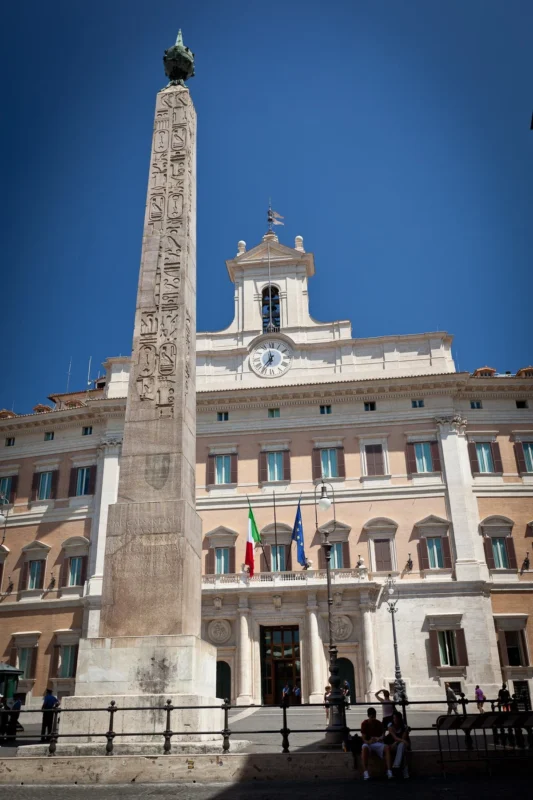
Palazzo Montecitorio stands in the Colonna district, about 100 yards from Via del Corso and close to Piazza Colonna. The visit is free and runs under the program “Montecitorio a porte aperte” (Montecitorio with open doors), usually on the first Sunday of every month. Registration is mandatory and is done on the eventi.camera.it portal. There are no paid tickets and no ticket office.
If you want to watch a session from the gallery, show up at Piazza del Parlamento 25 half an hour before the session begins. You need a completed request form and a valid photo ID.
In front of the palace rises the Montecitorio Obelisk, a genuine red granite monolith cut in the quarries of Aswan. Augustus brought it to Rome in 10 BC and used it as the gnomon, the shadow-casting rod, of a giant sundial in the Campus Martius.
Palazzo Madama – Italian Senate
Palazzo Madama fills the block between Corso del Rinascimento, Via del Salvatore, Via della Dogana Vecchia and Piazza Madama, in the Sant’Eustachio district. The main entrance is on Corso del Rinascimento, and the secondary one is on the side facing San Luigi dei Francesi. No subway station serves the square: it’s a three- or four-minute walk from the Pantheon and two minutes from Piazza Navona.
The palace is the seat of the Senate, so it has no ticket office, no continuous opening hours and no free access. The listings link it to guided visits and groups: check the format, days and booking details on the listing and on the Senate’s official website. Bus numbers change often, so it’s best to check them on the transit agency’s app.
Palaces Open to Visitors in Rome on Quirinal Hill
Quirinal Palace
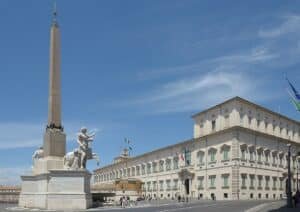
The Quirinal Palace is on Piazza del Quirinale, at the top of the highest of Rome’s seven historic hills. You can visit by reservation on Tuesday, Wednesday, Friday, Saturday and Sunday, from 9:30 a.m. to 4:00 p.m., with last entry at 2:30 p.m. It is closed on Monday and Thursday.
Entry is free, but there is a booking fee of €2.50 per person. Availability runs out weeks in advance.
You can book online on the official website of the Presidency of the Republic, by phone at the call center (06 42012191, every day from 9:00 a.m. to 5:00 p.m.), or in person at the Infopoint at Salita di Montecavallo 15. The ticket is made out in your name, tied to a specific day and time, and is non-refundable and non-changeable.
Piazza del Quirinale
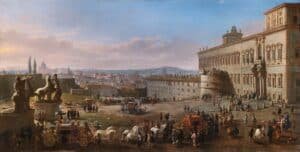
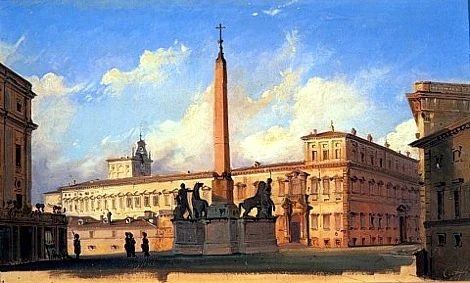
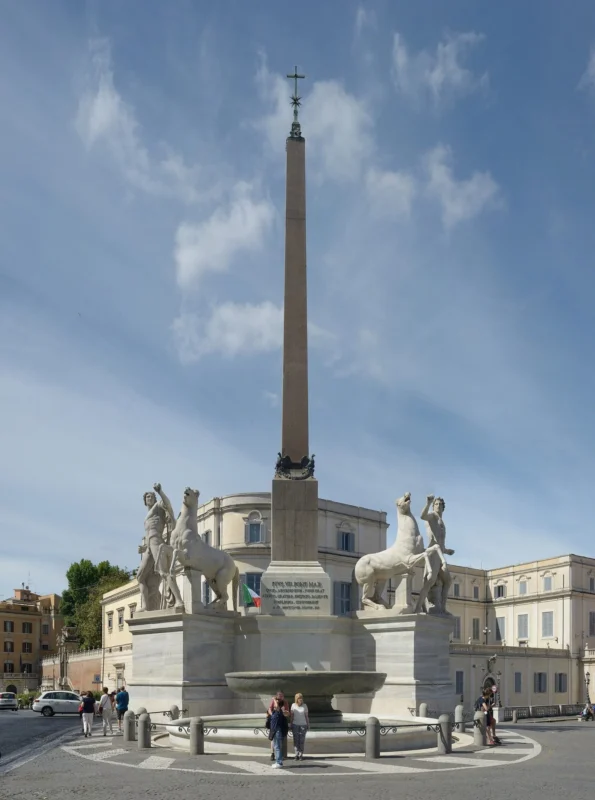
The square is free and you can cross it without a reservation. From the balustrade you can see half the city, all the way to the dome of St. Peter’s. In the center stand the two Dioscuri with their horses, an obelisk and a granite basin. The changing of the honor guard takes place here every day. The Republic has occupied the palace since 1946.
The Quirinal Obelisk is often mistaken for an Egyptian piece. In fact, the Romans built it, it carries no hieroglyphs, and it lay on its side in the ground for fifteen centuries before being raised again in 1786.
Scuderie del Quirinale
Scuderie del Quirinale is at Via XXIV Maggio 16, opposite the palace and next to Palazzo della Consulta. It is an 18th-century building put up for the popes’ horses and carriages, and it now belongs to the assets of the Presidency of the Republic. There is no permanent collection: the building hosts major temporary exhibitions, two or three a year. Hours and tickets depend on the current show, so check the listing.
Two Churches on the Hill
The Church of Sant’Andrea al Quirinale is on Via del Quirinale, a few steps from the palace. Gian Lorenzo Bernini designed it between 1658 and 1670 for the Jesuit novitiate. It has an elliptical plan, a dome with gilded coffers and polychrome marble on every wall.
The Church of San Silvestro al Quirinale stands in the middle stretch of Via Ventiquattro Maggio. The urban expansion of the late 1800s took away its facade and first bay, and today the entrance is on the side. Inside are the landscape frescoes by Polidoro da Caravaggio and Maturino da Firenze.
Palazzaccio on the Tiber
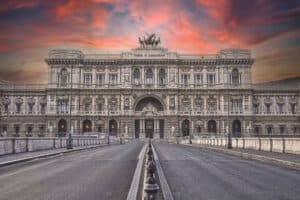
Palazzaccio – Palace of Justice of Rome sits on the Tiber embankment in Prati, between Piazza Cavour and Ponte Umberto I. It’s a mass of travertine that seems to press against the river. Arriving from the bridge and turning right, the facade looks like an endless wall of pale stone.
The listing describes it mainly as architecture to see outdoors, with its sculptures and its relationship to the Tiber. There are no practical details on getting inside, so check the listing or the official website before you go.
Other Palaces of Power and History
If you’re looking for more palaces open to visitors in Rome, there are several alternatives with simpler access rules.
Capitoline Hill and the Palace of the Conservators
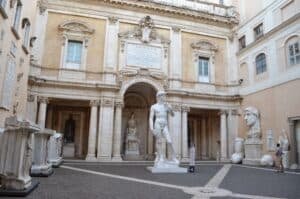
Capitoline Hill is at Piazza del Campidoglio 1, just behind Piazza Venezia. You climb on foot up the Cordonata, which starts at Piazza d’Aracoeli. On three sides of the square are the Palazzo Senatorio, seat of the City of Rome, the Palazzo dei Conservatori and the Palazzo Nuovo, which together house the Capitoline Museums.
The museums are open every day from 9:30 a.m. to 7:30 p.m., with last entry one hour before closing. They close for the year on May 1 and December 25. Ticket prices change with the exhibitions on view, so check the listing. The Palace of the Conservators, on the right as you face the staircase, is the oldest core of the museums.
On the side of Palazzo Venezia you’ll also find San Marco Evangelista al Campidoglio. Tradition dates its founding to 336. The entrance isn’t on Piazza Venezia but on Piazza San Marco, in a recess that traffic hides from view.
Palazzo Poli and the Istituto Centrale per la Grafica
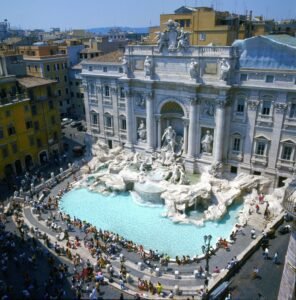
Palazzo Poli closes off the scene at the Trevi Fountain and houses the Istituto Centrale per la Grafica. The entrance to the exhibitions is at Via Poli 54. The exhibition spaces are open Tuesday through Sunday, 10 a.m. to 7 p.m., closed Monday, with last entry one hour before closing. Between one exhibition and the next, the palace stays closed.
Admission to the Institute’s exhibition hall is free, according to its listing. The Palazzo Poli listing, on the other hand, notes that some exhibitions charge admission. The phone number is 06 699801. The study room and library require a written request and an appointment.
Palazzo Ruspoli
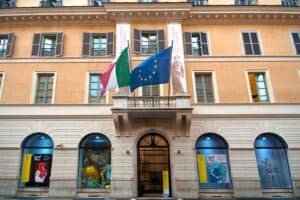
Palazzo Ruspoli stands where Via del Corso meets Largo Goldoni, near the intersection with Via dei Condotti. It has a long, composed facade that doesn’t try to get noticed. The listing doesn’t give enough information on opening hours, so check the official website.
Villa Farnesina
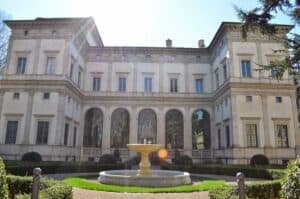
Villa Farnesina is at Via della Lungara 230, in Trastevere, and is the seat of the Accademia Nazionale dei Lincei. You can reach it by bus 23 or 280, stop Via della Lungara. Admission is €12 full price and €10 reduced. From February 16, 2026, the hours are Monday through Saturday, 9:00 a.m. to 2:00 p.m., with last entry at 1:15 p.m. It is closed on Sunday.
Palazzo Chigi in Ariccia
Outside the city, at Piazza di Corte 14 in Ariccia, the palace is open every day except Monday. The guided visit of the piano nobile (main floor) with the Museo del Barocco Romano costs €15 full price and €12 reduced. The self-guided visit costs €12 full price and €9 reduced. Hours differ between winter and summer.
How to Choose Among the Palaces Open to Visitors in Rome
On a tight budget, start with Montecitorio: the visit is free, but you have to register in advance and the calendar usually points to the first Sunday of the month. To see the inside of the Quirinal Palace, you need to book weeks ahead and pay €2.50.
For a morning with no reservations, Piazza del Quirinale and Palazzaccio can be seen from the outside at no cost. On rainy days, Capitoline Hill and the exhibitions at Palazzo Poli are better choices.
If you’ve already seen the palaces of power, you can move on to Quirky and Unusual Places in Rome. To see the city from above, there’s our guide to the Best Views of Rome: Free Viewpoints and Terraces.
Practical Tips
- Bring a valid photo ID: you need it for the Montecitorio gallery.
- Book the Quirinal Palace well ahead: the ticket is made out in your name and can’t be changed.
- Arrive on time: latecomers risk losing their entry.
- Check the listing and the official website every time: days and rules can change.
FAQ: Palaces Open to Visitors in Rome
Is Montecitorio free to visit?
Yes. The visit is free, under the program “Montecitorio a porte aperte,” usually on the first Sunday of the month. Registration is mandatory at eventi.camera.it.
How much does it cost to visit the Quirinal Palace?
Entry is free. You only pay a booking fee of €2.50 per person. The ticket is made out in your name, non-refundable and non-changeable.
Which days is the Quirinal Palace open?
Tuesday, Wednesday, Friday, Saturday and Sunday, from 9:30 a.m. to 4:00 p.m., with last entry at 2:30 p.m. It is closed on Monday and Thursday.
Can you walk into Palazzo Madama freely?
No. It is the seat of the Senate, with no ticket office or continuous hours, and it can’t be visited freely. Check the details on the listing and the official website.
How do you get to Palazzo Madama?
On foot, in three or four minutes from the Pantheon and two from Piazza Navona. There is no subway station on the square. For buses, check the lines on the transit agency’s app.
All the places in this guide (18)
 Montecitorio – Chamber of DeputiesHistoric CenterPalazzo Montecitorio, seat of the Chamber of Deputies, occupies the square of the same name in Rione Colonna, about 100 meters from Via del Corso a…
- Montecitorio ObeliskRomeThe Montecitorio obelisk is the red granite monolith that rises in the center of the square in front of the Chamber of Deputies, between the Panthe…
- Palazzo Madama – Italian SenateHistoric CenterPalazzo Madama occupies the block between corso del Rinascimento, via del Salvatore, via della Dogana Vecchia and piazza Madama, in the Sant'Eustac…
- Quirinal PalaceHistoric CenterPiazza del Quirinale, 00187 Roma: the Quirinal Palace occupies the top of the highest of the seven historic hills and is open for visits by reserva…
- Piazza del QuirinaleRomePiazza del Quirinale is the most beautiful free panoramic terrace in the center of Rome, and nobody sells it to you as such because you don't pay f…
- Quirinal ObeliskRomeThe Quirinal Obelisk rises in the middle of the highest square in Rome, wedged between the two colossi of the Dioscuri holding back their horses an…
- Scuderie del QuirinaleHistoric CenterScuderie del Quirinale - Via Ventiquattro Maggio, 16, 00186 Rome RM, Italy
- Church of Sant’Andrea al QuirinaleRomeThe Church of Sant’Andrea al Quirinale is on Via del Quirinale, a few steps from Palazzo del Quirinale and Scuderie del Quirinale, in one of the de…
- Church of San Silvestro al QuirinaleRomeThe Church of San Silvestro al Quirinale stands in the middle of Via Ventiquattro Maggio, on the Quirinal Hill, in the Trevi district, halfway betw…
- Palazzaccio – Palace of Justice of RomePratiThere are buildings in Rome that you visit and others that simply loom over you. The Palazzaccio - Palace of Justice of Rome undoubtedly belongs to…
- Capitoline HillRomeCapitoline Hill, also called Mount Capitoline (Mons Capitolinus), is one of the Seven Hills on which Rome was founded.
- Palace of the Conservators on Capitoline HillHistoric CenterPalace of the Conservators on Capitoline Hill - Piazza del Campidoglio, 4, 00186 Rome RM, Italy
- San Marco Evangelista al CampidoglioRomeSan Marco Evangelista al Campidoglio is one of the oldest churches in Rome and, at the same time, one of the least visited in the Historic Center.…
- Palazzo PoliHistoric CenterPalazzo Poli - via della Stamperia 6, 00187 Rome
- Istituto Centrale per la Grafica – Palazzo PoliHistoric CenterIstituto Centrale per la Grafica - Palazzo Poli - Via della Stamperia, 6, 00187 Rome RM, Italy
- Palazzo RuspoliHistoric CenterPalazzo Ruspoli, a Stern Backdrop on the Corso There are buildings in Rome that assault you with columns and angels, and then there is Palazzo Rusp…
- Villa Farnesina – Accademia Nazionale dei LinceiTrastevereVilla Farnesina - Accademia Nazionale dei Lincei - Via della Lungara, 230, 00165 Rome RM, Italy
- Palazzo Chigi in AricciaAriccia (RM)Palazzo Chigi in Ariccia - Piazza di Corte, 14, 00072 Ariccia RM, Italy