Orchestra Nazionale Barocca dei Conservatori at Teatro dell’Opera di Roma, March 18, 2027
In short. The Orchestra Nazionale Barocca dei Conservatori plays at Teatro Costanzi, the main hall of Teatro dell'Opera di Roma at Piazza Beniamino Gigli 7, on Thursday, March 18, 2027 at 20:00, conducted by Ignazio Maria Schifani.
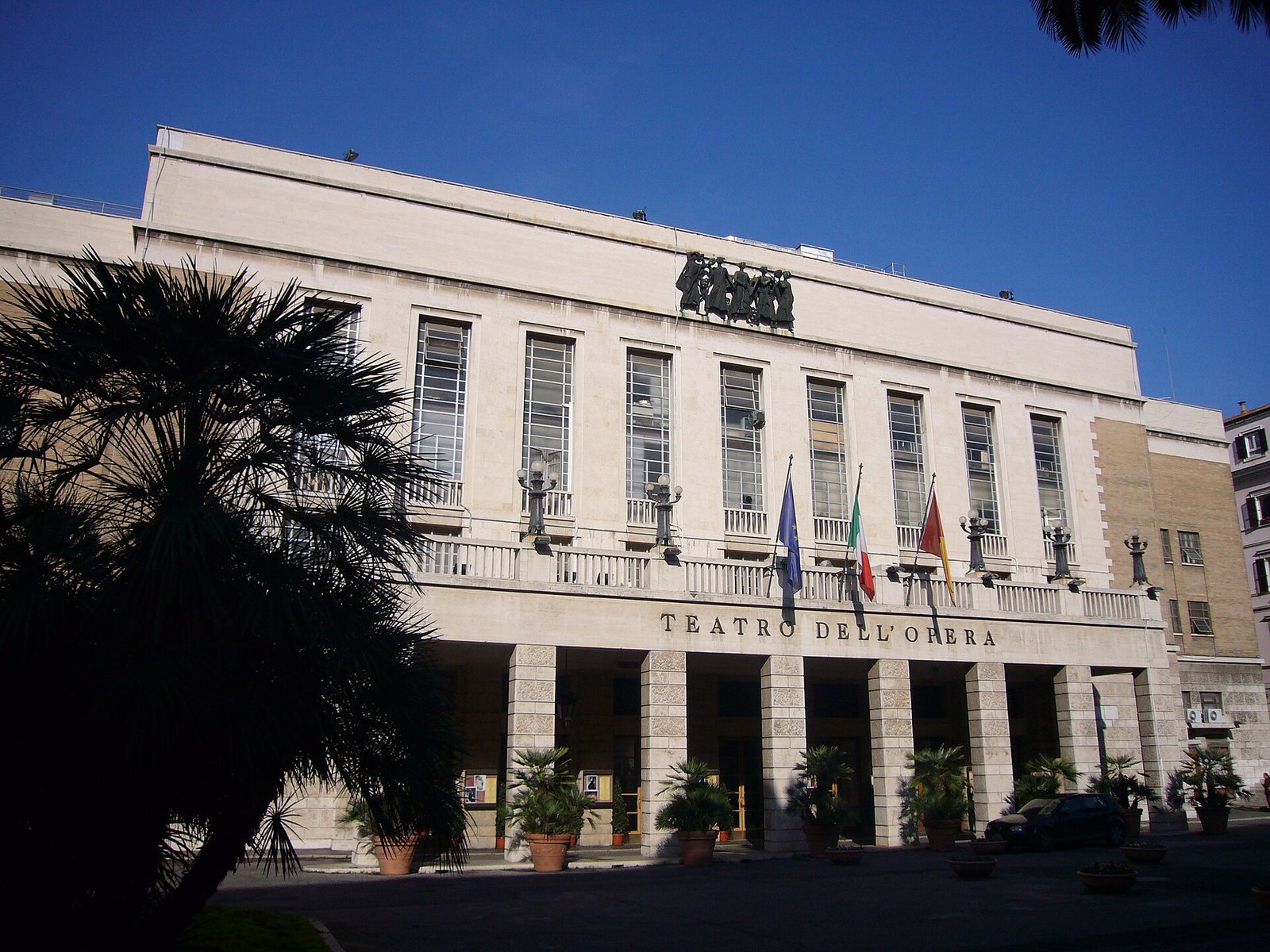
The Orchestra Nazionale Barocca dei Conservatori plays at Teatro Costanzi, the main hall of Teatro dell'Opera di Roma at Piazza Beniamino Gigli 7, on Thursday, March 18, 2027 at 20:00, conducted by Ignazio Maria Schifani. The program features two unpublished concertos by Ranieri Nanni, one for bassoon and one for oboe and orchestra, dated 1821 and offered in modern premiere, and Ludwig van Beethoven's First Symphony in C major, Op. 21, on historical instruments, in the year marking 200 years since the composer's death. You get to the theater by metro A, Repubblica Teatro dell'Opera stop, or by the buses that run along Via Nazionale and Via Depretis. Prices are published on the official concert page on the website of Teatro dell'Opera di Roma. Tickets are bought at the theater's box office at Piazza Beniamino Gigli 1 or through the authorized presale network indicated by the official site.
It's a special evening in the 2026/2027 season of Teatro dell'Opera: an orchestra formed in Italy's institutes of advanced music education, a conductor who specializes in early music, two pieces that stayed closed for two centuries in the library of a Sicilian conservatory and a symphony everyone thinks they know, returned to the sound of the instruments it was written for. The project belongs to the Ministry of University and Research, in collaboration with the Alessandro Scarlatti Conservatory in Palermo.
Orchestra Nazionale Barocca dei Conservatori at Costanzi in Brief
The Orchestra Nazionale Barocca dei Conservatori concert is a single date: Thursday, March 18, 2027, 20:00, Teatro Costanzi. The theater lists it among the 2026/2027 season's Special Events, outside the opera and ballet titles.
Date, Time and Hall
The official page lists a single performance, Thursday, March 18 at 20:00, at Teatro Costanzi. The running time isn't published. With two solo concertos and a classical symphony, the evening has the measure of a medium-length symphonic concert, in all likelihood split by an intermission. The exact structure should be checked on the theater's website close to the date.
Who Plays and Who Conducts
On the podium is Ignazio Maria Schifani, a harpsichordist and organist from Palermo, professor of Theory and Practice of Basso Continuo at the Palermo Conservatory and coordinator of the orchestra. The orchestra is the Orchestra Nazionale Barocca dei Conservatori, which brings together young musicians from Italian conservatories.
The Soloists
The Rome page for the concert doesn't list the names of the oboe and bassoon soloists. Teatro Massimo in Palermo, which hosts the same program on Sunday, March 14, 2027 at 20:30 in Sala Grande, lists Gioacchino Comparetto on oboe and Alessandro Nasello on bassoon. It's reasonable to think of a tour with the same lineup, but confirmation for the Rome date should be sought on the website of Teatro dell'Opera.
Tickets
Tickets are on sale at the box office of Teatro dell'Opera, at Piazza Beniamino Gigli 1, and through the authorized presale network that the official site links to. Prices for this evening are published on the theater's website. Anyone under 30 would do well to check the youth discounts the foundation offers for the current season.
The Program: Ranieri Nanni and Beethoven's First
The program pairs two concertos by Ranieri Nanni written in 1821 and never performed in modern times with Beethoven's First Symphony, composed between 1799 and 1800. Two worlds separated by 20 years, played on the same type of instruments.
Two Concertos Found in Palermo
Ranieri Nanni's Concerto for Bassoon and Concerto for Oboe and Orchestra are dated 1821 and dedicated to Don Ferdinando Monroy, Prince of Ranchibile. The manuscripts are held in the Library of the Palermo Conservatory, and Teatro dell'Opera presents them as unpublished in modern premiere: no one in recent times has heard them in a hall. The dedication to a Palermo aristocrat places the two scores in the world of Sicilian instrumental music of the early 19th century, when solo winds had an enthusiastic audience in noble salons.
Why Oboe and Bassoon
Oboe and bassoon are the double-reed instruments of the woodwind family, the first high and singing, the second low and capable of surprising comedy. Heard on period instruments, with fewer keys and a softer intonation than modern ones, they change color: the oboe becomes more nasal and vocal, the bassoon rounder. Two concertos for these instruments in the same evening allow a direct comparison.
Beethoven's First Symphony
Symphony No. 1 in C major, Op. 21, was composed by Beethoven between 1799 and 1800 and performed for the first time on April 2, 1800 at the Burgtheater in Vienna. Beethoven came to the symphony relatively late: at his age Mozart had already written dozens, Haydn almost 20. The slow introduction of 12 measures opens with a chord that doesn't belong to the home key, a harmonic gesture that must have astonished the first listeners. The third movement, marked as a minuet, is in fact a rousing scherzo, the newest movement of the score.
With Historical Instruments
The symphony is performed with historical instruments, on the occasion of the bicentennial of Beethoven's death. That means string instruments with gut strings, natural winds without piston valves, drier timpani and an ensemble close to the one Beethoven wrote for. The result, in our opinion, is a First that is less monumental and sharper, in which accents and dissonances regain the force they had in 1800.
Who the Orchestra Nazionale Barocca dei Conservatori Is
The Orchestra Nazionale Barocca dei Conservatori is a project of the Ministry of University and Research, carried out in collaboration with the Alessandro Scarlatti Conservatory in Palermo, and coordinated by Ignazio Maria Schifani. It brings together students and young musicians from Italian institutes of advanced music education specialized in historical performance practice.
An Orchestra of the Conservatories
The acronym ONB, used by Teatro Massimo in Palermo to refer to it, identifies an orchestra that doesn't belong to a single institute but to the whole conservatory system. It's a different model from that of the large private Baroque ensembles: here training is part of the project, and the concert is also the endpoint of a course of study.
Already a Guest at Costanzi
It's not the first time the orchestra plays at Costanzi. On Monday, April 28, in the 2024/2025 season, Teatro dell'Opera di Roma hosted it with Ignazio Maria Schifani in Alessandro Scarlatti's Gloria di primavera, performed on the 300th anniversary of the composer's death, with soloists Jiayu Jin, Martina Licari, Chiara Brunello, Luca Cervoni and Antonino Arcilesi and a running time of about 160 minutes. The 2027 concert continues that collaboration.
In Palermo and Elsewhere
The orchestra has a regular presence at Teatro Massimo in Palermo, where it has performed with Schifani the Stabat Maters of Alessandro Scarlatti and Pergolesi, and where the Nanni and Beethoven program is on the schedule four days before Rome. The link with the conservatory named after Scarlatti explains how often the Palermo composer appears in its programs.
Ignazio Maria Schifani, the Conductor
Ignazio Maria Schifani was born in Palermo and devoted himself to early music, perfecting his skills in harpsichord, historical organ and basso continuo practice. He is considered one of the most appreciated performers on the early music scene, for combining expressiveness and historical-stylistic knowledge of the repertoire.
A Career Among Theaters and Festivals
He has conducted and played for Accademia Nazionale di Santa Cecilia, RAI, Scuola di Musica di Fiesole, Maggio Musicale Fiorentino, Carnegie Hall and Lincoln Center in New York, Bayerischer Rundfunk, Berlin Philharmonie and Wiener Konzerthaus. Among opera houses are La Scala in Milan, Teatro dell'Opera di Roma, San Carlo in Naples, Comunale in Bologna, Regio in Turin, the Paris Opéra, Oper Frankfurt, Teatro Real in Madrid, Opéra National du Rhin, La Monnaie in Brussels, Opéra National de Bordeaux and Den Norske Opera in Oslo.
The Ensembles
He has collaborated with the Cappella della Pietà de' Turchini conducted by Antonio Florio and with Gabriel Garrido's Ensemble Elyma, from 1994 with Studio di Musica Antica Antonio Il Verso and from 1998 with Rinaldo Alessandrini's Concerto Italiano, also as assistant in several theatrical productions.
Teaching and Conducting
He teaches Theory and Practice of Basso Continuo in the early music department of the Palermo Conservatory and is a member of the National Council for Advanced Artistic and Musical Education. At Teatro Massimo he has conducted Cinderella set to music by Handel, a concert dedicated to Bach, the Johannes-Passion, the 2018 Baroque New Year, Michelangelo Falvetti's Il diluvio universale, Handel's Water Music and Dangerous Liaisons set to music by Rameau.
A Fun Fact About the Orchestra Nazionale Barocca dei Conservatori at Teatro dell'Opera di Roma, March 18, 2027
The title of the March concert hides a coincidence of dates: Ranieri Nanni's two concertos are from 1821, and 1821 is also the year the Accademia Filarmonica Romana was founded. While in Palermo a composer was writing two pieces for solo winds for a prince, in Rome a group of amateur musicians was giving life to one of the city's oldest concert institutions.
The second fun fact concerns the name of the conservatory that supports the project. The Palermo Conservatory is named after Alessandro Scarlatti, the Palermo composer whose Gloria di primavera the orchestra brought to Costanzi in 2025, for the 300th anniversary of his death. In two seasons the orchestra of the conservatories has thus presented in Rome a Scarlatti for the tercentenary and a Beethoven for the bicentennial: two anniversaries, two worlds, the same conductor.
The third is in the dedication of Nanni's concertos. The Prince of Ranchibile, Don Ferdinando Monroy, is the recipient of the two manuscripts: early 19th-century music for winds was often born this way, on commission or as homage to a patron who played or who kept a private orchestra. The fact that the scores stayed in the conservatory library, rather than being scattered, is what allows their modern premiere today.
Finally, a calendar fun fact: in the same month, at Costanzi, Verdi's I due Foscari is on stage, scheduled from March 13 to 21, 2027. The Baroque concert falls in the middle of the performances of a Verdi opera, and anyone in Rome that week can hear two very distant languages in the same theater.
Teatro Costanzi, the Concert Hall
Teatro Costanzi today has a capacity of 1,560 seats, across orchestra, three tiers of boxes, balcony and gallery, under a dome frescoed by Annibale Brugnoli. At its birth, in 1880, it could hold up to 2,212 spectators.
A Hall Designed for Sound
The builder Domenico Costanzi commissioned the design in 1879 from the Milanese architect Achille Sfondrini, a theater specialist, who conceived the horseshoe-shaped hall as a sound box. The construction site lasted only 18 months. For an orchestra on historical instruments, with gut-string instruments and natural winds of lower volume than modern ones, the shape of the hall is a concrete advantage.
Piacentini and the Chandelier
In 1926, with the purchase by the city, Marcello Piacentini renovated the theater and moved the entrance to Piazza Beniamino Gigli. For the second inauguration, on February 27, 1928, the chandelier of 27,000 crystal drops was lit. In 1958, ahead of the 1960 Olympics, Piacentini signed the restyling that gave the building its current look.
The Hall's Sections
The theater's price list distinguishes premium orchestra seats and orchestra seats, orchestra boxes, boxes of the first, second and third tier, central and side, the balcony and the gallery. For a symphonic concert the view matters less than for an opera: even a rear seat in a side box, usually cheaper, offers a full listening experience.
The Foundation and Its Venues
Teatro dell'Opera di Roma also runs Teatro Nazionale at Via del Viminale 51 and, in summer, the Baths of Caracalla. The theater's full listing is on our page about Rome Opera House.
Something Nobody Tells You About the Orchestra Nazionale Barocca dei Conservatori at Teatro dell'Opera di Roma, March 18, 2027
What the presentations don't say is that a concert like this is one of the rarest occasions of the Roman season: a modern premiere inside the city's opera house. World premieres are usually associated with contemporary music, here the novelty is 200 years old.
Anyone listening to an unpublished work has no points of comparison: there are no recordings, no reference interpretations, no already formed idea of how it should sound. It's a condition similar to that of the 1821 audience, and for a curious listener it's an experience classical music rarely offers. In our opinion it's worth the ticket on its own.
Second thing little said: Costanzi's Special Events are often less crowded than opera titles. Anyone who has never seen the hall and wants to enter it for the first time without facing the lines of a repertoire opera premiere finds a quieter evening here, with the same chandelier and the same dome.
Third: at Costanzi you don't enter the orchestra, or the numbered seats of the balcony and gallery, once the performance has started, and latecomers wait in the foyer. In a concert the first piece is short compared to an opera act, but missing the start means missing one of the two unpublished works. The coat check is mandatory for umbrellas, hats, bags, helmets and cameras: in March, with rain, it's best to arrive with a 20-minute margin.
My Advice for Seeing the Orchestra Nazionale Barocca dei Conservatori at Teatro dell'Opera di Roma, March 18, 2027
My advice is to choose a central seat in the balcony or in a first-tier box, and to arrive with time to read the program booklet before the start. With two unpublished works on the program, knowing who the dedicatee was and where the manuscripts come from changes the way you listen.
The balcony and the central first-tier boxes offer at Costanzi a good balance between sound and view: you see the whole orchestra, you can make out the solo winds at center stage, and the sound of the historical instruments arrives more gathered than in the orchestra. Anyone who wants to spend less can look at the rear seats of the side boxes: for a concert the reduced view matters little.
The second piece of advice is about listening to Beethoven's First. It's best to listen to it beforehand, at home, in a recording with a modern orchestra. Then, in the hall, the difference with historical instruments is heard immediately: the natural horns, the drier timpani, the strings that vibrate less. It's the simplest way to understand what it means, in practice, to play on period instruments.
The third concerns the week. March 18 is a Thursday: if you're in Rome for a few days you can pair the concert with a performance of Due Foscari in the same theater, or, the same evening, choose between Costanzi and Auditorium Parco della Musica, where from March 18 to 20 Charles Dutoit and Martha Argerich are on the schedule. Rome that week offers a lot to anyone who loves music.
How to Get to Teatro Costanzi
Teatro Costanzi is reached by metro A, Repubblica Teatro dell'Opera stop, a few minutes' walk from Piazza Beniamino Gigli. It's the simplest solution even on rainy evenings.
By Metro
Line A stops at Repubblica Teatro dell'Opera, in Piazza della Repubblica. From the square the theater is a few minutes' walk. From Termini you can take the same line or walk.
By Bus
The theater lists these lines:
- Via Nazionale: H, 40, 60, 64, 70, 71, 170, 116T.
- Via Depretis: 70, 71.
- Via Cavour: 16, 75, 84, 150 (holidays), 360, 590, 649, 714.
- Termini Station: 16, 38, 75, 86, 90, 217, 310, 360, 649, 714.
By Taxi
At the theater entrance there is a taxi service for the audience with Radio Taxi 6645. During intermissions the house staff collects return ride bookings. The theater also lists the number 06 6696.
By Car
Driving is discouraged: the area between Via Nazionale, Via del Viminale and Termini is central and busy, and the theater doesn't list its own parking. If you're coming from outside the city, you can leave the car in a park-and-ride along line A and continue by metro.
Another Well-Known Fact, Yet Rarely Mentioned
It's well known that Cavalleria rusticana debuted at Teatro Costanzi on May 17, 1890 and Tosca on January 14, 1900. It's mentioned less often that for its first 46 years it was a private theater, which the State had refused to take over.
Domenico Costanzi inaugurated it on November 27, 1880 with Rossini's Semiramide, in the presence of King Umberto I and Queen Margherita. According to the theater's own account, programming went on thanks to the financial and organizational efforts of the builder and then his son Enrico. From 1907 management passed to the impresario Walter Mocchi and from 1912 to his wife, the soprano Emma Carelli, who led the Impresa Costanzi for 14 years. Only in 1926 did the purchase by the city arrive, along with the name Teatro Reale dell'Opera.
There's a parallel with the March evening. Ranieri Nanni's music, too, was born in a private system, made of patrons and aristocratic dedicatees, and the Orchestra Nazionale Barocca, too, lives on public support, that of the Ministry of University and Research. Two centuries of Italian music history have passed from private patronage to institutions, and the March 18 concert puts the two phases on the same stage.
A second known and little-cited fact concerns Beethoven: the First Symphony was presented on April 2, 1800 at the Burgtheater in Vienna, a court theater. It too, like Nanni's pieces, was born in an environment tied to the aristocracy, before becoming the heritage of public concert halls.
House Rules and Dress Code at Costanzi
At Teatro dell'Opera di Roma dark dress is welcome at opening nights and premieres. For other evenings the theater lists no dress code. For a special event like this a neat outfit is enough.
Coat Check and Phones
Umbrellas, hats, bags, helmets, cameras and recording devices must be left at the coat check. In the hall mobile phones are banned, photographs are banned, with or without flash, as is any recording. Refreshments are allowed only at the theater's bars.
Late Arrivals
Once the performance has started, you can't enter the orchestra or the numbered seats of the balcony and gallery: latecomers wait in the orchestra foyer. Management reserves the right to move purchased seats for technical reasons.
Information
For lost items the theater lists the number 06 48160284. The full rules are on the General Information page of the official site.
The Right Photo to Take at the Orchestra Nazionale Barocca dei Conservatori at Teatro dell'Opera di Roma, March 18, 2027
At Costanzi you don't take photos in the hall, with or without flash: the evening's right photo is taken outside, in Piazza Beniamino Gigli, before going in. It's the theater's rule, and it applies during the applause too.
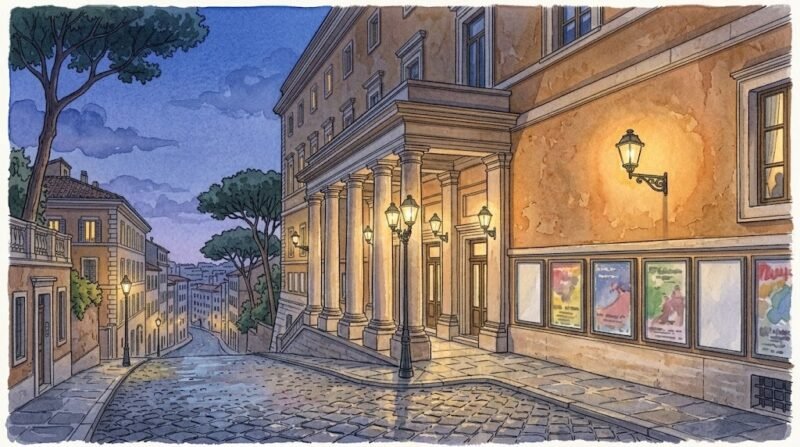
The square is the one onto which Marcello Piacentini moved the theater's entrance after the 1926 purchase, to make room for the audience crowding under the porticoes. In mid-March, at 19:30, the light has already faded and the facade is lit: it's the best moment for a photo with the theater behind you and the entrance sign clearly legible.
A second image is found in the foyer, before going into the hall: the evening's poster, with the name of the orchestra and the two unpublished concertos. A photo of the program booklet, with the wording of the modern premiere, is a keepsake with a precise value: in a few years, if Nanni's concertos enter the repertoire, it will be proof of having been at the premiere.
The hall, with Brugnoli's dome and the crystal chandelier, remains an image to take away with your eyes. Anyone who wants to photograph it at leisure can book one of the visits the theater organizes during the day, according to the calendar published on the official site.
Some Important Events That Happened Here in History
Teatro Costanzi was inaugurated on November 27, 1880 with Rossini's Semiramide and became Teatro dell'Opera di Roma in 1946. In between, two world premieres that made opera history and a change of ownership that changed its face.
Dates to Remember
- 1879: Domenico Costanzi entrusts the design to the architect Achille Sfondrini.
- November 27, 1880: inauguration with Rossini's Semiramide, in the presence of Umberto I and Queen Margherita.
- May 17, 1890: world premiere of Pietro Mascagni's Cavalleria rusticana.
- January 14, 1900: world premiere of Giacomo Puccini's Tosca.
- 1905: the Orchestra Municipale is born, with 100 members, and becomes in effect the Costanzi orchestra until 1926.
- 1907: management passes to Walter Mocchi. From 1912 it is led by the soprano Emma Carelli.
- 1926: the City of Rome buys the theater, which becomes Teatro Reale dell'Opera.
- February 27, 1928: second inauguration with Arrigo Boito's Nerone.
- 1935: the permanent chorus is founded at the wish of Tullio Serafin.
- 1946: the theater takes the name Teatro dell'Opera di Roma.
- 1958: Piacentini's definitive restyling ahead of the 1960 Olympics.
In recent history, Special Events have opened Costanzi also to ensembles that do not belong to the foundation. On April 28 of the 2024/2025 season the Orchestra Nazionale Barocca dei Conservatori performed Scarlatti's Gloria di primavera there. On March 18, 2027 it returns with Nanni and Beethoven.
Who Has Passed Through the Orchestra Nazionale Barocca dei Conservatori at Teatro dell'Opera di Roma, March 18, 2027
Through Teatro Costanzi have passed Umberto I and Queen Margherita at the 1880 inauguration, and then Pietro Mascagni, Giacomo Puccini and Ottorino Respighi, whom the theater lists as the musicians who marked its destiny.
There's Emma Carelli, who from 1912 brought to Rome La fanciulla del West, Turandot, Il trittico, Parsifal, Samson et Dalila and Diaghilev's Ballets Russes. There's Marcello Piacentini, who reworked the building in 1926 and 1958. There's Tullio Serafin, who in 1935 wanted the permanent chorus. And there are the conductors the theater cites in the history of its orchestra: Victor de Sabata, Gianandrea Gavazzeni, Herbert von Karajan, Carlo Maria Giulini, Giuseppe Sinopoli, Mstislav Rostropovich, Riccardo Muti, Daniele Gatti.
In the history of the theater's orchestra there is also an unexpected name: among the band professors included in the 1935 roster was Pietro Sordi, bass tuba player, father of Alberto Sordi.
Among the more recent passages is Ignazio Maria Schifani, who in his biography lists Teatro dell'Opera di Roma among the opera houses where he has worked and who in 2025 conducted the conservatories' orchestra there in Gloria di primavera. With him passed the soloists of that evening, Jiayu Jin, Martina Licari, Chiara Brunello, Luca Cervoni and Antonino Arcilesi. On March 18, 2027 at Costanzi step onto the stage the orchestra's young musicians, the two oboe and bassoon soloists and, ideally, two authors: a 30-year-old Beethoven and a Ranieri Nanni whom Rome has never heard.
Around Costanzi: Repubblica, Viminale and Monti
Teatro Costanzi sits between Via Nazionale, Via del Viminale and Via Depretis, a few minutes' walk from Piazza della Repubblica and Termini station. Anyone who arrives an hour early has around some of the most interesting places of Umbertine and ancient Rome.
Piazza della Repubblica and the Baths
Coming out of the metro you arrive in Piazza della Repubblica, where you find the Basilica of Santa Maria degli Angeli e dei Martiri and the remains of the Baths of Diocletian. Toward Termini is Palazzo Massimo alle Terme, home of the National Roman Museum: an afternoon at the museum and the evening at the concert combine without taking any transport.
Santa Maria della Vittoria
A few minutes from Piazza della Repubblica is Santa Maria della Vittoria, a short stop for anyone who wants to fill the half hour before the theater opens.
Toward Monti and Santa Maria Maggiore
Going down Via Nazionale you come to the Palazzo delle Esposizioni. Farther down begins the Monti district. Beyond Via Cavour, Santa Maria Maggiore is reachable on foot.
Where to Eat Before and After the Concert
Around Teatro dell'Opera the offering is concentrated on Via Nazionale, Via del Viminale, the streets toward Termini and the Monti district. The theater allows refreshments only in the inside bars, so dinner has to be organized before or after.
Before 20:00
With the start at 20:00 you can have an early dinner, around 18:30, at a trattoria near Via Nazionale or Via del Viminale: the theater is a few minutes' walk. Alternatively, a light aperitivo and dinner after the concert.
After the Concert
The Monti district is the most natural choice: you walk down from Via Nazionale and find osterias, wine bars and pizzerias. On a Thursday night many kitchens close early, and it's best to book.
The Rule of Thumb
In the streets around Termini, be wary of places with a menu translated into many languages displayed at the door, and go a few streets toward Monti: at equal price, you can taste the difference.
Accessibility and Practical Information
For accessibility needs at Teatro Costanzi, contact the box office before buying, at 06 48160255 or 06 4817003 or at ufficio.biglietteria@operaroma.it. It's the surest way to get a suitable seat and up-to-date information on entrances and services.
The Gallery
The theater excludes the gallery from the accessible route of its tours: anyone with mobility difficulties would do well to choose orchestra, boxes or balcony, following the box office's guidance.
With Kids
A concert with two unpublished works and a classical symphony is a good chance for a kid who studies a wind instrument: hearing a solo oboe and bassoon on period instruments is rare. The fact that the performers are young conservatory musicians can make the evening even closer to those who study music.
March in Rome and Beethoven's Bicentennial
2027 marks 200 years since Beethoven's death, and the Roman spring carries signs of it in more than one hall. The Costanzi concert is one of the events marking the anniversary with historical instruments.
Other Beethoven in Rome
In the same season, at Auditorium Parco della Musica, the Accademia di Santa Cecilia schedules the Ninth Symphony conducted by Daniel Harding from April 22 to 24, 2027. Hearing the First on historical instruments in March and the Ninth with a modern orchestra in April is a path the city makes possible.
The Costanzi Schedule
After the Baroque concert the theater continues with Motus by Blanc, McGregor and Ekman, from March 31 to April 4, and with Gluck's Iphigénie en Tauride, from April 18 to 27. Among the Special Events, on April 21 is scheduled Piccinni e Gluck, una corona per due, and on May 23 È ancora troppo presto.
The Weather
In mid-March in Rome evenings are still cool and rain is frequent: a light coat and an umbrella, to leave at the coat check, are the right gear.
Frequently Asked Questions About the Orchestra Nazionale Barocca at Costanzi
When Does the Orchestra Nazionale Barocca dei Conservatori Play in Rome?
The Orchestra Nazionale Barocca dei Conservatori plays at Teatro Costanzi on Thursday, March 18, 2027 at 20:00, conducted by Ignazio Maria Schifani. It's a single date, listed among the Special Events of the 2026/2027 season of Teatro dell'Opera di Roma. The running time isn't published on the official page.
What Is on the Program at the March 18 Concert at Costanzi?
The Orchestra Nazionale Barocca concert at Costanzi presents the Concerto for Bassoon and the Concerto for Oboe and Orchestra by Ranieri Nanni, from 1821, in modern premiere, and Beethoven's First Symphony in C major, Op. 21, on historical instruments, for the 200 years since the composer's death.
How Much Are Tickets for the Orchestra Nazionale Barocca at Teatro dell'Opera?
Prices for the Orchestra Nazionale Barocca concert at Teatro dell'Opera are published on the official page of the evening on the theater's website. Tickets are bought at the box office at Piazza Beniamino Gigli 1 or through the authorized presale network indicated by the official site.
Who Are the Oboe and Bassoon Soloists?
The Rome page for the Orchestra Nazionale Barocca concert doesn't list the soloists. For the same program, at Teatro Massimo in Palermo on March 14, 2027, Gioacchino Comparetto on oboe and Alessandro Nasello on bassoon are announced. Confirmation for Rome should be sought on the website of Teatro dell'Opera.
What Does Modern Premiere Mean?
For Ranieri Nanni's two concertos at Costanzi, modern premiere means that the scores, unpublished and held in the Library of the Palermo Conservatory, had never been performed in recent times. Anyone in the hall on March 18 hears music that no one has recorded or played in public for generations.
How Do You Get to Teatro Costanzi by Public Transport?
Teatro Costanzi is reached by metro A, Repubblica Teatro dell'Opera stop, and then a few minutes' walk. The lines of Via Nazionale (H, 40, 60, 64, 70, 71, 170, 116T) and Via Depretis (70, 71) pass nearby. At the entrance there is a taxi service for the audience.
Is There a Dress Code at Teatro dell'Opera?
Teatro dell'Opera di Roma welcomes dark dress at opening nights and premieres. For other shows it lists no code. For the Orchestra Nazionale Barocca concert a neat outfit is enough. Bags, umbrellas and hats must be left at the coat check.
The Final Advice on the Orchestra Nazionale Barocca dei Conservatori
Two concertos that stayed for two centuries in a library in Palermo, a Beethoven symphony returned to the instruments of its time, an orchestra of young conservatory musicians and the hall where Cavalleria rusticana and Tosca debuted: March 18, 2027 at Costanzi is an evening unlike the others of the season. My advice is to take a seat in the balcony or in a central box, arrive early to read the program, and listen to Nanni's two concertos as whoever received them as a gift in 1821 heard them: without knowing what to expect.
Article written by the editorial team of Tour Leader Pro, contact them for Private/Corporate/V.I.P. Tours and Experiences.
Planning a trip to Rome? The English-language guides for visiting the city are on ItalyPlanner.com.
Contact Information
Nearby
 Rome Opera House100 m
- St. Paul’s Within the Walls100 m
- Basilica of San Vitale100 m
- Teatro Nazionale100 m
- Enrico Fermi Center – Historical Museum of Physics and Study and Research Center at the Viminale200 m
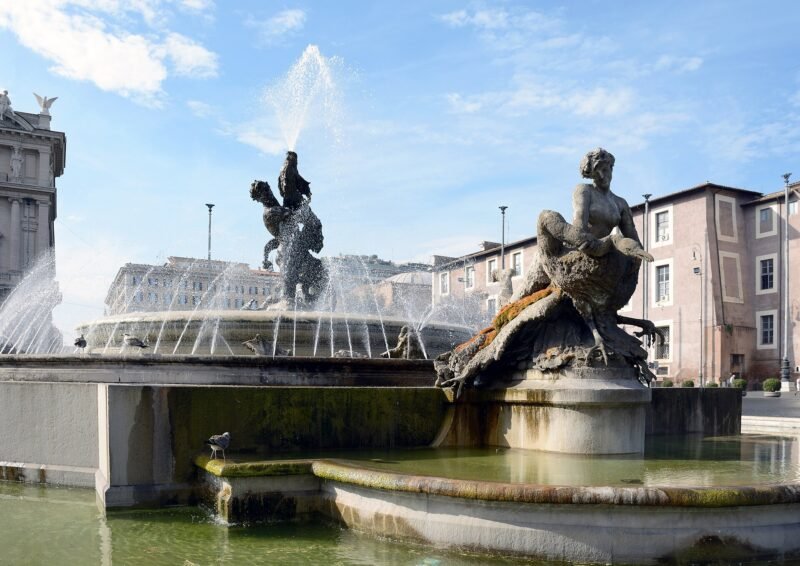
- Fontana delle Naiadi200 m

Upcoming events nearby
- Swan Lake at Teatro dell’Opera di Roma, December 17 to 31, 2026100 m
- Andrea Chénier at the Teatro dell’Opera di Roma, January 17-26, 2027100 m
- Il barbiere di Siviglia with Cecilia Bartoli at Teatro dell’Opera di Roma, May 27, 2027100 m
- Goecke / Robbins / Bausch at Teatro dell’Opera di Roma, from October 27 to November 8, 2026100 m


You might also like
- PFM Premiata Forneria Marconi, On the Road Again at Teatro Brancaccio, February 6, 2027
- Il Cantico by Angelo Branduardi at Teatro Brancaccio, January 27, 2027
- Pietro Morello, Fatti di musica at Teatro Brancaccio, January 26, 2027
- Eduardo De Crescenzo, Essenze Jazz at Teatro Brancaccio, November 13, 2026
- Francesco Renga at Teatro Brancaccio, Live Teatri 2026, May 11, 2027
- Opera Concerto at St. Paul’s Within the Walls, Every Thursday Through December 9, 2027