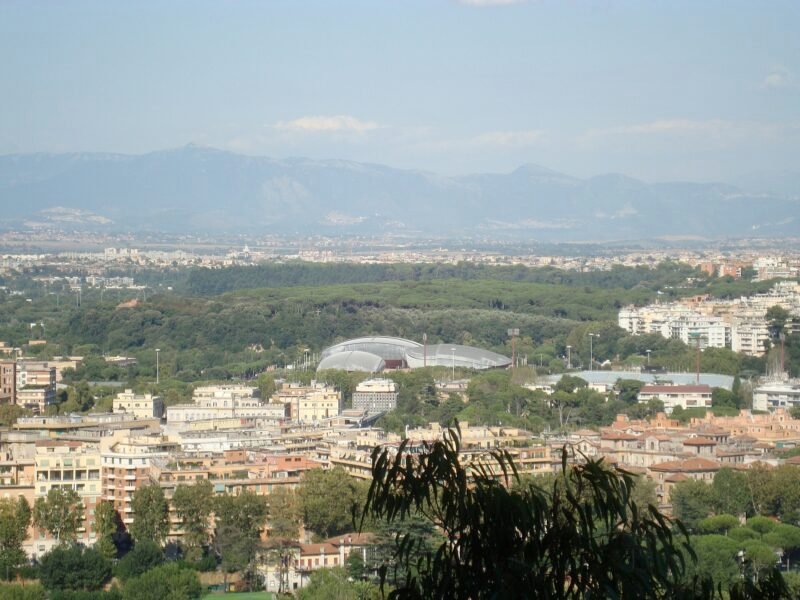
Beethoven’s Ninth with Daniel Harding in Rome: Auditorium Parco della Musica, April 22 to 24, 2027
In short. Beethoven's Ninth with Daniel Harding in Rome: Harding conducts Beethoven's Ninth Symphony with the Orchestra and Chorus of the Accademia Nazionale di Santa Cecilia in Sala Santa Cecilia at Auditorium Parco della Musica Ennio Morricone,…
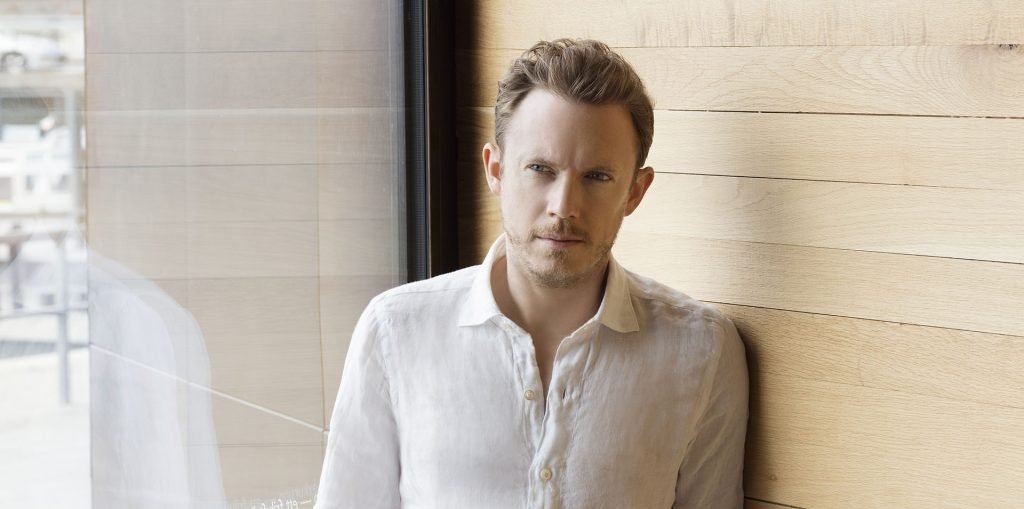
Beethoven's Ninth with Daniel Harding in Rome: Harding conducts Beethoven's Ninth Symphony with the Orchestra and Chorus of the Accademia Nazionale di Santa Cecilia in Sala Santa Cecilia at Auditorium Parco della Musica Ennio Morricone, Viale Pietro de Coubertin 30, on three evenings: Thursday, April 22, 2027 at 19:30, Friday, April 23 at 20:00 and Saturday, April 24 at 18:00. The concert opens with the world premiere of Stefano Gervasoni's Rischiare la gioia (Risking Joy), commissioned by the Accademia. The Auditorium is reached by Metro A to Flaminio and then tram 2, Flaminia/Reni or Apollodoro stops, or by bus 910 from Termini. Tickets cost €28 to €65 and are sold from the official concert page on the Accademia website, which links to the presale network authorized by the organizers, at the Auditorium box office or at the one on Via Vittoria 6.
2027 marks the 200th anniversary of Beethoven's death, and the Accademia di Santa Cecilia celebrates it with its music director on the podium and the symphony that belongs to everyone more than any other. Soloists, chorus, and a new piece written for the occasion by an Italian composer who lived in Rome as a fellow at Villa Medici: three evenings worth the trip to the Auditorium even if you think you know the Ninth by heart.
Beethoven's Ninth with Harding: dates, times, performers
Beethoven's Ninth conducted by Daniel Harding is performed three times in Sala Santa Cecilia: Thursday, April 22, 2027 at 19:30 (series G-G2), Friday the 23rd at 20:00 (series V-V2), Saturday the 24th at 18:00 (series S-S2).
The performers
On stage are the Orchestra and Chorus of the Accademia Nazionale di Santa Cecilia, with chorus master Andrea Secchi. The Ninth's soloists are soprano Christiane Karg, mezzo-soprano Sara Mingardo, tenor Andrew Staples and bass Alexander Grassauer. Mezzo-soprano Lucile Richardot sings in the Gervasoni world premiere. The conductor is Daniel Harding, music director of the Santa Cecilia Orchestra.
The program
The program published by the Accademia has two pieces: Stefano Gervasoni, Rischiare la gioia, a world premiere commissioned by the Accademia di Santa Cecilia, and Ludwig van Beethoven, Symphony No. 9. The Ninth lasts about 70 minutes on average. The length of Gervasoni's piece isn't published.
Which evening to choose
The three performances have the same program, only the time changes. Thursday at 19:30 is for those coming from work who want to get home early. Friday at 20:00 is the most classic. Saturday at 18:00 is the best choice if you're coming from outside Rome or bringing young people: you come out at dinnertime and the trip home is easy.
Beethoven's Symphony No. 9: what you'll hear
Symphony No. 9 in D minor, Op. 125, the "Choral", is Beethoven's last symphony, written between 1822 and 1824 and first performed on May 7, 1824 at the Theater am Kärntnertor in Vienna.
Four movements, one turning point
The first three movements are purely instrumental: Allegro ma non troppo, un poco maestoso, Molto vivace, the Scherzo, and Adagio molto e cantabile. The fourth, Presto, allegro assai, brings in the soloists and chorus singing Friedrich Schiller's Ode to Joy. This entry of voices into a symphony is what makes the Ninth a case apart: for a long time it was the greatest symphonic work with voices.
The forces
Beethoven calls for a large orchestra for the time: piccolo, two flutes, two oboes, two clarinets, two bassoons and contrabassoon, four horns, two trumpets, three trombones, timpani, cymbals, triangle, bass drum and strings, plus a four-part chorus and four soloists. Forces this size, with the chorus behind, sound in the hall in a way no recording captures.
From the Vienna premiere to the European anthem
At the 1824 premiere the singers included contralto Caroline Unger and tenor Anton Haizinger. The score was published by Schott in Mainz in 1826, dedicated to King Frederick William III of Prussia, and the autograph is kept at the Berlin State Library. The finale's theme, arranged by Herbert von Karajan, was adopted in 1972 as the European anthem, and since 1985 it has been the official anthem of the European Union. Few pieces in music history have had such a long public life outside the concert hall.
Why hear it live
In our opinion the Ninth is the symphony that loses most on record. The arrival of the voices after three purely instrumental movements is pure theater, and in a hall of 2,756 seats with a symphonic chorus behind the orchestra it becomes a physical experience. The finale is sung in German.
Stefano Gervasoni and Rischiare la gioia
Stefano Gervasoni's Rischiare la gioia is a world premiere commissioned by the Accademia di Santa Cecilia for the Ninth evenings, with mezzo-soprano Lucile Richardot. The title openly converses with Schiller's ode, which closes Beethoven's symphony.
Who Stefano Gervasoni is
Stefano Gervasoni was born in Bergamo on July 26, 1962. He began studying music in 1980, after meeting Luigi Nono, attending the classes of Luca Lombardi, Niccolò Castiglioni and Azio Corghi at the Milan conservatory. He then studied further with György Ligeti, Brian Ferneyhough, Peter Eötvös and Helmut Lachenmann.
Paris, Rome, Berlin
Between 1993 and 1995 he lived in Paris, attending IRCAM's composition and computer music courses. Between 1995 and 1996 he was composer in residence at the French Academy at Villa Medici in Rome. In 1998 he taught at the Darmstadt summer courses, and in 2006 he was composer in residence in Berlin with the Berliner Künstlerprogramm. He teaches composition at the Paris Conservatoire.
Awards and commissions
Gervasoni has won many competitions, from the Viotti in Vercelli in 1985 to the Petrassi in Parma, as well as competitions in Vienna, Montreal and Boswil. He has received commissions from the Ensemble Intercontemporain, the German radio stations in Cologne and Baden-Baden, the RAI National Symphony Orchestra and Radio France. His works have been performed at the Venice Biennale, the Concertgebouw in Amsterdam and the Festival d'Automne in Paris.
A world premiere before the Ninth
Putting a new piece before the Ninth is a bold choice, and the right one. The audience that comes for Beethoven hears music written today, designed to converse with what follows. My advice is to listen to it without prejudice: a world premiere is the only moment when nobody in the hall, not even the most expert critic, knows what they're about to hear.
Who Daniel Harding is, music director of Santa Cecilia
Daniel Harding was born in Oxford on August 31, 1975 and is music director of the Orchestra of the Accademia Nazionale di Santa Cecilia: appointed on March 6, 2023, he took up the post in October 2024.
An early start: Rattle and Abbado
Harding studied trumpet at Chetham's School of Music in Manchester and joined the National Youth Orchestra at 13. At 17 he gathered a group of musicians, conducted Schoenberg's Pierrot lunaire and sent the recording to Simon Rattle, who took him on as assistant at the City of Birmingham Symphony Orchestra for the 1993-1994 season. After a year at Cambridge University, in 1996 Claudio Abbado called him to be his assistant at the Berlin Philharmonic. That same year he took the podium at the Proms, the youngest conductor in the festival's history up to then, at 21.
Orchestras
He has been music director of the Trondheim Symphony Orchestra, the Norrköping Symphony Orchestra, the Deutsche Kammerphilharmonie Bremen and, from 2016 to 2019, the Orchestre de Paris. He has a special relationship with the Mahler Chamber Orchestra: principal guest conductor, then music director from 2003 to 2008, principal conductor until 2011, and conductor laureate since. He was principal guest conductor of the London Symphony Orchestra from 2006 and music director of the Swedish Radio Symphony Orchestra from 2007.
Opera: Salzburg, Aix, La Scala
At the Salzburg Festival he has conducted, among others, Don Giovanni with the Vienna Philharmonic in 2006, Le nozze di Figaro in 2007 and Ariadne auf Naxos with Jonas Kaufmann in 2012. At Aix-en-Provence, with the Mahler Chamber Orchestra, Peter Brook's Don Giovanni and Patrice Chéreau's Così fan tutte. At La Scala he opened the 2005/2006 season with Idomeneo, after Riccardo Muti's resignation, and returned for Salome, Pagliacci, Cavalleria rusticana and Falstaff. In 2013 he debuted at the Vienna State Opera with Der fliegende Holländer.
Awards and recordings
His recording of Britten's Billy Budd with the London Symphony Orchestra won the 2010 Grammy for best opera recording. In 2002 France made him a Knight of the Ordre des arts et des lettres, and on December 31, 2020 he was named a Commander of the Order of the British Empire for services to music. On Beethoven he has recorded the overtures with the Deutsche Kammerphilharmonie Bremen, the Piano Concertos Nos. 3 and 4 with Maria João Pires and the Emperor with Yundi and the Berlin Philharmonic.
Harding and Italy
His relationship with Italy is long. He has conducted La Fenice's New Year's Concert in Venice several times, in 2011, 2015, 2021, 2023 and 2025, and on February 16, 2013 he was a guest at the final night of the Sanremo Festival, conducting Wagner's Valkyrie and the Triumphal March from Aida. Santa Cecilia is the destination of an Italian journey that began in 1998 with a Don Giovanni at the Nuovo Piccolo Teatro in Milan.
Harding, Santa Cecilia and the Beethoven year
The April Ninth comes in Daniel Harding's second season as Santa Cecilia's music director, a season he himself opened in October 2026 with Wagner's Siegfried in concert.
A season that opened with Wagner
The Accademia calendar opens the 2026/2027 season with Wagner: Siegfried conducted by Harding on October 21, 24 and 27, 2026. If you followed that cycle, told on our page on Harding's Siegfried at Santa Cecilia, in April you'll find the same conductor with a different repertoire but the same idea: great works with voices, full orchestra, full hall.
The Beethoven bicentenary
The Accademia states that these evenings celebrate the 200th anniversary of Beethoven's death, 1827 to 2027. The full picture of the season, with the other Beethoven events, is in our guide to the 2026/2027 Santa Cecilia season. The Ninth with the music director is, logically, its centerpiece.
A curious fact about Beethoven's Ninth with Daniel Harding in Rome, April 22 to 24, 2027
The first curious fact concerns the conductor. Daniel Harding doesn't live by music alone: he's also a professional airline pilot, employed by Air France. A conductor with an airline pilot's license is a very rare case, and it says something about his temperament: precision, control, a taste for the responsibility of guiding many people through a complex undertaking. The Ninth, with orchestra, chorus and four soloists, is the repertoire where that kind of control shows most.
The second concerns his debut. At 17 Harding conducted Schoenberg's Pierrot lunaire with a group of musicians he had gathered himself and sent the recording to Simon Rattle. That's how his career began: with a tape mailed to a famous conductor. 30 years later he's on the podium of one of Italy's most important symphony orchestras.
The third concerns the composer of the world premiere. Stefano Gervasoni began studying music in 1980 after meeting Luigi Nono, and between 1995 and 1996 he was composer in residence at Villa Medici. So Rischiare la gioia is the work of a composer who knows Rome from the inside, returning to the city with a commission from the capital's oldest musical institution.
Sala Santa Cecilia, the home of the Ninth
Sala Santa Cecilia is the largest of the three concert halls at Auditorium Parco della Musica Ennio Morricone: 2,756 seats, designed by Renzo Piano for symphonic music and opened on December 21, 2002 with the Santa Cecilia Orchestra conducted by Myung-whun Chung.
The cherry wood ceiling
The ceiling is made of 26 shells of American cherry wood, each with an average surface of about 180 square meters: the hall works like a sound box. The reverberation time is 2.2 seconds, due to the hall's size and the wooden shells acting as an acoustic mirror. The stage is very large, and around it, even behind the performers, runs a gallery with more seats.
Where to sit for the Ninth
For a symphony with chorus, your seat matters. Frontal seats, in the center orchestra or the front gallery, give the balance between orchestra, chorus and soloists. Seats behind the stage offer a different experience: you see the conductor's face and hear the orchestra from the inside, but the solo voices come through less clearly. For the Ninth, go frontal. Sound intensity in this hall seems to drop until the 10th row and then hold steady: you don't need to sit right by the stage to hear well.
Renzo Piano's beetles
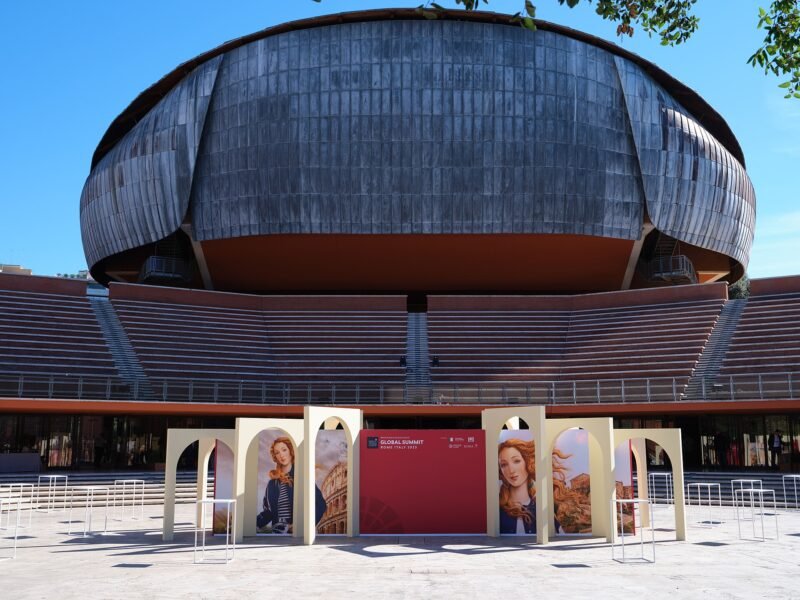
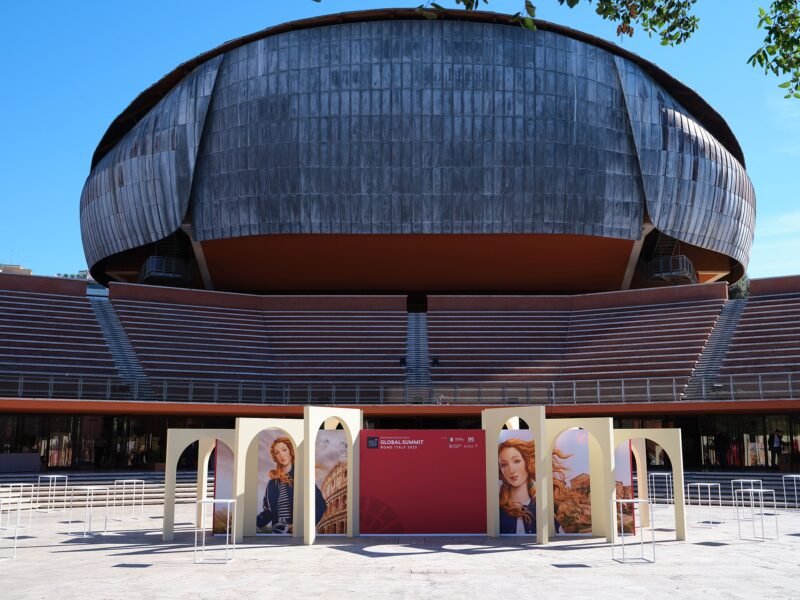
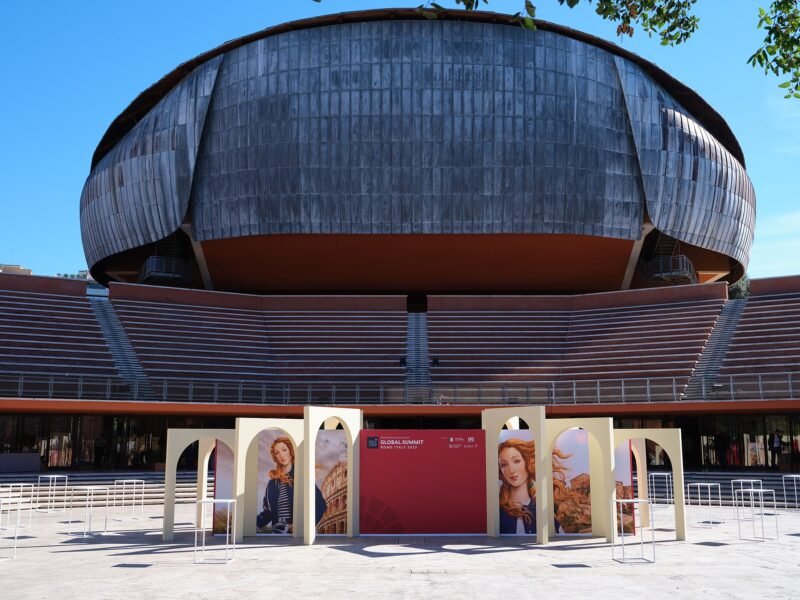
From outside, the three halls look like three giant beetles, clad in lead on a brick base, arranged around the open-air cavea named after Luciano Berio. Renzo Piano won the invited competition in 1993 and worked with acoustician Jürgen Reinhold of the Müller-BBM firm and landscape architect Franco Zagari.
Something nobody tells you about Beethoven's Ninth with Daniel Harding in Rome, April 22 to 24, 2027
At Santa Cecilia the punctuality rule allows no exceptions. The Accademia says it bluntly: concerts start on time, and latecomers can't enter the hall but can follow the concert in the listening rooms, while seats last. For these evenings the rule has a precise consequence: the program opens with Gervasoni's world premiere, and if you're late you miss it. A world premiere, by definition, can't be made up.
The second thing few people mention: Sala Santa Cecilia is built on a level well above the ground, because the remains of a Roman villa emerged underneath, and there are only two elevators to the galleries. With three likely sold-out evenings, the elevators become a bottleneck in the minutes before the start. If you have mobility issues and a gallery seat, arrive well in advance.
The third concerns the series. Saturday at 18:00 is the time many Romans ignore, used to evenings. Yet it's the best time if you want an unhurried dinner after the concert, or if you're coming from out of town and have a train to catch.
My tip for Beethoven's Ninth with Daniel Harding in Rome, April 22 to 24, 2027
Choose Saturday at 18:00 and a frontal gallery seat. Saturday because the time lets you arrive calmly, listen with a clear head and have dinner afterward, and the front gallery because for a symphony with chorus the balance of the sound masses matters more than closeness to the podium.
Second: get to the Auditorium at least 40 minutes early. Picking up tickets, security, the climb to the hall and the coat check take time, and in a hall of more than 2,700 seats lines form fast. With the punctuality rule, missing Gervasoni because of a coat check line would be a shame.
Third: prepare a little. Read the text of Schiller's ode before going in, even just in translation. The Ninth's finale is sung in German, and knowing what the chorus and soloists are saying transforms the listening.
Fourth, if you have time: take a walk on the terrace that runs around the buildings before the concert. Between Sala Santa Cecilia and Sala Sinopoli you can see the remains of the Roman villa found during construction. More than 2,000 years of Rome underfoot, 200 years of Beethoven in your ears: the most honest summary of the evening.
Tickets for Harding's Ninth at Santa Cecilia
Tickets for Beethoven's Ninth conducted by Daniel Harding cost €28 to €65, depending on the section, and are sold only through the authorized sellers named by the Accademia.
Where to buy
The Accademia names as authorized sellers the outlets of the presale network the official concert page links to, the Auditorium Parco della Musica Ennio Morricone box office and the one on Via Vittoria 6. Online purchase starts from the button under your chosen date on the concert page. The Accademia takes no responsibility for markups on tickets sold by unauthorized sellers.
Young people and information
The Accademia has a section on its website devoted to discounts for young people. For information there's the info line 06 8082058 and the addresses info@santacecilia.it and biglietteria@santacecilia.it. Full notices are published on the Accademia website.
Via Vittoria box office
Via Vittoria 6 box office is in the Tridente, not far from Piazza del Popolo: handy if you're staying in the center and prefer to buy in person, choosing your seat with the staff's help.
How to get to the Auditorium for the Ninth
Auditorium Parco della Musica Ennio Morricone is reached by tram 2, Flaminia/Reni or Apollodoro stops, and by buses 910, 982, 168 and 53. The metro doesn't come this far: the nearest station is Flaminio, on line A.
Metro A and tram 2
From Flaminio station you come out on Piazzale Flaminio and take tram 2 toward Piazza Mancini. Get off at Flaminia/Reni or Apollodoro and walk a few minutes toward Viale Pietro de Coubertin, through the Villaggio Olimpico.
Bus 910 from Termini
The 910 leaves from Piazza dei Cinquecento, in front of Termini station, and takes you to the Auditorium without changes. If you arrive by train it's the simplest option. The 53 links Piazza Mancini and the center, the 982 comes from Viale XVII Olimpiade area and the 168 from Tiburtina station. For times and frequencies on your chosen day, check the transit company's journey planner.
By car
Viale Pietro de Coubertin is closed to traffic along the Auditorium stretch. The complex has a paid internal parking lot with limited spaces, and on concert nights cars spill into the streets of the Villaggio Olimpico. Drive only if there's no alternative.
Another well-known fact, yet one rarely mentioned
Everyone knows the Ode to Joy, but few remember that the melody Europe uses as its anthem isn't exactly Beethoven's. The finale's theme was arranged by Herbert von Karajan, and in that form it was adopted in 1972 as the European anthem, and since 1985 it has been the official anthem of the European Union.
The second fact, known to insiders, concerns the dedication. The Ninth, the symphony of universal brotherhood, is dedicated to a king: Frederick William III of Prussia. The score was published by Schott in Mainz in 1826, and the autograph is kept at the Berlin State Library. The contrast between the finale's message and the dedication to an absolute monarch says a lot about the world Beethoven worked in.
The third concerns Rome. The Accademia di Santa Cecilia, performing the Ninth in April for the bicentenary, has a permanent symphony orchestra and chorus: a condition that makes it possible to tackle this symphony entirely with its own forces, without a guest chorus. On stage will be the home musicians, with their music director.
The Accademia Nazionale di Santa Cecilia
The Accademia Nazionale di Santa Cecilia, which produces the Ninth with its own orchestra and chorus, is one of the oldest musical institutions in the world: born as a congregation of musicians, it's now a foundation with a symphony orchestra and chorus and advanced training programs.
The Accademia inside the Auditorium
The Auditorium is the Accademia's main home, where it also keeps its Bibliomediateca library and the Museum of Musical Instruments. Since 2003 the Accademia's symphonic season has been held here permanently. The patron saint of the Accademia and of music is the saint venerated in the Basilica of Santa Cecilia in Trastevere.
April in the season
The Accademia calendar for fall 2026 shows the season's rhythm: Harding's Siegfried in October, Alexander Soddy with Poulenc and Prokofiev and Kirill Petrenko in November, Antonio Pappano at the end of November. The April Ninth fits into this path as the music director's event in the Beethoven year.
The right photo to take at Beethoven's Ninth with Daniel Harding in Rome, April 22 to 24, 2027
During the concert your phone stays in your pocket: in a hall with such sensitive acoustics every shot can be heard, and in the Ninth the silences between movements are part of the music. The right photo is taken before and after.
Before: from the top of the cavea, frame Renzo Piano's three beetles with their lead cladding reflecting the light. On Saturday at 18:00, in late April, there's still daylight, and the Auditorium shows its best profile. If you can include the Sala Santa Cecilia entrance with the audience going in, the photo tells the story of the evening.
Inside the hall, before the concert begins and if the staff allows it, the shot to take is toward the stage: the full orchestra, the chorus rows already lined up behind, the cherry wood shells above. You recognize a Ninth by its crowded stage, and that image, before the conductor walks on, is the record of the evening.
After the concert, during the final applause, many people pull out their phones. If you must, do it then, without flash. But my advice is different: photograph the empty cavea on your way out, with the evening lights. It's the photo of the silence after the Ninth.
Some important events that happened here in history
The ground the Auditorium stands on has a history far longer than the complex. During construction the remains of a Roman villa emerged, built in the 3rd century BC on the site of an archaic farm from the 6th century BC. The discovery forced Renzo Piano to change his design: two of the three beetles were moved west, almost to the Corso di Francia viaduct. The finds are displayed in a small museum under the cavea.
The modern story begins with a demolition. In 1936 the Augusteo, Rome's great concert hall, was torn down, and for more than 60 years the capital had no auditorium built for symphonic music. Only in 1992 did the city council choose the Villaggio Olimpico area, and in 1993 Renzo Piano won the competition.
Sala Sinopoli opened on April 21, 2002, and on December 21, 2002 the rest of the complex was inaugurated with Sala Santa Cecilia and a concert by the Accademia Orchestra conducted by Myung-whun Chung. Since 2003 the Auditorium has been the permanent home of the Accademia's season, and since 2006 it has hosted the Rome Film Fest. In 2020 the city council approved naming it after Ennio Morricone.
And an anniversary almost nobody notices: Sala Sinopoli opened on April 21, 2002. Harding's Ninth arrives the day after the 25th anniversary of the opening of the Auditorium's first hall. A quarter of a century of symphonic music in a city that had gone 60 years without it.
Who has passed through Beethoven's Ninth with Daniel Harding in Rome, April 22 to 24, 2027
Sala Santa Cecilia has had important guests from day one. The December 21, 2002 inaugural concert was conducted by Myung-whun Chung. A few months earlier, at the opening of Sala Sinopoli, the elderly composer Goffredo Petrassi insisted on being present and heard the first performance in the new hall of his 1931 Concert Overture, and the complex's smallest hall now bears his name. Luciano Berio, who led the Accademia in those years, gave his name to the cavea.
In its first months the hall was also criticized: conductor Wolfgang Sawallisch expressed doubts about the stage and the acoustics, and corrections followed. Since then the hall has become the home of the Santa Cecilia Orchestra and the conductors who have led it, from Antonio Pappano to Daniel Harding.
The link between Pappano and Harding is curious: the outgoing and incoming music directors share the same season. In fall 2026 the Accademia calendar brings both Harding, with Siegfried, and Pappano, at the end of November, to the Sala Santa Cecilia podium. Seeing the previous and current music directors alternate on the same podium a few weeks apart is a sign of continuity. For Harding, who as a teenager mailed tapes to Rattle and served as Abbado's assistant, the April Ninth is a chance to leave his mark on a hall that already has its own history.
Around the Auditorium: Flaminio and the Villaggio Olimpico
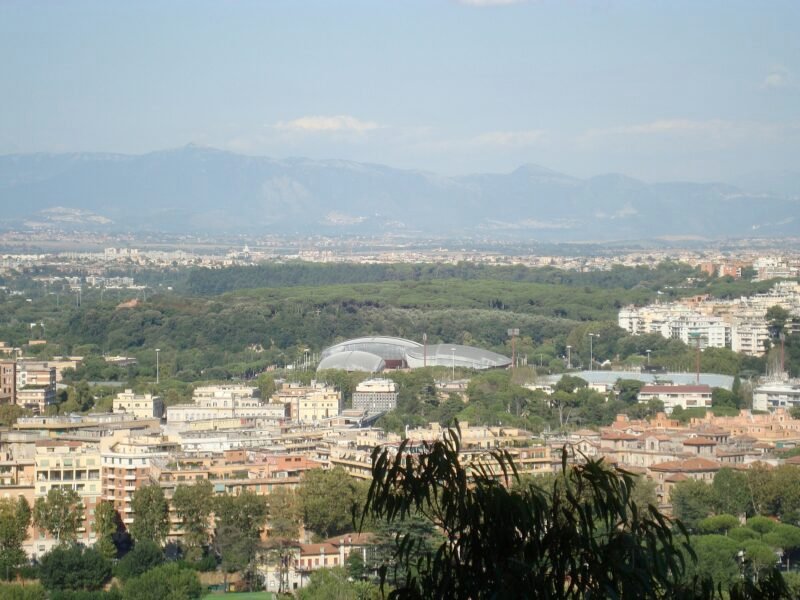
The Auditorium covers about 55,000 square meters between Villa Glori, the Villaggio Olimpico, the Corso di Francia viaduct and Viale Maresciallo Pilsudski: a piece of modern Rome where contemporary architecture converses with green space.
MAXXI and Teatro Olimpico
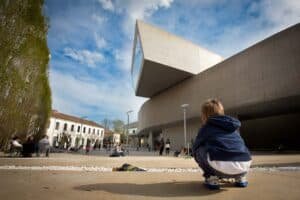
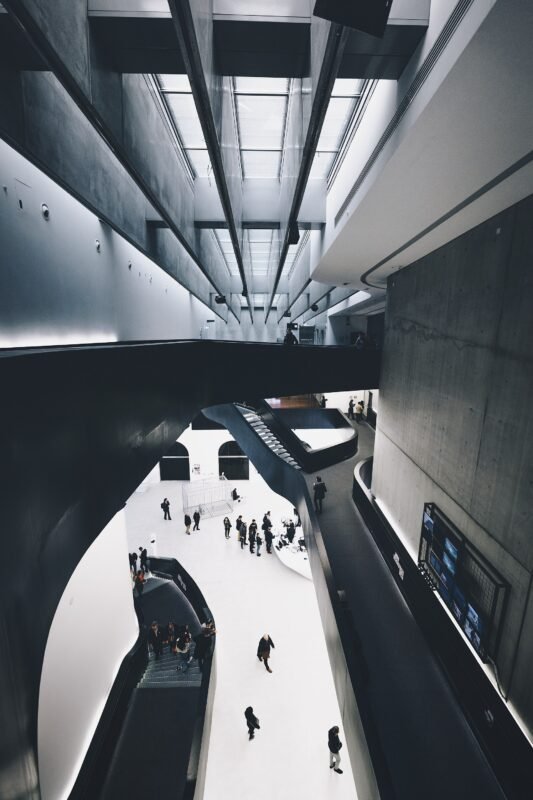
Near the Flaminia/Reni stop of tram 2 is MAXXI, the museum of 21st century arts. A little farther is Teatro Olimpico, another historic hall in the neighborhood.
Toward the Tiber and the center
From the Auditorium you head down to the river and the Ponte della Musica, the footbridge linking Flaminio to the Foro Italico. Farther north is Milvian Bridge, which in the evening becomes one of the busiest meeting points in north Rome. Tram 2 takes you back to Piazzale Flaminio, where Villa Borghese and the Tridente begin: Villa Borghese is right there.
Where to eat before or after the Ninth
Inside the Auditorium there's a bar and café in the foyer and a bar-restaurant with a street entrance too: the most convenient option if you're coming straight from work.
In the neighborhood
Between the Villaggio Olimpico, Via Flaminia and Piazza Mancini there are pizzerias, trattorias and neighborhood bars, used more by residents than tourists. For the Thursday 19:30 concert, eat afterward, and for the Saturday 18:00 one, dinner after the concert comes naturally.
Ponte Milvio and the center
If you'd rather eat afterward, the widest choice is around Ponte Milvio, where places stay open late. In the opposite direction, toward Piazzale Flaminio and Piazza del Popolo, the choice is that of the historic center, with historic-center prices.
Accessibility and young people at the Ninth
Sala Santa Cecilia is raised above street level and the galleries are reached by only two elevators: for accessibility needs, contact the Accademia box office in advance at the info line 06 8082058 or biglietteria@santacecilia.it.
People with reduced mobility
Arrive at least an hour early and ask the house staff for the elevator route before the line forms.
With young people
The Ninth is one of the best symphonies for taking a young person to their first symphonic concert: the finale with chorus, the theme they already know without knowing it, the spectacle of a crowded stage. The Saturday 18:00 performance is the right one. Entry rules for minors and youth discounts are published by the Accademia.
Frequently asked questions about Beethoven's Ninth with Harding in Rome
When is Beethoven's Ninth with Daniel Harding performed in Rome?
Beethoven's Ninth conducted by Daniel Harding is performed three times in Sala Santa Cecilia at Auditorium Parco della Musica: Thursday, April 22, 2027 at 19:30, Friday, April 23 at 20:00 and Saturday, April 24 at 18:00. The program is the same on all three evenings.
How much are tickets for the Ninth at Santa Cecilia?
Tickets for Beethoven's Ninth with Harding at the Accademia di Santa Cecilia cost €28 to €65, depending on the section. They're sold from the official concert page on the Accademia website, which links to the authorized network, at the Auditorium box office or at the one on Via Vittoria 6.
Who are the soloists in Harding's Ninth?
The soloists in Harding's Ninth at Santa Cecilia are soprano Christiane Karg, mezzo-soprano Sara Mingardo, tenor Andrew Staples and bass Alexander Grassauer, with the Accademia Orchestra and Chorus and chorus master Andrea Secchi. Lucile Richardot sings in Gervasoni's world premiere.
What else is on the program besides the Ninth?
Besides Beethoven's Ninth, the Santa Cecilia program includes the world premiere of Stefano Gervasoni's Rischiare la gioia, commissioned by the Accademia, with mezzo-soprano Lucile Richardot. Gervasoni's piece opens the concert.
What happens if I'm late for the Santa Cecilia concert?
Accademia di Santa Cecilia concerts start on time, and latecomers can't enter the hall: they can follow the concert in the listening rooms, while seats last. For Harding's Ninth, arriving late means missing Gervasoni's world premiere.
How do you get to Auditorium Parco della Musica?
Auditorium Parco della Musica, at Viale Pietro de Coubertin 30, is reached by Metro A to Flaminio and then tram 2, Flaminia/Reni or Apollodoro stops, or by bus 910 from Termini, with no changes. The 53, 982 and 168 also stop nearby.
How long is Beethoven's Ninth?
Beethoven's Ninth Symphony lasts about 70 minutes on average. At Santa Cecilia it's preceded by Gervasoni's world premiere, whose length isn't published: allow for a concert of a couple of hours and plan your exit accordingly.
Final tip on Harding's Ninth
200 years after Beethoven's death, the symphony that became a continent's anthem returns to Rome's largest hall with Santa Cecilia's music director on the podium and a new piece opening the evening. My tip is simple: choose Saturday at 18:00 and a frontal seat, arrive 40 minutes early, read Schiller before going in and listen to Gervasoni with the same attention you'll give Beethoven. It's a concert you'll remember.
Article written by the editorial team of Tour Leader Pro, contact them for Private/Corporate/V.I.P. Tours and Experiences.
Planning a trip to Rome? The English-language guides for visiting the city are on ItalyPlanner.com.
Contact Information
Nearby
 Museum of Musical Instruments (MUSA)100 m
- Auditorium Parco della Musica100 m
- Villa Glori500 m
- Fountain of Anna Perenna500 m
- MAXXI – National Museum of 21st Century Arts700 m
- Flaminio700 m
Upcoming events nearby
- Roma Jazz Festival 2026, November 1 to 24 at the Auditorium and Casa del Jazz100 m
- Roma Gospel Festival 2026 at Auditorium Parco della Musica, December 13, 2026 to January 1, 2027100 m
- Santa Cecilia 2026/2027 Concert Season at Auditorium Parco della Musica, October 21, 2026 to June 5, 2027100 m
- Kyle Dixon and Michael Stein, The Music of Stranger Things at Auditorium Parco della Musica, November 19, 2026100 m




You might also like
- Daniel Harding Conducts Ravel and Debussy at Auditorium Parco della Musica, April 8, 9 and 10, 2027
- Argerich and Capuçon for Beethoven at Auditorium Parco della Musica, April 6, 2027
- Gustavo Gimeno and Frank Peter Zimmermann at Auditorium Parco della Musica, April 1, 2 and 3, 2027
- Manfred Honeck Conducts Beethoven at Santa Cecilia: March 25, 26 and 27, 2027
- Grigory Sokolov at Santa Cecilia, March 22, 2027
- Charles Dutoit and Martha Argerich at Auditorium Parco della Musica, March 18, 19 and 20, 2027