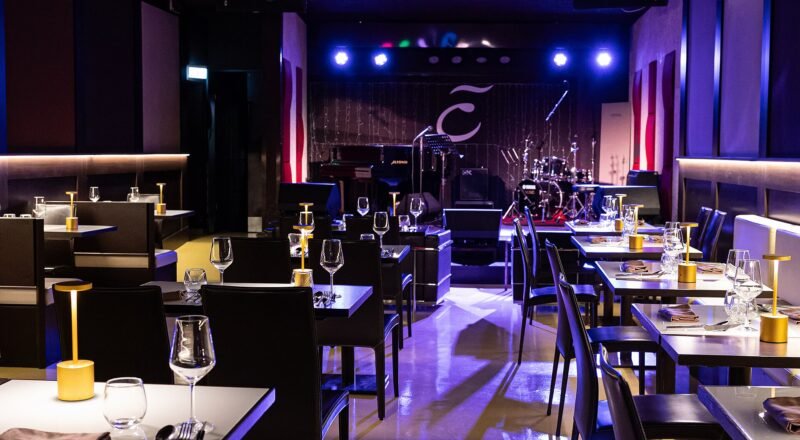
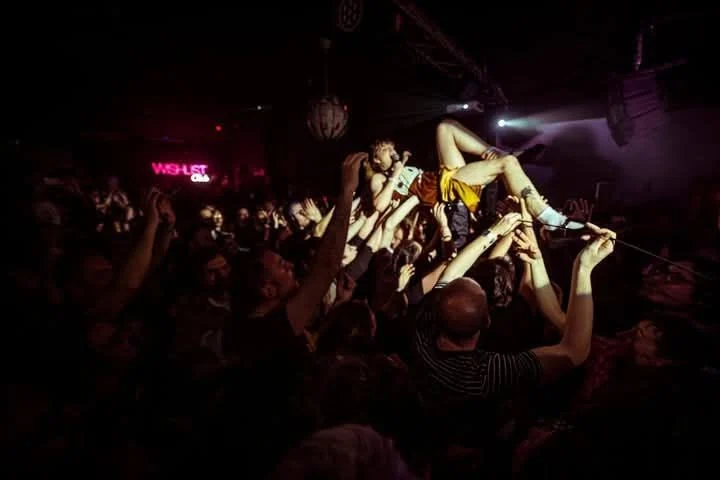
Black Market
In short. Black Market is the club at Via Panisperna 101, in the Monti district, the one that (almost) the whole international indie-folk-pop community envies us.
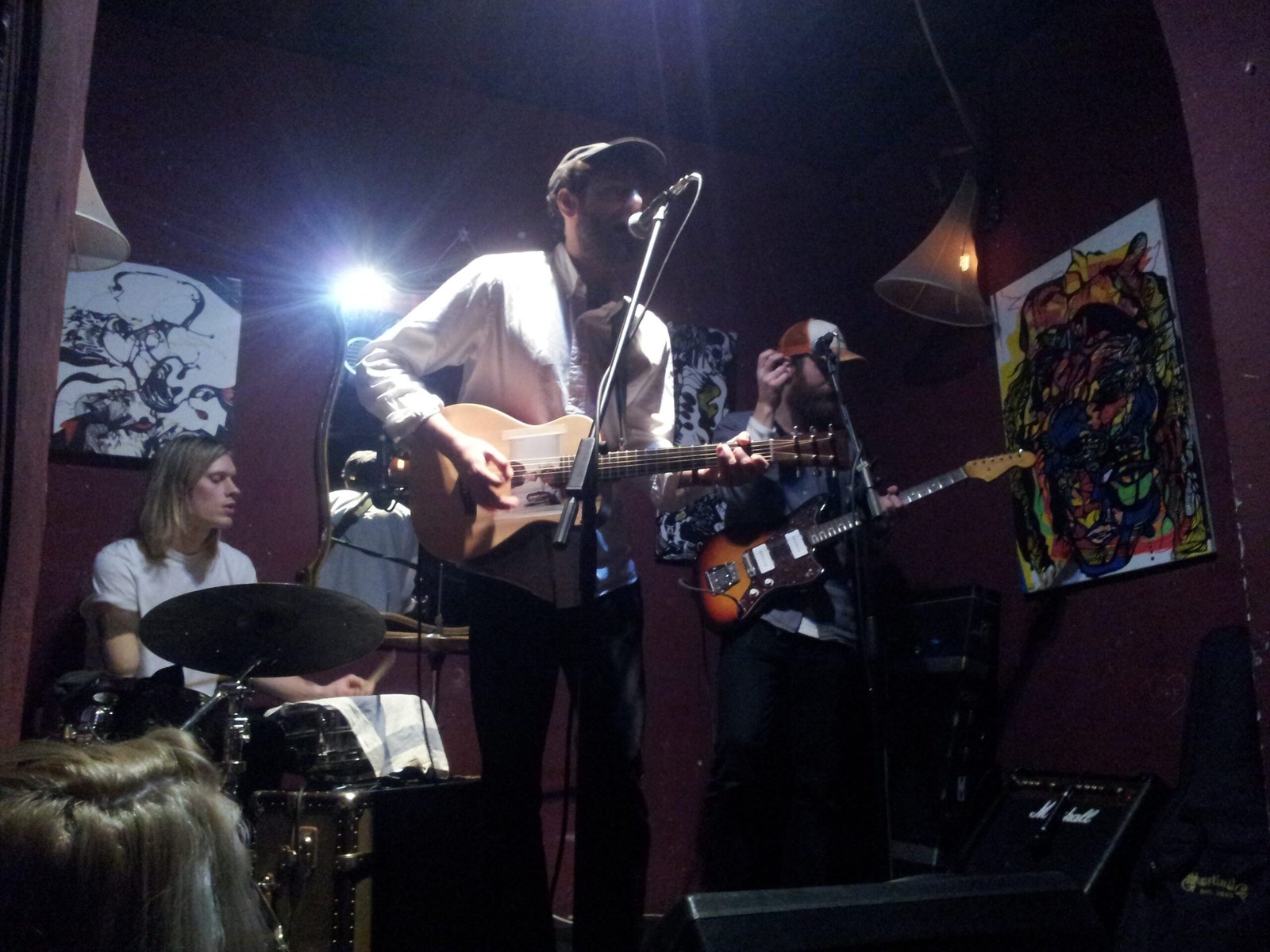
Black Market is the club at Via Panisperna 101, in the Monti district, the one that (almost) the whole international indie-folk-pop community envies us. I say it right away because it's the line that has been going around for years about this address and, for once, it's not an inflated line: it's the honest summary of what happens inside a building that promises nothing from the outside. You get there going up and down through Monti in a style that someone has described as Frisco, meaning those short, continuous slopes that make you understand, with your legs before your head, that you're on a real hill. Then doorbell, membership card, bar counter. Three gestures that look like a formality and are actually a filter: whoever rings the bell knows where they're going, whoever gets a card is entering a club and not just any bar, whoever reaches the counter has already understood that here the order of things is different from the street.
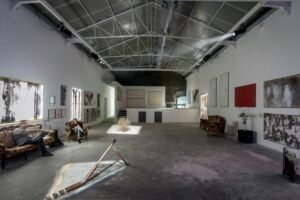
The first room is where you drink and where records get played. The sound system needs work, and I write it plainly because it's one of those things that regulars admit first: the sound of the entrance room is not the reason people come back. The reason is something else, and it's the sum of three spaces that coexist without resembling each other. After the first room, a second, darker space opens up, with small sofas and a bookshelf on a mezzanine that is the most photographed thing in the place, the one that becomes instantly recognizable in the images circulating online even to people who have never set foot in Monti. Then there's the floor below, and that's where the club is at its best: a small room that is a cube out of this world, just a kick drum, walls and a console, a place built to give substance to the word after. No furnishings to distract you, no view, no windows to remind you that outside it's night or morning. Just the room and what happens inside it.
There is, though, a fourth element, and it's perhaps the one that explains the reputation of the place better than the lower room: the intimate space upstairs, which is perfect for the most regular live event within these walls, Unplugged In Monti. The name says it all: unplugged, so voice and instrument without the apparatus, and In Monti, meaning inside a district that has a density of people, alleys and venues that no other part of Rome's historic center reaches in the same way. It's a series that has built a recognizable format over the years, with the audience seated or standing an arm's length from the musician, in a room where silence counts as much as sound.
Let's line up the practical information, because everything else is storytelling. The address is Via Panisperna 101, Rome, Monti district, halfway between Via Nazionale and Via Cavour, in that grid that climbs toward the Viminale on one side and descends toward the Forums on the other. The club runs on membership, so you enter after registering: it's the classic club model, not a barrier meant to exclude anyone but the legal form with which a place that plays live music and opens late is kept going in Italy. The doorbell at the entrance isn't folklore: the door stays closed and opens when someone inside decides to open it. For hours, programming and opening status, it's always best to check the club's official channels before setting out, because in Monti the calendars change from week to week and the series follow their own seasons.
How to really get there, and why it's best to walk
The best way to reach Via Panisperna 101 is the one no app suggests first, namely on foot from far away. From Termini station it's a little under 15 minutes on a gentle downhill: you take Via Cavour, turn right onto Via Urbana or go up one of the cross streets, and without noticing you're inside. From the Cavour stop on metro line B the time is halved and the climb is steeper, with that staircase everyone calls the salita dei Borgia, which is the most theatrical way to enter the district. From the Repubblica stop, still on line A, you walk down Via Nazionale and it's yet another thing: you pass shop windows, 19th-century doorways, the wide facades of a street that was conceived as the showpiece axis of the new capital, and then you turn and end up in an alley that looks like it's from 200 years earlier.
If you come by bus, Via Nazionale is one of the best-served routes in the center, with lines that connect Termini to Piazza Venezia and continue toward the Tiber. Parking the car, on the other hand, is a chapter I recommend closing before you even open it: Monti is a limited traffic zone for a large part of the week and in the evening hours, free spots are a mirage and the alleys are so narrow that two side mirrors touch. Arriving by taxi or public transport to the edge of the district and then walking is the only strategy that holds up. Besides, walking here is not a sacrifice: it's how the neighborhood explains itself.
A note on the way back, which people often forget to plan. If the night ends late, and at Black Market it ends late by definition, the metro is closed. What's left are taxis, which in Monti you find more easily on the wide streets (Via Nazionale, Via Cavour, Piazza dell'Esquilino) than in the alleys, and the night buses that pass through Termini. Knowing in advance which way to leave saves you from wandering around in the wrong shoes on a pavement that has quite a lot of sampietrini.
The three souls of the club, one at a time
A three-level club is not a big club: it's a club that is different three times over. And Black Market works exactly like that, with a progression that is not random. The entrance floor is the convivial one: counter, bottles, records spinning, people talking in a normal voice without having to shout. It's the room where you decide what kind of night it will be. Whoever stays there stays to drink and talk, and the fact that the sound system isn't flawless here almost helps: nobody is put in the position of having to compete with the volume.
The second room, the darker one with the small sofas and the bookshelf on a mezzanine, is the room of waiting and long conversation. This is where you understand the aesthetic of the place, which is made of accumulated objects, wood, low lights and a staircase leading to a loft of books. The word that comes to mind is living room, but a living room that has stopped being private. Furnishings collected and put back into circulation are a trait you find in more than one business in Monti, and it's a trait with a history: the district lived for a long time alongside junk dealers, restorers, salvage workshops, and that culture of reuse left a visual imprint that the venues opened in recent decades have inherited and reinterpreted.
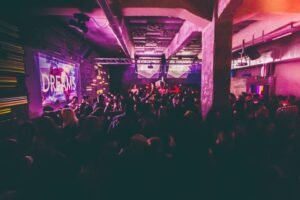
The floor below is the opposite of all this. Kick drum, walls, console. The description that circulates talks about a cube out of this world, and the image is right: it's a space that voluntarily gives up any comfort to do one thing only. There are no sofas to sink into, no corners to retreat to for a chat. There's the sound and there are the people listening to it standing up. It's the place of the after, that time slot when the city above has already closed and what's left is a group of people who have decided not to go to sleep. Whoever wants a quiet night will go down once, look, and come back up. Whoever wants the other thing will stay down.
And then there's the floor above, the intimate space that hosts the live shows. Here the relationship between size and result flips: precisely because the space is small, an acoustic concert works the way it wouldn't in a hall with a thousand seats. The person playing hears the breathing of those listening, and those listening see the fingers on the strings. It's a format that doesn't forgive: if the voice doesn't hold, you hear it. If the song isn't well written, you hear it. No sound system covers for you. That's why acoustic series, when they work, build a loyalty in the audience that big venues never get.
Unplugged In Monti, the format that built the reputation
Unplugged In Monti is the name of the most regular live event within these walls, and it's also the reason this address gets cited outside Rome. The idea is the simplest possible: live music without heavy amplification, in a small room, at a regular cadence. Simple to say, hard to keep going for years, because it requires three things that rarely come together: an audience willing to be quiet, a venue willing to give up the takings of a full house, and a network of contacts able to bring to a small neighborhood room musicians who elsewhere play in front of many more people.
The acoustic formula has a consequence worth explaining to anyone who doesn't go to this kind of night. At an amplified concert, the background noise of the audience is covered and becomes almost part of the atmosphere. At an unplugged concert, every glass set down badly on the table enters the song. This turns the audience into a participant: the quality of the night depends on those listening too, not only on those playing. It's not a given in Rome, and in Monti, for reasons that have to do with the kind of people who live in and frequent the district, it works better than elsewhere.
The definition of international indie-folk-pop community is not a marketing label. It describes a real circuit: singer-songwriters and bands moving between European cities on low-cost tours, often as a duo or solo, looking for places where acoustic quality and the audience's attention count more than capacity. These circuits work by word of mouth among the organizers, and a club that builds a reputation in that scene ends up receiving proposals it could never have bought. That's why the club is envied: not for its size, not for its sound system, but for the position it occupies in a network.
A curiosity about Black Market
The curiosity I like best concerns the name, and the game of mirrors it carries with it. Black Market means mercato nero, and in Rome the black market has a precise historical image: that of the war and postwar years, when in the working-class districts people sold and bought everything the ration card didn't allow. Monti was one of those working-class districts, one of the densest, with courtyards, workshops and stairways where informal trade was part of daily survival. A club that today goes by that name, inside a building on Via Panisperna, with card and doorbell, ironically picks up exactly that image: the restricted access, the door that opens only for those who know, the feeling of being in a place that doesn't display its goods in the window.
The second level of the game is that Black Market is also the name that in Anglo-Saxon music culture evokes the rare record, the one you can't find in ordinary shops. And in fact the entrance is a room where records are played. I don't think it's a coincidence. There's a line connecting the Monti junk dealer, the vinyl collector and the manager of a club who decided to put a mezzanine bookshelf in a drinking room: all three of these figures work on the idea that the value of an object lies not in its novelty but in the fact that someone looked for it.
The third curiosity is topographical and I notice it every time I pass by. Number 101 on Via Panisperna is a few hundred meters from number 89a, and 89a is one of the most famous addresses in the history of Italian science, because that's where the Physics Institute of the Royal University was based, where Enrico Fermi's group worked. So on a single street, within a couple of blocks, you have the place where one of the most important discoveries of the 20th century was made and the place where acoustic music is played today in a small room. There's no connection between the two, and that's exactly why the contrast is curious: Via Panisperna is a street that seems made to host things that happen away from the spotlight and get recognized later.
Via Panisperna, the name, the bread and the perna
The street the club faces has one of the most curious names in Rome, and the most accredited origin goes through the church of San Lorenzo in Panisperna, located a little higher up on the Viminale hill. Tradition says the name comes from the distribution of bread and ham, panis et perna in Latin, that the Poor Clare nuns handed out to the poor on the feast day of Saint Lawrence. It's a popular explanation, the kind scholars accept with caution, and it coexists with the hypothesis that the name instead comes from a family that owned the land, the Perna. Neither version is definitively proven, and I like this uncertainty: a street that owes its name to a humble dish or a forgotten surname is in any case a street that tells of ordinary people, not emperors.
It's worth remembering that Saint Lawrence, to whom the church is dedicated, is one of the patrons of Rome and that tradition ties him to this very hill: according to the hagiographic account the deacon's martyrdom on the gridiron took place in a spot that devotion has placed here. Beneath the church, over the centuries, remains of ancient buildings have layered up, and the whole area of the Viminale and the Esquiline is a palimpsest where every excavation brings something to light. Anyone walking on Via Panisperna is walking on one of the few stretches of Rome where the modern street level and the ancient one differ by several meters.
The character of the street today is mixed, and for me that's its merit. In the upper part there are institutional buildings, offices, the flank of the Viminale complex. Going down, the street gets narrower and more lived-in, with doorways, small shops, the kind of commerce that serves those who live there and not those who pass once. It's in this second part that you find number 101. The jump between the two stretches is sharp: you go from the administrative register to the domestic one in 200 meters, and a nightclub in the middle of this passage makes precise sense, because it occupies the threshold between two different cities.
The boys of Via Panisperna, or the most illustrious neighbor
At number 89a on Via Panisperna, inside the complex that today houses the Ministry of the Interior at the Viminale, stood the Royal Physics Institute of the University of Rome. There, in the 1930s, a group of very young scientists worked, whom history baptized with the name of the street: the boys of Via Panisperna. The acknowledged leader was Enrico Fermi, born in Rome in 1901 and a professor at a little over 25 thanks to a chair in theoretical physics created expressly for him on the initiative of Orso Mario Corbino, who directed the institute and had the insight to bet on that group. Around Fermi were Franco Rasetti, Emilio Segrè, Edoardo Amaldi, Bruno Pontecorvo, the chemist Oscar D'Agostino and Ettore Majorana.
In October 1934, something happened in that building that would change the physics of the century: the group discovered that by slowing neutrons, passing them through a substance rich in hydrogen such as paraffin or water, their ability to produce artificial radioactivity in the target materials increased enormously. The story of the goldfish pond in the institute's garden, used as a water screen during the experiments, is one of those details that collective memory has kept better than the formula. Four years later, in 1938, Fermi received the Nobel Prize in physics, and in that very year the racial laws of the Fascist regime pushed him and his wife Laura Capon not to return to Italy after the ceremony in Stockholm. The group scattered: some emigrated, others took different paths, and in March 1938 Ettore Majorana disappeared during a sea voyage, leaving one of the most debated unsolved cases of 20th-century Italy.
I tell you all this because someone coming to Monti for a night out rarely knows they're walking on this street. And yet it changes the way you look at it. The institute's building still exists and today is linked to the Museo storico della fisica e Centro studi e ricerche Enrico Fermi, which has made it a place of scientific memory. It's not a museum for a quick visit and it doesn't keep the hours of a tourist attraction, so it's best to check the opening times before showing up at the door. But even just walking past, reading the plaque and then continuing downhill toward number 101 is a way of crossing the 20th century in five minutes on foot.
There's one last notable thing in this story, and it's the scale. I'm not talking about steps: I'm talking about proportions. One of the decisive discoveries of modern physics was made in a handful of rooms, with instruments built by hand, by a group of people who all knew each other by name. It's the same scale as an acoustic concert in a small room on the upper floor of a Monti club. I don't want to force the analogy, because it would be ridiculous to compare a music night to an experiment that changed history. I only want to say that this street, for some reason, has always hosted small things that worked well.
Something nobody tells you about Black Market
What nobody tells you is that this club has to be taken in two goes, and that if you take it in one go you come away with the wrong idea. The first time you almost always come for a record night, entering at the counter, staying in the first room, maybe going down for 10 minutes to the floor below out of curiosity, and the mental summary that comes out of it is that of a slightly special night bar with a bookshelf for show. Whoever stops at this first impression won't come back, or will come back only when they've already been drinking elsewhere and are looking for an open place. It's the most common reading and also the most unfair.
The second time has to be on an acoustic concert night upstairs. Everything changes, and it changes not because of a matter of taste but because of a physical factor: the room is sized for that. The ceiling, the walls, the number of people who fit, the distance between the one playing and the one listening: these are elements that turn a guitar and a voice into something that can't be replicated in a theater or in an amplified club. If the first experience you have here is an intimate live show, the club stays in your head for years. If the first experience is a noisy after-dinner drink, what stays with you is the sound system that needs work.
The second piece of this matter concerns timing. Many people arrive early, around the late aperitivo hour, and find a half-empty place where nothing is happening. This is a club with its own curve: it takes shape when elsewhere they're closing. The room downstairs, the one dedicated to the after, exists precisely for this. Going there at nine in the evening and complaining that it's dead is like going to the market at five in the afternoon and complaining that they've taken down the stalls. Every place has its hour and this one has it late.
Third piece, and here I get practical. The card. Whoever arrives without knowing finds themselves at the doorbell having to do a procedure that requires an ID and a few minutes. It's not a problem, but if you arrive as six with a group that doesn't know what it's about, those minutes become 20 and the entrance gets clogged. Preparing beforehand, having the ID within reach and knowing that you're entering a club and not a pub makes everything easier for everyone, including the people working behind the door.
The Monti district, that is the Subura, that is the place where half of ancient Rome lived
To understand where you are, you have to clear up a misunderstanding. Monti today is perceived as an elegant neighborhood, with craft shops, well-kept restaurants and rents that aren't for everyone. Historically it's the exact opposite: this is the area of the Subura, the most populous, noisy and disreputable quarter of ancient Rome, the place where tens of thousands of people lived crammed into the insulae, the multistory tenements that ancient texts describe as shaky and prone to collapses and fires. The Subura occupied the valley between the Quirinal, the Viminal and the Esquiline, exactly where Via Urbana, Via dei Serpenti, Via del Boschetto and Via Panisperna itself in its lower part run today.
Latin authors cite it often and almost never with affection. Juvenal and Martial describe it as noisy and crowded, with shops open late, mud, vendors. It was also the quarter of trades: barbers, cobblers, blacksmiths worked there, and there you found activities that respectable Rome preferred to keep away from the monumental center. The link with the Forum went through the Argiletum, the street that came out between the Curia and the Basilica Aemilia, that is, in the political heart of the city. In a few dozen meters you went from the center of power to the working-class quarter: an urban compression that, if you think about it, Rome has never stopped practicing.
The detail that strikes people hearing this story for the first time is that Julius Caesar, according to Suetonius, lived in the Subura in a modest house until he became pontifex maximus and moved into the official residence along Via Sacra. The future dictator coming from the working-class quarter is an image worth more than many pages of social history: it means that the separation between classes in republican Rome was not yet the geographic segregation we know in modern cities.
The name Monti comes much later, in the medieval and modern period, and derives from the heights included in the district: the Quirinal, the Viminal, the Esquiline and part of the Caelian. The district's coat of arms, not by chance, shows three green hills on a silver field. It is the largest of Rome's 22 historic rioni, and for centuries its upper part was countryside inside the walls, with vineyards, vegetable gardens and farmhouses, while the lower part remained inhabited. This double nature, half urban and half agricultural, lasted until the 19th century and is the reason why, when Rome became the capital, it was right here that the space was found to build the great axes of the new city.
The advice I give you for visiting Black Market
There is only one piece of advice and I put it at the top: choose the night before you choose the club. The logic of just dropping by and seeing doesn't work here, because the place changes nature depending on what it has scheduled. If it's a record night, you arrive late, stay at the counter, move between the two rooms and enjoy the conversation. If it's an acoustic concert night upstairs, you arrive early relative to the announced start, take a spot where you can see and hear, and accept staying still and quiet for the length of the set. They are two different uses of the same address and they don't mix well.
Second piece of advice: the card. Find out beforehand how the membership works and show up with an ID. It's the difference between getting in in three minutes and getting in in 20. If you're coming from outside Rome and have never been to Italian clubs, know that it's a normal, widespread practice, not an oddity of this place.
Third piece of advice, and perhaps the one that changes the night most: build a route through Monti instead of heading straight for the door. The district can be walked in 20 minutes and each stretch has a different character. The best starting point is Piazza della Madonna dei Monti, which is the neighborhood's living room, with the fountain in the middle where people sit on the edge with a glass in hand. From there I go up Via dei Serpenti, turn into Via del Boschetto, cut across Via Urbana toward Santa Pudenziana, then climb back toward Via Panisperna. This way, when you ring the bell at 101, the club is no longer an isolated point on a map: it's the last piece of a route.
Fourth piece of advice: eat first, and eat in the district. Monti has a density of good places to eat that is almost embarrassing, from sandwiches to trattorias to pizza. Arriving on a full stomach completely changes how you manage a long night, especially if you plan to go down to the floor below where the after doesn't stop for dinner.
Fifth piece of advice, for those who sleep lightly or have little patience with crowds: the best nights for an intimate experience are the midweek ones. On weekends Monti fills up with people coming from outside the district, the alleys become a continuous current and the club suffers too. A Tuesday or a Wednesday with a concert scheduled is the ideal scenario.
Sixth and last: check the hours and programming on the club's official channels shortly before leaving home. The series follow seasons, venues close for periods, calendars change. Showing up in front of a closed door is a hassle you can avoid with 30 seconds of checking.
What's around, within a five-minute walk
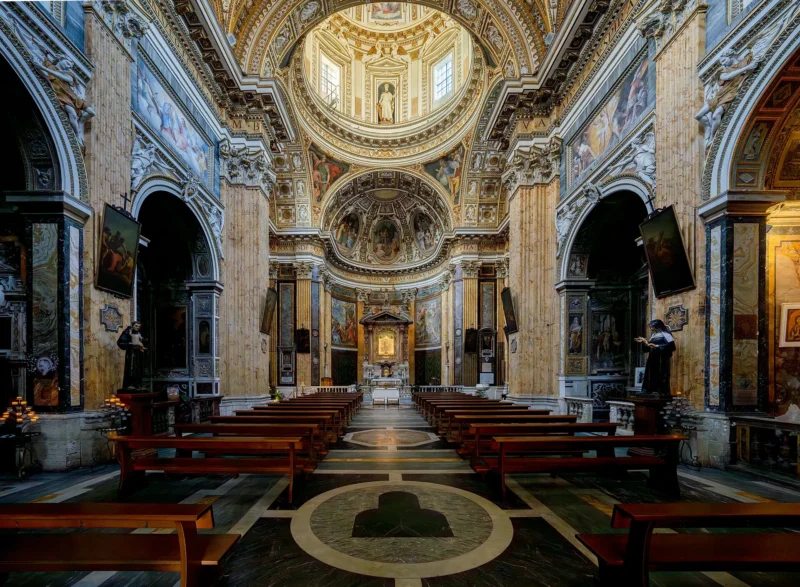
One of the reasons I recommend arriving early in the district is that around Via Panisperna there is a concentration of things to see that in any other city would make an itinerary on its own. You start with the Basilica of Santi Silvestro e Martino ai Monti, which is one of the most underrated churches in Rome: beneath the floor of the current church an ancient space of great interest is preserved, and inside there are the landscapes painted by Gaspard Dughet, brother-in-law of Nicolas Poussin, which are among the most surprising things you can find in a Roman church. In the square in front rises the Torre dei Capocci, one of the surviving medieval towers of the district, and not far away the Graziani tower: they remind us that in the Middle Ages this was an area of family fortifications, not of living rooms.
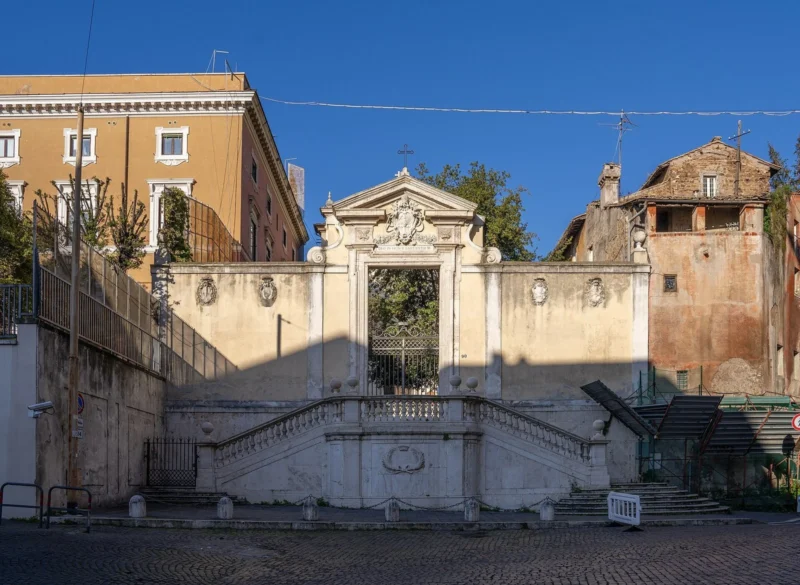
Going down toward Via Cavour you meet the Salita dei Borgia, the covered staircase that connects the lower street to the upper level passing under an arch. It's one of the most photographed passages in the district and one of the most charged with stories: popular tradition ties it to the palace attributed to Vannozza Cattanei, the woman who was long linked to Rodrigo Borgia, later Pope Alexander VI, and mother of Cesare and Lucrezia. The attributions of the building are debated by scholars, and the dark legend that makes that passage the scene of ambushes should be taken for what it is, namely legend. The fact remains that few places in Rome have the same atmosphere at nightfall.
At the top of the climb you reach San Pietro in Vincoli, where Michelangelo's Moses is, part of the funerary monument of Pope Julius II. A few hundred meters further on, on the opposite side, the places of monumental archaeology open up: Nero's Domus Aurea on the Oppian Hill, the Trajan's Markets with Museo dei Fori Imperiali, and of course the Colosseum, which from the lower part of Monti you reach in a 10-minute walk. Anyone who wants to widen out toward the Esquiline finds the Nuovo Mercato Esquilino, which is yet another Rome, that of the stalls of spices and products arriving from half the world.
If instead the day is devoted to music and not to archaeology, within a few stops there are other addresses worth knowing: the Alexanderplatz Jazz Club, a historic reference of Roman jazz, and the Casa del Jazz, with its park and concert season. They are different formats from that of an acoustic neighborhood room, but together they tell the sonic geography of the city.
Santa Maria dei Monti, the square and the fountain
The church of Santa Maria dei Monti, or Madonna dei Monti, is the devotional and social heart of the district. Its story begins in 1579, when in a hayloft made out of an ancient monastery an image of the Virgin was found to which prodigious events were attributed. Popular devotion exploded, Pope Gregory XIII decided on the construction of a church and the project was entrusted to Giacomo della Porta, who here created one of the most elegant examples of Roman religious architecture of the late 16th century. The building was opened for worship in 1580.
Inside this church rests Saint Benedict Joseph Labre, the French pilgrim who died in Rome in April 1783 in a house on Via dei Serpenti, a few meters from here. His figure tells a piece of the district's history that is hard to imagine today: a man who lived on alms, who slept under the arches of the Colosseum, and whose death sparked an immediate and imposing popular devotion. The canonization came in 1881. Anyone entering the church today, among the tourists photographing the altar, rarely notices this story.
Outside, Piazza della Madonna dei Monti is the place where the district looks at itself in the mirror. The fountain in the center, simple in form, has become over the years a spontaneous gathering point: people sit on the edge, drink, talk, and on mild evenings a sort of permanent assembly forms. It's also one of the points where the tension between residents and nightlife is most evident, because living above a square that at two in the morning is still full is not easy. This tension is part of Monti's recent history and it's worth knowing about, because it explains many of the rules and hours that the area's venues have to respect.
Another well-known fact, yet rarely cited
The well-known fact is that Monti is the oldest and largest rione of Rome. What almost nobody stops to consider is the urban planning consequence: the district as we see it today is the result of two great 19th-century amputations, and without those cuts we would have neither Via Nazionale nor Via Cavour, the two streets that today bound the part of Monti where Via Panisperna is.
After 1870, with Rome as capital, the city had to provide itself with ministries, banks, hotels and barracks. The available land was the high ground of Monti, still largely occupied by vineyards and villas. Via Nazionale was opened to connect Termini station to the center through a modern, wide thoroughfare, suited to carriages and later to trams. Via Cavour was the second axis, opened in the following years to connect Termini to the Forums area. To make it pass, entire blocks of the medieval fabric were demolished and street levels were shifted by several meters.
The consequence is that the ancient heart of Monti, the one of the alleys, is today an island enclosed between two big modern streets. When you walk on Via Urbana or on lower Via Panisperna and you feel the rhythm change, the cars disappear, the voices bounce off the walls, it's not a suggestion of the mind: you're inside the piece of fabric that the demolitions spared, bounded by two surgical cuts. That's why this district feels like a village inside the city. Literally it is one: it's a surrounded fragment.
There is a second well-known and rarely cited fact, and it's that this encirclement produced a community. Monti has a strong neighborhood associative life, with a local market, festivals, residents' initiatives and an identity that people openly claim. Whoever opens a venue here is not opening in just any place: they're opening inside an organism that has opinions about what happens around it. This explains why the Monti venues that last are the ones that found a balance with those who live there, and why intimate formats, like an acoustic concert in a small room, work better than expansive formats.
The right photo to take at Black Market
The right photo is not the one of the counter and it's not the one of the stage. It's the mezzanine bookshelf of the second room, shot from below, with the staircase going up and the volumes lined up above the heads of the seated people. It's the image that identifies the club immediately, because it puts together two things that usually don't coexist in a single frame: books and nightlife. To do it well you need little: lean against the opposite wall, hold the phone vertically, don't use the flash. The light is low and warm, so accept the noise in the image instead of fighting it, because a slightly grainy photo here looks more like the place than a clean one.
The second photo, the one I recommend to those who want to tell the story of the night and not just the furnishings, is the detail of the musician during an acoustic set upstairs. Not the frontal portrait, which in a small room becomes intrusive and disturbs the one playing: the detail. The hands on the strings, the microphone, the profile of the people listening against the light. Here a rule of manners applies before one of photography: screen at minimum brightness, phone on silent, no long recordings. In an amplified room nobody notices. In an acoustic room a lit screen in the middle of the audience is a small aggression.
The third photo you take outside, and it's the one that tells the club better than the first two. The closed door of Via Panisperna 101, at night, with the doorbell and the uphill street disappearing into the dark. No flashy sign, no line, no indication for the passerby. It's the image of the threshold: a piece of city that doesn't declare what it contains. With the phone's wide-angle lens, standing on the other side of the street, you also catch the slope and the street lamps, and you get a photograph you could take in Rome at very few other points.
For those who feel like widening out, the district offers two shots that complete the story. One is the Salita dei Borgia, best from below toward the arch, on a cloudy day or right after sunset, when the contrast isn't harsh. The other is the downhill alley of Via Urbana with the Romanesque bell tower rising beyond the roofs. In all cases, the advice is to avoid the middle hours of the day: in Monti the good light comes early in the morning, when the streets are empty, or in the early evening, when the shop windows light up and the yellow walls warm up.
What to drink, what to expect, how to behave
On drinking, no rankings and no price lists, because they change and prices written today would be false tomorrow. What I can say is that the setup of the first room is that of a working bar counter, with classic mixing and beer, and that in a place like this the sensible choice is to ask whoever is working behind the counter what they recommend that specific night. It's a habit that has been lost in Italy and that instead works very well in small venues: whoever works there knows what they do best and is happy to say so.
On what to expect, I'll put my cards on the table about one thing. This is not a large club. Whoever arrives with the idea of a night out with 20 people and a reserved table will find themselves thrown off. The spaces are intimate by definition and on full nights it's tight. It's part of the format: the same intimacy that makes an acoustic concert memorable makes a crowded night tiring. Knowing in advance what kind of experience you're buying avoids disappointment.
On how to behave, the unwritten rules are three. During the live shows you listen, and conversations are taken to the other room. On the way out you speak in a low voice, because above the street there are inhabited homes and the coexistence of nightlife and residents in Monti is a delicate balance that venues pay for first when it breaks. And the door is a door, not a shop window: whoever opens decides, and insisting on the doorbell has never gotten anyone in faster.
The seasons of Monti, why it's not the same place all year
The district has four versions of itself. In winter Monti is at its best for those who love the indoors: the streets empty early, the venues become refuges, and a low room with small sofas takes on a meaning that it doesn't have in August. The afternoon light lasts little and the alleys light up at five, which makes the walk before the night especially beautiful.
In spring the district explodes. Piazza della Madonna dei Monti becomes an open-air living room, the small tables come out, and the outdoor part of the night weighs as much as the indoor one. It's the season when it's worth arriving early and devoting an hour to a tour of the alleys before slipping through a doorway.
In summer Rome changes rhythm and Monti empties of Romans and fills with visitors. It's also the season of the Estate Romana, when the city's cultural programming moves outdoors, toward the arenas, the parks and the banks of the Tiber, and indoor venues go through a slower phase. Many addresses reduce activity or close for a few weeks in August: it's the main reason I insist on checking the calendar before going out.
In autumn everything starts again, and it's the best moment of the year for a night like this. The series begin again, the audience is the usual one, the temperature lets you walk without sweating and without freezing, and the district finds its measure again. If I had to name just one month, I'd say October.
Some important events that happened here in history
The events listed concern the street and the district, not the club, because for Black Market there are no verifiable public chronologies. The first event is very ancient and concerns the very shape of the city: the valley of the Subura, meaning the lower part of present-day Monti, was one of the first densely inhabited areas of Rome, and the construction of the Servian Walls, attributed by tradition to King Servius Tullius and built in the surviving form in the 4th century BC, defined the perimeter within which that density developed. Pieces of those walls are still visible in the area of Termini and the Esquiline.
The second event is narrative more than archaeological, but the source is ancient: Suetonius recounts that Julius Caesar lived in the Subura in a modest house until his election as pontifex maximus. It means that in the 1st century BC this part of the city hosted extreme poverty and families of high politics at the same time.
The third event is the great fire of 64 AD under Nero, which devastated large portions of Rome and opened the way to the construction of the Domus Aurea on the slope that descends from here toward the Colosseum. The post-fire reconstruction introduced new building rules, with height limits and obligations on materials, precisely because the insulae of the Subura had shown how fragile that housing model was.
The fourth event is medieval and concerns the towers. During the 1200s Roman families built defensive and prestige towers in the district: the Torre dei Capocci and the Torre dei Graziani, in the square of San Martino ai Monti, are what remains of a much denser forest of towers, largely demolished in the following centuries. Those were the years when Rome was a city of a few tens of thousands of inhabitants within walls made for a million, and the district was an archipelago of fortified clusters among the ruins.
The fifth event is from 1579 and changed the face of the area: the finding of the Marian image to which miracles were attributed, with the resulting decision by Pope Gregory XIII to have the church of Santa Maria dei Monti built to a design by Giacomo della Porta, opened for worship in 1580. Since then the district's social life has been organized around that church.
The sixth event is from 1783, when Benedict Joseph Labre died in a house on Via dei Serpenti. The popular devotion that followed was such that it blocked the streets of the district, and his burial at Santa Maria dei Monti made that church a pilgrimage destination. He was proclaimed a saint in 1881.
The seventh event is the urban transformation that followed 1870, with the opening of Via Nazionale and then Via Cavour and the construction of the Viminale complex. In a few decades Monti went from a district with vineyards and farmhouses to a hinge between the station and the center of the nation's political power.
The eighth event is the one that made the street's name famous: in October 1934, in the Physics Institute at Via Panisperna 89a, the group led by Enrico Fermi discovered the effect of slow neutrons on artificial radioactivity. In 1938 Fermi received the Nobel and left Italy, and in the same year the disappearance of Ettore Majorana closed the group's season. From then on, nuclear physics would speak other languages, but the name of this street remains one of the most cited in the history of 20th-century science.
The ninth and last event is recent and collective: the transformation of Monti, in recent decades, from a working-class district to a neighborhood of venues, shops and short-term rentals. It's a process that brought vitality and also pushed out residents, and that is openly discussed in Rome. A club like this sits exactly inside that discussion: it is part of the nightlife that attracts people, and at the same time it represents the kind of small, rooted business that residents tend to defend compared with more aggressive formats.
Who has been through Black Market
Here I have to be precise, because this is the point where lists of flashy names are usually written. I don't write them. There is no consultable public archive of individual musicians passing through this room, and lining up plausible names would be a terrible service to the reader. What can be said with certainty is the kind of people this address goes through, and that's already a rich description.
Through here pass the singer-songwriters of the indie-folk-pop circuit who move between European cities on light tours, often alone with a guitar, sometimes as a duo. It's a category of musicians who in the last 20 years have built whole careers outside the big circuits, playing in rooms of 50 or 100 people, selling records and T-shirts at the merch table at the end of the night, and cultivating an audience that follows them from city to city. For this kind of artist a club like this is the perfect format, and that's why the place has ended up inside an international network of references.
Through here pass the Roman musicians who try out new material live before taking it elsewhere. A small room is the most honest testing ground there is: if a song holds up in front of 40 people a meter away, with no volume covering for it, it holds up anywhere.
Through here pass the DJs and those who select records, who in the room downstairs find a space dedicated to the after and therefore to a kind of night for which the city has few suitable places. And through here passes, above all, the district's own audience: people who live in Monti or the surrounding areas, who know the doorbell and the card, and who have made this address a regular stop rather than an excursion.
If we widen our gaze from the club to the street, then the names are there and they are documented. Through Via Panisperna passed Enrico Fermi, Franco Rasetti, Emilio Segrè, Edoardo Amaldi, Bruno Pontecorvo, Oscar D'Agostino and Ettore Majorana, under the direction of Orso Mario Corbino. It's a list that belongs to the history of world physics and concerns a building a few hundred meters from number 101. Through this district, in different eras, passed Julius Caesar when the Subura was the most crowded quarter of the empire, Benedict Joseph Labre when the district was full of pilgrims and beggars, and Michelangelo Buonarroti every time he climbed to San Pietro in Vincoli for the monument to Julius II. I prefer to tell about these passages, which are verifiable, rather than invent a list of concerts.
Why a place like this matters, in a city like Rome
Rome has a known problem with small-scale live music. Suitable spaces are few, the rules are complicated, running costs are high and real estate pressure on the historic center pushes out everything that doesn't produce quick margins. In this scenario, a club that has kept an acoustic series going for years inside a residential district does something that resembles a cultural service more than an entertainment business.
The value, then, is not only for those who listen. For a young musician, having in the city a handful of places to play in front of an attentive audience means being able to build a repertoire. Without those places, the jump between the rehearsal room and the big stage is a chasm that almost nobody manages to fill. The music scenes of cities are not born in theaters: they are born in rooms like this one, and they show up in theaters 10 years later.
There is also a question of urban form. A club that has no shop window, that doesn't occupy public land with tables, that keeps the door closed and lets people in on the doorbell, is a model of nightlife with very low impact on the street. In a district that struggles to live with the movida, this is a choice worth noting, because it indicates a possible way of being inside an inhabited historic center without turning it into a square of continuous consumption.
Frequently asked questions about Black Market
Where is Black Market?
Black Market is at Via Panisperna 101, in the Monti district of Rome, a few steps from the Viminale, in the area that in antiquity was the Subura, the most populous quarter of imperial Rome. Today Monti is perceived as an elegant neighborhood, but its historical identity is exactly the opposite.
How do you get to Black Market?
From Termini station, Black Market is reachable in about 15 minutes on foot on a gentle downhill, taking Via Cavour and then Via Urbana or one of the cross streets. From the Cavour stop on metro line B the time is halved, although the final climb is steeper along a staircase in the Monti district.
What music do you hear at Black Market?
At Black Market two musical souls coexist. On the entrance floor there is the counter with records spinning, in a convivial setting where you talk without having to shout. On the upper floor Unplugged In Monti takes place, the club's most regular live event, made of live music without heavy amplification.
What is Unplugged In Monti, Black Market's live event?
Unplugged In Monti is the name of the most regular music event at Black Market, and it's also the reason this address gets cited outside Rome. The idea is simple on paper: live music without heavy amplification, in a small room, at a regular cadence, but hard to keep going for years.
How many floors does Black Market have?
Black Market spreads over three levels, each with a different function: the convivial entrance floor, with counter and bottles. A second room with a mezzanine bookshelf that characterizes the club. And a space dedicated to live events like Unplugged In Monti, with a more intimate atmosphere.
Is it best to choose the night before going to Black Market?
Yes, according to the advice of those who know it well, at Black Market it's best to choose the night before choosing the club, because the space changes nature depending on what it has scheduled. For a record night you arrive late and move between the rooms, while for an acoustic concert it's best to arrive early relative to the announced time.
A half-day itinerary that ends here
I'll leave you the route I'd do again tomorrow. You start in the early afternoon from the Colosseum, climb the Oppian Hill and pass in front of the entrance of the Domus Aurea, then go down toward San Pietro in Vincoli for the Moses. From there you take the Salita dei Borgia downhill, cross Via Cavour and enter the heart of Monti from Via dei Serpenti.
First stop Piazza della Madonna dei Monti, with a rest seated on the edge of the fountain, then the church of Santa Maria dei Monti for Giacomo della Porta and for the tomb of the French pilgrim. You climb back up Via Urbana to Santa Pudenziana, turn toward Piazza di San Martino ai Monti for the medieval towers and for the landscapes painted in the Basilica of Santi Silvestro e Martino ai Monti.
Return toward sunset along Via Panisperna, with the detour to 89a for the plaque of the physics institute and two minutes of silence dedicated to the boys of Via Panisperna. Dinner in one of the district's trattorias. And when the city starts to go quiet, number 101, the doorbell, the card, the counter. If that night there's an acoustic concert upstairs, the day ends the right way. If instead records are spinning, you go down to the floor below and see how far the night goes.
Anyone who organizes trips and accompanies groups in Italy knows how hard it is to get people arriving from outside to meet this kind of Rome, the kind that doesn't end up in the standard routes: to build itineraries, manage bookings and hold together the operational side of the work there's TourLeader Pro, while those planning a trip on their own who want to work out how to fit together days, neighborhoods and distances can find at Italy Planner a way to put their ideas in order before leaving. Monti is one of those places that reward those who arrive prepared and then let themselves go.
Contact Information
Via Panisperna, 101
Roma Roma Città, Roma Città
Nearby
 Museum of the Central Institute of Book Pathology Alfonso Gallo100 m
- Sant’Agata dei Goti100 m
- San Lorenzo in Panisperna200 m
- Blackmarket Hall, restaurant and concerts in Monti200 m
- Santa Maria dei Monti200 m
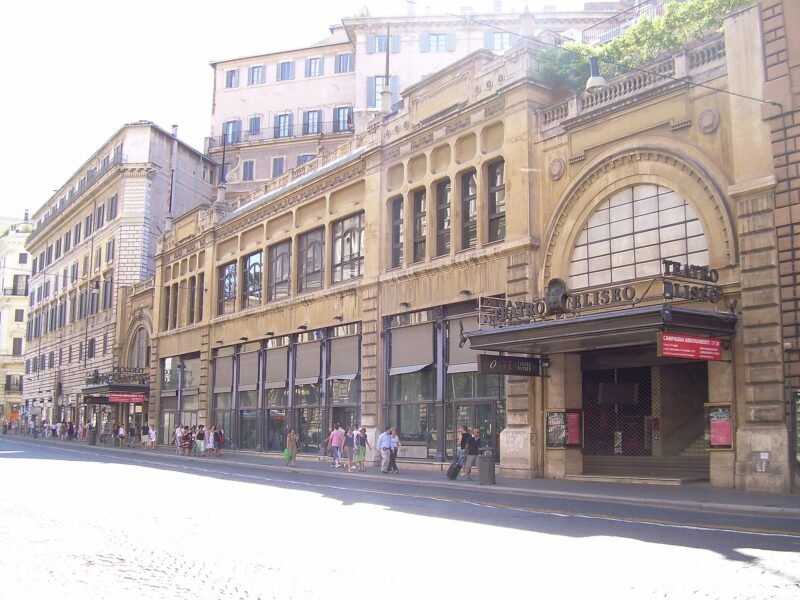
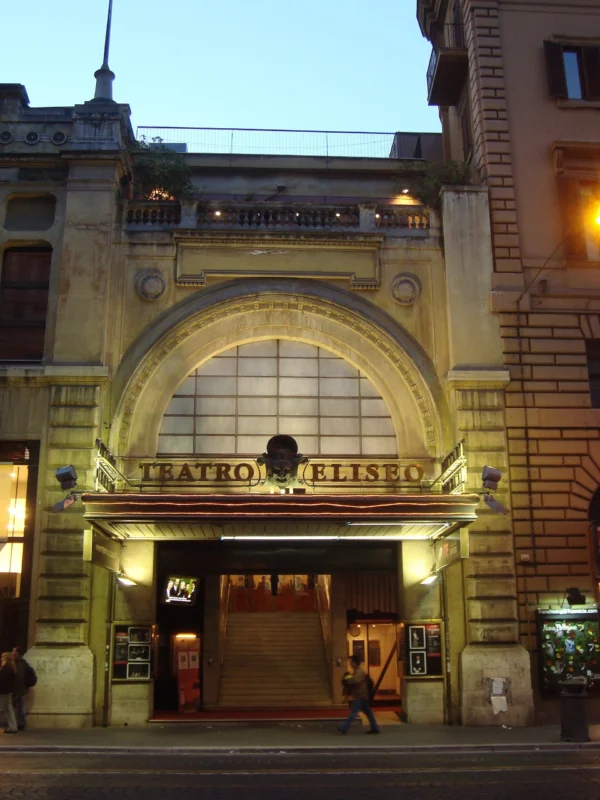
- Teatro Eliseo200 m

Upcoming events nearby
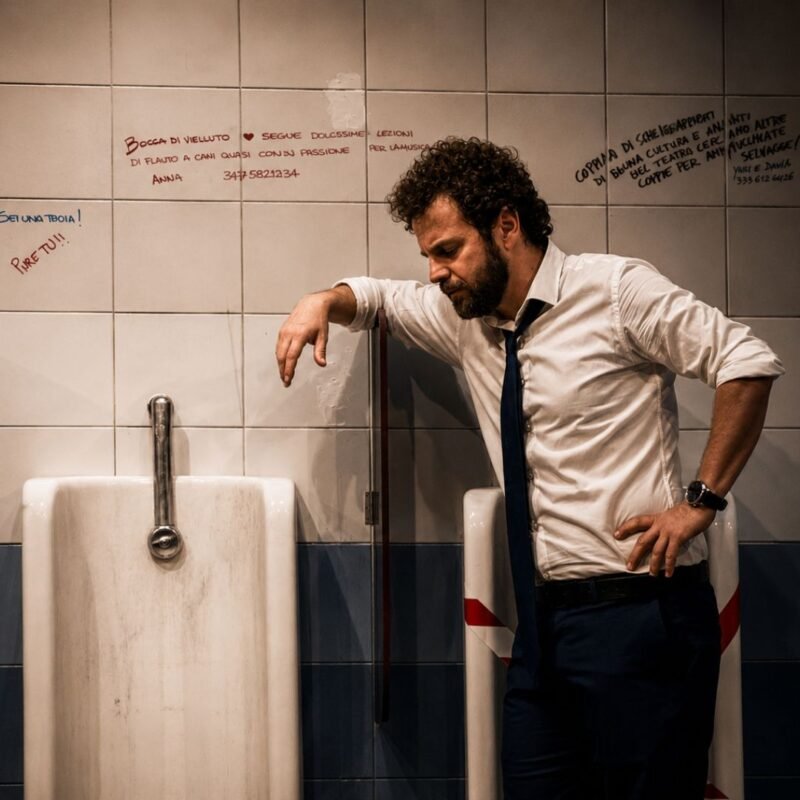
- Toilet at Piccolo Eliseo, from October 27 to November 8, 2026200 m
- Lezione d’amore with Milena Vukotic at Piccolo Eliseo, April 14 to 25, 2027200 m
- Un marziano a Roma at Piccolo Eliseo, April 7 to 11, 2027200 m
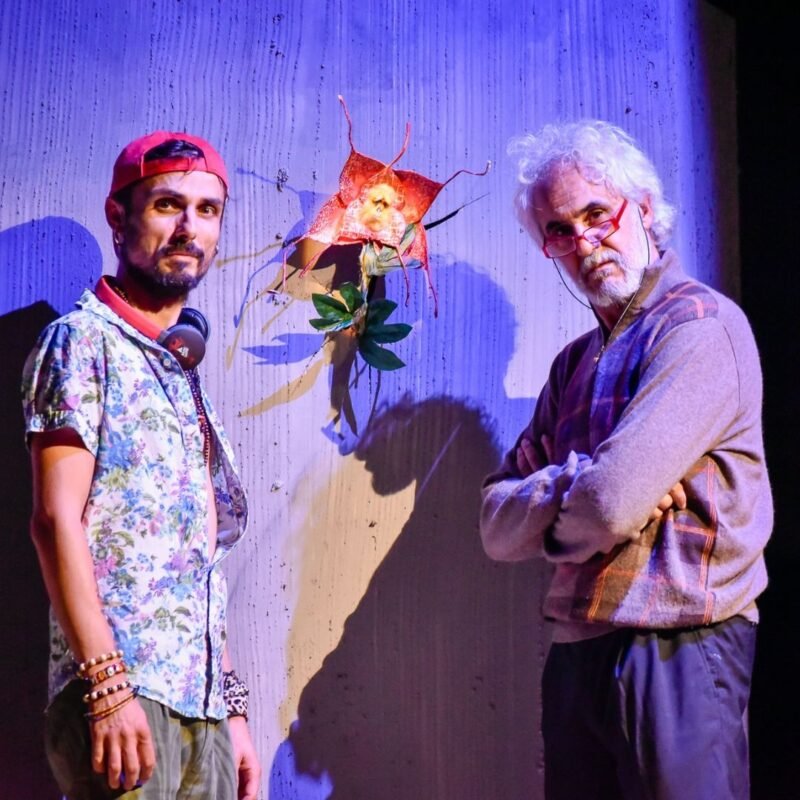
- Life is a flower at Piccolo Eliseo, November 10 to 15, 2026200 m