Un marziano a Roma at Piccolo Eliseo, April 7 to 11, 2027
In short. Un marziano a Roma by Ennio Flaiano, with Milvia Marigliano and directed by Emilio Russo, is on stage at Piccolo Eliseo, Via Nazionale 183, 00184 Rome, from April 7 to 11, 2027.
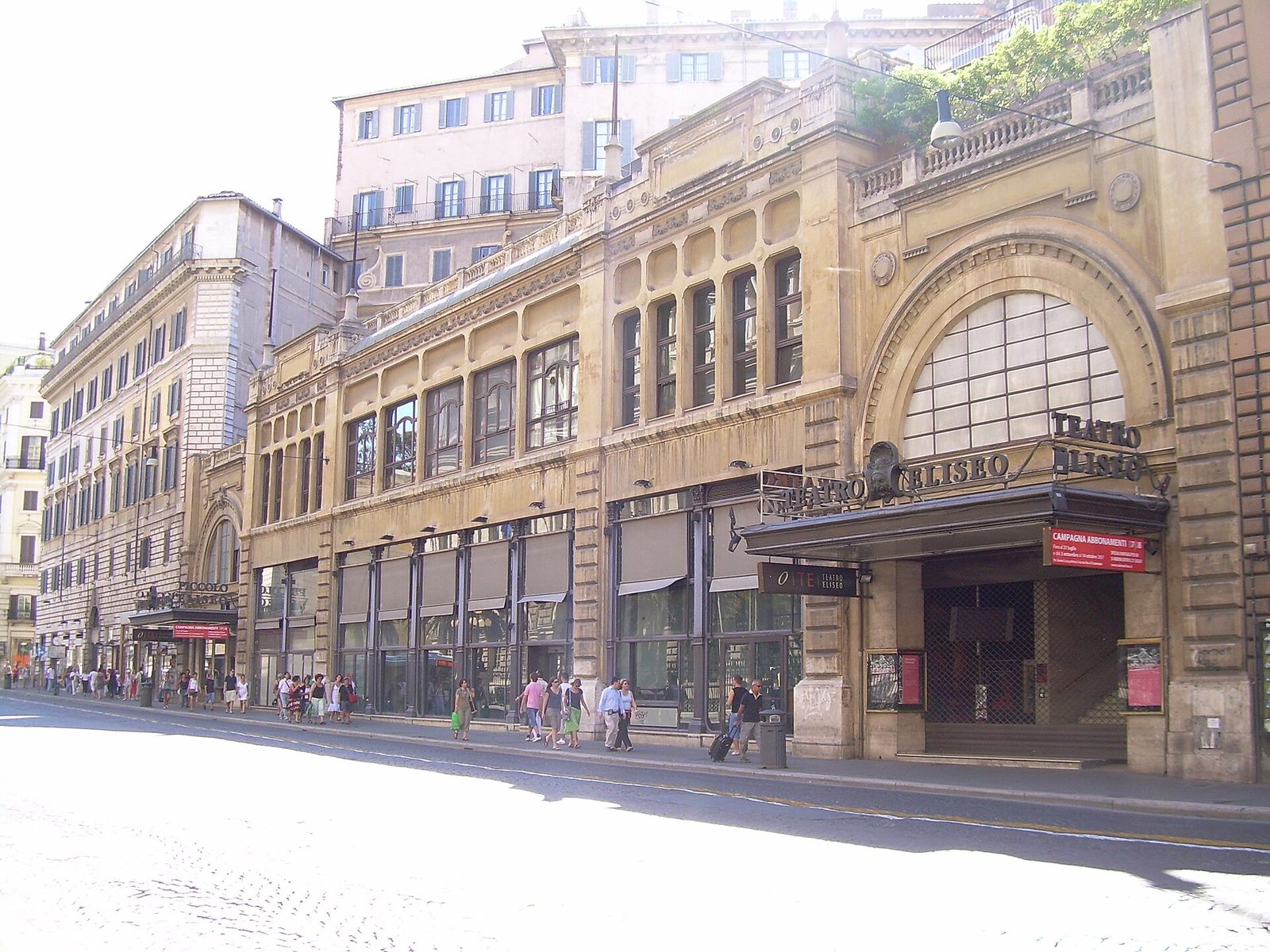
Un marziano a Roma by Ennio Flaiano, with Milvia Marigliano and directed by Emilio Russo, is on stage at Piccolo Eliseo, Via Nazionale 183, 00184 Rome, from April 7 to 11, 2027. Performances are Wednesday the 7th, Thursday the 8th and Friday, April 9 at 20:00, and Saturday the 10th and Sunday, April 11 at 17:00. The production is by Tieffe Teatro. Piccolo Eliseo is the smaller hall of Teatro Eliseo, in the Monti district, between Piazza della Repubblica and Piazza Venezia: you get there on the buses that run along Via Nazionale, including the 64, 70, 71, 117, 170 and H, by Metro A to Repubblica or by Metro B to Cavour. An orchestra ticket costs €28 full price and €20 reduced, according to the official show page, which lists the other sections. Tickets are sold at the box office on Via Nazionale or from the official Teatro Eliseo website, which links to the authorized presale network.
Language: performed in Italian. No English version or English surtitles are announced.
A Martian lands in Villa Borghese, Rome celebrates him, then grows tired of him, then mocks him. Flaiano wrote it in 1954, and 70 years later the story has become a figure of speech: anyone who feels like an outsider in the city feels like "a Martian in Rome." Staging it a short walk from the Quirinale, in the smaller hall of one of the historic theaters of Roman drama, has a special flavor. A single actress, Milvia Marigliano, gives voice to the whole city.
Un marziano a Roma at Piccolo Eliseo: the show
Un marziano a Roma is Ennio Flaiano's visionary satire of a city that welcomes novelty, uses it up and forgets it. At Piccolo Eliseo it's directed by Emilio Russo, with Milvia Marigliano on stage, lighting by Mattia De Pace and costumes by Pamela Aicardi.
The story
A being from Mars, Kunt, lands in the middle of Villa Borghese. According to the theater's presentation, his tragicomic saga plays out over a few months, from October 12 to January 6, and takes shape through the voices of a whole city: a community that first welcomes the Martian as the promise of a better future, then mocks him, forgets him and finally destroys him.
A city of voices
The directing choice is clear-cut: one performer for all the voices of the city. The presentation describes Milvia Marigliano as an actress able to move across registers, from comic to tragic, and to turn the stage into a fresco full of voices, looks and contradictions.
Why it still speaks to us
The theater presents the show as a surprisingly current satire. Flaiano's insights, it says, foresee an ephemeral, uniform society, suspended between the real and the imaginary, in search of meaning: a society that today, perhaps more than ever, recognizes itself in them. In our view that's the right description for a story born in postwar Italy and perfectly readable in the age of social media.
The team
Direction by Emilio Russo, lighting by Mattia De Pace, costumes by Pamela Aicardi, production by Tieffe Teatro. A spare staging, designed for an intimate hall like Piccolo Eliseo.
From story to stage: the history of Un marziano a Roma
Un marziano a Roma was born in 1954 as a short satirical story by Ennio Flaiano, published in the magazine Il Mondo, and over time it has become a stage comedy, a TV film and even a figure of speech.
The 1954 story
Flaiano wrote the story when science fiction was just becoming a popular genre in Italy. Kunt arrives in his spaceship near Villa Borghese. The Romans' amazement turns into curiosity, everyone wants to see and interview him, and the Martian is even received by the pope. Then the novelty wears off, the Romans get used to him and begin to ignore and mock him. The text was later collected in the volume Diario notturno, published by Bompiani in 1956.
The 1960 flop
Flaiano himself adapted the story into a play, first staged by Vittorio Gassman's Teatro Popolare Italiano at Teatro Lirico in Milan on November 23, 1960, with Gassman, Carlo D'Angelo, Ilaria Occhini and Carmen Scarpitta. It was a resounding failure, met with whistles and raspberries. Yet the play has been revived many times by different companies, and it has become one of its author's best-known works for the stage.
Fellini and television
In 1958 Federico Fellini also considered a film adaptation of the story, later abandoned. In 1983 Rai produced a television version directed by Bruno Rasia and Antonio Salines, with Salines as Kunt, broadcast on Rai Uno on August 6 of that year.
A story that keeps coming back
Flaiano's idea has been picked up many times: in Tinto Brass's 1964 film Il disco volante, in Pier Francesco Pingitore's Ciao marziano from 1980 and in an episode of Woody Allen's To Rome with Love, played by Roberto Benigni. Few 20th-century Italian stories have had such a long life.
Who Ennio Flaiano was, the author
Ennio Flaiano, born in Pescara on March 5, 1910 and died in Rome on November 20, 1972, was a screenwriter, novelist, journalist, humorist, film critic and playwright. The first winner of the Premio Strega in 1947, he wrote the stories and screenplays of La strada, La dolce vita and 8½ with Federico Fellini.
Arriving in Rome
After a childhood moving between Pescara, Camerino, Senigallia, Fermo and Chieti, he arrived in Rome in 1922: on October 27 he traveled by train, by coincidence, together with the Fascists headed for the March on Rome, an episode he later told with irony. In Rome he attended the art high school and enrolled in architecture, without finishing his studies.
Journalism
In the 1930s he met Mario Pannunzio and Leo Longanesi and began writing reviews. He contributed to Longanesi's Omnibus and to the weekly Oggi, and after the war became managing editor of Il Mondo until 1951, with the column Diario notturno. He then wrote for Corriere della Sera, l'Espresso and L'Europeo.
The Premio Strega
In 1947 he won the first edition of the Premio Strega with Tempo di uccidere, a novel born from his experience in Ethiopia and written in three months at Leo Longanesi's request. In 1970 he won the Premio Campiello with Il gioco e il massacro.
Film
Between 1947 and 1971 he wrote some of the most important screenplays of postwar Italian cinema: 10 films with Fellini, and collaborations with Blasetti, Monicelli, Risi, Rossellini, Antonioni, Germi, Petri and the American William Wyler. He went to the United States for the Oscar for 8½. His collaboration with Fellini broke off soon after.
Flaiano and Rome
His name is tied forever to Rome, a city he loved and hated: he wrote about its building sites, the cafes of the dolce vita, the traffic-choked streets and the urban growth that swallowed the countryside. He was a regular at Antico Caffè Greco and at the trattorias where writers and artists met. The municipal library of Municipio Roma III is named after him.
Who Milvia Marigliano is, the performer
Milvia Marigliano is an actress born in Milan in 1956, a 1982 graduate of the Accademia dei Filodrammatici in Milan, who since the 1980s has worked with Italy's best-known directors in the country's main repertory theaters.
Early years
In 1978 she opened Teatro Arsenale in Milan with other actors. At the Piccolo Teatro di Milano she worked with Tino Carraro, Ferruccio Soleri, Piero Mazzarella and Ernesto Calindri, and in the 1980s she acted in many shows directed by Lamberto Puggelli, from Goldoni's I rusteghi to Pasolini's Pilade.
The theaters
She has worked with Teatro Stabile di Catania, Teatro Stabile di Calabria, Teatro Franco Parenti, Teatro dei Filodrammatici and Teatro Stabile di Torino. In 1993 she was in Luigi Santucci's Noblesse oblige directed by Andrée Ruth Shammah.
Testori, Carsen, Fosse
In 2001 she debuted at the Benevento Festival in Giovanni Testori's Erodiadi directed by Cristina Pezzoli. In 2006 she was at the Piccolo Teatro in Brecht's Mother Courage directed by Robert Carsen. At the end of 2008 she was in Rome, at Teatro India, in Jon Fosse's And the Night Sings directed by Valerio Binasco.
Voice and music
In 2006 she started the project Volti with the band Sulutumana, a spoken and sung monologue on texts by Erri De Luca, which led to Slum, a show about Africa in which she starred and directed with the band Il Parto delle Nuvole Pesanti, premiered at Mittelfest in 2007. It's an experience that explains well the choice to give her, alone, all the voices of a city.
A curious fact about Un marziano a Roma at Piccolo Eliseo, April 7 to 11, 2027
The best curious fact concerns the Martian's first time on stage. On November 23, 1960, at Teatro Lirico in Milan, Flaiano's play was a resounding flop, met with whistles and raspberries. On stage, and directing, was Vittorio Gassman. A few years earlier Gassman had been part of Luchino Visconti's Compagnia Italiana di Prosa, which performed at the Eliseo. In 2027 the Martian returns to Via Nazionale, in the smaller hall of that same theater: a small revenge 67 years later.
The second curious fact is about timing. In the story, Kunt's saga plays out from October 12 to January 6, in the Roman autumn and winter. The show arrives in April instead, when Villa Borghese, where the Martian lands, is in full spring: theatergoers can stop by the landing site first.
Third: the story was born in a magazine, Il Mondo, where Flaiano was managing editor until 1951. Before becoming a stage character, then, the Martian was a piece of satirical journalism: its dry, ironic language comes from there, and you can still hear it in the stage version.
Piccolo Eliseo, the smaller hall of Teatro Eliseo
Piccolo Eliseo is the second hall of Teatro Eliseo on Via Nazionale: about 265 seats, carved out of the theater's old Ridotto and devoted since the 2000s mainly to contemporary drama.
From Arena Nazionale to Teatro Apollo
The story of the site begins in 1900 with an open-air wooden theater, the Arena Nazionale. On September 24, 1910 Teatro Apollo opened in its place, built in masonry with a reinforced concrete structure by Giovanni Antonio Porcheddu's firm. In May 1918, under Mentore Clerici's management, the theater took the name Eliseo, chosen through a contest.
The Ridotto
As early as 1912 the Ridotto was separated from the rest of the building and run as a café chantant under the name Sala Apollo. In October 1977, under Giuseppe Battista's management, it was rebuilt and renamed Piccolo Eliseo.
The 1938 theater
The current building opened on January 5, 1938, after six months of rebuilding, and the main hall has about 760 seats. For almost 40 years it was run by Vincenzo Torraca, who made it one of the leading stages of Italian drama.
The 2026/2027 season
After the long closure that began in March 2020, the Eliseo announced the 2026/2027 season of Piccolo Eliseo. Before the Martian, the program has included, among others, Lucia Calamaro's Turbati come siamo and Gabriele Pignotta's Toilet.
Something nobody tells you about Un marziano a Roma at Piccolo Eliseo, April 7 to 11, 2027
What people rarely say about Un marziano a Roma is that it isn't a science fiction story. The Martian is almost a pretext: Flaiano is writing about the city, not the alien. The real protagonist is the chorus of Romans, journalists, nobles, intellectuals and ordinary people, who go from enthusiasm to boredom in a few weeks. That's why giving all the voices to a single actress is less odd than it seems: Rome is on stage, and Rome speaks with many mouths.
The second little-mentioned thing concerns the story's sources. According to an often-cited critical reading, one of Flaiano's inspirations was The Day the Earth Stood Still, Robert Wise's 1951 science fiction film, with its peaceful alien landing in Washington. Flaiano turned its meaning around: the alien threatens no one, and it's the city that uses him up. The play, booed at its 1960 Milan premiere, survived the flop and was revived many times: in time, audiences proved the author right.
Third, a practical point: Piccolo Eliseo is a small hall, and a show built on a single performer lives on the closeness between stage and audience. The front rows let you catch the shifts from one character to another, which would be lost in a large hall.
My tip for seeing Un marziano a Roma at Piccolo Eliseo, April 7 to 11, 2027
My tip is to read the story before going to the theater. It's short, you can read it in an hour, and it's collected in Diario notturno and in several stand-alone editions. Knowing the story doesn't spoil any surprises: it lets you follow more closely how a single actress brings a whole city to life.
Second tip: do as the Martian did and stop by Villa Borghese. For the Saturday and Sunday performances at 17:00 there's plenty of time for an April morning walk on the Pincio, lunch toward Via Veneto and a walk down to Via Nazionale.
Third: if you live in Rome, choose one of the weekday evenings. The Wednesday and Thursday audience is made up of Romans coming from work, exactly the city Flaiano pokes fun at: laughing at yourself in that company is part of the game.
Finally, there are only five performances in a hall of about 265 seats: buy in good time.
Un marziano a Roma at Piccolo Eliseo: dates, times and tickets
Un marziano a Roma is on at Piccolo Eliseo for five performances: Wednesday the 7th, Thursday the 8th and Friday, April 9, 2027 at 20:00, and Saturday the 10th and Sunday, April 11 at 17:00.
The schedule
Three weekday evenings at 20:00 and two weekend afternoons at 17:00: the typical Piccolo Eliseo formula, which lets both Romans coming from work and visitors in town for the weekend find a suitable date.
Prices
The official page lists an orchestra ticket at €28 full price and €20 reduced. Other sections appear when you choose seats, and the price of each is shown at the time of purchase.
The launch offer
The theater's website ran a launch offer, valid until October 19, 2026 and now expired.
Where to buy them
Tickets are sold at the Teatro Eliseo box office on Via Nazionale and from the show page on the official Eliseo website, which links to the authorized presale network. The running time has not been published.
How to get to Piccolo Eliseo
Piccolo Eliseo is at Via Nazionale 183, and the easiest way to get there is by bus: Via Nazionale is served by lines 64, 70, 71, 117, 170 and H, which connect it to Termini station and Piazza Venezia.
By metro
On Metro A, get off at Repubblica and walk along Via Nazionale for about 10 minutes: it's the most direct route, along the street's main axis. On Metro B, get off at Cavour and walk up toward Via Nazionale through the Monti district.
From Termini
From Piazza dei Cinquecento, the lines heading down to Piazza Venezia along Via Nazionale drop you near Palazzo delle Esposizioni, a few steps from the theater. On foot, through Piazza della Repubblica, it takes a quarter of an hour.
By car
Driving is not recommended: the area is central, parking is hard and the access rules for the historic center should be checked before setting out. If you have to come by car, look for a parking garage toward Termini and allow for the walk.
Another well-known fact, yet one rarely mentioned
It's well known that Ennio Flaiano wrote La dolce vita. Less often mentioned is how vast and wide-ranging his film work was: between 1947 and 1971 he worked with Fellini on 10 films, with Marcello Pagliero and Alessandro Blasetti on four each, and then with Luigi Zampa, Luciano Emmer, Alberto Lattuada, Mario Soldati, Mario Monicelli, Dino Risi, Roberto Rossellini, Michelangelo Antonioni, Pietro Germi, Elio Petri and even William Wyler. A huge part of postwar Italian cinema passed through his typewriter.
The second rarely mentioned fact concerns his literary fortune. Flaiano is remembered as the author of aphorisms and quips, many still in common use. Less known is that he was the very first winner of the Premio Strega, in 1947, with a novel that is anything but comic, Tempo di uccidere, set in Ethiopia. The satirical and the tragic always lived side by side in him.
In our view this double register is the key to reading Un marziano a Roma: you laugh at the city, but in the end the Martian is destroyed, and the laughter dies out.
Via Nazionale and the area around Piccolo Eliseo
Piccolo Eliseo faces Via Nazionale, the great 19th-century axis between Piazza della Repubblica and Piazza Venezia, at the edge of the Monti district and at the foot of the Quirinal.
Palazzo delle Esposizioni
On the same side of the street, a few steps away, is Palazzo delle Esposizioni, opened in 1883 to a design by Pio Piacentini, the first Italian building built specifically for the fine arts. An exhibition in the afternoon and the matinee at the theater make a full weekend.
Toward Piazza della Repubblica
Walking up you reach Piazza della Repubblica, with the Baths of Diocletian and the Basilica of Santa Maria degli Angeli built into the bath halls. A little further on, Palazzo Massimo alle Terme holds frescoes and bronzes of the Museo Nazionale Romano.
The Quirinal
Behind the theater rises the Quirinal Hill: Quirinal Palace and the Scuderie del Quirinale are a few minutes' walk away, uphill.
Monti and Villa Borghese
Heading down toward Via Cavour you enter the Monti district, with shops, stairways and small squares: the page on what to see in Monti collects its highlights. In the opposite direction, beyond Via Veneto, is Villa Borghese, where the Martian lands in the story.
How to plan your evening at the theater
For the 20:00 performances, arrive on Via Nazionale at least 20 minutes early, enough time to collect your tickets and settle into a hall where coming in after the show has started disturbs everyone.
Evening performances
Wednesday, Thursday and Friday at 20:00: a quick aperitivo beforehand toward Piazza della Repubblica, and dinner after the show in Monti. When the show lets out, Via Nazionale is still served by buses.
Matinees
Saturday and Sunday at 17:00: you go in with the April afternoon light and come out at aperitivo time. It's the best choice if you're coming from outside Rome and want to head home in the evening.
Getting back
After the evening performances, Metro A at Repubblica is a 10-minute walk. If you live far from the center, check the times of the last runs on the Atac route planner.
The right photo to take at Un marziano a Roma at Piccolo Eliseo, April 7 to 11, 2027
No photos or filming in the hall: a show built on a single actress lives on concentration, and a lit screen in the half-dark of a small hall is noticed right away. Take your photo before or after, outside.
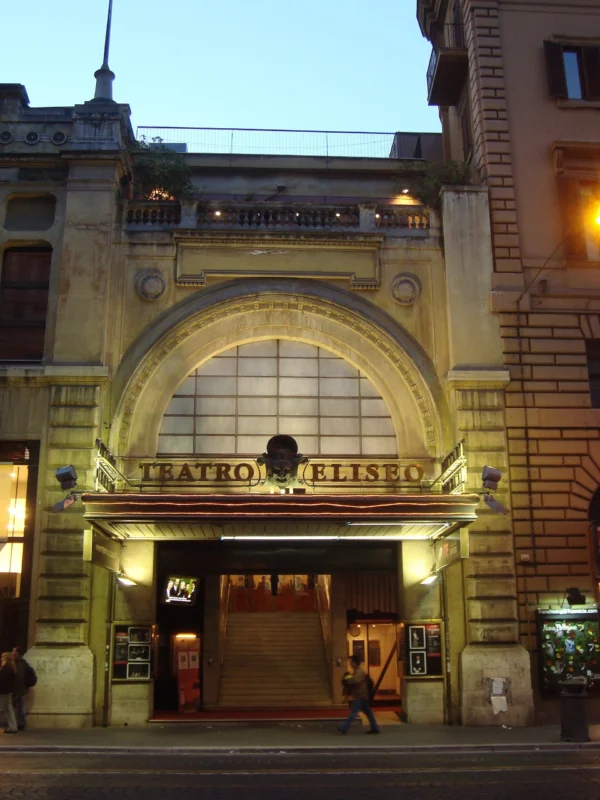
The first is the Eliseo facade on Via Nazionale, taken from the opposite sidewalk when the lights come on. For the April evening performances, at 20:00, the sky is still dark blue, and the theater sign over the busy street is a very Roman image.
The second, if you go to a matinee, is the one the Martian himself would have taken: Villa Borghese from the top of the Pincio, with Piazza del Popolo below and the dome of St. Peter's in the background. It's the view of the Rome that welcomes its guest and then forgets him.
The third is the show poster at the theater entrance: the simplest souvenir of the evening, and the best way to find the names of the director and performer later.
Some important events that happened here in history
The history of the Eliseo is a century of Italian theater. In 1900 the Arena Nazionale, an open-air wooden stage. On September 24, 1910 Teatro Apollo, with Porcheddu's reinforced concrete structure. In 1912 the separate Ridotto that became Sala Apollo. In May 1918 the name Eliseo. In 1935 the Grande Compagnia Spettacoli Eliseo was born with Anna Magnani, and on January 5, 1938 the theater reopened in its current form, with Vincenzo Torraca as director.
On January 30, 1945, with the war not yet over, Luchino Visconti made his debut as a stage director with Cocteau's Les Parents terribles. With his Compagnia Italiana di Prosa came A Streetcar Named Desire, Death of a Salesman and Three Sisters, and on February 23, 1961 Testori's L'Arialda was seized for obscenity. In the 1950s and 1960s came Anna Proclemer and Giorgio Albertazzi, the Compagnia dei Quattro and Strehler's Piccolo di Milano.
In October 1977 Giuseppe Battista took over management and the rebuilt Ridotto became Piccolo Eliseo, with the season opened by Romolo Valli and Giorgio De Lullo's Enrico IV. In 2015 the theater reopened with Luca Barbareschi, who bought it in 2018. From March 2020 it stayed closed for a long time, until the 2026/2027 season.
Who has passed through Un marziano a Roma at Piccolo Eliseo, April 7 to 11, 2027
Almost the entire Italian stage of the 20th century has passed through the Eliseo. In the 1930s Ettore Petrolini, Totò, Macario and Anna Magnani. Among the greats of drama, Emma Gramatica, Maria Melato, Angelo Musco and Paola Borboni. The house company brought together Andreina Pagnani, Gino Cervi, Rina Morelli and Paolo Stoppa, and the De Filippo siblings performed Natale in casa Cupiello here in 1936.
With Visconti came Ruggero Ruggeri, Arnoldo Foà, Franco Zeffirelli, Marcello Mastroianni and Vittorio Gassman: the same Gassman who in 1960 was the first to stage Un marziano a Roma, in Milan, and took the boos on opening night. Then Anna Proclemer and Giorgio Albertazzi, Giorgio Strehler, Giuseppe Patroni Griffi, Romolo Valli and Giorgio De Lullo.
In the 1980s and 1990s, Rossella Falk, Umberto Orsini and Gabriele Lavia. Monica Vitti performed The Odd Couple here directed by Franca Valeri, and Mariangela Melato was Medea for Giancarlo Sepe. Andreina Pagnani, an Eliseo regular, was also among the voices of a Flaiano radio comedy, Il caso Papaleo, broadcast by Rai in 1963. In April 2027 the Martian passes through, with the voice of Milvia Marigliano.
Where to eat before or after the show
Around Piccolo Eliseo you eat better by heading down into Monti. On Via Nazionale, bars, cafes and quick places dominate.
Before the evening show
With a 20:00 start, a substantial aperitivo or an early dinner is best. On Via Nazionale and toward Piazza della Repubblica there are bars and quick places, and Palazzo delle Esposizioni has a cafe inside.
After the evening show
After the show the best choice is Monti: trattorias, osterias and small places serving Roman and international food, a few minutes' walk away. On Friday, booking is wise.
After the matinee
The 17:00 performances end at aperitivo time: the moment for a stroll among the Monti shops and an early dinner before heading home.
Accessibility and young people
Piccolo Eliseo is a hall of about 265 seats in a historic building: for wheelchair access, reserved seats and services, contact the box office before buying.
Reduced mobility
In the historic theaters of the center, access to the smaller halls can involve stairs or alternative routes. If you have specific needs, mention them when booking. A taxi to Via Nazionale entrance is the most convenient option.
With young people
For high school students the show is an excellent opportunity: satire, postwar Italian history, a major 20th-century author. For younger kids, a monologue with many voices is probably too demanding.
April in Rome: the Martian's season
In early April Rome is in full spring: Villa Borghese is in bloom, the days grow longer and the evenings turn mild. For visitors it's one of the most pleasant times of the year, and also one of the most crowded.
A day in Flaiano's footsteps
A morning at Villa Borghese, where the Martian lands. A coffee on Via Veneto, among the places of the dolce vita. The evening at the theater on Via Nazionale. It's a short itinerary, all on foot, that turns the show into a piece of the city.
The same week
In the same week, at Auditorium Parco della Musica, Martha Argerich plays Beethoven on April 6 and Daniel Harding conducts Ravel and Debussy from the 8th to the 10th: if you're staying in Rome for a few days you can alternate theater and music.
Frequently asked questions about Un marziano a Roma at Piccolo Eliseo
When is Un marziano a Roma on at Piccolo Eliseo?
Un marziano a Roma is on at Piccolo Eliseo from April 7 to 11, 2027: Wednesday the 7th, Thursday the 8th and Friday the 9th at 20:00, Saturday the 10th and Sunday the 11th at 17:00. The theater is at Via Nazionale 183, in Rome.
Who is on stage in Un marziano a Roma?
In Un marziano a Roma at Piccolo Eliseo, Milvia Marigliano performs, giving body and voice to the whole city Flaiano describes. Direction is by Emilio Russo, lighting by Mattia De Pace, costumes by Pamela Aicardi, and the production is by Tieffe Teatro.
How much are tickets?
For Un marziano a Roma at Piccolo Eliseo an orchestra ticket costs €28 full price and €20 reduced, according to the official show page, which also shows the other sections. The launch offer announced by the theater was valid until October 19, 2026.
What is Un marziano a Roma about?
Un marziano a Roma, Ennio Flaiano's 1954 satirical story, tells of the Martian Kunt arriving in Villa Borghese: the city welcomes him with enthusiasm, then mocks him, forgets him and finally destroys him. It's a satire of postwar Italy and of a society that consumes every novelty.
Where is Piccolo Eliseo?
Piccolo Eliseo is the smaller hall of Teatro Eliseo, at Via Nazionale 183 in Rome, between Piazza della Repubblica and Piazza Venezia. You get there on buses 64, 70, 71, 117, 170 and H, by Metro A to Repubblica or by Metro B to Cavour.
Is the show suitable for students?
Un marziano a Roma suits high school students: Flaiano's text is a classic of 20th-century Italian satire, and the show tells the story with a single performer. The Saturday and Sunday matinees at 17:00 are the most convenient for families.
My final tip on Un marziano a Roma at Piccolo Eliseo
A story that is 70 years old and doesn't show it, a veteran actress who carries a whole city on her shoulders, an intimate hall in a theater where Gassman and Visconti once worked: in our view it's one of the most Roman shows of the spring. My advice is to read the story first, stop by Villa Borghese and pick one of the five performances in advance, because seats are few and the Martian, as in the story, doesn't stay in town for long.
Article written by the editorial team of Tour Leader Pro, contact them for Private/Corporate/V.I.P. Tours and Experiences.
Planning a trip to Rome? The English-language guides for visiting the city are on ItalyPlanner.com.
Contact Information
Nearby
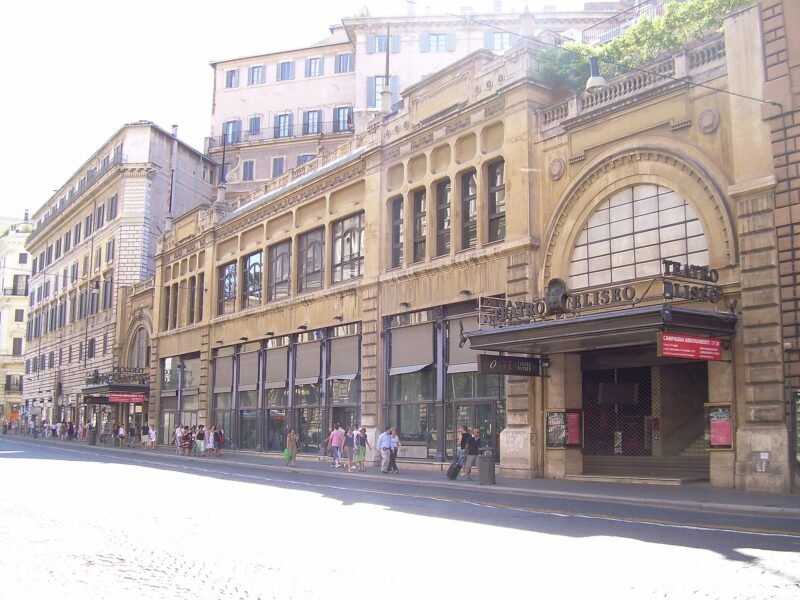
 Teatro Eliseo100 m
- Sant’Agata dei Goti200 m
- Church of San Silvestro al Quirinale200 m
- Scuderie del Quirinale200 m
- EXP200 m
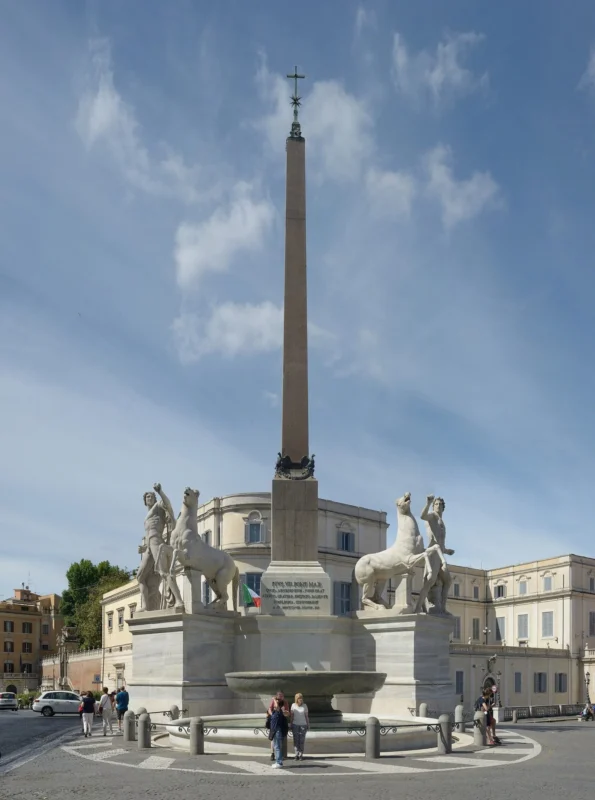
- Quirinal Obelisk200 m


Upcoming events nearby
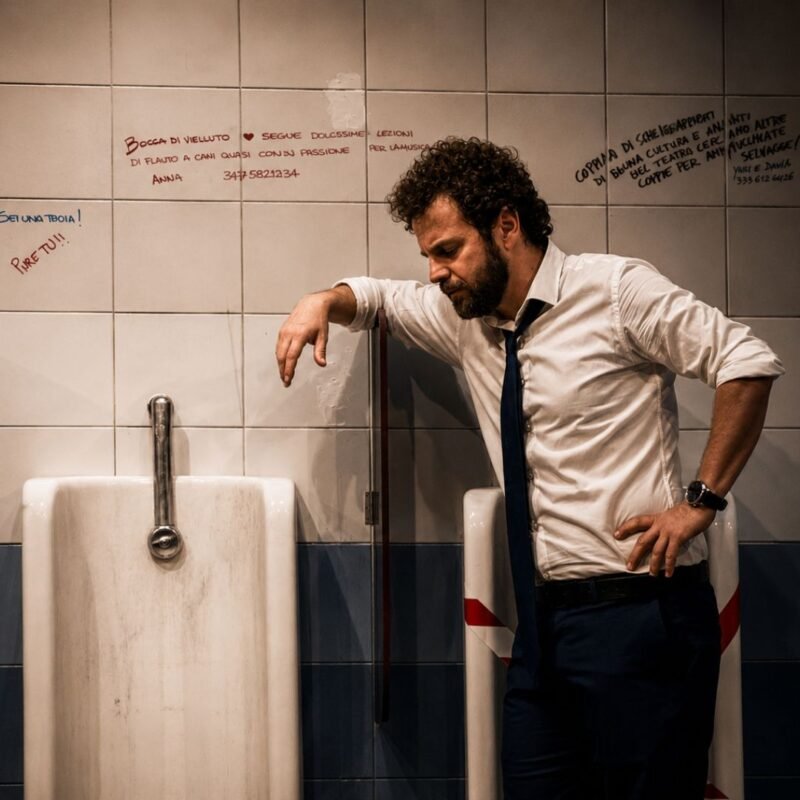
- Toilet at Piccolo Eliseo, from October 27 to November 8, 2026100 m
- Lezione d’amore with Milena Vukotic at Piccolo Eliseo, April 14 to 25, 2027100 m
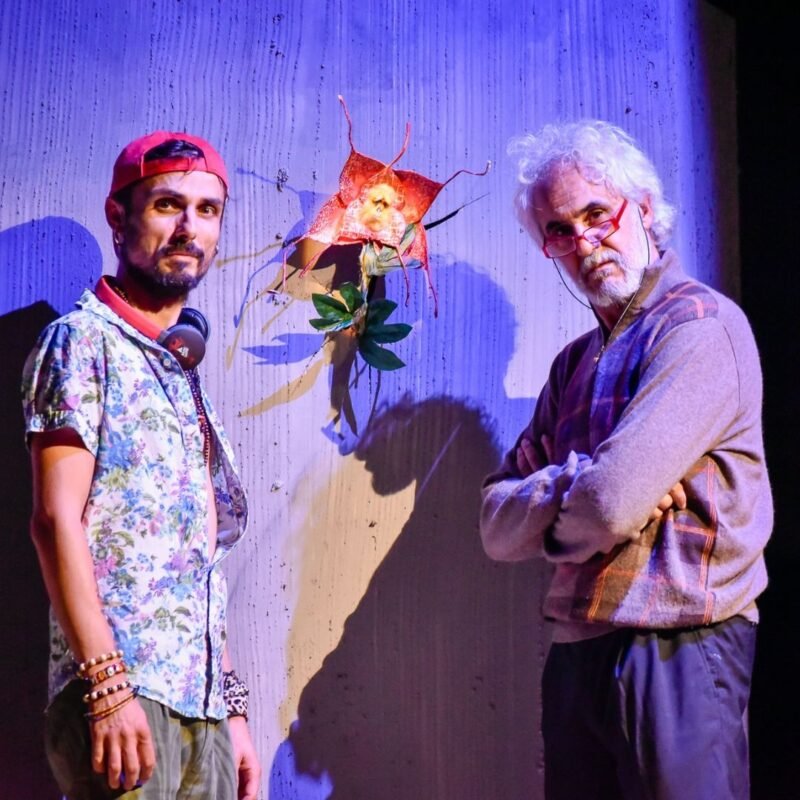
- Life is a flower at Piccolo Eliseo, November 10 to 15, 2026100 m
- Crime and Punishment at Piccolo Eliseo, November 17 to 29, 2026100 m
You might also like
- L’uomo, la bestia e la virtù with Vanessa Gravina at Teatro Quirino, March 16 to 21, 2027
- Ispettore in casa Birling with Ettore Bassi and Galatea Ranzi at Teatro Quirino, March 2 to 7, 2027
- Belle Ripiene at Teatro Sistina in Rome, from April 8, 2027
- Sfidati di me, Paolo Kessisoglu at Teatro Sala Umberto, April 1 to 4, 2027
- L’anatra all’arancia with Emilio Solfrizzi at Teatro Quirino, April 20 to May 2, 2027
- Barutz in Due ore d’aria at Teatro Sala Umberto, March 8, 2027