EXP
In short. EXP is the name under which the Caffè delle Esposizioni presents itself today: we are at Via Nazionale 194A, in Rome, on the ground floor of the Palazzo delle Esposizioni, and the venue has a second entrance at the back, at Via Milano 13.
EXP is the name under which the Caffè delle Esposizioni presents itself today: we are at Via Nazionale 194A, in Rome, on the ground floor of the Palazzo delle Esposizioni, and the venue has a second entrance at the back, at Via Milano 13. The official formula with which the parent institution describes it is "a contemporary bistro inside the historic palace on Via Nazionale", and the interesting thing for those reading these lines with the evening in mind is that the cafe's hours don't coincide with those of the museum. The Palazzo closes at 20:00 and stays closed entirely on Monday. EXP is closed on Monday too. On Tuesday, Wednesday and Sunday it runs 10:00-20:00, but on Thursday, Friday and Saturday it keeps going until 02:00 at night. It's on those three evenings that the bistro changes skin: the music that plays in the background during the day becomes the protagonist, the presentations, the talks, the live shows and the DJ sets arrive, and the ground floor of a 19th-century palace built for the Fine Arts turns into one of the most curious places to spend an evening in central Rome.
I'm writing this right away because it's the part that confuses almost everybody: you don't need the exhibition ticket to get in here. The ground floor of the Palazzo delle Esposizioni is the public part of the building, the one you can cross for free, where together with the cafe you find the Bookshop, the Art Workshops and the free-admission exhibitions. The venue's direct contact is info@esposizionicaffe.it, while the Palazzo's switchboard is 06 696271 and the administrative address is Via Nazionale 194, 00184 Rome. On social media the cafe can be found as esposizionicaffe. Keep in mind two dates in 2026 that explain any closed doors: the summer break, with the Palazzo, the Bookshop, the cafe and the study room closed from August 13 to 28, and the days of September 17, 18 and 19, when the study room, the Bookshop and the Caffè delle Esposizioni close at 18:00 for the MAGEIA festival, a project conceived, produced and carried out by Lux Entertainment, with the free-admission art takeover from 10:00 to 16:00 and the evening program from 18:00 to 02:00.
From here on I'll try to tell you what this place really is, what you eat and drink there, how the evening works, and above all what it is inside: because the container, in this case, is worth as much as the content. The Palazzo delle Esposizioni is the first Italian building built entirely for the Fine Arts, it is 143 years old, and its history runs through the Quadriennali, the Secessions, the propaganda of the Fascist 20 years, the postwar period, the great exhibitions of the 1970s and the contemporary Kunsthalle that it is today. Sitting on the ground floor with a glass in your hand means sitting inside all of this, and usually nobody says so.
Where EXP Is and How to Get There
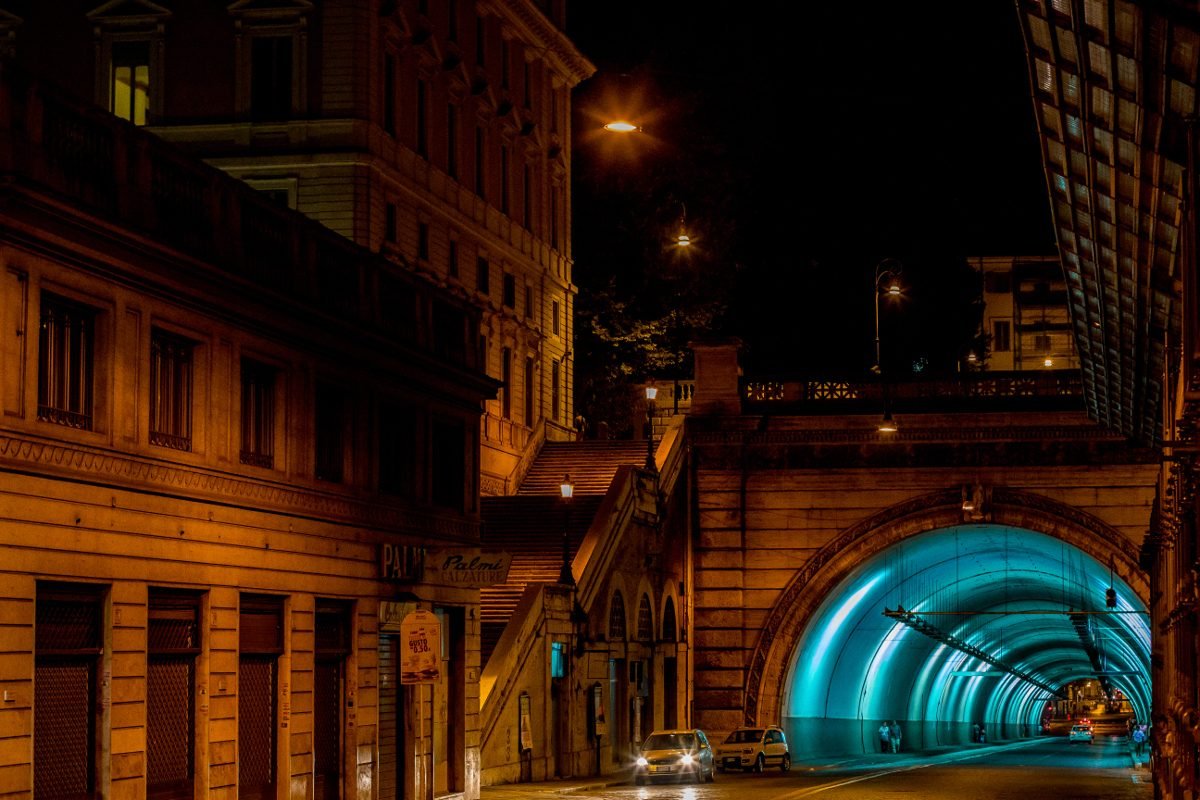
Via Nazionale 194A is on the right side of the street going up from Piazza della Repubblica toward Piazza Venezia, almost level with the big arch of the Palazzo delle Esposizioni. The cafe's main entrance is the one on the street, but there is a second access from Via Milano 13, which corresponds to the back of the building, where the Palazzo leans on the difference in level of the Quirinal Hill. It's worth knowing because the two entrances give two different experiences: from Via Nazionale you enter Pio Piacentini's great scenic machine, with the staircase, the portico and the statues overhead. From Via Milano you enter from behind, almost like a service entrance, on a much quieter street, and you find yourself directly in the lower part of the building without having to cross anything.
By Public Transport
The most convenient metro stop is Repubblica on line A, from which you walk down Via Nazionale for five or six minutes, slightly downhill. From the other side, those arriving from Piazza Venezia have Cavour on line B, but the route is less direct and goes through Largo Magnanapoli. Via Nazionale is served by a bundle of surface lines connecting Termini to the historic center: the street has been one of the backbone axes of Roman urban transport since it was opened, and that is exactly why the building was put here and not elsewhere. Those arriving by train at Termini Station can do everything on foot in a good quarter of an hour, passing through Piazza della Repubblica and looking to your left at Koch's hemicycle.
By Car, and Why I'd Avoid It
Via Nazionale is inside the Limited Traffic Zone of the historic center during the hours it is active, and surface parking in this area is a lottery that you almost always lose. If you really must arrive by car, the garages in the Termini and Quirinale area are the least painful solution, but the ratio between the cost of the spot and the five minutes saved doesn't hold up. For a Thursday or Friday evening, with the venue open until 02:00, a taxi or the night surface service are more sensible choices, and not only for the parking question: if you drink, you don't drive, and that is a rule that applies here as everywhere.
The Difference in Level, Which Nobody Considers
A practical detail worth more than many street directions: between Via Nazionale and Via Milano there are quite a few meters of difference in level, because the 19th-century street was lowered with respect to the original height of the hill, and the lowering was accentuated by the construction of the Umbertine tunnel. Piacentini was already complaining about it while building, and to remedy it he designed a double-ramp staircase that would embrace the base of the building, almost a Baroque echo. That project was not approved and the architect had to settle for building two additional levels of the exterior staircase. Result: the entrance from Via Nazionale involves steps, the one from Via Milano far fewer. Those with mobility problems, those arriving with a stroller or those who simply have tired legs after a day in Rome should aim directly for the back.
What EXP Is Today, From Breakfast to Night
The official description speaks of a bistro with a contemporary and creative style with different offerings for every moment of the day, and the most interesting formula is that of express cooking that is always open. It means there is no dead afternoon window in which in half of Rome they tell you the kitchen is closed and offer you a sandwich left over from the morning. Here you start with breakfast, classic Italian or American, continue with lunch which has its own formulas and its menus designed for the lunch break of people working nearby, arrive at dinner, which can be themed or by reservation, and in between there is the aperitivo with vegetarian and vegan platters.
The Weekend Brunch
On Saturday and Sunday the brunch splits into two offerings, and it's the most notable thing about the menu. On one side the classic American style, with pancakes and Eggs Benedict. On the other the Italian style, which the house defines as "grandma's on holidays", with fresh pasta and braised dishes, inspired by the variety of regional cuisines. It isn't a marketing trick: it's a choice that recognizes that Roman brunch has two different audiences, the international one looking for the poached egg and the local one that on Sunday wants to eat the way they ate at home. Finding both things on the same menu, in the same place, at the same time, happens less often than you'd think.
The Garden, Which Is the Best Part
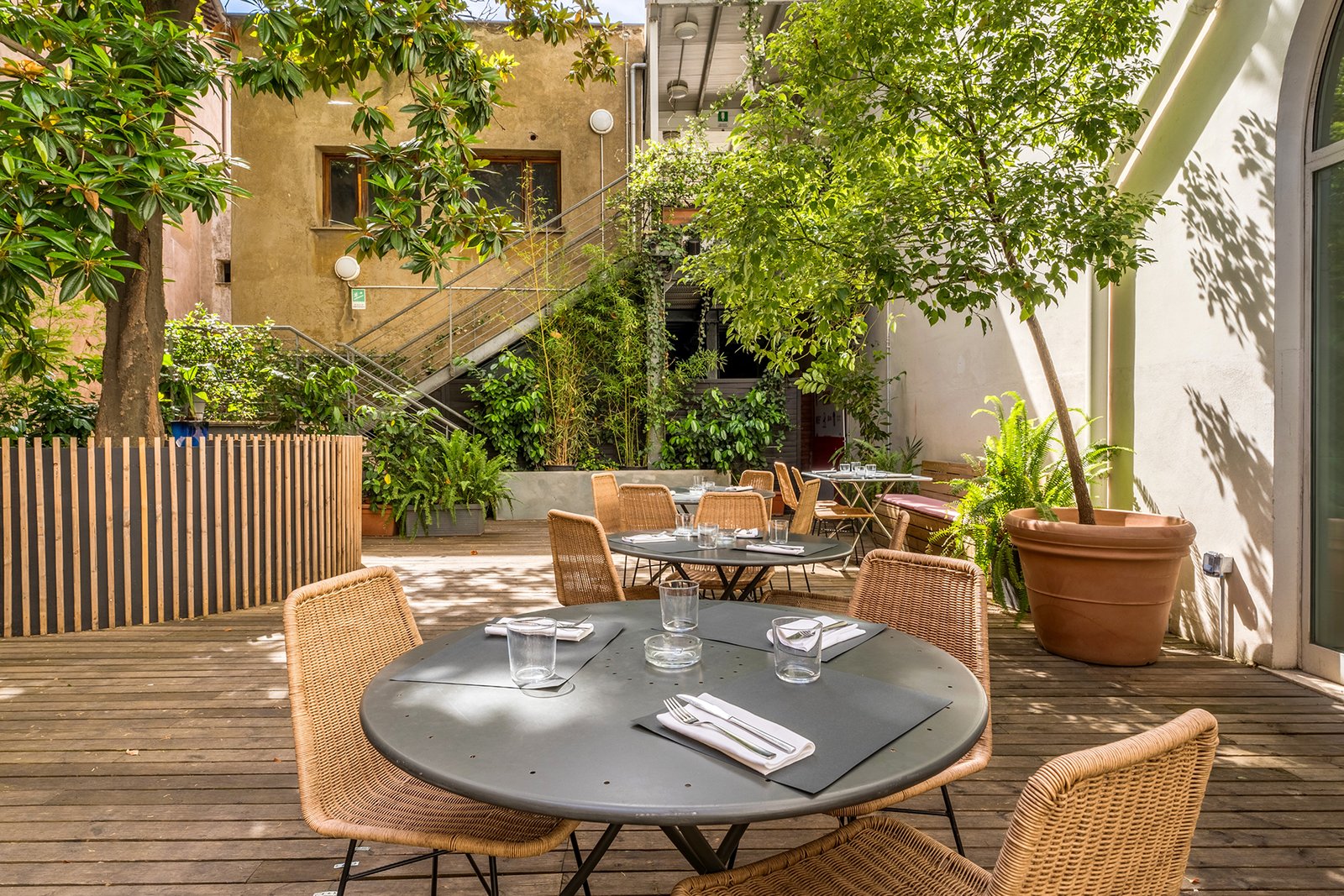
The showpiece, the one you can't see from the street and that almost nobody knows, is the cafe's garden. It is a space wedged between the walls of Piacentini's building, the early Christian basilica of San Vitale and a lush magnolia, and the combination is one of those that in Rome happen only through layering: a building from 1883, a church from 15 centuries earlier, and a tree that shades both. In the evening, when the street stays noisy and the garden doesn't, the difference is felt. By day, in spring and autumn, it is one of the few places in the center where you can sit outside without traffic on top of you and without paying the postcard surcharge.
The Long Evenings
Thursday, Friday and Saturday it closes at 02:00. It's the fact that explains everything else. The house puts it with an effective formula: the events, presentations and music enrich the offering, and the leitmotif that plays in the background during the day can become the protagonist of the evenings. Translated: on the three long evenings the bistro works like a venue with live music and DJ sets, inside the ground floor of a palace that at 20:00 has already sent the exhibition visitors home. The space can also be rented for private or corporate events, parties and birthdays, and it's something worth keeping in mind if you're looking for a hall in central Rome that isn't the usual hotel ballroom.
A Curiosity About EXP
The real curiosity concerns the name, and has to be explained backwards. The venue has two overlapping identities: the institutional one, Caffè delle Esposizioni, which is the name under which it appears on the Palazzo's official pages, and the short one, EXP, three letters that go on a sign, on a social profile, on an evening flyer. The two coexist, and the house itself writes them together: Caffè delle Esposizioni - EXP. It's the signature of a place that has to work as a museum service by day and as an independent venue by night, and that to do so has given itself two faces and two ways of naming itself.
The curiosity within the curiosity is that this double nature is not a recent invention. The Palazzo delle Esposizioni has had a bar and reception rooms since the great postwar restoration, and the fact is documented: when in 1950, after the Mostra della Ricostruzione, work was begun on the building to bring it back into operation, the works to restore the rooms and set up the displays were entrusted to the engineer Giacomo Maccagno, an employee of the Comune of Rome, and to the architect Adolfo Bobbio, while to Mario Bellina was expressly entrusted the arrangement of the bar and the reception rooms. In 1951, in an Italy emerging from the rubble, one of the three assignments of that building site concerned the bar. It means that the idea that an exhibition venue should have a place to sit and talk is not a contemporary fashion of museum retail: here it was already written in the documents 75 years ago.
And there is a third curiosity, which concerns the architecture. The fact that today the ground floor can host a bistro, a bookshop, the art workshops and the free exhibitions all together depends on a decision made in 1930, when to adapt the Palazzo to the needs of the first Quadriennale it was decided to demolish the rear greenhouse, defined in the chronicles of the time as an "ugly and expensive railway station canopy". To Del Debbio are owed the demolition and the construction of a floor slab, which made it possible to carve out on the level below six more exhibition rooms around a central space, reproposing on a reduced scale Piacentini's layout. That slab, that is, that decision of almost a century ago, is the floor on which the little tables rest today.
The Palazzo delle Esposizioni, the Container Worth the Content
To understand where you are sitting you need to take a step back of 150 years. In 1874 the construction of the new railway station was completed, to a design by Salvatore Bianchi, and at that point a strong connecting sign between the station and the city center became urgent. That sign was Via Nazionale, with the marked design of Piazza Esedra, then called Piazza delle Terme, which in Koch's project, carried out between 1886 and 1890, followed the layout of the Baths of Diocletian. The reference to the ancient was not new: Michelangelo had already proposed it with the construction of Santa Maria degli Angeli inside the tepidarium of the baths. From the great square, a monumental place of welcome for those arriving from the train, you walked along Via Nazionale to the extension toward Piazza Venezia, and reconnected with the historic heart of the city.
The Competition, the 40 Designs and the 74
The competition for the Palazzo delle Esposizioni Nazionali di Belle Arti was born exactly in this context: to equip capital Rome with the representative buildings it lacked. The declared goal was to build a building that exalted the city's cultural vocation, the first in Italy entirely dedicated to the Fine Arts without being a museum, able to document continuously the artistic history of past and present and at the same time to stand up to the great European models.
The first competition was announced in 1876 and was a deliberately vague call: it did not establish the site, left to the free choice of the designers, so much so that there were those who proposed Piazza del Popolo, and did not even indicate the sum allocated. It said only that the building should occupy 4,000 square meters, have only two floors and possibly be surrounded by gardens. 40 designs arrived, exhibited at the Collegio Romano. A little over a year later a second competition was announced, this time with the indication of Via Nazionale site, considered the most suitable location for the representative character the building had to have. 74 designs arrived. After much controversy and no little indecision within the judging committee, the design of Pio Piacentini won, marked with the motto "Sit quod vis simplex et unum": let it be simple and unified, whatever you want to do. Work began only in 1880.
Who Pio Piacentini Was
Piacentini was born in Rome in 1846 and trained at the Accademia di San Luca, of which he would later become president. He had absorbed that purist tendency that had dominated the city under Pius IX, and like many Roman architects of his generation, heirs to an academic culture, he paid more attention to the drawing than to the urban context in which the building would end up. In the case of the Palazzo delle Esposizioni, however, he was aware of the problem: the space was tight, the margin of access on the street limited, the difference in level due to the lowering of Via Nazionale later accentuated by the tunnel. He looked for solutions that were not carried out, and this is one of the keys to reading the building: what you see is a compromise between a more ambitious idea and the square meterage available.
A Building Without Windows
The fiercest controversy concerned exactly this: "a building without windows" was one of the slogans of the press campaign against the project, along with the accusation of French influence instead of adherence to a national style. The contrast split the judging committee itself. But the criticisms missed the point. The lack of windows was intentional, and served to create inside continuous surfaces that answered as much as possible to exhibition needs. The natural light was to come from above, through the transparent iron and glass roofing, because that was considered the right light for looking at works. Put another way: it wasn't an oversight, it was a museographic thesis, and for the time it was very advanced.
The layout is symmetrical, with six wide rooms converging toward the central rotunda and with the two halves of the building mirrored, so as to allow a continuous reading and a linear path both horizontally and vertically. Costantino Dardi, the architect who a hundred years later restored the Palazzo trying to bring it back to the integrity of the original design, described the interior space as "marked above all by the theme of visibility: looking and looking through appears a constant goal of the design, from the street toward the inside and from the inside toward the street, from top to bottom and from bottom to top, from the stairs to the rooms and from the rooms to the stairs". If when you enter you have the feeling of being continually invited to look elsewhere, it's no accident: it's the design at work.
The Statues Above Your Head
The sculptures of the facade were placed at the end of the 1880s, a few years after the inauguration, and in any case answered a decorative intention wanted by the architect. The sculptors are academic and the documented names are Cencetti, Biggi, Aureli, Trabacchi, Ferrari, Galletti and others. The subjects are equally academic, and have a precise logic worth knowing before you look up: at the top, art supported by peace and study. On the four pillars of the portico, architecture, sculpture, painting and industrial art. Along the balustrades, 12 artists of the past. It is an iconographic program that declares what united Italy wanted art to be: a civic matter, supported by peace and study, and not a private luxury.
Something Nobody Tells You About EXP
That the garden is not just any garden, and that the church that bounds it is much older than everything else. The basilica of San Vitale is an early Christian building that sits several meters below the current level of Via Nazionale, and that alone should make you understand how much the walking surface of this area was altered in the 19th century. When you're sitting in the cafe's garden, on one side you have Piacentini's walls, from 1883, and on the other a wall that is about 15 centuries older.
And there is a detail almost nobody knows: Piacentini wanted to move that church. The architect's first idea, faced with the narrowness of the space allotted to the Palazzo, was to dismantle the church of San Vitale and rebuild it inside a garden, so as to create a wide space around the new building. At a second moment he thought instead of realigning it to the street axis and bringing it to the same level as the Palazzo. Neither idea was carried out, and luckily. But the fact that in the Rome of the 1870s and 1880s it was conceivable to dismantle an early Christian basilica and rebuild it elsewhere to make room for an exhibition palace says a great deal about that moment in the city, and also says why that courtyard today has that narrow and irregular shape: it's the space left after the church didn't move.
The second thing nobody tells you concerns the relationship between the venue and the museum, namely that they are two different clocks. The Palazzo, with the paid exhibitions, closes at 20:00, and entry to the exhibitions is allowed until an hour before. The cafe, on the three long evenings, continues for another six hours. Those who don't know arrive at 19:30, see the lights going down in the rooms, think everything is closing and leave. Those who know stay, and at 21:00 find themselves in a place that has just changed function. It's the difference between visiting a building and inhabiting it, and it all lies in a published schedule that almost nobody reads to the end.
Third thing, practical: the ground floor is the free part. Bookshop, art workshops, free-admission exhibitions and cafe coexist on the same level, which is designed precisely as the space you can cross without a ticket. This choice has a precise genealogy. When in 1998 the Azienda Speciale Palaexpo was born, the first company in the national field dedicated exclusively to culture, one of the problems to solve was that the Palazzo had no real place of welcome for the public. The solution was to make the crossing of the central axis accessible without a ticket, from the entrance to the rear wing where the services took place, reproposing that horizontal connection that Piacentini had wanted "from the street toward the inside and from the inside toward the street". The fact that today you can walk in, sit down and order a coffee without paying anything to cross the threshold is the direct consequence of that management decision of 1998, which in turn translated an architectural intention of 1880.
Via Nazionale, the Street That Invented This Part of Rome
Via Nazionale has a bad reputation among Romans, who often dismiss it as a street of shops and traffic. It's a lazy judgment. This street is the most readable document we have of what it meant, in 1870, to transform a papal city into the capital of a new State. Mayor Luigi Pianciani wrote it without beating around the bush in 1882: "Rome is the first museum in the world, but it is not a capital that satisfies the needs of the present. It is not a municipality to be administered, it is the greatest of the ancient metropolises to be respected, a modern metropolis to be created". In that sentence is all the tension that produced this street.
Why It Passes Right Here
Because it had to connect the station to the center. Without that constraint, Via Nazionale wouldn't exist. And since the connection had to cross an area of villas, gardens and convents on the slopes of the Quirinal and the Viminal, the street was laid out going down and cutting, lowering the ground level, leaving behind buildings like San Vitale that suddenly found themselves below street level. The result is a 19th-century street with much older pieces set into it that pop out at the wrong heights, and that is exactly its interest.
Palazzo Koch and the Hemicycle
On the same street, toward Piazza della Repubblica, you meet the seat of the Banca d'Italia, Palazzo Koch, which bears the name of the architect Gaetano Koch, the same one to whom we owe the design of the hemicycle of Piazza Esedra carried out between 1886 and 1890 following the curved layout of the Baths of Diocletian. It's the same hand and the same season that produced the Palazzo delle Esposizioni, and it's the reason why the two buildings, though very different, speak the same language: compact masses, pilasters, public monumentality, an idea of decorum that was supposed to tell the foreigner arriving from the station that this was a capital. The advice is banal but it works: after the coffee, walk back up 200 meters and look at the hemicycle from the center of the square. You'll understand the building you've just left better too.
My Advice for Visiting EXP
It's best to take the day backwards compared to how most people take it, and to do it on a Thursday.
The majority of those who arrive here do this: buy the exhibition ticket, wander for two hours, come out tired at 18:30 and stop at the bar because their feet are wrecked. The cafe becomes a fallback, and in those conditions any place seems only a place to sit. Try flipping the sequence. Arrive at 17:00, enter the ground floor without a ticket, sit in the garden with something to drink and half an hour of nothing. Look at the wall of San Vitale, look at the magnolia, truly rest. Then, around 18:00, go up to the exhibition rooms with good energy instead of leftover energy: you'll notice that the exhibitions hold up much better when you don't look at them at the end of the day. Just remember that entry to the exhibitions is allowed until an hour before the 20:00 closing, so your last useful train is 19:00.
At 20:00 the museum sends you out, but you don't leave the building: you go back to the ground floor. If it's Thursday, Friday or Saturday the cafe stays open until 02:00, and around 21:00 the place has already changed temperature. You've seen the same rooms in two different states, of light and of function, in the same afternoon. No other place in central Rome lets you do that without moving a meter.
The Rule That Always Applies
Monday it's closed. It applies to the Palazzo, it applies to the cafe. It's the most common mistake, and in Rome it's a mistake you pay dearly for because Monday is already the worst day for the city's museums. If your Roman Monday is free, do the churches, the squares and the walks, and keep the Palazzo for another day. I'll add the 2026 calendar we know: the summer break kept everything closed from August 13 to 28, and on September 17, 18 and 19 the study room, the Bookshop and the Caffè delle Esposizioni close early at 18:00 because of the evening festival.
What Is Around, All on Foot
One of the reasons it's worth building an evening around EXP is that this stretch of Via Nazionale is a hub: within 15 minutes on foot in every direction you reach very different things, all of the first rank. Here they are in order of distance.
The Scuderie del Quirinale and the Hill
Going up toward the Quirinal you reach the Scuderie del Quirinale, the other great exhibition space in the area, and then the square of the Quirinal Palace, which on clear evenings offers one of the widest views over the rooftops of Rome and the dome of Saint Peter's. The route is uphill but short, and it's the right walk to do before sitting down, not after.
The Ramp of Palazzo Colonna
Going down toward Piazza Venezia, between Via Nazionale and the Forums, you find one of the most surprising archaeological discoveries of recent Rome: the great ramp of the Domitianic age that connected the Forum with the slopes of the Quirinal, brought to light and made visitable in the spaces near Palazzo Colonna. It's an ancient monumental staircase you walk inside, and for those who have spent half an hour looking at the 19th-century architecture of the Palazzo delle Esposizioni it's a perfect counterpoint: 2,000 years earlier, same hill, same problem of difference in level, completely different solution. The hours and visiting arrangements of this space change over time and don't have the continuity of an ordinary museum, so it's best to find out beforehand.
The Markets of Trajan
A bit farther down, at the foot of the same hill, the Markets of Trajan tell what was here before the Quirinal was cut by modern streets. The Museo dei Fori Imperiali that occupies them is one of the most underrated museums in the city, and its merit is exactly that of making you understand the heights, the cuts and the differences in level of this sector of Rome. Those who want to continue in the same direction reach in 10 minutes the Altar of the Fatherland and the Imperial Forums Museum.
The Baths of Diocletian and Santa Maria degli Angeli
On the opposite side, toward the station, are the Baths of Diocletian, which are the reason Piazza della Repubblica has that curved shape, and the basilica of Santa Maria degli Angeli that Michelangelo carved out of the baths' hall. This short itinerary, from the cafe to the baths, is in practice the urban planning lesson that the 19th-century project wanted to give you: the new city hooking onto the ancient city by reusing its design.
The Casa dell'Architettura at the Acquario Romano
A little beyond Piazza Vittorio, in Piazza Manfredo Fanti, there is a building I recommend to anyone who loved the Palazzo delle Esposizioni: the Acquario Romano, designed by Ettore Bernich and inaugurated in 1887, today home to the Casa dell'Architettura. It's another building of the same season, with the same ambition to equip the capital with a structure it didn't have, with the same faith in iron and glass and with the same bumpy story of successive reuses. Seeing them in the same afternoon, 20 minutes from each other, explains Umbertine Rome better than any book.
Another Well-Known Fact, Yet Rarely Cited
That this building, for almost half a century, was the place where Italy decided what Italian art was, and that it did so through a precise institution: the Quadriennale.
In 1927 the Governorate of Rome resolved to establish the Esposizioni Quadriennali d'Arte Nazionale with its seat at the Palazzo delle Esposizioni. The resolution named the members of the organizing committee chaired by the Governor, with representatives of the Accademia di San Luca, of the Società degli Amatori e Cultori di Belle Arti, of the Associazione artistica internazionale and artists designated by several institutions, and allocated 250,000 lire a year, therefore 1 million for each edition. The same resolution spoke of establishing prizes and of devoting a significant sum to the purchase of works for the Galleria Nazionale. The first exhibition was supposed to open on March 1, 1931 and instead was opened early, on January 3, 1931, under the direction of Cipriano Efisio Oppo as secretary general.
The machine was well designed: two juries selected the works, one appointed by the organizing committee and the other by the representatives of the exhibiting artists themselves. The first prizes went to Arturo Tosi and Arturo Martini, and important retrospectives were dedicated to Medardo Rosso, Armando Spadini and Antonio Mancini, who had recently died. The exhibition had over 200,000 visitors, Mussolini called it "historic", and the renovation work was much appreciated: from that moment the Palazzo became definitively the seat of the Quadriennali.
Why It's a Fact Rarely Cited
Because the Quadriennale, unlike the Venice Biennale, never became an international brand, and because its history is intertwined in a very uncomfortable way with the regime. The fact that should be remembered more is another: before the Quadriennali, for over three decades, the Palazzo had been the permanent seat of the exhibitions of the Società degli Amatori e Cultori di Belle Arti, an association founded in 1829 in the climate of papal Rome, of conservative culture, which welcomed artists together with nobles, patrons, intellectuals and academics, and had been supported by personalities such as Bertel Thorvaldsen and Horace Vernet, with King Ludwig of Bavaria as honorary president. Its exhibitions reflected an extremely conservative vision, and the result was that Rome entirely lacked that function of international showcase that a few years later Venice took on with the Biennale.
There was an attempt to recover lost ground: the four editions of the Esposizione Internazionale d'Arte della Secessione, held right here from 1913 to 1916, with the intention of documenting, even if late, what was happening abroad and the work of Italian artists inspired by a widespread modernism. Rome had not felt the profound renewal of taste and expressive forms that the Secessions had represented in France, Germany and Austria, and those four editions remain the most open window in the entire pre-war story of the building.
The Quadriennale After the War
At the end of the war the Palazzo was occupied by the food rationing offices and the Ente Autonomo Quadriennale was placed under a commissioner. The first postwar Quadriennale had to be organized at the Galleria Nazionale d'Arte Moderna, because the building on Via Nazionale had been made practically unusable by the most disparate occupations. Only after the Mostra della Ricostruzione of 1950 and the reconstitution of the Ente, with Fortunato Bellonzi as secretary general, was restoration begun: stuccos and plasters repaired, floors restored, central rotunda cleared, systems overhauled, skylights darkened with awnings, exhibition surfaces increased with movable partitions later reused for other exhibitions. The sixth edition was inaugurated on December 18, 1951, with a Modigliani retrospective curated by Jean Cassou.
Then the others: the seventh in 1955, played entirely on the controversy between abstractionists and realists, with about 3,000 works and the retrospectives of Savinio curated by Giorgio de Chirico and of Atanasio Soldati curated by Nello Ponente, considered by many the best of the postwar period. The eighth between December 1959 and April 1960, set up by the architects Melis and Clerici and contested by a group of artists linked to abstract and informal research, including Vedova, Turcato, Leoncillo, Burri, Dorazio, Afro and Mastroianni. The ninth in October 1965, set up by Mario Melis, with the retrospectives of Morandi, Mafai, Sironi, Casorati and Depero alongside the new Roman situation of Angeli, Festa and Ceroli. The tenth developed in five sections between 1972 and 1977. The twelfth brought the Ente back into the Palazzo in 1992 with the title Profili, and its second section, opened in September 1996, occupied two venues, the Palazzo delle Esposizioni and the Ala Mazzoniana of Termini Station, with a design by Massimiliano Fuksas. The thirteenth, in June 1999, was titled Proiezioni 2000, with a design by Enzo Serrani.
The Right Photo to Take at EXP
Here are three, in order of difficulty, with a note on which one everybody gets wrong.
The Photo Everybody Gets Wrong
The frontal facade from the opposite sidewalk, in full daylight, with the sun behind the building. It never works, and there are two technical reasons. The first is that Via Nazionale is too narrow compared to the bulk of the Palazzo: from the sidewalk you can't fit the whole front without tilting the camera, and as soon as you tilt it the vertical lines converge and the building seems to fall backward. The second is that the portico is deep and in shadow almost all day, while the street is bright: the difference in brightness blows out your whites or crushes your blacks. If you really want the facade, shoot it in the half hour before sunset, when the light comes in raking from the right going uphill, and stand as much at an angle as possible instead of head-on.
The First Right Photo: The Garden
The photo worth the trip is the one in the cafe's garden, with the wall of the basilica of San Vitale on the left, Piacentini's walls on the right and the magnolia closing the top. It's a photo that tells a story in a single frame: 15 centuries apart between the two walls, and in the middle a tree and a little table. Shoot it vertically, putting the magnolia foliage in the upper third of the frame, and wait for the hours when the sun isn't hitting directly, because the magnolia leaves are glossy and throw back reflections that are hard to tame. The best light is late morning in the cold months and late afternoon in the warm ones.
The Second Right Photo: The Backlit Arch
Stand under the portico, inside the shade, and shoot outward, with the big arched opening framing Via Nazionale and the passing traffic. It's exactly the point of view Piacentini designed: looking from the inside toward the street. The arch gives you a natural frame and the contrast, which in the frontal photo was a problem, here becomes the subject. If someone is going in or out, wait until they are halfway through the arch and shoot: the human figure gives scale and makes you understand how big that opening is.
The Third, for Those With Patience: The Statues
With a telephoto lens, or even just the zoom of a recent phone, isolate the sculptures of the balustrade from the opposite sidewalk, toward evening. The statues are 12 artists of the past, and photographing just one, detached from context, against the darkening sky, gives a much stronger result than the overall shot. If you want the full program, the four pillars of the portico carry architecture, sculpture, painting and industrial art, and at the top there is art supported by peace and study: knowing what you're looking at changes the way you frame too.
Good Manners
Inside the venue, in the evening, a simple rule applies: no flash. The place has low, carefully designed lighting, flash destroys it and disturbs those around you. If musicians are playing, ask before filming. In most cases they'll say yes, but asking is the difference between a guest and a problem. In the exhibition rooms of the Palazzo the rules on photographs depend on the individual exhibition and on the loans: look at the signs at the entrance instead of improvising.
Some Important Events That Happened Here in History
Here are the facts that left a mark on this building, because when you're sitting on the ground floor it's good to know what has passed over your head.
January 21, 1883: The Inauguration
The Palazzo was inaugurated with a grand ceremony in the presence of the King. The inaugural exhibition was supposed to be reserved for Italian artists only, then it was widened to a limited and modest presence of some foreigners. The exhibition had an evident political meaning and reflected a strongly academic and backward-looking cultural climate: the subjects were drawn largely from episodes of Roman history emphasized in their symbolic value, from the recent battles of the Risorgimento or from themes tied to the origins of Christianity, with a careful balance between secular and religious elements. The landscape paintings revealed an academicism very far from that search for truth that in France, with Impressionism, was by then taking hold and was influencing even the official Salons.
1913-1916: The Four Secessions
The four editions of the Esposizione Internazionale d'Arte della Secessione were Rome's attempt to catch the European train, and all took place here. They were the only moment, before the war, in which this building tried to be a window instead of a home display case.
January 3, 1931: The First Quadriennale
Over 200,000 visitors, the prizes to Arturo Tosi and Arturo Martini, the retrospectives of Medardo Rosso, Spadini and Mancini. The year before, renovation work had begun: more rooms were needed, elevators, the modification of the skylights and a heating system to regulate an interior climate too cold in winter and too hot in summer. On that occasion the greenhouse was demolished and Del Debbio built the slab that gave six new rooms to the lower floor, while Aschieri signed a display design that, as the architect Luigi Piccinato wrote in the magazine Domus in March 1931, had "given new life to the great halls of Via Nazionale. By proportioning spaces, arranging partitions, dimming lights, softening shadows, the great phalanx of paintings has found itself ordered and exalted in a calm, simple, dignified and restful environment".
October 28, 1932: The Mostra della Rivoluzione Fascista
It is the heaviest episode in the history of the building and must be told in full. The exhibition was promoted by the National Fascist Party for the tenth anniversary of the March on Rome, and the preparatory work was regularly submitted for Mussolini's approval, who called it the "sacred, evocative and solemn documentation" of Fascism. The purpose was exclusively propagandistic and celebratory. But it was also, it must be said, an extraordinary event of exhibition design: the catalog spoke of an architectural manner "scenographic, apt to evoke the atmosphere of the times, all fire and fever, tumultuous, lyrical, splendid", and artists such as Nizzoli, Funi, Maccari and above all Sironi worked on its realization together with architects such as Terragni, Libera and Valente. The exterior facade, designed by De Renzi and Libera, with metal fasces 25 meters tall, remains one of the most cited documents of Italian architecture of those years. The exhibition was supposed to be moved as a permanent seat to the Palazzo del Littorio, which was never built, and so it remained inside the Palazzo delle Esposizioni for about two years.
February 5, 1935 and February 5, 1939: The Second and Third Quadriennale
The second was organized on a very tight schedule because the previous exhibition had occupied the building for two years. The design by Aschieri and Montuori brought the Piacentini facade back to light and limited itself, in the columned atrium, to a sober access portal. Inside, with the covering of the rotunda, the awnings of the roofs and the three shades of gray on the walls, it created an almost metaphysical atmosphere in which 1,800 works were placed. Mafai had a room with 29 works and was awarded for the painting Lezione di piano. The third, in 1939, is a dark page: the Ente, which had become autonomous in 1937 with a statute signed by Minister Giuseppe Bottai, was placed under the oversight of two ministries that, applying the racial laws issued the year before, imposed very strict surveillance and documentation on the origins of every artist, with the compiling of personal files. What came out was a confused and heavily compromised exhibition, set up by Mario Paniconi and Giulio Pediconi, with the important presence of Giorgio Morandi and a section dedicated to Futurist aeropainting and aerosculpture.
May 1943: The Quadriennale at War
The fourth edition opened in the midst of the war, the last under Oppo's direction, in a much reduced version and with only part of the rooms used. It was set up by the architect Ernesto Puppo and the engineer Alessandro Mangioni, hosted the works of Enrico Prampolini and the Futurists, and gave the major prizes to Vagnetti and Manzù. A few months later, Rome would be bombed and occupied.
The 1950s and 1960s: The Three Great Exhibitions
Three appointments left a memory that still lasts. Il Seicento Europeo, promoted by the Council of Europe between November 1956 and February 1957, would today be unrepeatable for its size and for the importance of the loans that arrived from museums around the world. Il Settecento a Roma, in 1959, brought together 2,600 works, of which 600 were paintings, as well as sculptures, goldwork, furnishings and evidence of the cultural life of the time. Arte messicana dall'antichità ai nostri giorni, between October 1962 and January 1963, documented the pre-Columbian cultures, Latin American Baroque and, on the upper floor, the contemporary artists: Rivera, Siqueiros, Orozco, Rufino Tamayo, Frida Kahlo. With these three exhibitions an excellent cycle closed that had no sequel in the 1960s.
The 1970s: Vitalità del negativo
The restart came with an exhibition that has entered the textbooks: Vitalità del negativo nell'arte italiana 1960/70, curated by Achille Bonito Oliva together with the Incontri Internazionali d'Arte. It was not an aseptic reconstruction of a decade, but the story of how new poetics based on the vitality of the creative act had been born from the crisis of historical languages. Inside were Roman pop, conceptual art, happenings and body art, the materials of the minimalists, kinetic art and the recent experiences of arte povera. From then on, for over a decade, the Palazzo was the home of some of the most important exhibitions in Italy.
The Closure, Dardi's Restoration and the 1990 Reopening
The alarm bell rang during the exhibition Cinque miliardi di anni. Ipotesi per un Museo della Scienza, set up by Maurizio Sacripanti: fragments of stucco fell, other damage followed, and it became clear that work on the entire building could no longer be postponed. The commission went to Costantino Dardi. The goals were to recover the original qualities of the Palazzo by freeing it from the improper additions accumulated over the years, to restore natural light from above and reopen the vertical vision, reconnecting the three levels, reopening the two interior stairs that rise from Via Milano level to the monumental floor and the interior balconies. Not everything was carried out: the transparent roofing system, which also included an open-air theater, was rejected twice by the building commission, and the great "light machines" that were to replace the skylights were built without the automatic regulation mechanisms, thus proving ineffective. What remains is the geometric design of the travertine and peperino floors, the recovery of the marmoridea and of the original decorative parts, and above all a multimedia room and a small, well-equipped theater space: the idea, that is, of a Kunsthalle for Rome.
The Palazzo reopened in 1990 with three contemporary exhibitions on three levels, which declared the program: on the monumental floor La grande Roma dei Tarquini, curated by the municipal Soprintendenza, on the upper floor Peter Paul Rubens, on the lower floor Mario Schifano. Ancient, old master and contemporary in the same building, on the same day.
1998: The Azienda Speciale Palaexpo Is Born
With the establishment of the Azienda Speciale Palaexpo in 1998, the first Italian company dedicated exclusively to culture and with a prevalence of the visual arts, the Palazzo took on a leading role in the cultural activities promoted by the Comune of Rome. The choice was born from the need to give a space unique in size and in multiplicity of functions a managerial autonomy that would allow cultural programs to be developed within the structure. It is from that moment that the choices seen today on the ground floor are born: the free crossing of the central axis, the services in the rear wing, the characterization of the spaces according to the type of activity. It is also the season in which photography took a stable place in the smaller rooms of the upper floor, with a continuity exceptional for the Italy of that time.
Who Has Passed Through EXP
The honest answer: the names of those who play or present a book here on any given evening change from week to week, and there is no sense in listing a few passing them off as the schedule. What I can tell you, and what matters far more, is who has passed through this building, that is, through the staircase you've just sat down on.
The Artists
The rooms of the Palazzo have hosted retrospectives of Giorgio de Chirico, with the exhibition pictor optimus in 1992, of Alberto Burri with the works from 1944 to 1955 in 1996, of Enrico Prampolini from Futurism to Informal in 1992, of Fortunato Depero from Futurism to the art house in 1994, and then the great exhibition on Futurism 1909-1944 realized in 2001 in collaboration with the Sprengel Museum of Hannover. In 1994 Richard Long created eight installations specifically for these spaces: he didn't bring works, he made them for the building. Going further back, Mario Mafai, Giorgio Morandi, Mario Sironi, Felice Casorati, Arturo Martini, Arturo Tosi, Medardo Rosso, Antonio Mancini, Amedeo Modigliani with the retrospective curated by Jean Cassou in 1951, Alberto Savinio with the exhibition curated by Giorgio de Chirico in 1955: there is very little of Italian 20th-century art that hasn't passed through here at least once.
The Photographers
The photography chapter deserves a line of its own because it set a standard in the city. The first great retrospective of Mario Giacomelli was held here, shortly before the photographer's death. Here passed Parigi+Klein, Francesca Woodman with Providence, Roma, New York, Gianni Berengo Gardin with Copyright, Herb Ritts, and the exhibition dedicated to Alfred Stieglitz and the photographers of Camera Work. At a time when photography was regaining a leading role internationally, this building gave it the rooms of the upper floor continuously, and for Rome it was an exemplary case.
The Curators, the Architects, the Directors
Achille Bonito Oliva curated Vitalità del negativo here. Manfredo Tafuri curated Vienna Rossa. Nello Ponente worked at length on the lines of artistic research in Italy and died during the preparation of the 1980 exhibition. Massimiliano Fuksas designed the second section of the twelfth Quadriennale in 1996. Costantino Dardi restored the building. Maurizio Sacripanti, Maurizio Di Puolo, Lucio Turchetta, Enzo Serrani signed exhibition designs. Tadeusz Kantor previewed one of his shows here. And then there is the group Studio Azzurro, which in 1999 filled the six main rooms with interactive multimedia installations, and the exhibition Le Temps conceived by the Centre Pompidou in Paris.
The Public
I'll add the category that usually doesn't appear in the lists and that is instead the right one. 200 thousand people at the first Quadriennale of 1931, in a Rome with fewer than a million inhabitants. The lines for the Seicento Europeo in 1956. The whole classes that have passed through the Art Workshops in recent decades. The students who today occupy the 24 seats of the study room. Whoever sits at the cafe at Via Nazionale 194A on a Thursday evening in 2026 joins a line 143 years long, and it is a line that this palace has always tried to keep open: it is no accident that the central axis can be crossed without paying anything.
Frequently Asked Questions About EXP
Do you need the exhibition ticket to get into the cafe
No. The Caffè delle Esposizioni is on the ground floor, which is the part of the Palazzo accessible without an admission ticket, together with the Bookshop, the Art Workshops and the free exhibitions. The ticket is needed only to go up to the paid exhibition rooms.
What are the hours of EXP
Monday closed. Tuesday and Wednesday from 10:00 to 20:00. Thursday, Friday and Saturday from 10:00 to 02:00. Sunday from 10:00 to 20:00. The Palazzo's hours are different and shorter: Monday closed and Tuesday to Sunday from 10:00 to 20:00, with entry allowed until an hour before closing.
What are the entrances
Via Nazionale 194A and Via Milano 13. The second is more convenient for those who want to avoid the steps of the staircase on Via Nazionale.
Can you have dinner there
Yes. The kitchen is express and always open, and the offering covers breakfast, lunch, aperitivo and dinner, with themed dinners or by reservation. Brunch is on Saturday and Sunday, with the double American and Italian formula.
Is there an outdoor space
Yes, the cafe's garden, bounded by Piacentini's walls, the early Christian basilica of San Vitale and a large magnolia.
Can you organize private events
Yes, the cafe also offers itself as a space for private or corporate events, parties and birthdays. The contact for information is info@esposizionicaffe.it.
What music do you hear
The programming varies, and the house formula is that the music that plays in the background by day becomes the protagonist in the evenings, together with events and presentations. The long evenings, the ones that run until 02:00, are Thursday, Friday and Saturday. To know what's on a specific date it's best to look at the venue's channels, which on social media can be found as esposizionicaffe.
Is it suitable for children
By day yes, and the advantage is that on the same floor there are the Art Workshops, which have continuous programming for children and families, and the Bookshop with a section dedicated to children's publishing. The long evenings, with music and an adult crowd, are another thing.
Are there extraordinary closures to know about
In 2026 the Palazzo, with the Bookshop, the cafe and the study room, stayed closed for the summer break from August 13 to 28. On September 17, 18 and 19 the study room, the Bookshop and the Caffè delle Esposizioni close at 18:00 for the MAGEIA festival, with a free art takeover from 10:00 to 16:00 and evening programming from 18:00 to 02:00.
What can you see nearby in an hour
The Scuderie del Quirinale and Piazza del Quirinale going up, the Markets of Trajan and Piazza Venezia going down, the Baths of Diocletian and Santa Maria degli Angeli toward the station. All on foot, all within a quarter of an hour.
The Final Advice
If I had to save just one thing about this place, it wouldn't be the menu and it wouldn't even be the Friday music. It would be the fact that here, in an afternoon, you can do something that rarely works out in Rome: stand still inside a building that has changed function 10 times and feel them all at once. A palace born in 1883 to tell the world that Italy had a capital and an art. A greenhouse demolished in 1930 to make room for six rooms. A facade covered with metal fasces 25 meters tall in 1932 and freed three years later. A bar put back in order in 1951 by an architect who had the specific assignment of taking care of it. A Kunsthalle designed in the 1980s and reopened in 1990. And today a ground floor you can cross for free, with kids in the workshops, students in the study room, books in the bookshop and little tables in a garden enclosed between an early Christian basilica and a magnolia.
The right way to use it is this: arrive early, sit in the garden before going up, do the rooms with a fresh head, come out at 20:00 and don't leave. Stay on the ground floor and watch the building empty while the venue fills. Around 22:00, if it's one of the three long evenings, get up for a moment and step out under the arch onto Via Nazionale, with the street calmed down and the lit portico behind you. That is the image that will stay with you, and it costs nothing.
One last practical recommendation and a single rule of common sense: always check the day, because Monday is closed and because in setup or festival periods the hours get shorter. And if your evening includes drinking, go home by public transport or taxi. Rome at night is most beautiful exactly when you cross it slowly.
Article written by the editorial team of TourLeaderPro, contact them for Private, Corporate and V.I.P. Tours and Experiences in Rome and Lazio.
Planning a trip to Rome from abroad? The English guides to organizing your days in the city are on ItalyPlanner.com.
Contact Information
Via Nazionale, 194A
Roma Roma Città, Roma Città