Altroquando
In short. Altroquando is an independent bookshop on Via del Governo Vecchio, in the Parione district, a couple of steps from Piazza Navona.
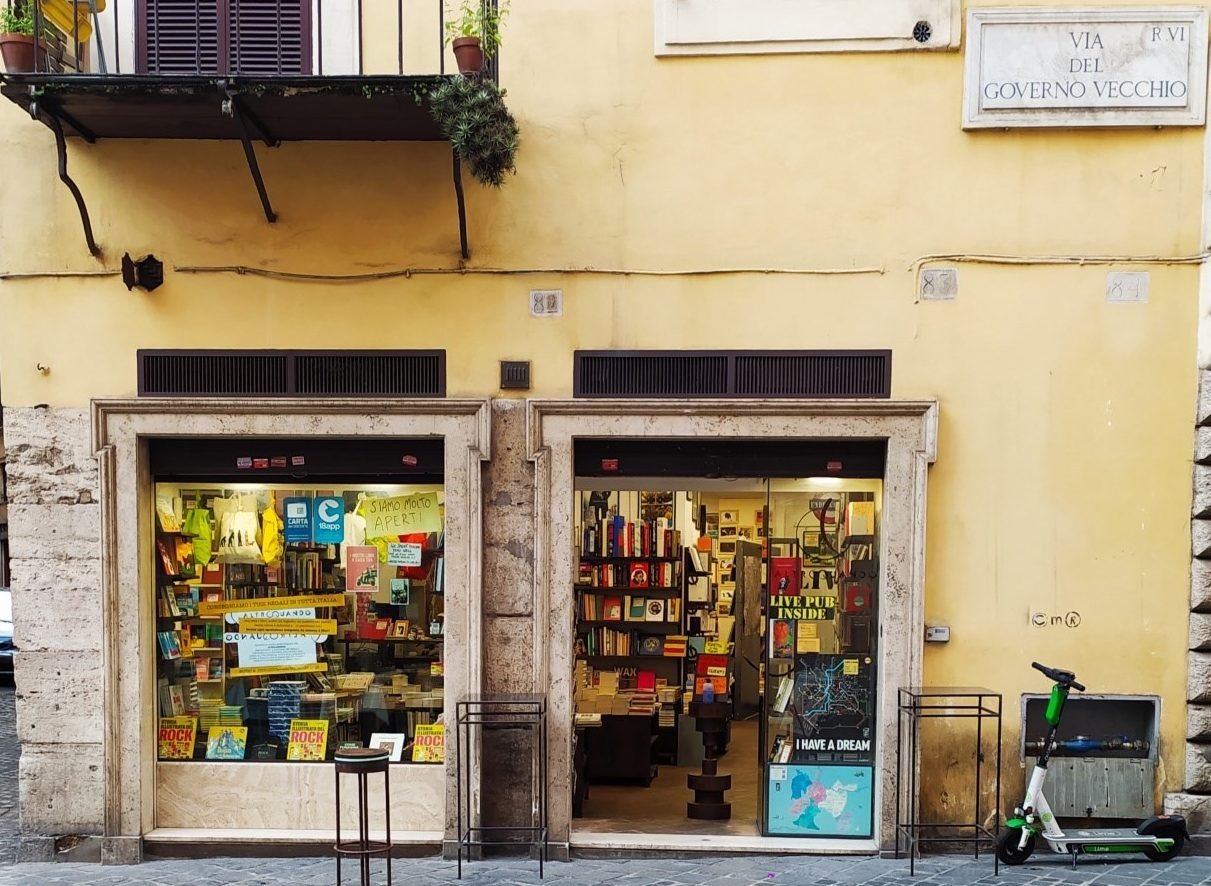
Altroquando is an independent bookshop on Via del Governo Vecchio, in the Parione district, a couple of steps from Piazza Navona. It started as a space devoted to comics, cinema, illustration and fiction, and over time it has turned into something more composite: a bookshop with a craft pub in the basement, Anderquando, and a packed calendar of presentations, meetings with authors, exhibitions and small concerts. The name, openly borrowed from science fiction and comics, already says a lot about the character of the place: a spot made for people looking for the threshold between one genre and another, more than for shelves neatly ordered by subject.
Where Altroquando Is and How to Get There
The address is Via del Governo Vecchio 80, in the heart of the Parione district, one of the oldest and most history-dense districts of Rome's historic center. The street runs parallel to Corso Vittorio Emanuele II, ideally linking Piazza Navona to Castel Sant'Angelo, and is one of the best-preserved urban stretches of Renaissance and Baroque Rome: low buildings, ocher and rust facades, artisan workshops and vintage clothing shops that over the last 20 years have made the street one of the most photographed in the center. Finding the bookshop is simple if you arrive on foot from Piazza Navona: just take Via di Tor Millina or Vicolo di Sant'Agnese in Agone and continue until you cross Via del Governo Vecchio, where the sign and the windows full of movie posters can be seen from far away.
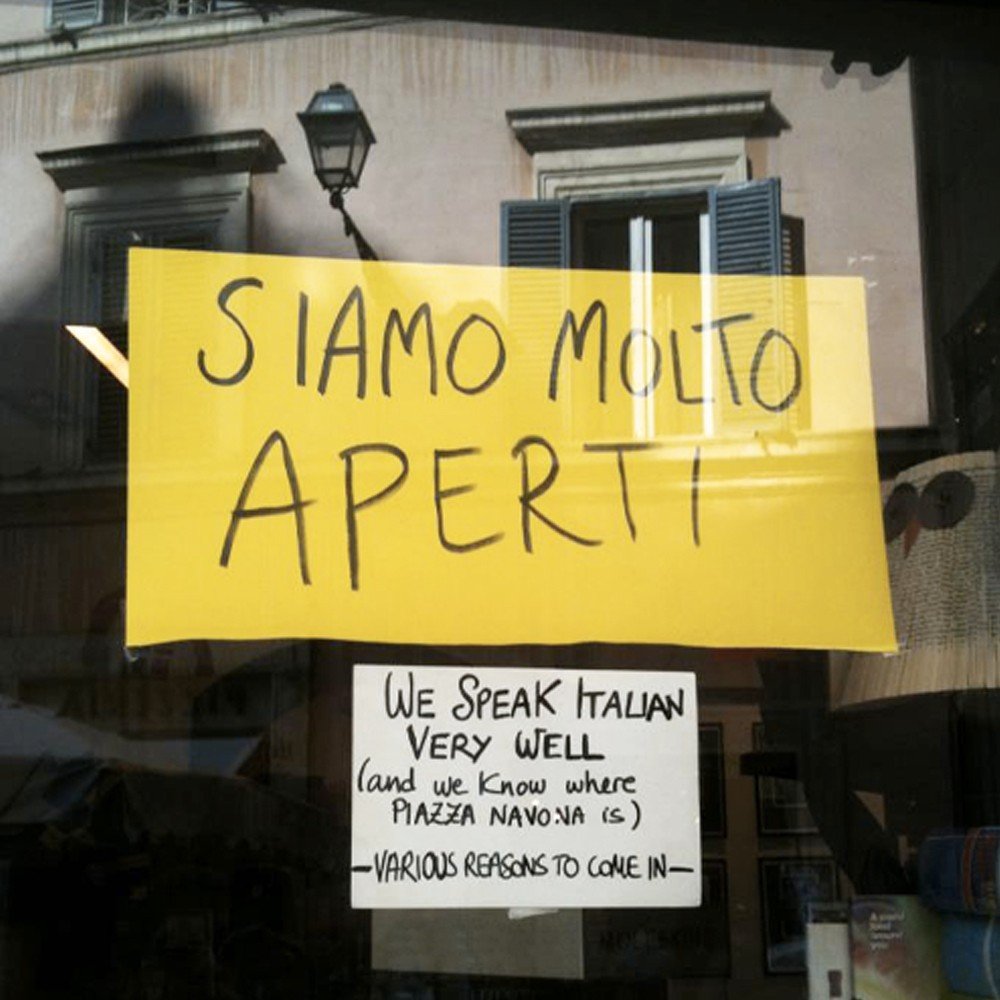
Via del Governo Vecchio, in the Heart of the Parione District
If you're arriving in this part of Rome for the first time, you do well to put away the GPS and orient yourself by the fixed points: Piazza Navona to the east, Corso Vittorio Emanuele II to the south, Piazza di Pasquino about 100 meters away, the Chiesa Nuova on the Corso. Via del Governo Vecchio cuts across this grid diagonally, and it's a very narrow street, made for walking and not for cars, where the low street numbers have housed for decades a mix of longtime residents, tailoring studios, vintage shops and places that open in the evening. Altroquando occupies one of these narrow, elongated spaces, typical of the district's buildings: the bookshop extends in depth more than in width, with the ground floor devoted to books and the step that goes down toward the underground pub.
By Metro, Bus and on Foot
The most convenient Metro stop is Spagna, on Line A, from which you reach the area in some 20 minutes on foot through Via dei Condotti, Via del Corso and Piazza Navona: a walk worth taking slowly, because it passes through some of the most history-dense stretches of the center. Alternatively you can get off at Barberini or Cavour, also on Line A, with walks of similar length. Many bus lines touch Corso Vittorio Emanuele II and Corso Rinascimento, a few hundred meters away: if you come by bus, you get off on these two arteries and walk up the alleys toward Via del Governo Vecchio. The area is in any case made for walking: the distances between Piazza Navona, the Pantheon, Campo de' Fiori and the Vatican are all within some 20 minutes' walk, and anyone staying in the historic center reaches Altroquando without ever taking a vehicle.
Parking and the ZTL in the Historic Center
If you arrive by car you have to take into account the limited traffic zone of the historic center of Rome, active during daytime hours on weekdays and, in some periods, also on weekend evenings: access is allowed only to residents and authorized vehicles, and the cameras at the entrances record unauthorized plates. The simplest solution remains leaving the car in one of the guarded parking lots outside the ZTL perimeter, for example along the Lungotevere or near Piazza della Repubblica, and continuing on foot or by public transport. Taxis and rental cars with driver can instead enter without particular restrictions, which makes arriving by taxi convenient for those staying outside the center or getting around in the evening, when the underground pub is open and the alleys of the Parione district become one of the most frequented gathering points of Rome's upscale nightlife, quieter and less noisy than Trastevere.
Piazza di Pasquino and the Talking Statues of the Parione District
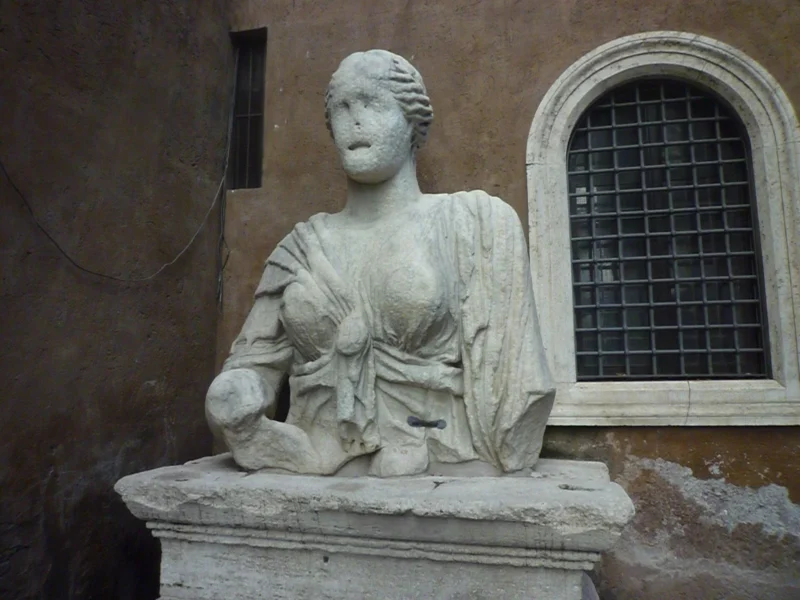
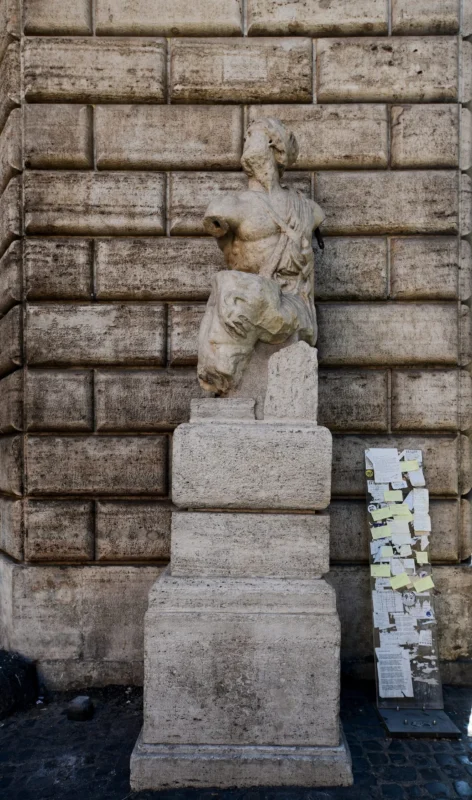
Less than 100 meters from Via del Governo Vecchio is Piazza di Pasquino, which gives its name to the most famous of Rome's talking statues. Since the 16th century Romans have used the eroded base of this ancient statue to post pasquinades, anonymous satirical verses aimed at power, papal first and secular later: a tradition of popular dissent that has run through centuries of the city's history and has survived, in different forms, to this day. It's no accident that precisely in this corner of the Parione district, historically tied to biting criticism and the written word as an instrument of resistance, a dense network of bookshops, printers and publishing houses sprouted over time: a thread that ideally ties the 16th-century pasquinades to the shelves of Altroquando, a few dozen meters away.
What Altroquando Really Is: Bookshop, Pub and Cultural Outpost
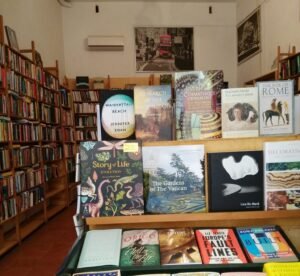
Defining Altroquando only as a bookshop is reductive, and the sign itself says so: on the official website the place presents itself as "a bookshop, a pub, a dimension, a catalyst". The formula is not an empty slogan: the ground floor holds the shelves, organized by genre and, in the case of fiction, by publisher rather than in alphabetical order, an unusual choice that reflects the idea of a bookshop made to be explored more than consulted. The basement instead holds Anderquando, the house pub, while the space as a whole also works as a venue for book presentations, exhibitions, small concerts and themed nights.
The Catalog: Comics, Cinema, Illustration and Fiction Organized by Publisher
Altroquando's catalog covers literature, children's books, comics, pop-up and artist's books, illustration, photography and gastronomy, with a declared focus on small and medium independent publishers, Italian and foreign. The comics section is historically one of the bookshop's strong points, consistent with the very name of the place, which according to what its managers say takes inspiration as much from a science fiction story by Robert Heinlein as from the comic Dylan Dog. Every month the bookshop offers a curated selection of titles, presented as a kind of recurring reading recommendation, made for people who walk in without a specific title in mind and look instead for a suggestion.
Overlook, the Brand Devoted to Cinema
For the cinema side Altroquando relies on its own brand, Overlook, which collects film books, original and collectible posters, DVDs, Blu-rays and memorabilia tied to the seventh art. It's the section that leads many city guides, including institutional ones, to describe the place simply as the "cinema bookshop": the windows on Via del Governo Vecchio, full of auteur posters and collectible material, are one of the distinctive traits of the facade and one of the reasons enthusiasts and collectors consider it a fixed stop in Rome, on a par with few other specialized shops left in the city.
Anderquando, the Underground Pub
Anderquando, the pub in the basement, describes itself as "the place under the place, with all the words at once": a play on words that echoes the very name of Altroquando and signals from the sign onward the close tie between the two spaces. The offering centers on craft and independent beer, alongside wine, cocktails, soft drinks, sandwiches and platters of cured meats and cheeses. The underground space also hosts book presentations, concerts and events, and its most cited feature among those who frequent it is the late closing, which on weekdays runs until midnight: a schedule that, together with the evening events, has made it over the years a reference point for those looking for an informal meeting place in the heart of the Parione district, an alternative to the more touristy places crowding the surroundings of Piazza Navona.
A Model of Neighborhood Economy
On the official website the bookshop explicitly claims its role within the local economy, recalling a figure that recurs in studies of neighborhood commerce: of every €100 spent in an independent shop, about 65 stay in circulation in the local economy, against much lower percentages when the same amount is spent at a big chain or online. It's an argument Altroquando uses to justify, almost as a declared mission, its choice to remain an independent physical shop in a neighborhood where traditional retail is under growing pressure, both from rent costs and from e-commerce competition. The bookshop thus also presents itself as a small outpost of economic and environmental sustainability, an argument that in recent years has entered more and more often into the communication of Italian independent bookshops.
A Curiosity About Altroquando
The name of the bookshop is no accident and has a declared origin, recounted several times by its managers in interviews given over the years: Altroquando combines the nod to a famous science fiction story by Robert Heinlein and the suggestion of the comic Dylan Dog, the Nightmare Investigator created by Tiziano Sclavi, in which the concept of a threshold between different worlds, between the real and the elsewhere, is a recurring theme. The idea behind the name was that of a space acting as a passage, a place introducing a small discontinuity from the street and ordinary time, while offering those who crossed it stimuli and a confrontation with what is different from oneself. Comics and science fiction, then, appear not only on the bookshop's shelves but in its very name, and it's a detail few occasional visitors catch, absorbed as they are by the windows full of cinema posters.
There is then a second element, less well known, tied to the physical threshold of the shop: over the years the bookshop chose to remove the front door, leaving the entrance open to the street. The choice stems from practical reasons, tied to the growing flow of tourists who get lost in the alleys of the Parione district and who, without a door marking a clear boundary, walk in more easily to browse among the shelves. It's a small architectural gesture that tells well how the bookshop has accompanied, almost without noticing, the transformation of the area: from a street populated mostly by residents to one of the most touristy streets of the historic center.
A third curious element concerns the way the underground pub speaks to the name of the mother bookshop: Anderquando is not just a made-up name, but a linguistic game built on purpose to sound like an echo of Altroquando, with that prefix that recalls both the idea of a "below" and a phonetic variation designed to stick in the mind. Few occasional visitors stop to notice this detail, yet it is precisely in the coherence between the names of the two spaces, the one above devoted to reading and the one below devoted to conviviality, that the overall idea of the project reads most clearly.
The Origins of Altroquando: From Neighborhood Bookshop to Reference Point of the Parione District
Altroquando was born in the early 2000s on the initiative of Alessandro Alessandroni, who is still its managerial reference point. In an interview given in 2017 to the specialized portal Oblique, devoted to Italian independent bookshops, Alessandroni himself recounts that at the time of opening, 15 years earlier, it was rarer than today to find an informal, non-snobbish place, welcoming to anyone who walked in regardless of the literary genre they preferred. That basic choice, declaredly opposed to any distinction of rank among genres, from comics to the most highbrow fiction, remains according to those who tell it the distinctive trait of the bookshop even more than 20 years after opening.
A Second Location and the Choice to Stay on Via del Governo Vecchio
In the course of its history Altroquando also had a second location, with sections devoted to street art, tattooing and a selection of special books, later closed. The final choice was to concentrate the business at the historic location on Via del Governo Vecchio, expanding instead in depth, with the Anderquando pub in the basement and a calendar of events that makes up for giving up a second physical address. It's a trajectory common to several Roman independent bookshops born between the late 1990s and the early 2000s: the phase of physical expansion, followed by a phase of consolidation around the historic location and by growing investment in cultural programming, more than in sales floor space.
A Neighborhood Changing Around the Bookshop
Those who have run the bookshop for more than 20 years observe a deep change in the context in which it operates: Via del Governo Vecchio, once a street with a more residential and artisan vocation, has become over the last two decades one of the most photographed destinations in the historic center, helped by the international fame of its vintage clothing shops. Altroquando has lived through this transformation while staying faithful to its identity as a specialized independent bookshop, and precisely for this reason it is cited by city guides and cultural portals as one of the fixed points of the area, able to keep an audience of regulars alongside the growing flow of passing visitors.
The Relationship with Overlook and Cinema Collecting
The audience that follows the Overlook brand is largely made up of collectors, a world with its own rules and references, where the value of a poster depends on factors like the original print run, the state of preservation, the presence of folds or restorations and the country of first release. People who come to Altroquando for this specific section, more than for the books, tend to be a knowledgeable crowd, often looking for particular pieces to complete a personal collection tied to a director, a genre or a decade of Italian or international cinema. It's a kind of clientele rarely found in general bookshops, and one that has helped build the bookshop's reputation over the years well beyond the borders of the Parione district, to the point of making it a reference point cited even by magazines and portals specialized in cinema.
The Parione District and Via del Governo Vecchio in the History of Rome
The Parione district is one of the 22 historic rioni of Rome, among the smallest in area but among the densest in monuments and historical layers, and includes within it Piazza Navona, as well as a dense network of medieval and Renaissance alleys linking Corso Vittorio Emanuele II to the Tiber. The name of the district, according to the most accredited tradition, would derive from "Paro", the surname of a family that owned houses in the area, or from an ancient wall, the "parietone", belonging to the Stadium of Domitian, whose underground remains can be visited today right under Piazza Navona. Via del Governo Vecchio takes its name instead from Palazzo Nardini, the 15th-century building that for centuries housed the seat of the governor of Rome, before the administrative functions moved elsewhere in the course of the 19th century: hence the adjective "old" placed beside the word "government", to distinguish the historic seat from the later one.
Alleys, Antique Shops and Neighborhood Life
The street, narrow and slightly curved, still preserves today the medieval course of its layout, with low buildings, dark wooden doors and framed windows that tell of centuries of building layers. For much of the 20th century Via del Governo Vecchio was home to artisan workshops, restorers and antique dealers, a vocation that still survives at some street numbers, alongside the vintage fashion shops that since the 2000s have made the street a fixed stop for those looking for period clothing in Rome. Altroquando fits into this fabric as one of the last independent cultural outposts of the area, on a street where neighborhood commerce has gradually given way to an offering oriented mostly toward tourism.
From Via del Governo Vecchio to Piazza Navona in a Few Steps
The proximity to Piazza Navona is not a secondary detail in the bookshop's history: the square, with its elongated shape that exactly follows the perimeter of the ancient Stadium of Domitian, has always been one of the main poles of attraction of the historic center, and the constant flow of visitors crossing it spills naturally into the neighboring alleys, including Via del Governo Vecchio. It's one of the reasons the bookshop chose over the years to open up more to the street, removing the front door and investing in windows able to catch even those who weren't looking for a bookshop, but simply strolling between Piazza Navona and Campo de' Fiori.
Palaces, Churches and the Layered Memory of the District
Walking along Via del Governo Vecchio and the neighboring side streets you meet many historic buildings that tell of the long administrative and religious life of the Parione district: from small neighborhood churches, often closed to the public except at limited hours, to noble palaces with travertine portals that hide inner courtyards rarely visible from the street. It's a density of historical layering that makes every stroll through the district an almost archaeological exercise, in which you only need to raise your eyes from the shop windows to notice heraldic coats of arms, Latin inscriptions worn by time and walled-up windows that testify to successive remodelings. Altroquando, with its modern sign set into a facade of this kind, is itself a small example of how the Parione district continues to renew itself without denying its historic physiognomy.
Something Nobody Tells You About Altroquando
What is rarely told is that Altroquando does not organize its fiction shelves in alphabetical order by author, as almost all Italian bookshops do, but by publisher. It's a precise editorial choice, which reflects the basic idea of the place: not a neutral catalog to consult quickly, but a path to discover, in which the organizing criterion itself invites you to browse rather than look for a specific title already in mind. Those who walk in used to the alphabetical logic of the big chains are often thrown off in the first minutes, and that very disorientation is, according to those who run the bookshop, part of the experience they want to offer.
A second little-known aspect concerns the coexistence of bookshop and pub at the same address. Many visitors who look in at the windows of Via del Governo Vecchio in the evening think they are facing a simple nightspot with a few books in the window, without realizing that above their heads, on the ground floor, there is a fully specialized bookshop, with a curated catalog and a precise editorial identity. The relationship is the reverse of what you'd expect: it's not the pub that sits beside the bookshop as an accessory attraction, but the bookshop that maintains, from the very name of the underground space, a close conceptual link with the literary identity of the place, so much so that the name of the pub, Anderquando, is built on purpose as a phonetic and conceptual echo of the name of the bookshop above.
A third little-told detail concerns the quiet seasonality of the cultural programming. While big chain bookshops concentrate their main events in the fall months, coinciding with the release of the most awaited new publications, Altroquando keeps a calendar more evenly spread across the whole year, with events even in the months traditionally deadest for publishing, as part of a strategy aimed at keeping attendance at the shop alive regardless of the calendar of the big publishing launches. It's an approach typical of small independent bookshops, which, unable to compete on the number of copies sold, bet instead on the continuity of the relationship with their audience.
My Advice for Visiting Altroquando
The most useful advice is to arrive at a time that lets you experience both souls of the place, not just one of the two. In the early afternoon the bookshop is quieter, with less coming and going, and it's the best moment to leaf calmly through the comics and cinema sections, curated by Overlook, without the crush that builds in the evening hours when the underground pub starts to fill. Anyone with a real interest in collectible posters and rare film materials would do well to spend time on exactly that section, often overlooked by those who walk in distractedly drawn by the windows.
In the evening, instead, is the time to go down to Anderquando and understand why the pub has become over the years a reference point for the area: a craft beer, a platter and, if the calendar has one, a book presentation or a small concert turn the visit into something more than a simple purchase. To get the most out of the visit, check the events calendar in advance on the official website or the bookshop's social channels before planning the evening, because the programming changes constantly and some events, like presentations with several guests or music nights, fill the space quickly. One last practical warning: the bookshop, now without a front door, stays very exposed to the foot traffic of Via del Governo Vecchio, so anyone looking for a moment of quiet reading should choose the less crowded hours of the day, away from late afternoon and evening.
It's worth adding one last practical tip, often overlooked by people planning a quick visit to the historic center: combine the stop at Altroquando with a wider walk through the Parione district, perhaps starting from Piazza Navona, passing through Piazza di Pasquino and ending the route right in front of the bookshop, before going down to Anderquando for an evening stop. This way the visit stops being a simple point on the map and becomes part of a coherent itinerary, joining monuments, the district's lesser-known history and the cultural stop the bookshop represents, giving a more complete picture of this part of Rome than the single photo taken in a hurry in front of the fountains of Piazza Navona.
Events, Presentations and Cultural Life at Altroquando
The cultural programming is probably the element that sets Altroquando apart most from the majority of Roman bookshops of similar size. The calendar, updated on the official website and on the club's social profiles, alternates presentations of fiction and nonfiction, meetings tied to cinema and comics, readings, small acoustic concerts and themed nights, often hosted right in the space of the Anderquando pub in the basement, which serves as an informal event hall as well as a drinking venue. Among the events that have animated the calendar in recent years are presentations of contemporary Italian fiction, meetings devoted to genre cinema and horror with the participation of specialized critics and authors, and hybrid nights mixing readings, stand-up comedy and live music.
The cultural portal Artribune, which follows the bookshop's activity regularly, periodically reports its photography exhibitions, shows tied to graphic journalism and animation, as well as presentations of art books and catalogs. It's a programming profile that places Altroquando closer to a small independent cultural center than to a traditional bookshop, and that explains why the bookshop often appears in press roundups devoted to the cultural life of Rome's historic center, alongside realities like the nearby Museo di Roma in Trastevere for photography exhibitions or the Romics fair for comics and animation.
Collaborations with Publishers and Specialized Outlets
A relevant aspect of Altroquando's cultural programming is the network of collaborations with independent publishers, trade magazines and online outlets specialized in cinema, comics and genre fiction. It's not rare for a presentation to start from the initiative of a small publisher who chooses precisely the space of the Anderquando pub as the setting for launching a title, preferring it to a more formal and impersonal conference room. This network of relationships, built over more than 20 years of activity, is probably one of the reasons the bookshop continues to appear regularly in the event calendars of Roman cultural magazines, and one of the factors that have consolidated its reputation as a reference space for independent publishing in the capital.
Another Well-Known Fact That Is Rarely Cited
That the historic center of Rome has been, through the centuries, the natural home of the city's book trade is known to everyone who frequents Piazza Navona and the surrounding alleys: here, between the 16th and 19th centuries, printers, publishers and booksellers serving the Roman curia and the great noble families were concentrated, in an area that also included the ancient Via dei Librai near Campo de' Fiori. What tends to be forgotten instead is how much this commercial vocation for books has survived, though profoundly transformed, to our day: the Parione district and the neighboring areas continued to host, throughout the 20th century, a dense network of independent bookshops, many of which have closed in recent decades under the pressure of rising rents and the competition of big chains and online commerce.
Altroquando, opened in the early 2000s, fits right into the hardest phase of this history, the one in which many historic bookshops in the center had to close or move to neighborhoods with more sustainable rents. The choice to stay on Via del Governo Vecchio, on one of the most touristy streets of the Parione district, and to do so by betting on a precise specialization, comics and cinema, instead of a general catalog, is part of the same strategy that has let a few other Roman independent bookshops hold out: offering something the big book chains don't easily replicate, a carefully conceived catalog and a physical space that also works as a meeting place, not just a point of sale.
One last element rarely cited concerns the relationship between the independent bookshops of the historic center and international tourism. Many foreign visitors who walk Via del Governo Vecchio for vintage shopping don't know that the street also hosts, among other businesses, a specialized bookshop able to stand comparison, for the depth of its cinema catalog, with similar shops in cities like Paris or London, historically richer in thematic bookshops of this kind. It's an element that partly overturns the commonplace that Rome is a city poor in specialized bookshops compared with other European capitals: within the small perimeter of the Parione district, the presence of a sign like Altroquando shows that the Roman book tradition, though reduced in overall numbers compared with the past, still keeps points of excellence recognized even outside national borders.
The Right Photo to Take at Altroquando
The photograph that best conveys the character of this place is not the interior of the bookshop, often cramped and not very photogenic because of the depth of the spaces, but the window on Via del Governo Vecchio in the evening hours, when the interior lights come on and the movie posters displayed by Overlook stand out against the dark of the street, while passersby slow down, curious. It's a framing that tells the story of the bookshop and the neighborhood together, because the same image takes in the low, irregular facade typical of the Parione district's buildings and the sign that signals, almost against the trend of a street increasingly oriented toward vintage fashion, the persistence of an independent cultural outpost.
Technically it's best to shoot at sunset or in the first hour of darkness, when the bookshop's interior lighting balances the ambient light of the street without creating excessive backlight on the windows. A normal focal length, around 35 or 50 millimeters equivalent, gives the proportions of the street without distorting the facades, which are particularly narrow in this stretch of Via del Governo Vecchio. A second image not to miss, for those visiting in the evening, is the step that goes down toward Anderquando: the pub's sign, the passage to the basement and the contrast between the warm light of the venue and the dark of the stairs tell well the relationship between the two levels of the place, the bookshop above and the convivial one below.
A Sign in the Fabric of the District
It's worth closing this parenthesis by returning to the urban context in which the bookshop grew. In the same years in which Altroquando opened its doors, Via del Governo Vecchio was going through a first wave of commercial renewal, with the arrival of the first vintage clothing shops that would later make the street famous internationally. From its first years of activity the bookshop thus found itself sharing the street with a very different kind of business from its own, oriented toward fashion and tourism more than culture, without ever distorting its own offering to fit that trend. It's a choice of consistency that, with hindsight, helped distinguish the bookshop from the rest of the street's commercial offering, making it a recognizable reference point precisely because it is different from everything around it.
Some Important Events That Happened Here in History
The first relevant event is the birth of the bookshop itself, in the early 2000s, on the initiative of Alessandro Alessandroni: an opening that falls in a period of deep transformation of the Roman book trade, marked by the growth of the big chains and the progressive contraction of independent neighborhood bookshops. Choosing to open right then, and with a precise specialization in comics and cinema, was a gamble that over time proved winning, as shown by the bookshop's survival more than 20 years later.
The second event is the birth of the Overlook brand, devoted to cinema, which let the bookshop carve out a recognizable niche within the Roman book landscape, so much so that institutional guides like Turismo Roma describe it essentially as a cinema bookshop. The third is the opening of the Anderquando pub in the basement, which transformed Altroquando from a simple point of sale into a hybrid space, able to attract an audience in the evening hours too and to host continuous cultural programming made of presentations, exhibitions and concerts.
The fourth event, less documented but recounted by those who run the bookshop, concerns the choice to remove the front door, an apparently small gesture that nonetheless marks a change in the way the bookshop relates to the street: from a space protected by a physical threshold to an open space permeable to the growing flow of tourists crossing Via del Governo Vecchio. The fifth, finally, is the closure of the bookshop's second location, devoted to street art and tattooing, and the resulting choice to concentrate the business at the historic location, investing in cultural programming more than in physical expansion: a trajectory that reflects the difficulties, but also the adaptation strategies, of many independent bookshops in Rome's historic center over the last 20 years.
A sixth event, of a broader order, concerns the growth of the neighborhood as an international tourist destination, a phenomenon that hit Via del Governo Vecchio starting in the 2000s and that ended up shaping, for better and for worse, the way the bookshop presents itself to the public today. The increase in foreign visitors brought more eyes to the bookshop's windows, but also heightened the pressure on commercial rents in the area, a phenomenon that over the last two decades has led to the closure of many historic businesses in the Parione district, including several independent bookshops that couldn't withstand the rise in rents. That Altroquando survived this phase of transformation, keeping its identity intact, is in itself one of the most significant events of its recent history.
Who Has Passed Through Altroquando
Given its nature as a bookshop specialized in comics, cinema and illustration, Altroquando has hosted over the years a substantial number of authors, screenwriters, film critics and illustrators, invited to present their work in the space of the Anderquando pub or at events organized together with publishers and specialized magazines. Among the most recent events are presentations tied to genre cinema and horror, with the participation of authors and critics in the field, in collaboration with specialized outlets like Bookciak Magazine and Horror Italia 24, and meetings with contemporary Italian novelists invited to present their novels in an informal setting, far from the big conference halls of the major publishers.
The bookshop is also a reference point for fans of book trekking and traveling readings, formats that combine a book presentation with a walk through the neighborhood, often organized in collaboration with tour guides and tour leaders. The audience at Altroquando's events is as composite as the bookshop's catalog: comics and niche cinema fans, readers of independent fiction, collectors of posters and film memorabilia drawn by the Overlook brand, and of course the longtime residents of the Parione district, who recognize in the place one of the last independent cultural outposts of a street increasingly oriented toward tourist commerce.
The recurring audience deserves separate mention, the people who frequent the bookshop not for a single event but continuously over the years: they are mostly residents of the Parione district and neighboring areas, workers in Rome's cultural and publishing sector, and a growing share of university students drawn by the program of readings and informal presentations. It's a less visible audience than the tourists crowding the windows during the day, but it's the one that, according to those who run the bookshop, guarantees its economic continuity in the less touristy months of the year, when the flow of occasional visitors drops sharply compared with high season.
What's Around Altroquando
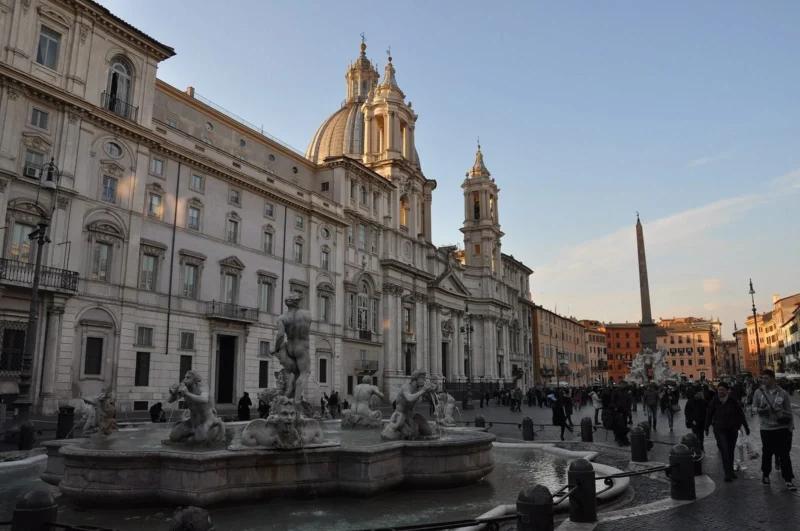
The location in the Parione district puts Altroquando in the middle of one of the densest areas of attractions in all of Rome. A few steps away, to the east, opens Piazza Navona, with its Baroque fountains and the underground remains of the Stadium of Domitian. Continuing toward the Pantheon you pass through some of the most characteristic alleys of the historic center, until you reach the Pantheon, one of the best-preserved monuments of Roman antiquity. To the south, beyond Corso Vittorio Emanuele II, is Campo de' Fiori, with its morning market and the evening life that animates the square until late at night.
To the north, following Via del Corso, you reach Via del Corso and, farther on, Piazza di Spagna, the heart of Roman shopping. For those who love photography and thematic museums, it's worth including in the itinerary the Museo di Roma in Trastevere, reachable by crossing the Tiber on one of the pedestrian bridges in the area. Comics fans, finally, find a natural complement to a visit to Altroquando in the Romics fair, the Roman event devoted to comics and animation that every year draws enthusiasts from all over Italy.
A Walking Itinerary in the Parione District
If you have half a day available, you can build around Altroquando a walking itinerary that covers a good part of the Parione district without ever straying too far from the starting point. You can begin at Piazza Navona, spending time on the fountains and, for those interested in archaeology, on the underground remains of the Stadium of Domitian that can be visited under the square. Continue toward Piazza di Pasquino for the talking statue and its historic pasquinades. Then go down Via del Governo Vecchio, stopping at Altroquando and, if the hour allows, at the vintage shops that dot the street. Finish toward Corso Vittorio Emanuele II, in the direction of Campo de' Fiori or, alternatively, toward the Pantheon. It's a route that in a little over two hours gives a good taste of the historical and cultural layering of this part of the center, with the bookshop as the central stop and not just an accessory.
When to Go and How to Make the Most of Altroquando
There is no wrong season to visit Altroquando: being an indoor venue, its enjoyment doesn't depend on the weather as it does for many outdoor Roman destinations. That said, anyone visiting Rome in spring or fall finds a less crowded historic center and a more pleasant walk between Piazza Navona and Via del Governo Vecchio, without the heat and tourist crush of high summer. In the summer months, with the mass tourism that floods Piazza Navona and the neighboring alleys, it's best to plan the visit in the early morning hours or, on the contrary, late in the evening, when most of the day visitors have left the center.
For those relying on the events calendar, the evening events are concentrated mostly in the months from September to June, in line with the city's cultural season, while in high summer the programming tends to thin out. Hours, events calendar and availability should always be checked on the official website or the bookshop's social channels before planning the visit, because they can change from season to season and should not be taken for granted after some time has passed.
A Typical Week at Altroquando
Although the exact hours should always be checked on the official channels, the weekly rhythm that emerges from the available information has the bookshop open continuously from morning to evening for most of the week, with slightly reduced opening at the start of the week compared with the midweek days, when the events programming tends to intensify. It's a model common to many independent bookshops with an attached evening venue: the daytime hours follow the logic of retail, while the evening slot, especially from Thursday to Saturday, follows instead the logic of events and socializing, with an audience that changes noticeably from the daytime one.
Altroquando with Children and Families
The section devoted to children's books and pop-ups makes Altroquando an interesting stop for families too, especially in the daytime hours, when the bookshop is quieter and far from the pub atmosphere that characterizes the evening. The basement, with the counter and tables of Anderquando, is instead designed for an adult audience, and nights with live music or crowded events are not the most suitable setting for a visit with small children.
Accessibility
The bookshop space, laid out on a single level on the ground floor, is generally passable without great difficulty, while access to the Anderquando pub, located in the basement, is by an internal staircase that may be an obstacle for people with mobility difficulties. Given the narrow and irregular layout of the spaces, typical of the historic buildings of the Parione district, anyone with specific accessibility needs does well to contact the bookshop in advance to check the most up-to-date access conditions.
Quick Questions About Altroquando
Where exactly is Altroquando?
At Via del Governo Vecchio 80, in the Parione district, a few minutes on foot from Piazza Navona, in the historic center of Rome.
What does Altroquando sell?
Fiction, comics, illustration, children's books and pop-ups, photography and gastronomy, as well as film books, original posters and memorabilia offered under the Overlook brand.
What is Anderquando?
It's the craft pub in the basement of the bookshop, specializing in independent beers and accompanied by wine, cocktails, sandwiches and platters, and also hosting presentations and events.
How long has Altroquando existed?
The bookshop was opened in the early 2000s by Alessandro Alessandroni, as recounted in a 2017 interview with the portal Oblique, devoted to Italian independent bookshops.
Why is it called Altroquando?
The name combines the nod to a science fiction story by Robert Heinlein and the suggestion of the comic Dylan Dog, both tied to the idea of a threshold between the real and the elsewhere.
How do you get to Altroquando from the Metro?
The most convenient stops are Spagna, Barberini and Cavour, on Line A, from which you reach Via del Governo Vecchio with a 15 or 20 minute walk through the historic center.
Can you park near Altroquando?
The area falls within the ZTL of the historic center, active during daytime hours on weekdays: it's best to leave the car in a parking lot outside the perimeter and continue on foot or by public transport.
Does Altroquando organize events and book presentations?
Yes, the calendar includes presentations of fiction and nonfiction, meetings tied to cinema and comics, readings, exhibitions and small concerts, mostly hosted in the space of the Anderquando pub.
Is Altroquando suitable for a visit with children?
The daytime hours, when the bookshop activity prevails, lend themselves to a family visit thanks to the section devoted to children's books. The evening hours, more oriented toward the pub, are designed mostly for an adult audience.
What is the Overlook brand?
It's the bookshop's in-house brand devoted to cinema, which collects books, original and collectible posters, DVDs, Blu-rays and memorabilia tied to the world of film.
Is Altroquando far from Piazza Navona?
No, the bookshop is a few minutes on foot from Piazza Navona, within the same Parione district, on one of the most characteristic streets of the historic center.
What are the main monuments near Altroquando?
Piazza Navona, the Pantheon and Campo de' Fiori are all within a few minutes' walk, as are Via del Corso and Piazza di Spagna heading north.
Does Altroquando specialize in comics?
Yes, comics are one of the historic strands of the catalog, consistent with the very name of the bookshop, also inspired by the comic Dylan Dog, and find a natural complement in the annual Romics fair.
Why aren't the fiction shelves in alphabetical order?
It's an editorial choice of the bookshop, which organizes fiction by publisher rather than by author, in line with the idea of a catalog made to be explored more than quickly consulted.
Has Altroquando had other locations in Rome?
Yes, in the past the bookshop had a second location, with sections devoted to street art, tattooing and special books, later closed, with the choice to concentrate the business at the historic location on Via del Governo Vecchio.
Who founded Altroquando?
The bookshop has been tied since its opening, in the early 2000s, to Alessandro Alessandroni, who recounts its birth and evolution in a 2017 interview given to the portal Oblique.
What is the Parione district?
It's one of the 22 historic rioni of Rome, which includes Piazza Navona and a dense network of Renaissance alleys between Corso Vittorio Emanuele II and the Tiber, of which Via del Governo Vecchio is one of the main arteries.
Where does Via del Governo Vecchio get its name?
From Palazzo Nardini, which for centuries was the seat of the governor of Rome before the administrative functions moved elsewhere, leaving the street the name it still bears today.
Is Altroquando connected to Piazza di Pasquino?
Not directly, but the bookshop is a few dozen meters from the famous talking statue, within the same Parione district historically tied to the written word and satire.
In our judgment Altroquando, in this part of the Parione district, remains one of the most interesting addresses in Rome's historic center for anyone looking for something different from a general bookshop or a purely touristy venue. The combination of a specialized catalog, its own cinema brand and an underground pub with continuous cultural programming is rare to find in so small a space, and it's the reason why, more than 20 years after opening, the bookshop keeps appearing in city guides and in the accounts of people who live on or regularly visit Via del Governo Vecchio. Anyone content with a quick photo of the windows will catch only the surface. Anyone who stops to browse among the shelves, and maybe goes down to Anderquando in the evening, will understand why the name chosen 20 years ago, with its nod to the threshold between different worlds, still fits today.
Frequently Asked Questions About Altroquando
Where exactly is Altroquando?
Altroquando is at Via del Governo Vecchio 80, in the Parione district, a few minutes on foot from Piazza Navona, in the historic center of Rome. The street runs parallel to Corso Vittorio Emanuele II, ideally linking Piazza Navona to Castel Sant'Angelo, in one of the best-preserved urban stretches of Renaissance and Baroque Rome.
What does Altroquando sell?
Altroquando sells fiction, comics, illustration, children's books and pop-ups, photography and gastronomy, as well as film books, original posters and memorabilia offered under the Overlook brand. The ground floor holds the shelves, organized by genre and, in the case of fiction, by publisher rather than in alphabetical order.
What is Anderquando?
Anderquando is the craft pub that occupies the underground spaces of Altroquando, and that together with the bookshop makes up the two souls of the place. It's the space where in the evening hours presentations, readings, small acoustic concerts and themed nights are concentrated, while in the early afternoon the bookshop above stays quieter.
Why is it called Altroquando?
The name Altroquando comes from the union of two references declared by the managers in several interviews: a famous science fiction story by Robert Heinlein and the suggestion of the comic Dylan Dog, the Nightmare Investigator created by Tiziano Sclavi, in which the concept of a threshold between different worlds, between the real and the elsewhere, recurs.
How are the fiction shelves at Altroquando organized?
The fiction shelves at Altroquando don't follow alphabetical order by author, as almost all Italian bookshops do, but are organized by publisher. It's a precise editorial choice, which reflects the basic idea of the place: not a neutral catalog to consult quickly, but a path to discover by browsing among the shelves.
What events does Altroquando organize?
Altroquando organizes a dense cultural program, updated on the official website and on the club's social profiles, which alternates presentations of fiction and nonfiction, meetings tied to cinema and comics, readings, small acoustic concerts and themed nights, often hosted in the space of the Anderquando pub on the underground floor.
When is the best time to visit Altroquando?
There is no wrong season to visit Altroquando, since it's an indoor venue whose enjoyment doesn't depend on the weather as with many outdoor Roman destinations. Anyone visiting Rome in spring or fall finds in any case a less crowded historic center and a more pleasant walk between Piazza Navona and Via del Governo Vecchio.
Article written by the editorial team of TourLeaderPro, contact them for Private/Corporate/V.I.P. Tours and Experiences. For a cultural walk in the historic center of Rome, with a licensed tour guide, start from the TourLeaderPro contact page. Tour operators building literary and cultural itineraries in the Parione district will instead find the consulting service in the section dedicated to tour operators.
Planning a trip to Rome? The English-language guides for visiting the city are on ItalyPlanner.com. For those thinking in terms of days outside the city there's the guide to the best day trips from Rome, while those who want to discover the most beautiful beaches around the capital will find the explanation in the guide to free beaches in Italy.
Contact Information
Via del Governo Vecchio, 82
Roma Roma Città, Roma Città
Nearby
 The Talking Statues of Rome100 m
- Pasquino100 m
- Basilica of Sant’Andrea della Valle100 m
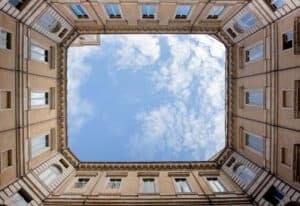
- Museum of Rome – Palazzo Braschi100 m
- Sant’Agnese in Agone100 m
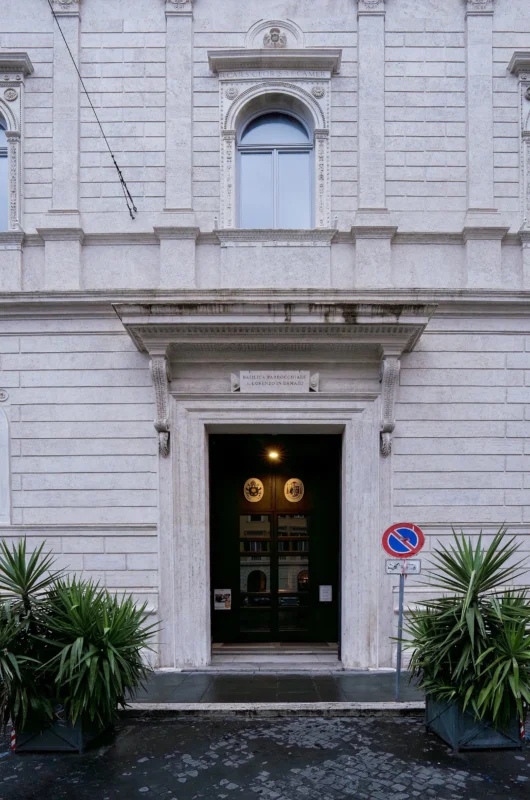
- San Lorenzo in Damaso100 m

Upcoming events nearby
- Primarosa Cesarini Sforza, Ines Fontenla, Thorsten Kirchhoff, Daniela Monaci, Luana Perilli at Galleria Emmeotto, from October 3 to November 27, 2026100 m
- Keith Haring at Museo di Roma in Palazzo Braschi, from October 6, 2026 to April 11, 2027100 m
- Rooftop Bar Opera Show at Palazzo Pamphilj, until December 30, 2026100 m
- Divina d’Acciaio, the portrait statue of Maria Callas at the Barracco Museum, September 24 to November 15, 2026100 m