Almost Corner Bookshop
In short. Almost Corner Bookshop is an English-language bookshop in Rome, set in an alley of Trastevere a few steps from the Tiber.
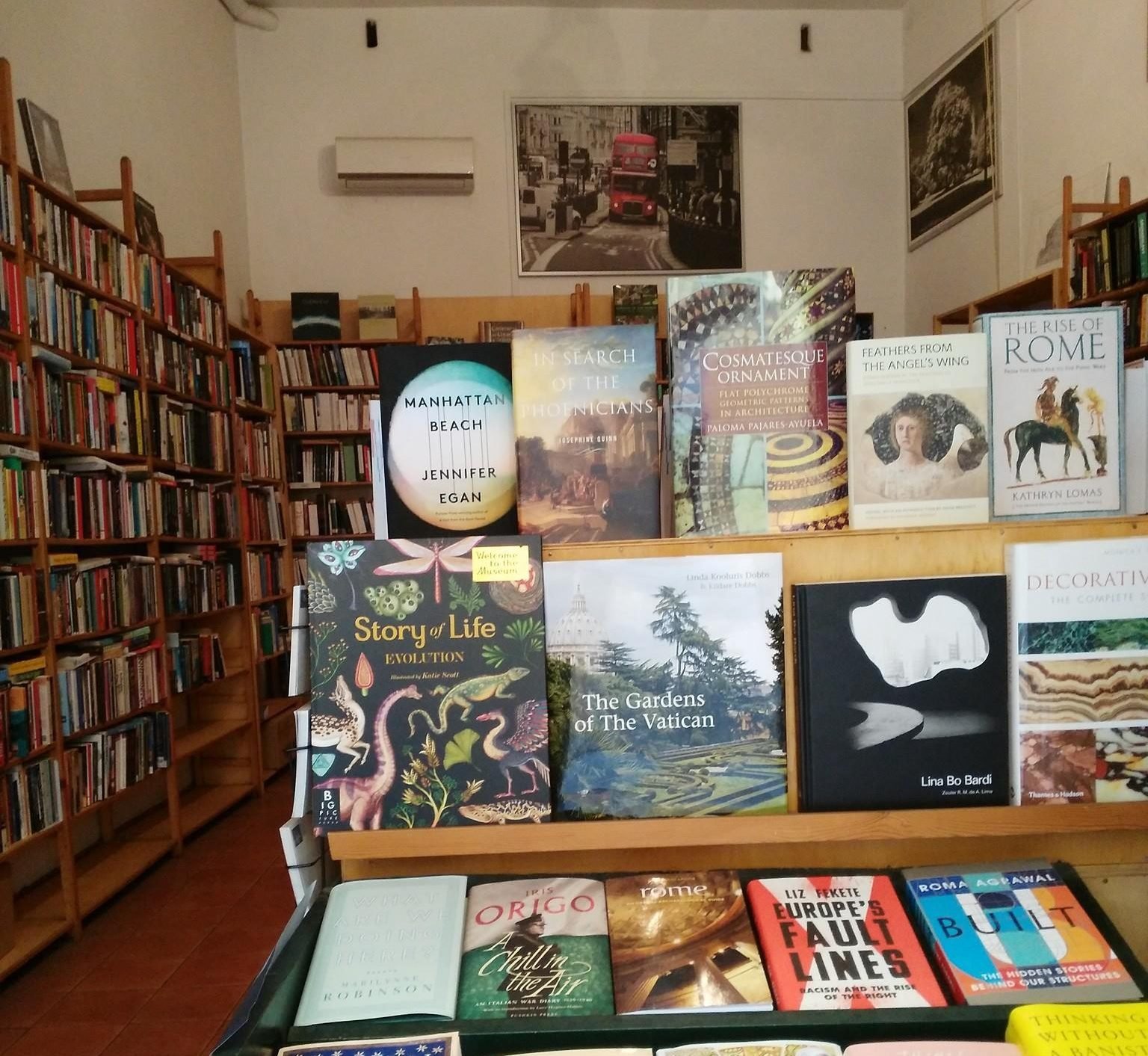
Almost Corner Bookshop is an English-language bookshop in Rome, set in an alley of Trastevere a few steps from the Tiber. It isn't the biggest bookshop in the capital and doesn't even try to be: it's a small space, literally full of books from floor to ceiling, where regular customers already know where to look and occasional visitors rely on whoever works the counter. It opened in 1991 and has been through, for more than three decades now, the changes of a neighborhood that has radically transformed in the meantime, remaining one of the reference points for anyone in Rome looking for a novel, an essay or a guide in English without having to walk into a chain.
The name, for someone arriving in Rome for the first time and reading the sign without knowing its story, can seem a linguistic affectation like many others used by businesses that want to get noticed by an international clientele. In reality it tells a very concrete fact, that of the physical position of the shop relative to the nearest intersection, and at the same time it conveys well the spirit with which the business has always presented itself: not very solemn, very practical, rooted in a neighborhood that over the last 30 years has changed its skin several times without entirely losing its working-class identity. Anyone looking in Rome for a place to find untranslated novels, original editions of classics of English-language literature, illustrated children's books in English or simply an up-to-date guide to the city written by a foreign publisher will find in this little Trastevere bookshop one of the few answers left in a commercial landscape that in recent decades has seen several similar businesses close all over Europe.
Where Almost Corner Bookshop is and how to really get there
The address is Via del Moro 45, in the heart of Trastevere, the rione that spreads along the right bank of the Tiber opposite the historic center. The bookshop is a short walk from Piazza Trilussa and Ponte Sisto, the pedestrian bridge that connects Trastevere to Via Giulia and Campo de' Fiori: crossing it on foot is the most natural way to get there for anyone staying in the historic center or coming down from the Pantheon. From Piazza Trilussa it takes a couple of minutes on foot along the cobbled alleys, past the first side streets of Via del Moro, to find yourself in front of the narrow window of the bookshop. Anyone coming from Piazza di Santa Maria in Trastevere, the beating heart of the rione with its basilica and its fountain, takes about five minutes on foot among narrow alleys where it's easy to get lost at least once, but it's also the most pleasant way to arrive, passing workshops, trattorias and the colorful facades typical of Trastevere.
By car, Trastevere is anything but convenient: a large part of the rione is a limited traffic zone and free parking nearby is rare, especially in the evening hours when the neighborhood fills up with residents and visitors. If you arrive by public transport, you can count on tram 8, which connects Piazza Venezia to Trastevere and has a convenient stop on Viale di Trastevere, from which you continue on foot toward the Tiber in about 10 minutes. Several bus lines, including the H coming from Termini station, stop along Viale di Trastevere and at Largo di Porta Settimiana, both reachable on foot in a few minutes from the bookshop. There is no metro stop in the heart of Trastevere: the nearest stations are Circo Massimo on line B, from which you cross the Tiber on foot or with a short bus ride, or you come down from the Janiculum on the opposite side of the neighborhood. For those walking from the historic center, the most direct route is still the one through Campo de' Fiori, down toward Via Giulia and across Ponte Sisto: a walk of about 20 minutes that lets you discover Trastevere by entering from its most authentic side, that of the minor alleys away from the main arteries.
Anyone coming from outside Rome can use Termini station as a starting point, taking one of the bus lines heading toward Trastevere or combining metro line B to Circo Massimo with a stretch on foot along the Lungotevere. If you land at Fiumicino or Ciampino instead, you'll find direct connections to the center of Rome by train or bus, then continue by city transport to Trastevere: a trip that, overall, generally takes between 40 minutes and an hour depending on the point of arrival and the traffic at the moment. Anyone staying in accommodation already located in Trastevere, an increasingly common choice among visitors looking for a less touristy atmosphere than the historic center, obviously has the advantage of reaching the bookshop on foot in a few minutes from almost any point of the rione, since the extent of Trastevere remains relatively contained compared with other, larger Roman neighborhoods. It's worth remembering that Via del Moro, like many side streets in Trastevere, isn't clearly marked by the main tourist signage: it's best to rely on an up-to-date digital map or ask residents for directions, who in most cases know the shop well and can point out the quickest way to reach it even to someone who got lost in the alleys.
What Almost Corner Bookshop really is, beyond the label of tourist bookshop
Calling it simply a bookshop for foreigners would be reductive. Almost Corner Bookshop is first of all a reference point for the English-speaking community that lives permanently in Rome: according to the magazine Wanted in Rome, the regular clientele is made up of about 40 percent local residents and another 20 percent university students, including many enrolled at John Cabot University, the American university that has one of its campuses right in Trastevere. The rest of the public is made up of passing visitors, Italian readers looking for original editions and enthusiasts who come specifically to browse the shelves. The physical space is small: the shelves run from the floor to the ceiling, books are stacked horizontally on top of the vertical rows, and moving through the narrow aisles is as much a part of the experience as choosing the titles. It isn't a shop designed for a quick shopping-mall flip-through: it's a dense environment, a bit messy in appearance, where however the person at the counter knows the exact location of a large part of the catalog.
The catalog combines new and used books, with an inventory turnover that according to the management is fairly quick: a substantial part of the titles is sold within three months of arrival, another share within six months, which explains why coming back after a few weeks often offers a different selection from the one seen before. You'll find contemporary fiction and classics, nonfiction, children's books, travel guides, cookbooks and a section devoted to Rome and Italy designed both for those visiting the city and for those who have moved here and want to understand it better. The philosophy declared by the management, summed up in the phrase "a book for every customer and a customer for every book," tells the approach well: rather than a boundless catalog, the goal is a carefully made selection, in which the people working in the shop can truly steer whoever walks in toward the right title.
One element that sets Almost Corner Bookshop apart from many general bookshops is the constant presence of a section devoted to nonfiction about Rome and Italy written by English-speaking authors: expat memoirs, historical guides, photographic collections and journalistic reportage that tell the city to a public that experiences it from the outside, often as a temporary or permanent resident. Alongside this section are the shelves devoted to contemporary fiction, with particular attention to novels recently published in the English-speaking world and not yet translated into Italian, and a smaller but still present part reserved for poetry and the classics, from Victorian literature to American novels of the 1900s. Children's books occupy a visible portion of the shop, often placed in a lower, more accessible corner, designed for the families of foreign residents who want their children to grow up reading in English too, a not secondary public for a shop that lives on regular customers more than on occasional tourist passage.
Finally, the catalog is completed by a selection of English-language magazines and periodicals, when available, as well as paperback editions designed precisely for travel, easy to slip into a backpack and read during train or plane trips. Among the shelves there are also some publishing treats that are hard to find elsewhere in the city: small independent British or American publishers, collections of short stories, English translations of Italian authors less known to the international public. It's precisely this variety, together with the small size of the shop that forces a rigorous selection of the titles kept in stock, that makes each visit different from the previous one: whoever comes back after months rarely finds the same shop they left the last time.
People who work in the used-book trade often explain how the quality of a stock depends to a large extent on where the volumes sold by customers come from: in the case of Almost Corner Bookshop, the constant presence of foreign residents who leave the city after a period of stay guarantees a continuous turnover of titles that are often recent and in good condition, an advantage that can't be taken for granted compared with used-book shops that depend instead on older warehouse stock or occasional donations. This mechanism, informal as it is, has probably helped over time to keep the bookshop's catalog up to date without having to rely only on buying new releases at full price, a not negligible economic lever for a small shop operating in a niche market like that of English-language publishing in Italy.
Trastevere, the rione where the bookshop stands
Trastevere, whose name comes from the Latin trans Tiberim, meaning across the Tiber, is one of the oldest rioni of Rome, inhabited since Roman times by a mixed population of fishermen, artisans and foreign merchants who settled there thanks to the proximity of the river port. This vocation as a neighborhood open to foreign presences is therefore not a recent characteristic, but has roots in a history of more than 2,000 years, during which the rione hosted Jewish, Syrian and Jewish communities from different areas of the Mediterranean, helping to form a popular identity distinct from the rest of the city, long perceived as a world apart from the center of Rome on the opposite bank of the river.
Through the 1900s Trastevere long kept this working-class physiognomy, made of shared courtyards, artisan workshops and a strong sense of belonging among residents, many of them tied for generations to the same neighborhood. Starting in the 1960s and 1970s, the rione began to attract artists, intellectuals and a first generation of foreign residents, helped by the appeal of its cobbled streets and its colorful facades, which survived largely intact compared with other areas of Rome more heavily transformed by postwar urban planning. It is in this context, already marked by a growing international presence, that Almost Corner Bookshop also opened in the 1990s, fitting into a transformation of the neighborhood that had already been under way for some time rather than starting it itself.
Today Trastevere coexists with a tourist reality much more intense than the one experienced even just 20 years ago, with evening venues, restaurants and shops largely oriented to a passing public. Despite this transformation, the rione keeps some long-standing institutions, from the historic churches to the neighborhood markets, which continue to mark the daily life of residents, and Almost Corner Bookshop belongs fully to this small group of businesses able to speak at the same time to those who have always lived in the neighborhood and to those discovering it for the first time during a short stay.
The story of the founders and the changes of management
The bookshop was opened in 1991 by Claire Hammond, an Australian citizen who worked for the United Nations in Rome. In a city where English-language bookshops were already relatively few back then, the idea of opening a shop devoted to English-speaking readers, in a neighborhood frequented by foreign residents like Trastevere, proved solid over time. In 2002 the business changed hands: the buyer was Dermot O'Connell, an Irish citizen who according to available sources had moved to Rome after a period of work in Saudi Arabia. Under his management, which lasted more than a decade, the bookshop consolidated its identity and in 2012 opened a second location, Almost Corner Too, at Via Monserrato 49, a few steps from Piazza Farnese, on the other bank of the Tiber from the historic Trastevere location. The idea behind the expansion was to divide the contents between the two spaces: Via Monserrato shop would host a selection focused on Rome, art, history and literature, while the original Via del Moro location would remain the reference point for fiction, children's books and cooking. At the time of the second shop's opening, O'Connell himself described the operation as an initiative not without risks, in a difficult economic period for independent book retail across Europe.
In more recent years the day-to-day management of Via del Moro shop has been told through the figure of Anita Ross, who came to Rome from Edinburgh after training in the Scottish city library system. According to an article published by Wanted in Rome, Ross works alongside a few assistants, among whom Jahan and Romina were mentioned, and describes the bookshop as a place where the selection of titles still comes, in large part, from the direct judgment of those who work there every day, more than from automated catalog logic. The same sources point to the difficulties the sector has faced in recent years: the spread of low-cost travel, which has reduced the time many visitors devote to cultural shopping, and the impact of Brexit on book imports from the United Kingdom, with a cost increase estimated at around 28 percent linked to longer delivery times after the United Kingdom left the European Union. As for the pandemic, the management said that the shop remained completely closed for only five days during the hardest months of the restrictions, a detail that gives a measure of how much the bookshop was considered, even by those who run it, an outpost to keep open as much as possible for the community of readers who rely on it.
It must be said that the information available on the bookshop's most recent management remains fragmentary: some sources, including an account published by the blog Rome the Second Time, report that the business was supposedly sold again in relatively recent times, without however providing precise details on the new owners or the exact date of the handover. This is information that, in the absence of firmer confirmation precisely dated, should be treated with caution: what is documented with greater certainty is the path from the founding in 1991 to O'Connell's management that began in 2002, while the most recent developments should be checked directly, for example by calling the shop's long-standing number or consulting the bookshop's official social channels before relying on outdated information.
The English-language book market in Rome and in Italy
The Italian market for foreign publishing remains, overall, a niche compared with other European countries where reading in the original language is a more widespread practice even among the local public. In Italy the great majority of readers turn to translated editions, and bookshops that import titles in English therefore address a narrower public, made up largely of foreign residents, international university students, language teachers and a share of Italian readers who prefer the original edition for reasons of study, work or simply personal taste. This specificity of the market explains why the number of bookshops entirely devoted to English has historically remained small even in a large city frequented by international visitors like Rome, unlike what happens in capitals with a larger resident English-speaking population.
The spread of e-commerce and digital readers has also eroded, over the last 15 years, part of the clientele of those who bought English books mainly out of a need for availability, since today any title published in the English-speaking world can be ordered online and delivered to Italy in a reasonable time, albeit with the shipping costs and customs complications discussed earlier. In this context, physical bookshops like Almost Corner Bookshop survive by betting on an added value that digital purchase can't replicate: the chance to physically leaf through books before buying, the direct advice of the person at the counter, the chance discovery of titles that a recommendation algorithm would hardly suggest, and a human relationship with the clientele that builds over time through repeated visits rather than through single isolated transactions.
It should be added that the used-book segment, on which the bookshop has always bet significantly since its founding, answers a precise economic logic: for a city like Rome, where the cost of importing a new edition from the United Kingdom or the United States is still higher than an equivalent Italian edition, the chance to buy or resell used titles is a more accessible channel both for those who buy and for those who, leaving the city after a period of stay, prefer to get rid of their personal library by handing it to a local shop rather than carrying or disposing of it.
A curiosity about Almost Corner Bookshop
The very name of the bookshop comes from an urban detail: the shop occupies a space that is, precisely, almost on the corner between Via del Moro and the nearby side streets, without looking exactly onto the intersection. From this topographical position, not perfectly on the corner but almost, comes the name Almost Corner, literally "almost corner." It is a detail that tells well the informal and slightly ironic spirit with which the bookshop has always presented itself to its customers, far from the solemn signs of certain historic European bookshops and closer to the direct tone of small independent English-speaking shops.
A second little-known detail concerns the very word chosen for the name: in English "corner" indicates not only the corner of a street, but also, in a more figurative sense, a small, cozy space, a recognizable corner of the world. The sign thus plays on a double meaning, urban and at the same time emotional, which suits a shop conceived from the start as a gathering point for those who, living far from their country of origin, were looking for a corner of linguistic normality in a city that speaks another language. This double level of reading of the name is rarely explained in general tourist guides, which limit themselves to giving the address and the hours, while it emerges more clearly in the direct accounts of those who have frequented the bookshop for years, among regular customers and collaborators.
One thing nobody tells you about Almost Corner Bookshop
People entering for the first time often underestimate how small the interior space is compared with what the shop's reputation would suggest. It isn't unusual that, at the busiest hours, a small informal line forms among the shelves, with customers swapping places to let pass whoever is looking for a title on a higher shelf. Another little-told aspect concerns the offer of used books: a not negligible part of the catalog comes from people reselling volumes read during a stay in Rome or before leaving the city for good, which makes the used selection less predictable and more tied to the passage of people than to scheduled resupply. Finally, the shop traditionally closes in August, in line with the widespread habit among small Roman businesses of suspending activity during the period of peak summer heat: anyone planning a visit in that period should check availability by phone before going, as is always advisable for hours and closing days, which have changed over time.
Another little-told element concerns the relationship between the bookshop and the rest of the commerce on Via del Moro and the nearby streets: in recent years the street has seen a growing number of businesses explicitly aimed at tourism, from restaurants with multilingual menus to souvenir windows, a phenomenon common to much of Trastevere. Almost Corner Bookshop, staying faithful to a slower commercial model tied to direct knowledge of its clientele, stands out precisely for this gap from the surrounding context: it doesn't chase the fashions of the moment, it doesn't offer gadgets or merchandising, and its survival in a neighborhood increasingly oriented to passing tourism tells indirectly how solid the hard core of regular customers still is, who have frequented it for years, often people who live permanently in Rome as foreign residents or Romans passionate about literature in the original language.
The advice I give you for visiting Almost Corner Bookshop
The most useful advice is not to treat the visit as a quick stop to tick off a list. The small space takes time to explore calmly: it's best to arrive without hurry, perhaps in the early afternoon when the crowd is smaller than in the late afternoon, and ask for advice directly from whoever works the counter, who often knows not only the location of the titles but also curiosities about the authors and the editions available. Anyone looking for a specific book, especially a little-known one, would do well to call before going to check its availability, since the catalog of such a small shop changes quickly. It's also worth combining the visit with a wider walk in the rione: Trastevere is best explored on foot, without a rigid itinerary, letting yourself be guided by the alleys that open around Via del Moro toward Piazza di Santa Maria in Trastevere on one side and toward the Tiber on the other. Bringing a little cash doesn't hurt, as with many small Roman businesses that, while accepting electronic payments, work more smoothly with simple transactions for purchases of modest amounts.
One last practical piece of advice concerns the approach to take when searching the shelves: anyone used to chain bookshops, organized by genre with clearly visible signs above each section, may find the arrangement of the titles less immediate to decipher at a glance. It's best to be guided more by curiosity than by a precise goal, perhaps starting from a title you already know and then discovering, a shelf further on, an author you've never read before placed there for affinity of subject or simply for the space available at the time of restocking. It's exactly this kind of chance discovery, hard to replicate in online purchases, that makes the visit more memorable for many readers, who then describe it as one of the most authentic stops of their Roman stay.
Its place among the historic English-language bookshops of Rome
Rome has never had an enormous number of bookshops devoted to the English language, and several of those active in past decades have closed or changed formula over time. Among the businesses cited together with Almost Corner Bookshop in surveys devoted to foreign publishing in the city are Anglo American Book Co., historically tied to Piazza di Spagna area and later moved elsewhere, the Otherwise bookshop, opened in 2017 on Via del Governo Vecchio in the Parione rione, near Piazza Navona, and Open Door Bookshop, specialized in used books and located on Via della Lungaretta, also in Trastevere, a few steps from Via del Moro. This set of shops tells a precise geography of foreign-language reading in Rome, concentrated mainly between the historic center and Trastevere, two rioni that in the 1900s hosted a significant share of the foreign population resident in the city. The presence of several bookshops with slightly different vocations, from contemporary novels to art and history books, allowed English-speaking readers in Rome for years to find a varied offer without having to rely too much on online purchases, even in a context of growing competition and ever-thinner margins for independent book retail across Europe.
It should be specified, for those who easily confuse the two areas, that Via del Governo Vecchio is in a completely different rione from Trastevere: it runs through the Parione rione, on the opposite bank of the Tiber, a few steps from Piazza Navona, and is today one of the best-known streets in the capital for vintage shopping and small artisan workshops, as well as the home of the Otherwise bookshop. Anyone looking for Almost Corner Bookshop and starting by mistake from that area should cross the river, for example via Ponte Sisto or Ponte Garibaldi, to reach Trastevere and Via del Moro: a walking distance of about 20 minutes that is worth taking calmly, since both areas deserve a separate and complementary visit in the same day itinerary. This geographic distinction, trivial for those who know Rome well, instead creates recurring confusion among visitors less familiar with the city, helped by the similarity between the names of the streets of the Roman historic center, often dedicated to trades, families or minor place names that repeat with small variations from one rione to another.
Another well-known fact, yet rarely cited
It's known that Trastevere is today one of the rioni most frequented by tourists and evening visitors in Rome, but it's less often mentioned that the popular identity of the neighborhood, made of families resident for generations and a fabric of neighborhood commerce, still coexists with this tourist transformation. Almost Corner Bookshop, opening in 1991, fit into a moment when Trastevere was already beginning to attract an international population, helped by the proximity of John Cabot University and other foreign academic institutions present in the neighborhood. The bookshop therefore accompanied, more than anticipated, a transformation of the rione that further intensified in the following decades, with the rise of short-term rentals and the growth of the tourist offer concentrated around Piazza di Santa Maria in Trastevere and the nearby alleys. In this context, an independent bookshop like Almost Corner Bookshop represents a rare element of continuity, able to speak both to the long-time resident and to the visitor who stays in the city only a few days.
It should also be remembered how the presence of John Cabot University, a US university with a permanent seat right in Trastevere, has helped over time to periodically renew the bookshop's young public: every academic year brings to the city hundreds of American and international students who, during the months spent in Rome, look for familiar reference points, including the chance to read in their mother tongue. This public adds to the more stable one of long-term residents and creates a constant flow of new customers, generation after generation, which has allowed the bookshop to renew its base without necessarily chasing the hit-and-run tourism that characterizes other areas of the center of Rome. It is a quiet but decisive mechanism for the survival of an independent shop in a sector, that of selling physical books, that over the last 20 years has seen a significant contraction almost everywhere in Europe.
The right photo to take at Almost Corner Bookshop
The most successful photo is almost never the one taken from outside at the window, which is often narrow and not very photogenic because of the limited width of the alley of Via del Moro. The best viewpoint is from the inside, toward the back of the shop, framing the perspective of the shelves rising to the ceiling and the books stacked into small towers above the vertical rows: it is this visual density, more than the sign, that truly tells you what the shop is. Anyone who prefers to stay outside can look for a shot that includes the alley itself, perhaps with the warm late-afternoon light filtering between the facades of Via del Moro, typical of the atmosphere of Trastevere at that hour of the day. It's good manners to ask permission before photographing the interior with other customers in the frame, since it's a small space where the privacy of people browsing the books must be respected.
Another interesting shot is the one that captures the detail of the book spines lined up next to one another: different colors, formats and editions create a dense visual effect that also works well as a background for close-up photographs, without needing to include the whole space. Anyone visiting Trastevere in the evening can also choose to photograph the lit window from outside, when the bookshop is closed: the effect of warm light filtering from the interior toward the dark alley tells a different, more intimate atmosphere than the daytime shots crowded with passersby. In both cases it's worth avoiding the flash, which tends to flatten the colors of the covers and create annoying reflections on the window glass, preferring the natural light available at the different hours of the day.
Some important events that happened here in history
Besides the opening in 1991 and the change of ownership in 2002, a significant moment in the bookshop's history was 2012, the year of the opening of the second shop, Almost Corner Too, on Via Monserrato, near Piazza Farnese: an attempt at expansion that testifies to the management's confidence in the independent-shop model in a period of sharp contraction of the book sector in Europe. During the pandemic years, between 2020 and 2021, the bookshop went through, like all Roman businesses, a period of closures imposed by health regulations, then reopened keeping, according to what the management has said, an extremely small number of actual closing days compared with other businesses in the sector. Over the years the bookshop has also been cited several times by Italian and foreign outlets devoted to Rome as an example of the resistance of independent book retail in the face of competition from the big chains and online sales platforms, a theme that has run across the whole recent history of foreign-language bookshops in the capital.
It should also be pointed out that the decade between 2010 and 2020 coincided, globally, with the massive growth of the big online book-selling platforms, a phenomenon that put the entire independent bookshop sector under pressure, not only in Italy. Several English-language bookshops active in other European cities in the 1990s and 2000s closed in precisely this period, unable to stand up to the price comparison with the big online retailers, while others, like Almost Corner Bookshop, chose to bet on a different model, based on a curated selection, on a direct relationship with the clientele and on a catalog that combines new and used: a strategy that doesn't compete on the price of the single title but on the overall experience of the visit, harder to replicate from a distance.
On the more recent front, the spread of Brexit starting in 2020 was a concrete watershed for the supply of English-language titles published in the United Kingdom: the customs procedures introduced after the British exit from the European Union lengthened delivery times and drove up import costs, as the management itself has pointed out on several occasions since 2022. For a small bookshop, which works with thin margins and frequent orders that are small in volume, an increase in logistics costs of this size is no minor challenge, met through a gradual adaptation of supply sources, with a growing weight also given to US publishers compared with British ones for some categories of titles.
Who has been through Almost Corner Bookshop
Since it is a neighborhood bookshop frequented mostly by residents and students, there are no official lists of notable people who have visited it, but the available sources agree in describing it as a reference point for the community of English-speaking writers, journalists and academics who over time have lived or stayed in Rome, particularly in the Trastevere area, where the presence of foreign residents tied to the world of culture is historically significant. Some accounts published by blogs devoted to the cultural life of Rome describe episodes of writers passing through the city who, during work or research stays, used the bookshop as a base for obtaining texts otherwise hard to find in the city, a use of the bookshop closer to that of an informal documentation center than that of a simple point of sale. The bookshop has also been described as an occasional venue for meetings with authors, book presentations and activities tied to a small reading group, according to what is reported by visitor accounts and blogs devoted to the cultural life of Trastevere: a role as a small neighborhood cultural outpost that goes beyond the simple sale of books and that has helped, over the years, to consolidate its reputation among those who live permanently in Rome.
Several reviews left over time by visitors on international travel platforms tell similar stories: people who come in looking for a specific title often say they left with two or three other unplanned books, suggested by whoever works the counter after a brief conversation about tastes and previous reading. It is a sales model based on direct relationship more than on the recommendation algorithm typical of the big online platforms, and several regular readers point to it as the main reason they keep preferring the physical bookshop over buying remotely, even though they have the option. This kind of loyalty, built over time through word of mouth more than through marketing, partly explains the longevity of a business that has been through more than three decades of transformations in the publishing sector and in retail in general.
When to go to Almost Corner Bookshop and when to avoid it
Weekday mornings are generally the quietest time to visit the bookshop, with fewer people among the shelves and a greater chance to linger on a specific section without having to give way to other customers. Late afternoon and evening, especially on weekends, coincide with the time when Trastevere fills up the most with visitors heading to the neighborhood's bars and restaurants, and this is also reflected in more foot traffic inside the shop. The month of August, as mentioned, has traditionally been a closing period for many small Roman businesses, Almost Corner Bookshop included in some past seasons: anyone organizing a trip in that period should always check in advance, by phone or through the shop's social channels, whether it is actually open before including the stop in their itinerary. Hours and weekly closing days have changed several times over the years, so any information gathered from non-recent sources should always be confirmed at the time of the visit, avoiding relying on hours read some time earlier.
The season also has a weight on the quality of the experience, albeit indirectly: during the spring and autumn months, when Rome is crossed by an intense flow of tourists but temperatures stay mild, Trastevere is particularly pleasant on foot in the middle hours of the day, and it is the ideal moment to combine the visit to the bookshop with a wider walk in the rione. In the summer months, with the heat that in Rome can become oppressive in the afternoon hours, many visitors prefer to concentrate their movements in the cooler hours of the morning or evening, leaving early afternoons for stops indoors, and a cool bookshop sheltered from direct sun like Almost Corner Bookshop can in this sense be a welcome break during a walking itinerary in the neighborhood. In the winter months, less crowded with international tourism, the visit is often more relaxed, with a rhythm more similar to the one lived by the rione's regular residents.
Finally, consider the daily time that best fits with the other commitments of a day in Rome: anyone organizing a visit that also includes museums or archaeological sites in the historic center, such as the area of Piazza Navona with the underground Stadium of Domitian or Palazzo Altemps, can conveniently concentrate the morning on the historic center and reserve the early afternoon for the crossing toward Trastevere, so as to arrive at the bookshop calmly before devoting the evening to dinner at one of the many restaurants of the rione. This kind of planning, which alternates different banks of the Tiber over the same day, lets you make the best of the closeness between the two sides of the river without giving up either of the two souls of the city, the monumental one of the historic center and the more popular and intimate one of Trastevere.
What's around Almost Corner Bookshop
The neighborhood around the bookshop offers much more to see without walking far. The Basilica of Santa Maria in Trastevere, with its apse mosaics among the oldest in Rome, is a few minutes' walk away and is the symbolic heart of the rione, facing the square of the same name where bars and venues frequented by both residents and visitors are concentrated. Going down toward the river you quickly reach the Tiber and the Tiber Island, the small river island connected to the bank by two ancient bridges, a natural crossing point toward the Sant'Angelo rione and the Jewish Ghetto on the other bank. For those with more time, climbing up toward the Janiculum offers one of the widest panoramic views over Rome, reachable on foot with an uphill walk of about 20 minutes from the heart of Trastevere, or there is the Museo di Roma in Trastevere, housed in the former convent of Sant'Egidio, which tells the daily life of the rione between the 1800s and 1900s through settings and works that convey well the popular identity of the neighborhood before its tourist transformation. Crossing Ponte Sisto you reach Via Giulia and Campo de' Fiori in a few minutes, and continuing toward Piazza Navona you pass bookshops and stores that tell another geography of Roman cultural commerce, that of the historic center on the opposite bank of the Tiber.
Those who prefer to stay on the Trastevere bank find, besides the main basilica, small churches less visited but of great historic interest, such as those gathered along the minor alleys around Piazza San Cosimato, where one of the longest-running neighborhood markets in the city is traditionally held, a daily reference point for residents even before visitors. Strolling among these alleys, away from the arteries most trodden by evening tourism, lets you catch the most authentic side of the rione, made of laundry hung between windows, artisan workshops still active and a daily rhythm of life that resists, at least in part, the pressure of the tourist transformation of recent decades. It is in this urban fabric, more than on the main streets crowded in the evening, that you best understand why a bookshop like Almost Corner Bookshop was able to take root and endure for more than three decades.
On prices, the used books sold by Almost Corner Bookshop generally remain more affordable than imported new editions, as happens in most bookshops specializing in used books: anyone looking for a paperback novel can count on modest figures, while new hardcover releases, especially if imported directly from the United Kingdom or the United States after Brexit, reflect the higher transport and distribution costs discussed earlier. Since an up-to-date price list that can be checked from a distance is not available, the exact price of each title should always be checked directly in the shop or by phone, avoiding relying on prices that may be reported by dated sources, which lose reliability over time in a sector, that of imported publishing, particularly sensitive to currency and logistics swings.
Frequently asked questions about Almost Corner Bookshop
Where exactly is Almost Corner Bookshop?
Almost Corner Bookshop is at Via del Moro 45, in the Trastevere rione, a few minutes on foot from Piazza Trilussa and Ponte Sisto, the pedestrian bridge that connects Trastevere to Via Giulia and Campo de' Fiori. It is one of the best-known English-language bookshops in the historic center of Rome.
What kind of books can you find at Almost Corner Bookshop?
The catalog of Almost Corner Bookshop includes new and used books mainly in English, with fiction, nonfiction, children's books, travel guides, cookbooks and a section devoted to Rome and Italy. It is an offer designed mostly for the English-speaking community that lives permanently in the city.
Who goes to Almost Corner Bookshop?
Almost Corner Bookshop is first of all a reference point for the English-speaking community that lives permanently in Rome: according to the magazine Wanted in Rome, the regular clientele is made up of about 40 percent local residents and another 20 percent university students.
Since when has Almost Corner Bookshop existed?
Almost Corner Bookshop was opened in 1991 by Claire Hammond, an Australian citizen who worked for the United Nations in Rome, at a time when English-language bookshops in the city were relatively few. In 2002 the business changed hands to a new management.
Why is it called Almost Corner Bookshop?
The name Almost Corner Bookshop comes from an urban detail: the shop occupies a space that is almost on the corner between Via del Moro and the nearby side streets, without looking exactly onto the intersection. From this position, not perfectly on the corner but almost, comes the name, literally almost corner.
When is it best to visit Almost Corner Bookshop to avoid the crowds?
Weekday mornings are generally the quietest time to visit Almost Corner Bookshop, with fewer people among the shelves and a greater chance to linger on a specific section. Late afternoon and weekend evenings, on the other hand, coincide with the time when Trastevere fills up the most with visitors.
Has Almost Corner Bookshop had other shops in Rome?
Yes: in 2012 the management opened a second shop, Almost Corner Too, on Via Monserrato, near Piazza Farnese, in a period of sharp contraction of the independent book sector in Europe. It is an attempt at expansion that testifies to confidence in the independent-shop model.
Anyone looking for places to eat in the area finds in Trastevere one of the highest concentrations of traditional Roman trattorias in the city, together with a more recent offer of venues for aperitivo and international cooking, which has grown in parallel with the rione's tourist popularity. It's worth moving a few side streets away from Via del Moro to find addresses less exposed to tourist traffic, where prices stay more in line with those paid by residents. For families with children, Trastevere also offers some recommendable green spaces for a break after the visit to the bookshop, such as the gardens that run along the Lungotevere toward the Tiber Island, quieter than the heavy foot traffic of the central streets of the rione, as well as historic gelaterias and pastry shops that make the area suitable for a family afternoon too, without having to concentrate the visit on the cultural component alone. To organize your movements between Trastevere and the rest of the city as well as possible, including combinations with other cultural stops in the area, it can be useful to consult the travel-planning resources gathered on Italy Planner, while those who work in the tourist guiding sector and want to go deeper into professional tools and updates for guides can refer to Tour Leader Pro.
Quick questions about Almost Corner Bookshop
Where exactly is Almost Corner Bookshop?
The address is Via del Moro 45, in the Trastevere rione, a few minutes on foot from Piazza Trilussa and Ponte Sisto.
What kind of books can you find in the bookshop?
The catalog includes new and used books mainly in English, with fiction, nonfiction, children's books, travel guides, cookbooks and a section devoted to Rome and Italy.
When was it opened?
The bookshop was founded in 1991 by Claire Hammond and in 2002 passed under the management of Dermot O'Connell.
Does the second shop, Almost Corner Too, still exist?
The second location, opened in 2012 on Via Monserrato near Piazza Farnese, appears from the available sources to be tied to a specific phase of the business's history: anyone interested in checking its current status would do well to ask directly before planning a visit aimed at that address.
Do you need to book to visit the bookshop?
No, it is a free-entry shop during opening hours, with no need to book.
How do you get there without a car?
Tram 8 and several bus lines stop along Viale di Trastevere, from which you continue on foot in about 10 minutes. From the historic center on foot, you can cross Ponte Sisto starting from Campo de' Fiori.
Is Almost Corner Bookshop near Piazza Navona?
No: the bookshop is in Trastevere, on Via del Moro, on the opposite bank of the Tiber from Piazza Navona. Anyone who confuses the two areas should cross the river via Ponte Sisto to reach it from the historic center.
Does the bookshop also sell books in Italian?
The catalog is concentrated mainly on English, with an offer aimed above all at English-speaking readers and at those looking for original editions not translated, more than a general assortment in Italian.
Can you sell used books to the bookshop?
The shop has a tradition of buying and selling used books, but the conditions for handing over personal volumes should always be checked directly on site, since they may vary over time depending on the available space and the demand of the moment.
What is the best time for a visit without too many crowds?
Weekday mornings, especially in the autumn and winter months when the tourist flow is smaller, are generally the quietest time to explore the shelves calmly.